The Bees Knees ~ The Lover of Tarot de Marseille

O Crown of Light, O Darkened One,
I never thought we’d meet.
You kiss my lips, and then it’s done:
I’m back on Boogie Street.

The Lover/L’Amoureux has typically been interpreted as Hercules (Herakles) at the Crossroads, or an emblematic representation of the choice between vice and virtue. Other theories abound – that the young man is choosing between an older and younger woman, or the older woman is bequeathing her daughter. It’s been debated, also, whether the word is singular or plural. [Answer: singular, although it can also be used as plural.] Here it most likely refers to the central character; ‘the loving one’, ‘the amorous one’, ‘the lover’. But the triad is also important.

While these explanations are adequate, if we want to know what lies beneath the surface, we must, as always, pay attention to the details in this version of the card, which are ‘hidden in plain sight.’
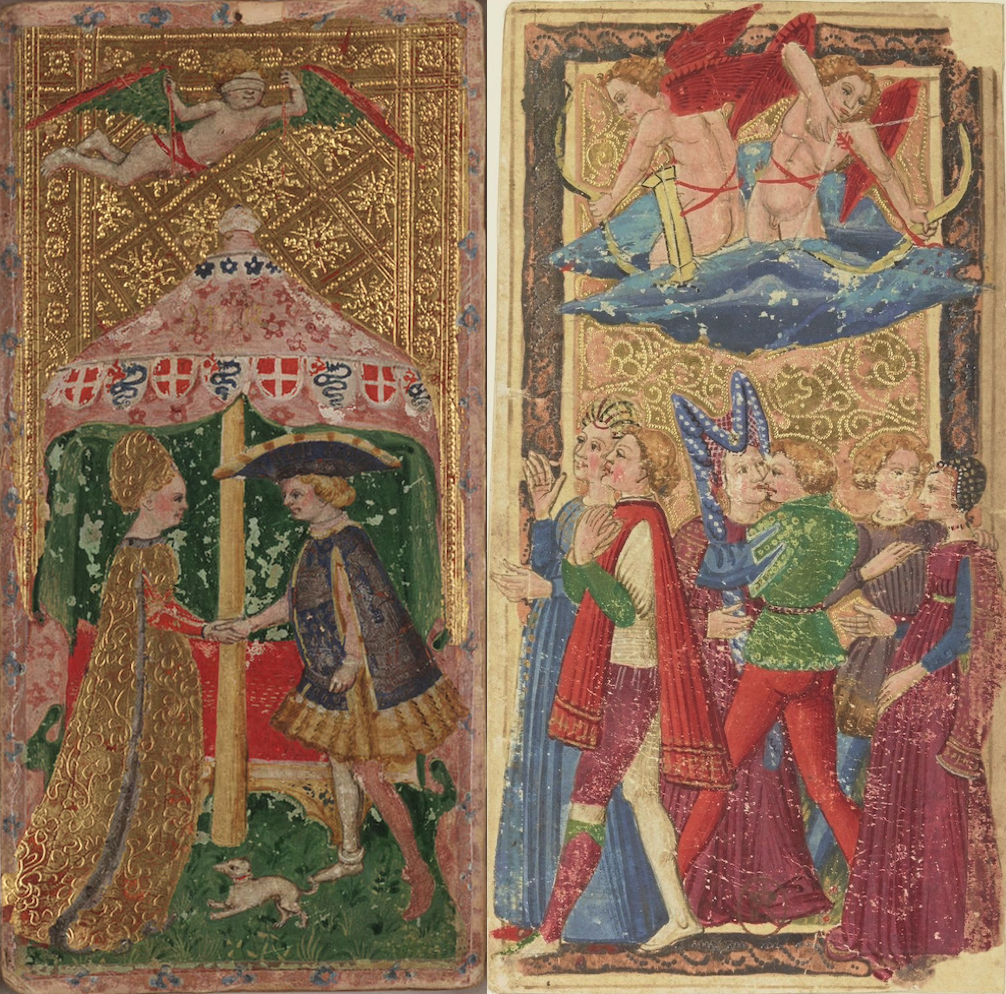
Visconti-Sforza Love ca 1450 and Charles VI Lovers ca 1475-1500.
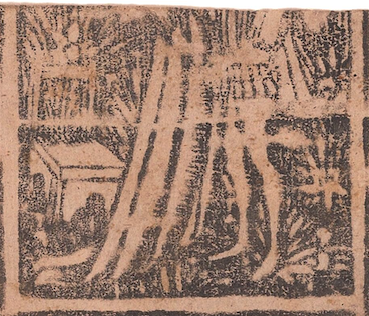
Love (fragment) Cary Sheet, ca 1500.

First, let’s look at the Visconti-Sforza and Charles VI cards, which offer few, but relevant clues. The V-S depicts the actual people for whom the deck was commissioned, Bianca Maria Visconti and Francesco Sforza, who were married in 1441 to unite the Visconti and Sforza families. This has nothing to do with the eventual TdM theme, except that it may have been inspired by Tristan and Isolde (very popular in Italy at the time), also likely the subject of the Cary fragment. In the legend, Tristan is delivering Isolde to a king to be married, but the two of them drink a love potion en route and tragic, ‘courtly love’, ensues.
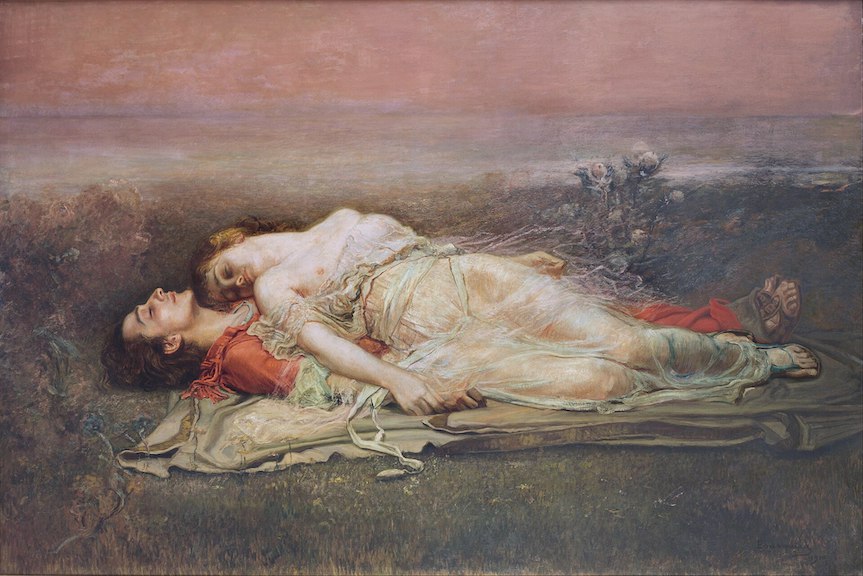
Death of Tristan and Isolt, Rogelio de Egusquiza, 1910

In the Charles VI card, a pair of very determined cupids shoot at three pairs of courtly lovers below. Two of the men on either side clasp their hearts, while the one in the middle can’t contain his passion for his lady. That’s what it was all about – Eros had 0 to do with marriage.
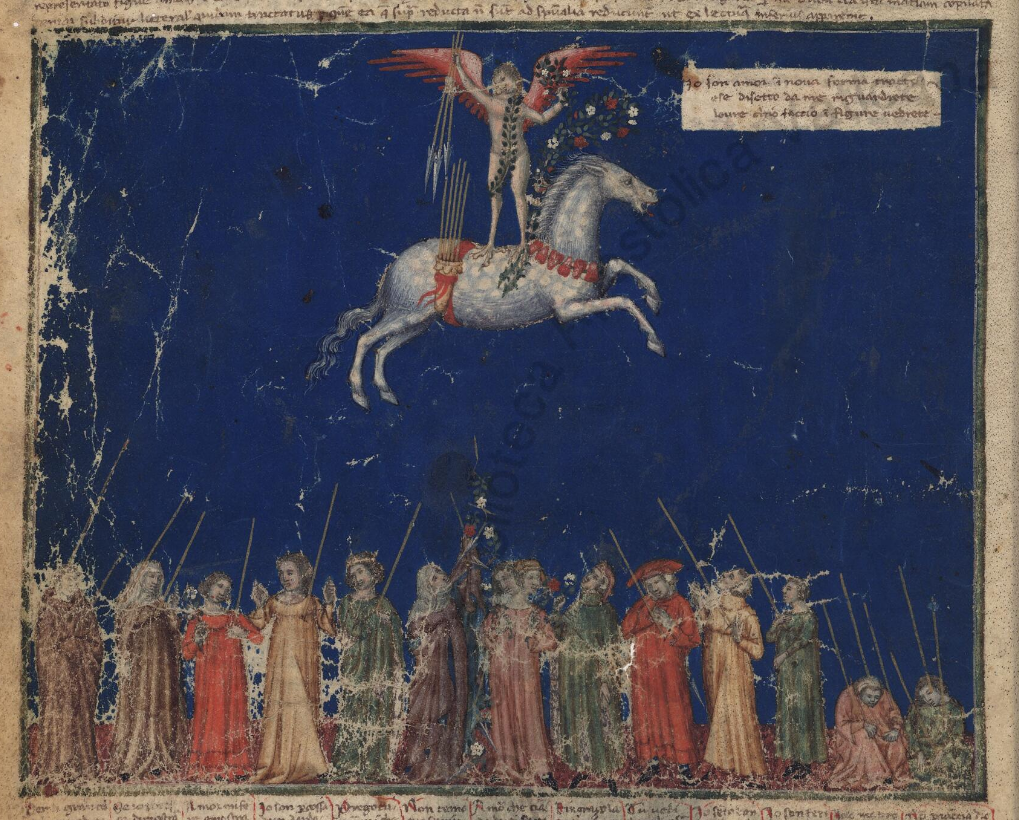
The claw-footed Love, from Documenti d’Amore by Francesco da Barberino, ca 1315.

The Charles VI card recalls the imaginings of the early Renaissance poet and Giotto contemporary, Francesco da Barberino, who “deliberately inverted” love’s personification, emphasizing Cupid as the son of Mars and changed his image from “a personification of Divine Love to a personification of illicit Sensuality” by removing his blindfold.*
The connection to erotic love (Eros) and death is becoming established, and the card becomes less about marital love in the general sense. Much too dull for theatre, darling.
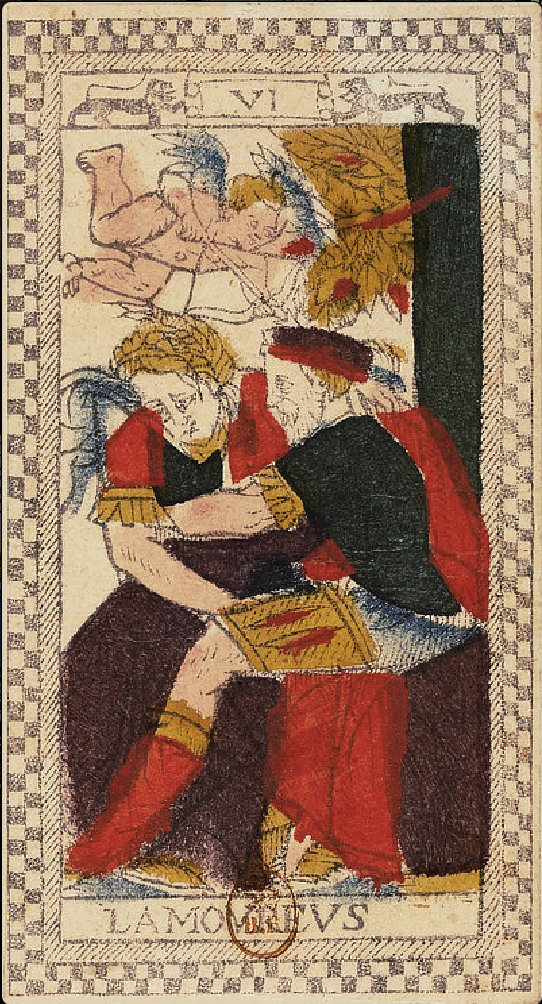
The Lovers, Anon. Tarot of Paris, ca 1650.

The Anonymous Tarot of Paris (ca 1650) gives us our first clue as to the French tradition. The amorous man holding in his arms a resigned, but not altogether unwilling woman might be modelled on Pluto and Persephone. The engraver has managed to convey much in her downward gaze, as if the man’s saying, ‘Come live with me, reign as my Underworld Queen!’ and she’s having an inner conflict, ‘Do I really want to go live down there…forever??’ Think of all the young women who must have felt this way through the centuries, marrying men they hardly knew, often far from home. The story of Bluebeard takes this very rational fear to its extreme. 
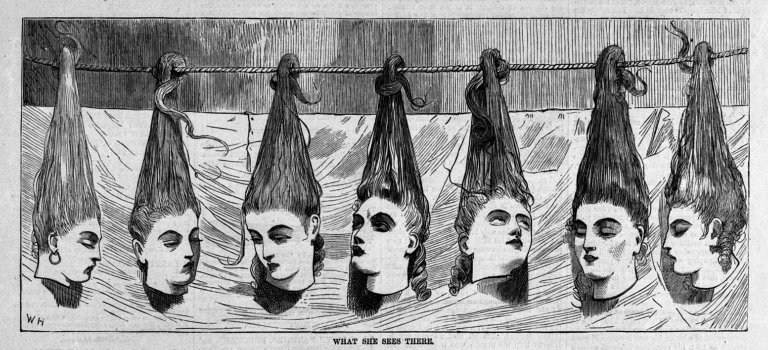
Winslow Homer, ‘What she sees there’ from Bluebeard.

In ancient Greco-Roman times, love was rarely, if ever, the basis for marriage. A bride would effectively ‘die’ to her own family, transferred as property from father to husband, and would from here on have to worship at the altar of his family ancestors. Because it would be insulting to her own ancestral gods if she abandoned them willingly, a ‘faux’ kidnapping a la Pluto and Persephone had to be enacted, which is where the tradition of ‘carrying the bride over the threshold’ comes from. She has to pretend it’s not her own choice, that she was stolen!
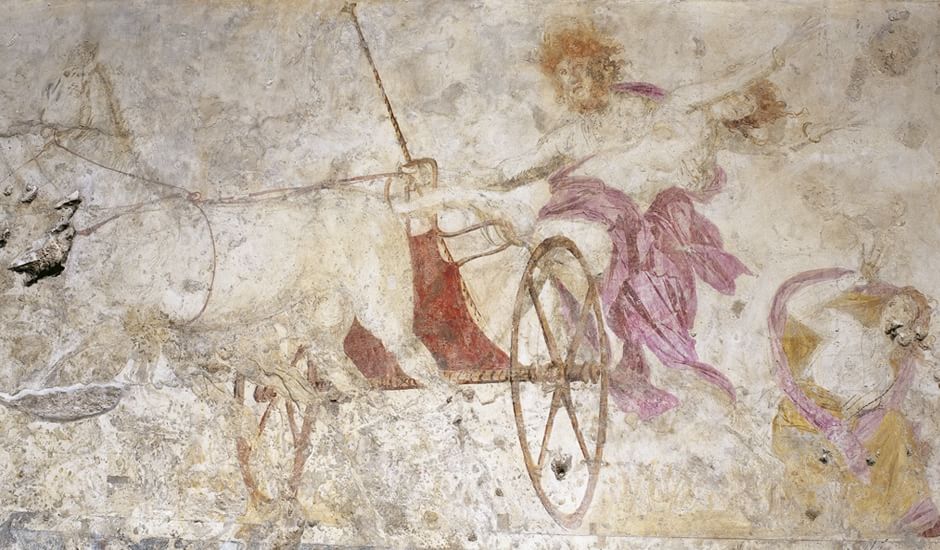
Pompeii fresco featuring the abduction of Persephone.

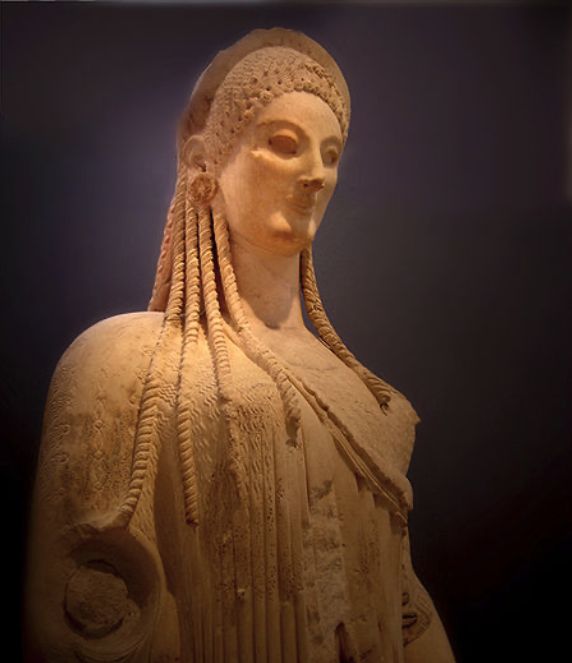
In actual fact, Persephone (‘bringer of destruction’, ‘bringer of death’, aka the ‘Iron Queen’) was already an Underworld ruler for a long time before the Hellenized myth, and the TdM card is perhaps faithful to this. Before Persephone’s abduction and while she’s above ground, she is called ‘Kore’ (‘maiden’), and as part of the Underworld Goddess triad with Demeter and Hecate, she’s also the ‘maiden’ to mother and crone. Her priestesses were called ‘kores’ (masc. ‘kouros’) and it’s possible that initiation involved ritual marriage with one, ie, ‘marrying death’, so that later, ‘death’ in the form of a beautiful, young, underworld partner awaited the initiate when the time came to cross that threshold. Nobody knows for sure.

Sculpture of a Kore

The connection to Persephone in Tarot of Paris becomes more honed and specific in the TdM card. Here, it is the man who some would assume is having to make a choice. He looks toward the woman wearing a crown of leaves or fronds, while his arms point toward the woman wearing a crown of flowers. The Pierre Madenié 1709 version makes it perfectly clear what kind: Narcissus, the flower Persephone was said to have been picking when she was snatched by Pluto. Further, if we look carefully at the halo around Eros above, in the Conver (type 2) versions, it is visibly skull-shaped. This can hardly be a printing mistake.
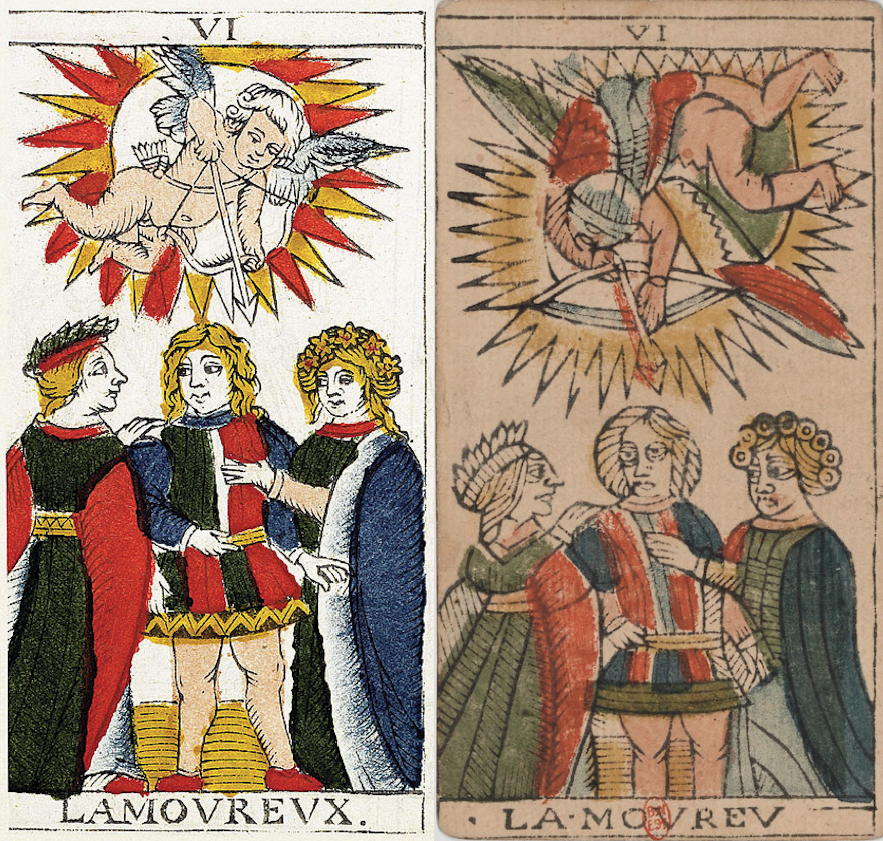
Pierre Madenié [type 2] 1709 (Yves Renaud) and orig. Jean Dodal [type 1] c 1701-15.
Not convinced? Alright, let’s turn to Dodal (type 1). It is difficult to make out the details of this somewhat ‘cubist’ Eros, but we if we examine closely, we see that his bow is also the handle of a jagged scythe or sickle (maybe a mix of both), which is an attribute of Demeter, as well as Kronos-Saturn, sixth planet-god from the Sun (ancient ‘end of the line’). So we can deduce that, in the esoteric sense of this card, the young man stands between Demeter and Persephone. He could be an initiate, who, after having undergone the ritual would have been referred to as one of the ‘olbioi’, meaning ‘blessed’ ‘blissful’ or ‘fortunate’ – ie, no longer fearing death. He looks kind of blissful…

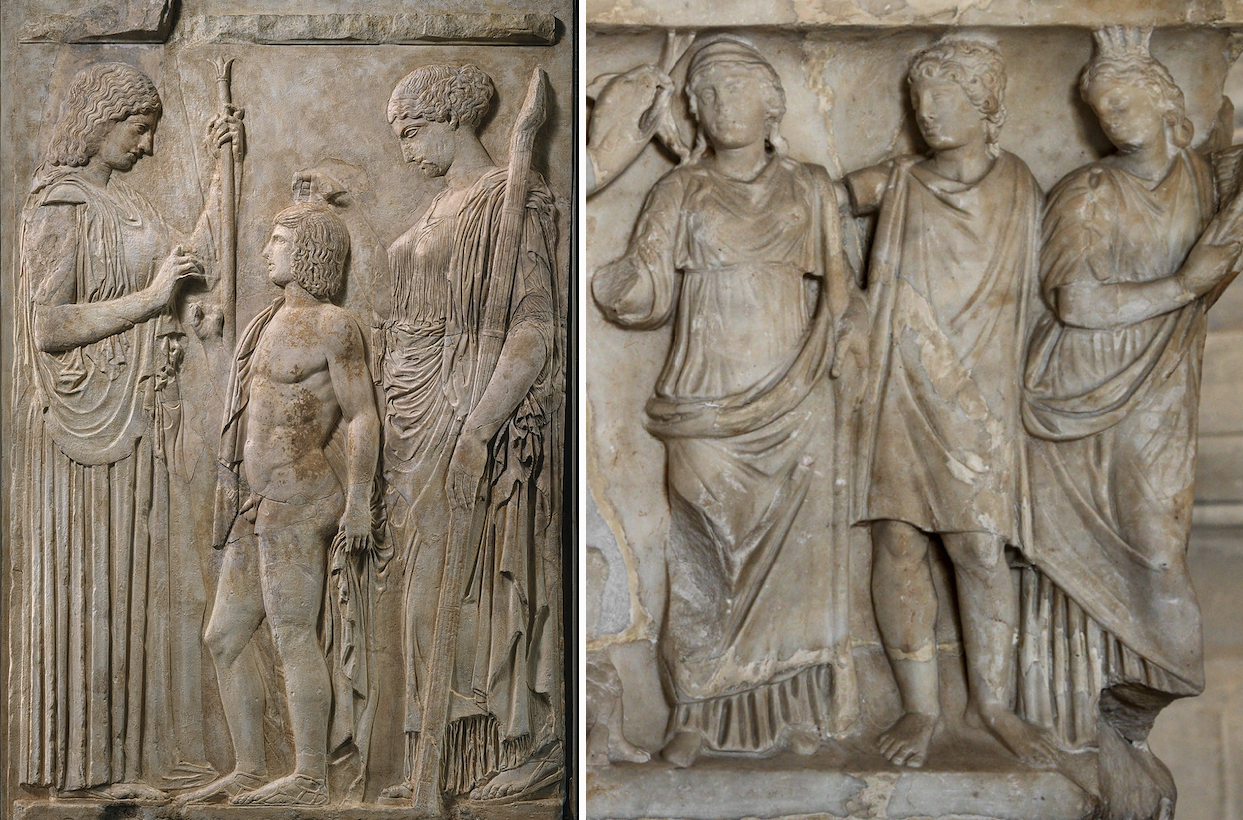
Reconstructed fragment of ‘The Great Eleusinian Relief’ 27 BC-14 AD (MET) and sarcophagus detail from 2nd c (Louvre) depicting Triptolemus with Demeter and Persephone. [please click image for more details]
Central to the Eleusinian Mysteries was the hero Triptolemus, frequently depicted in the same setting, standing between Demeter and Persephone. He was the first initiate, who received from Demeter the knowledge of the grain; ie, the art of agriculture, the cycles of which also held the secrets of death and rebirth (metempsychosis). The Demeter cult was first and foremost an agricultural one.

(Syracuse in Italy, that is).

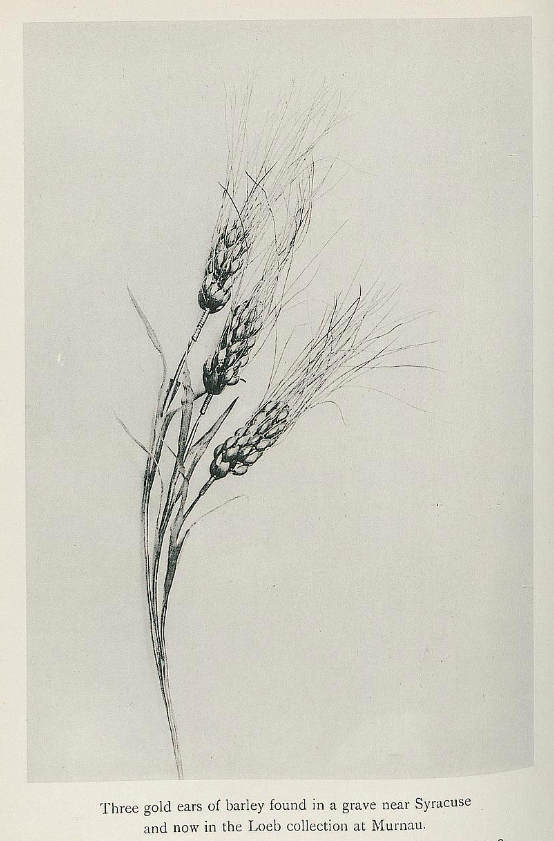
An ear of golden grain [barley, sometimes referred to as ‘corn’, though actual maize would not reach Europe until 1492] can be seen in the very first card. The Fool also has a similar shape dangling from his belt, though in this case I think it’s his passport – a leaf-shaped, gold, Orphic tablet. But anything gold, especially if flame-shaped, generally has to do with fire and the eternal, ever-resplendent spirit.
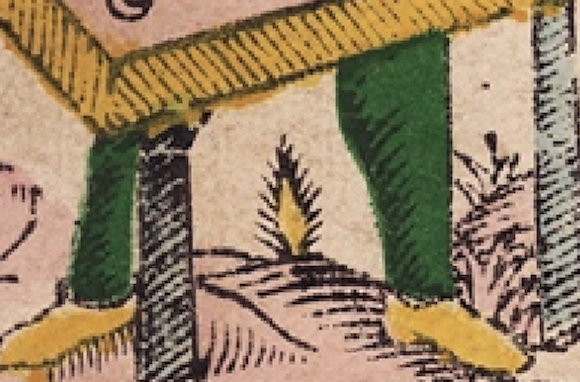
How to begin agrain…

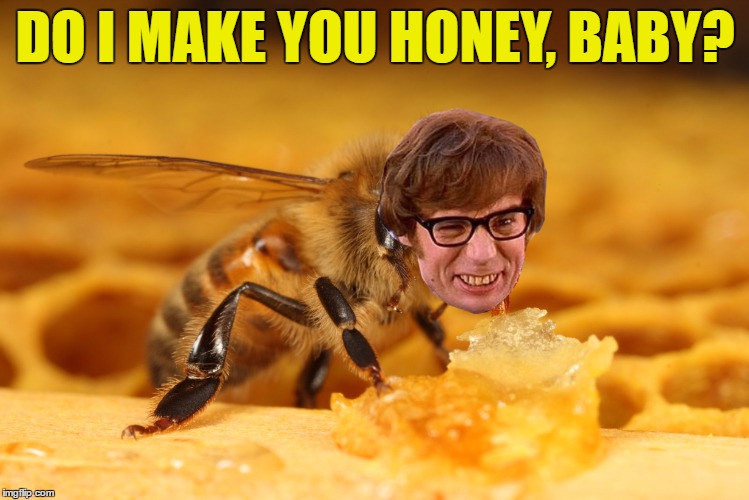
The movie still below is from a modern, rock-n-roll kitsch interpretation. Recognize it?  Extra points if you are old enough!
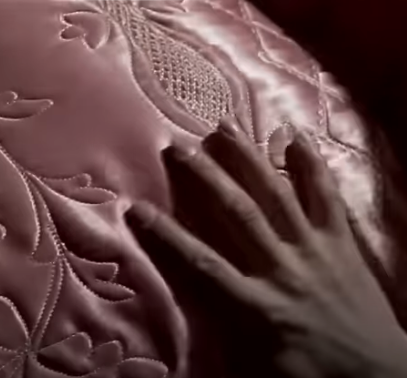
[click pic for more details]
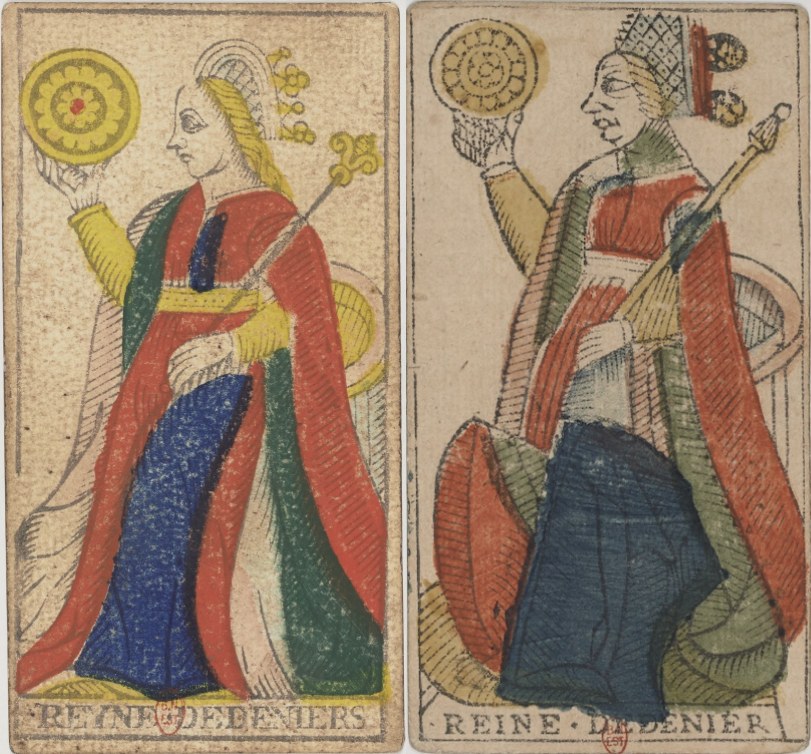
Honey, the liquid gold of nature’s tiny agriculturalists has been used to anoint and in libations since ancient times. (‘Christos’ means ‘anointed one’). This is, after all, the 6th card, and the hexagram of the apis has 6 sides. Astute TdM lovers will recall that the type 2 Queen of Money (Reyne de Denier) has a bee/beehive staff and her crown resembles a honey comb. This raises the question, are the ‘coins’ actually coins? Or are they phailes (libation dishes)? 

Conver (type 2) and Dodal (type 1) Queen of Coins (Are those pine cones on her crown?)
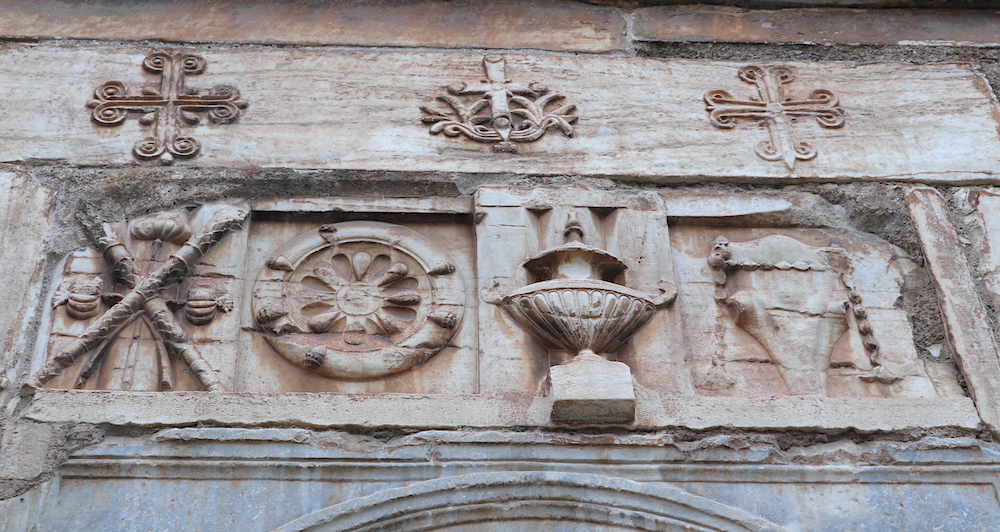
Spolia’ featuring ritual objects from temple of Demeter at Eleusis, repurposed on ‘Little Metropolis’ church in Athens: torches with poppies (baton), libation phaile (coin), incense burner (cup) and bucranium of sacrificed ox (sword). The crosses above are meant to ‘baptize’ and thereby neutralize the pagan imagery.

We should not be too rigid about naming precisely which mystery cult the cards might be pointing to, as the imagery seems to draw from several traditions as well as being mytho-alchemical. But the Eleusinian and Bacchic cults were inter-related, and one needn’t throw a stick far in ancient Greek myth to find some hero or heroine transgressing death in search of a loved one or sacred object and returning twice born and wiser or crazier for it. Dionysus, the Greek Osiris, was closely associated with alchemy, because his crop of expertise was the grape, and wine-making involved the essential fermentation process, from the blackened soil to the distillation of spirit. The long-haired Lover is certainly Dionysian, as his popularity with the ladies shows. To me it looks like they might be undressing him.
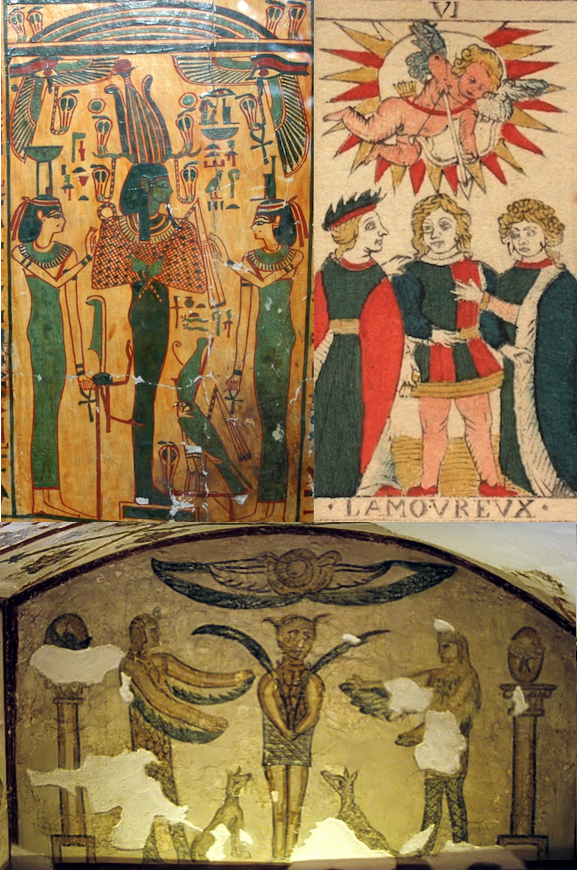
Isis and Nephthys preparing their beloved Osiris for his Underworld travels, Conver Lover card, fresco of an initiate from Tigran Tomb, Alexandria (note the Orphic eggs).

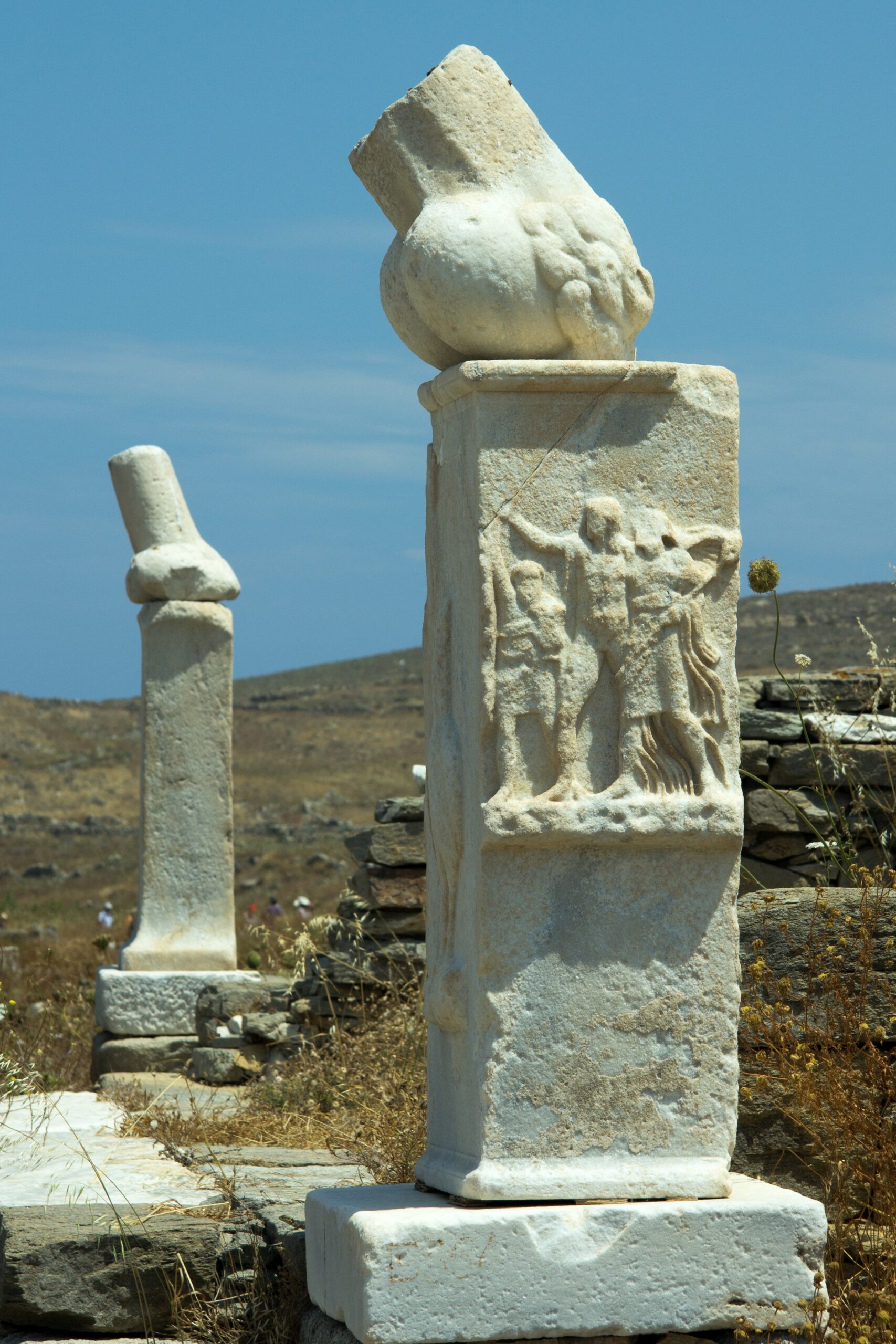
Worth a mention here is the similarity between the woman on the left of the Conver card with the Valet of Batons. Might this suggest a link to the Dionysian ritual phallus, or, to the club of Hercules, weighted/pulled toward the Underworld, while the young man looks ahead? Is he drawing up some chthonic energy, or, like the Juggler (prototype of the Valets), is he too young and inexperienced to recognize its ritual significance? Instead, maybe he’s using it to measure true, astronomical and visible horizons, with the intention of building a temple to his god…a Herculean task, surely.
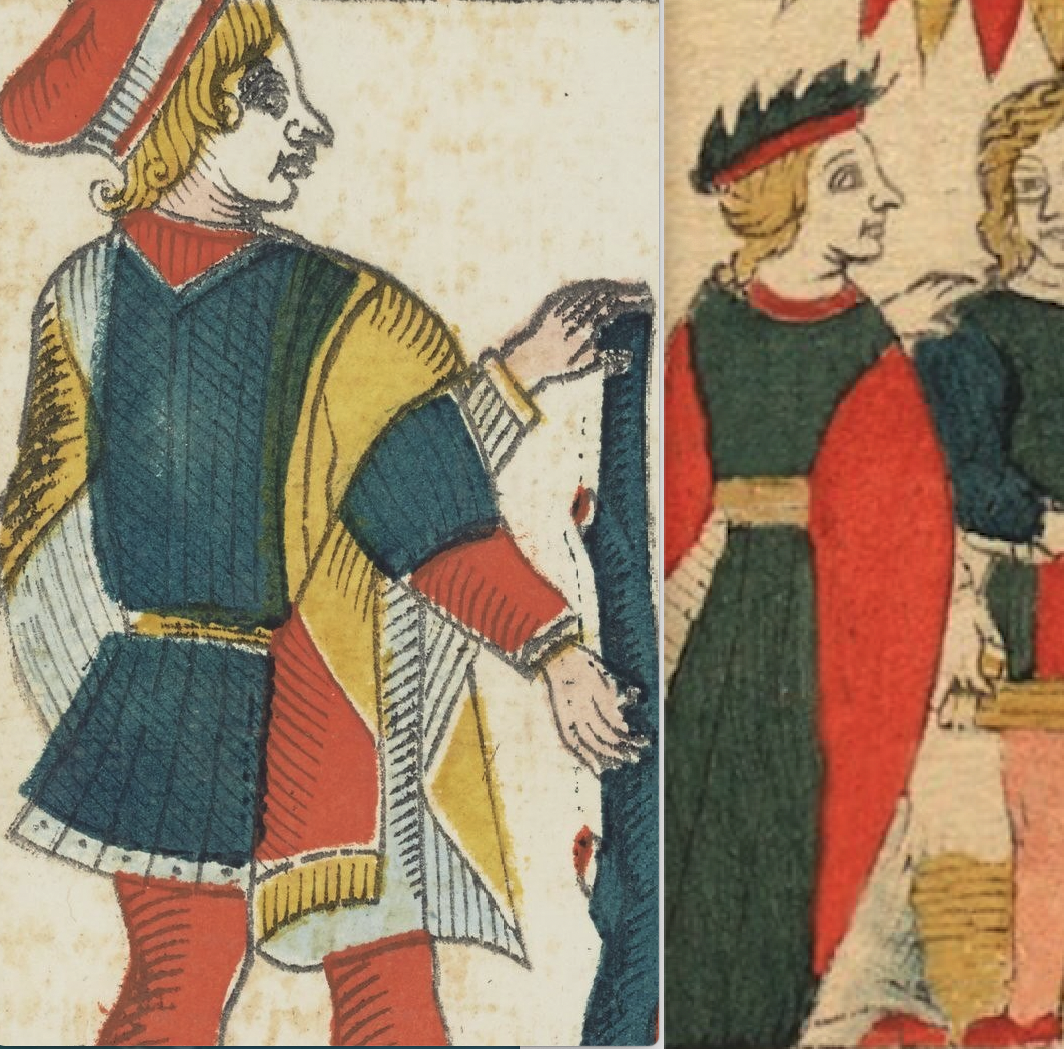
Valet of Batons and detail from Lover card
Ruins of Dionysus temple at Delos, Greece

Hercules had to become an initiate in order to go kidnap Cerberus, the three headed hound of Hades, as his final labour. So if this card does relate to him, he’s likely not at the crossroads choosing between two women, but at the crossroads of the upper and lower realms, receiving initiation from two goddesses. In the next card, the newly-anointed, golden-crowned hero is in a liminal state, his lower half having descended into a square-shaped (matter/earth/Saturn) Chariot that is at least partly fixed to the ground (in type 2), resembling something funerary.
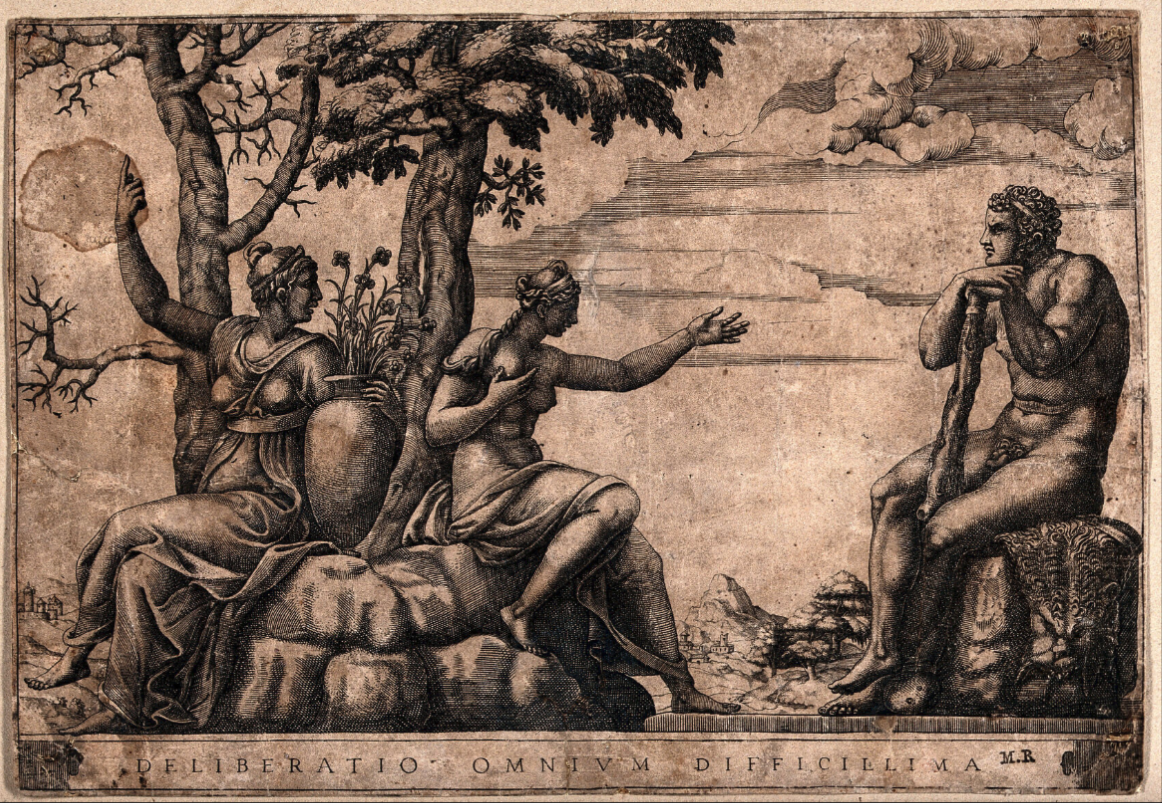
Don’t strain yourself thinking to hard, Herc!   Engraving by Giulio Romano, 16th c

Eros, son of Aphrodite, was said to be able to overpower all the heroes, for love really does wipe out fear of death (Thanatos) and the loss of a love is akin to dying. I’ll be entertaining/tackling this topic further, from a different horizon, in an upcoming post about the Sun card. Stay tuned!  ~rb

So come, my friends, be not afraid.
We are so lightly here.
It is in love that we are made;
In love we disappear.

***
Credits:

*Shelly MacLaren, “Or guarda tu …desta donna la forma”: Francesco da Barberino’s Poetic and Pictorial Invention (Dissertation)

Lyrics from ‘Boogie Street’ by Sharon Robertson/Leonard Cohen

All written content except quotations and meme is copyright ©Roxanna Bikadoroff and may not be re-used or reprinted without my permission. You are welcome to share the article via LINK and with a short pull quote/credit.
Thank you for being respectful.

Immortal Hand with Eye

Once upon a time, now long forgotten,
that first human pondered their hand.
How is it that I can imagine something, 
and my hand knows how to make it?
How is it there are this many fingers? 
What can it mean?
Hands must be magical. 
Talk to the Hand.

beaded icon tapestry with hamsa hand and two lamias
Talk to the Hamsa   ©Roxanna Bikadoroff

“Put your hand in mine, we will travel to another time…”
    ~Lucious Jackson, Gypsy

Khamsa necklace of silver, horn, coral, late 20th c, Morocco

The Hamsa/Khamsa or hand of Fatima, like the Nazar (‘evil eye’)  is a common and ancient protective amulet throughout the Mediterranean and Middle East.
Who was Fatima? She seems to have many incarnations…in Islam, she’s the daughter of the prophet Muhammad, five years old when her father began receiving revelations. In Catholicism she’s a Marian apparition, reported in Portugal by three shepherd children. In legend, she is sometimes a great warrior princess, other times, as in ‘Fatima  the Spinner and the Tent‘, an artisan who’s accumulated crafting skills and ingenuity save her from one calamitous situation after another. This Sufi retelling of Greek folklore describes Fatima in her role as creatrix and teacher, of which the female hand symbol is perhaps most indicative. Lucky? Yes, because I learned how to make things and can show you how.

Nossa Senhora de Fatima  ©Roxanna Bikadoroff

“A man who works with his hands is a laborer; a man who works with his hands and his brain is a craftsman; but a man who works with his hands and his brain and his heart is an artist.”  ~ Louis Nizer

Thus we have the  combined energies of crafty magician, Hermes-Mercury and beauty-loving Aphrodite-Venus, whose sacred number is five (symbol is the pentagram) and who is married to Vulcan, the craftsman who forges exquisite, metal creations. We conjure ideas with our imagination, but we manifest them with our hands, though perhaps less and less, these days, which is why, apparently we are getting dumber!  Talk to the Hamsa!

Votive ‘Hand of Sabazios’ with Mercurial, alchemical attributes
Clay rose Hamsa (with eye milagro) ©Roxanna Bikadoroff

Often the hands will solve a mystery that the intellect has struggled with in vain.  ~ Carl Jung

Native American serpent disc, unearthed in Alabama, 1800s


All written content herein except quotations is copyright ©Roxanna Bikadoroff and may not be reproduced without permission. Please share via link only. Thank you.

Venus in Pisces – Sea Siren and Star Season

Venus is in Pisces until March 21st, so I thought it would be a good time to post  some of my mermaid and Stella Maris themed art.

This acrylic painting is called Pacific Puttanesque.  I did it when living near the beach in White Rock, BC, back in 2010. The title refers to Puttanesca sauce which basically means ‘whore sauce’, either because it originated in a Naples bordello or because it’s fishy-smelling, due to the anchovies. Her half-shell looks more like a Venus’ flytrap than a scallop and doesn’t quite conceal her monsters. Victorian fantasy postcards provided inspiration. The frame is decorated with  local shells, to resemble  boards from an old, sunken boat. (NFS, private collection).

painting of seductive siren and sea monster in deep greens, victorian fantasy style with sea shell frame
Pacific Puttanesque

This next, mixed media piece, called Stella Maris was sort of a pre-trial for the Star card in my Tarot deck, which ended up being something entirely different.  It’s from 1999-2000. A friend of mine said after looking at it she had a dream about the Statue of Liberty.  (Limited edition, digital prints are available).

Stella Maris

On the topic of Stella Maris, the star in Mari’s crown…
This miniature, beaded icon of her is a more recent creation, the last of a series of attempts to return the universal (or original pagan) meaning to Catholic imagery, which had ‘borrowed’ and adapted it. In Roman times, fish was eaten on Friday to honour Aphrodite-Venus, because it was thought to be an aphrodisiac. This was prior to her being covered with heavy robes.
The star itself might have been Venus or any guiding star for mariners, such as Polaris or Sirius.

Stella Maris

Similarly, we have La Virgin de la CaridadOur Lady of Charity. One of the Seven Virtues, she is said to have appeared to rescue two Cuban boatmen and their slave, who were caught in a storm, sometime in the early 1600s. Hence she’s the patron saint of Cuba, but of course religion had to be practiced underground there for about four decades. Caridad is also paired with the more Venusian Oshun in Orisha religion, who rules sex, pleasure, marriage, the arts and money matters.  (NFS, private collection).

miniature lace icon of our lady caridad above some men in a boat
Caridad Mini

Following the BP oil spill disaster, off the coast of Florida in 2010,  I created a whole series of these Worst Cocktail Ever Florida Souvenirs, using some old cocktail mermaids, shells and driftwood. Self-explanatory. This is one of two that remain, and they are for sale.

shell souvenir with oil drenched mermaid
Worst Cocktail Ever Souvenir

Sea Spirit was also painted in response to the BP spill. It takes inspiration from the Cape Dorset prints I loved, as a child. I thought about how awful it would be if such a spill were to occur in the pristine Arctic waters, for all the marine mammals there. Unfortunately, with the ice melting and more oil exploration going on, the likelihood is increasing. So this is a Sedna type Goddess who’s  life-giving breasts are clogged with oil blobs. Acrylic on canvas. (NFS private collection).

Sea Spirit

But let’s end things on a cheerier note. This mixed-media icon is of Poseidon-Neptune’s partner, Amphitrite. One of those Victorian fantasy postcards I referred to in the beginning of the post. (NFS, private collection).

icon made of pink flowers and shells with sea goddess victorian photo
Amphitrite

All text and images ©copyright Roxannna Bikadoroff and may not be re-used without permission and credit/link to this site. Thank you.