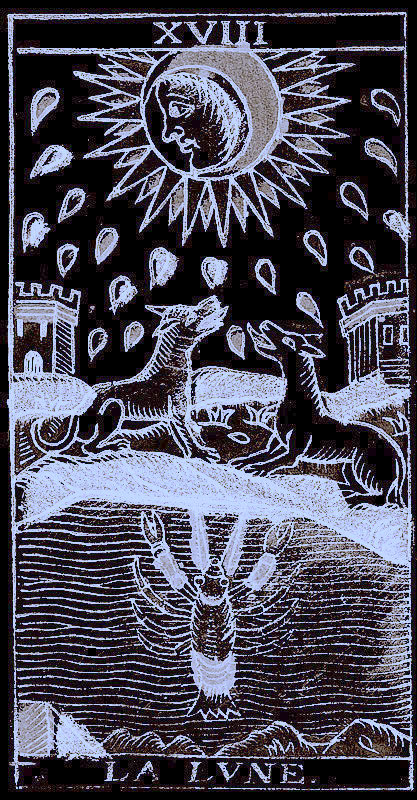
‘Between a Hound and a Jackal’ – The Surrealist Moon of Tarot de Marseille

Pierre Madenié 1709 (negative of)

This is an update to a previous posting on the Moon card, but more specifically exploring how it relates to an old French medieval saying, ‘entre chien et loup’ (‘between a dog and a wolf’), which describes the twilight hour between day and night. I had made a comparison of the liminal, canine critters to the crocodile in one of Horapollo’s Hieroglyphics, ‘How they shadow forth darkness’, as well as the beastie Amut, who devours heavy hearts after they are weighed in the Egyptian afterlife.
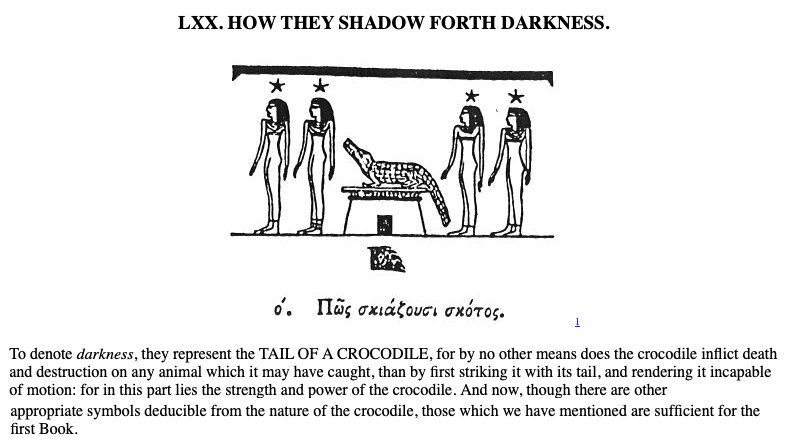
Horapollo (Horus Apollo), like many who would come after him, made a valiant attempt to decipher hieroglyphs that were thousands of years before his time. What’s interesting is that while many of his descriptions were ‘corrected’ with the discovery of the Rosetta Stone, there are quite a few TdM cards that suggest someone just might have been using Horapollo for inspiration.

Anyway, I’d admitted the croc and beastie were perhaps a stretch, so here’s an example much closer to the mark. Not sure why it had eluded me before…
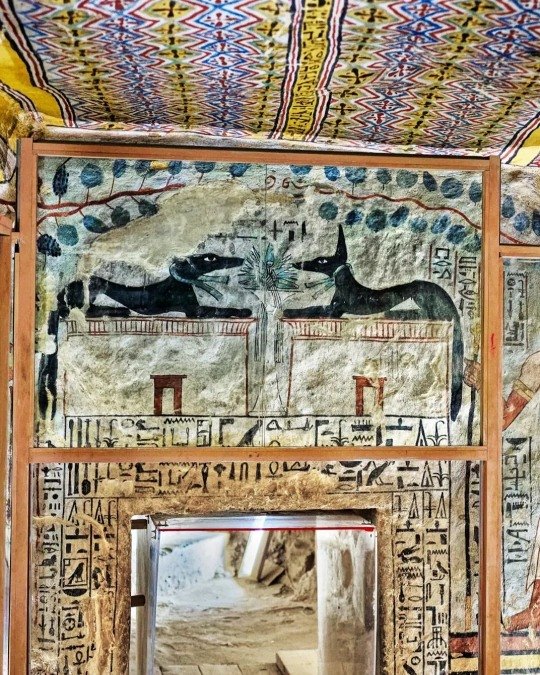
Tomb of Sennefer or Tomb of the Vineyards, in the Valley of the Nobles

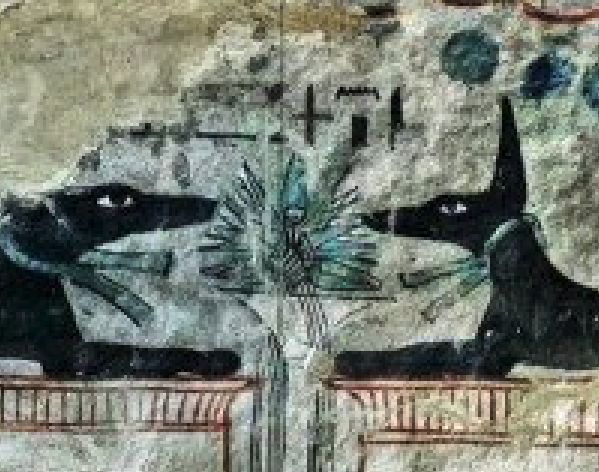
All the details are there, the bunches of grapes even look like dew drops of the Moon card! Between the two guardians, there is a long stand with a platter of lotuses on top. Often depicted in tomb paintings, lotuses were considered to have an aphrodisiac sent, which revitalized the dead. A similar metaphor to the crayfish in the TdM card (resembling a scarab or triple Hekate of the liminal spaces), lotuses grow from the muddy waters and into the light of day (or night, as it were).
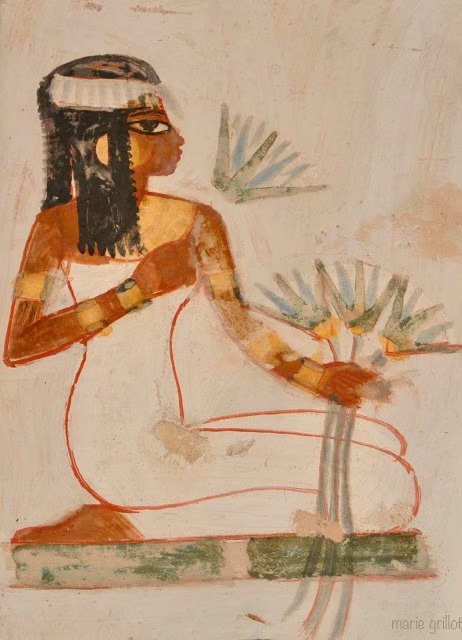
Girl with Lotuses, Theban tomb of Menna

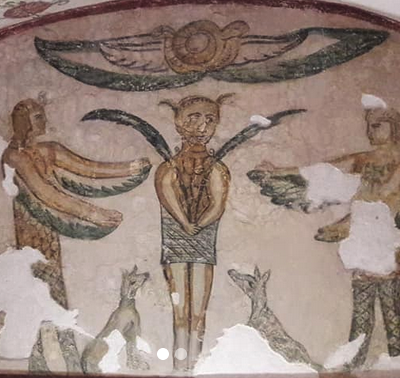
The expression, ‘entre chien et loup’ actually has much older, Latin roots: ‘intra hora vespertina inter canem et lupum’, which is though to date back to at least the 7th century. So it’s not a huge stretch to relate it to Egyptian or Egypto-Greco-Roman tomb imagery. As a metaphor, it is used to describe a time when clarity is fading and things become uncertain, creating a sense of fear or unease. The hound and jackal (Anubis) served as guides through the underworld journey, the in-between state which can also be thought of as the Bardo (Tibetan) or simply the time when lack of light begins to create phantoms that take on a life of their own in our dreams.
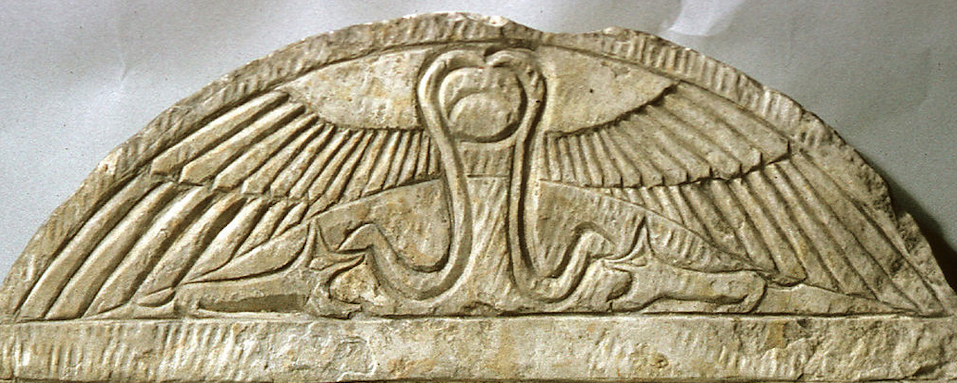
Stela of Pekysis 1st c B.C.–A.D. 4th c  (detail)

Catacombs of Kom El Shoqafa [Alexandria] ca 2nd c AD (detail)
Much later, the Surrealists would find their inspiration at this liminal precipice, drawing from dreams and the unconscious, which were also being explored in modern psychoanalysis. The Surrealist movement was officially founded in 1924. Salvador Dali developed a technique called the ‘paranoiac-critical method‘ which was much like an enhanced dream or nightmare state, possibly not unlike the Bacchic-Orphic mystery, with its essential ritual objects:

‘One of the types of objects theorized in surrealism was the phantom object. According to Salvador Dalí, these objects have a minimum of mechanical meaning, but, when viewed, the mind evokes phantom images which are the result of unconscious acts.’ [Wikipedia]
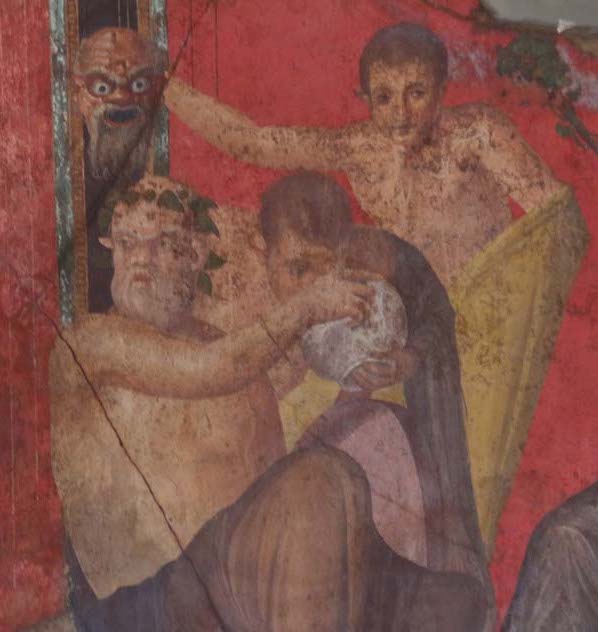
Villa of Mysteries, Pompeii fresco (detail)

Perhaps the original reason for all ritual objects was as a means with which to create phantom ‘guides’ or signposts in the inner or unconscious state. If so, should we be making a conscious effort to be more selective with the objects (and subjects) we ritualize on a daily basis?

Pompeii fresco

The Moon card has often been compared to a Giorgio de Chirico landscape or Surrealist painting, it’s one of the few cards depicting a landscape with perspective (and is the most pronounced of these). De Chirico was a great inspiration to the Surrealist painters. His often disquieting landscapes feel neither here nor there.
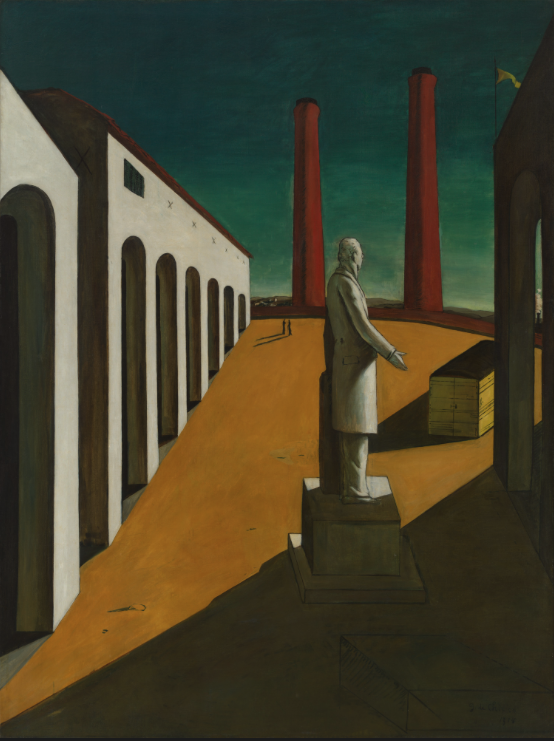
Giorgio de Chirico, ‘The Enigma of a Day’ (Paris, early 1914) MOMA

The Surrealists were also exploring the potential of film, which until the late 1920s had been silent. One of the most disquieting scenes in cinema to this day is in the Surrealist film, Un Chien Andalou/L’Âge d’Or (‘An Andalusian Dog/The Golden Age’) by Luis Buñuel and Salvador Dali (1929). The first part of the film’s title is an obvious word play on the old saying. Surrealism came about during the aftermath of WWI, during the ‘twilight’ before WWII…between the hound of Hades and wolf of Mars. Phantoms were everywhere. War itself is a grand surreal (‘super-real’) event that tears the fabric of waking reality.
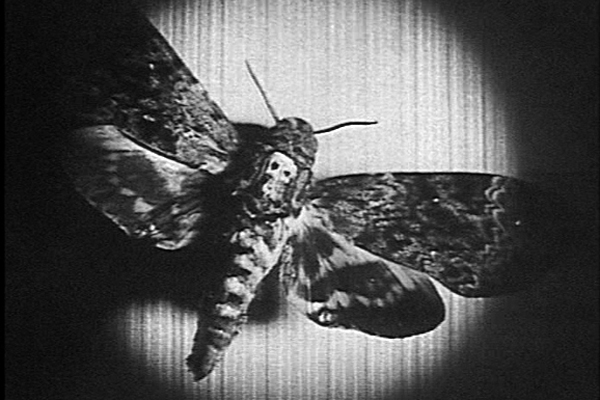
Death’s-head hawk moth from Un Chien Andalou/L’Âge d’Or

In his own work, Dali often featured lobsters. Being a Taurus he experienced food as erotic, and lobsters in particular as aphrodisiac. In my previous post I had also noted the uterine shape of the crayfish (interchangeable with lobster), but of course it can also be phallic, an all-in-one, so to speak.

Read about Dali’s cookbook here.
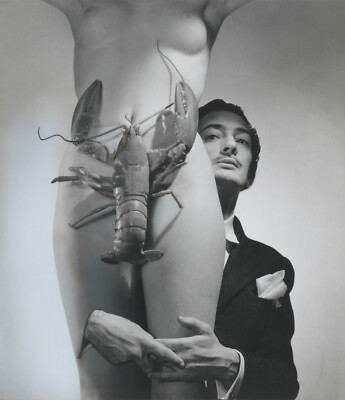
Dali by George Platt Lynes 1939

The TdM Moon card depicts an in-between state, a possibly perilous time where the soul is either drawn back into a body or up to the heavens. Illusions of the mind and ‘persistent memories’ are everywhere, fears and desires (Dali’s lobster) can become phantoms that direct us. No wonder the Fool takes his spirit animal along! It tears his garment, as if to show us how the fabric of our reality or persona can thus be torn open. Obvious yonic symbolism there, too, foreshadowing rebirth in the World card. Future article! ~rb
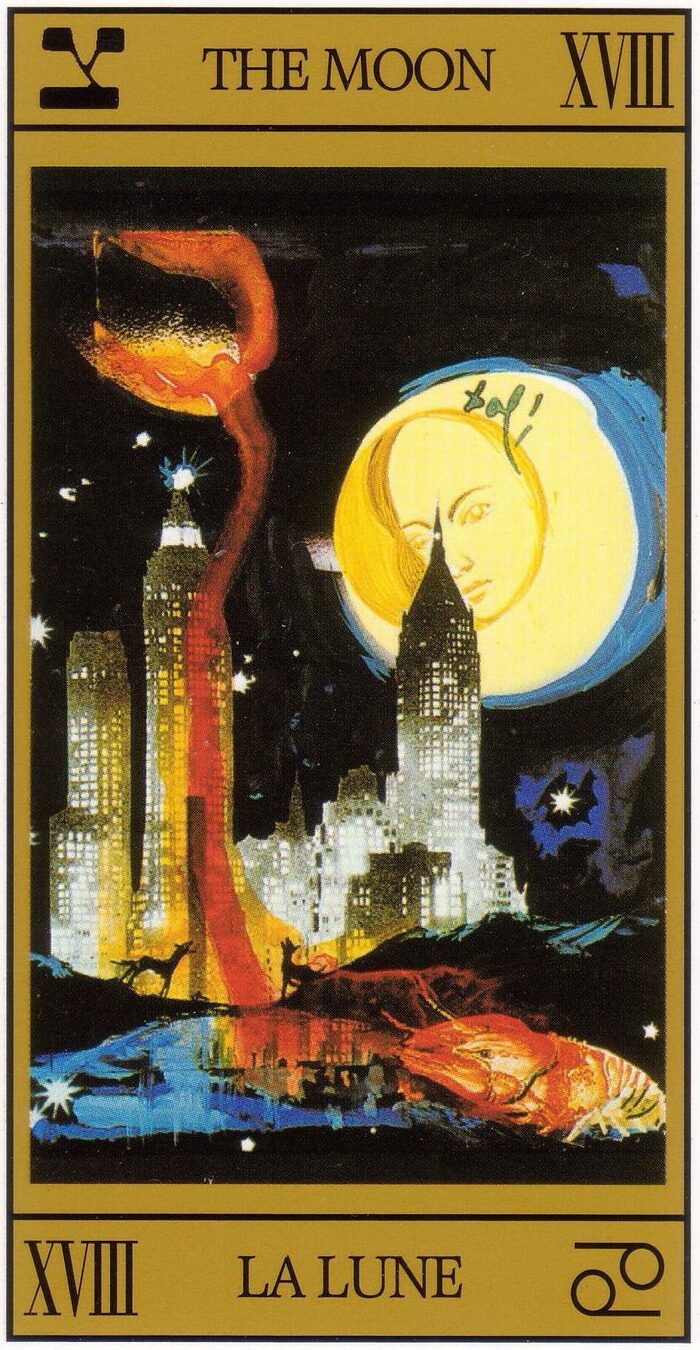
Dali Moon card (featuring old skyline of New York), 1984.

All written content herein is ©copyright ROXANNA BIKADOROFF, except quotations. Do not reprint without getting my permission first. Please share via LINK only (a short pull quote is fine, with credit). Thank you for being respectful.


Full Moon in Cancer, Lilith, Menopause

Menopause is the new “hot topic”, according to the CBC news.
I’m guessing my Pluto in Virgo peeps “opened the floodgates” (media’s words, not mine) of taboo removal, because if there’s one thing Pluto/Virgo understands, it’s the deep, psychological  changes that are going on, together with the physical, as we enter opposite virginity, amirite, ladies? So, as we’ve now ‘crossed over’,  let us X-gens pass down what we have learned to the next gens.

Menses and month both come from the same root (men also means moon, and there was even a cute, little moon-god named Men, see below). The Moon is our oldest time keeper, as we find depicted on the walls of Lascaux (this is a recent article about it, here I thought it was common knowledge) and elsewhere, because her cycles coincide with those of  the female sex.
In the modern age of electricity, humans became out of sync with these natural cycles and the moods that go with them.

Roman Anatolian  ‘Men’ who presided over the lunar months.

When a woman (or a man, for that matter) is not in touch with her lunar nature, or feels ashamed of it, the unexpressed Moon self is diverted to shadow, where it becomes an initiate of the Black Moon, Lilith – you know, like those secret tiki god bohemian black magic clubs that respectable members of society used to have in their basements. Her creative power, like that of Pluto, can turn destructive, self-sabotaging, in an attempt to kill off the false self. When this finally occurs with age, we stop giving a damn what others think, and Lilith becomes a staunch ally and a force to be reckoned with. (She’ll be leaving Cancer and entering Leo in a couple of days, so, ya).

Fun fact: ‘Hysteria’ and ‘hysterics’ were once thought to be caused by the uterus  moving around through the body at night. (I think mine was actually doing this during perimenopause).

Grandmother Moon has been keeping time and observing all us babies since we were just amoebas on Earth’s watery womb, so if she could talk (and she does), oh the bedtime stories she could tell.  This is especially true under the Cancer full Moon, currently opposite retrograde Mercury. The past is bound to resurface in some shape or form. So how does this relate to menopause?

Venus of Laussel with her calends, Upper Paleolithic

The word itself means a ceasing (pause) of menses. Remember, the menstrual cycle is directly associated with time cycles, both inner and outer.  Perimenopause can be even more difficult than menopause or post-menopause (note the lunar triad within the triad, there), because everything is getting de-programmed and re-adjusted to a new phase, a new kind of time…hormones surge and drop in ways that make Cancerian mood-swings seem like a toy see-saw. This reverse puberty onset can be downright terrifying (I personally experienced losing half my blood and requiring a transfusion). Maiden and mother phases grow smaller in the distance, as we cross the threshold into Hecate’s cold, lunar landscape. Here, the unconscious knows no solar age…in the soul, everything is fluid. 

As beginner crones (root same as crow and crown), we must now become inwardly re-attuned with the Moon, as we feel the ravages of time on our bodies, and face the fact that the physical is temporal. We fear the body loss, because rational, scientific thinking tells us it is primarily our physical self that defines us (see previous Solar Heroes post), that it is the body that ‘has a soul’. But in fact, it is the eternal soul that has a body, or rather, bodies. Grandmother Moon is firm on this. She presides over the inner world like Sun does the outer. At night, we traverse her realm….but, how many of us at this stage find our sleeping patterns are all over the place?  Might it mean that our inner Moon is now wide awake and roaming out of bounds? Or just that darned, roaming uterus?

Will leave you with those thoughts, for now.
Stay tuned for more meno memos!

moon face with lolling tongue blue and white
Moon-faced Gorgoneion,  protectress of mysteries by RB

All written content ©Roxanna Bikadoroff 2023. Do not repost/republish my work in part or whole without first getting my permission.
Blogposts may be shared freely via link only (and with no more than a small, introductory excerpt).
Any RB artwork shared must include a credit/link [©Roxanna Bikadoroff] to the site. Thank you  for your respect.