

Theory has it that the 4th Cardinal Virtue, Prudence, is ‘missing’ from Tarot de Marseille. Many have tried to figure out which, if any, of the other trumps could possibly be her (Star, Popess, Hanged Man, Hermit and World have been proposed). My own speculation is that, if she is indeed present and hiding, a conglomerate of Popess and Pope could share the role of Prudence, on account of the Janus face, as well as making sense numerically – each Virtue falls into the ‘2’ placement, as do the Pope and Popess. Prudence was said to be the ‘mother of all Virtues’, without which one could not master the others. However, the World card does suggest wisdom attained (the Stone), as opposed to wisdom being received or sought.

In a previous article, ‘Disrobing the Papal Couple – Tarot de Marseille’s Pope and Popess,‘ I used an image (sculpture) of a Janus-faced Prudence as the opener. But because I’m more attracted to exploring the cryptic, esoteric principals at work in TdM, and the Cardinal Virtue identities of Justice, Strength and Temperance are exoteric, I didn’t venture down that road. There’s enough existing literature on this. Instead, I explored the Popess as an initiator, oracle and portal to the mysteries, noting that her book was wide open because her ‘greater’ mystery was hidden inside. Also that the strap going across her chest went from the book’s spine to her heart, suggesting a pathway of ascent.
BUT there was one thing I had neglected to notice, another piece of the puzzle. It just amazes me how Tarot de Marseille keeps offering up new bits n pieces, like treasures washing up on the beach. Maybe I’m late to the game, but I’ve never encountered mention of it anywhere, so, for what it’s worth…

Above is a relief from the gothic Cathedral of Notre Dame in Paris. It’ is a figure of Philosophia, a 19th century restoration by Eugène Viollet-de-Luc, honouring the medieval sciences. Believed to be based on Boethius‘ vision of Philosophia with the ladder of Liberal Arts (see below), it has nevertheless come to be widely known by its esoteric name, Allegory of Alchemy, as deduced by the mysterious 20th century alchemist Fulcanelli in his Le Mystère des Cathédrales. The two aren’t mutually exclusive, to alchemists, since alchemy is ‘natural philosophy’ and at one time they did refer to themselves as philosophers (hence the ‘philosopher’s stone’, not the ‘alchemist’s stone’). The important detail for us is that the figure is holding two books; one is held open, symbolizing the exoteric or lesser mysteries, the other is hidden behind, closed, symbolizing the esoteric or greater mysteries (which is not universal in depictions of Philosophia).
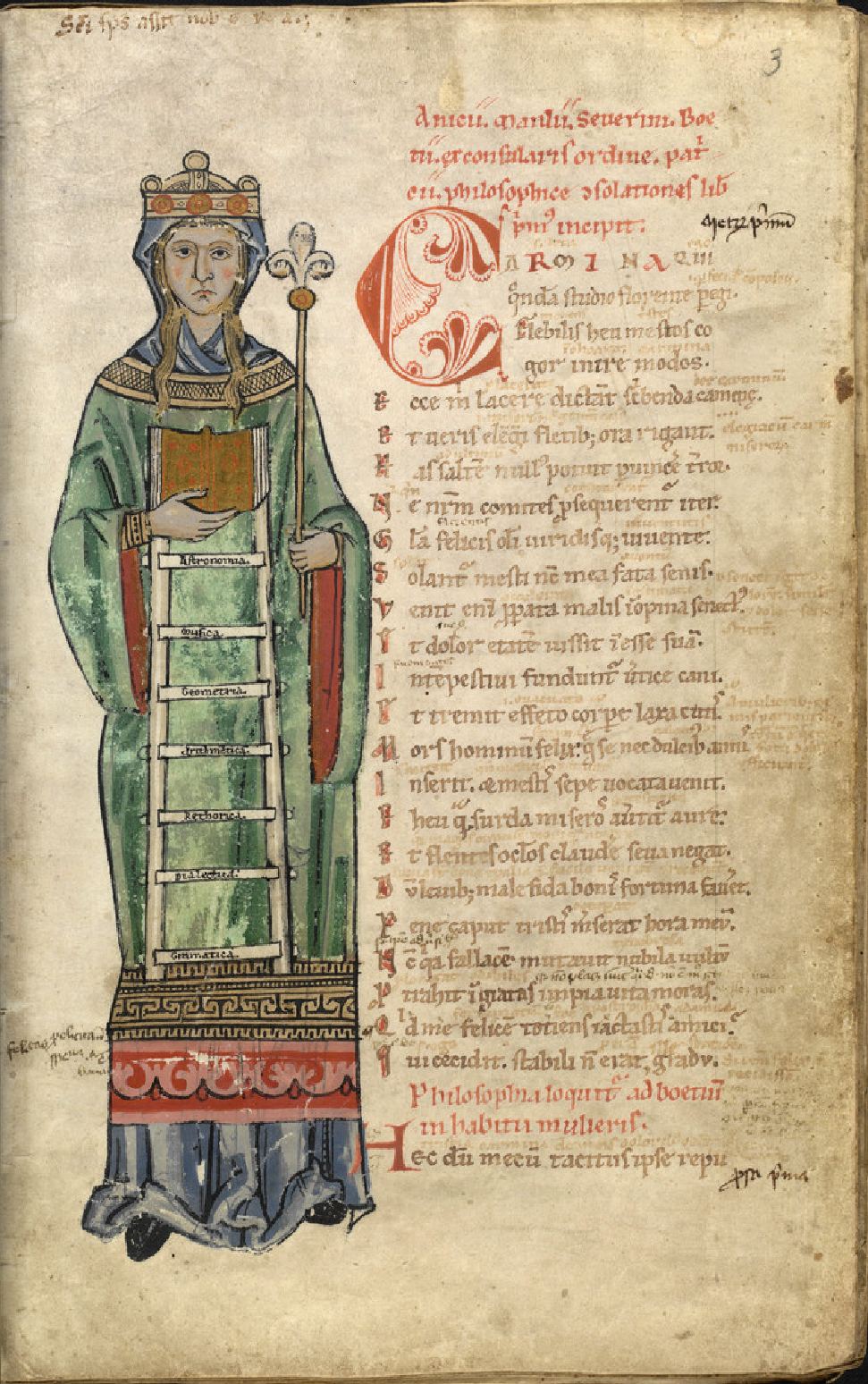
The 9-runged ladder – the scala philosophorum or scale of the wise – is an emblem of the mystical ascension “that raises man through the transformation towards the Divine and the understanding of art.” [Melinda Miceli, ‘Isis in Paris‘] In his definitive book, Fulcanelli describes it as “glyph of the patience the faithful must possess in the course of the nine successive operations of the hermetic labour.” [Wikipedia]
Besides Boethius and alchemy, this mystical, hierarchical set of steps to spiritualization has other symbolic variations, including Plato’s Ladder of Love, which ascends from erotic, physical love to appreciating beauty in the soul: ‘This hierarchy is conventionally referred to as Plato’s scala amoris or ‘ladder of love’, for the reason that the uppermost form of love cannot be reached without having initially stepped on the first rung of the ladder, which is the physical attraction to a beautiful body or individual.’
Philosophia means ‘lover of wisdom’.
However one wishes to interpret the scala philosophorum, the hidden book’s content is revealed only by way of its ascension. Wisdom is unfolded to us in a timely process, there’s no skipping steps to the second book.
Now, please look tres carefully at these ‘type 2’ versions of the TdM Popess, below. Do you see it?

…How about in these ones?

That’s right…TWO BOOKS. One open on top, the other closed, hidden behind/under it.
The serpent held by Prudence is said to represent Wisdom (‘be ye wise as serpents’), but when she also holds a book, the serpent might represent esoteric wisdom in particular, ie, mysteries. “Look like th’ innocent flower but be the serpent under’t” ? The Popess, by nature of her number is the first expression of duality. Thus, she is the gateway to and source of two wisdom paths; outer and inner, solar and lunar. On one level, she represents the orthodox or dogmatic teachings of the faith (church) and/or (if you like) the Cardinal Virtue Prudence, aka classical Wisdom. Simultaneously, on another level, Gnostic Wisdom and/or secret spiritual self-knowledge, aka ‘for initiates’.
The Juggler laid out the tools and the Popess provides the instruction manuals, two ways of understanding the Tarot de Marseille. But maybe it’s first necessary to start with the book that is (somewhat suggestively) held wide open, before following the strap from its spine, toward the greater mysteries of her heart. ~rb
All written content except quotation is copyright ©ROXANNA BIKADOROFF and may not be reproduced without my permission. Kindly share via LINK ONLY. If you wish to use a pull quote/short excerpt, please clearly credit and link. It helps me greatly.
Care to support my work? Donations are always welcome!
– Full text of Fulcanelli’s Mystery of the Cathedrals ( English translation).
– Audio of same, for those who like to be read to.
– Great image of the alchemical ladder in this scholarly paper on alchemy in Shakespeare’s Julius Caesar’.
– Another site detailing the alchemical symbolism at Notre Dame.
Here’s another example from Notre Dame, which, according to Fulcanelli, represent the different stages of the work.


