‘Festina Lente’ ~ Riding Tarot’s Hermetic Wheel of Fortune


Bless us, divine number, thou who generated gods and men! O holy, holy Tetractys, thou that containest the root and source of the eternally flowing creation! For the divine number begins with the profound, pure unity until it comes to the holy four; then it begets the mother of all, the all-comprising, all-bounding, the first-born, the never-swerving, the never-tiring holy ten, the keyholder of all.
~ prayer of the Pythagoreans to the ‘Mystic Tetrad’ [Wikipedia]
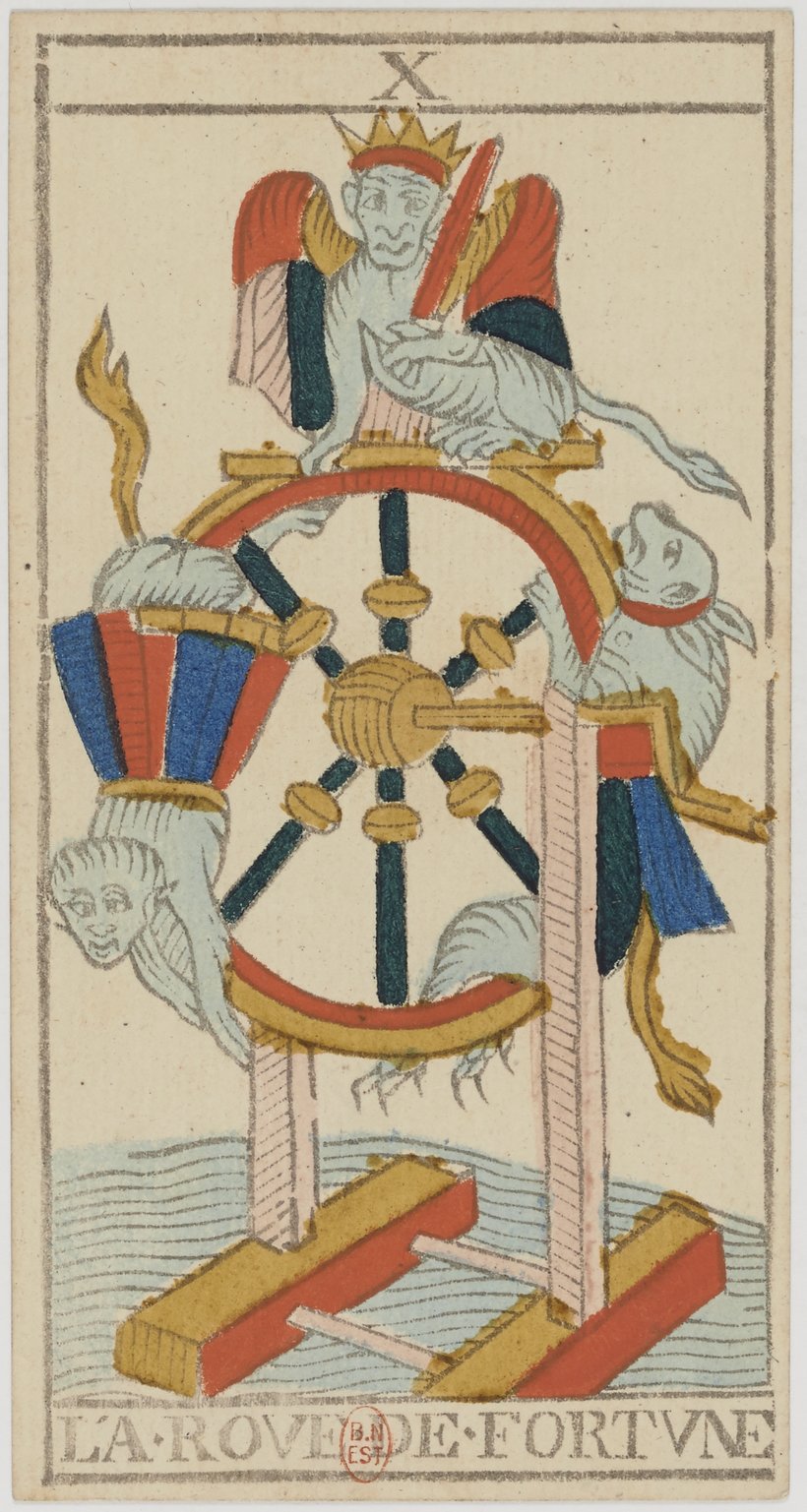
Nicholas Conver type II,  1760

Though it may appear comical, the importance of the triumph in tenth position is underlined by the reverence Pythagoreans paid to its number. To get a better grip on the Wheel of Fortune, it’s essential to understand it’s placement in the TdM numerical cycle, as it relates to the cosmology of  Pythagoras, famed philosopher-polymathematician (ca 570-495 BCE). The same cosmology was also the axiom of Maria the Jewess/Prophetess, famed alchemist-sage and inventor of the Bain-Marie and other alembics (ca 1st-3rd CE):

“One becomes Two, Two becomes Three,
and out of the Third comes the One as the Fourth.”
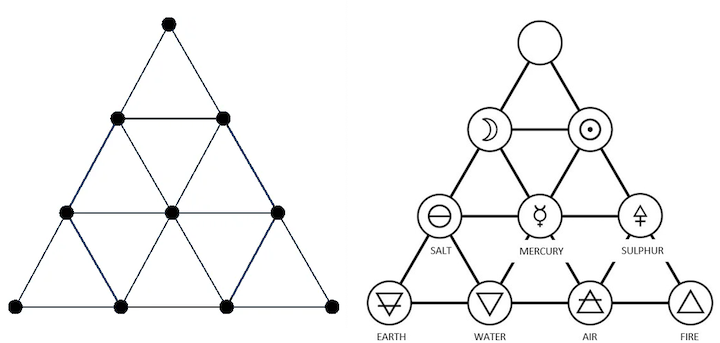
mathematical and alchemical versions of the same thing

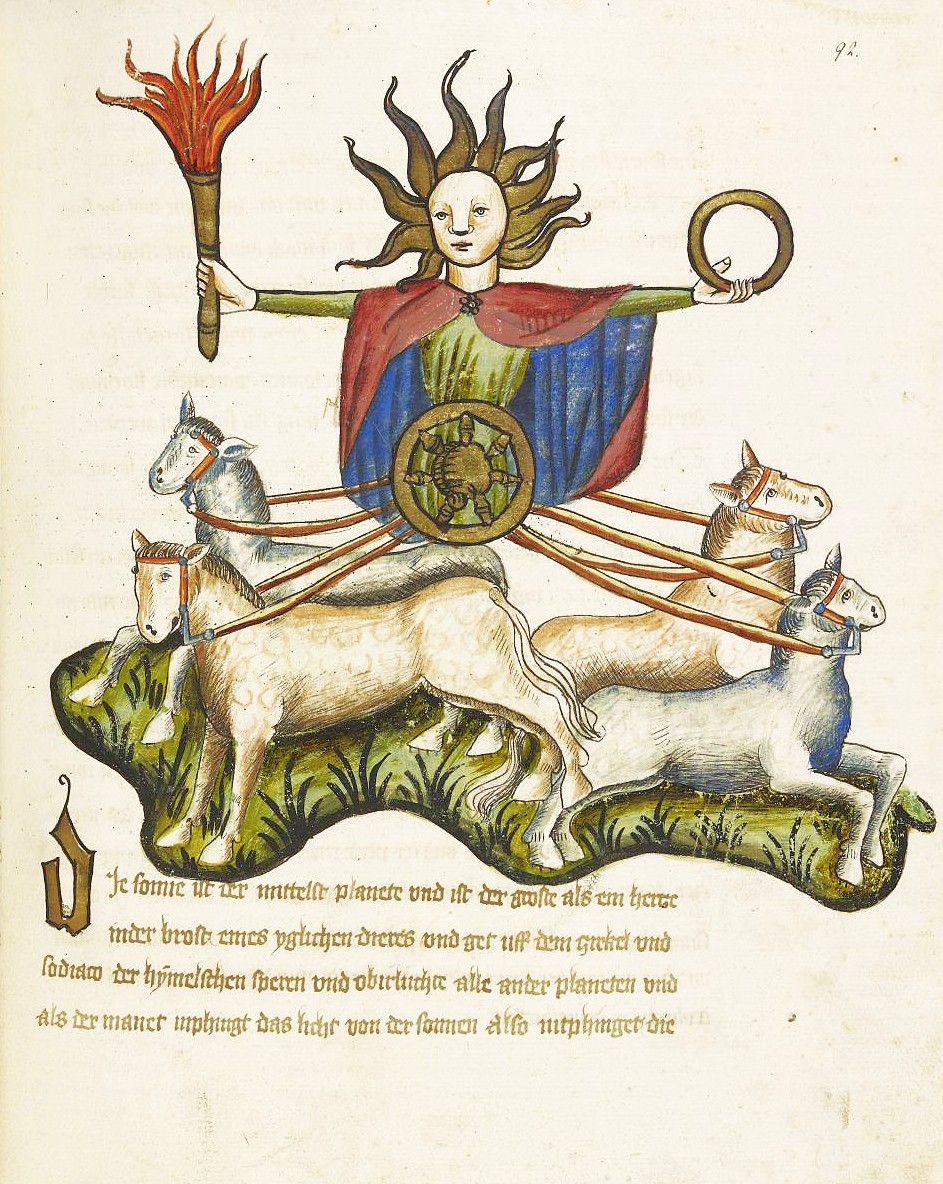
This simple formula, hidden in plain sight in triumph I, provides the foundational structure on which to then load our various interpretations; The Wheel of Fortune is both the first card of a three part cycle (10, 11, 12) as well as being the fourth card (the death) of the previous cycle (7, 8, 9). All the 1/4 cards indicate both initiation and completion – ie, change. They are always masc/solar (see below). Wheels are typically a solar symbol, and besides including the Sun itself, the 1/4 series contains the two triumph cards with wheels (7 and 10). Notice all the cards between 1 and 19 have crowns in them – another solar symbol – and that the the Wheel is central.
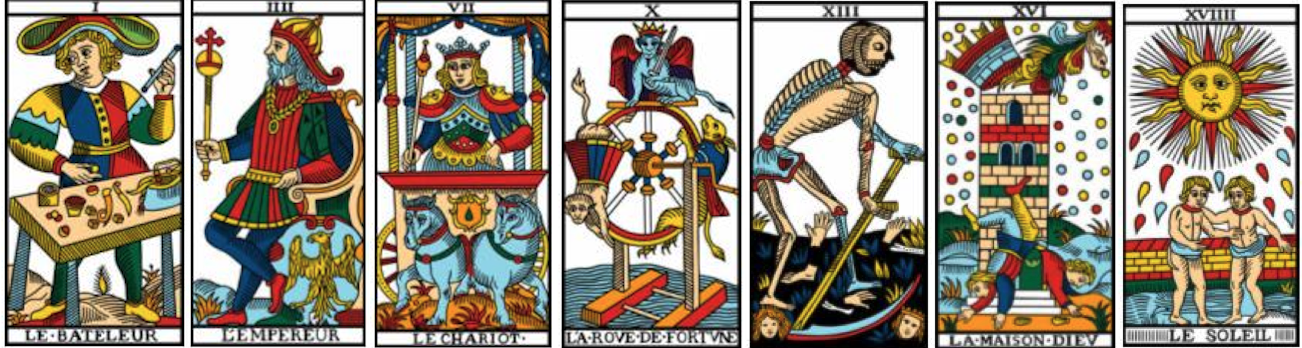
Cards in the 1/4 placements [Camoin-Jodorowsky deck]
German astronomical illustration of the Sun, 1445. How many cards from the 1/4 series do you see represented?

With 10, the perfect, complete number, ‘the great work’ (ie, the soul’s work) may now commence. 9 was the number of endings and of memory (Mnemosyne), of reflected, inner light. Similar to the Emperor, the old Hermit turns toward the past, drawing the numerological cycle to a close. We might imagine a shadow puppet play of life highlights projected onto the inside of his curtain-like cloak.
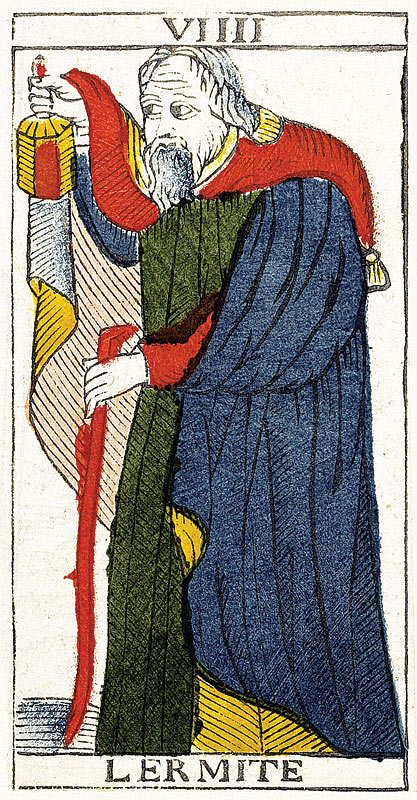
Pierre Madenié, 1709

Mathematically, 9 always returns to itself. The Pythagoreans were not enamoured with 9, but understood its importance as the first square (3×3) and for its role in human gestation, relating to the 9 spheres a soul transited before rebirth. More about the Hermit and his lamp here.

Pythagoras himself had been initiated into the Orphic Mysteries, among others, ’tis said. He believed in and taught metempsychosis (reincarnation), and that mathematical principals – numbers – are universal, guiding principals.
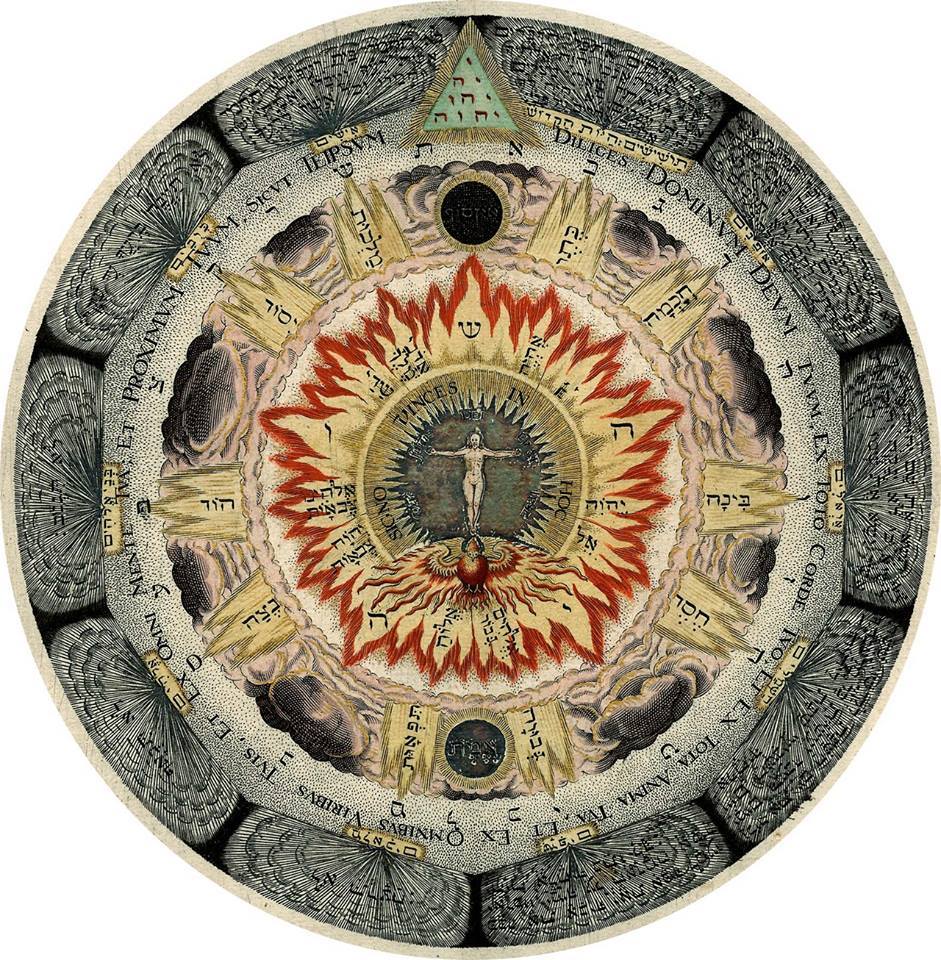
Alchemical etching from the ‘Amphitheatrum Sapientiae Aeternae’ by Heinrich Khunrath, Hamburg, 1595

10 is the ‘higher octave’ of 1. To Pythagoreans and alchemists alike, 1 was not actually a number (it could not be ‘numbered’ and anything multiplied or divided by 1 was still the same), but represented the Monad (God, origin, unity), symbolized by a circle with a central dot or eye. This is still the symbol for both the Sun and gold. Wheels are essentially monad shaped. [Note: They did not use or accept 0 as a number.].
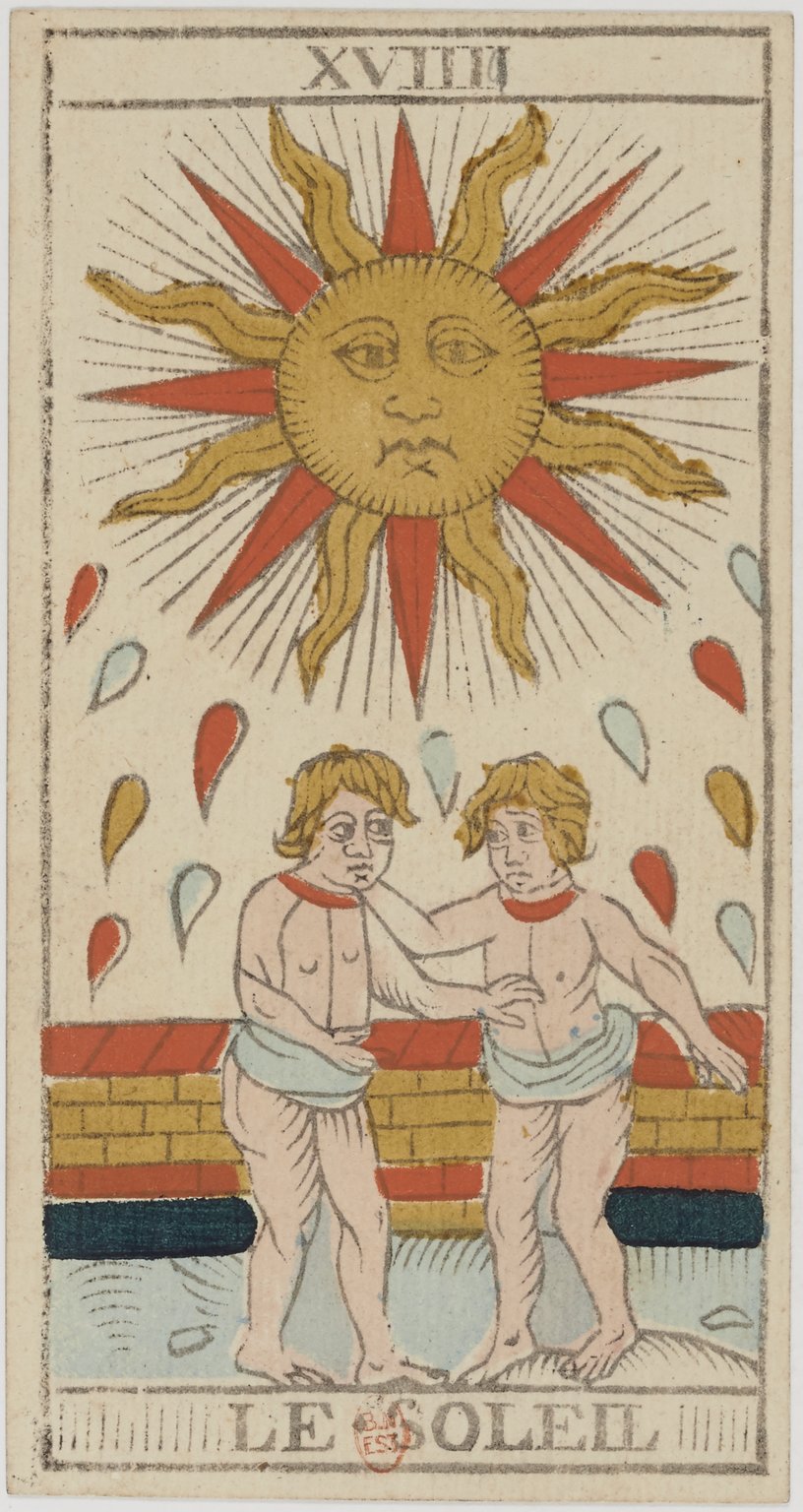
Conver type II, 1760

The next card after 10 that reduces to 1 when the digits are added together is 19, the actual Sun. There is no 4 in this last, seventh cycle of 3, unless we include Le Mat as 22. While ‘Pythagorean’ numerology considers 22 to be the ‘master builder’ (aka god), the man himself did not specifically mention this. However, what’s very interesting indeed is that the ratio of 22/7 was used by Archimedes to approximate pi. Thus by adding Le Mat as a 22nd triumph, division by 7 no longer gives us 3, the trinity, but pi, which is ‘never-ending.’

“Numbers are the Highest Degree of knowledge. They are knowledge themselves.” ~ Plato
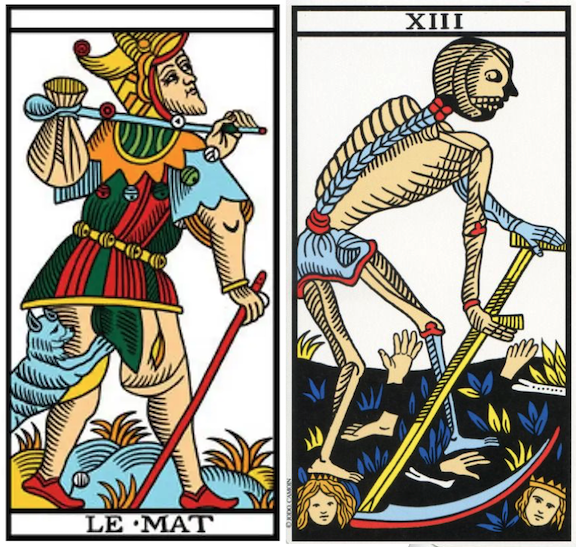
The infinite and the eternal? Camoin-Jodo Conver type II, 1997

The process of destruction and purification by fire and water prior to what will be rebirth in 19, 20, 21 begins with this most sacred number of the Pythagoreans because, where unity and wholeness is the ultimate intent of the work, God/the Divine must be invoked.

Alright, math class dismissed, time for art, myth and philosophy…

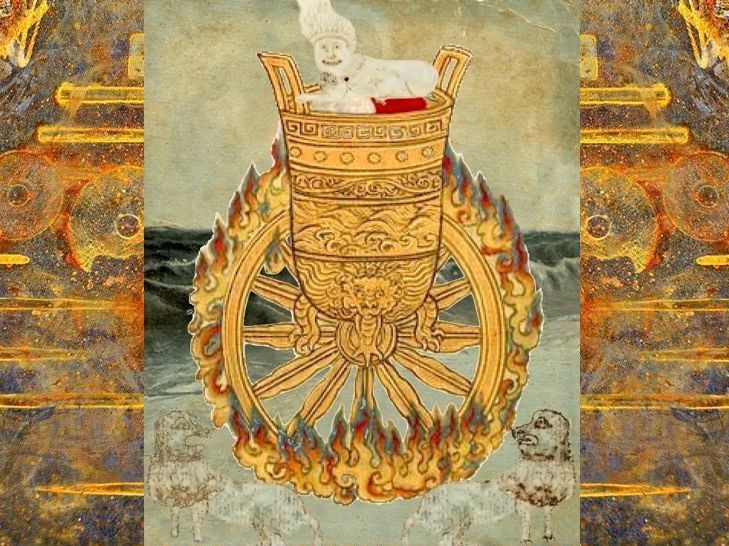
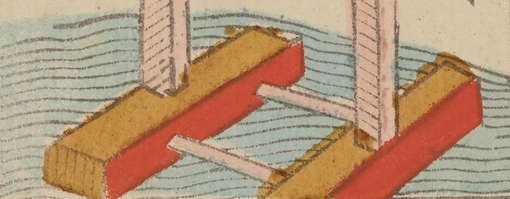
The Marseille Roue de Fortune card is a bit of a visual conundrum. The parts don’t quite fit together and though the creatures on it appear to be in motion (at least, the ones on either side do), nobody’s turning the handle. The base, which resembles a section of ladder, stands on water. Is it a water wheel? Maybe this rota cannot be fully understood literally, but is another riddle asking to be read as a composite of its parts.

I won’t go into the entire history of Fortuna’s Wheel, or ‘wheel’ be here all day, but one, particular detail in the Marseille version is what got my wheels in motion: at some point in the card’s r-evolution (perhaps simultaneously, in different traditions), the creature on the left transitions into a flaming pot.
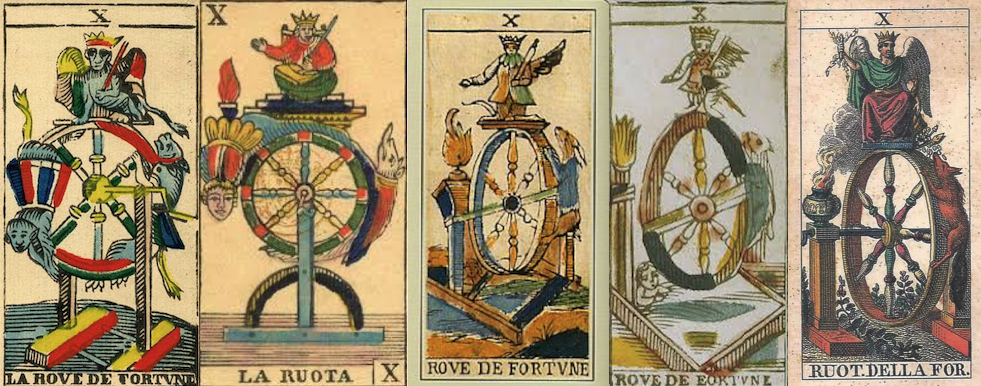
This has been dismissed as misinterpretation of worn away plates by printers who, (correctly) interpreting the tail as a flame, figured the Wheel should be equip with an altar or censer with which the passing of earthly existence into smoke was symbolized. (And now it does resemble an Arabic ’10’).

One possible precedent is in images of Ixion, where the wheel Zeus binds him to is being lit with a torch, although, there are plenty of mythical, flaming wheels (and altar pots) to choose from. Ours is not Ixion’s wheel per se, but maybe the flame is mnemonic of it. Ixion, having killed a kinsman and twice flagrantly violated the sacred law of Xenia, was denied the cathartic rituals that would cleanse him of his guilt, and, under Zeus’ orders was bound by Hermes to a fiery solar wheel for eternity [either rolling across the sky or stationary, down in Tartarus]. At this point in the game, there are two options; change or be stuck on repeat forever.
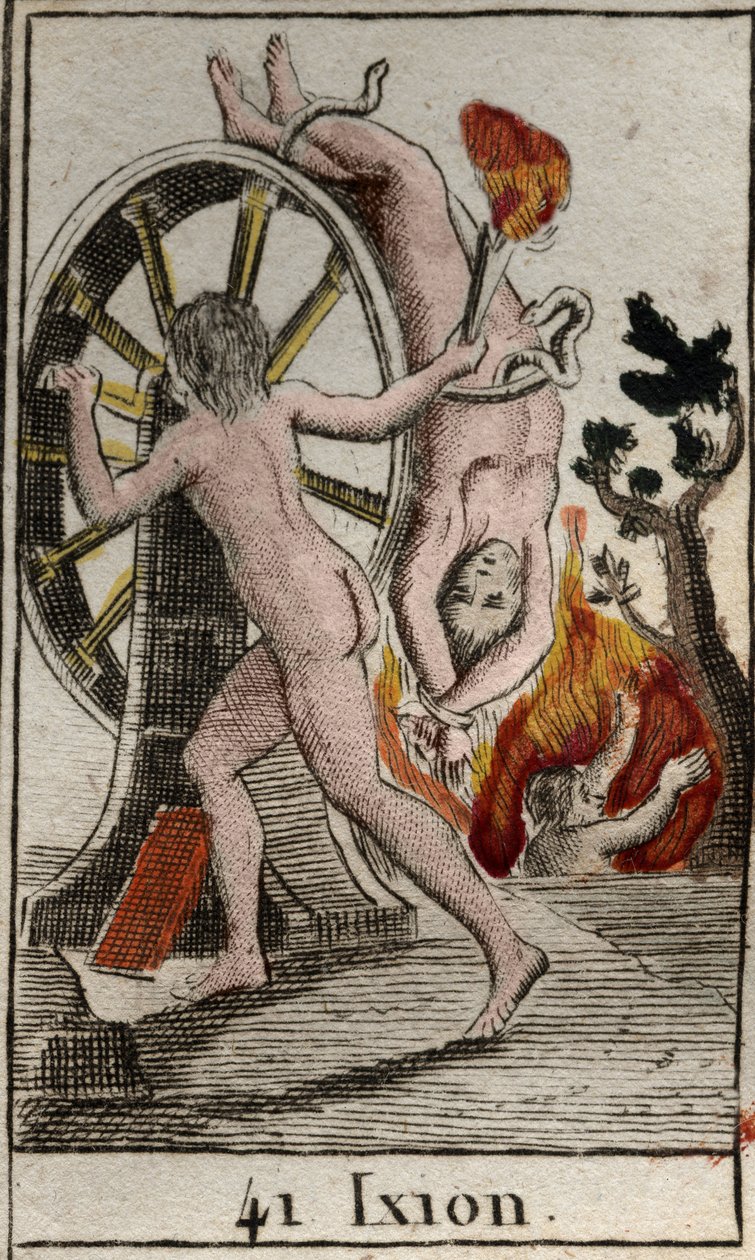
Ixion about to be lit, from ‘Mythologie de la jeunesse’, 1803

The Wheel’s stand can elude to a couple of things; like the Hanged Man’s gibbet, it might suggest a gateway, recalling the dokana of the Dioscuri (even shaped like the Gemini sign, a prelude to the twins in 19).
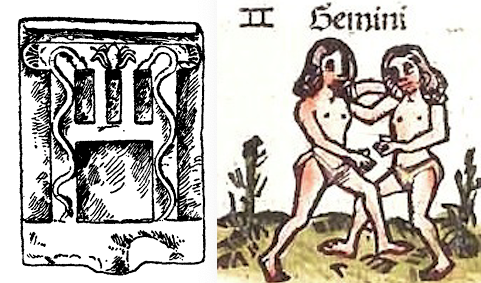
Dokana symbol and Gemini

It could also indicate that ‘the initiate’ has now made it this far on the scale philosophorum (philosopher’s ladder of mystical ascention), which will later appear atop the wall in 19. The two bars form the Arabic numeral 11, and/or the Roman numeral II, recalling “one becomes two…” Double digits begin here and the images start to reflect this. 10, with this design element, seeds 11 (La Force), situated exactly in the middle, a threshold with ten numbered cards on either side. The formidable lion-wrestling mistress is partner to the Le Bateleur.
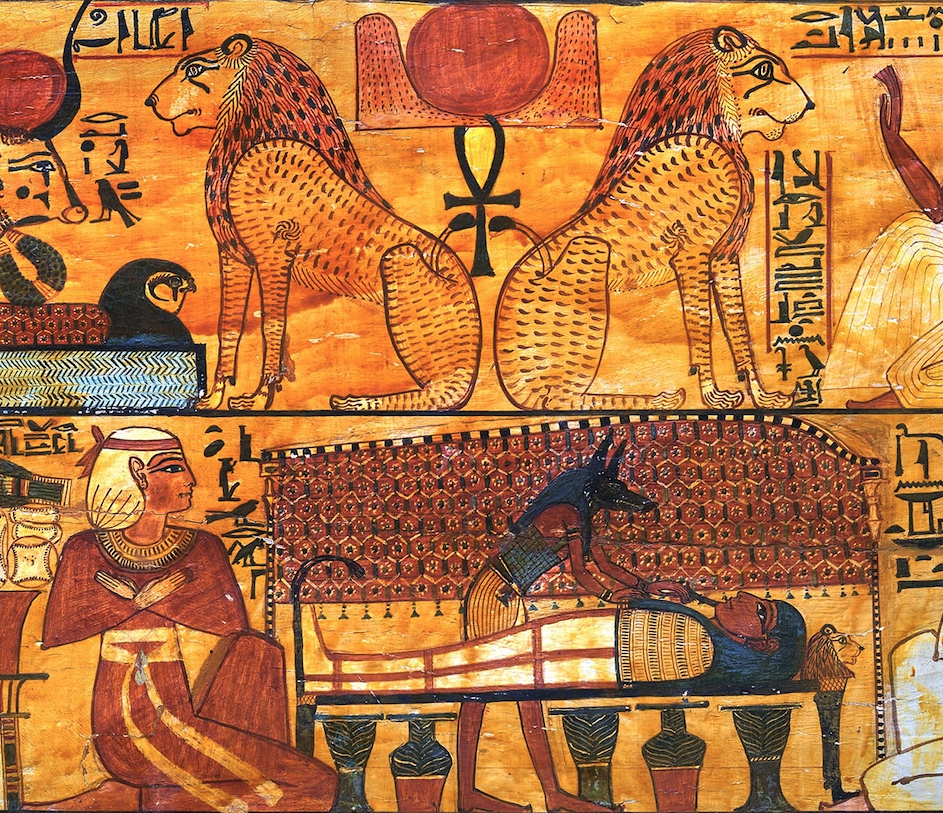
Lions of yesterday and tomorrow (eastern and western horizons), with the eternal in the middle, hieroglyph for ‘the horizon.’

The ‘foreparts of a lion’, seen here at the head of the embalming table, is the hieroglyph for ‘strength’, and is featured in the Strength card.

We might also imagine the Wheel as metaphorically representing the Sun above the watery horizon and the beings on either side as ‘yesterday’ and ‘tomorrow’’ – traditionally, ‘I have reigned’, and ‘I shall reign’ – with the top middle one as the present, ‘I reign’. Instead of a fourth on the bottom (usually an old, impoverished figure) there is a gateway to watery rebirth.
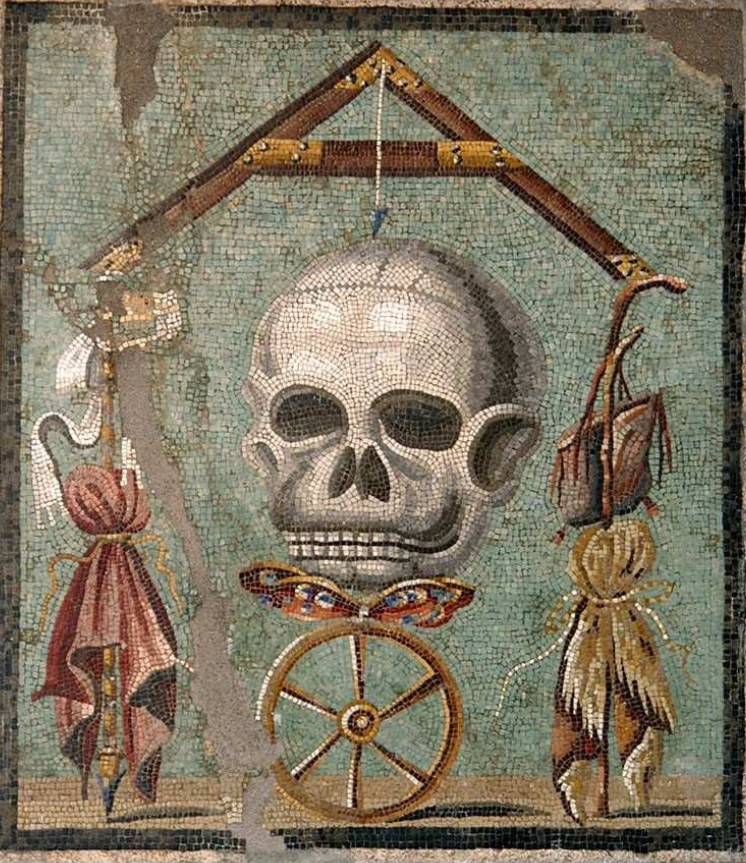
Memento Mori mosaic, in the Museo archeologico Nazionale di Napoli, 1st c

In this iconic ‘memento mori’ Roman mosaic from Pompeii, a simian skull is balanced atop a butterfly on a wheel. Above, a square level’s plumb bob is just touching it, the tool balanced atop two staffs, hung with the garbs of rich and poor. All are equalized in death, all are subject to Fortune’s whims. The mosaic was part of a banquet table, where Romans often practiced ‘carpe diem’, remembering their death tomorrow by partying today. The butterfly represents the immortal soul (Psyche). Butterfly, torch (especially going out or pointed downward), plumb line, fortune wheel, urn and of course skull/skeleton were all symbols of death, typical of the Roman ‘carpe diem’ motif.
[The tradition of death symbolism is also recurrent in Freemasonry. Masons practice reflecting on their mortality at every turn. The plumb represents death as well as the upright, balanced life and is a common,  gravestone motif.]
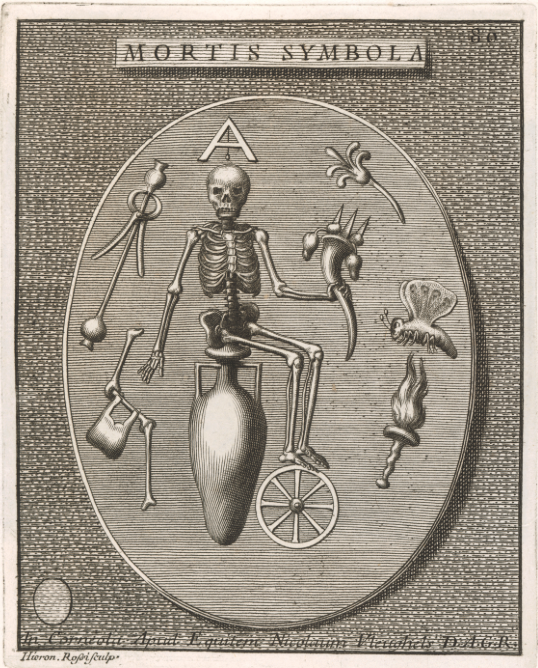
Roman symbols of Death

The explanation usually given for the monkey skull in the Roman mosaic is that cremation practices of the day had left the artist without a human one to refer to, but this ignores the fact that monkeys/apes were often used to parody humans. The memento mori theme was very popular and there is more than sufficient proof that artists of the day knew how to depict human skulls. An artist could easily have improvised the bone structure from a living human.
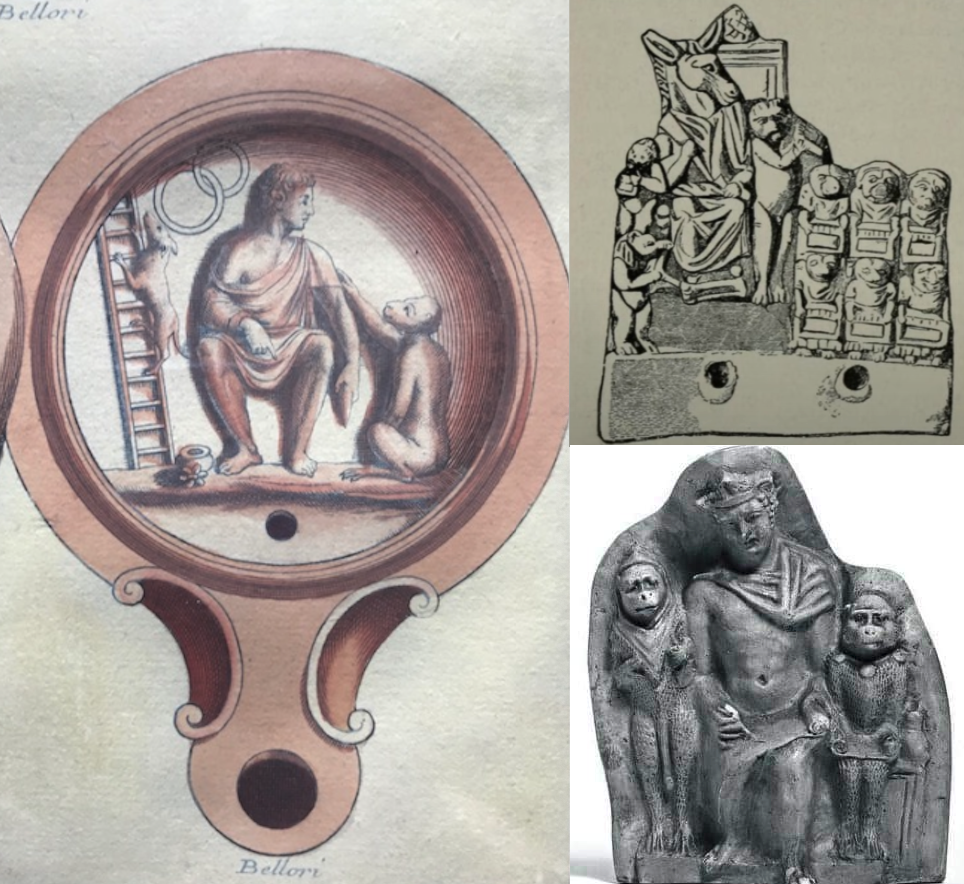
Lamp showing a juggler with monkey and dog (Carthage 1st c), Terracotta plaque (S. Italy, 1st c), Hermes seated between two baboons (Egypt, 3rd c BC, British Museum)

The little creatures on the TdM Wheel also seem to be parodying fearful humans stuck on the mortal coil, immediately following the card of remembering. Regrets…I’ve had a few…
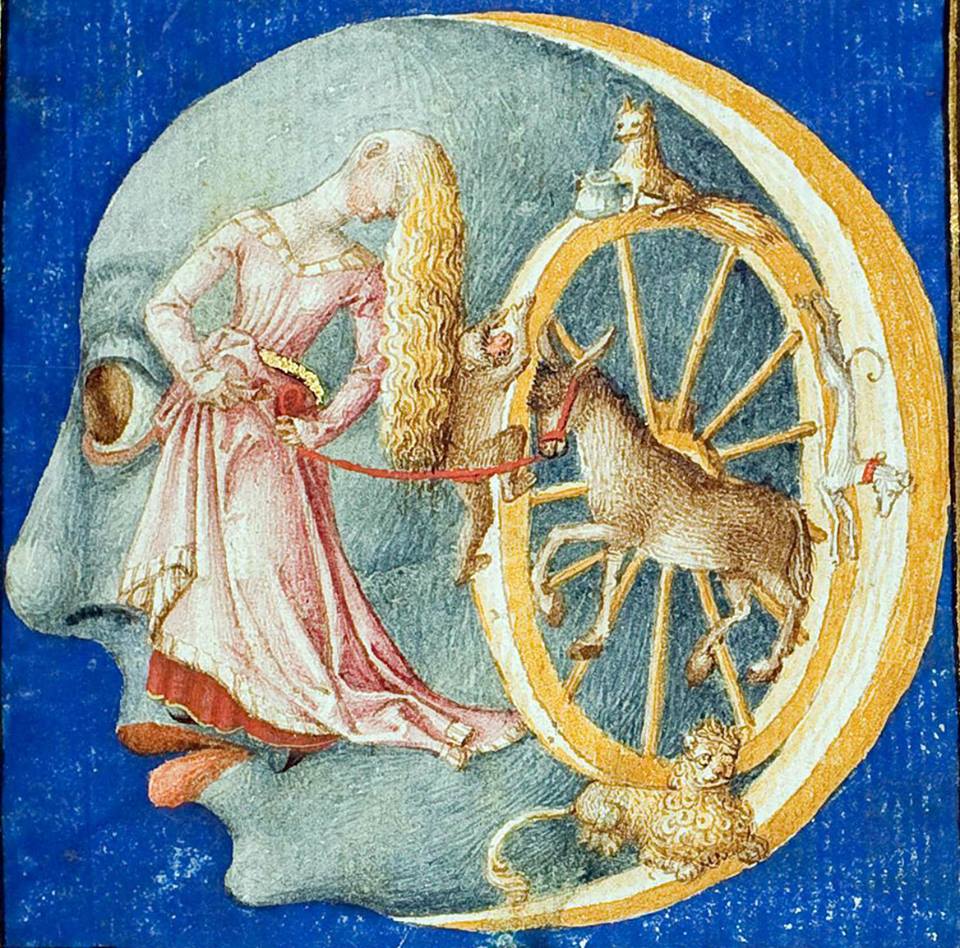
A Lunar Wheel of Fortune or Fate being turned by an ass, Hekate’s familiar. The woman’s hair-do is similar to that of Kairos (‘critical timing’), she might be the Roman equivalent, Occasio, who was female.

It would seem the tail of the simian-looking creature on the left side of the card was always intended to resemble a flame, both to illustrate the fire element, and to suggest that being turned on the wheel is akin to being ‘cooked.’ Perhaps there is nobody turning the handle because, as with the Chariot, which is not physically moving, there is no outer influence, the change is happening inside. Either we turn our own wheel or invite “fate” to do it – an outer expression whereby things seem to randomly happen to us (wheel of karma). The ‘winged’ Mercurial being at the apex might be symbolic of will, overseeing  the process, making sure the pace is natural and steady, that an even temperature is maintained. 

“Its purpose is constant digestion. Within its womb, substances are subjected not to violent flames but to the slow and merciful fire – ignis temperatus that mimics the warmth of the earth’s own generative belly. There, in that tranquil inferno, base substances soften, combine, and refine, until that which was profane begins its ascent toward the sacred. This is no vulgar boiling, but a sacred gestation.” ~ Universal Co-Masonry FB post, regarding the Athanor (alchemical furnace).
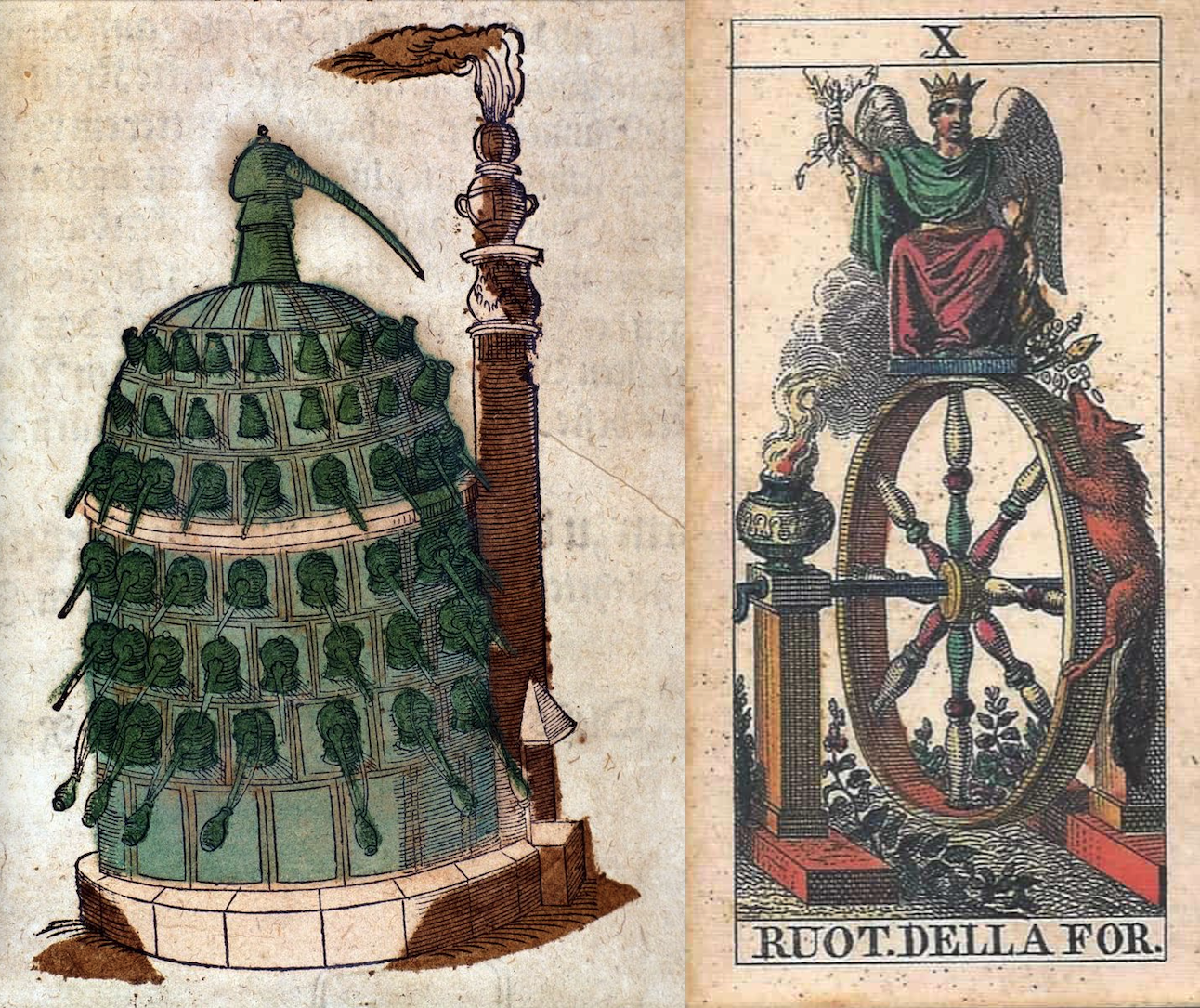
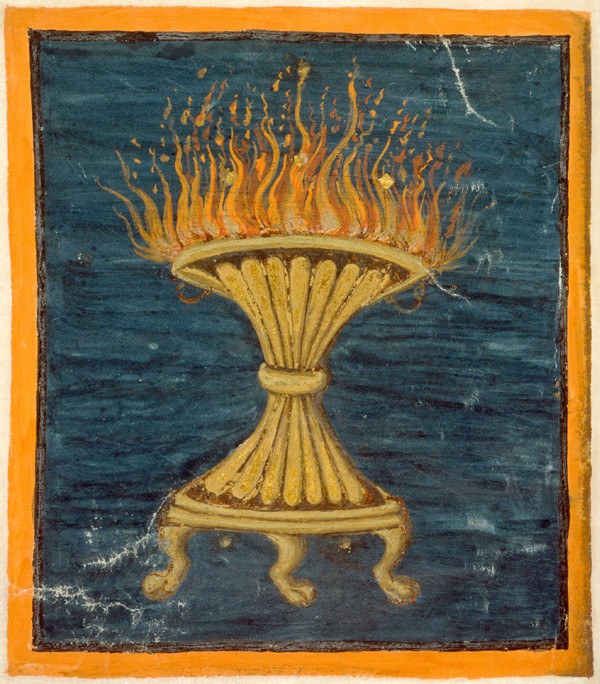
Athanor and Soprafino Wheel, 1835

Above, with a suitable Tarot card for comparison, is the image that finally unlocked this card’s cryptic meaning for me. It is of an alchemist’s ‘athanor’, which is a self-feeding, clay furnace designed to maintain a steady temperature. Although etymologically unrelated (it comes from Arabic at-tannūr, “the baker’s oven”), ‘athanor’ oddly enough contains the Latin word ‘rota’ in it (albeit spelled backwards). Note the familiar design of the heat-release valve.

“The athanor’s design further symbolizes the unity of the macrocosm and microcosm through its correspondence to the four classical elements, integrating them into a harmonious whole; Fire represents the transformative heat in the lower chamber, Earth the stable structure, Air the circulating vents, and water the surrounding baths, collectively mirroring the alchemist’s inner equilibrium and the cosmic order. This elemental interplay underscores the Hermetic principle of “as above, so below,” where the furnace’s operations reflect the soul’s alignment with universal forces.” [Grokipedia…forgive me!]

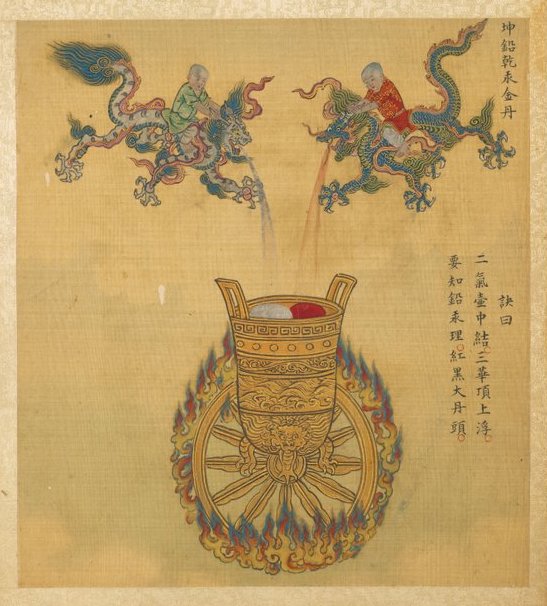
Qing Dynasty Chinese School Taoist Alchemy

In fact, the alchemists did use the term ‘wheel’ (rota) as a metaphor for the cyclical nature of their art. The stages were not linear, but continuous – the end could also be the beginning, just as in nature.

The three figures on the TdM Wheel might represent the 3 philosophical elements – left, sulphur (soul/emotions/desires), right, salt (body), and top, mercury (spirit/imagination/moral judgement/higher mental faculties). The salt/body fellow has ass ears, which typically are a sign of ignorance (think Pinocchio) but also, again, possibly suggestive of Hekate, triplicate Goddess of the crossroads and occasional consort of Hermes (aka Mercurius) or Hermanubis. As supreme navigator of liminal spaces, her torch burned with the sacred solar fire of Helios. 

“O Sun our lord and sacred fire, the spear of Hekate of the roads, which she carries as she attends her mistress in the sky and as she inhabits the sacred crossroads of the earth, crowned with oak-leaves and the woven coils of savage dragons!”

~ fragment of a hymn to Helios and Hekate from the play Rhizotomoi (Root-Cutters) by the Greek tragedian, Sophocles [Loeb Classical Library].
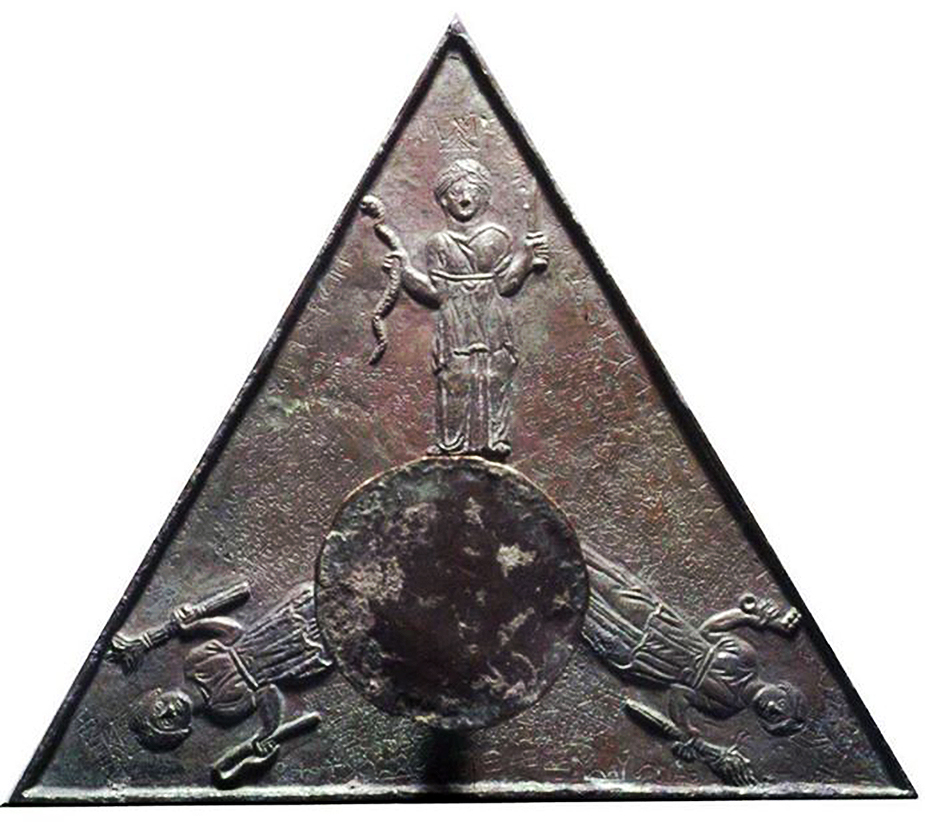
Goddess Hekate in magical plate from ancient Pergamon, Anatolia [Berlin Museum]
All 4 classical elements, too, are present:

AIR (sword pointed up, wing-like cape)
FIRE (flame-like tail pointed up)
WATER (below)
EARTH (vine or snake-like tail pointed down)

4 classical + 3 philosophical elements = 7.

In both type I and II, the number of spokes appears to be 6 (or three divided), but notice that a seventh is also formed by the Wheel’s handle. Clever. Seven elements, planets, metals and stages.

Addendum: The 6 spoked Wheel can also be read as the Labarum symbol (solar) adopted by Christian iconography, which is nevertheless based on the idea of “inverse directions…one of which is like a reflection or mirror image the other” – ie, ‘as above, so below’ – similar to Solomon’s seal. [René Guénon, Symbols of Analogy, via Wikipedia]
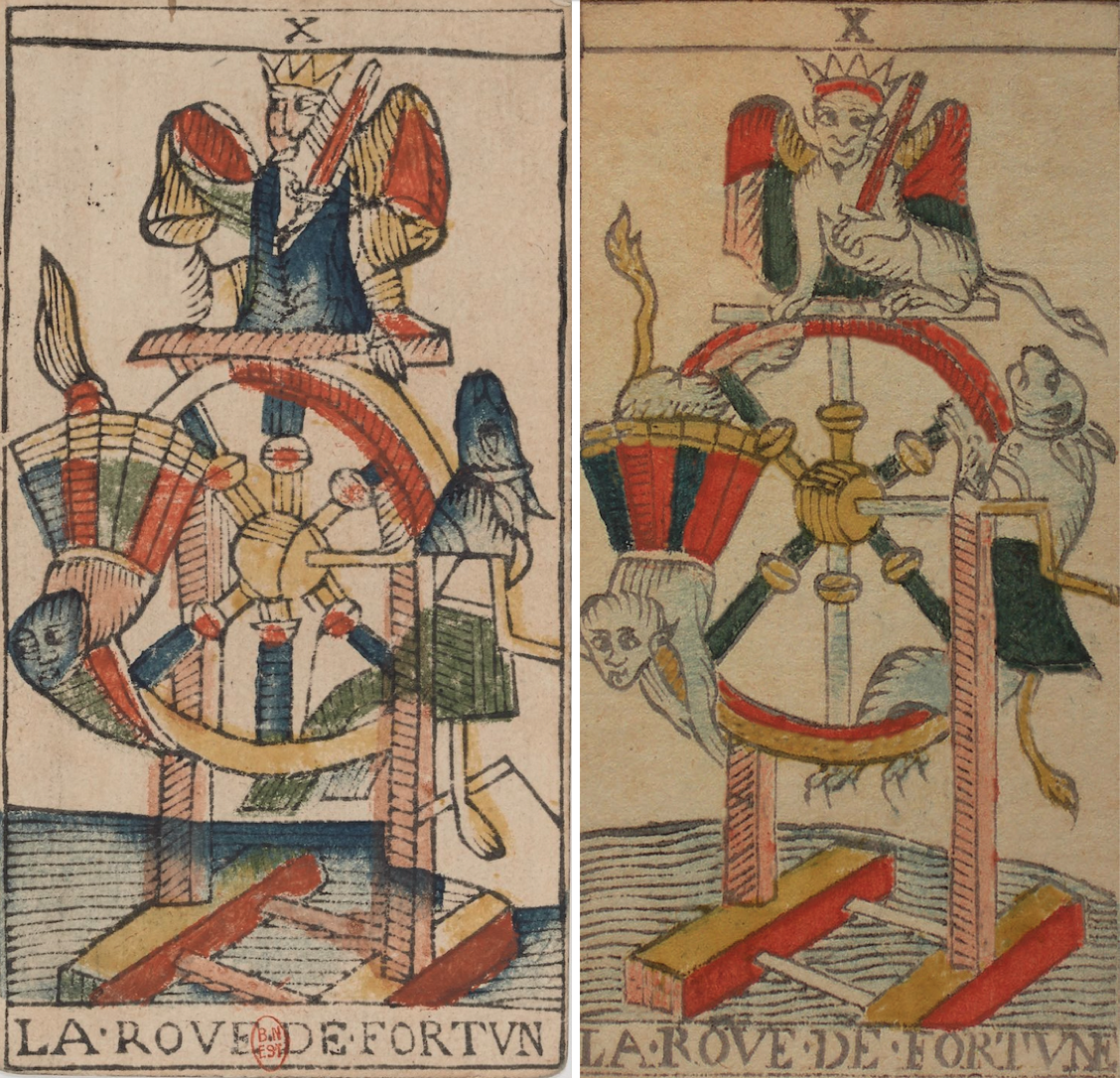
Dodal type I (ca 1701-15) and Chausson type II (1672)

The hub of the Wheel is divided into 3 sections, and resembles a lunar-solar combination – navigation of liminal spaces as we progress toward unity.

That the flaming tail was turned into an altar pot/censor doesn’t change the intrinsic meaning and actually alludes more strongly to the alchemical cooking process. The water below suggests ‘a slow, gentle cooking’, akin to that of the Bain Marie. Similar to the gentle turning of a wheel, the contents of a cooking pot or cauldron is stirred in a slow, spiralling motion. In Shakespeare’s tragic play of alchemy gone backwards, MacBeth, the Wyrd Sisters famous chant, ‘Double double, toil and trouble,’ is a reference to ‘the work.’ Originally, the old English word ‘wyrd’ (which became ‘weird’) meant  ‘fate’ or ‘destiny.’
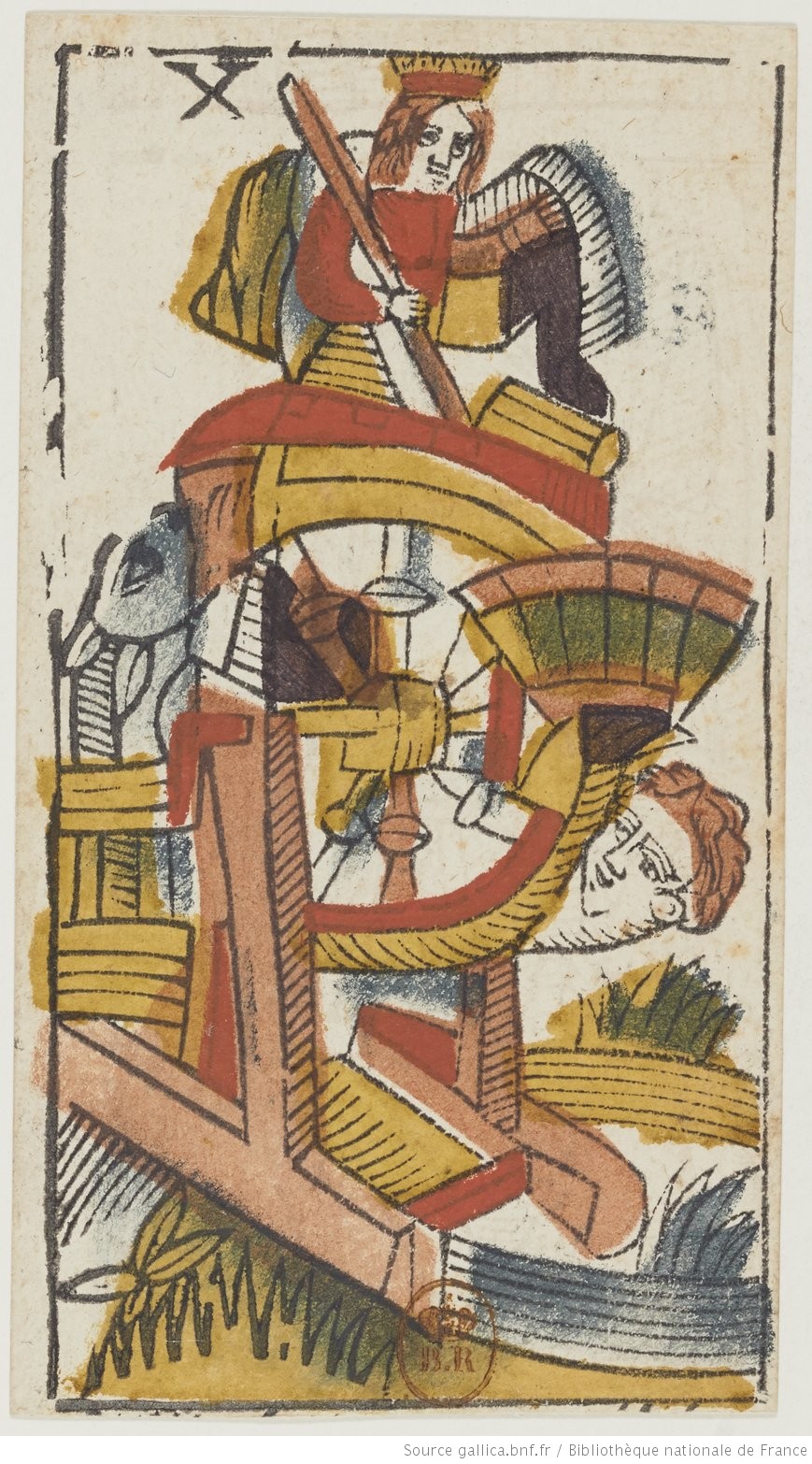
Jacques Vieville 1650

The Vieville card does not show any flame on the side, but rather, some suspiciously fiery-looking, yellow grass, below, possibly suggesting the pool of water is being heated from beneath. But the shape of the fire being’s skirt is consistent across TdM decks. It bears a similarity to the shape of constellation Ara, the altar on which sacrifices to Zeus were made, and is reminiscent of the Emperor’s skirt  (‘I have reigned’). The Wheel of Fortune was also an attribute of Zeus, god of optimists and gamblers. By ‘letting go and letting God’, we sacrifice our dross to the pyre, turning fate to faith. Remember Pythagoras’ holy number 10.

Ara constellation, Roman

Apollo, though one of the great gods of Olympus, is yet represented in some sort of dependence on Zeus, who is regarded as the source of the powers exercised by his son. [Theoi.com]

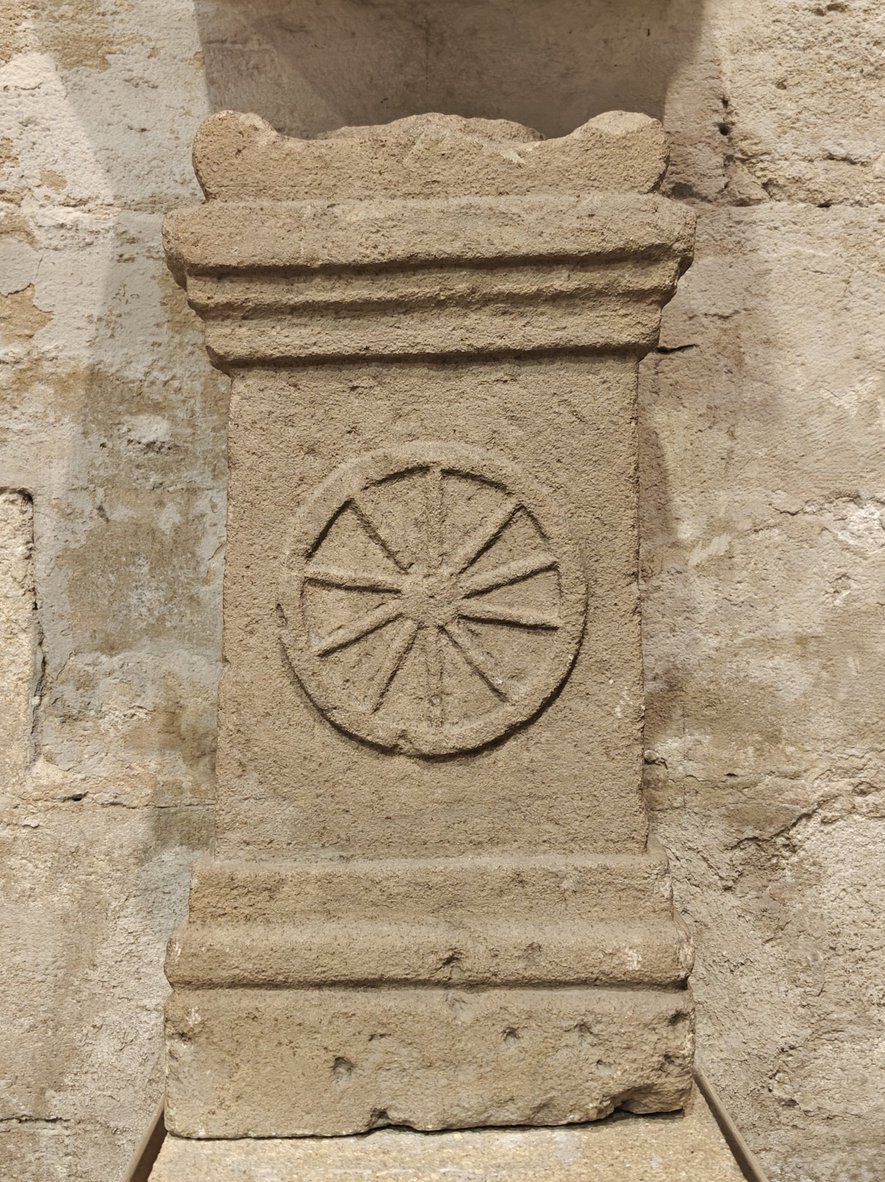
Jupiter (Zeus) altar featuring a 10-spoked wheel, the number of months in a Roman year.

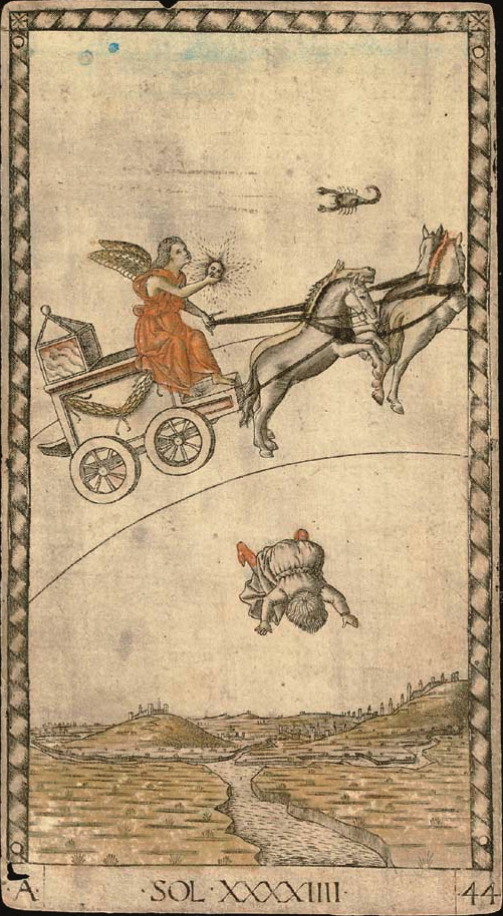
Helios, a Titan, was the Sun personified, later identified with Olympian Apollo, god of light and prophecy. The sad myth of Phaethon – the son of Helios who insisted he could drive his father’s chariot, but lost control of the horses and fell to his death – can, in the mythoalchemical sense, be equated with ‘the work’ being scorched by impatience (or hubris) or halted by negligence (or ignorance).

Tarocchi of Mantegna Sun, featuring the myth of Phaethon, 1465

The meaning of the Latin phrase Festina lente (‘make haste slowly’), is that activities should be performed with a proper balance of urgency and diligence. If tasks are rushed too quickly then mistakes are made and good, long-term results are not achieved. Work is best done in a state of flow in which one is fully engaged by the task and there is no sense of time passing. In this way we are in harmony with nature. ~rb

“Thus, let the Athanor burn–not with haste, but with faith–and may its light ever guide the hand and the heart of the true seeker.”
~ Universal Co-Masonry, ibid
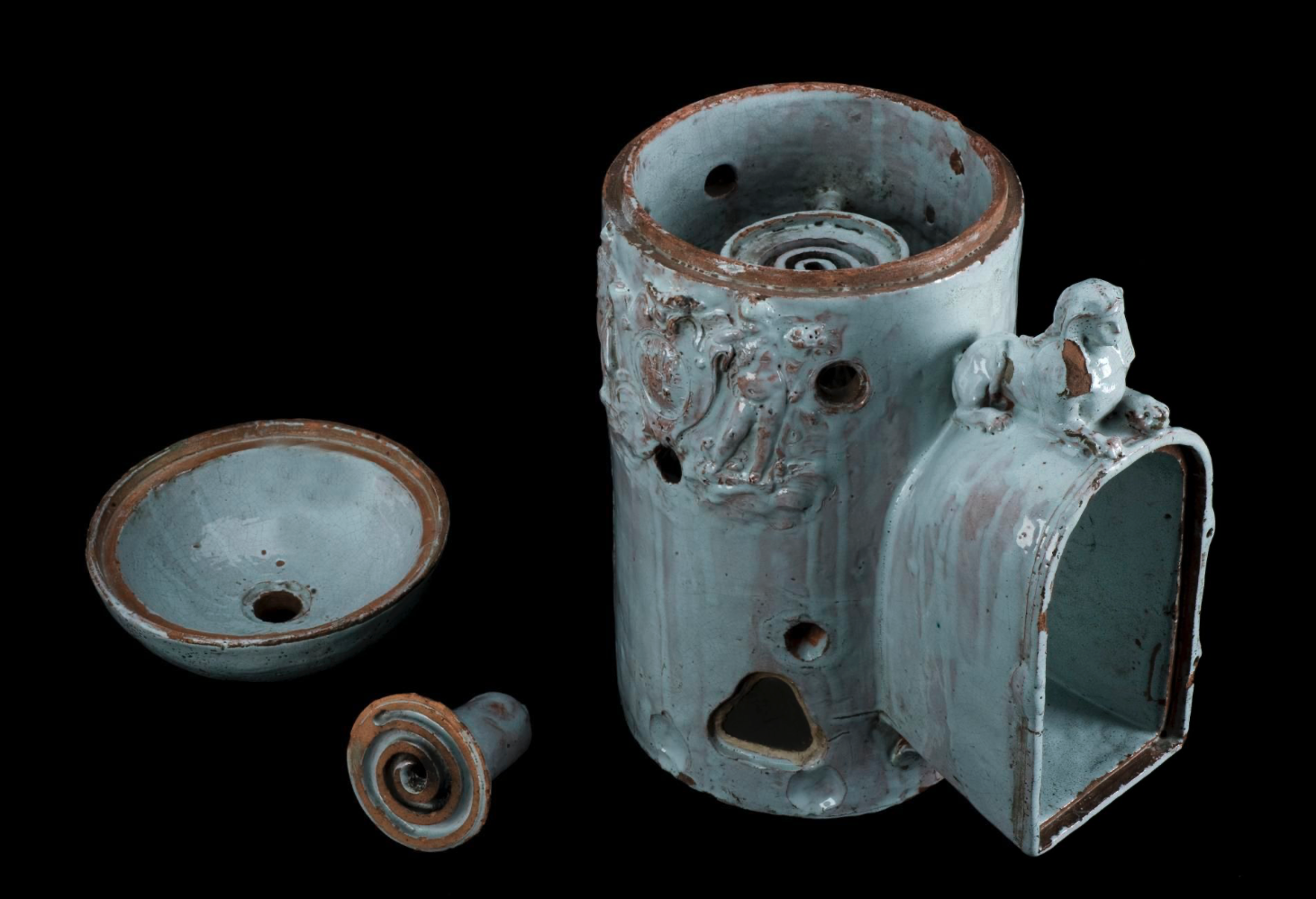
Alchemist’s athanor (top removed), stoneware, German, 1501-1700

All written content, besides quotations, is ©ROXANNA BIKADOROFF and may not be reprinted for republished in full without my permission. Kindly share via LINK only, which helps direct traffic here. If you wish to use a short pull quote, please include a credit (and link).

Divine Measure – Traversing the Star Card of Ancient Tarot

In Greek mythology, while transformation into a rock is usually a barren fate, a pattern emerges in which the heroines who were transformed into islands are lovers of the gods; just as islands, like cities, were usually personified as minor goddesses or heroes. [Wikipedia]

This is precisely what happened to Asteria [not to be confused with Astraea], Titan Goddess of falling stars, oneiromancy (divination by dreams) and astrology (by stars), and mother of Hecate. She transforms herself into the Island of Delos, where her sister Leto at last gave birth to the lunar Artemis and solar Apollo, after an exhaustive search for refuge. The usual suspects were to blame; Zeus for making Leto pregnant, then pursuing Asteria, and jealous Hera’s subsequent curse, that Leto not be able to find solid ground on which to give birth, forbidding all places on earth to accept her. Hera also kidnapped the goddess of childbirth to ensure that Leto’s labour would be ultra painful. Asteria (‘star’) defied Hera’s orders, but as she had not succumb to Zeus’ advances, Hera, though angry, did not punish her.

Artemis was an easy delivery, but Apollo took 9 days and nights to come out (luckily, Artemis was able to assist). There are a few variations on the myth, as is typical. Delos means ‘to manifest or reveal’. It had been a floating island, ’emerged’ for Leto by helpful Zeus (the least he could do since he can’t seem to keep his Tower in his robe). Either it was uninhabited or it was and the people didn’t want her giving birth there, so Leto gifted the island with 4 anchors to keep it stable, which pleased them. Are these ‘anchors’ the 4 Royal Stars (Aldebaran, Regulus, Antares, Fomalhaut)?

‘Cary Sheet’ Star, ca 1500

“Hail. O heaven-built isle [Delos], most lovely scion of the children of bright-haired Leto, O daughter of the sea, thou unmoved marvel of the spacious earth, by mortal men called Delos, but by the blessed gods of Olympos (Olympus) known as the far-seen star (astra) of the dark-blue earth . . . For aforetime, that isle was tossed on the waves by all manner of whirling winds; but, when Leto, the daughter of Koios (Coeus), in the frenzy of her imminent pangs of travail, set foot on her, then it was that four lofty pillars rose from the roots of earth, and on their capitals held up the rock with their adamantine bases. There it was that she gave birth to, and beheld, her blessed offspring.”  ~ Pindar, Processional Song on Delos (Greek lyric ca 5th B.C.)  [Theoi.com]

Ancient Greek coin (date?)

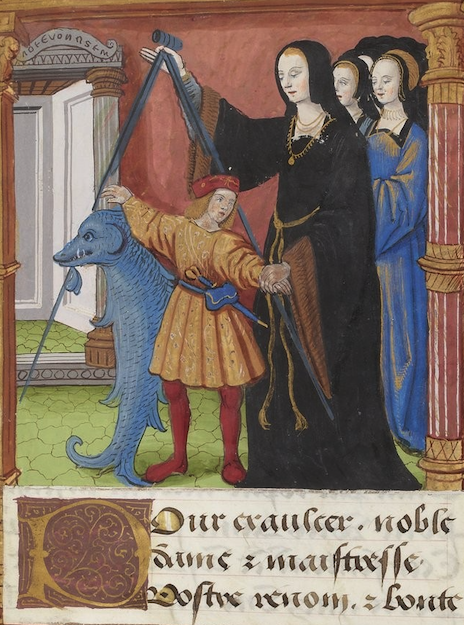
Both Delos and Delphi, site of Apollo’s famous oracle and omphalos (navel), share the root word ‘del’ with ‘delphini,’ which means dolphin in Greek. Dolphins are sacred to Apollo, Dionysus and Poseidon. The Cary sheet hints at location with a fish-tail shape in the shoreline. Dolphins were considered by mariners to be a very good omen indeed, guiding and protective. They are also known to protect whales giving birth. So saviour-like are dolphins, that in the 14th century, French heirs began calling themselves ‘dauphin.’ It is beyond shameful and utterly reprehensible how modern humans have abused these sacred beings (the marine mammals, not the French kings).

Louise of Savoy instructing her son, Dauphin Francis I, ca 1505

Apollo wore his golden hair long and his sacred number is 7, associated with the traditional planets, stringed lyre and the Pleaides (starry rain-makers).
The cards do not give us absolutes, but evoke in a mnemonic, riddling fashion, so don’t be too confused by the lack of breasts on the Cary water-bearer.

After her transformation into Delos, several stars, deeply moved by her tale, aligned themselves in her honor. This formation, known as an asterism, served as a protective shield and a tribute to the goddess. For sailors navigating the vast seas and stargazers looking up in wonder, this celestial pattern became a symbol of Asteria’s indomitable spirit. [Olympioi.com]

Greek jug (both sides), 3rd-2nd c BC

It’s obvious that the birthing waters have broken, which explains why the card is somewhat incorrectly interpreted as illustrating the zodiac sign of Aquarius. Aquarius signifies a similar idea (and the constellation once included the Southern Fish, with Royal Star Fomalhaut in its mouth) – albeit in the dead of Winter we are talking more about inward, spiritual rebirth, ultimately necessary for a more evolved, physical return (Saturn).
The androgynous figure pours one jug onto the earth and one into the water, as she will do in the classic Tarot de Marseille card. We get the sense of purification by libation – libation of feminine fluids – as well as the cyclical nature of water, aka life, connecting with her arms in a continuum. In alchemy the liquid purification of spirit is considered Lunar and feminine, inner.

A sea of blood and milk…
‘Eternitas’ 1640 emblemata, after Francesco da Barberino (early 14th c)

Now it’s also possible that her two pitchers contain waters of Mnemosyne and Lethe – some Orphic lamellae (gold tablets) instruct the deceased to only drink from Mnemosyne’s streams, not Lethe’s, in order to avoid another, terrestrial birth or an eternity in gloomy Hades:

“You will find a spring on the left of the halls of Hades, and beside it a white cypress growing. Do not even go near this spring. And you will find another, from the Lake of Memory, flowing forth with cold water. In front of it are guards. You must say, ‘I am the child of Ge and starry Ouranos; this you yourselves also know. I am dry with thirst and am perishing. Come, give me at once cold water flowing forth from the Lake of Memory.’ And they themselves will give you to drink from the divine spring, and then thereafter you will reign with the other heroes.” ~ from Petelia, 4-3 BC

Other sources seem to indicate we’re to drink a bit of each. Hmm.

Chosson TdM, 1736, feat. one of many misspellings

The little black bird, which could represent the soul or ‘Ba bird‘, in the background is also a mytho-alchemical clue, for the crow in alchemy is symbolic of Saturn and the blackening (the first stage of the work, now fading in the distance, but not entirely forgotten).
In another, Apollo myth, he sends his originally white bird to keep watch (spy) on his lover, Coronis (‘crow’).  Unfortunately for everyone involved, the bird reports she’s been cheating with a mortal. Seething, Apollo scorches the messenger for his efforts, then shoots his woman down. Naturally, he regrets it, tries to revive her, but it’s too late, because Greek tragedy. In the opener image kylix detail, we see the blackened crow or raven as Apollo’s bird of prophecy. Are bird and lover one and the same? Only the shadow knows.

Apollo kills Coronis, 1590 engraving by Hendrick Goltzius

During the alchemical opus, there is something called the ‘impregnation stage’ wherein:

The star rises to the surface and thus connects both the upper spiritual part of the vessel and the lower substance. The bird flies upwards, the soul of the process also seeks union with the spirit. The Impregnation is the turning point of this phase, and indeed it marks the point in the whole process where we are no longer dealing with mere material substances, but the seed of the spiritualization of substance has here been sown, and from now on we will see, through the many following stages, just how this seed grows, metamorphoses, and develops.  ~ Adam McLean, The Alchemy Website

The blackening of Apollo’s bird and the rising of the 7-pointed star

It’s been pointed out that in the Cary, there is an emphasis on 4 stars surrounding the main one, creating a starry quintessence, but problematic is the 5th ‘extra’ star in the figure’s right shoulder. In keeping with with the theme, however, this evokes the constellation of Orion, aka Osiris, with red star Betelgeuse placed thusly. Osiris was the god of death and regeneration par excellence, whose reappearance signified the annual rising of the Nile and the land becoming fertile again with birthing waters. (Hapi, who was male but had breasts, was the god of the actual flooding of the Nile, that became Aquarius).
Interestingly, one of the reasons Pythagoreans were superstitious about the number 17 was that Osiris was killed on the 17th day of the month of Athyr.

Eridanus, the cosmic River of Night, has a bright, fixed star at either end; in the north, Rigel, situated in the foot of Orion/Osiris, and in the south, Achernar, the ‘end of the river.’ The god-king has one foot in the water at the serpentine river’s mouth, as if being born out of it. (Article with more on this here).

Eridanus, John Bayer

If we count the number of little plants sprouting from the earth in the Cary card, they equal the number of small stars. As above, so below. Inner quintessence = outer/cosmic. This unification can only happen after the Tower – the structures we build around our minds from the outer, ego, etc – has been transformed. The star not only depicts ‘outer space’ but ‘inner space.’

Marriage stela of Tjanetiset feat. red and white Nut, ca. 825–712 BC (MET)

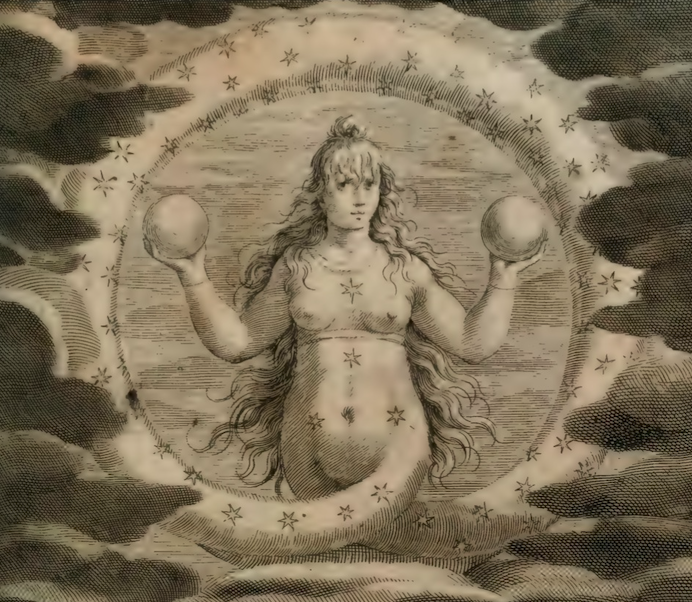
The ancient Egyptians saw earth as the mirror of the heavens. The sky goddess Nut is depicted, like Hapi of the Nile, holding two jugs that flow with the waters of creation/fertility.

Nut was the goddess of the sky and all heavenly bodies, a symbol of protecting the dead when they enter the afterlife. According to the Egyptians, during the day, the Egyptian decans would make their way across her body. Then, at dusk, they would be swallowed, pass through her belly during the night, and be reborn at dawn. She was often painted on the inside lid of the sarcophagus, protecting the deceased. The vaults of tombs were often painted dark blue with many stars as a representation of Nut. [Wikipedia]

Rosenwald sheet 15th c (National Gallery of Art)

In astrology the ‘big three’ of a natal (birth) chart are our Sun, Moon and Ascendant. The Sun indicates the time of year we’re born, energizing the present lifetime and our natural, outward expression of what we aspire to be this time around. The Moon shows time of the month (phase, day) and is indicative of the past and of our inner or nighttime realms – memory, dreams, soul lineage – what we bring with us, unconsciously. The Ascendant completes the picture with our precise moment of arrival/first breath. There is something very fated and acutely personal about this moment.

To the ancients, it was not so much the moment itself or even the rising sign, necessarily, but the star heralding or accompanying the Sun, as it rose on the day of birth (they didn’t have clocks) that was of prime importance. Stars on any angle or conjunct a luminary or planet are also significant, coming into play at different times during the course of a life. We could muse that this first star on the horizon is our navigational star, guiding us back to the ‘berth’.

Compass rose, France 1543 and sounding lead (for measuring depths), Marseille, 1st c

The TdM Star card is also interpreted as Venus, since she is symbolized with 8 points, but of course she can also have 5 (evening and morning star symbols). In the Tarocchi of ‘Mantegna’ print below, we find Venus in her river toilette (note the anagram, there), with her entourage of Eros and the Graces, looking suspiciously like the Star card figure. Meanwhile, in the unique, Leber-Rouen card, a witchy ‘Stella Maris’ looks like the wild twin of Botticelli’s serene goddess. (Might the cross/ankh around her neck have been an add-on?). 

‘Mantegna’ Venus and Leber-Roen Venusian, mid 15th c

Lodovico Lazzarelli, in his De Gentilium Deorum Imaginibus (trans. William O’Neal) described the first one:

Nude Venus swims forth from the midst of the natal wave of the sea, and the fair one holds a sea-shell in her right hand. For she divests lovers from extraordinary cares and affairs. Nude Venus calls nude bodies to herself Indeed the sea shell engages itself in sexual union within its own body. Passionate love is ship-wrecked by a sea of troubles.

The victor stands with his quiver of arrows, and he is swift on his wings. The nude boy Cupid stands with eyes covered. At one time he hurls down golden arrowheads from his bow and at another time lead ones, and each strikes the hearts of men with a different wound. The lead-tipped arrows drive love away but the golden-tipped bring it about. As hatred is strong so also love is dear. The nude boy loves the defenseless. Love with eyes covered does not know at whom he aims. He drags his prisoners through hard places. And those ignorant of every road wander off through lonely places The boy calls young men to his camp. Love marks out their unstable souls for his swift wings. He causes wounds hastened along by his quivers.

The Idalian nymphs, the fair and pleasing crowd of three, stand together with their bodies unclothed. They hold their arms together bound by interchanging bonds as often interchanging Love ties the bonds. The first holds the light of her countenance and her eyes toward us. The rest of her group sees us in her gentle eyes. First, Pasithea enraptures us in her gentle fires. Aglaia revives those taken in with her flattery. Euphrosyne entangles them in fetters and strong chains, and she does not permit her captives to go back. Then, Venus, pitying those mangled in such sorrows encourages them with her sweet enticements and flattery. Poets have treated these many things from the star of Venus which lovingly presides over the triple place of heaven. This constellation stands in the highest part of heaven with a triple name. Of course, it has always been said to be Venus.

Sounds a bit like alchemy-speak, no? Lead and gold-tipped arrows? I’m still pondering the arrangement of her four doves. Anyone?

In the Leber-Rouen card, our Stella Maris is of course Venus-Fortuna, for she holds in one hand a large arrow-cum-spindle, its quiver wound (with hair?). In the other, she grasps a lock of her windswept tresses. It bears a similarity to Lazzarelli’s description – she lures or navigates ships through shifting weather in the same, fated manner as Cupid sends forth his arrows.

Dame Fortune wielding a large arrow, French, 1403

Sailors were a superstitious lot. They believed women, being ‘wetter’ (ie, more lunar) than men had a special power over the sea. Medical writers like Pliny the Elder, in his Natural History (77 AD) declared, “For, in the first place, hailstorms, they say, whirlwinds, and lightening even, will be scared away by a woman uncovering her body while her monthly courses are upon her. The same, too, with all kinds of tempestuous weather; and out at sea, a storm may be lulled by a woman uncovering her body.”
Hence ancient goddesses, Isis in particular, but also the Stella Maris (‘Star of the Sea’, which could be Venus or any navigational star) became protector of ships at sea, and female figureheads were often bare-breasted.

The power of the jugs

Now, obviously I’ve focused only on the more cryptic Star cards, as mystery is what I find interesting, but there are just a few more worth an honourable mention, before wrapping up this essay. Their imagery, at first, may not seem to relate to our running theme, but let’s take a closer look…

Tarot of Paris early 1600s, Jacques Vieville 1650, ‘Mantegna Tarocchi’ Geometria 1460s

The third image is not a Star card but depicts one of the Liberal Arts inspiring these learned men: Geometry (‘to measure the earth’). Of all the Liberal Arts personified in the ‘Mantegna’, she is the only one floating in the sky above.
In the first card, the man sits at a drafting or reading table with books on it and holds the compass to his head, in thought. It’s hard to say whether he’s aware of the Star or whether it’s symbolic only, but divine, mathematical inspiration is being transmitted. I like to think of him as either an astrologer or an explorer creating maps.

Checkered floor of the alchemy lab

In the second card, the central Star and four little stars form a ‘quintessential’ arrangement. An astronomer/astrologer or mason (or alchemist) sits in contemplation or meditation before a cathedral-like building that has a clock or rose window in its bell tower. The division of the cosmos has now become a precision science, thanks to the sacred gadget. He appears to be measuring the heavens, but as in the Paris card, the compass almost seems to be a conduit and, held this way, it resembles the numeral V (5). The ground has a checkered pattern typical of masonry tiles and alchemists’ labs, but also resembling meridian lines of the earthly plain. Vieville or whoever created the the images for this deck was likely of the Rosicrucian Brotherhood. It’s just barely possible find a rose hidden under that red circle behind the figure’s head.

Like the Cary, in Vieville we find a 5th small star, this time in the clock/window face, connecting the above and the below. The Vieville Star card with its theme of enlightenment is in contrast to his Moon card, wherein an old woman sits spinning yard (and fate) under a tree, in the realm of night.

Geometry’s sacred tool.

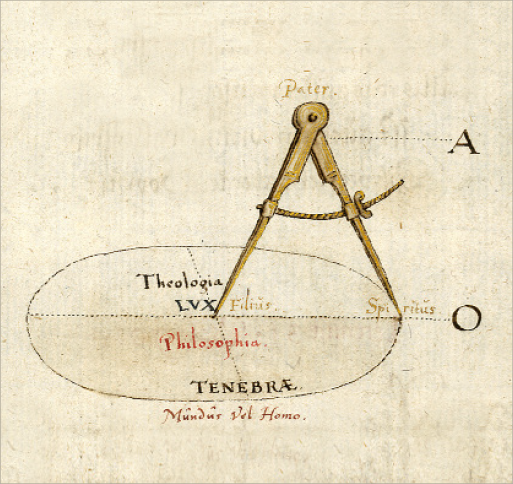
The compass (actually called a divider) was specifically created in order to measure the heavens (hence time), while the much older square was used for earthly structures. These were the two essential tools of the stone masons and still form the well-known, Freemason logo. Because it allowed for the concept of eternity/divinity (the monad) to be perfectly drawn, the compass became a symbol of man’s spirituality and higher nature.

“It is said that the compasses’ two points represent spirit and matter, life and form; from these all the complexities of the fleeting, ever-changing mantle of the one-life are produced within the circle, self-imposed by the Being who has decreed the bounds of His Universe or His System.” ~ Harold Bayley, The Lost Language of Symbolism

Thus in these two variations, another aspect of the Star is emphasized: human intellect (Mercury/Aquarius) or indeed wisdom as the vehicle for uniting Heaven and Earth.

God/Christ the Geometer creating the world soul, 13th c

The sacred tool bears a notable resemblance to a stork or crane, birds associated with birth/immortality (like crow and raven, they are interchangeable, symbolically). We all know the greeting card baby delivery propaganda, but it was once the belief in Ancient Greece that they actually stole infants, like Harpies. [Fun fact: vultures evolved from storks.] Hera’s wrath again – this time at some haughty Pygmy queen who’d just given birth to a son:

The other Pygmies brought many gifts for the newborn infant, but Hera, enraged that Gerana would not worship her, elongated her neck and turned her into a crane. Wishing to keep close to her child, Gerana as a crane would fly from roof to roof, but the people armed themselves and chased her away, and thus arose the rivalry between the Pygmies and cranes. [Wikipedia]

“I’m crushing your head!”

Nevertheless, the nesting of cranes/storks on one’s rooftop is generally considered auspicious. People sometimes placed old cartwheels on the roof, to help initiate nesting. (Interesting we have named the mechanical monsters of construction after them, due to the resemblance).
Indeed,  if we zoom in on the ‘Mantegna’ Geometria print, we find one of these very birds hunting in the river below….and it has caught a snake!

Master of the e-series, Ferrara, 1460s (MET)

From compass to compass, star to star, this concludes our sojourn of the 17th Triumph. Thank you for reading. To explore more articles on the Tarot de Marseille, simply type ‘TdM’ into the search, or scroll the Home page, where I list recent articles. ~rb

Related, excellent talk,  if you wish to go deeper:
How the Alchemists Meditated by alchemist Dennis William Hauck

All written content is copyright ©Roxanna Bikadoroff, except that which is in bold quotation (and meme). Please share via LINK only. You may include a short excerpt, but do not copy the article to your own site. Thanks for being respectful. Donations toward my continuing work are gratefully accepted.