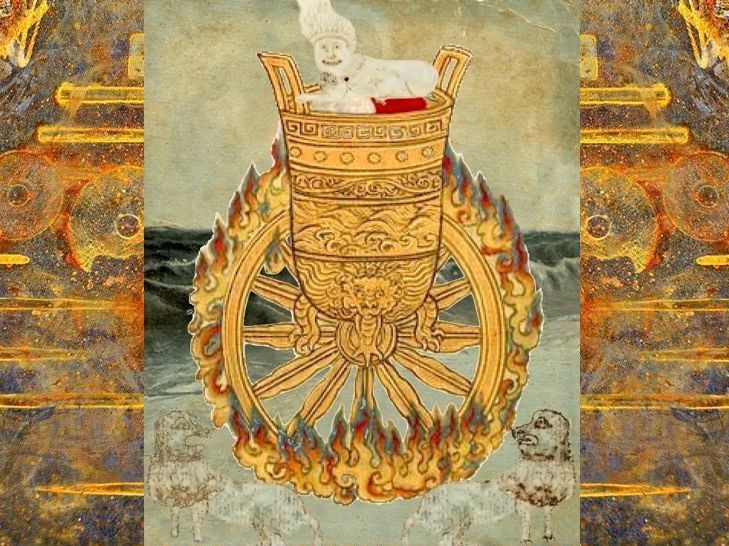
‘Festina Lente’ ~ Riding Tarot’s Hermetic Wheel of Fortune


Bless us, divine number, thou who generated gods and men! O holy, holy Tetractys, thou that containest the root and source of the eternally flowing creation! For the divine number begins with the profound, pure unity until it comes to the holy four; then it begets the mother of all, the all-comprising, all-bounding, the first-born, the never-swerving, the never-tiring holy ten, the keyholder of all.
~ prayer of the Pythagoreans to the ‘Mystic Tetrad’ [Wikipedia]
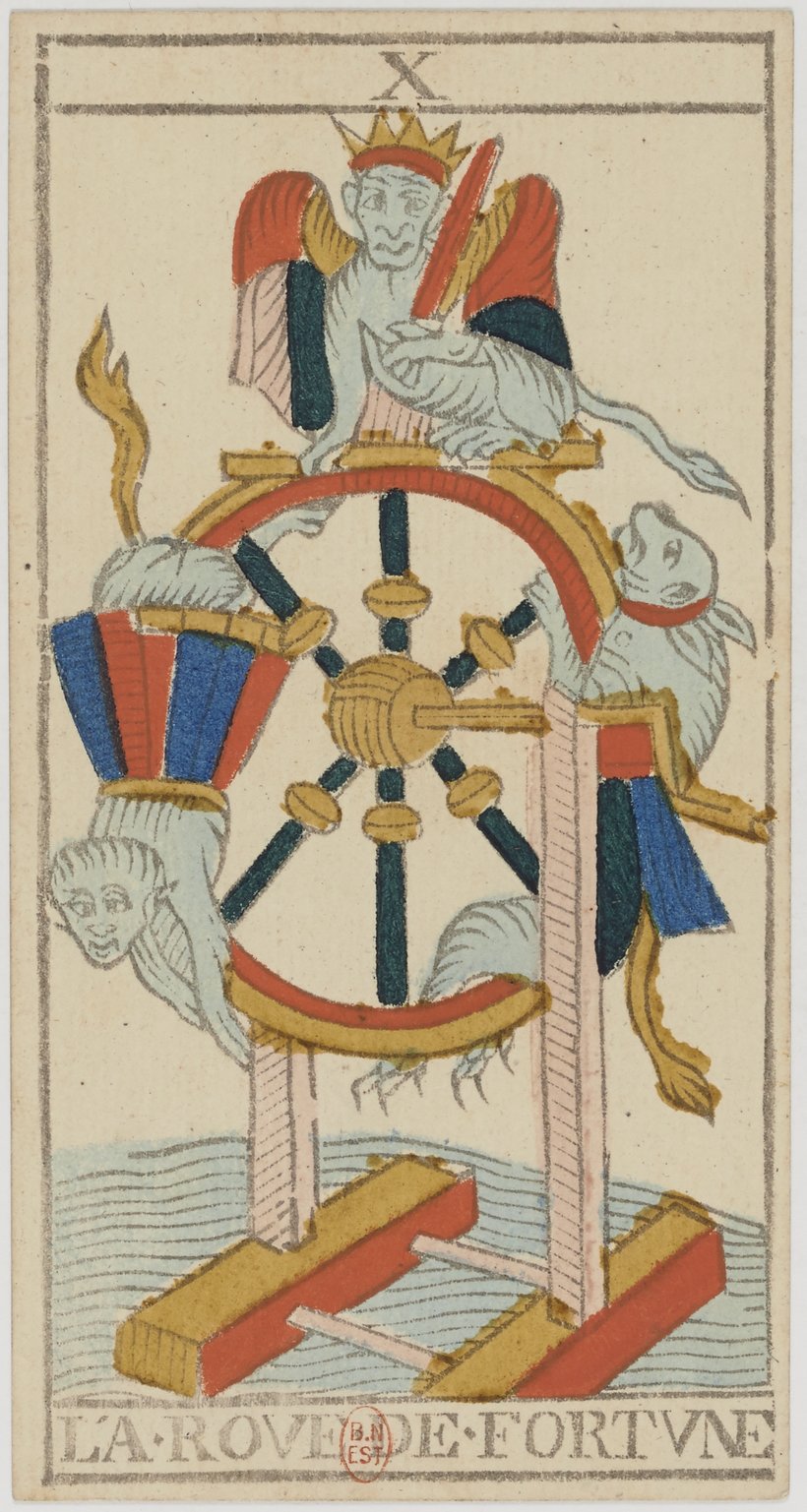
Nicholas Conver type II,  1760

Though it may appear comical, the importance of the triumph in tenth position is underlined by the reverence Pythagoreans paid to its number. To get a better grip on the Wheel of Fortune, it’s essential to understand it’s placement in the TdM numerical cycle, as it relates to the cosmology of  Pythagoras, famed philosopher-polymathematician (ca 570-495 BCE). The same cosmology was also the axiom of Maria the Jewess/Prophetess, famed alchemist-sage and inventor of the Bain-Marie and other alembics (ca 1st-3rd CE):

“One becomes Two, Two becomes Three,
and out of the Third comes the One as the Fourth.”
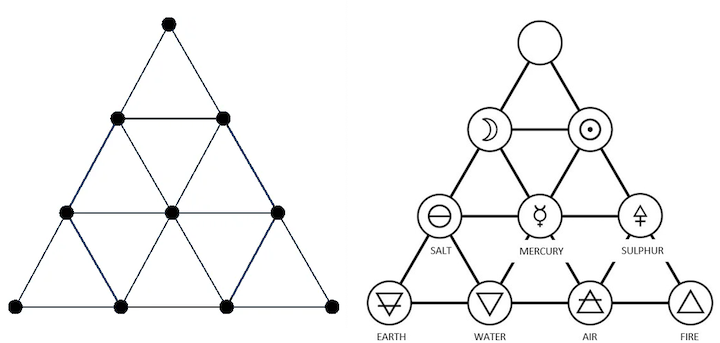
mathematical and alchemical versions of the same thing

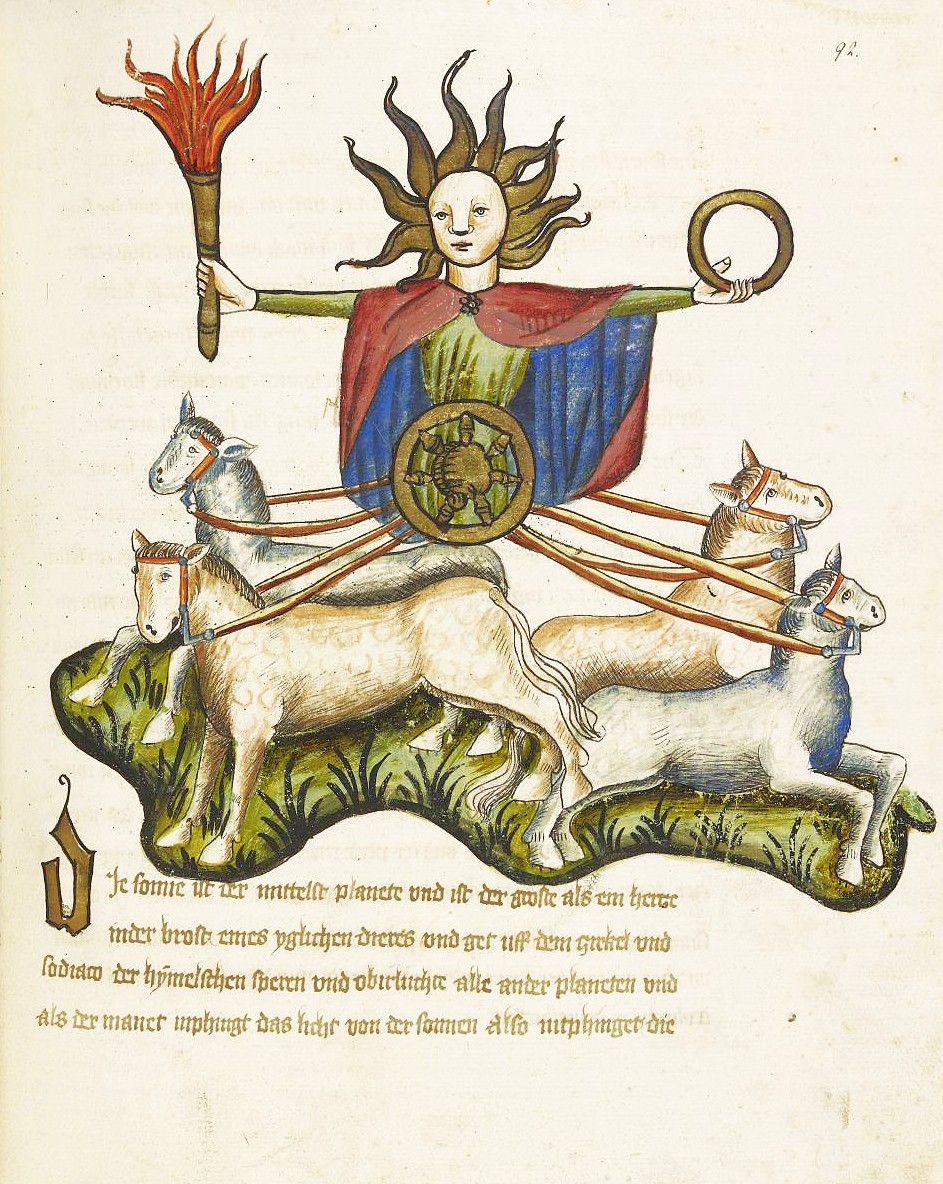
This simple formula, hidden in plain sight in triumph I, provides the foundational structure on which to then load our various interpretations; The Wheel of Fortune is both the first card of a three part cycle (10, 11, 12) as well as being the fourth card (the death) of the previous cycle (7, 8, 9). All the 1/4 cards indicate both initiation and completion – ie, change. They are always masc/solar (see below). Wheels are typically a solar symbol, and besides including the Sun itself, the 1/4 series contains the two triumph cards with wheels (7 and 10). Notice all the cards between 1 and 19 have crowns in them – another solar symbol – and that the the Wheel is central.
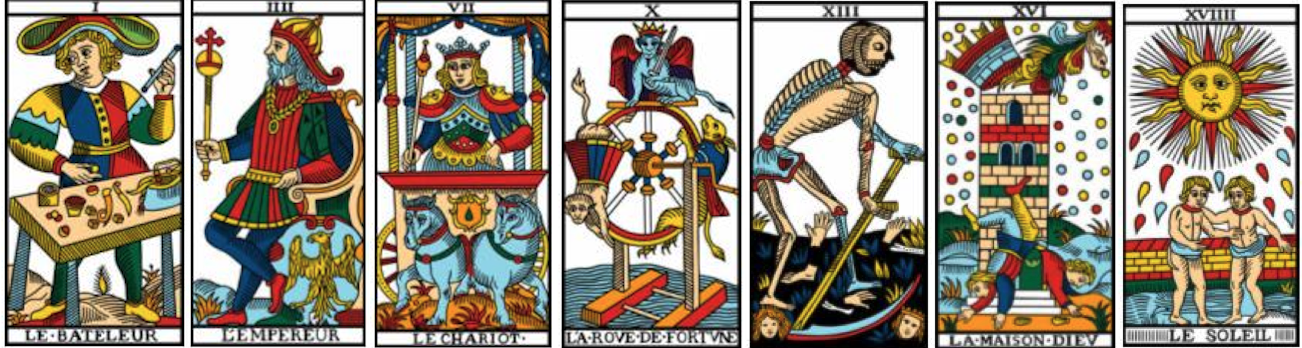
Cards in the 1/4 placements [Camoin-Jodorowsky deck]
German astronomical illustration of the Sun, 1445. How many cards from the 1/4 series do you see represented?

With 10, the perfect, complete number, ‘the great work’ (ie, the soul’s work) may now commence. 9 was the number of endings and of memory (Mnemosyne), of reflected, inner light. Similar to the Emperor, the old Hermit turns toward the past, drawing the numerological cycle to a close. We might imagine a shadow puppet play of life highlights projected onto the inside of his curtain-like cloak.
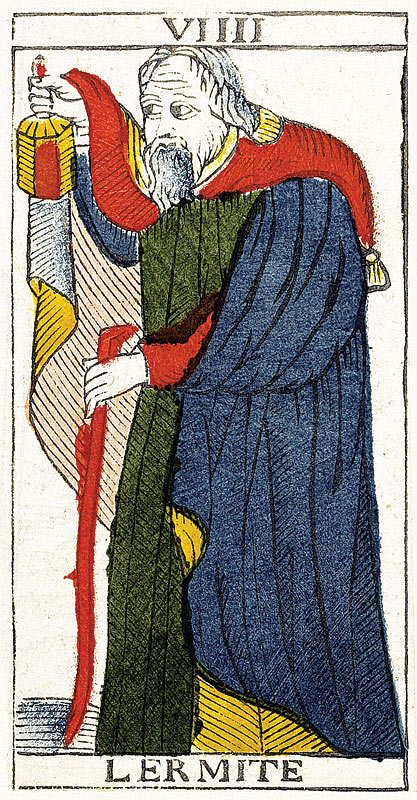
Pierre Madenié, 1709

Mathematically, 9 always returns to itself. The Pythagoreans were not enamoured with 9, but understood its importance as the first square (3×3) and for its role in human gestation, relating to the 9 spheres a soul transited before rebirth. More about the Hermit and his lamp here.

Pythagoras himself had been initiated into the Orphic Mysteries, among others, ’tis said. He believed in and taught metempsychosis (reincarnation), and that mathematical principals – numbers – are universal, guiding principals.
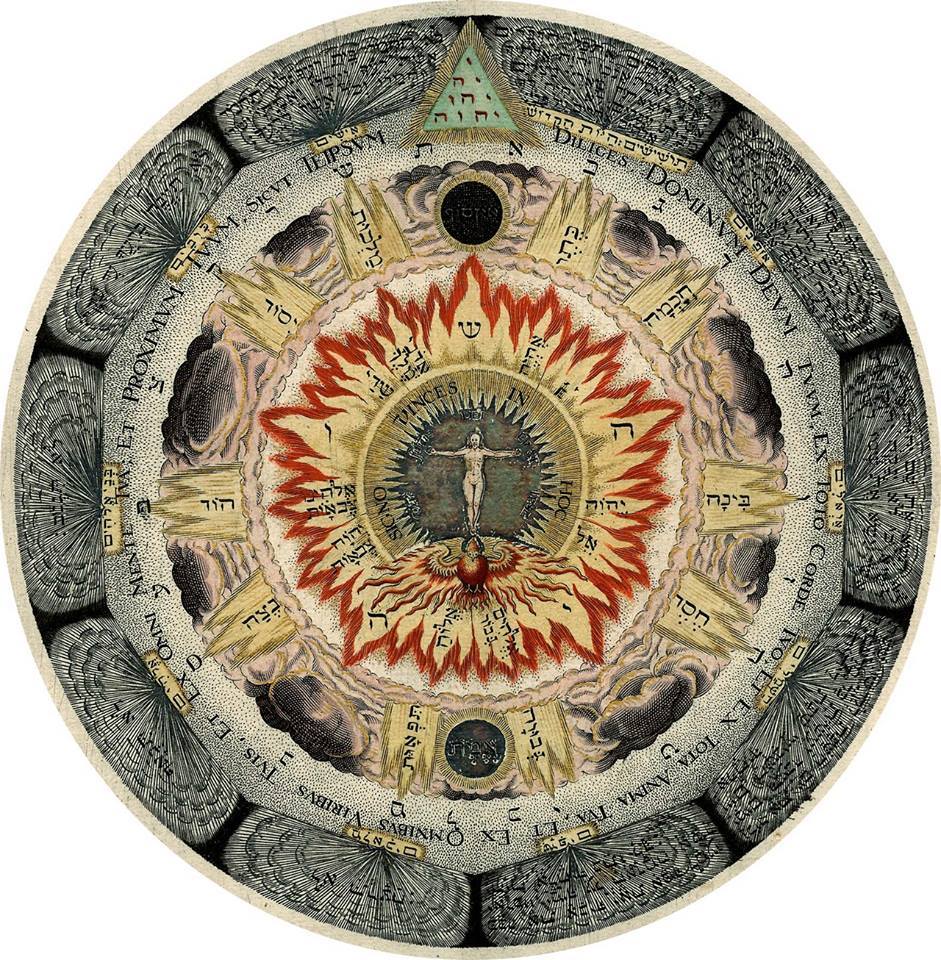
Alchemical etching from the ‘Amphitheatrum Sapientiae Aeternae’ by Heinrich Khunrath, Hamburg, 1595

10 is the ‘higher octave’ of 1. To Pythagoreans and alchemists alike, 1 was not actually a number (it could not be ‘numbered’ and anything multiplied or divided by 1 was still the same), but represented the Monad (God, origin, unity), symbolized by a circle with a central dot or eye. This is still the symbol for both the Sun and gold. Wheels are essentially monad shaped. [Note: They did not use or accept 0 as a number.].
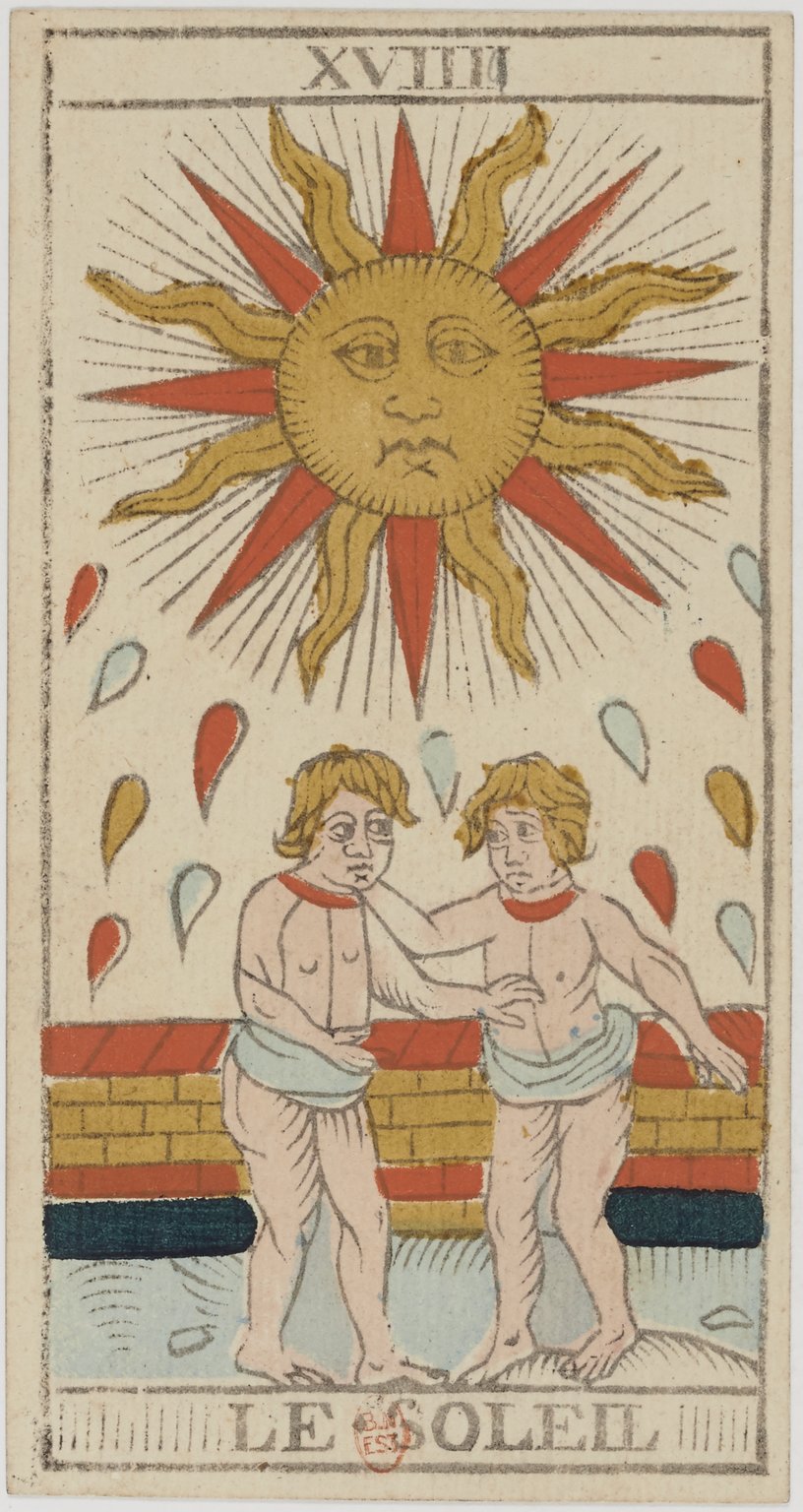
Conver type II, 1760

The next card after 10 that reduces to 1 when the digits are added together is 19, the actual Sun. There is no 4 in this last, seventh cycle of 3, unless we include Le Mat as 22. While ‘Pythagorean’ numerology considers 22 to be the ‘master builder’ (aka god), the man himself did not specifically mention this. However, what’s very interesting indeed is that the ratio of 22/7 was used by Archimedes to approximate pi. Thus by adding Le Mat as a 22nd triumph, division by 7 no longer gives us 3, the trinity, but pi, which is ‘never-ending.’

“Numbers are the Highest Degree of knowledge. They are knowledge themselves.” ~ Plato
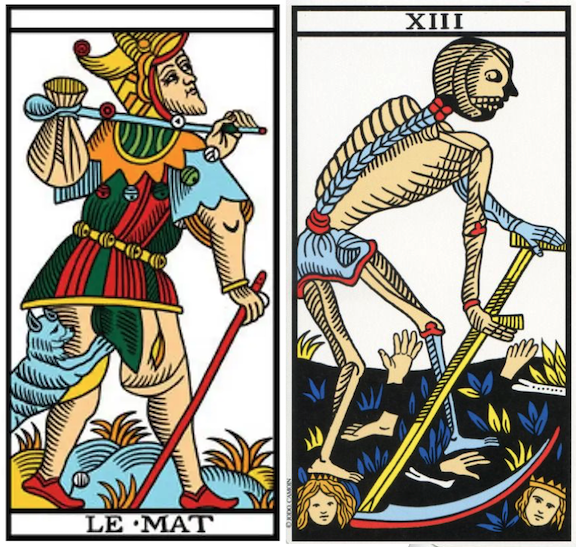
The infinite and the eternal? Camoin-Jodo Conver type II, 1997

The process of destruction and purification by fire and water prior to what will be rebirth in 19, 20, 21 begins with this most sacred number of the Pythagoreans because, where unity and wholeness is the ultimate intent of the work, God/the Divine must be invoked.

Alright, math class dismissed, time for art, myth and philosophy…

The Marseille Roue de Fortune card is a bit of a visual conundrum. The parts don’t quite fit together and though the creatures on it appear to be in motion (at least, the ones on either side do), nobody’s turning the handle. The base, which resembles a section of ladder, stands on water. Is it a water wheel? Maybe this rota cannot be fully understood literally, but is another riddle asking to be read as a composite of its parts.

I won’t go into the entire history of Fortuna’s Wheel, or ‘wheel’ be here all day, but one, particular detail in the Marseille version is what got my wheels in motion: at some point in the card’s r-evolution (perhaps simultaneously, in different traditions), the creature on the left transitions into a flaming pot.
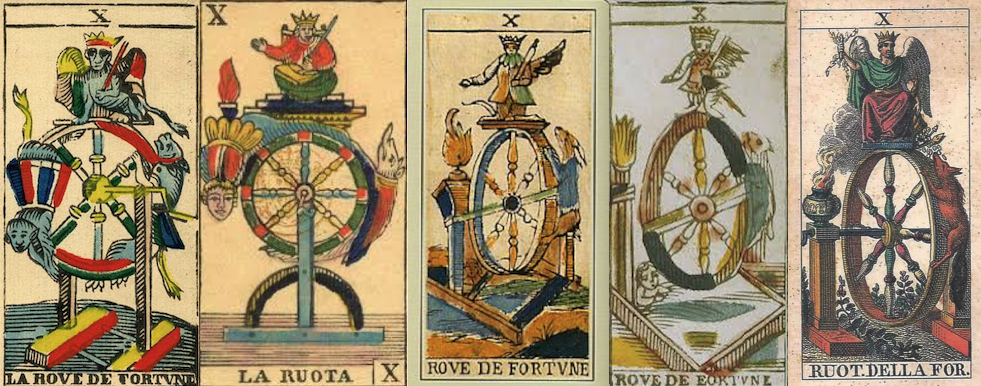
This has been dismissed as misinterpretation of worn away plates by printers who, (correctly) interpreting the tail as a flame, figured the Wheel should be equip with an altar or censer with which the passing of earthly existence into smoke was symbolized. (And now it does resemble an Arabic ’10’).

One possible precedent is in images of Ixion, where the wheel Zeus binds him to is being lit with a torch, although, there are plenty of mythical, flaming wheels (and altar pots) to choose from. Ours is not Ixion’s wheel per se, but maybe the flame is mnemonic of it. Ixion, having killed a kinsman and twice flagrantly violated the sacred law of Xenia, was denied the cathartic rituals that would cleanse him of his guilt, and, under Zeus’ orders was bound by Hermes to a fiery solar wheel for eternity [either rolling across the sky or stationary, down in Tartarus]. At this point in the game, there are two options; change or be stuck on repeat forever.
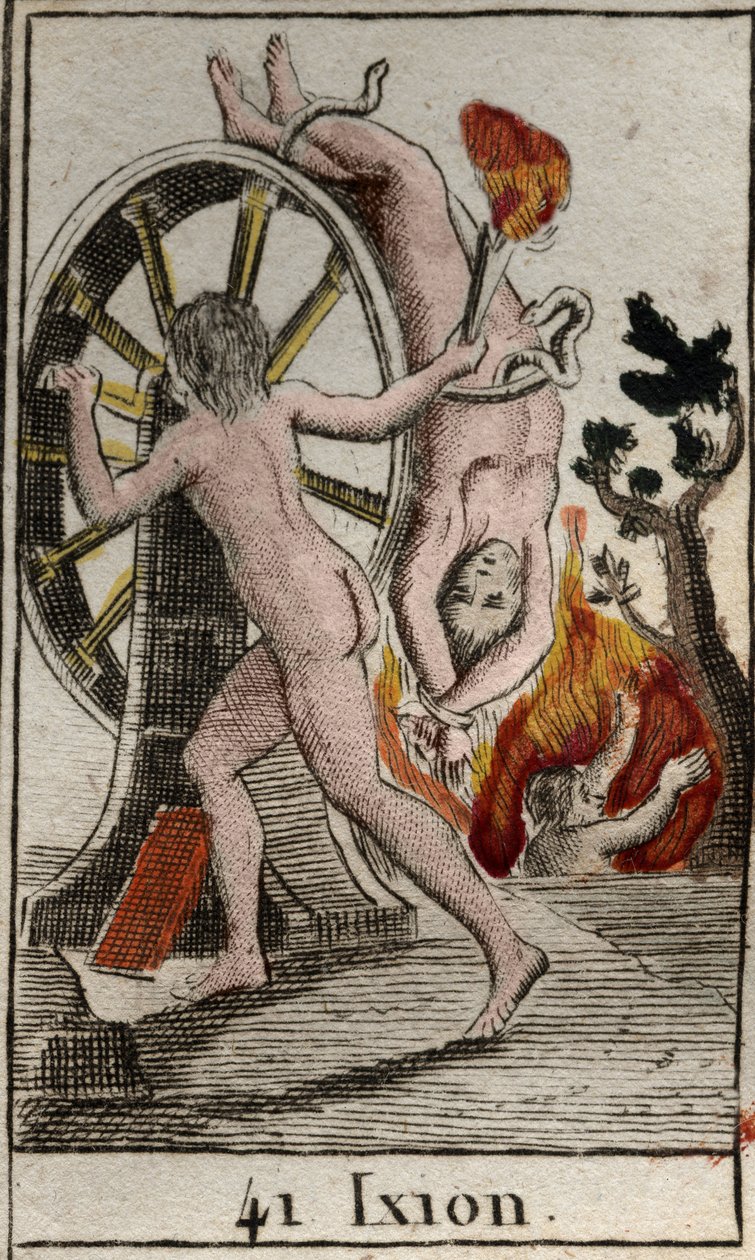
Ixion about to be lit, from ‘Mythologie de la jeunesse’, 1803

The Wheel’s stand can elude to a couple of things; like the Hanged Man’s gibbet, it might suggest a gateway, recalling the dokana of the Dioscuri (even shaped like the Gemini sign, a prelude to the twins in 19).
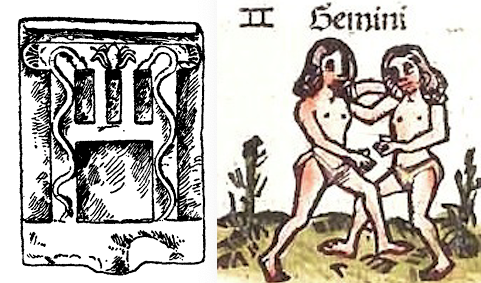
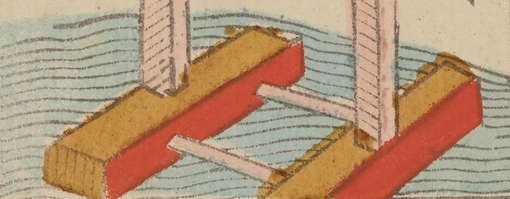
Dokana symbol and Gemini

It could also indicate that ‘the initiate’ has now made it this far on the scale philosophorum (philosopher’s ladder of mystical ascention), which will later appear atop the wall in 19. The two bars form the Arabic numeral 11, and/or the Roman numeral II, recalling “one becomes two…” Double digits begin here and the images start to reflect this. 10, with this design element, seeds 11 (La Force), situated exactly in the middle, a threshold with ten numbered cards on either side. The formidable lion-wrestling mistress is partner to the Le Bateleur.
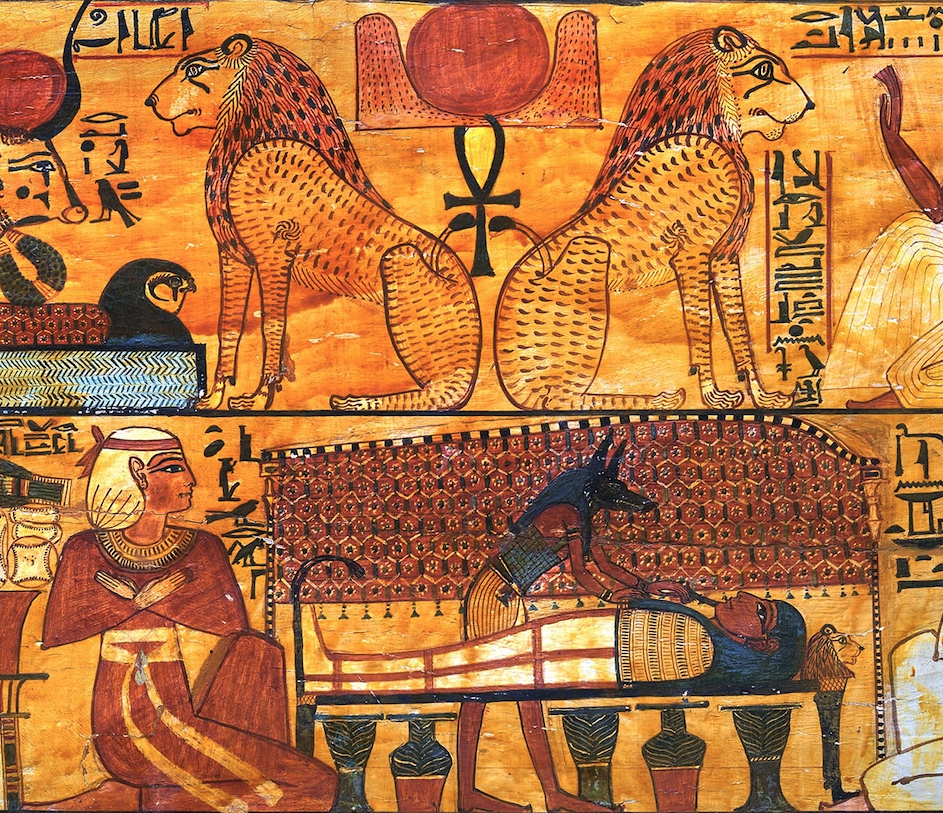
Lions of yesterday and tomorrow (eastern and western horizons), with the eternal in the middle, hieroglyph for ‘the horizon.’

The ‘foreparts of a lion’, seen here at the head of the embalming table, is the hieroglyph for ‘strength’, and is featured in the Strength card.

We might also imagine the Wheel as metaphorically representing the Sun above the watery horizon and the beings on either side as ‘yesterday’ and ‘tomorrow’’ – traditionally, ‘I have reigned’, and ‘I shall reign’ – with the top middle one as the present, ‘I reign’. Instead of a fourth on the bottom (usually an old, impoverished figure) there is a gateway to watery rebirth.
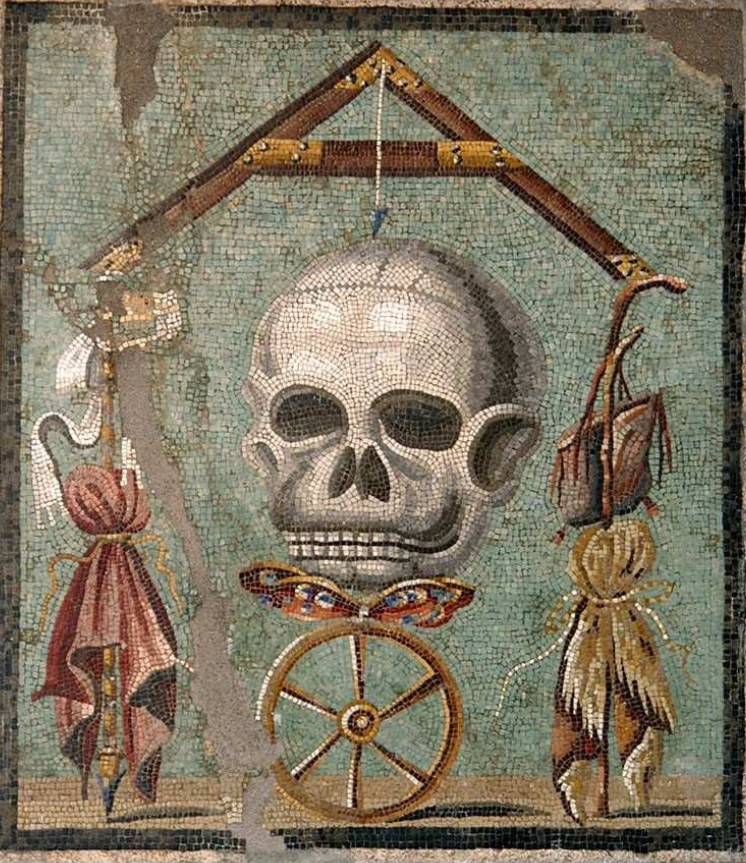
Memento Mori mosaic, in the Museo archeologico Nazionale di Napoli, 1st c

In this iconic ‘memento mori’ Roman mosaic from Pompeii, a simian skull is balanced atop a butterfly on a wheel. Above, a square level’s plumb bob is just touching it, the tool balanced atop two staffs, hung with the garbs of rich and poor. All are equalized in death, all are subject to Fortune’s whims. The mosaic was part of a banquet table, where Romans often practiced ‘carpe diem’, remembering their death tomorrow by partying today. The butterfly represents the immortal soul (Psyche). Butterfly, torch (especially going out or pointed downward), plumb line, fortune wheel, urn and of course skull/skeleton were all symbols of death, typical of the Roman ‘carpe diem’ motif.
[The tradition of death symbolism is also recurrent in Freemasonry. Masons practice reflecting on their mortality at every turn. The plumb represents death as well as the upright, balanced life and is a common,  gravestone motif.]
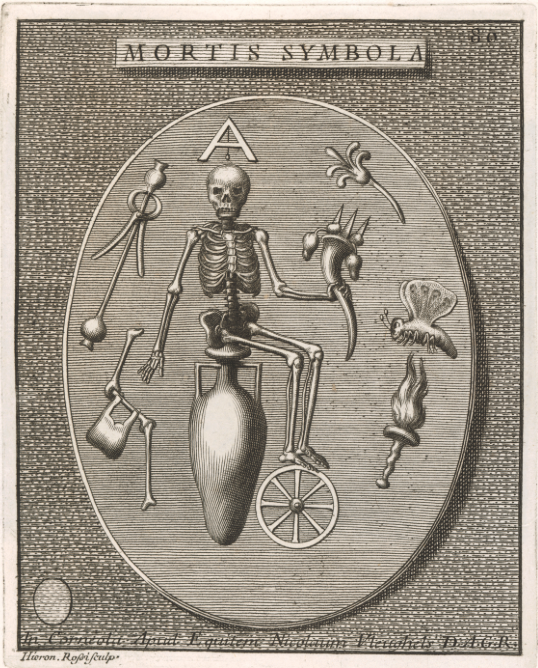
Roman symbols of Death

The explanation usually given for the monkey skull in the Roman mosaic is that cremation practices of the day had left the artist without a human one to refer to, but this ignores the fact that monkeys/apes were often used to parody humans. The memento mori theme was very popular and there is more than sufficient proof that artists of the day knew how to depict human skulls. An artist could easily have improvised the bone structure from a living human.
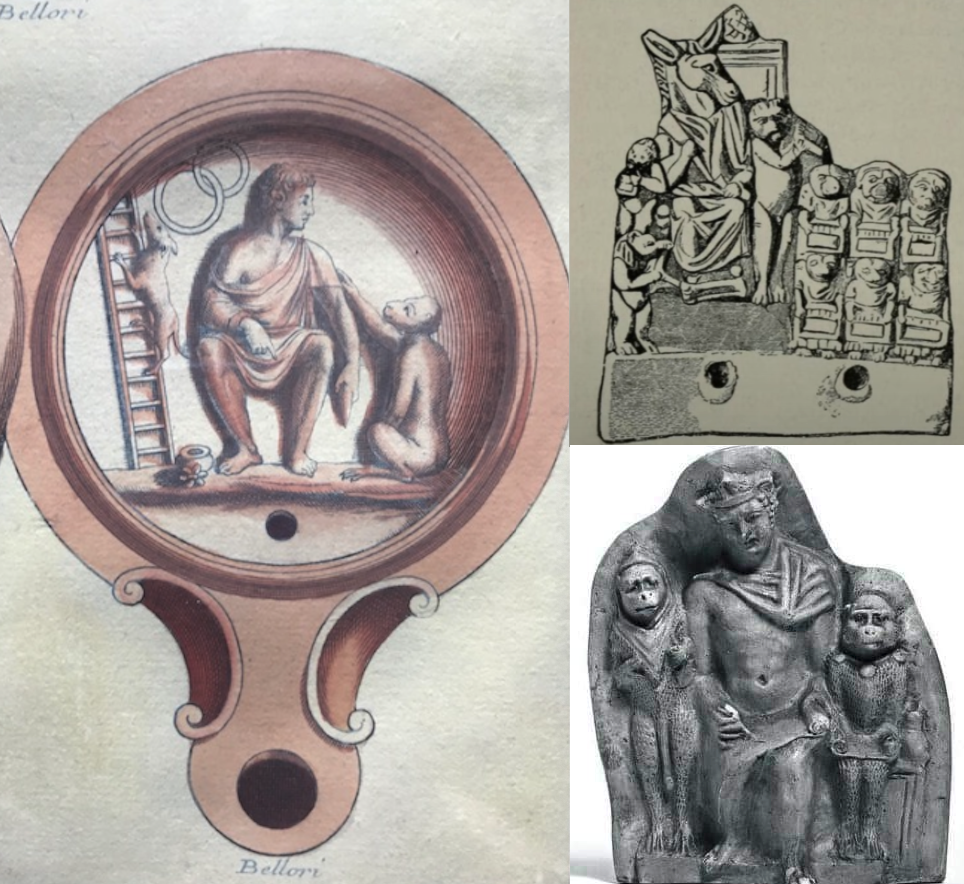
Lamp showing a juggler with monkey and dog (Carthage 1st c), Terracotta plaque (S. Italy, 1st c), Hermes seated between two baboons (Egypt, 3rd c BC, British Museum)

The little creatures on the TdM Wheel also seem to be parodying fearful humans stuck on the mortal coil, immediately following the card of remembering. Regrets…I’ve had a few…
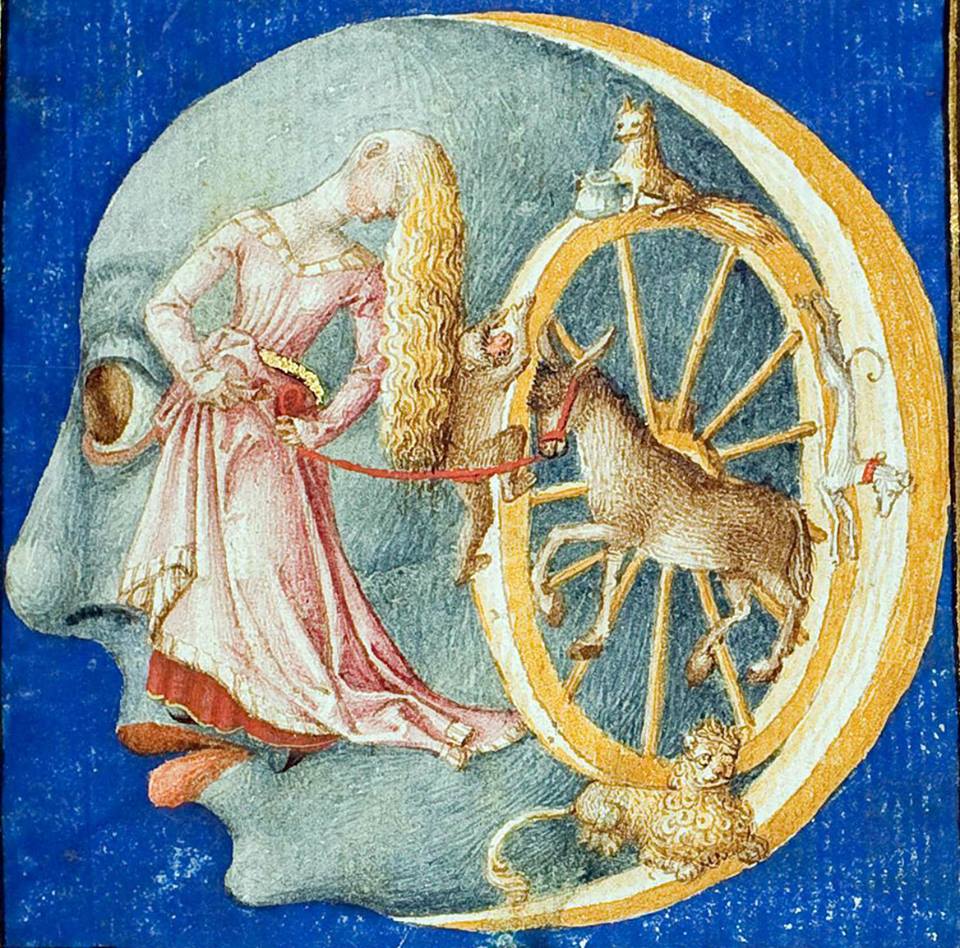
A Lunar Wheel of Fortune or Fate being turned by an ass, Hekate’s familiar. The woman’s hair-do is similar to that of Kairos (‘critical timing’), she might be the Roman equivalent, Occasio, who was female.

It would seem the tail of the simian-looking creature on the left side of the card was always intended to resemble a flame, both to illustrate the fire element, and to suggest that being turned on the wheel is akin to being ‘cooked.’ Perhaps there is nobody turning the handle because, as with the Chariot, which is not physically moving, there is no outer influence, the change is happening inside. Either we turn our own wheel or invite “fate” to do it – an outer expression whereby things seem to randomly happen to us (wheel of karma). The ‘winged’ Mercurial being at the apex might be symbolic of will, overseeing  the process, making sure the pace is natural and steady, that an even temperature is maintained. 

“Its purpose is constant digestion. Within its womb, substances are subjected not to violent flames but to the slow and merciful fire – ignis temperatus that mimics the warmth of the earth’s own generative belly. There, in that tranquil inferno, base substances soften, combine, and refine, until that which was profane begins its ascent toward the sacred. This is no vulgar boiling, but a sacred gestation.” ~ Universal Co-Masonry FB post, regarding the Athanor (alchemical furnace).
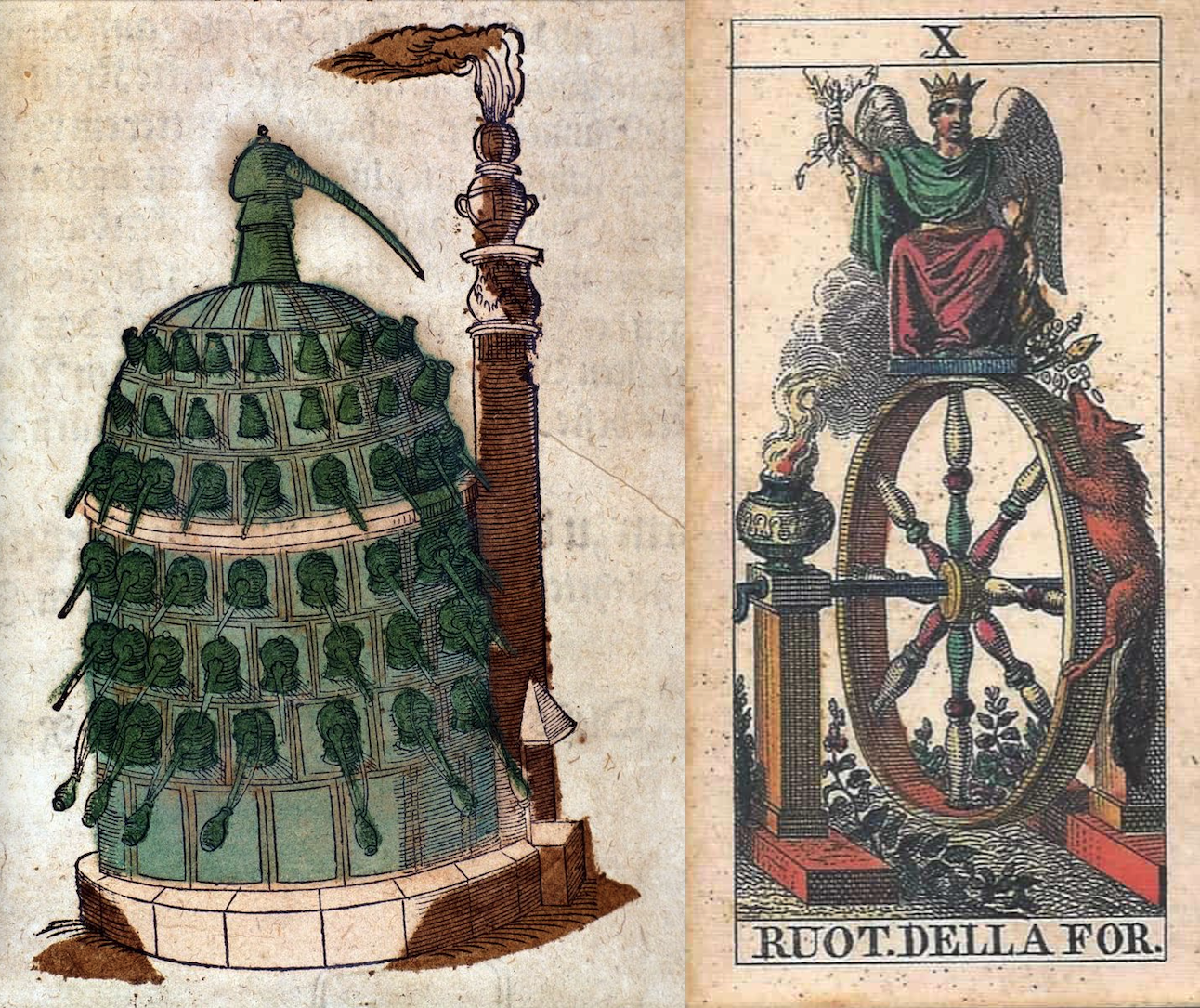
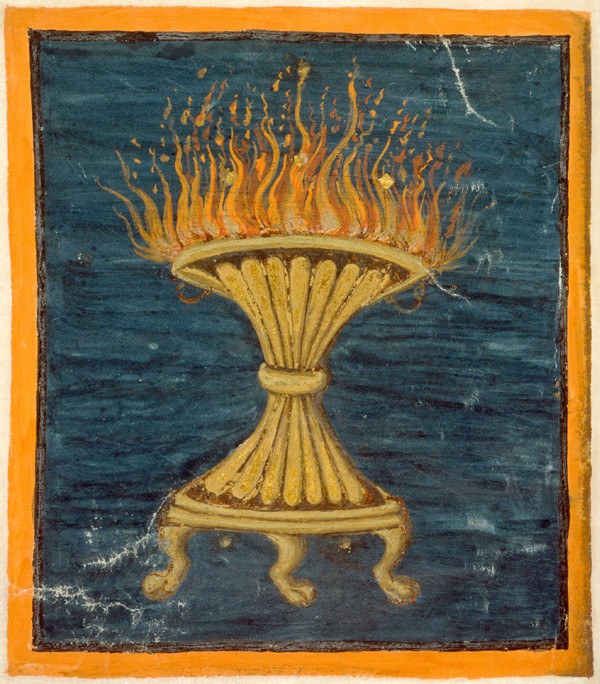
Athanor and Soprafino Wheel, 1835

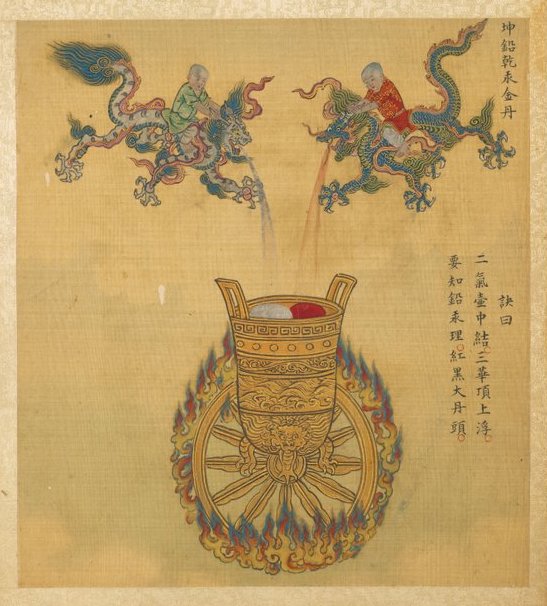
Above, with a suitable Tarot card for comparison, is the image that finally unlocked this card’s cryptic meaning for me. It is of an alchemist’s ‘athanor’, which is a self-feeding, clay furnace designed to maintain a steady temperature. Although etymologically unrelated (it comes from Arabic at-tannūr, “the baker’s oven”), ‘athanor’ oddly enough contains the Latin word ‘rota’ in it (albeit spelled backwards). Note the familiar design of the heat-release valve.

“The athanor’s design further symbolizes the unity of the macrocosm and microcosm through its correspondence to the four classical elements, integrating them into a harmonious whole; Fire represents the transformative heat in the lower chamber, Earth the stable structure, Air the circulating vents, and water the surrounding baths, collectively mirroring the alchemist’s inner equilibrium and the cosmic order. This elemental interplay underscores the Hermetic principle of “as above, so below,” where the furnace’s operations reflect the soul’s alignment with universal forces.” [Grokipedia…forgive me!]

Qing Dynasty Chinese School Taoist Alchemy

In fact, the alchemists did use the term ‘wheel’ (rota) as a metaphor for the cyclical nature of their art. The stages were not linear, but continuous – the end could also be the beginning, just as in nature.

The three figures on the TdM Wheel might represent the 3 philosophical elements – left, sulphur (soul/emotions/desires), right, salt (body), and top, mercury (spirit/imagination/moral judgement/higher mental faculties). The salt/body fellow has ass ears, which typically are a sign of ignorance (think Pinocchio) but also, again, possibly suggestive of Hekate, triplicate Goddess of the crossroads and occasional consort of Hermes (aka Mercurius) or Hermanubis. As supreme navigator of liminal spaces, her torch burned with the sacred solar fire of Helios. 

“O Sun our lord and sacred fire, the spear of Hekate of the roads, which she carries as she attends her mistress in the sky and as she inhabits the sacred crossroads of the earth, crowned with oak-leaves and the woven coils of savage dragons!”

~ fragment of a hymn to Helios and Hekate from the play Rhizotomoi (Root-Cutters) by the Greek tragedian, Sophocles [Loeb Classical Library].
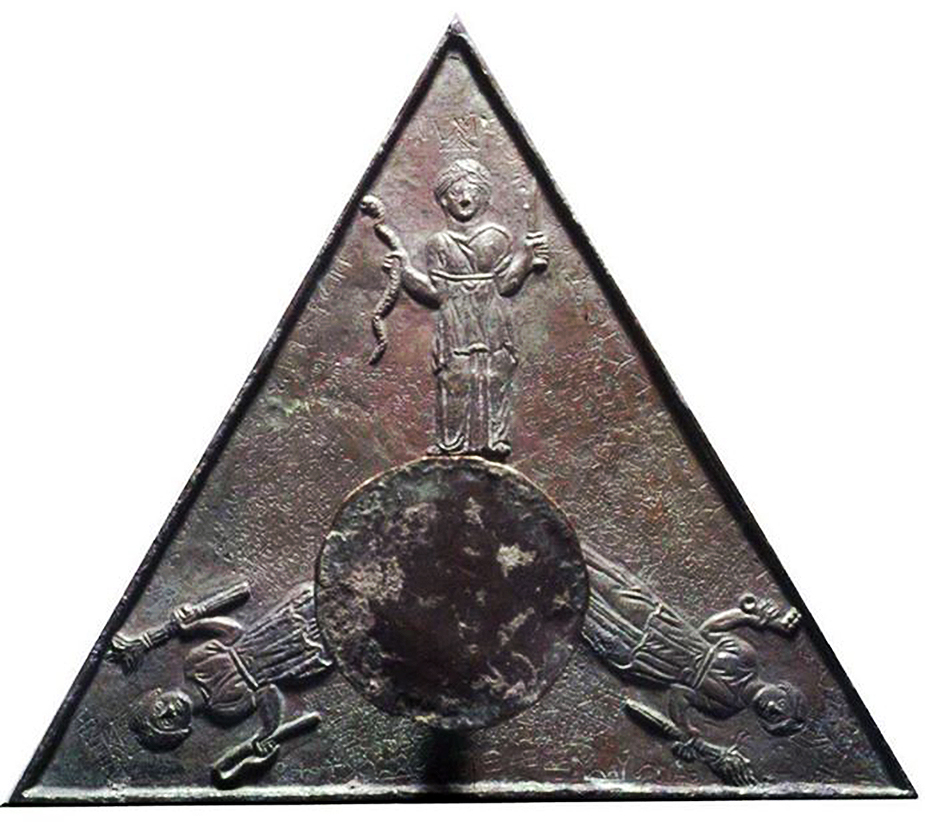
Goddess Hekate in magical plate from ancient Pergamon, Anatolia [Berlin Museum]
All 4 classical elements, too, are present:

AIR (sword pointed up, wing-like cape)
FIRE (flame-like tail pointed up)
WATER (below)
EARTH (vine or snake-like tail pointed down)

4 classical + 3 philosophical elements = 7.

In both type I and II, the number of spokes appears to be 6 (or three divided), but notice that a seventh is also formed by the Wheel’s handle. Clever. Seven elements, planets, metals and stages.

Addendum: The 6 spoked Wheel can also be read as the Labarum symbol (solar) adopted by Christian iconography, which is nevertheless based on the idea of “inverse directions…one of which is like a reflection or mirror image the other” – ie, ‘as above, so below’ – similar to Solomon’s seal. [René Guénon, Symbols of Analogy, via Wikipedia]
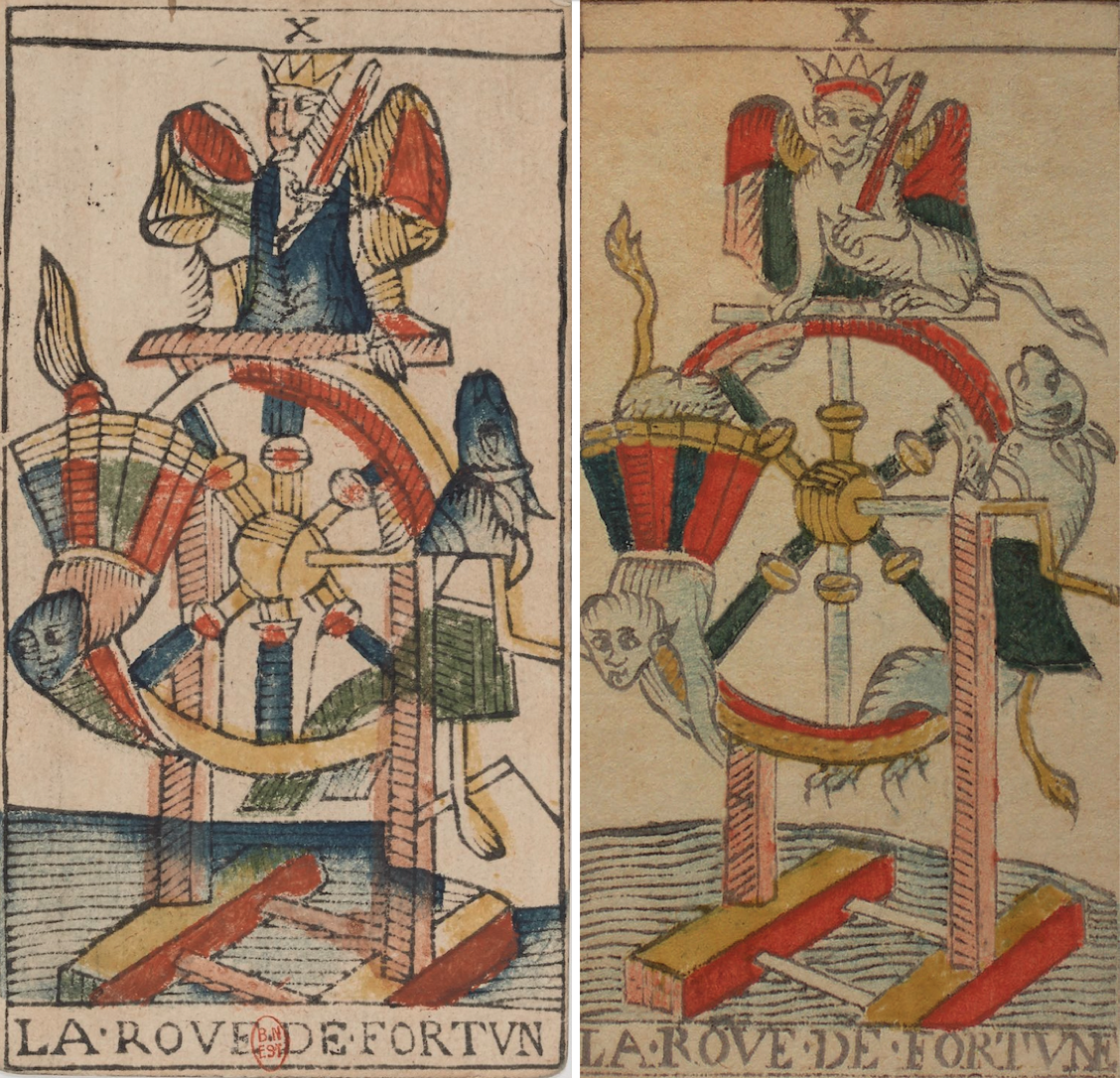
Dodal type I (ca 1701-15) and Chausson type II (1672)

The hub of the Wheel is divided into 3 sections, and resembles a lunar-solar combination – navigation of liminal spaces as we progress toward unity.

That the flaming tail was turned into an altar pot/censor doesn’t change the intrinsic meaning and actually alludes more strongly to the alchemical cooking process. The water below suggests ‘a slow, gentle cooking’, akin to that of the Bain Marie. Similar to the gentle turning of a wheel, the contents of a cooking pot or cauldron is stirred in a slow, spiralling motion. In Shakespeare’s tragic play of alchemy gone backwards, MacBeth, the Wyrd Sisters famous chant, ‘Double double, toil and trouble,’ is a reference to ‘the work.’ Originally, the old English word ‘wyrd’ (which became ‘weird’) meant  ‘fate’ or ‘destiny.’
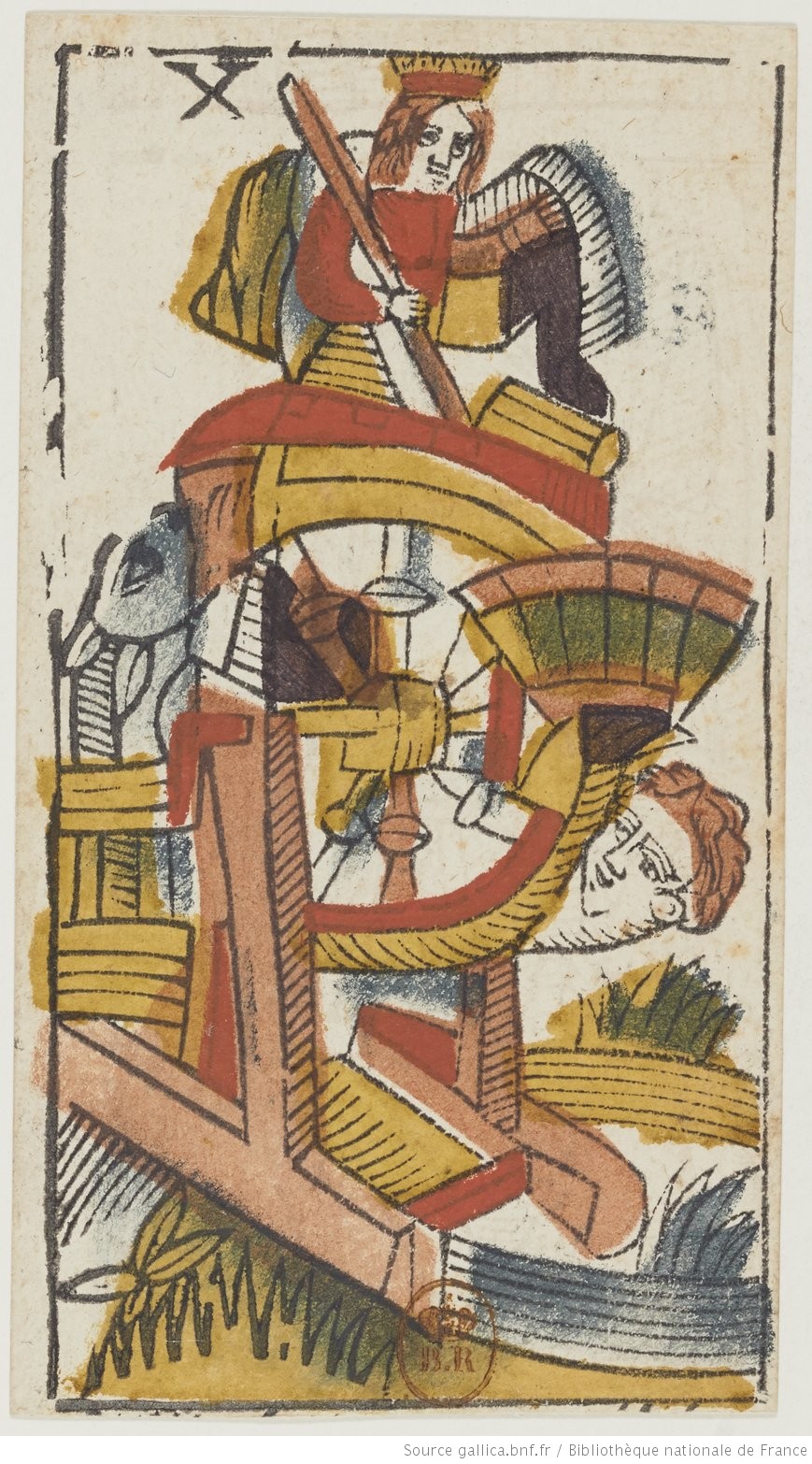
Jacques Vieville 1650

The Vieville card does not show any flame on the side, but rather, some suspiciously fiery-looking, yellow grass, below, possibly suggesting the pool of water is being heated from beneath. But the shape of the fire being’s skirt is consistent across TdM decks. It bears a similarity to the shape of constellation Ara, the altar on which sacrifices to Zeus were made, and is reminiscent of the Emperor’s skirt  (‘I have reigned’). The Wheel of Fortune was also an attribute of Zeus, god of optimists and gamblers. By ‘letting go and letting God’, we sacrifice our dross to the pyre, turning fate to faith. Remember Pythagoras’ holy number 10.

Ara constellation, Roman

Apollo, though one of the great gods of Olympus, is yet represented in some sort of dependence on Zeus, who is regarded as the source of the powers exercised by his son. [Theoi.com]

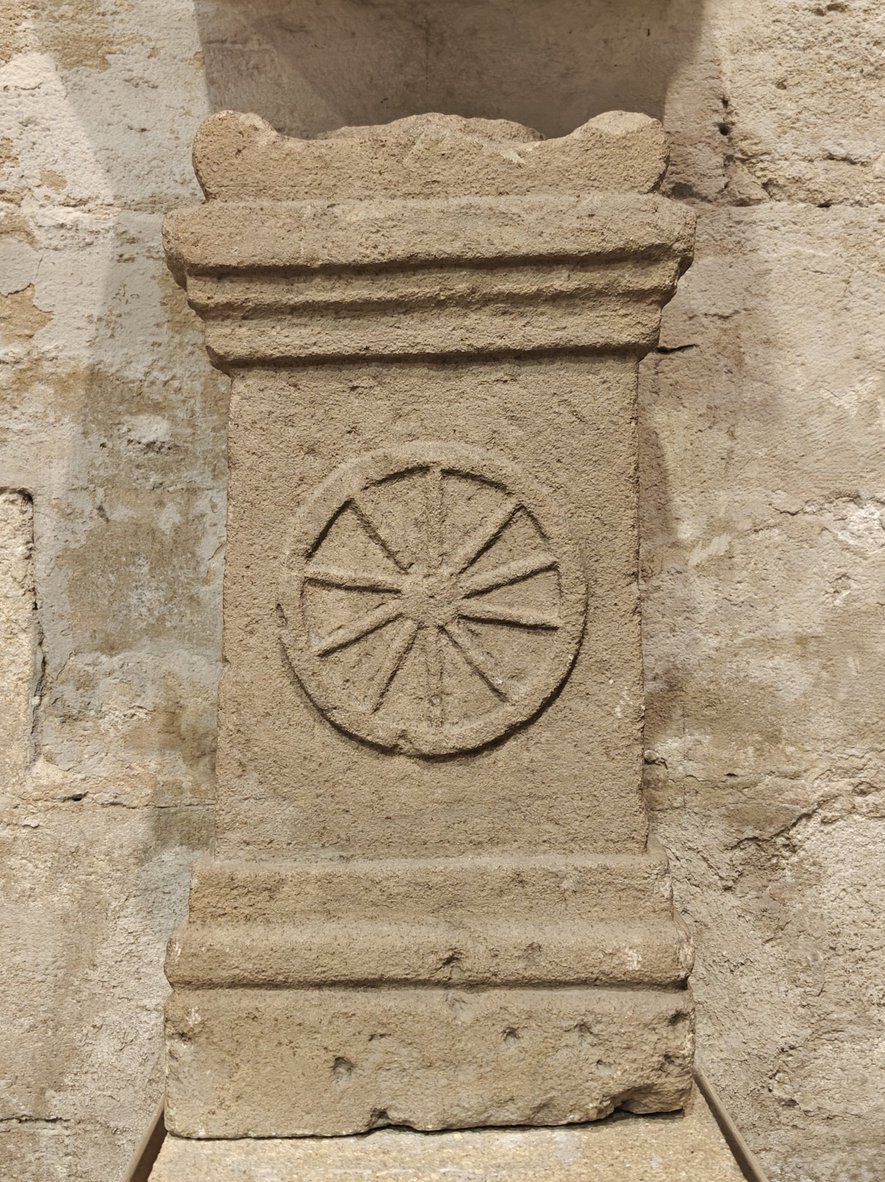
Jupiter (Zeus) altar featuring a 10-spoked wheel, the number of months in a Roman year.

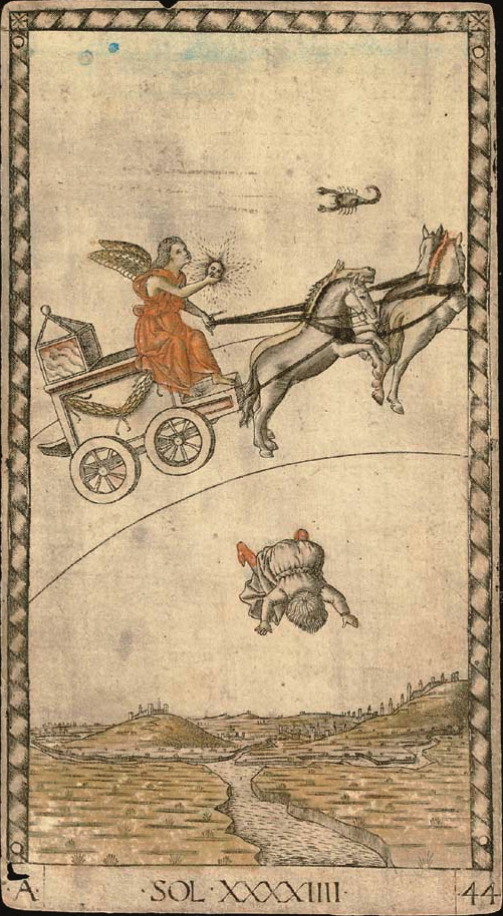
Helios, a Titan, was the Sun personified, later identified with Olympian Apollo, god of light and prophecy. The sad myth of Phaethon – the son of Helios who insisted he could drive his father’s chariot, but lost control of the horses and fell to his death – can, in the mythoalchemical sense, be equated with ‘the work’ being scorched by impatience (or hubris) or halted by negligence (or ignorance).

Tarocchi of Mantegna Sun, featuring the myth of Phaethon, 1465

The meaning of the Latin phrase Festina lente (‘make haste slowly’), is that activities should be performed with a proper balance of urgency and diligence. If tasks are rushed too quickly then mistakes are made and good, long-term results are not achieved. Work is best done in a state of flow in which one is fully engaged by the task and there is no sense of time passing. In this way we are in harmony with nature. ~rb

“Thus, let the Athanor burn–not with haste, but with faith–and may its light ever guide the hand and the heart of the true seeker.”
~ Universal Co-Masonry, ibid
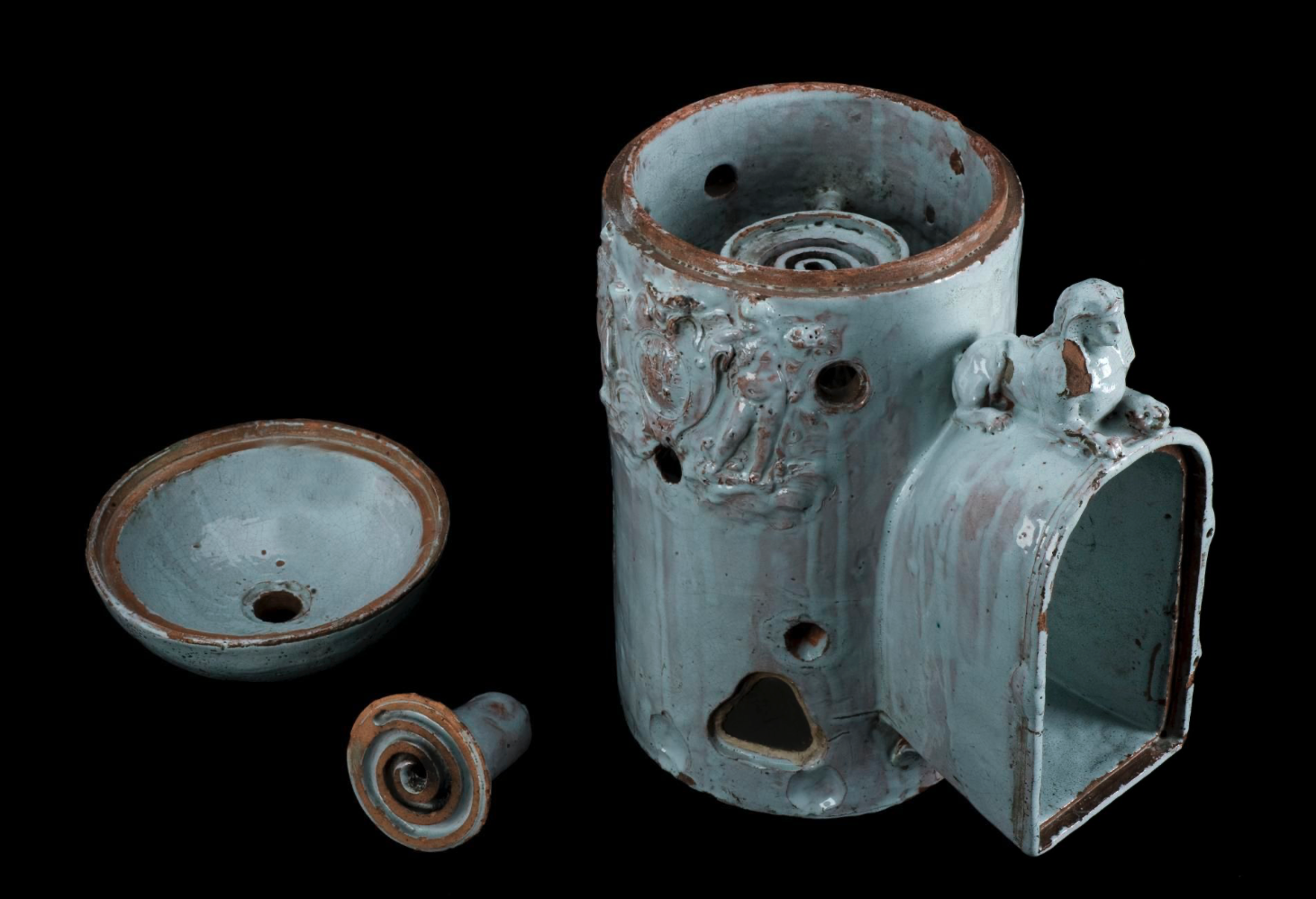
Alchemist’s athanor (top removed), stoneware, German, 1501-1700

All written content, besides quotations, is ©ROXANNA BIKADOROFF and may not be reprinted for republished in full without my permission. Kindly share via LINK only, which helps direct traffic here. If you wish to use a short pull quote, please include a credit (and link).

Strange Fish – Reflecting On the Hanged Man/Le Pendu of Tarot de Marseille

The Hanged Man/Le Pendu

The Hanged Man/Le Pendu is surely among the most disturbing and evocative of the Tarot triumphs. He’s undergoing torture, but seems unwilling to reveal anything about his inner experience (I almost titled this piece, “We have ways of making you talk,” but this is now the title of some TV series). As it turns out he’s got a LOT to communicate to those who have crossed the threshold (XI) of Tarot’s ‘greater mysteries.’ Think of him as the babbling head of Orpheus. So let’s dive in, head first and dissect this frightful, human pendu-lum from toe to head; his mytho-alchemy, number symbolism, religious/cult connotations and more!

Charles VI Tarot (15th c) Note the 3 and 4 pegs beside his bags.


HUMBLE BEGINNINGS

Formerly called ‘The Traitor,’ the figure initially held a sack in each hand, presumably containing money he either stole or acquired in a dubious exchange (such as bribery). In the Charles VI card (above), he almost looks like he ran into a trap, baited with the dough. The image is thought to be modelled on pittura infamante (‘shame portraits’) of the Italian Renaissance – horrifically, this punishment was actually inflicted on criminals and Jews. We could also imagine these ‘hermetically sealed’ bags as containing something secret (like the Fool’s bindle) that he won’t release, even under duress – alembics, if you will. In some Minchiate decks (cousin of Tarot), he is simply holding two roundels and is cleaned up to like an acrobat/jongleur.

Although he wasn’t hung thusly, it is also perhaps a reference to Judas Escariot, who was paid 30 pieces of silver for betraying Jesus to the Romans. Silver is the Moon’s metal, gold is the Sun’s, and Christ, the other twin, is characterized as solar/gold – similar in the nocturnal/diurnal sense to Dionysus and Apollo, who both ‘possess’ Orpheus at different times.

Here is a fantastic article explaining Orphism , by Judith Eleanor Bernstock, APE, History of Art and Visual Studies, Cornell University

Visconti Sforza 16th c, Jacques Vieville 17th c, Nicholas Conver TdM 18th c

In the Visconti Sforza card (left, above), the calm, golden-haired rendition, similar to our TdM figure emerges. We see no money bags (did he even commit a crime?) and his hands are now hidden (tied?) behind his back. If we zoom in, we can see red ‘flames’, ie, life force, dripping from his clothing. Obviously fire doesn’t drip, blood does, but it’s shaped like flames, similar to the red plume escaping from the Charles VI figure’s leg. These flaming blood drips are transferred to the cut branches of his gibbet in TdM.

Beneath his head, just touching his hair is a pool of blue water – again, we are reminded of the head of Orpheus, thrown into the River Hebron, by the maenads. His leggings are green, the colour of new life, yet to ripen, and his very prominent gibbet now resembles a golden doorway. Because of how his leggings seem to be ‘chomping’ him, this card always reminds me of the alchemical Green Lion devouring the Sun image (below), said to represent vitriol (sulphuric acid) dissolving gold.

V.I.T.R.I.O.L. or V.I.T.R.I.O.L.U.M.  (‘visita interiora terrae, rectificandoque, invenies occultum lapidem’, or ‘visit the interior of the earth, and purifying it, you will find the hidden stone.’ This is another way of saying, ‘look within yourself for the truth’). This phrase must be present in all Masonic chambers of reflection directly facing the candidate. 

Visonti-Sforza hanged Man and Alchemical Green Lion devouring the Sun

In the Vieville version (middle) the number is printed/situated so that we must turn him ‘right-side up’ to read it correctly, thus also bringing the Lunar and Solar mounds either side of his large-ish head into view. Note the Solar mound also contains the planetary spheres. His fingers seem to sprout like angelic wings from his shoulders, symbolic of Mercury elevating the spirit to the realm of the gods (we see this detail in Noblet, Dodal, and Chausson, also). As with the Marseille card, his gibbet now shows 6 cut branches on each side, only here the middle piece upon which he lands or dances has 4.

The Hanged Man dangles by his foot, not unlike a bunch of grapes clinging to a vine, and his wild hair in the TdM version does seem to evoke Dionysus. (Christ purportedly claimed to be ‘the true vine’, unlike that Pagan weirdo).

Grape flavoured Gods: The Wine Press by John Roddam Spencer Stanhope and Pompeii fresco Dionysus (both details)


ALCHEMICAL SCAPEGOAT

Ascending while or following descent is often expressed in myth by the ordeal of a [solar] god – Odin obviously comes to mind in relation to this card, but so do a few other resurrected or ‘twice-born’ gods. The Bacchic-Orphic mysteries also elude to a kind of simultaneous ascent-descent described as ‘rushing into milk’ (‘a bull, you rushed into milk’) or ‘falling into milk’ (‘a kid, I fell into milk’), found on a few of the gold tablets buried with initiates.

Alma Nungarrayi Granites, Seven Sisters MilkyWay Dreaming

Too involved to go into here (please check out the Orphic link posted above the three Pendu cards, if you want to know more), but ‘milk’ is thought to refer to the Milky Way and/or Paradise. Initiates would descend to the Underworld after death, where they were to tell the guardians they are ‘a child of the starry heavens, as you yourselves know,’ have been purified and wish to now return to their rightful place in the stars with their family of gods and heroes.

The Vieville card seems to elude to this concept, with its addition of heavenly spheres. He’s done or doing time here in human form, but will return. You decide which deity.

Ascend and descend: Franchises Gaffurius, Practica Musicae frontspiece, 1496

Aside: I asked musician friends for an example of ascending and descending notes being played/sung simultaneously, in order to possibly better comprehend the card on an emotional level, and was directed to JS Bach’s Chorale Harmonizations. These are just snippets, but have a listen.

In the classic Conver ‘type II’ version (right, above, next to Vieville), the mounds are just slightly differentiated and there is only one cut branch in the middle bough which has been reinterpreted as a little spoon, making 13.

For stirring up? Or making libations of wine on sacrificial victims?

Addendum: I only recently noticed in the Charles Cheminade deck (middle detail, above), one of the oldest existing type 1 TdM examples, the rope our Pendu hangs by is shaped like a spoon, so it must be a reference to the Fool and the ‘ultimate transformation’ process at hand. 

His mane is firey like the Sun and his blue leggings are watery, so either things are upside down or the Sun has essentially sunk. A fallen angel? Or a drowned person with hair flowing in the water?

The Death of Orpheus by Jean Delville 1893

In alchemy, oftentimes what is meant by fire is sulphur and by water, mercury. These are the two prime materials or principals which, along with salt were the three ‘heavenly substances,’ or tria primaphilosophical elements, which, combined with the four classical elements, were thought to be the basis of everything. (3 + 4 pegs in Charles VI card, Empress + Emperor). It’s a bit confusing, because philosophical Mercury is spirit, even though it’s equated with water, and sulphur is soul, although it is fiery. Salt is the physical body. Think of the salt in an hourglass, Le Pendu being like a human version.

XII Le Pendu/The Hanged Man is the middle ‘3’ card (1+2=3);  the first being III The Empress (3) and third being XXI The World (2+1=3). Previously, I speculated that The Empress represents the beginning of ‘the work’ and the alembic itself. (All the ‘3’ placement cards – III, VI, VIIII, XII, XV, XVIII, XXI – have this ‘combining’ theme).

‘From Me Life’ from a 1717 treatise

In this wonderful illustration, God/Yahweh shines above the slogan A ME VITA (‘from me life’). Messenger/psychopomp Mercury floats just beneath, in spiritual/philosophical form, delivering the life force with his caduceus (pointing it heads downward), waking and overseeing the transformation of the vulgar metals below – each corresponding to a planet/luminary.  (On the far left is his own metal ore). The solar and lunar trees have 7 ‘fruits’ in each (a set of parents for every metal?). The space between them forms an alembic shape. From each metal mountain, a stream leads to the fire in an egg-shaped, earthy furnace (watery and fiery purification). In the flames is an orb containing two opposite triangles of water and fire together in perfect union, with a monad (gold/divinity/totality, etc) in the middle. 

Compare with Le Pendu, hanging between solar and lunar trees (best example being the Vieville), his firey hair ‘becoming gold’ in a bizarre, purification torture ritual. He ascends as he descends, like two triangles meeting.

Payen (type I) Empress and Emperor cards-early 18th c

The two imperial eagles are akin to the two triangles, yet to meet, eagle being emblematic of ‘the work’ and the process of transformation [Scorpio] that is yet to occur. 3 x 4 = 12.  ‘Lovers don’t meet/they are in each other all along.’ [Rumi].

Article about European heraldic and hermetic emblems.

Vieville Temperance (c 1650) and Flamel Mercury (c 1330)

It is Mercury’s passive feminine divine nature, that allows the alchemist to transform one’s life and live more in harmony with the laws of nature. Mercury to the alchemist of today, is a symbol of the sexual waters of creation and the spinal fluid, that brings the carnal desires into submission of the divine mind. Once the alchemist understands the principles of Mercury (mind) and finds balance between its feminine passive force, and sulfur’s (soul) active masculine force, within his or her salt (fixed matter/body), he or she will become the philosopher’s stone, able to turn lead into gold at will.   ~  The Wandering Alchemist

Watery Hanged Man from Dali Tarot


TOE-DIP INTO THE OCCULT

The Dali Hanged Man (above) is based on the Waite-Smith Tarot, but gives him the Hebrew letter lamed, in accordance with the French occult school, even though the Golden Dawn assigned mem to this card. Mem means ‘water’ and has to do with (self) reflection.
There are at least five different arrangements of Hebrew letters to Tarot triumphs, which to me makes the whole concept a bit wobbly-legged. Based on the accommodating nature of TdM and what I have read so far on the Hebrew letters, if there is anything to see here, it is likely much more fluid and nuanced than simply ‘this card = that letter.’

Nevertheless, to my limited understanding, the Golden Dawn (and Crowley) choice of mem rather than lamed for the Hanged Man is kind of fitting, considering the wateriness, although in terms of self-reflection, it also works with the Unnamed/Death card.

‘Know Thyself’ Roman mosaic, 1st c AD

Most of these schools agree that The Empress = gimmel, the third letter of the Aleph-bet. Although gimmel is never assigned to XII or XXI, it bears a phonetic similarity the word ‘gibbet’ (13th c French). The earliest pictograph for gimmel was a foot. Here are some meanings associated with the letter gimmel. Does it describe the Empress?

– Foot, Pride, Camel 
– Lift up (above god = pride)
– The benefactor or the giver of charity; ‘A rich person running to give charity to a poor person.’
– ‘According to Kabbalah, the design of the gimmel is com­posed of two letters. The first is a vav, represents a person who stands upright. To the person’s left side is a yud, which signifies both the foot and the act of giving.’
– ‘He descended to die for us, he ascends to resurrect us. He is Jacob’s Ladder.’

That last one immediately reminded me of  Philippe Camoin’s theory. Jacob’s Ladder was the original ‘Stairway to Heaven’, a hypothetical set of steps by which angels (and thereby souls) ascend and descend.

Philippe Camoin’s ladder insight

The ladder is also a Hermetic symbol of initiation into esoteric wisdom, via exoteric knowledge, the first step. This fits with the position of the card, directly following XI, the threshold of the ‘greater mysteries,’ and X, wherein a small portion of of a ladder (two rungs) forms the base of the Wheel. Camoin also points out a little ladder in the Fool’s bindle.

Dante Gabriel Rossetti, How They Met Themselves (1851-60)


THROUGH A GLASS DARKLY

Esoteric (from Greek ‘within’) is a kind of knowledge that is only realized by ‘meeting it half-way.’ This is different from occult (from a Latin word meaning ‘hidden’), which suggests something outwardly revealed. The difference is subtle, and the two words are often used interchangeably (pet peeve!), but I think the TdM Hanged Man/Pendu exemplifies the esoteric. Each will come to know him on their own, personal terms, by their own projections and reflections.

Since ancient times, mirrors of some material or other have served the function of water (reflecting self/lunar) and fire (reflecting sun/solar). An example of the latter is the concave mirror with which the solar, Olympic flame was lit.
Bacchic-Orphic mystery initiation was thought to involve a simulated death experience wherein one essentially ‘met themselves’. This transformative and purifying ritual, of which little is actually known, was to prepare initiates for the real afterlife ordeal. The fresco detail below depicts the use of reflection in a metal bowl (spiked wine all drank), combined with the comedic death mask. It could be actual or a metaphor.
Consider also how the TdM Pendu’s face also bears a resemblance to the snake-haired gorgoneion – the mask concealing the greatest mystery of all – and how the six, ‘bloody’ branch cuts on each side evoke Medusa’s severed jugular veins; one that flowed with the elixir of rebirth, the other, of death. The Hanged Man hovers in the threshold between the two.

A scary revelation, Villa of Mysteries, Pompeii

Excerpt snagged from an alchemy group thread:

“The purpose of the mirror was not to allow a person to contemplate himself physically, because scarcely was the mirror put down, when the person lost memory of his own image. The Mirror represents the Divine Spirit. When the soul sees itself in it, it observes the shameful things in itself and rejects them. … Once purified, it imitates and takes as model the Holy Ghost; it becomes spirit itself; calm possesses it and it turns continuously to this superior state in which it knows (the divine] and is known [by it]. Then having become without shadow, it divests itself of the chains that are its own and those it has in common with the body. And what is the word of the philosophers? Know thyself.  –  from Julius Evola’s interpretation of ‘La Chimie au Moyen Age’ and has been translated into English by E. E. Rehmus

The Hanged Man may not appear to be suffering in physical pain for the simple reason that he isn’t undergoing any or it’s not really the point of this exercise. Rather, the appearance of an unbearable situation is for those of us on the outside to see, that we might grasp the nature of his/our inner process.
Always, the first truth revealed in darkness is…the darkest one; the face of that which we are ashamed or afraid of, hidden from or kept hidden from view, like whatever Le Pendu hides behind his back, while staring squarely at us. Always, the first stage in an alchemical opus is ‘the blackening.’

Uh oh…

Possibly the equal Sun and Moon of Vieville indicate an eclipse, ie, a temporary but significant darkening. Only after the shadow is brought into the light of our awareness can the light of the divine self be freely revealed as the complete being (ie, the ‘philosopher’s stone’) in the mandorla/vesica piscis of the World card. The shape is yonic as well as an opened eye; it represents rebirth through renewed vision, an awakening or ‘apocalypse’ which literally means ‘lifting of the veil’. Talk about words that become twisted beyond recognition!

Who hasn’t seen the reflection of their worst and best selves in the eyes of another, or God in the eyes of a beloved or a newborn? The ‘enlightened’ being reflects back to everyone their own, divine nature. 12 is 21, in the mirror.

Pierre Madenie World card 1709 and Leonhardt Thurneisser’s Anima Mercury 1570


SACRIFICIAL TO SACRED

Is this the ‘religious experience’ our Hanged Man, traitor to his divine ‘Christ’ self, has yet to experience? In making a sacrifice of his ‘sins’ or lesser being, the gods receive them as sacred gifts. Indeed, it was common practice to tear bits of clothing (or even body parts) from the sacrificed person, now magically imbued. The satyr Marsyas, while being flayed for his hubris at Apollo’s command, cries, ‘Why do you tear me from myself?!’  It’s to reveal the Apollonian within [Edgar Wind, Pagan Mysteries in the Renaissance].

Some literally do put themselves through ordeals and physical extremes in the name of ritual purification or sacrifice, similar to cooking/torturing the stone. Others, in the name of martyrdom. Jupiter is the traditional ruler of Pisces, 12th (last) sign of the zodiac, associated with self-sacrifice, self-undoing, martyrdom, and the whole Piscean Age we are currently birthing out of, into Aquarius.

Shiva devotee doing his daily practice. The Netherlands, 1727-1738

“The festival at which the king of Calicut staked his crown and his life on the issue of battle was known as the “Great Sacrifice.” It fell every twelfth year, when the planet Jupiter was in retrograde motion in the sign of the Crab, and it lasted twenty-eight days, culminating at the time of the eighth lunar asterism in the month of Makaram. As the date of the festival was determined by the position of Jupiter in the sky, and the interval between two festivals was twelve years, which is roughly Jupiter’s period of revolution round the sun, we may conjecture that the splendid planet was supposed to be in a special sense the king’s star and to rule his destiny, the period of its revolution in heaven corresponding to the period of his reign on earth.”
– ‘The Golden Bough’, by James George Frazer (on the Killing of Divine Kings)

“At the end of their reigns, some Irish Kings were sacrificed or slain by having their palaces burned about them while they were either stabbed or drowned in a butt of wine or beer. That is to say, they were sacrificed by the two chief elements controlled by the druids, Fire and Water, the sacrificial draught and the funeral pyre. Their fate was perhaps ritual purification before natural death.” – The Penguin Dictionary of Symbols, Jean Chevalier and Alain Gheerbrandt, trans. John Buchanan Brown 

God-King Kurtz’s bedtime stories in ‘Apocalypse Now’

Since the Solar cycle is a mini Jupiter cycle (12 months vs 12 years), the Sun is Jupiter’s (God’s) son, planetarily speaking. At the end of his 12 year reign, the king would have to die, preferably by suicide. Similarly, the 13th Lunar month in a Solar year ‘kills’ the Sun. “He’s murdering the time! Off with his head!”
Frazer suggests that in some places, this led to the practice of a false king – a substitute victim. Robert Graves writes about similar in Ancient Greece in ‘The Greek Myths,’ and an alternate Gospel from the late Middle Ages declares Christ himself had such a substitute, namely Judas.

Moon and Sun trees (detail), Rosarium Philosophorum, 19th c

The Hanged Man might be seeing his reflection upside down in water, outer and inner worlds reflecting each other, so that 13 branch cuts doubled become 26, the number of YHVH (Yahweh, aka God, Jupiter, Odin, etc). We too might be seeing only a reflection, or someone beneath the water. He does appear bloated, like a drowned body (or perhaps holding his breath). Yet, this is where life begins – in water, in utero, in a bath of mercury…

Liquid Mercury mirror telescope [NASA pic]

TO CONCLUDE

In its metal form, the surface of ‘quicksilver’ or ‘water-silver’ (Greek hydrargyros) is essentially a mirror. Mercury never shows its own face, only reflections – masks, as it were. Another fact is that our eyes see everything upside down, our brain turns what we see right side up. Hanging upside down for long periods of time will actually result in reversing this!

The Hanged Man/Le Pendu reveals that there are many different perspectives from which we can view things (Tarot, for one) and sometimes a new outlook can change the course of our lives. When turned ‘right-side up’, as many have noted, he appears to be doing the maenad jig, like the Hermetic-Bacchic-Orphic-Christ-Androgyne in the mandorla, thereby assuring us it’s all necessary, that we all turn upside down in water before undergoing birth trauma and finally re-emerging as a complete being in a state of grace. But at this point, 21 is still a long way off. The ‘dark night of the soul’ has only just begun. ~rb


poem b Efrem K. Weitzman, student at Cooper Union, 1943
(courtesy of Bill Wolf)


This original content (except the quotations) is copyright ©ROXANNA BIKADOROFF and may not be reposted/reprinted anywhere without my permission. Feel free to share via LINK, with a short pull quote, if necessary.  Sharing the link helps direct traffic here. Thank you!


Horapollo and the Hieroglyphic Mysteries of Tarot de Marseille


It is a tradition in esoteric history that whenever a new culture is embryonic in the womb of an older one, or when an esoteric school recognizes that a culture has served it’s purposes and is coming to an end, then a major work of art is created in dedication, as an outer sign for future ages. The work of art may be a remarkable piece of music, a poem, a garden or a building — but whatever its external artistic form, it encapsulates, in entirely esoteric principals, a summary of what has gone before, and what is to come. All great esoteric artists from Dante to Shakespeare, from Milton to Blake, have recognized this primal function of their art. The interesting thing is that all too often it is the exoteric aspects of their products which attract attention of those who follow, and the esoteric contents remain hidden, save perhaps for the seeing few, who are themselves alive to the esoteric background to human history.

– Fred Gettings, The Secret Zodiac

Marcus Zuerius Boxhorn, Emblemata, 1635

At the height of Renaissance in the 15th century, a fresh, Humanistic view of the world was flourishing. Scholarly and creative minds, it seems, had been opened through a revised symbolic and syncretic way of thinking. Revised, because a pre-existing, Medieval tradition of visuals serving as a window to higher concepts was already well-established, as were heraldic devices and emblems, but a big part of the collective re-awakening came by way of a new, parabolic language in the arts, born or copied from an older one shrouded in mystery. Renaissance literally means rebirth. But who and what was being reborn? A civilization, perhaps, that had planned for just such an everlasting afterlife?

[please click images to enlarge and read]

In Italy, especially in Florence, there was great interest in learning from the distant past. Greco-Roman revivalism in poetry and philosophy, art and architecture thrived, as the nobles competed for legacy and church fathers, for a time, actively encouraged and commissioned works. Pagan gods and goddesses frequently appeared alongside Christian ones, albeit not as subjects of worship (except for Isis, under guise as the Virgin). Ex-pats had returned from exile with personal libraries including medical, alchemical and astronomical manuscripts from the Middle East. Arthurian legends of courtly love from England and France were extremely popular. The printing press now meant more people could have access to literature – although nobles considered printed works to be gauche and still preferred to commission hand-crafted books. Among these, of course,  was the first, Latin translation of The Corpus Hermeticum. The ‘alchemization’ of Europe had begun.


(More here. Pre-Conver Emperors do not show the Basilisk throne).

Egyptian artifacts, housed in Italy since Roman times, were a major part of this resurgence in all things ancient, esoteric and therefor exemplary. (To give you an idea, Pope Alexander VI aka Rodrigo Borgia even had his genealogy ‘traced’ back to Osiris thus establishing a link between the Egyptian gods and the church). Renaissance Humanists, fascinated by hieroglyphs, began a race to unlock them that would continue for the next 3 centuries. One main source of reference was a manuscript called ‘The Hieroglyphics of Horapollo Nilous.’ Horapollo (Horus Apollo) was a 5th century Egyptian scribe and one of the last remaining priests of Isis, who had also made a partially successful effort at decipherment (hieroglyphs were already thousands of years old, by his time). A translation of his work had turned up in Florence, in 1422 and was first printed in 1505. Another, slightly later reference source was the ‘Mensa Isiaca‘ or Table of Isis, which Athanasius Kircher in particular took as a model.

Egyptian winged Uraeus and Hieroglyphica by Valeriani, 1556

‘Hieroglyphica’, as it became known, inspired a tidal wave of emblematic art (‘emblemata’), as neo-Platonists and others sought to emulate these cryptic little pictures, resulting in an imaginative, western European hybrid. Hermetic and alchemical artists would employ this method of concealed meaning ‘for initiates only’ (namely, other hermeticists/alchemists).

This genre of the symbolic rereading of the hieroglyphs – “enigmatic hieroglyphs” as Rigoni and Zanco (1996) call them – was very popular in the late Hellenistic period. It should not surprise us, then, that so many Renaissance Humanists – for whom this was all quite familiar through Lucan, Apuleius, Plutarch, Clement of Alexandria and, especially, Ennead V by Plotinus – should see in the Hieroglyphica a genuine connection with the highest sphere of wisdom.

– Studiolum 

Other antiquities being scoured for emblematic images were things like Roman coins, medallions and gem charms, which the ruling class loved to collect. Roman carved gems in particular were highly sought after, and became family heirlooms, often set in jewelry [see ‘Death and the Moon’ post].

It was out of this tradition that Tarot de Marseille emerged, presumably in Italy, during the mid 16th century. [No known prior examples of the classic TdM format exist and the oldest known example of a triumph is a single, World card – the oldest complete decks known are 17th century.] Its images are not just allegorical, but ‘hieroglyphic’ in nature – though obviously not actual Egyptian hieroglyphs. The apparent (I would even say obvious) application of Horapollo’s descriptions alone leaves little doubt, though, that they were purposefully designed with visual clues that provided a context for imbedded messages. What that purpose was and why playing cards, we can’t know for certain, but as Counter-Reformation loomed on the horizon, maybe it was time to encapsulate esoteric principals for future ages?

I will dive more deeply into some of the ‘glyphs in the other cards (not included herein), in upcoming blogposts, but wanted to provide this overview, first.

Stay tuned! ~rb

Wee sphinx from Minchiate Tarot, 18th c

All written content herein except quotations is COPYRIGHT ©ROXANNA BIKADOROFF and may not be reused in full anywhere without permission. Please share via LINK only (with short, credited pull-quote, if needed).

QUOTATIONS:
~ Fred Gettings opener from ‘The Secret Zodiac – The Hidden Art in Mediaeval Astrology’ [Routeledge & Kegan Paul, 1987]
~ ‘Enigmatic hieroglyphics’ quote from studiolum.com
~ Horapollo text translations (Alexander T. Cory, 1840) from
sacred texts.com

REFS/OTHER LINKS:
~ The Egyptian Renaissance – The Afterlife of Ancient Egypt in Early Modern Italy, Brian Curran, Penn State University (pdf)
~ Hieroglyphs and Meaning, Lucia Morra, Carla Bazzanella (pdf)
~ Pinturicchio’s Frescoes in the Sala dei Santi in the Vatican Palace, Roger Gill, Birmingham City University (pdf)
~ The Art of Small Things by John Mack [Harvard University Press]
~ Horapollo Hieroglyphica via Jason Colavito
~ Giovanni Pierio VALERIANO BOLZANI Hieroglyphica, Google Books