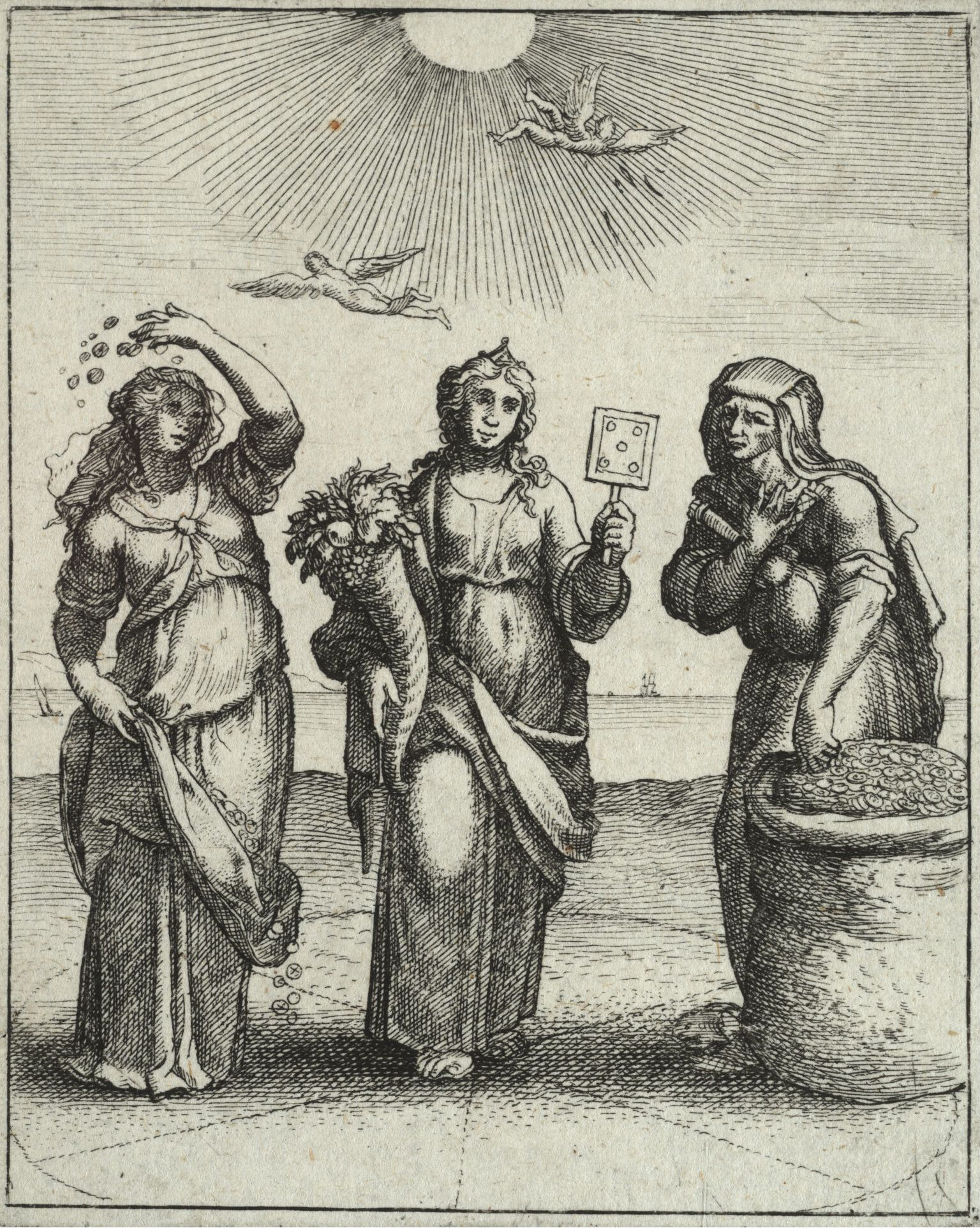
‘Festina Lente’ ~ Riding Tarot’s Hermetic Wheel of Fortune


Bless us, divine number, thou who generated gods and men! O holy, holy Tetractys, thou that containest the root and source of the eternally flowing creation! For the divine number begins with the profound, pure unity until it comes to the holy four; then it begets the mother of all, the all-comprising, all-bounding, the first-born, the never-swerving, the never-tiring holy ten, the keyholder of all.
~ prayer of the Pythagoreans to the ‘Mystic Tetrad’ [Wikipedia]
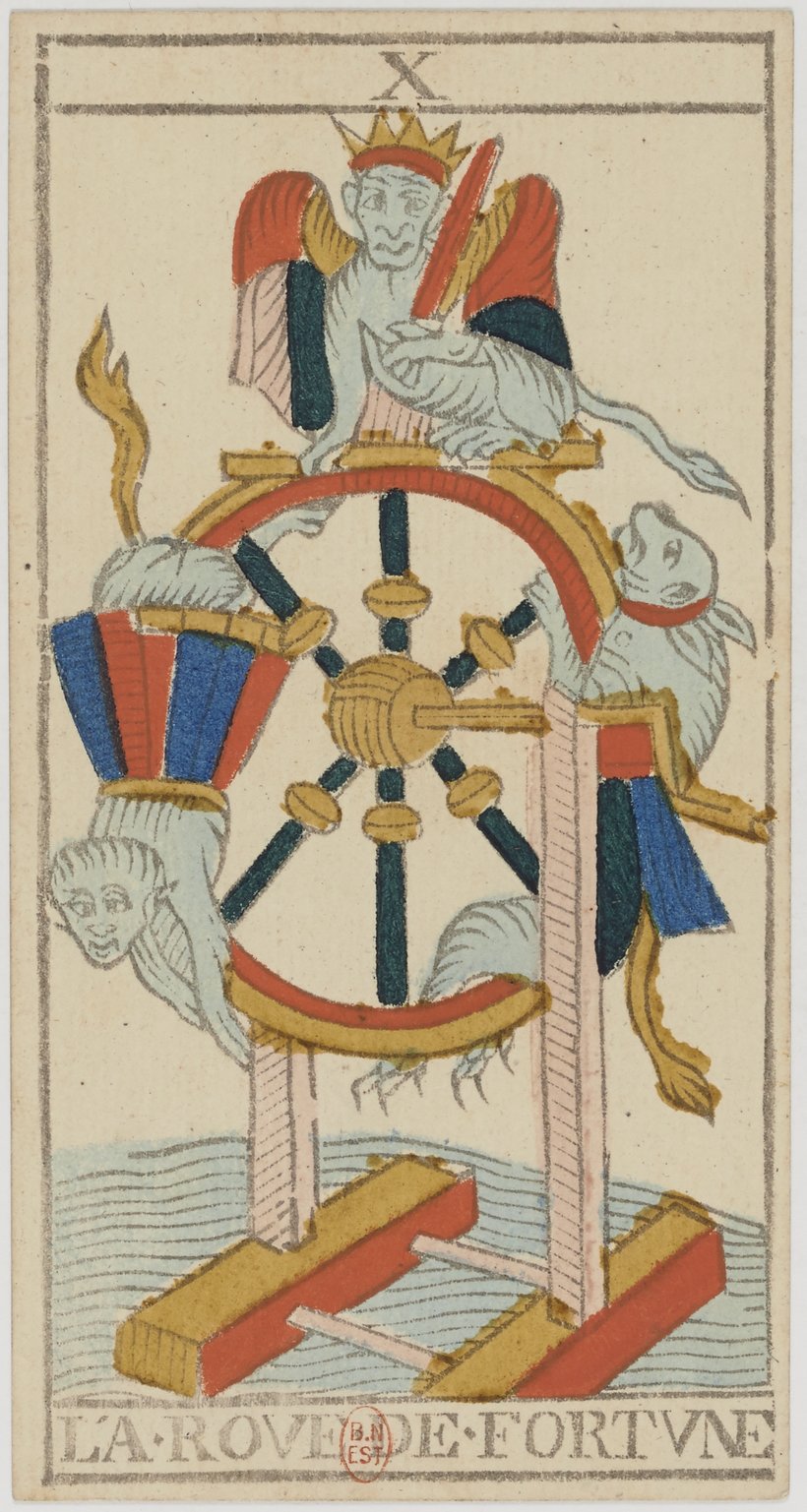
Nicholas Conver type II,  1760

Though it may appear comical, the importance of the triumph in tenth position is underlined by the reverence Pythagoreans paid to its number. To get a better grip on the Wheel of Fortune, it’s essential to understand it’s placement in the TdM numerical cycle, as it relates to the cosmology of  Pythagoras, famed philosopher-polymathematician (ca 570-495 BCE). The same cosmology was also the axiom of Maria the Jewess/Prophetess, famed alchemist-sage and inventor of the Bain-Marie and other alembics (ca 1st-3rd CE):

“One becomes Two, Two becomes Three,
and out of the Third comes the One as the Fourth.”
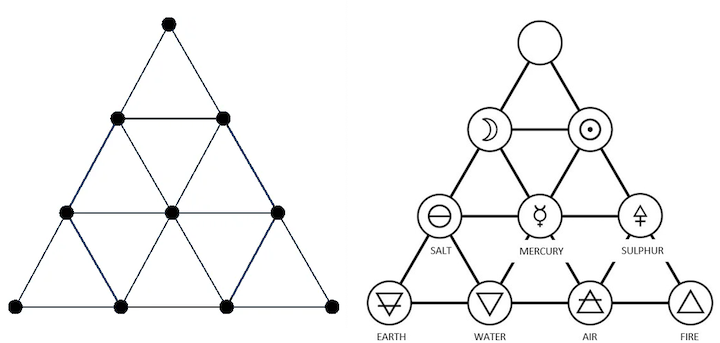
mathematical and alchemical versions of the same thing

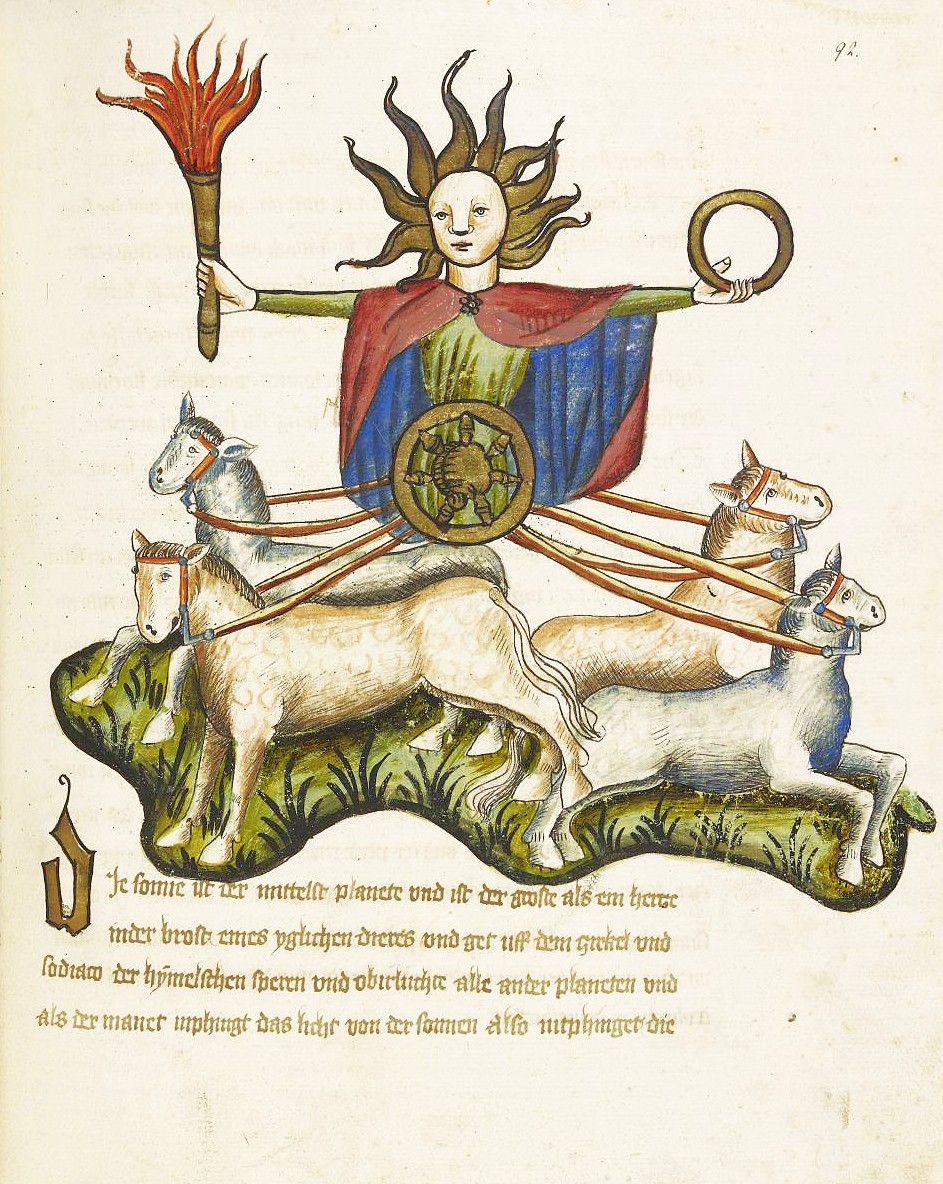
This simple formula, hidden in plain sight in triumph I, provides the foundational structure on which to then load our various interpretations; The Wheel of Fortune is both the first card of a three part cycle (10, 11, 12) as well as being the fourth card (the death) of the previous cycle (7, 8, 9). All the 1/4 cards indicate both initiation and completion – ie, change. They are always masc/solar (see below). Wheels are typically a solar symbol, and besides including the Sun itself, the 1/4 series contains the two triumph cards with wheels (7 and 10). Notice all the cards between 1 and 19 have crowns in them – another solar symbol – and that the the Wheel is central.
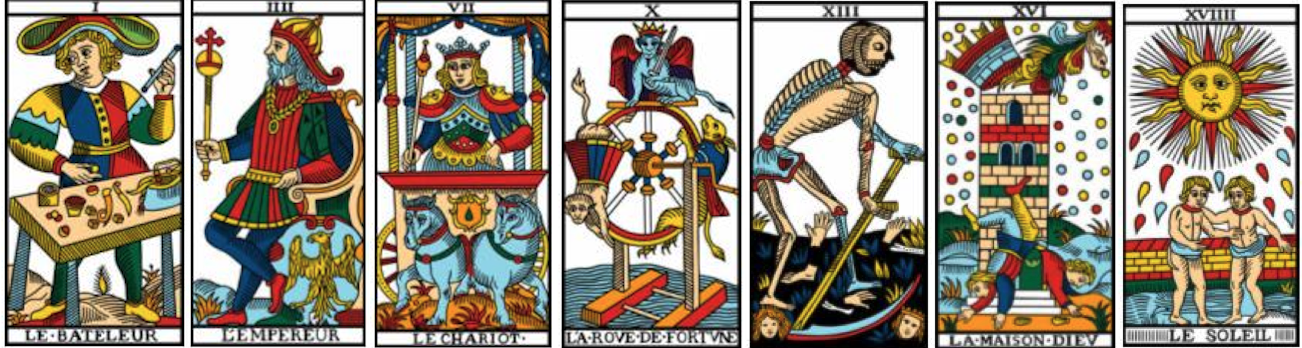
Cards in the 1/4 placements [Camoin-Jodorowsky deck]
German astronomical illustration of the Sun, 1445. How many cards from the 1/4 series do you see represented?

With 10, the perfect, complete number, ‘the great work’ (ie, the soul’s work) may now commence. 9 was the number of endings and of memory (Mnemosyne), of reflected, inner light. Similar to the Emperor, the old Hermit turns toward the past, drawing the numerological cycle to a close. We might imagine a shadow puppet play of life highlights projected onto the inside of his curtain-like cloak.
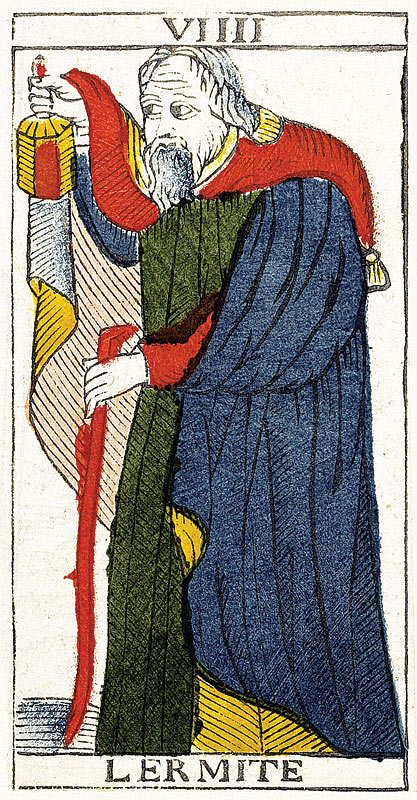
Pierre Madenié, 1709

Mathematically, 9 always returns to itself. The Pythagoreans were not enamoured with 9, but understood its importance as the first square (3×3) and for its role in human gestation, relating to the 9 spheres a soul transited before rebirth. More about the Hermit and his lamp here.

Pythagoras himself had been initiated into the Orphic Mysteries, among others, ’tis said. He believed in and taught metempsychosis (reincarnation), and that mathematical principals – numbers – are universal, guiding principals.
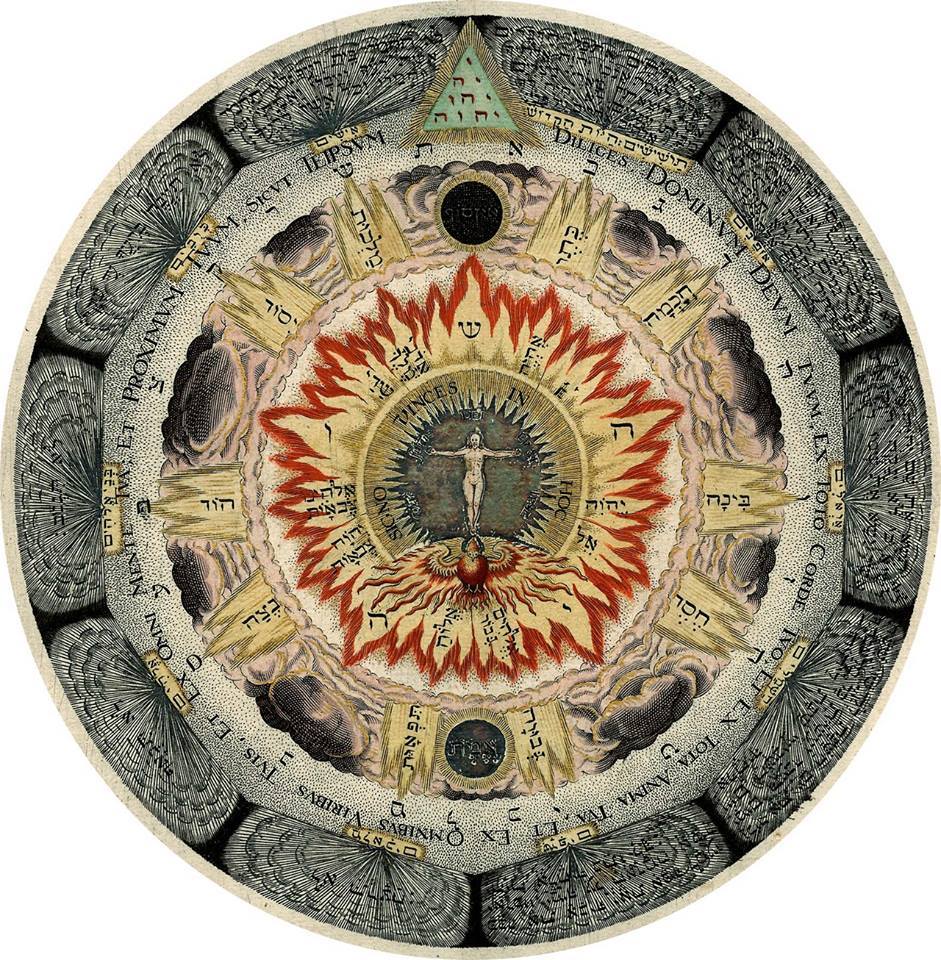
Alchemical etching from the ‘Amphitheatrum Sapientiae Aeternae’ by Heinrich Khunrath, Hamburg, 1595

10 is the ‘higher octave’ of 1. To Pythagoreans and alchemists alike, 1 was not actually a number (it could not be ‘numbered’ and anything multiplied or divided by 1 was still the same), but represented the Monad (God, origin, unity), symbolized by a circle with a central dot or eye. This is still the symbol for both the Sun and gold. Wheels are essentially monad shaped. [Note: They did not use or accept 0 as a number.].
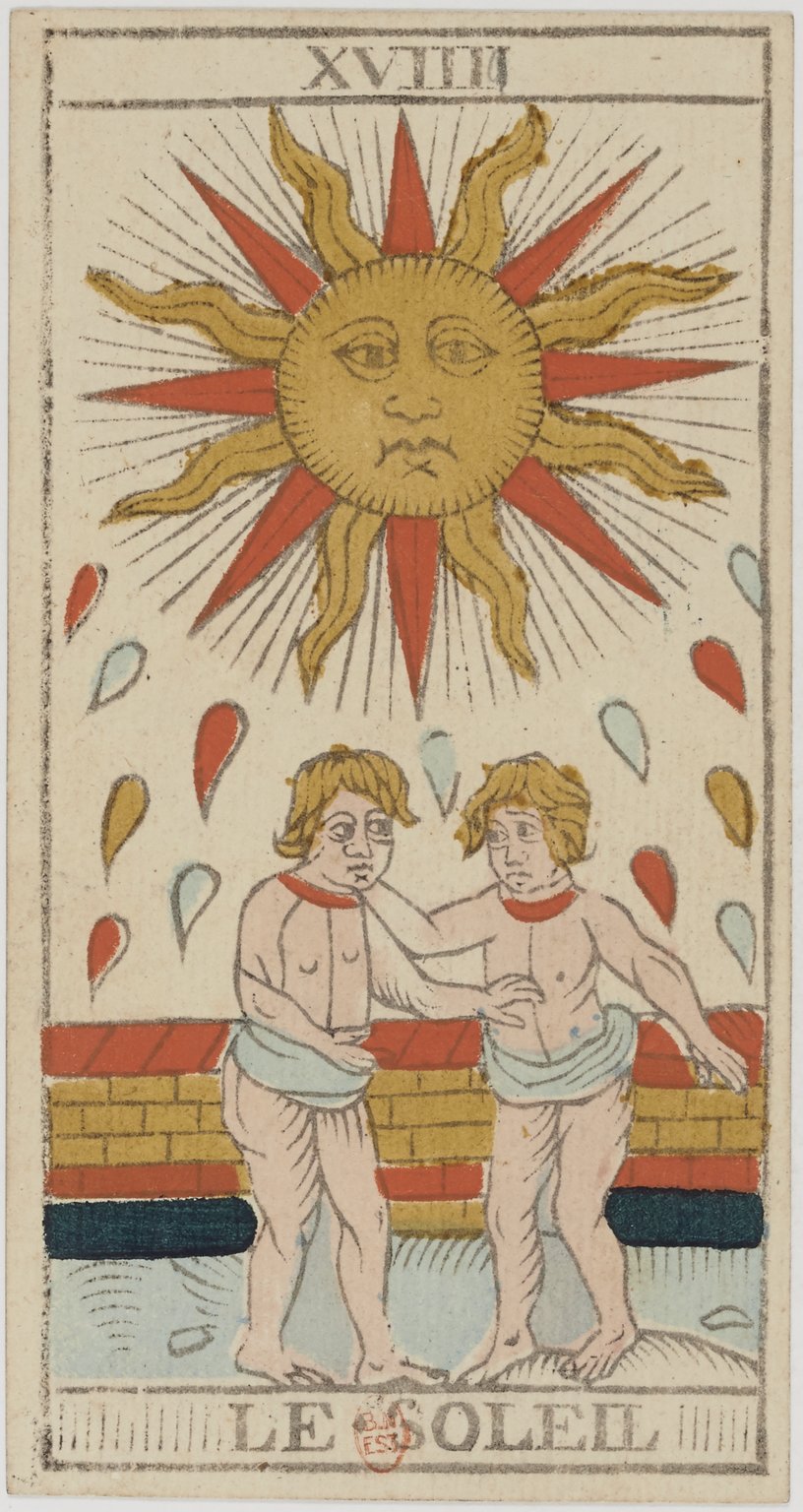
Conver type II, 1760

The next card after 10 that reduces to 1 when the digits are added together is 19, the actual Sun. There is no 4 in this last, seventh cycle of 3, unless we include Le Mat as 22. While ‘Pythagorean’ numerology considers 22 to be the ‘master builder’ (aka god), the man himself did not specifically mention this. However, what’s very interesting indeed is that the ratio of 22/7 was used by Archimedes to approximate pi. Thus by adding Le Mat as a 22nd triumph, division by 7 no longer gives us 3, the trinity, but pi, which is ‘never-ending.’

“Numbers are the Highest Degree of knowledge. They are knowledge themselves.” ~ Plato
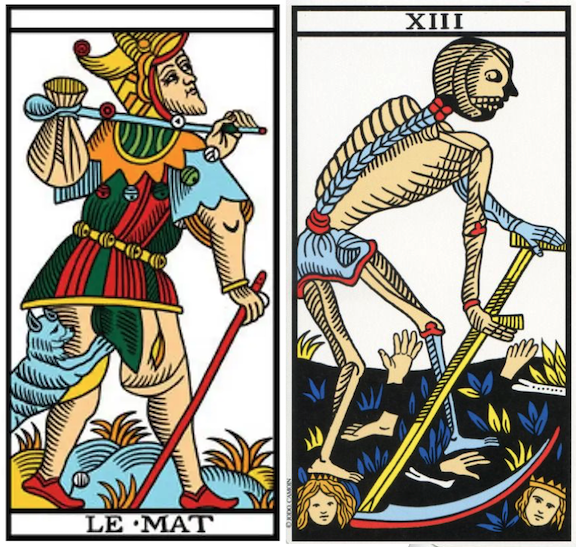
The infinite and the eternal? Camoin-Jodo Conver type II, 1997

The process of destruction and purification by fire and water prior to what will be rebirth in 19, 20, 21 begins with this most sacred number of the Pythagoreans because, where unity and wholeness is the ultimate intent of the work, God/the Divine must be invoked.

Alright, math class dismissed, time for art, myth and philosophy…

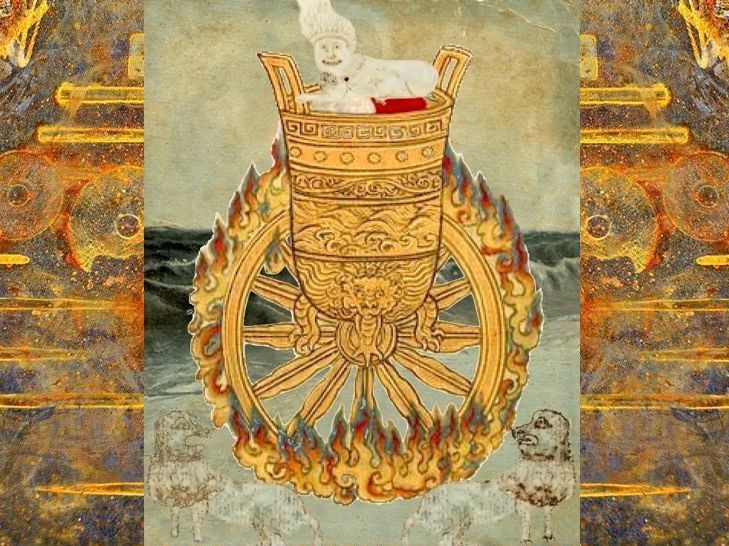
The Marseille Roue de Fortune card is a bit of a visual conundrum. The parts don’t quite fit together and though the creatures on it appear to be in motion (at least, the ones on either side do), nobody’s turning the handle. The base, which resembles a section of ladder, stands on water. Is it a water wheel? Maybe this rota cannot be fully understood literally, but is another riddle asking to be read as a composite of its parts.

I won’t go into the entire history of Fortuna’s Wheel, or ‘wheel’ be here all day, but one, particular detail in the Marseille version is what got my wheels in motion: at some point in the card’s r-evolution (perhaps simultaneously, in different traditions), the creature on the left transitions into a flaming pot.
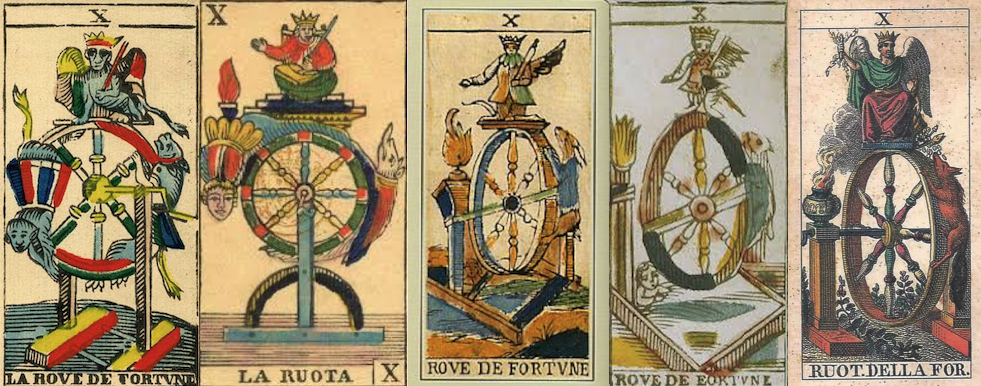
This has been dismissed as misinterpretation of worn away plates by printers who, (correctly) interpreting the tail as a flame, figured the Wheel should be equip with an altar or censer with which the passing of earthly existence into smoke was symbolized. (And now it does resemble an Arabic ’10’).

One possible precedent is in images of Ixion, where the wheel Zeus binds him to is being lit with a torch, although, there are plenty of mythical, flaming wheels (and altar pots) to choose from. Ours is not Ixion’s wheel per se, but maybe the flame is mnemonic of it. Ixion, having killed a kinsman and twice flagrantly violated the sacred law of Xenia, was denied the cathartic rituals that would cleanse him of his guilt, and, under Zeus’ orders was bound by Hermes to a fiery solar wheel for eternity [either rolling across the sky or stationary, down in Tartarus]. At this point in the game, there are two options; change or be stuck on repeat forever.
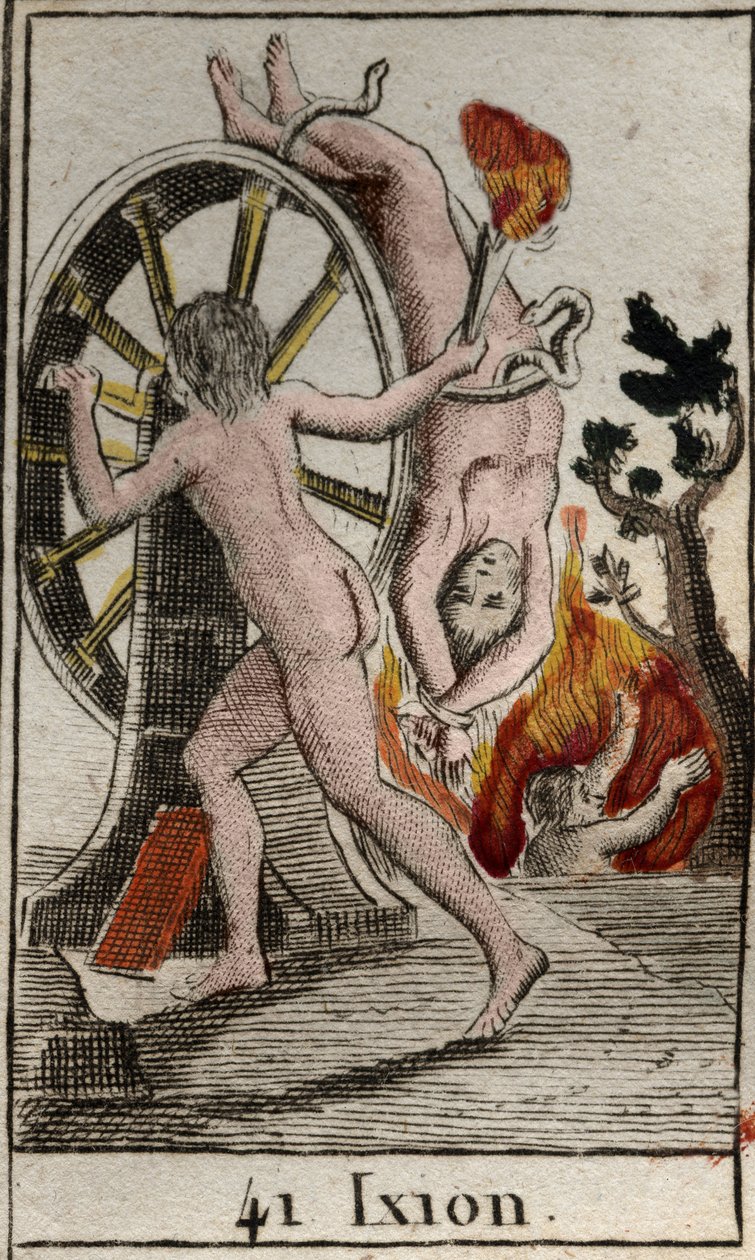
Ixion about to be lit, from ‘Mythologie de la jeunesse’, 1803

The Wheel’s stand can elude to a couple of things; like the Hanged Man’s gibbet, it might suggest a gateway, recalling the dokana of the Dioscuri (even shaped like the Gemini sign, a prelude to the twins in 19).
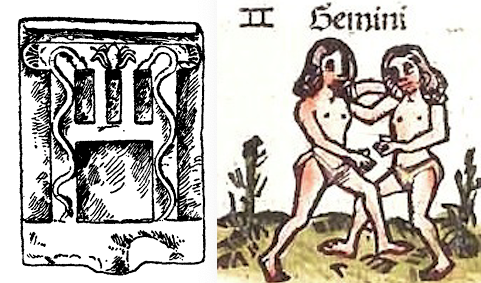
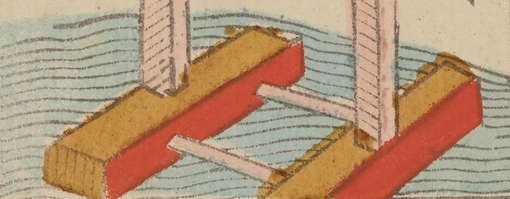
Dokana symbol and Gemini

It could also indicate that ‘the initiate’ has now made it this far on the scale philosophorum (philosopher’s ladder of mystical ascention), which will later appear atop the wall in 19. The two bars form the Arabic numeral 11, and/or the Roman numeral II, recalling “one becomes two…” Double digits begin here and the images start to reflect this. 10, with this design element, seeds 11 (La Force), situated exactly in the middle, a threshold with ten numbered cards on either side. The formidable, lion-wrestling mistress is partner to the Le Bateleur.
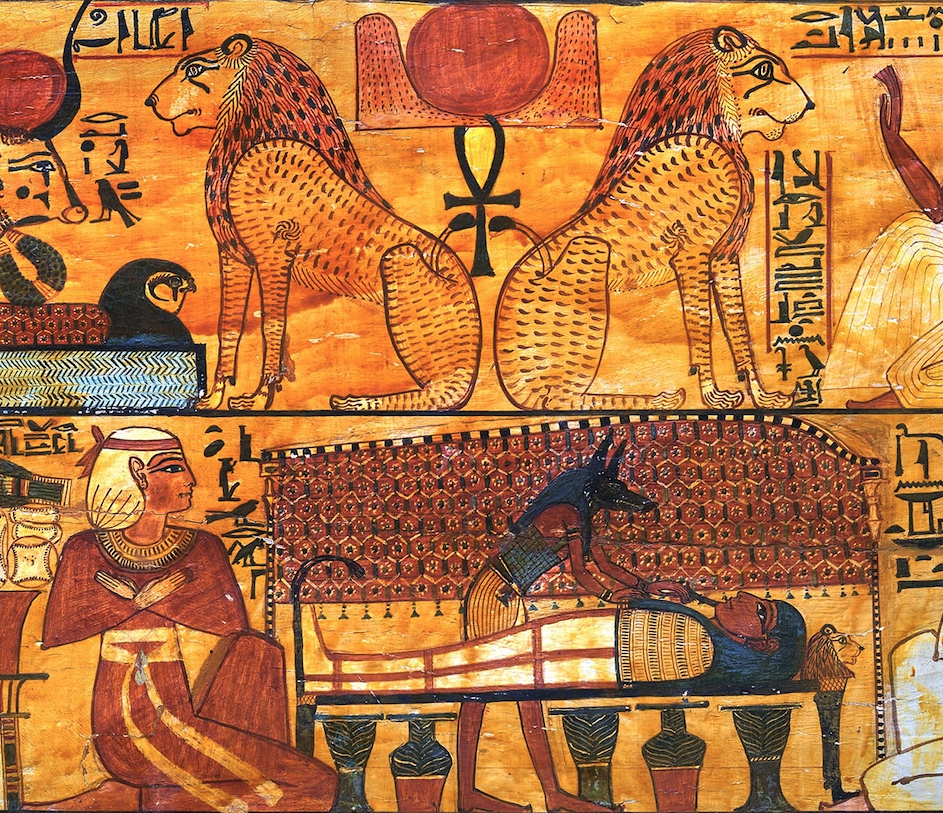
Lions of yesterday and tomorrow (eastern and western horizons), with the eternal in the middle, hieroglyph for ‘the horizon.’

The ‘foreparts of a lion’, seen here at the head of the embalming table, is the hieroglyph for ‘strength’, and is featured in the Strength card.

We might also imagine the Wheel as metaphorically representing the Sun above the watery horizon and the beings on either side as ‘yesterday’ and ‘tomorrow’’ – traditionally, ‘I have reigned’, and ‘I shall reign’ – with the top middle one as the present, ‘I reign’. Instead of a fourth on the bottom (usually an old, impoverished figure) there is a gateway to watery rebirth.
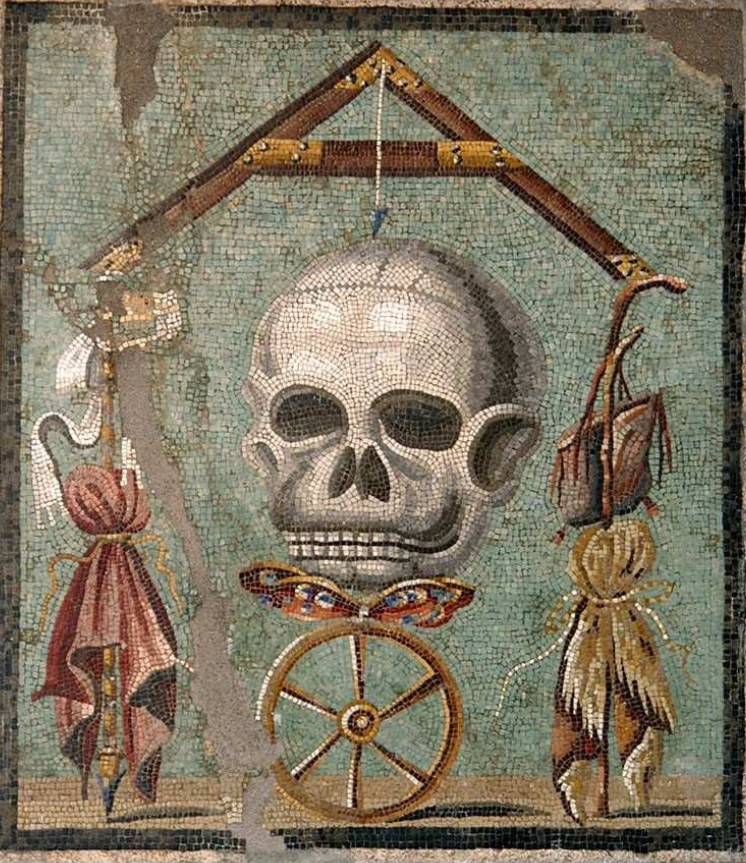
Memento Mori mosaic, in the Museo archeologico Nazionale di Napoli, 1st c

In this iconic ‘memento mori’ Roman mosaic from Pompeii, a simian skull is balanced atop a butterfly on a wheel. Above, a square level’s plumb bob is just touching it, the tool balanced atop two staffs, hung with the garbs of rich and poor. All are equalized in death, all are subject to Fortune’s whims. The mosaic was part of a banquet table, where Romans often practiced ‘carpe diem’, remembering their death tomorrow by partying today. The butterfly represents the immortal soul (Psyche). Butterfly, torch (especially going out or pointed downward), plumb line, fortune wheel, urn and of course skull/skeleton were all symbols of death, typical of the Roman ‘carpe diem’ motif.
[The tradition of death symbolism is also recurrent in Freemasonry. Masons practice reflecting on their mortality at every turn. The plumb represents death as well as the upright, balanced life and is a common,  gravestone motif.]
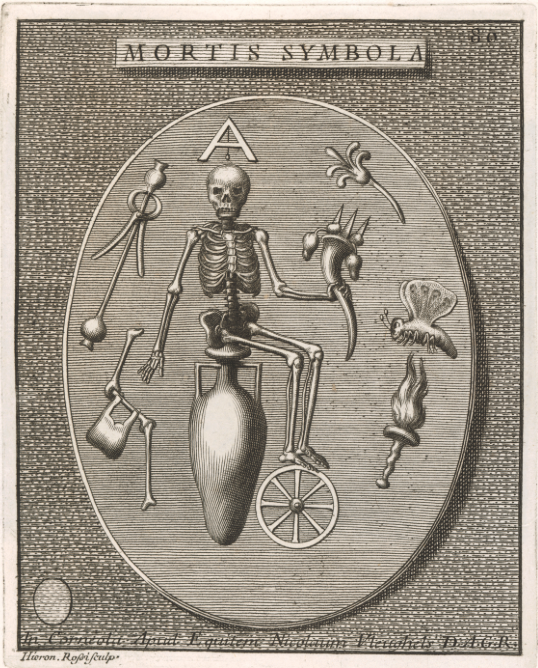
Roman symbols of Death

The explanation usually given for the monkey skull in the Roman mosaic is that cremation practices of the day had left the artist without a human one to refer to, but this ignores the fact that monkeys/apes were often used to parody humans. The memento mori theme was very popular and there is more than sufficient proof that artists of the day knew how to depict human skulls. An artist could easily have improvised the bone structure from a living human.
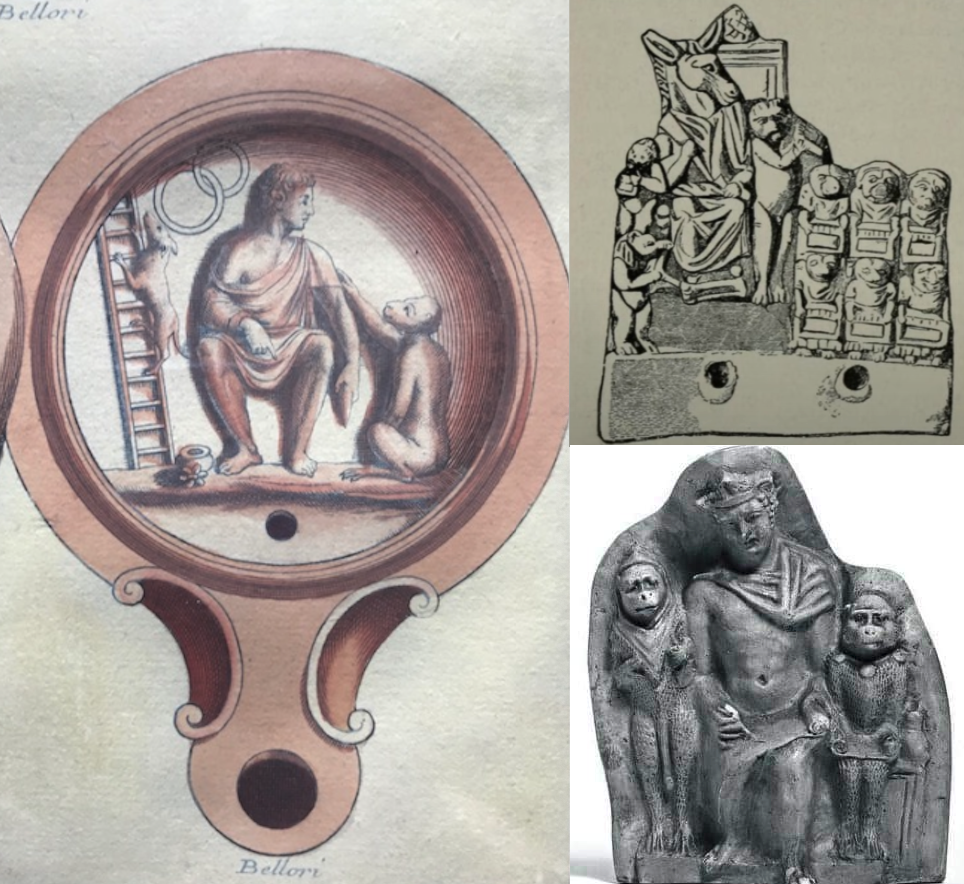
Lamp showing a juggler with monkey and dog (Carthage 1st c), Terracotta plaque (S. Italy, 1st c), Hermes seated between two baboons (Egypt, 3rd c BC, British Museum)

The little creatures on the TdM Wheel also seem to be parodying fearful humans stuck on the mortal coil, immediately following the card of remembering. Regrets…I’ve had a few…
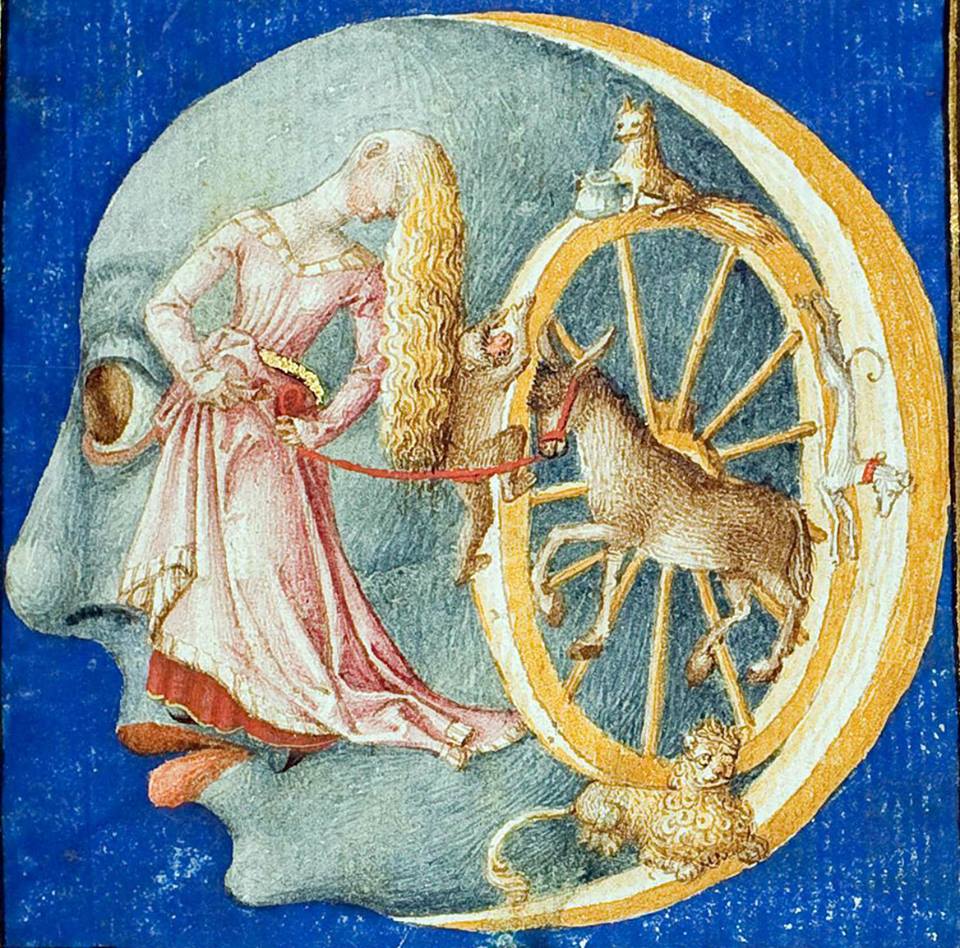
A Lunar Wheel of Fortune or Fate being turned by an ass, Hekate’s familiar. The woman’s hair-do is similar to that of Kairos (‘critical timing’), she might be the Roman equivalent, Occasio, who was female.

It would seem the tail of the simian-looking creature on the left side of the card was always intended to resemble a flame, both to illustrate the fire element, and to suggest that being turned on the wheel is akin to being ‘cooked.’ Perhaps there is nobody turning the handle because, as with the Chariot, which is not physically moving, there is no outer influence, the change is happening inside. Either we turn our own wheel or invite “fate” to do it – an outer expression whereby things seem to randomly happen to us (wheel of karma). The ‘winged’ Mercurial being at the apex might be symbolic of will, overseeing  the process, making sure the pace is natural and steady, that an even temperature is maintained. 

“Its purpose is constant digestion. Within its womb, substances are subjected not to violent flames but to the slow and merciful fire – ignis temperatus that mimics the warmth of the earth’s own generative belly. There, in that tranquil inferno, base substances soften, combine, and refine, until that which was profane begins its ascent toward the sacred. This is no vulgar boiling, but a sacred gestation.” ~ Universal Co-Masonry FB post, regarding the Athanor (alchemical furnace).
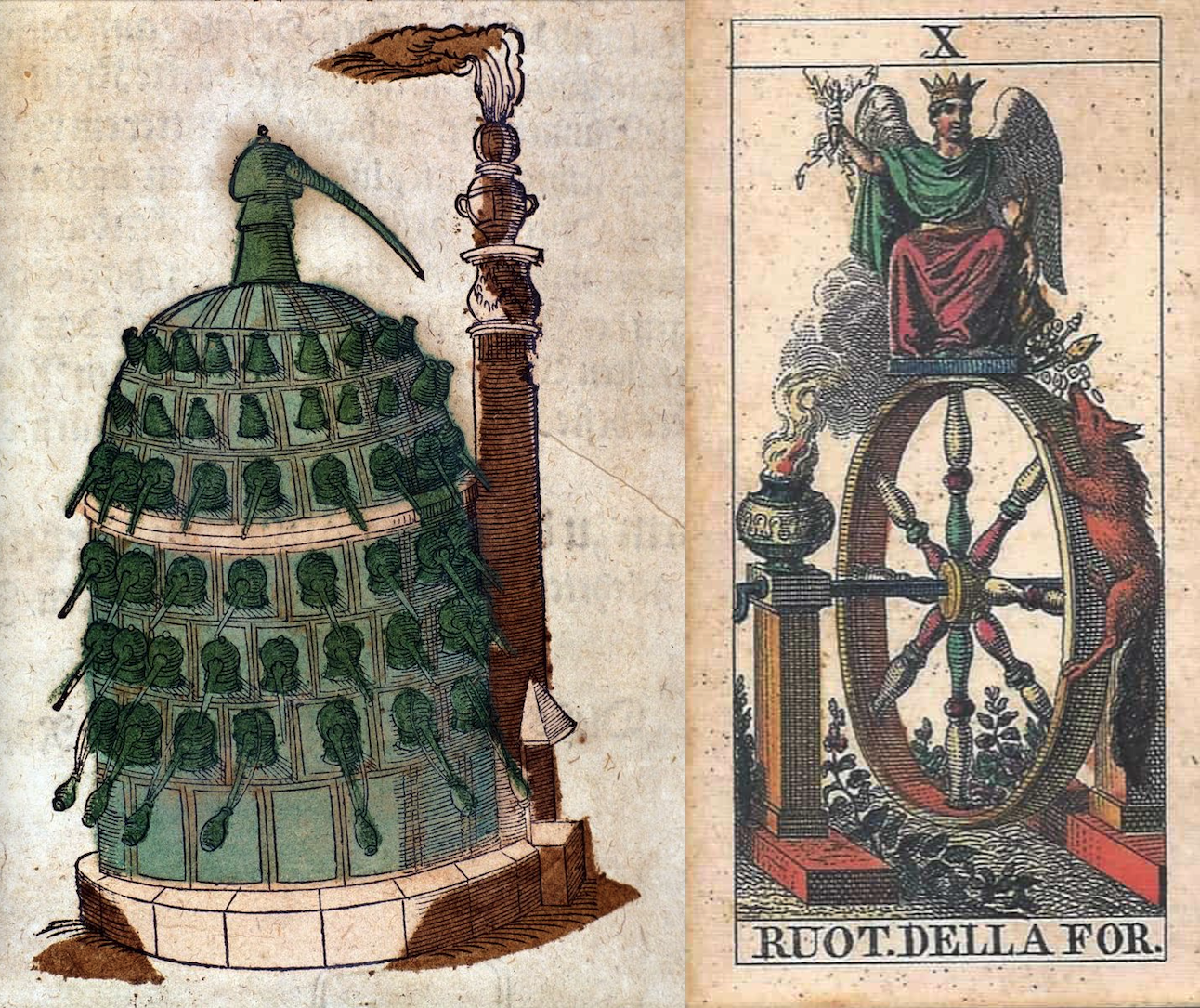
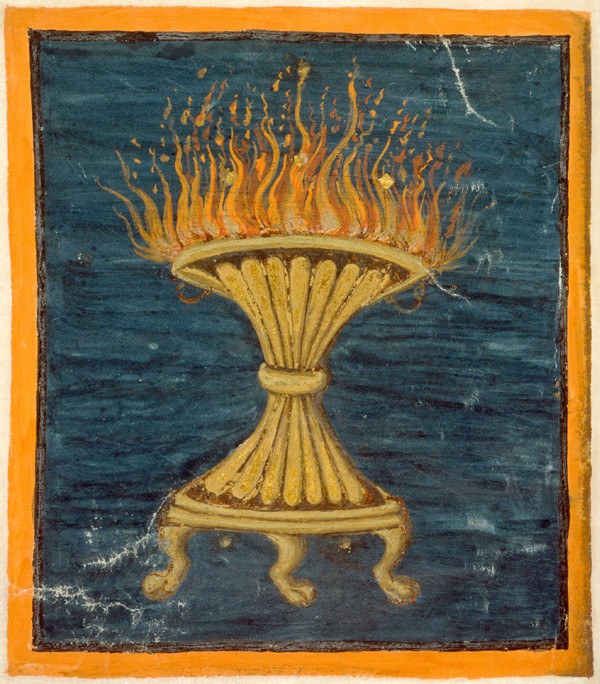
Athanor and Soprafino Wheel, 1835

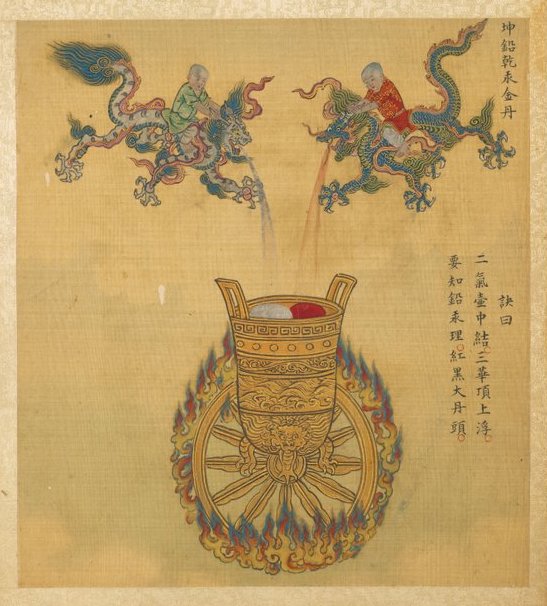
Above, with a suitable Tarot card for comparison, is the image that finally unlocked this card’s cryptic meaning for me. It is of an alchemist’s ‘athanor’, which is a self-feeding, clay furnace designed to maintain a steady temperature. Although etymologically unrelated (it comes from Arabic at-tannūr, “the baker’s oven”), ‘athanor’ oddly enough contains the Latin word ‘rota’ in it (albeit spelled backwards). Note the familiar design of the heat-release valve.

“The athanor’s design further symbolizes the unity of the macrocosm and microcosm through its correspondence to the four classical elements, integrating them into a harmonious whole; Fire represents the transformative heat in the lower chamber, Earth the stable structure, Air the circulating vents, and water the surrounding baths, collectively mirroring the alchemist’s inner equilibrium and the cosmic order. This elemental interplay underscores the Hermetic principle of “as above, so below,” where the furnace’s operations reflect the soul’s alignment with universal forces.” [Grokipedia…forgive me!]

Qing Dynasty Chinese School Taoist Alchemy

In fact, the alchemists did use the term ‘wheel’ (rota) as a metaphor for the cyclical nature of their art. The stages were not linear, but continuous – the end could also be the beginning, just as in nature.

The three figures on the TdM Wheel might represent the 3 philosophical elements – left, sulphur (soul/emotions/desires), right, salt (body), and top, mercury (spirit/imagination/moral judgement/higher mental faculties). The salt/body fellow has ass ears, which typically are a sign of ignorance (think Pinocchio) but also, again, possibly suggestive of Hekate, triplicate Goddess of the crossroads and occasional consort of Hermes (aka Mercurius) or Hermanubis. As supreme navigator of liminal spaces, her torch burned with the sacred solar fire of Helios. 

“O Sun our lord and sacred fire, the spear of Hekate of the roads, which she carries as she attends her mistress in the sky and as she inhabits the sacred crossroads of the earth, crowned with oak-leaves and the woven coils of savage dragons!”

~ fragment of a hymn to Helios and Hekate from the play Rhizotomoi (Root-Cutters) by the Greek tragedian, Sophocles [Loeb Classical Library].
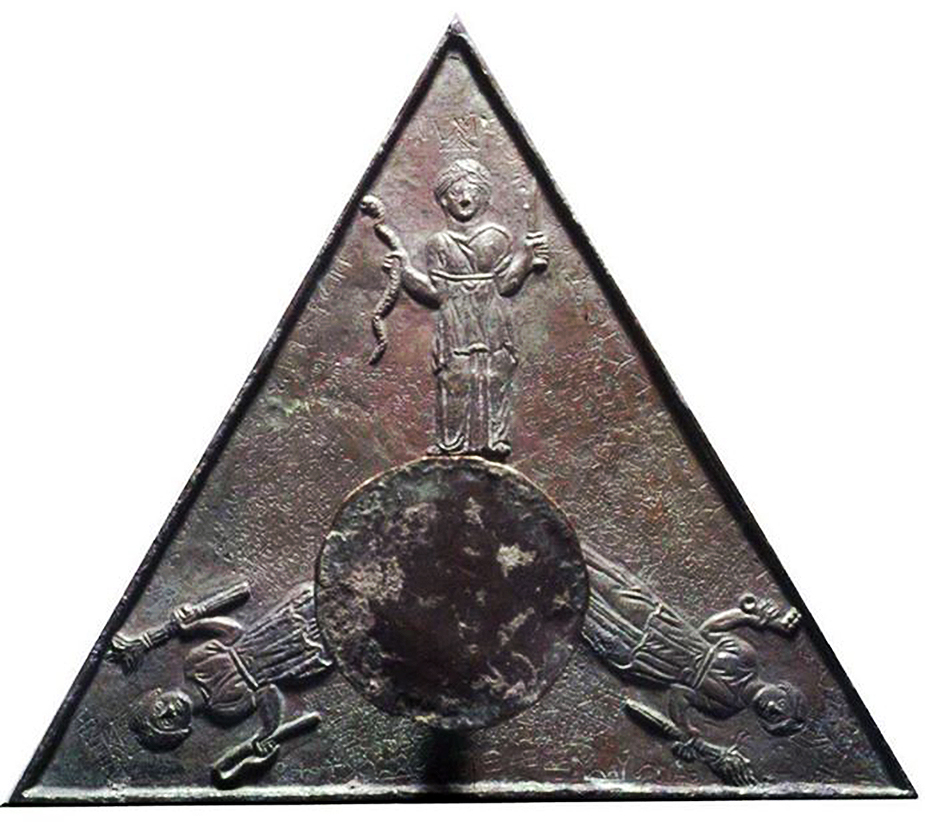
Goddess Hekate in magical plate from ancient Pergamon, Anatolia [Berlin Museum]
All 4 classical elements, too, are present:

AIR (sword pointed up, wing-like cape)
FIRE (flame-like tail pointed up)
WATER (below)
EARTH (vine or snake-like tail pointed down)

4 classical + 3 philosophical elements = 7.

In both type I and II, the number of spokes appears to be 6 (or three divided), but notice that a seventh is also formed by the Wheel’s handle. Clever. Seven elements, planets, metals and stages.

Addendum: The 6 spoked Wheel can also be read as the Labarum symbol (solar) adopted by Christian iconography, which is nevertheless based on the idea of “inverse directions…one of which is like a reflection or mirror image the other” – ie, ‘as above, so below’ – similar to Solomon’s seal. [René Guénon, Symbols of Analogy, via Wikipedia]
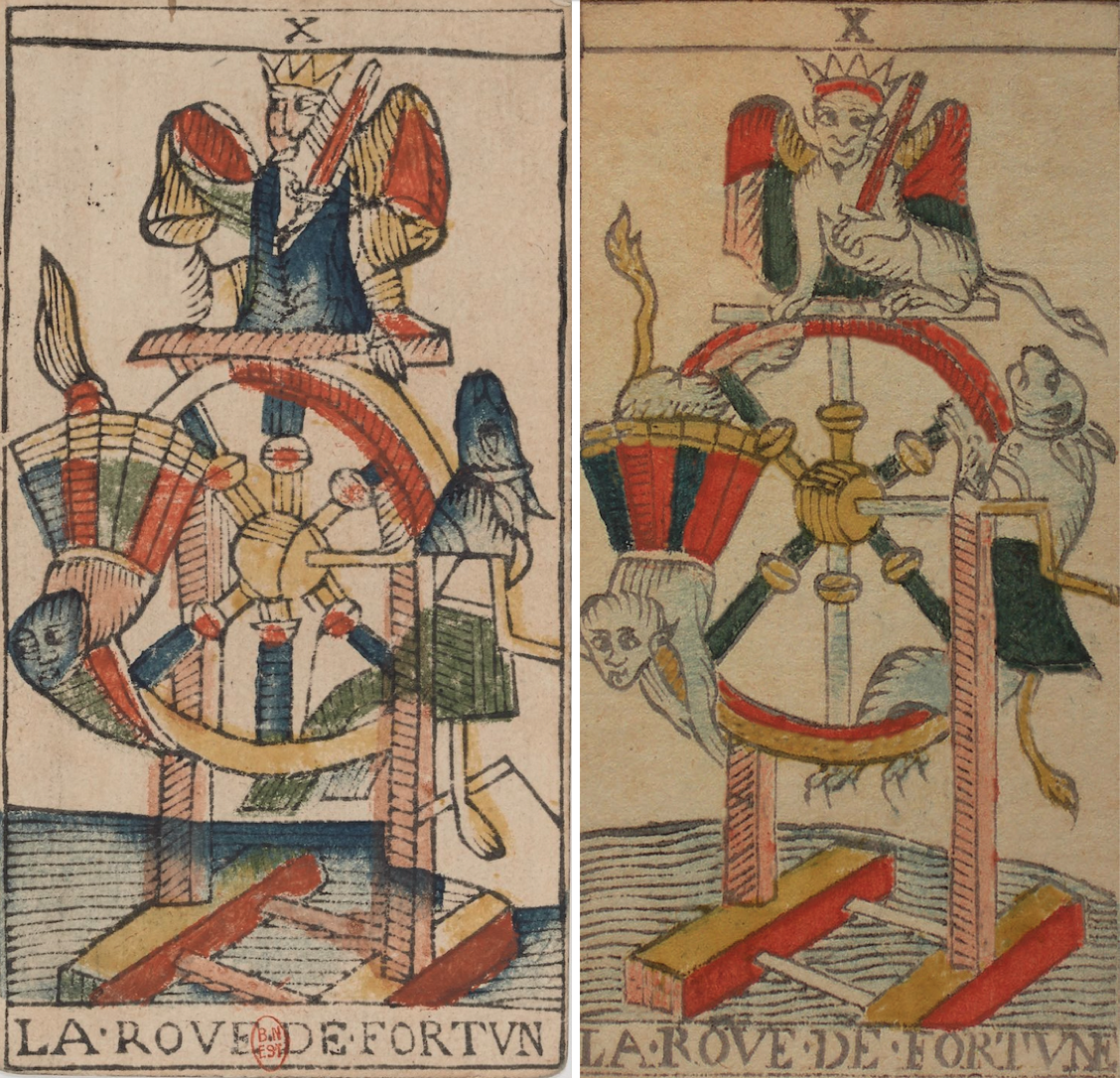
Dodal type I (ca 1701-15) and Chausson type II (1672)

The hub of the Wheel is divided into 3 sections, like a globus, while also resembling a lunar-solar combination – navigation of liminal spaces as we progress toward unity.

That the flaming tail was turned into an altar pot/censor doesn’t change the intrinsic meaning and actually alludes more strongly to the alchemical cooking process. The water below suggests ‘a slow, gentle cooking’, akin to that of the Bain Marie. Similar to the gentle turning of a wheel, the contents of a cooking pot or cauldron is stirred in a slow, spiralling motion. In Shakespeare’s tragic play of alchemy gone backwards, MacBeth, the Wyrd Sisters famous chant, ‘Double double, toil and trouble,’ is a reference to ‘the work.’ Originally, the old English word ‘wyrd’ (which became ‘weird’) meant  ‘fate’ or ‘destiny.’
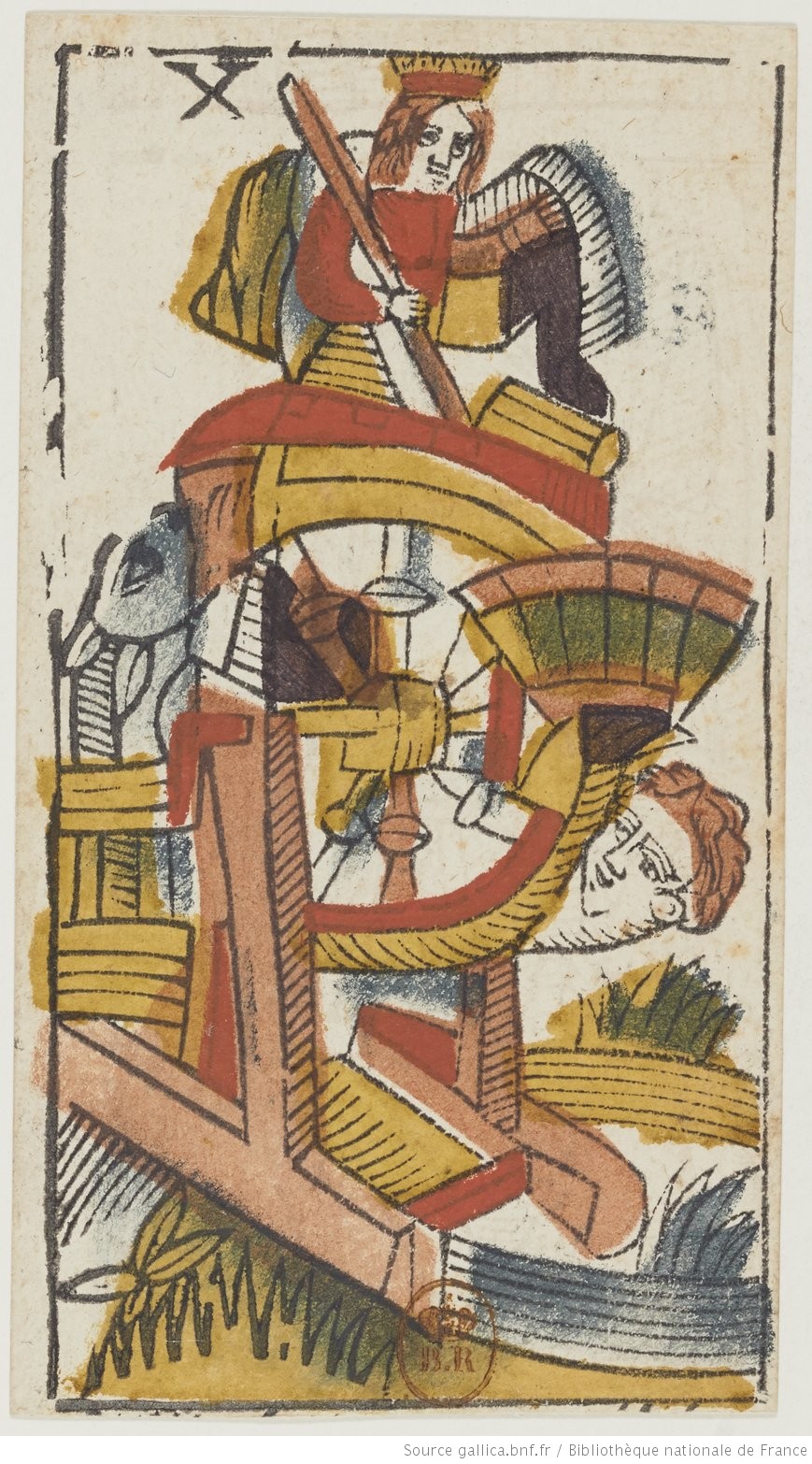
Jacques Vieville 1650

The Vieville card does not show any flame on the side, but rather, some suspiciously fiery-looking, yellow grass, below, possibly suggesting the pool of water is being heated from beneath. But the shape of the fire being’s skirt is consistent across TdM decks. It bears a similarity to the shape of constellation Ara, the altar on which sacrifices to Zeus were made, and is reminiscent of the Emperor’s skirt  (‘I have reigned’). The Wheel of Fortune was also an attribute of Zeus, god of optimists and gamblers. By ‘letting go and letting God’, we sacrifice our dross to the pyre, turning fate to faith. Remember Pythagoras’ holy number 10.

Ara constellation, Roman

Apollo, though one of the great gods of Olympus, is yet represented in some sort of dependence on Zeus, who is regarded as the source of the powers exercised by his son. [Theoi.com]

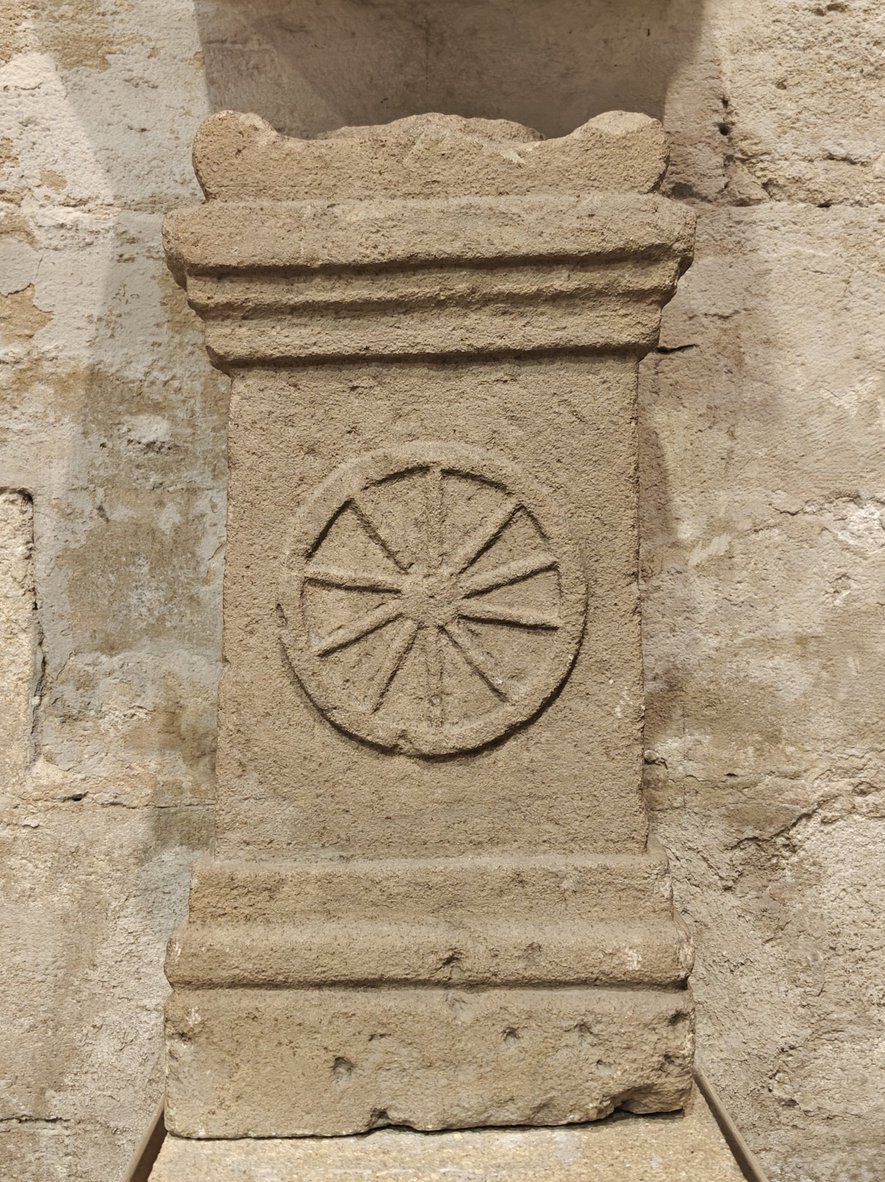
Jupiter (Zeus) altar featuring a 10-spoked wheel, the number of months in a Roman year.

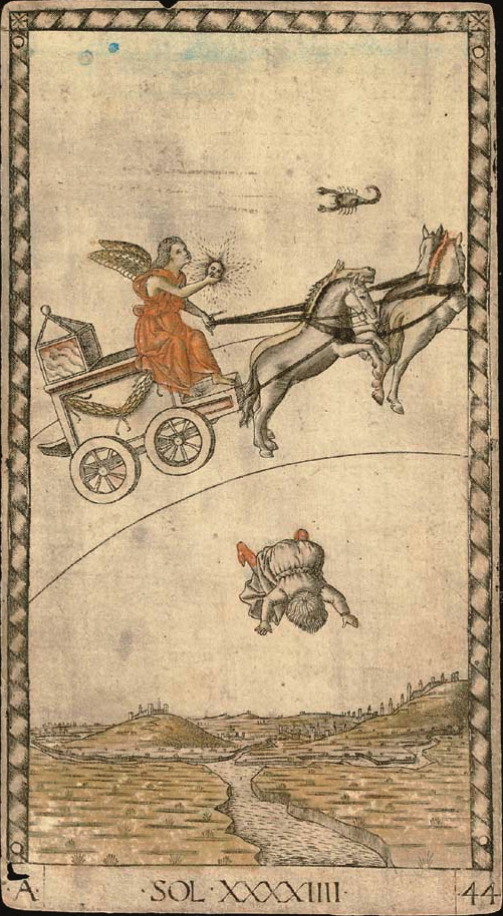
Helios, a Titan, was the Sun personified, later identified with Olympian Apollo, god of light and prophecy. The sad myth of Phaethon – the son of Helios who insisted he could drive his father’s chariot, but lost control of the horses and fell to his death – can, in the mythoalchemical sense, be equated with ‘the work’ being scorched by impatience (or hubris) or halted by negligence (or ignorance).

Tarocchi of Mantegna Sun, featuring the myth of Phaethon, 1465

The meaning of the Latin phrase Festina lente (‘make haste slowly’), is that activities should be performed with a proper balance of urgency and diligence. If tasks are rushed too quickly then mistakes are made and good, long-term results are not achieved. Work is best done in a state of flow in which one is fully engaged by the task and there is no sense of time passing. In this way we are in harmony with nature. ~rb

“Thus, let the Athanor burn–not with haste, but with faith–and may its light ever guide the hand and the heart of the true seeker.”
~ Universal Co-Masonry, ibid
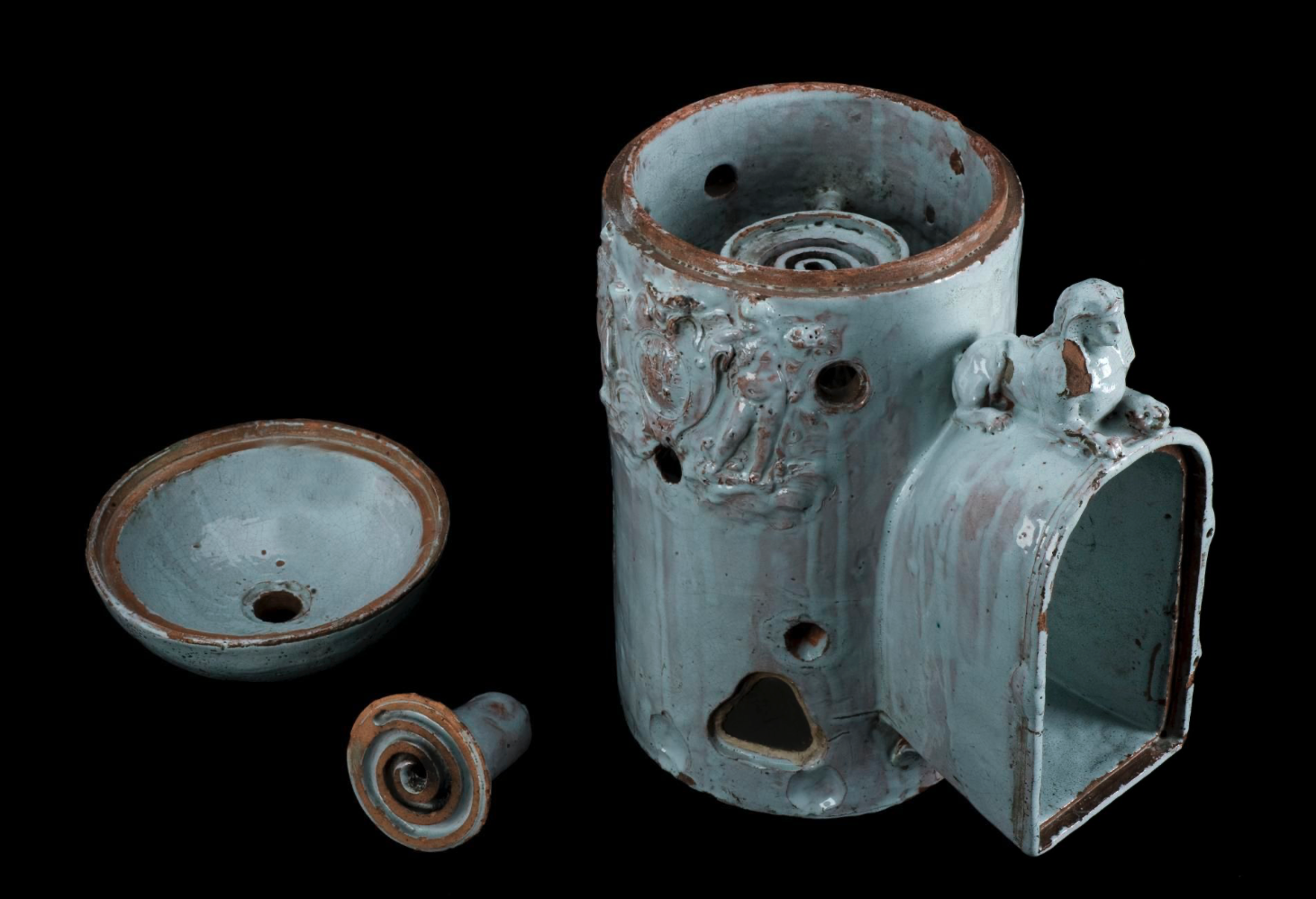
Alchemist’s athanor (top removed), stoneware, German, 1501-1700

All written content, besides quotations, is ©ROXANNA BIKADOROFF and may not be reprinted for republished in full without my permission. Kindly share via LINK only, which helps direct traffic here. If you wish to use a short pull quote, please include a credit (and link).
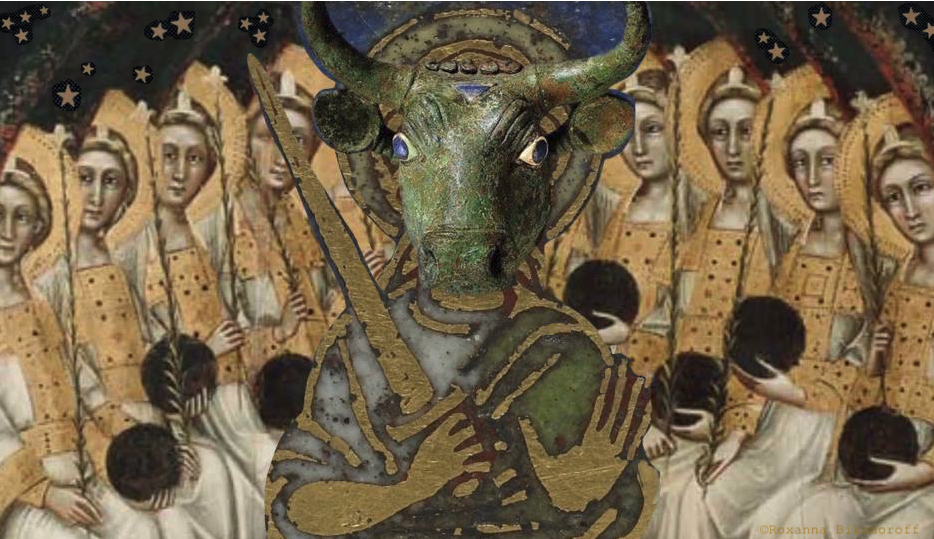
Seeing with Divine Mind – The Justice Card of Ancient Tarot

I prayed to Her, taking a flower in my hands:
“Mother, here is Thy knowledge and here is Thy ignorance.
Take them both, and give me only pure love.
Here is Thy holiness and here is Thy unholiness.
Take them both, Mother, and give me pure love.
Here is Thy righteousness and here is Thy unrighteousness.
Take them both, Mother, and give me pure love.”
I spoke of all these, but I could not say: “Mother,
here is Thy truth and here is Thy falsehood, take them both.”
I gave up everything at Her feet but could not bring myself to give up truth.

~ from the Prayer of Ramakrishna (translated by A. Mookerjee)

Tarot’s Lady Justice, with her direct gaze and formidable countenance, doesn’t just represent an institution, but is the embodiment of truth, and the natural sense of order and harmony that permeates the cosmos. For this reason, she has is often been equated with the Egyptian Goddess Maat.

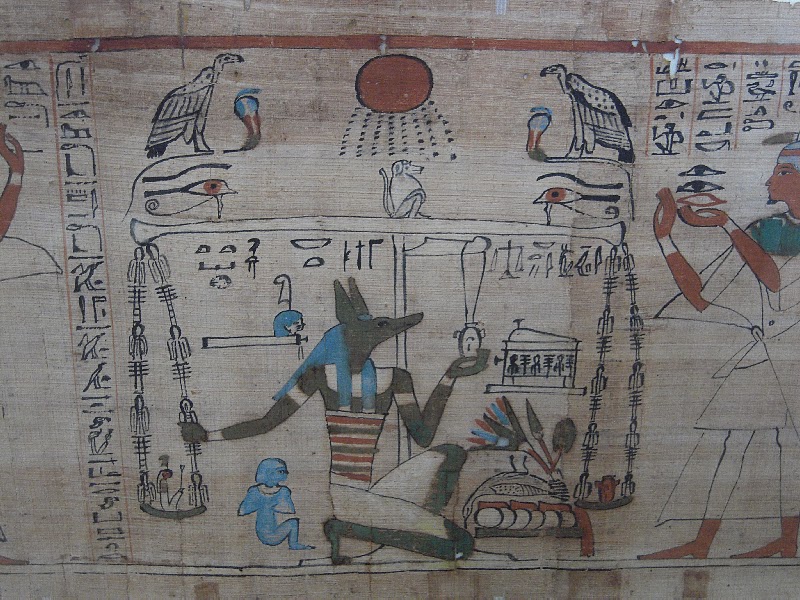
Anubis weighing a heart against a little figure of Maat

We’ve all seen images of the Weighing of the Heart ceremony, wherein the deceased person’s heart (seat of the mind, to the Egyptians) is weighed against her feather in the ‘Hall of Two Maats’ (two truths), but Maat was also a set of principals for the living:

“The ancient Egyptians deeply believed in the inherent grace and unity of the entire universe. They understood that cosmic harmony could be achieved through the most righteous ritual and public life, and any kind of disruption in this divine harmony would have many severe consequences, such as earthquakes or famine, which are caused by an impious king…”
[Egypt Tours Portal, Ancient Egyptian Principals of Maat]

“Tarocchi of Mantegna,” Anon Ferrara 1465

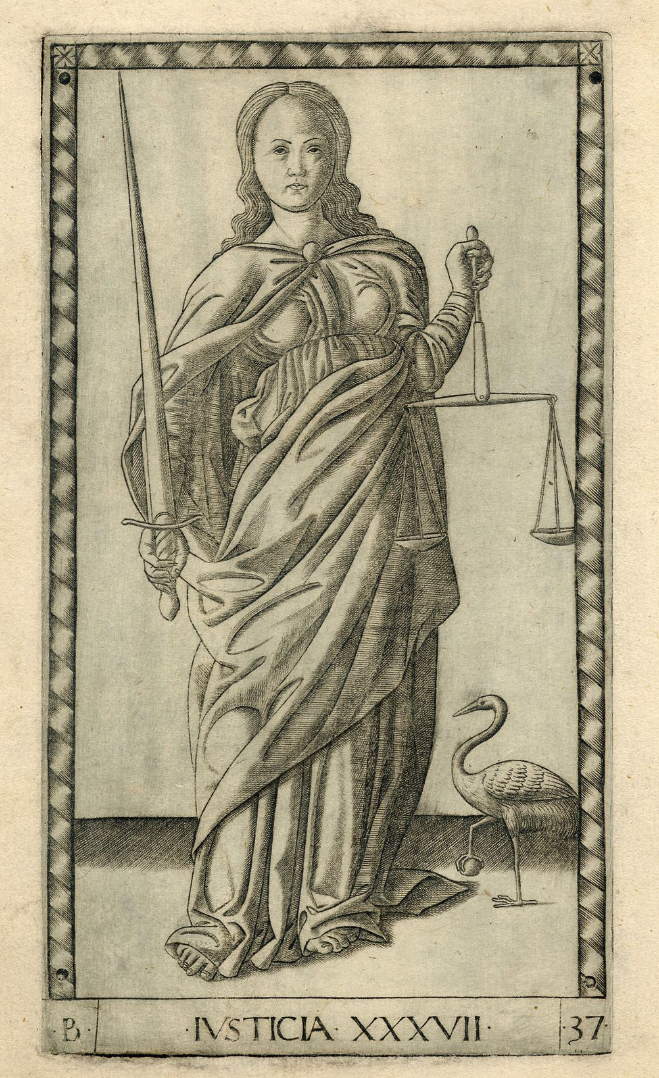
Similarly, to Renaissance humanists, Justice as Cardinal Virtue was a guiding principal to live by – particularly for princes – in order to maintain personal and collective, moral standards. In the ‘Mantegna Tarocchi‘, which depicts the hierarchy of stations from the lowly beggar ‘Misero’ all the way to ‘First Cause,’ Heavenly Virtues are exceeded only by the gods themselves. Note how the stork familiar of Justice harkens back to Thoth, Maat’s Ibis-headed scribe consort – perhaps indicating that virtues need to be taught and developed (the stork was also a symbol for rhetoric).
Tarot de Marseille’s Lady Justice, seated upon her throne, sword and scale in hand, seems straightforwardly emblematic. But, as with all TdM cards, might the particulars of her design reveal a more layered persona? Let’s investigate, beginning at the dawn of the Italian Renaissance…
[As always, please click on images to enlarge and for more details.]

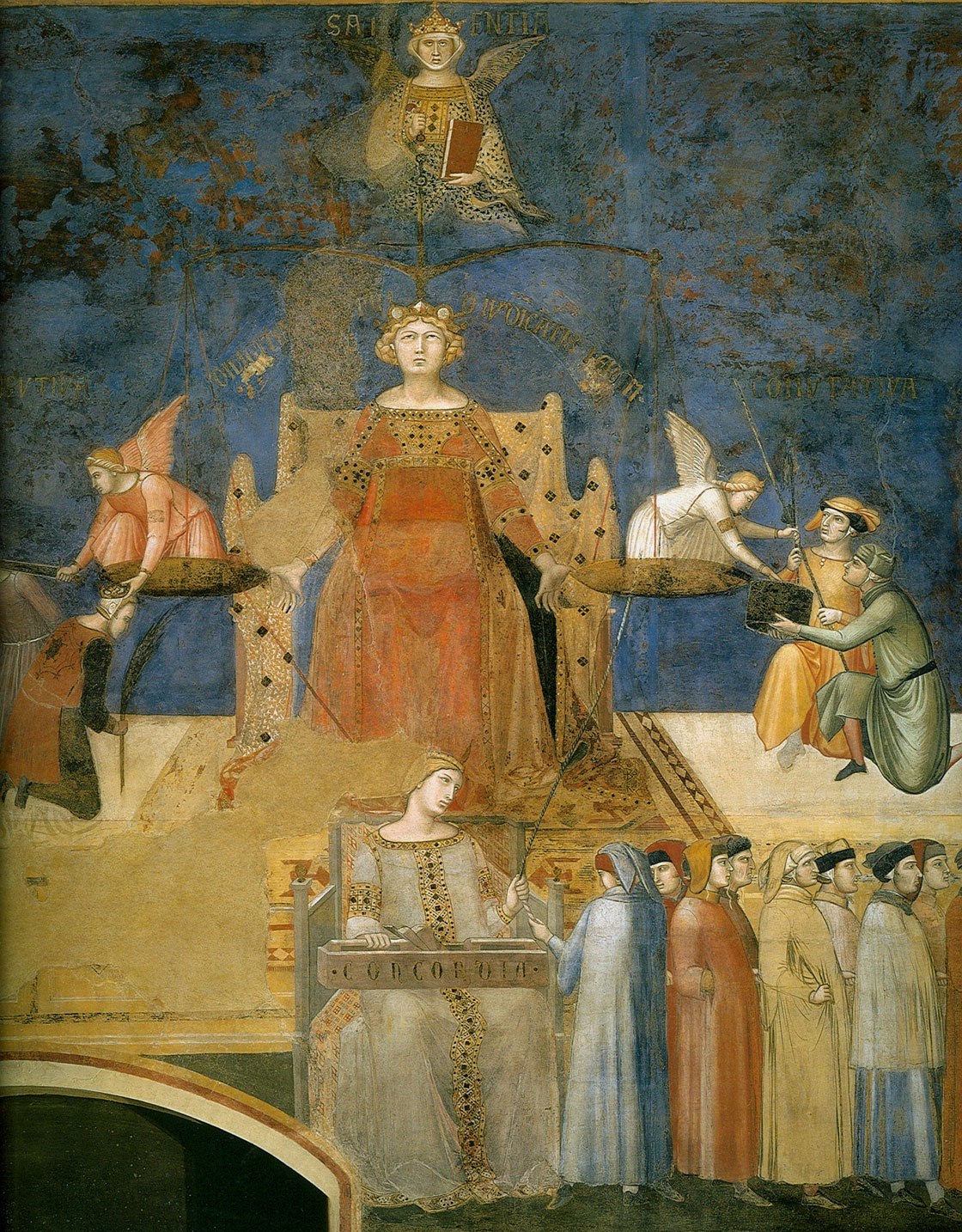
Ambrogio Lorenzetti, Justice (detail), Allegory of Good and Bad Government, 1338-39

The Allegory

Justice, still a figurehead of courthouses today, is the longest-surviving Cardinal Virtue. Her blindfold, supposed to indicate impartiality, makes her seem a bit benign, like she can’t actually witness what we’ve been up to. But prior to the 16th century, this was not the case, as we see in Ambrogio Lorenzetti’s exquisite, mid 14th c fresco, ‘Allegory of Good and Bad Government’ in the Palazzo Pubblico (town hall) of Sienna. Painted at a time when city states of Italy were becoming more secular, allegorical artworks like this in civic buildings were an attempt to incorporate the ancient virtues; to “legitimate and elevate secular activities by suggesting an association with the sacred.” By placing Justice and Judgement scenes in public places, “city states in Italy sought spiritual affirmation that their urban way of life was just as god-annointed as the old, feudal vision of society.” [Images of Justice, Curtis and Resnik, Yale Law Journal] 

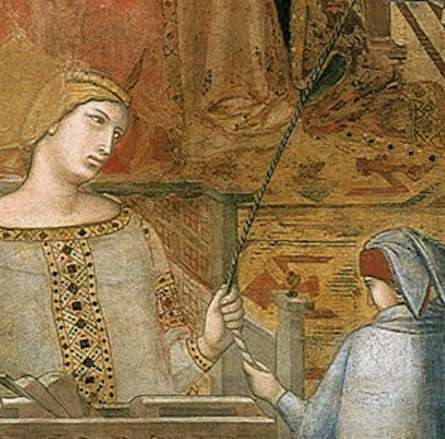
Justice appears in the mural a few times, in different forms; most prominently she’s seated on a throne (‘Distributive’ and ‘Commutative’ Justice), a hand resting on either scale, whereupon two angels dish out punishment or reward. She looks upward toward the higher power, Wisdom, who looks up to God. A cord runs from each scale (one is worn away) to the hand of Concordia, symbolizing a balanced state of society. Everything is connected in perfect equilibrium, everyone knows their place and responsibility as citizens.

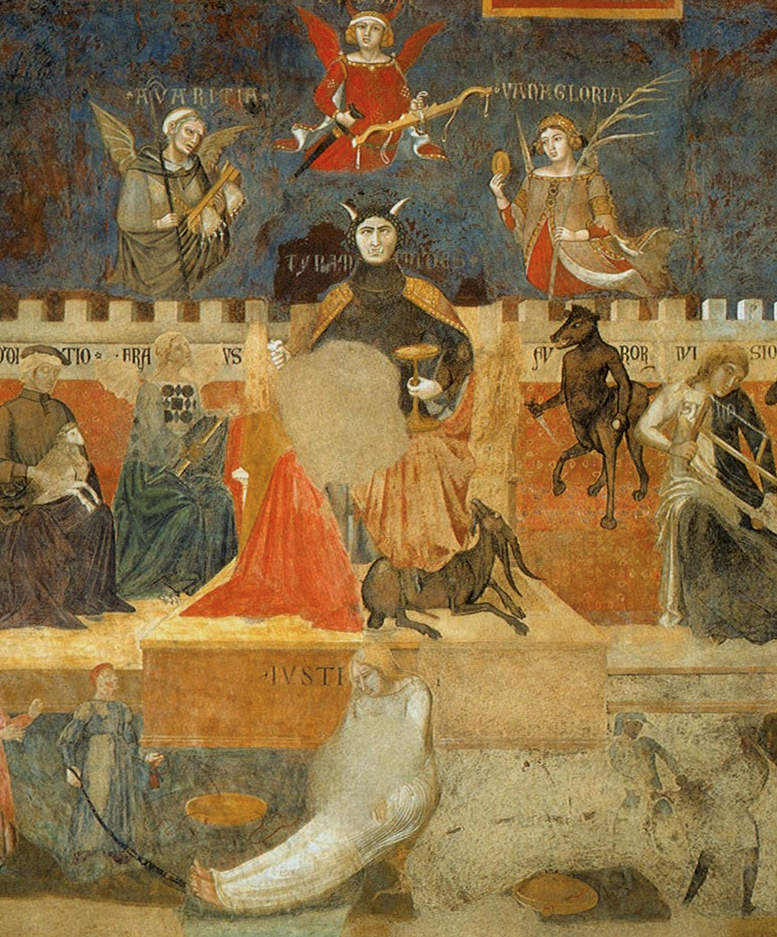
Ambrogio, Allegory of Bad Government (detail)

On the adjacent wall to her right/our left, the Satanic figure of ‘Bad Government’ is seated on a throne, the scales of Justice lie on the ground broken, and she sits in despair beneath him, possibly with hands bound. The relationship between the Supreme Court Justice and the Devil is established.

Watch this video for a more intricate tour of the mural. For our purposes, let it serve as an introduction to how the Virtue of Justice was “propagandized” at the time, and to some of the details that will carry over into the Tarot card.

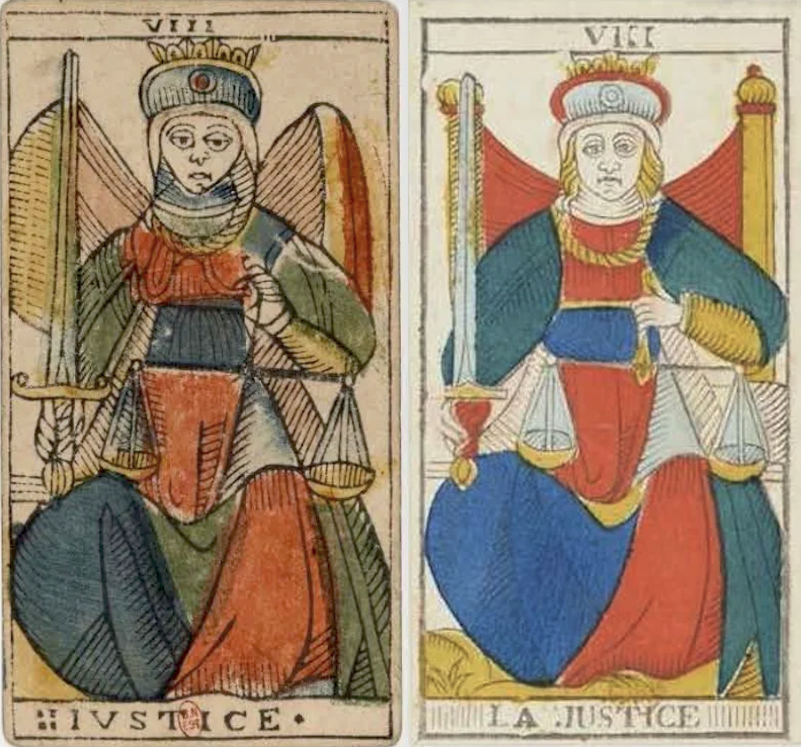
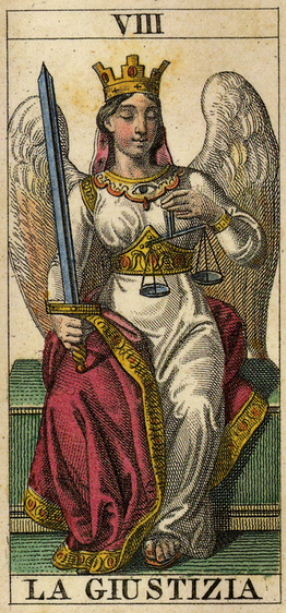
Examples of Type I (Dodal) and Type II (Conver) Tarot de Marsielle, 18th c.

The Pillared Throne

Type II TdM differs from type I, in that Justice’s ‘wings’ are absorbed into her throne’s concave and cylindrical shape. It features two, gold-coloured columns, one which is being ‘split’ by her sword. Emblemata books tell us that, unblindfolded, with sword held erect, she is ‘Divine Justice’. This is further indicated by her crown – more on that a bit later.

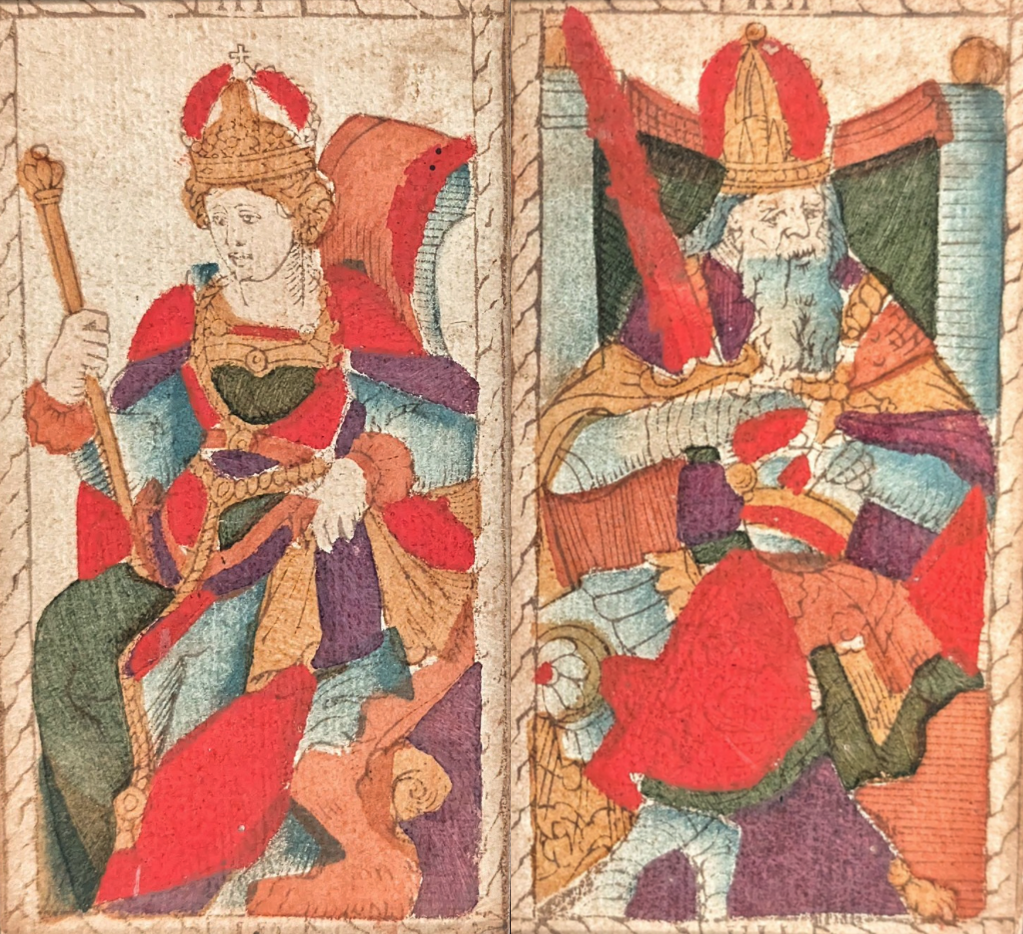
It’s important to compare decks for clues, and sometimes they’re found in unlikely places. In this earliest French Tarot, below, the Empress’ hand on the covered arm of her throne could also be seen as lifting her robe to reveal a leonine leg. Though it’s likely a skin she’s seated on, the gesture evokes a legend of the Queen of Sheba, where she lifts her skirt to step over water, revealing a hairy (sometimes exaggerated as bestial) leg.

If this connection was the artist’s intention, might the Emperor then show some hint of Solomon? I think yes – he is seated in columned throne, exactly like the one in TdM Justice, and holds not a sceptre, but a sword erect. “Remember, after all, the tale of Solomon, who offered to use the sword to cut the child in half, to give each claimant her share.” Ouch.

Empress and Emperor, Catelin Geofroy 1557 [photos: Alexandra Miron, click for details]
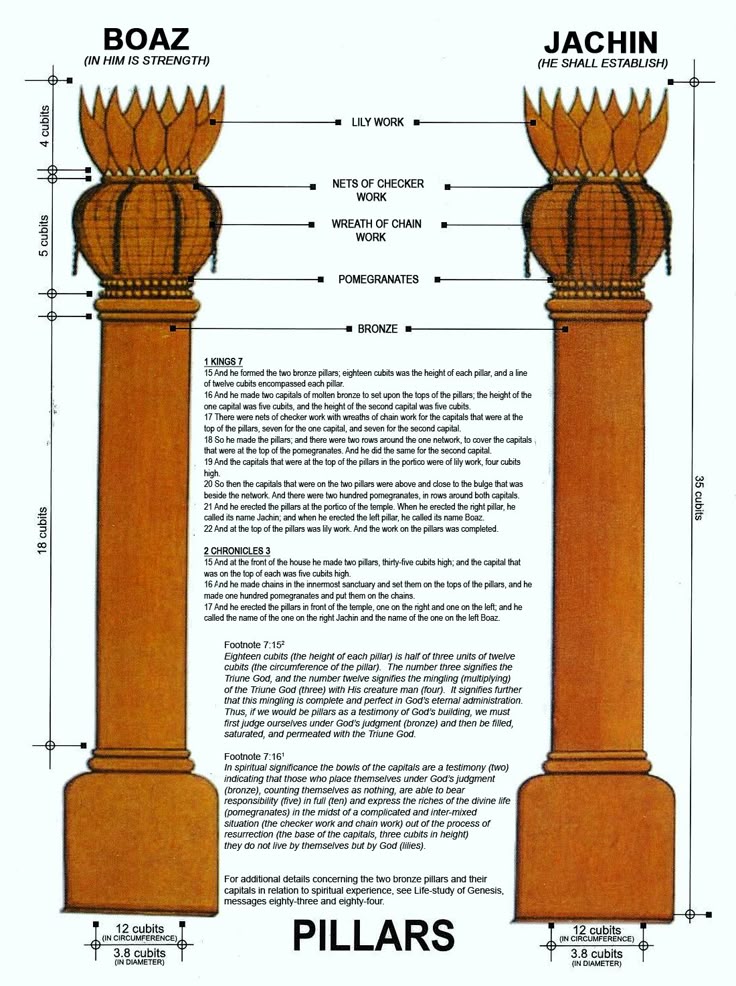
The Justice card of Catelin Geofroy no longer exists, alas. But, following this visual lead, the columns of TdM Justice’s throne might also be suggestive of Solomon’s brass pillars; on her right, the column of Boaz and on her left, Jachin.

“The earliest Jewish post-biblical account is of Romano-Jewish historian Flavius Josephus (Antiquities 8:165-9), who reframes the Queen of Sheba’s story for a Greek and Roman audience. He speaks of a philosopher Queen of Ethiopia and Egypt who, much like in the Hebrew Bible, travels to meet Solomon to subject him to a trial of wisdom. Josephus’ legend wasn’t picked up further in medieval Jewish and Islamic legends, but had a great influence on the further development of Christian tradition.” [The Collector]

Solomon’s temple pillars [note it reads ‘bronze’, which is the modern interpretation]
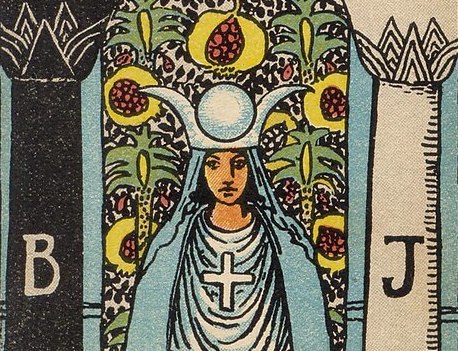
Each pillar was envisioned as having a bulge at the top, with a garland of pomegranates and a crown of lilies. The temple was also decorated with pomegranates. Described as symbols of ‘fertility and abundance’, ‘the promised land’, etc, it seems rather obvious from the Song of Songs that they have everything to do with Sheba’s divine (feminine) wisdom. So much so, that Smith and Waite (who was a Freemason) would put pomegranates and Solomonic pillars in the ‘High Priestess’ card, rather than Justice. (However, while the open pomegranates are saying one thing, her look is less than inviting, contrary to the traditional Popesse).

RWS High Priestess (detail)

In Greco-Roman tradition, the pomegranate is associated with fertility, death, changing seasons and immortality, its seeds resembling jewel-like blood droplets (often the blood of Dionysus). Persephone, by breaching the conditions of her spouse and eating six pomegranate seeds in Hades, is destined to remain underground for half the year and only return (be reborn) for the other half.

What is the little red dot on the pillar (right)?

In a similar and related tale, Eurydice is destined to remain in Hades after her beloved Orpheus breaks the one condition, that he mustn’t turn to look at her, en route back to the world of the living. The story of Eurydice may be a late addition to the Orpheus myths. In particular, the name Eurudike (‘she whose justice extends widely’) recalls cult-titles attached to Persephone. ” [wikipedia]

“Eurydice’s name means wide ruling Justice. She is the prototype of Dike, one of the Horea, born to Themis and Zeus. Dike stood for the All Way, The Way, The Truth, and The Light. As Dike’s prototype, Eurydice is a mythical goddess and archetype present in the underworld before the cloaking of the myth in the traditional romantic versions during the creation of the Classics by male authors.” [intro to Emily Miller, ‘Euridice’s Bones’]

(Similarly, Persephone was the ‘Iron Queen’ of the Underworld, prior to the Pluto abduction myth).

Horai (seasons) with pomegranates for Summer

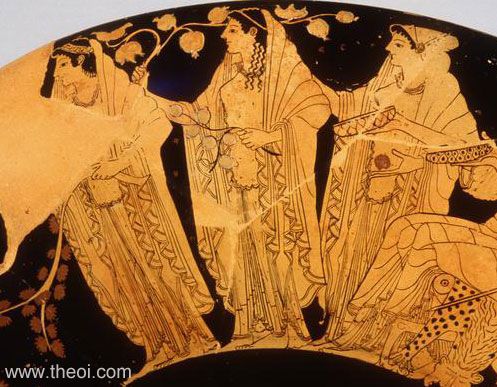
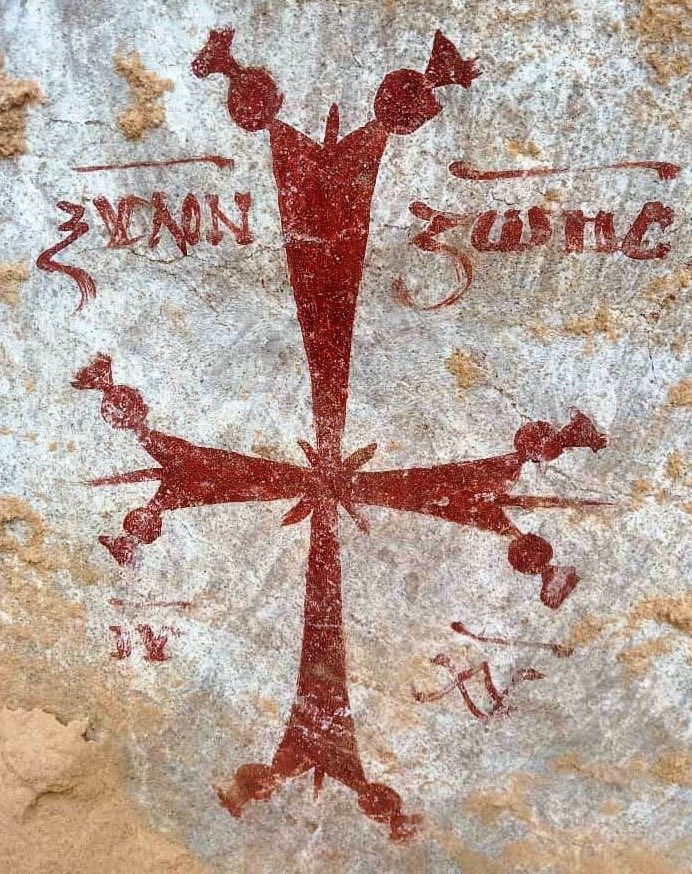
Coptic greek cross with pomegranates/”tree of life” from a recently discovered monastery in Egypt [Ministry of Tourism and Antiquities Egypt]
The fruit of the biblical tree of knowledge (of sex, death and immortality) was most likely a pom, not a pomme. The Lily, also a death and rebirth symbol is associated with Lilith, Isis and the Virgin Mary. Red and white are blood and milk, the colours of alchemical Rebis.

Brass signifies God’s judgement, ie, these are not merely ‘functional’ pillars. Passing between the two brass pillars represents entry into another world, eternity or another sphere. The card is divided not just vertically, but horizontally, by the bar of her scales; there is equilibrium between Heaven above and Earth below, just like in the Sienna mural. The curved back of Justice’s throne serves a dual design purpose, suggesting wings as well as heavenly spheres. Her sword traverses both realms and we notice the ball in its handle is threefold; the trinity of philosophical elements.

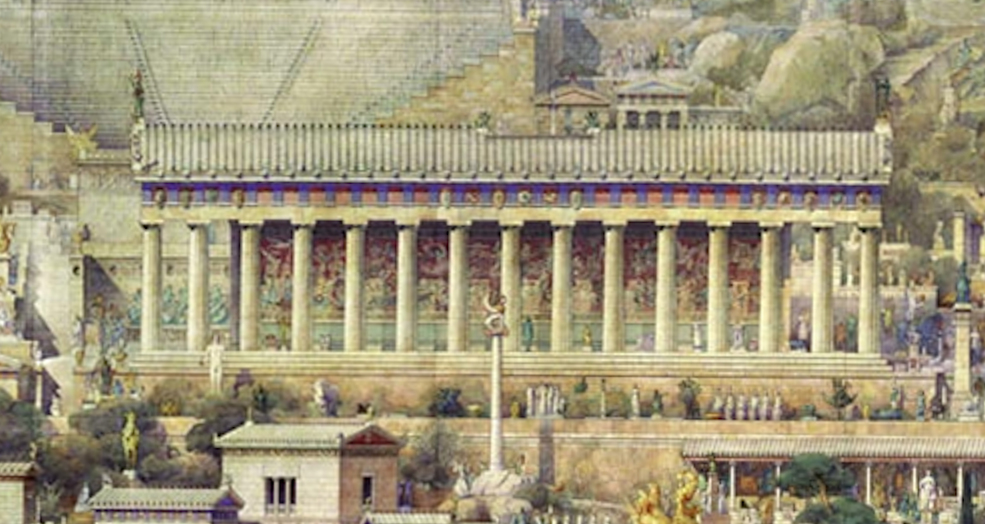
Temple of Apollo, Delphi

Wisdom Pillars

The two pillars of wisdom also can be likened to the two maxims inscribed at the entrance (possibly on columns) of the Temple of Apollo at Delphi. According to Pliney the Elder, these were written in letters of gold:

Know thyself
and
Nothing in excess

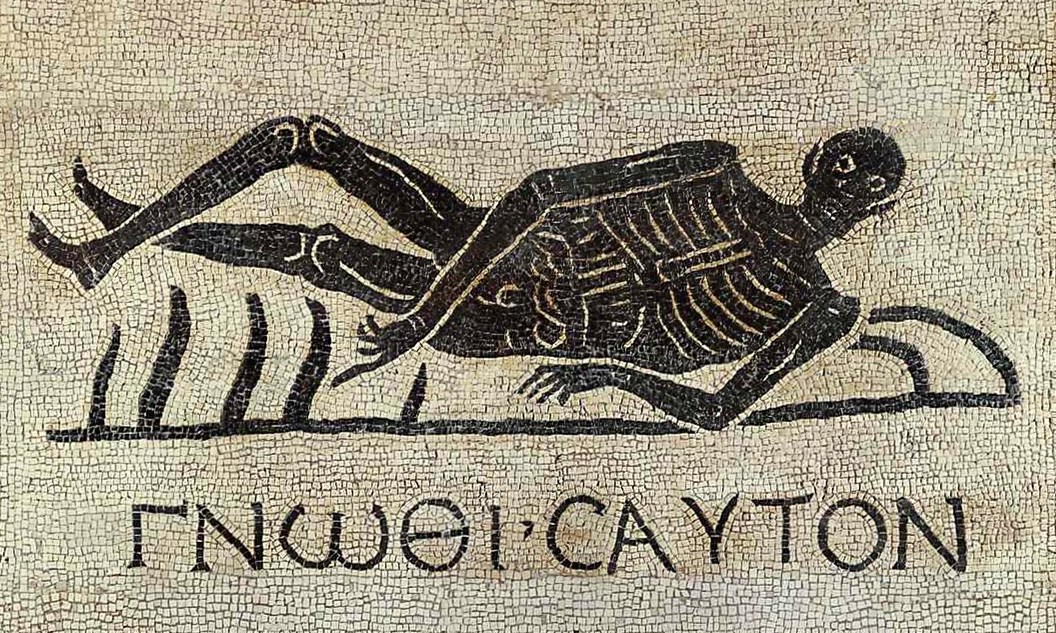
The famed ‘Know Thyself’ Roman mosaic (ca 30 BC-14 CE), Naples Museum

Know Thyself  [sword] 
The first application of the phrase to self-knowledge in the modern sense occurs in Plato’s Phaedrus, in which Socrates says that he has no leisure to investigate the truth behind common mythological beliefs while he has not yet discovered the truth about his own nature.

Wenceslas Hollar, The Golden Mean 1641-1644 (circa)

Nothing in Excess/Nothing too much  [scales]
The maxim has been said to have received its ‘ultimate expression’ in  Aristotle’s theory of ethics, according to which every classical virtue occupies  a middle place between the two extremes of excess and deficiency.

Concordia detail, Sienna mural

There was also a third maxim inscribed:

Give a pledge and trouble is at hand
The Greek word ἐγγύα, here translated “pledge”, can mean either (a) surety given for a loan; (b) a binding oath given during a marriage ceremony; or (c) a strong affirmation of any kind. Accordingly, the maxim may be a warning against any one of these things.
In Plutarch’s Septem sapientium convivium, the ambiguity of the phrase is said to have “kept many from marrying, and many from trusting, and some even from speaking.” [Wikipedia]

Among other things, which I’ll get to, the cord around Justice’s neck may indeed have to do with being bound to one’s word – or to one’s silence – especially in monetary and matrimonial matters (Libra).

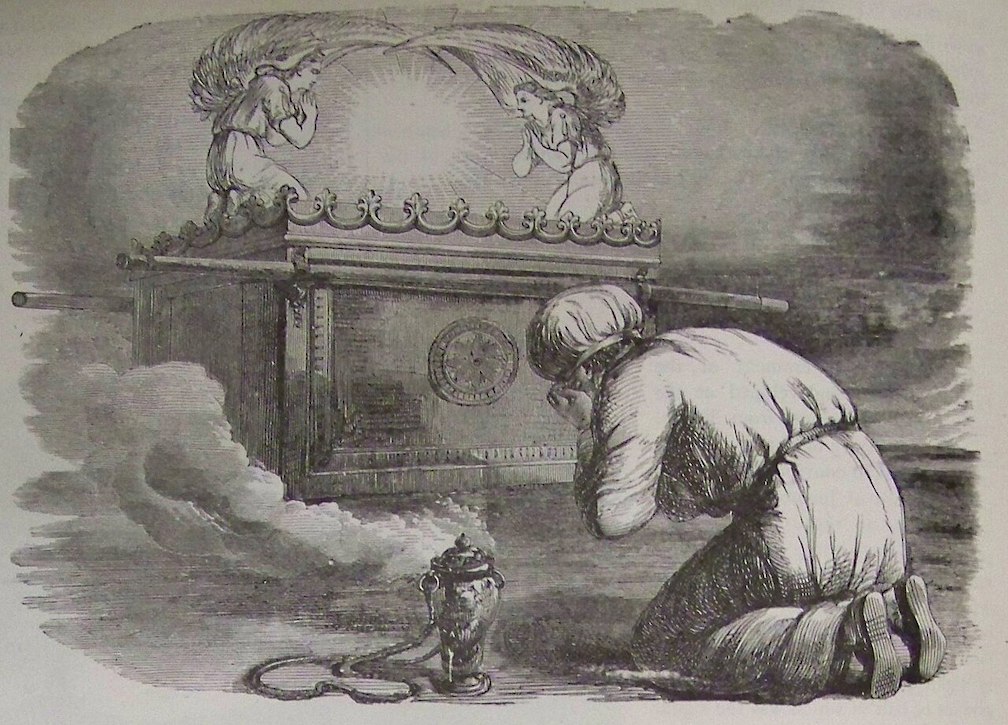
Mercy Seat, The Holman Bible, 1890 (note the curved angel wings are like bull horns).

Lady Have Mercy

Inside Solomon’s temple was something called a ‘Mercy Seat (hilasterion, “that which makes expiation” or “propitiation” for the removal of sin), which, according to the Hebrew Bible, was “the gold lid placed on the Ark of the Covenant with two cherubim at the ends to cover and create the space where Yahweh appeared and dwelled. This was connected with the rituals of the Day of Atonement.” (Yom Kippur, occurring in Libra season).

Oh my heart which I had from my mother! O heart of my different ages! Do not stand up as a witness against me, do not be opposed to me in the tribunal, do not be hostile to me in the presence of the Keeper of the Balance!

~ Egyptian Heart Prayer

Here the lines between Justice and Judgement start to blur, and the two often get conjoined when deciphering the meaning of this card, as was the intent of Italian civic hall murals. The difference is that Judgement (or Last Judgement) is a final verdict, whether it’s pronounced in a court of law or standing before a supreme being. Justice is about honing an inner sense of self-regulating equilibrium, guided by the understanding that we will ultimately face some kind of ‘judgement’ by the god(s) of our higher conscience – maybe not hellfire or pearly gates but ‘damned’ or ‘blessed’ to live in the kind of world we helped create. They are closely intertwined, but differing concepts.

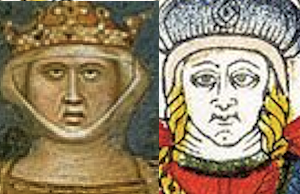
Sienna mural and Pierre Madenié details

In the ancient Greco-Roman world, supplication – begging for the sparing of one’s life, on the battlefield, for example – involved a specific set of gestures; the supplicant, on their knees (submissive stance), would clasp the dominant’s knees (they can’t walk away), reach up to clasp their chin (they can’t look away) and beg for mercy.

It’s been suggested that the scales rest on Lady Justice’s knee and are being tipped slightly. As well, the collar of her wimple, which again harkens back to our Sienna mural, has started to look a bit like hands. These are the type of details people often write off as ‘printing mistakes’, but might they have had a mnemonic function? In fact, during the Renaissance, Justice was sometimes depicted in a more gruesome way – as judges with severed hands.

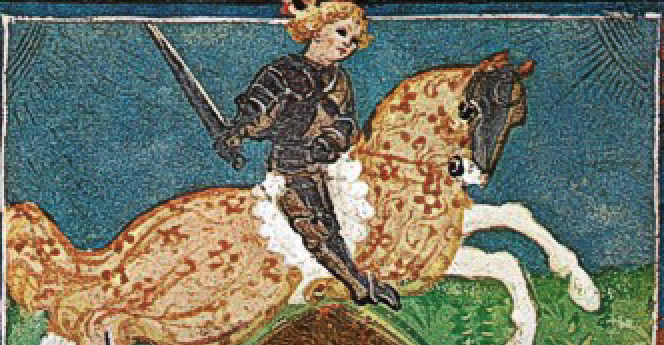
Visconti-Sforza Justice,  c 1450

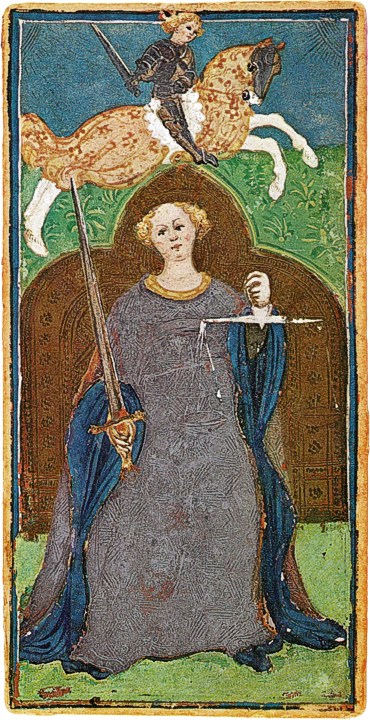
We can back up this notion of ‘having mercy’ with another Justice card, the Visconti-Sforza. It’s an anomaly in the deck (unless the original other two Virtues were also illustrated thus), in that the gold background does not go all the way up, but instead creates a throne back or triptych shape, while over her head leaps a knight on a white horse. Likely this figure represents the chivalric code of the Arthurian knights, who, while charged with enforcing justice, were also required to ‘be just,’ ie, to act from their higher consciousness and show mercy whenever possible, rather than give in to brutish impulses. This is in keeping with the idea of Temperance, also. We know that the Arthurian legends were extremely popular in Italy (some having been illustrated by Bonafacio Bembo, who painted the cards).

That this ‘hero rider’ – the solar hero – is situated above the Virtue’s head brings to mind Athena (wisdom and strategy, with violence only as last resort) who was conceived in and born from  Zeus’ head (intellect). The virtuous knight here takes the role of divine wisdom, by which lady Justice is guided, as in the Sienna mural.

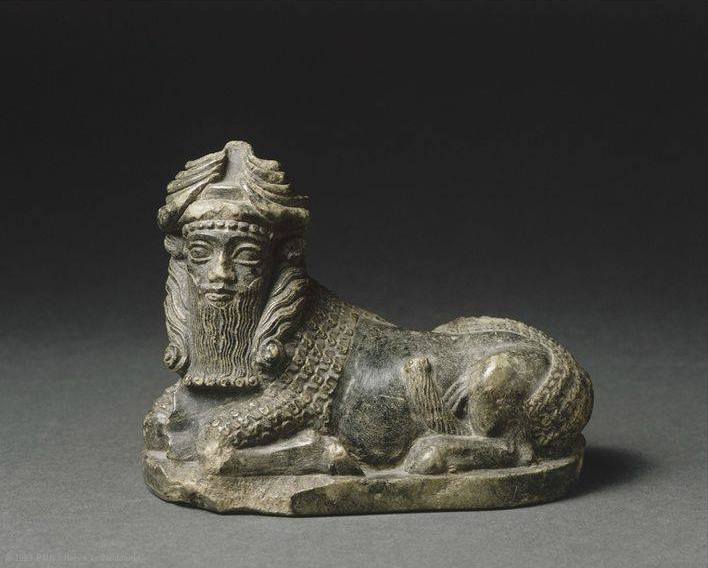
Recumbent bull with man’s head. Mesopotamia, c. 2350–2000 BC. Louvre

The Bull of Heaven

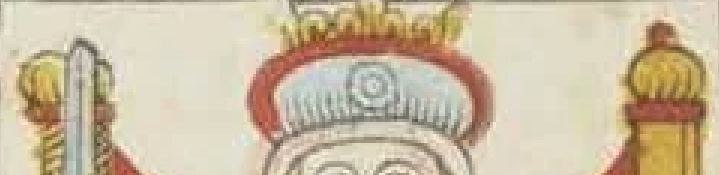
Let’s turn now to TdM Justice’s turbaned crown, up above the spheres. Although upside down, there is no mistaking the symbol for Taurus the bull, its horns cleverly formed by the interruption of her hair. The bull is a vehicle and/or attribute of any god or goddess worth their salt, particularly when they are acting as supreme judge. The two horns of the bull serve the same function as two pillars, maintaining stability and equilibrium.

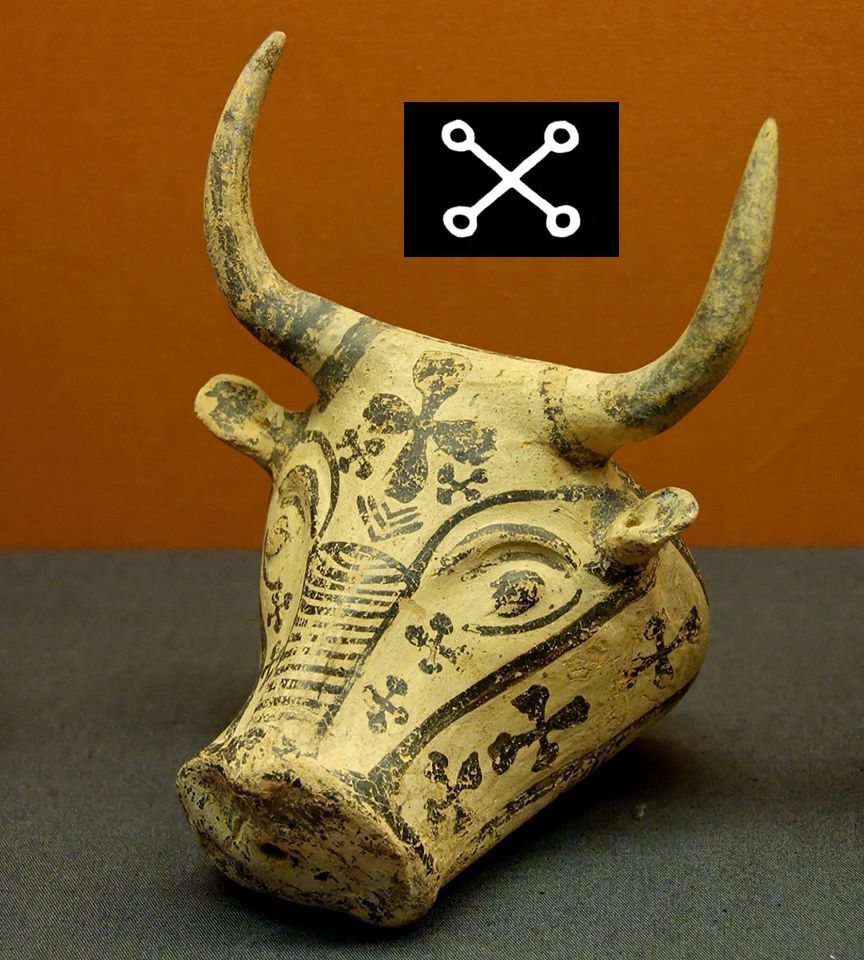
Mycenaean rhyton 1300-1200 BC, with sigil for Aldebaran (Agrippa)

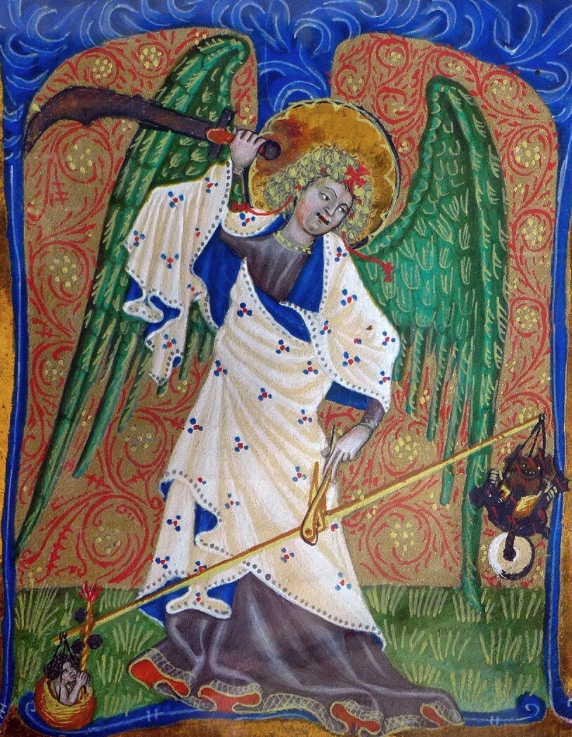
Central and level with the ‘sun and moon’ pillar bulges is the all-seeing, monadic eye in Justice’s bull crown. We are reminded of the ‘Bull’s Eye’ (aka ‘God’s Eye’) in the constellation of Taurus, Aldebaran, the watcher in the East. This royal star was once connected to the Spring Equinox (opposite Autumnal Antares, Heart of the Scorpion) and rises with the Pleiades aka ‘Seven Sisters.’ Aldebaran is associated with St. Michael, whose name is the rhetorical question he posed to Satan: ‘Who is like unto God?’ Might this be what Justice is asking? Could the rider of the V-S card also be a stand-in for St. George, chivalric incarnation of Michael the dragon-slayer?

St. Michael weighing souls during the Last Judgement, 15th c

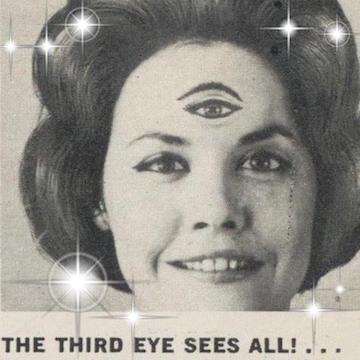
After 7 steps (or stages, or planetary spheres) we arrive at Justice, and 7 steps from Justice is the Devil. “If then you do not make yourself equal to God, you cannot apprehend God; for like is known by like.” If Justice is to be impartial in her judgement, she’s going to need that third eye.

The following is an excerpt from a fictitious 1490 dialogue by Italian doctor and humanist, Battista Fiera, between the painter Mantegna and the allegorical figure ‘Momus,’ on how to depict Justice. Mantegna, having heard conflicting accounts, has ‘consulted a series of philosophers’:

Mantegna: I began with Saxus Hippolytus. He said Justice should be represented with one eye; the eye being rather large and in the middle of the forehead; the eyeball, for sharper discernment, deep-set under a raised eyelid.

Momus: Suppose something happened behind her back? Might she not be taken in the rear? Will she be safe enough with only one eye in front?
. . . If she had an eye at the back as well, she’d be still more queenly and majestic.

Mantegna: Erasmus the Stoic [said] . . . that she ought to be shown seated, and holding scales in her hand.
“But . . . make her one-handed.”
“So that she couldn’t throw in a makeweight, of course.”
[Marianus] instructed me to depict her standing, and with eyes all over her as Argus was of old. . .  And brandishing a sword in her hand to ward off robbers, and to protect the innocent and the unfortunate . . . 
Astallius said she should be depicted sitting on a square marble chair with a slightly curved back, such as there was once at Lesbos, and measuring with a leaden rule.

Momus: To be sure, his was a milder image of Justice, since he left out the menacing sword; and he had good reason to fear she might have a fall. But why the leaden rule? Did he mean that Justice is sometimes twisted? For is not the common herd, remembering her waxen nose, loud in proclaiming that she is?

Mantegna: No, he didn’t mean that she is twisted; but he said she was to govern with equity – now and then to slacken the reins.

Momus: What did Fiera say?

Mantegna: [H]e enjoined me to depict her covered with ears as well.

Momus: Why? Was he afraid that she might become deaf?

Mantegna: He was . . . [and Astallius and Fiera also said] that Justice was to put on the habit of a penitent . . .

Momus: So, they want her to be mortified! But didn’t it occur to them to give her wings?

Mantegna: No one thought of that.

[excerpted with from ‘Images of Justice’ by Dennis E. Curtis and Judith Resnik, Yale Law Journal]

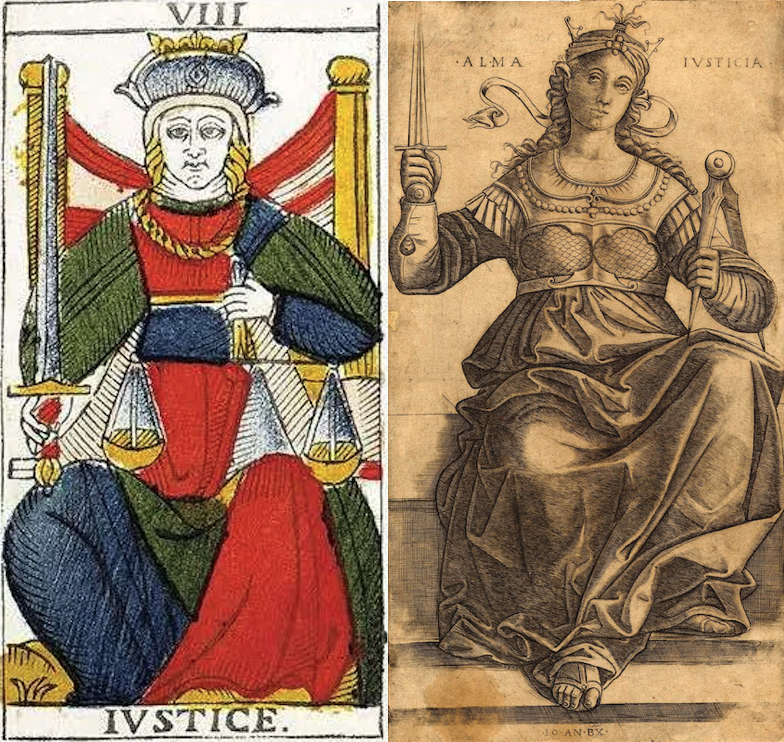
Pierre Madenié 1709 and Giovanni Antonio da Brescia 1475-1520  (note her foot shape).

The dividing line created by the bar of her scales can also be viewed as the horizon itself, where the cusp of Libra begins the Sun’s descent. The Pierre Madenié card provides another interesting detail; the handle of the scales is shaped like a divider compass (see Star post).

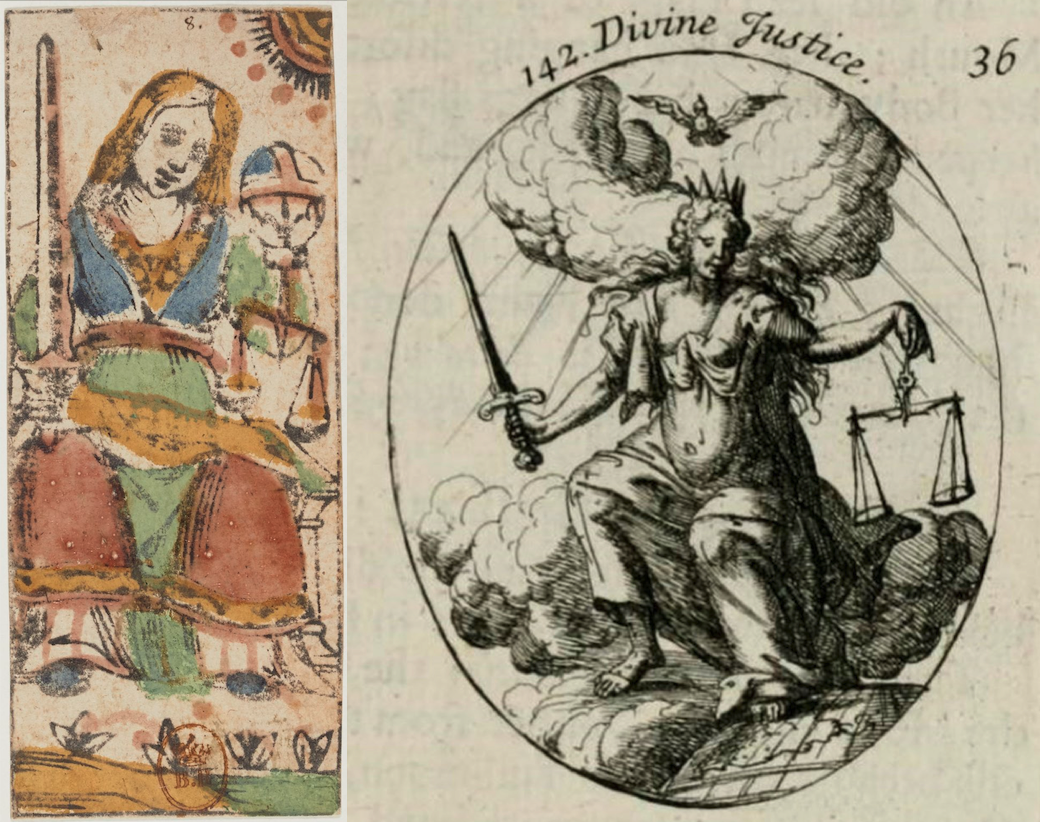
In the  Bolognese card, below, Justice’s scales hang from a globus she’s holding, similar to the Empress. This detail is consistent with emblems of Divine Justice, where her foot rests upon a globe. Like the TdM version, her lower half is weighty, grounded on Terra Firma, but in this case, she is Nature, ie, natural law, natural order, as above, so below. If we zoom in closely, there is what appears to be a little, bull head shape on her collar. Remember that Taurus is the sign of FIXED EARTH.

Alla Torre Justice card and Cesare Ripa Divine Justice

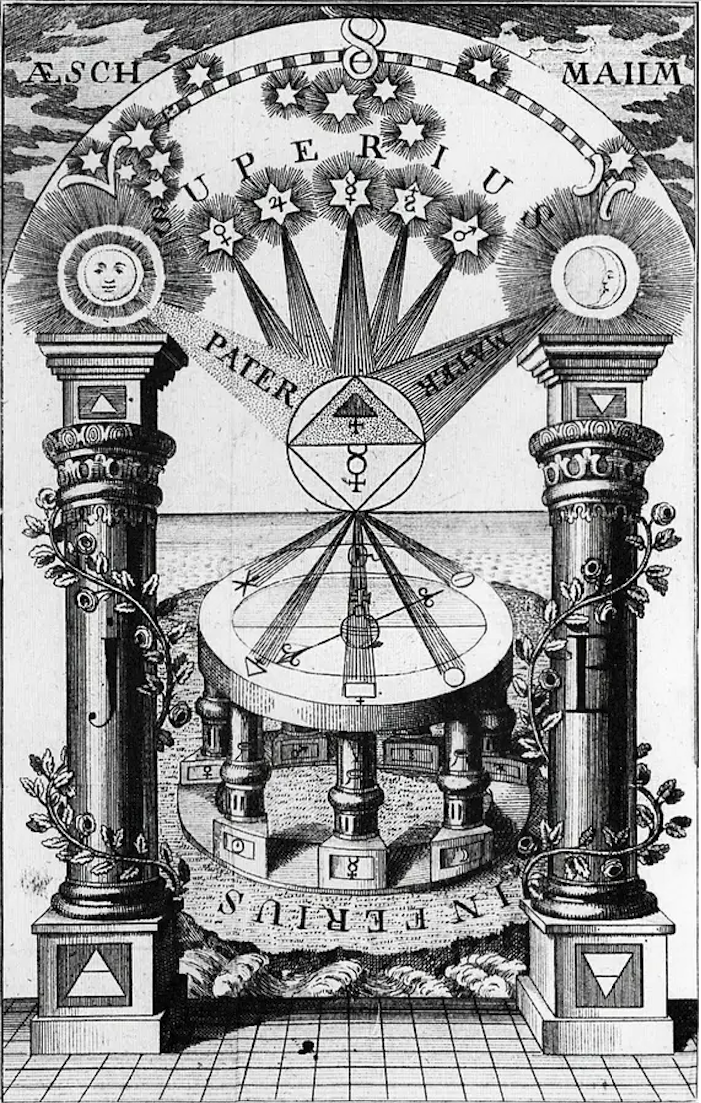
In the Rosicrucian image below, we can identify some similar components to the TdM Justice card, such as the two pillars of Wisdom (solar/father/fire/air and lunar/mother/water/earth). The above is as below, and the heavenly bodies shine onto a (directional) compass. In its centre is a globus cruciger, symbol for antimony (see Empress card) which is used in the purification of gold and silver, a material and spiritual process. At the very top is the symbol for Taurus, with Aries on the left, Gemini on the right. May, high Taurus season, when the Earth is most fecund, is when alchemists collect their dew, (again, Empress/Nature).

‘The Compass of the Wise’ frontispiece for a rare book on Freemasonry and Rosicrucianism by German author Adam Michael Birkholz, 1779

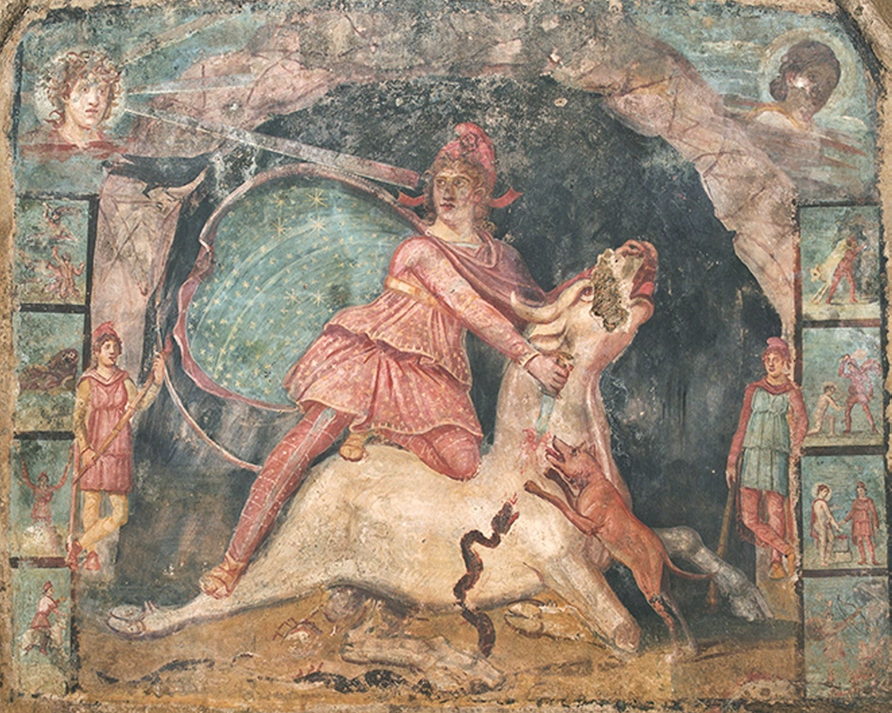
Mithras 

There is also a connection of these three Spring signs (Aries, Taurus, Gemini) to the Mithras Mystery Cult. Personally, I’ve never really jived with the brutal Tauroctony image – symbolic though it may be – central to every mithraeum in this exclusively male cult of Ancient Rome (2nd-3rd c). However, it is relevant to our topic. Originally, the Iranian god, Mithra was not associated with bull-slaying. Mithra is initiallyan ancient Iranian deity of covenants, light, oaths, justice, the Sun, contracts, and friendship. In addition to being the divinity of contracts, Mithra is also a judicial figure, an all-seeing protector of Truth…’As the god of contract, Mithra is indeceivable, infallible, eternally watchful, and never-resting. [Wikipedia]

Tauroctony fresco from a Mithras cave

Mithras is always accompanied by a pair of torch-bearing attendants, the Dadophori, a pair of ‘mini Mithras’ resembling the Dioscuri (Gemini). One holds his torch upwards, the other downwards, interpreted as the rising and setting Sun (life and death), creating a triad with the central solar god at the height of his power (noon) in the middle. They may also have symbolized the equinoxes. The slaying of the bull has been interpreted as the procession of Spring Equinox from Taurus to Aries (ca 2000 BC).

V-S detail

Interestingly, if we zoom in on the Visconti-Sforza Justice card, we can see the solar knight is also situated between two luminaries or suns. [Corner ‘suns’ were often just decorative, for example in the Bolognese tradition, but that was more than a couple of centuries later, and as noted, the background of this card is an anomaly.] And while we’re on the subject, does the TdM Justice’s hair not resemble torch flames?

“Within the Christianised zodiac, Taurus the bull was seen as an image of Christ in his role as the incarnating god, sacrificed in the redemptive act. Having rulership over the throat and vocals, Taurus was used in the secret zodiacal symbolism of Christianity as a symbol of the incarnate word ‘the Logos.” [Fred Gettings, The Secret Zodiac: The Hidden Art in Mediaeval Astrology]

Taurus was the word descending into matter/flesh, Pisces the ascent of the spirit back to the heavens.

Thus the death of the bull was the birth of life, and for this reason took its high place in the ceremony and art of the Mithraic cultus.” [ccel.org]

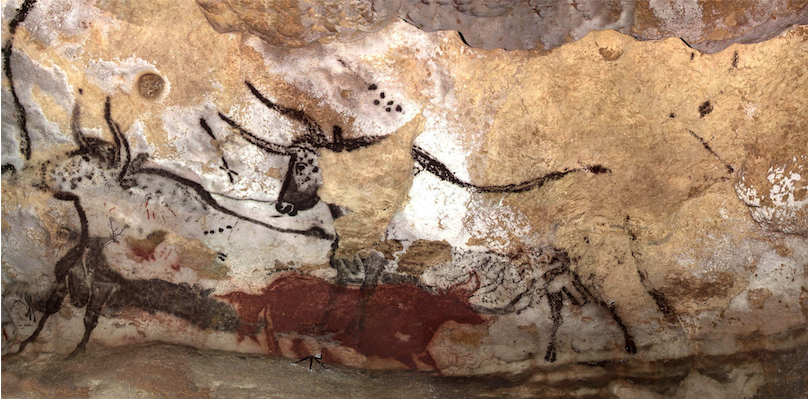
Lascaux Cave Bulls/Taurus constellation: ”Plus ça change, plus c’est la même chose.”

Some say that the Roman cult of Mithras, a ‘cult of the Sun that began as a personal  process in the darkness of a sacred cave’ was assimilated into Masonic traditions of the Middle Ages, or at least influenced them (he was born from a stone, after all). This purification ritual involved traversing 7 steps of his mystical staircase (possibly while on bended knee and blindfolded), corresponding to the 7 planetary spheres, in order to reach the Phrygian cap, a sword and a crown. Mithras, in the 8th sphere, represented cosmic order. 

Remnants of the olde religion?

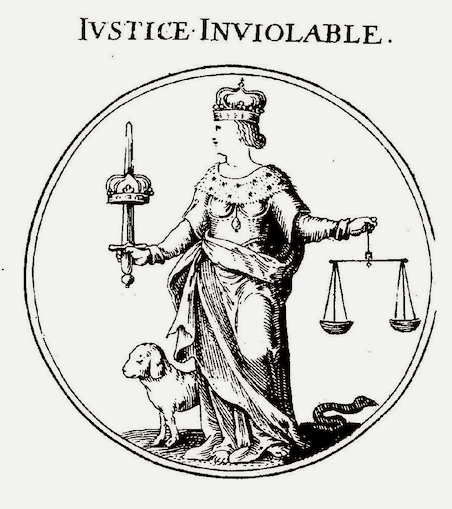
Curiously, Ripa later includes the dog and snake in his emblem of ‘Inviolable Justice,’ to symbolize how friendship and hatred can both corrupt good judgement. 

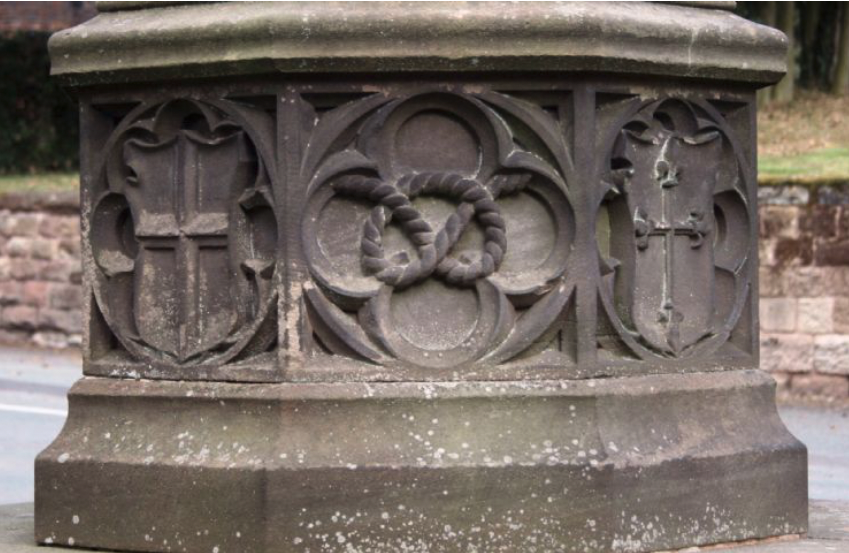
Masonry’s knotted cord

The Cord that Binds and Measures

Lastly we come to the golden rope or chain around TdM Justice’s neck. There are a few possible meanings for it. The most obvious explanation is that it’s to gently remind would-be criminals with, lest they should end up swinging like Le Pendu. However…

The English word ‘noose’ comes from the Old French ‘no(u)s’, from the Latin word ‘nodus’, meaning knot. But ‘nous’ was also the Ancient Greek concept for the higher, divine intellect, the mind’s eye that is the God’s eye. According to Aristotle, nous is the intelligence which apprehends fundamental truths (such as definitions, self-evident principles).’ 

‘Each intellectual virtue is a mental skill or habit by which the mind arrives at truth, affirming what is or denying what is not.’

[The cord connecting the two, Pisces fishes is called a ‘Nodus’, or ’Nodus Coelestis’, the Heavenly thread.]

Soprafino Justice with bleeding eye

Returning to the ‘Allegory of Good Government’, recall it is also the cord (or a portion of it) that binds Justice to Concordia.

There is an unseen cord that binds
The whole wide world together;
Through every human life it winds,
This one mysterious tether.
There are no separate lives; the chain
Too subtle for our seeing,
Unites us all upon the plane of universal being.

~ Small Talks on Freemasonry, Joseph Fort Newton, Masonic Service Association of the United States, 1928

If it’s the golden chain she wears round her neck (no reason it can’t represent both), it is probably the one by which Heaven and Earth are connected. To alchemists, this chain represented a series of transformations ‘from elemental chaos to quintessence’:

“Since all things follow one another in continuous succession, descending in order to the lowest, it will be found, by one who observes closely, that from the highest God to the lowest, all are bound together by mutual links, and the connection is nowhere broken. This is Homer’s golden chain, which he says God commanded to hang from heaven to earth.” – Macrobius, Commentary on the Dream of Scipio.

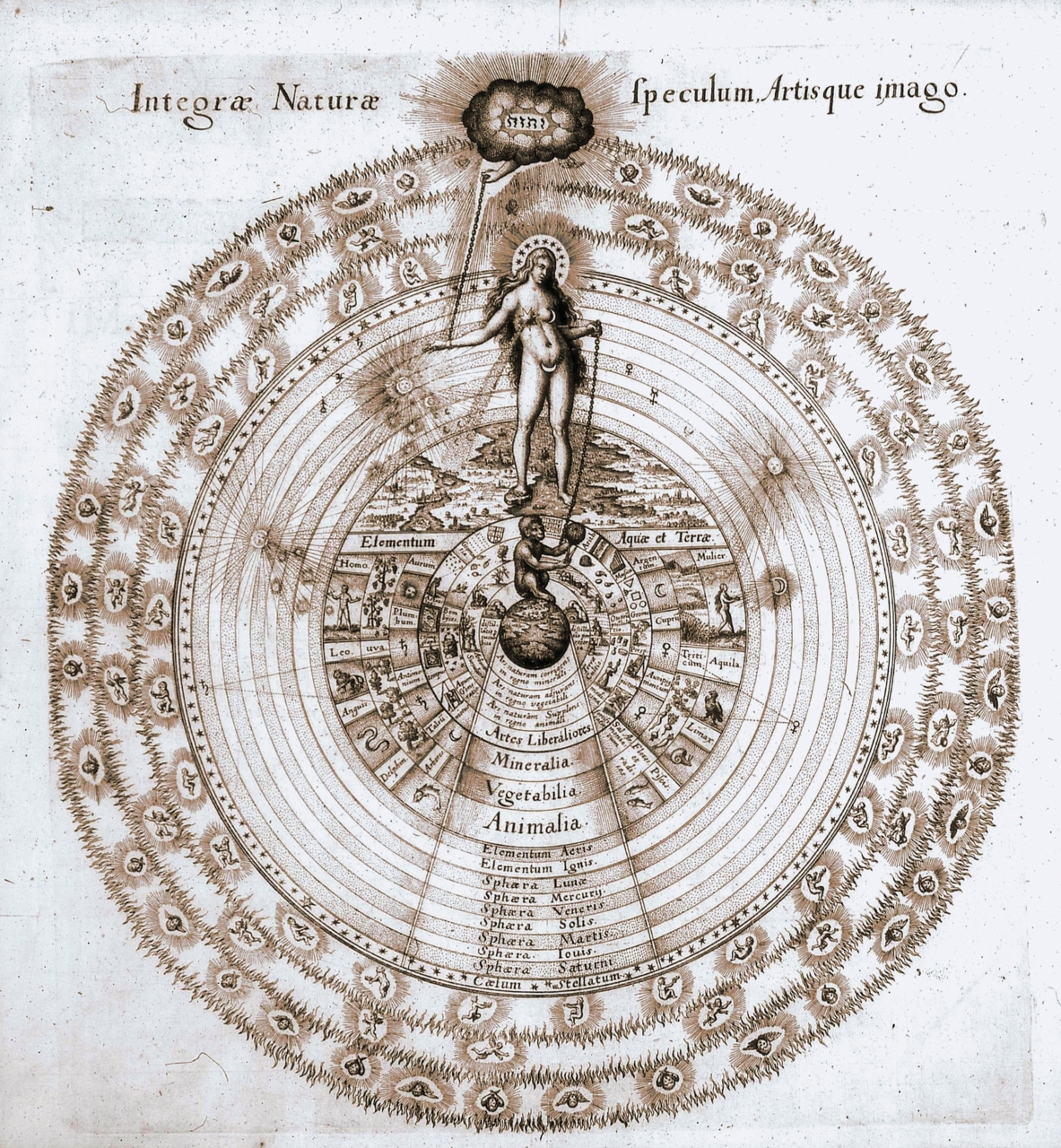
Integrae Naturae Speculum, Artisque Imago (Mirror of the whole of nature and the image of art), created by Robert Fludd, 1617. [click to enlarge]
You can kind of see a resemblance with the Anima Mundi here to a large, mediating figure of Justice, situated between heaven and earth, overlapping the planetary spheres. In place of sword and scales are two sections of the chain. Although she embodies both solar/masc and lunar/fem, the ‘world soul’ (like any soul) is considered feminine, and of this we are assured by the second lunar crescent in her pubis. Note also that the ape (reminiscent of Thoth?) uses a divider/compass.

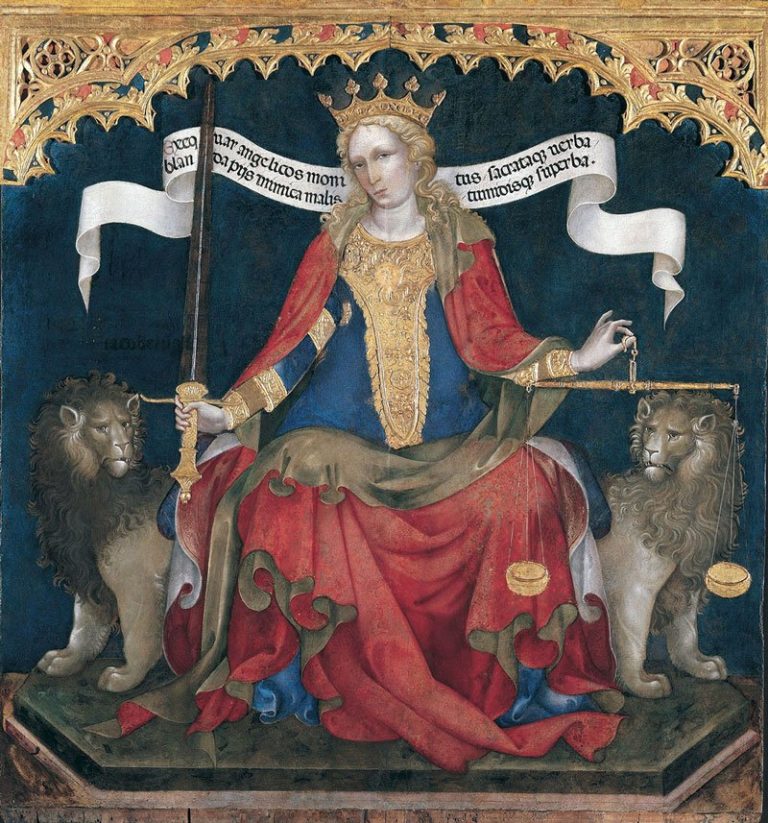
Jacobello del Fiore, Justice, part of triptych, 1421 (Gallerie dell’Accademia, Venice).

Finale (finally!)

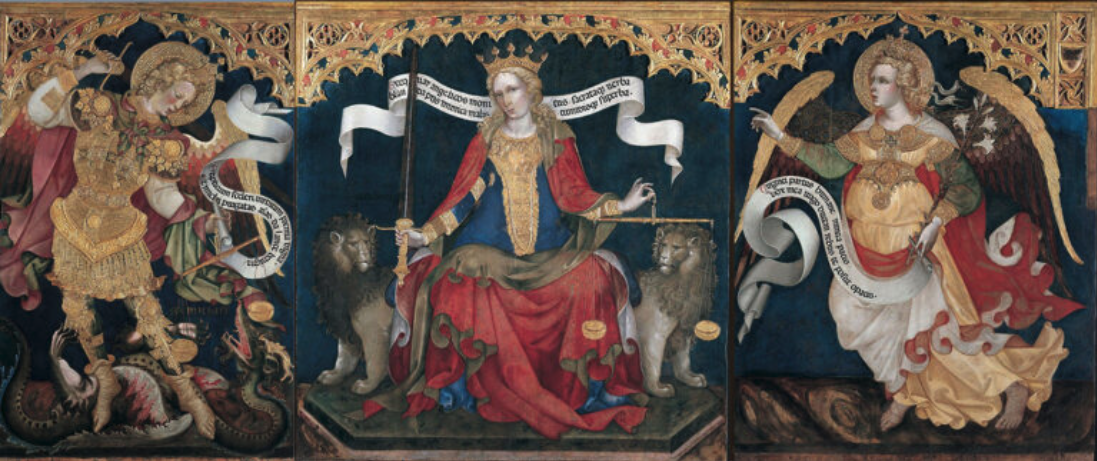
Perhaps my favourite Justice painting is another very fine Italian Renaissance depiction, where her divine and civic forms meet:

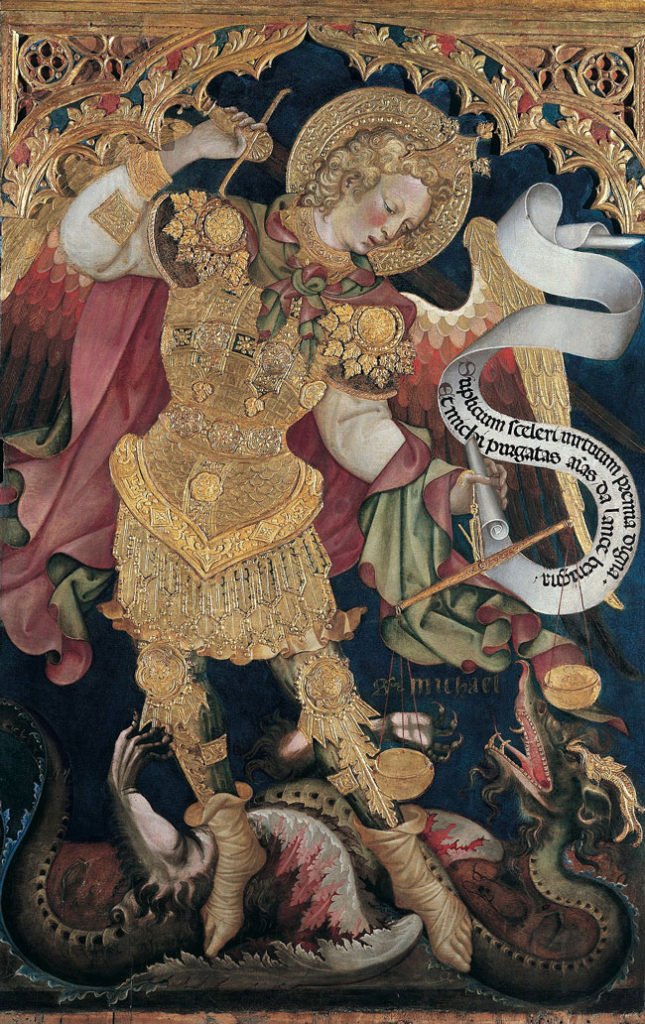
Justice is the primary virtue claimed by the Venetian state, and the lions allude to the justice and wisdom of Solomon. The female figure of Justice had even come to represent the personification of Venice herself. This identity is confirmed by the presence of Saint Michael in the left panel, minister of justice at the Last Judgment, who is shown in the act of unsheathing his sword to strike the final blow to the dragon beneath his feet and asks the enthroned Justice to “reward and punish according to merit and to commend the purged souls to the benign scales.

Jacobello, St. Michael

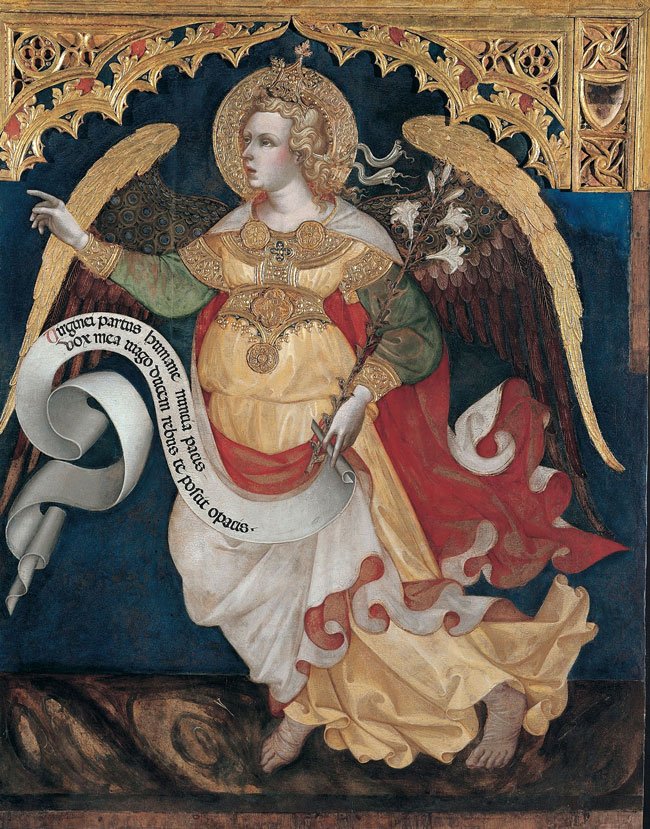
The Archangel Gabriel, bringer of peace, is depicted in the right panel, holding a lily in his left hand as he raises his right hand toward Justice in a gesture of benediction. Venetian legend professes that on the feast day of the Annunciation, when Christ was conceived for the spiritual salvation of humanity, God decreed the foundation of the city that was to offer political salvation to the Christian world following the fall of the pagan Roman Empire. In the allusive complexity of its self-representation Venice came to celebrate itself as a virgin city, never having been conquered, never violated. Jacobello’s figure thus acquires a complex persona, at once Justice, Venice, and the Virgin Mary.” [savevenice.org]

Jacobello, Gabriel

For a Tarot analogy, we could say she is at once Justice, the World and the Empress (and throw in Strength, too). As with many paintings of the time, it can also be interpreted in alchemical terms; Michael on Justice’s right, sword in his right hand, slays a black dragon, ‘fixing’ the volatile Mercury or breaking down prima materia, while a feminine Gabriel on Justice’s left wears a white cape and holds the white lily of purification in his/her left, the ‘white queen.’ The inside of his/her wings are even lined with peacock feathers.

All the colours of the alchemical stages are represented; black, white, [peacock], gold and red (see Michael’s wings, also). The complete and balanced Virtue wears a five-pointed crown (quintessence), the gold sun of wisdom and enlightenment on her chest (echoes of Athena’s aegis), and a red cape to match Gabriel’s white, signifying the union of opposites, integration of the soul, marriage of heaven and earth; the perfected work. ~rb

Jacobello del Fiore, Justice between the Archangels Michael and Gabriel, 1421 (full)

************************************************************
All written content *except quotations* is copyright ©Roxanna Bikadoroff. If you enjoyed the read, drop me a note, donate to my work, or share via LINK to the article. A short, credited excerpt/quote with link is fine, but do not republish the entire piece without permission, this would create imbalance in the world. Thanks!

La Force – Tarot de Marseille’s Enigmatic Strongwoman of the Threshold

In his essential book, Pagan Mysteries in the Renaissance, Edgar Wind describes ‘mystical imagery’ as belonging to ‘an intermediate state’:

They are never final in the sense of a literal statement, which would fix the mind to a given point; nor are they final in the sense of the mystical Absolute in which all images would vanish. Rather they keep the mind in continued suspense by presenting the paradox of an ‘inherent transcendence’; they persistently hint at more than they say. It is a mistake, therefore, to overlook a certain ambiguity in the praise of hieroglyphs which Ficino, and after him Giordano Bruno, adopted from an incidental remark by Plotinus. In a famous passage of the fifth Ennead, Plotinus had suggested that Egyptian ciphers are more suitable for sacred script than alphabetic writing because they represent the diverse parts of a discourse as implicit, and thus concealed, in one single form. Since Pico ascribed the same virtue to the writing of Hebrew without vowels, it is legitimate to suspect that the Renaissance speculations on ‘implicit signs’ were not concerned with a positive theory of optical intuition,  but with that far less attractive subject called steganography, the cryptic recording of sacred knowledge. Because God, in the opinion of Ficino, ‘has knowledge of things not by a multiplicity of thoughts about an object, but by a simple and firm grasp of its essence’, it seemed only right that the Egyptian priests had imitated the divine comprehension in their script, signifying ‘the divine mysteries not by the use of minutely written letters, but of whole figures of plants, trees, and beasts.’ But as Erasmus observed in the Adagia, the content of these figures was not meant to be open to direct inspection, or ‘accessible to anyone’s guess’; they presupposed in the reader a full acquaintance with the properties of each animal, plant, or thing represented… Thus, contrary to the divine intelligence which the reading of hieroglyphs is supposed to foreshadow, the intuitive grasp of them depends on discursive knowledge. Unless one knows what a hieroglyph means, one cannot see what it says. But once one has acquired the relevant knowledge, ‘unfolded’ by more or less exoteric instruction, one can take pleasure in finding it ‘infolded’ in an esoteric image or sign.

With this in mind, let us venture, armed with discursive information, to intuitively grasp the divine intelligence ‘infolded’ in this most hieroglyphic of TdM triumphs. [As always, click any images to enlarge and for more info.]

PART ONE

15th century ‘Fortitude’ cards: Visconti-Sforza, Cary-Yale, Charles VI

Earliest examples of the Fortitude card expressed the concept allegorically as physical strength/courage; Hercules or Samson beating up the lion or a formidable lady exerting control over it (taming animal instinct or temperament). Alternately, this formidable Virtue could be found grasping or busting up a pillar, as you do. Sadly, the dragon-extractor with an anvil on her head standing on a wine press didn’t get selected…guess Medieval fashions had become passé.

Engravings: Samson rendering the Lion late 15th c, Hans Ledenspelder ‘Forteza’ (after 15th c “Mantegna” prints) mid 16th c

La Force from a French Book of Hours, 1430-35 [Morgan Library]
Numerous variations of a man or woman atop a lion also appear in Valeriano’s 1556 Hieroglyphica book. He and others were directly inspired by Horapollo Nilous, an Egyptian scribe and one of the last remaining priests of Isis, whose ‘translations’ of Egyptian hieroglyphs had been re-discovered in 1422 and put to print  in 1505. Such as,‘To denote Strength, they portray the FOREPARTS OF A LION, because these are the most powerful members of his body.’ 
Read all about Horapollo’s Hieroglyphica and TdM here.

Lion tamers from Valeriano’s Hieroglyphica 1556

The word ‘force/forza’ comes from Latin ‘fortis’, meaning “strong, mighty; firm, steadfast; brave, bold.” It later came to include “courage, fortitude; violence, power, compulsion.” Being top of the food chain and having a solar mane (Leo), the noble lion is one of the oldest symbols of power and rule, including rule of law; it’s roar equated with the thundering word of God. Examples are exhaustive, going back to ancient times. But male deities could only hope to possess or overcome this indomitable force of nature, which ultimately belonged to the great Mother – giver, protectress and taker of life.

Lion Goddess Medley (click image for details)

Without diving too far into the whole lion-goddess topic, there are a couple that might be mythically relevant to us; Al-lāt and Medusa/the Gorgoneion/Athena. We’ll return to them, and to Hercules, in a circular fashion. But the use of a woman, rather than Hercules or Samson, in the TdM Strength card might be intended to illustrate a ‘princely virtue not confined of military strategy, a combination of force and prudence’ and the mitigating effect of Venus on Mars’ impulsive and destructive nature. She does not destroy it – nothing would ever perish without Mars, creating a different kind of imbalance – merely keeps it in check, Venus as lion-tamer.

Henri Cartier-Bresson, The House with the Caryatids, Athens, 1953

When we place all the numbered triumphs in a row, Strength/La Force is  situated smack in the middle – a gateway or junction between earth and heaven, waking life and the intermediate state, or even just at midlife:

Midway upon the journey of our life
  I found myself within a forest dark,
  For the straightforward pathway had been lost.

Ah me! how hard a thing it is to say
  What was this forest savage, rough, and stern,
  Which in the very thought renews the fear.

So bitter is it, death is little more;
  But of the good to treat, which there I found,
  Speak will I of the other things I saw there.

 ~ from The Inferno, Canto I, Dante Alighieri (trans by H.W. Longfellow)

That we can’t readily locate Prudence might indicate that Justice, Force and Temperance are more than just classical Virtues, if not the totality of them. Note how they all fall into the ‘2’ placement, according to the Pythagorean cosmology, ‘One becomes two, two becomes three, and out of the third comes the one as the fourth.’ Justice and Temperance flank Force on either side like two caryatids; one holding a sword and scales of dismemberment, the other, watery vessels of renewal. Seven cards (as with the 1s and 3s), three on either side of the central one.

Cards in the ‘2’ placement, Camoin-Jodorowsky deck, 1997

Ten, the divine number that forms the mystic tetractys – was also of great importance to Pythagoreans. Here is how the cards match up using their Roman numerals (this is not the numerology way of adding the digits together to reduce it to the ‘lower octave’, which can only be done with Arabic numerals):

Our chief concern here is that I (Le Bateleur), XI (La Force) and XXI (Le Monde) represent beginning, middle and end (and/or vice versa). In the beginning, as mentioned in this post about the Juggler/Bateleur, we see beneath his table a little, mandorla-shaped flame or golden barley grain (or cypress tree), in the distance. At the end, the complete being makes their appearance inside a similarly shaped wreath. And at the half-way mark, the lion’s maw extends directly from the yonic gates. Unique to TdM, this strongwoman doesn’t simply straddle the lion, it is part of her, just like Skylla’s hounds.

The ‘rule of three’: beginning, middle and end (Nicolas Conver TdM, ca 1760)

The pip cards are also numbered I to X, and the suit of swords bears a similar design to XXI. To Pythagoreans, the Vesica Piscis created by two, intersecting circles represented the intersection of heaven and earth – a place where dimensions merge into a lens or keyhole through which a more essential (or quintessential) reality might be glimpsed. Of course the church picked this concept up and ran with it.

Immaculate Conception, Taller del Pinturicchio, ca 1490

Notice how the TdM suit continually ‘blinks’ from sword (masc/odd) to flower (fem/even), until a blending of both (active red becomes passive blue, one sword becomes two) in the last card. The design is thought to be based on playing cards that originated during the Mamluk sultanate in Egypt, which ended in the early 16th century.

Conver TdM Sword pips

Now for a slight detour…

For over a thousand years prior to Islam, Northern Arabia and well beyond had been the domain of Al-lāt, central figure of a lunar triad known as ‘Manat’. The Black Stone in the Kabaa at Mecca (thought to be a meteor) was once part of Al-lāt’s cult and, as such, is not mentioned in the Quran. ‘The Kaaba marked the location where the sacred world intersected with the profane, and the embedded Black Stone was a further symbol of this; an object as a link between heaven and earth.’ [Wikipedia]
There were in fact two more stones (the other two goddess of the lunar triad?), a red one associated with the deity of the South Arabian city of Ghaiman and a white one in the Kabaa of Al-Abalat, near the city of Tabala, south of Mecca. (Note the relation to the three primary colours of alchemy).

Manat triad with Al-lāt in the style of Athena and Lion of Al-lāt from her temple (destroyed by ISIL).

One of the hidden secrets of the medieval bardic romance is the Arabian origin of the Waste Land motif, most prominent in the Holy Grail cycle of tales. Despite monkish efforts to convert it into a Christian chalice, the Grail was generally recognized as a female symbol, whose loss implied fear for the fertility of the earth. Crusaders had seen for themselves the desolation of Arabia Deserta, one of the most lifeless regions on earth. They heard the Shi’ite heretics’ explanation for it: Islam had offended the Great Goddess, and she had cursed the land and departed. Now nothing would grow there.  [Barbara G. Walker, The Women’s Encyclopedia of Myths and Secrets]

Preserving the source: Rochais 18th c, Visconti-Sforza 15th c, Al Leone 17th c
Moon face(?) detail of Visconti-Sforza card (attributed to Bonifacio Bembo)

In the three Aces of Cups, above, the lunar triad and feminine symbolism is obvious, as is a hint of Islamic influence. In the two, printed cards, it almost looks as if her ‘house’ has been up and transplanted (from the Holy Land?).

The Lyford House being transplanted by barge, 1957

In Christianity, the triple Moon Goddess became the ‘three Marys,’ the central or all-in-one figure being the ‘Mother of God.’ There were variations on the triad, depending on the context. She could also be expressed as the three virgins – Mother Mary with St. Catherine and St. Barbara.
In TdM tradition, the cup’s tripartite, central, steeple (flanked by three ‘minarets’ on each side = seven) evokes the robed Madonna – or at least something veiled and sacred with three conjoined circles at the top. All the great cathedrals of Europe were built and named for ‘Our Lady.’ Somewhat surprisingly, Mary is revered in Islam as the greatest and purest woman that ever lived, and is the only woman mentioned in the Quran.

Mary ‘Our Lady Of Willesden’ pilgrim’s badge, early 16th c

The Visconti-Sforza card depicts a beautiful fountain with water flowing from the ‘waxing’ and ‘waning’ flowers. Its central flower is aligned with the vessel-shaped winged figure, which may or may not have a full Moon face (it is too damaged to be certain). Under the Visconti, 14th-early 15th century Milan was a centre of Marian veneration out of which, despite macho, power politics, much wealth, beauty, art and culture was generated (or re-generated), including the hand-painted Tarot cards that bear their name.

Madonna and child flanked by lions, from a 15th c Parisian Book of Hours

END OF PART ONE

. . . . . . . . . . . . . . .

. . . . . . . . . . . . . . . .

PART TWO

Welcome back. Now let’s return to the card in question and examine some details of our TdM mistress, beginning with her infamous hat. Many have noted its ‘lemniscate’ shape, but otherwise it’s a conundrum. Examples of Renaissance era straw hats, hair nets (most likely) and headgear are continually compared, as if to suggest there is no other reason for its weird shape except that’s just (kind of like) what people wore. Well, alright, but why did the artist choose this particular shape of hat, for this particular card? Consistent in Tarot de Marseille, which takes cues from Renaissance art, is that the image components must serve more than one, visual function and must therefore remain vague enough to evoke or suggest, but never give the whole game away. It’s a puzzle we are invited to figure out. 

Dodal (type 1) and Conver (type 2) hats

In both type 1 and 2 versions, only one side of the brim has a leafy/scaled pattern. We’ve established that XI is midway between I and XXI, and that what begins as a single ‘grain’ shape in the first card will become a whole wreath in the end. Might it not stand to reason, then, that only one side of her hat has been ‘filled’ thus far?
The scaly side in type 1 also strangely resembles a (bearded) serpent head, like that of the Egypto-Greco-Roman Agathos Daimon or ‘good spirit’ guarding the mysteries in the catacombs, below (and in opener image). The four, petal-like shapes in the gorgoneion (Medusa mask) above it are also a close fit.

Kom el Shoqafa Egypto-Greco-Roman catacombs, Alexandria [photo: Justina Atlasito]
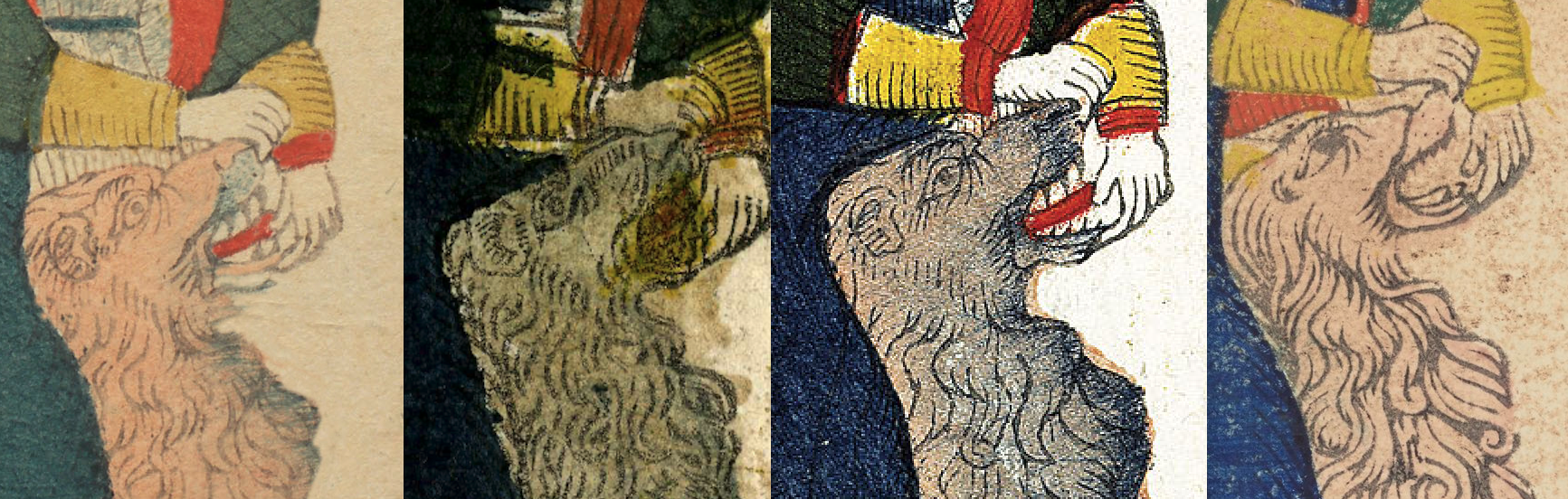
In the Conver card, we immediately notice a few irksome details about this so-called ‘lion.’ It looks like something  canine – or perhaps a bear – wearing a lion’s skin (and evoking the serpent?). Also, the top of the woman’s hat seems to replicate the beast’s lower mandible. In some versions, the lion has no lower teeth, as if they have migrated to her hat (below, right), but in others (the close up, below), it still has a few. Comparing with earlier versions, it does appear to be a printing mistake – or, was the image altered intentionally? Sometimes accidents can add another dimension.

L to R: Chosson 1672, Dubesset-Valentin 1680c, Pierre Madenié, Conver 1760.

Addendum: Didier Dufond, who is the expert on Bacchic-Orphic symbolism in TdM recently pointed out (in a comment on the Fool post, which is perhaps more relevant within the context of this post):

..I add that this liturgical sequence was unknown to scholars at the time of the Renaissance, which suggests a direct transmission, far from the elites of that time. Same concealment technique with the strange hat of Force, with the pine cone of the thyrsus decorated with a knot, plus undoubtedly a snake and a crown of ivy, all attributes of the bacchantes. And a bacchante thinking of tearing off the head of a lion with her hands is known in Euripides’ tragedy The Bacchae, when it was about her own son, Pentheus.

So, in this case, the serpentine ‘petals’ of the gorgoneion in the tomb are pinecones just like in the thyrsus the Agathos Daimon below holds. Can’t believe I didn’t catch that!!

What he is referring to is a scene in said Greek tragedy where Pentheus, King of Thebes, having imprisoned and insulted Dionysus, ends up having his head torn off by his own mother, Agave, who thinks he is a lion. So much for the ‘princely virtue not confined of military strategy, a combination of force and prudence’ and the mitigating effect of Venus on Mars’ impulsive and destructive nature! Agave is clearly a force of nature. I need to study this play.

It has also been suggested that the beast resembles the ‘Tarasque‘, an ancient, lion-headed, dragon-like creature from French/Gaulish mythology that was ‘tamed’ by St. Martha. This does not change the esoteric meaning at all, but rather adds to it, since Martha was one of the ‘3 Marys’ and appears in connection with her brother Lazarus being raised from the dead.  

Valentin & Dubesset c 1680 (previously dated earlier) and Conver ca 1760
Nicolas Conver (British Museum card) ca 1760

2 placement cards always depict some kind of vessel(s), here represented by her two, mismatched, gold vambraces. In Conver versions, each is divided by eight lines into nine sections (excluding the full bands on the ends). This might not be accidental, as we shall see.
It’s also odd that the artist, after having taken such great care with the animal’s detail right down to the teeth, would have neglect to fix the lady’s goitre – another detail unique to Conver (supposed to be her hair). Now it looks as though her head has been, idk, severed? Hmm, what mythical being had a severed head with serpent scales…oh right.

“Visita Interiora Terrae Rectificando Invenies Occultum Lapidem Veram Medicinam” [Visit the interior of the earth, and by rectifying you will find the hidden stone which is the true medicine].

‘Golgoi Sarcophagus’, 475-450 BC. Discovered by tomb robbers in 1873 [MET]
The Popess held open to us the book of lesser mysteries. Now it seems we’ve arrived at the gates of the greater mysteries, judging by the guardians:

At first in motion set those beauteous things;
  So were to me occasion of good hope,
  The variegated skin of that wild beast,

The hour of time, and the delicious season;
  But not so much, that did not give me fear
  A lion’s aspect which appeared to me.

He seemed as if against me he were coming
  With head uplifted, and with ravenous hunger,
  So that it seemed the air was afraid of him;

And a she-wolf, that with all hungerings
  Seemed to be laden in her meagreness,
  And many folk has caused to live forlorn!

~ Dante [ibid]

Dante running from the three Beasts, William Blake 1824-27

Throughout history, initiations have been performed in caves, or underground, in the belly of the Great Mother. We know that mystery initiates confronted the darker aspects of themselves during the simulated death experience that is essentially descent into the ‘unconscious’. Dante, who bridged classical/Pagan and Christian theologies, would have been no stranger to this idea. The three scary beasts he meets in the dark wood – a leopard-like creature, a lion and a she-wolf – are usually understood as fraud, violence and greed/incontinence, i.e., the very shadows of our three Virtues, whether personal or collective (the she-wolf, which frightened him most, is also thought to symbolize Rome).

The famed, Capitoline She-Wolf nursing Romulus and Remus, 5th c BC

What’s fascinating is how the TdM artist has merged the three, Dantean bardo-monsters into one creature. Wearing of a flayed skin easily subs for ‘fraud’ and Dante specifically refers to this creature by its ‘variegated skin.’ (Perhaps this mystery animal is otherwise occupied flaying Le Mat).

A fool may deceive by his dress and appearance, but his words will soon show what he really is.  ~ Aesop

As mentioned, both the Gorgoneion and Agathos Daimon (serpent/good spirit) had a powerful apotropaic function. Snakes were not considered evil by any means, they were the children of Mother Earth and protected her sacred places.

Shrine fresco showing offerings being made to the ‘good spirit.’ Pompeii, 1st c AD

Kom El Shoqafa, like other catacombs in Alexandria around this time, featured both Egyptian and Greco-Roman gods and rituals. When it came to the final journey, initiates agreed no ancestral Gods should be left out, regardless of anyone’s recent conversion. In a similar vein, travellers usually respected and made offerings to local gods – especially Hermes, in the form of a herm (where he gets his name) – for protection in foreign turf.

Whether or not the TdM artist(s) knew of such ancient catacombs where Egyptian, Greco-Roman and Christian religious imagery co-habitated peacefully, who knows (Kom El Shoqafa itself was only discovered in 1900), but they were certainly aware of the syncretization of the gods and had some grasp on how hieroglyphic imagery worked (on multi-levels), if not on the actual meanings of real hieroglyphs. And they surely would have been familiar with the likes of Leonardo da Vinci, a master at using a single, timeless image to tell more than one narrative, while leaving room for ambiguity.

‘An endeavour to concentrate in a single subject those various powers, which, rising from different points, naturally move in different directions’, was regarded by Sir Joshua Reynolds as unprofessional by a painter. ‘Art has its boundaries, though imagination has none.’ The expression of a ‘mixed passion’ was ‘not to be attempted’. But Renaissance artists rarely feared to attempt what the 18th century pronounced impossible. [Edgar Wind, ibid]

Hercules and the Hydra, 4th c, Catacomb of Via Latina, Rome

In the Christian Catacombs of Via Latina, we find this fabulous fresco of Hercules fighting a Medusa-esque Hydra, his second labour. Both figures are red, emphasizing the Martian life-blood-force, or force of nature, presumably being transferred to him from the monster. Fading into the background is the Nemean lion’s flayed skin (again resembling a bear), fruit of his first labour:

Because its golden fur was impervious to attack, it could not be killed with mortals’ weapons. Its claws were sharper than mortals’ swords and could cut through any strong armour.
According to Apollodorus, he was the offspring of Typhon. In another tradition, told by Aelian (citing Epimenides) and Hyginus, the lion was “sprung from” the moon-goddess Selene, who threw him from the Moon at Hera’s request.  [Wikipedia]

Hercules finally corners the lion in its own, dark cave, clubs it senseless, then strangles it with his bare hands. But after trying unsuccessfully to flay it with knife and stone, Athena finally has to intervene and tell him to use one of the lion’s own claws (those razor-like spikes in La Force’s hat?).

Aesop’s Ass in Lion’s Skin by Victor Wilbour, 1916 [Smithsonian]
Athena will help him out again in his final labour, as will Hermes the psychopomp, for it involves making the ultra-perilous trip to Hades, to kidnap Cerberus the three-headed Hell-hound. For this, Hercules must first be initiated into the Eleusinian Mysteries and purified. He will essentially enter the intermediate state, traverse the realm of death and re-emerge again.

That the fresco depicts Hercules naked and full of regenerative, serpent fire suggests his protective function in the afterlife, as well as perhaps a belief in re-emergence (be it on earth or in heaven). In the myth, the hero only achieves god status at the end of his trials when, in mortal pain from a nasty balm (made from the poison side of Medusa’s bloodstream), he finally throws himself on a funeral pyre, ie., the transforming fire. At this point, Hera and Zeus both decide he’s had enough and place him up in the heavens. [This old post goes into it in more detail.] Thus, Herc had his own cult back in the day, worshipped as a divine protector of mankind.

Franchises Gafurius, Practica Musicae frontspiece, 1496

11  has also been called the ‘mute’ number (perhaps because it is ‘neuter’; odd but reduces to even). In the woodcut above, Apollo’s serpent, fitted with the ‘special Cerberus of Serapis’ head (lion flanked by dog and wolf, which was also a hieroglyphic allegory of Prudence) descends the spheres from heavenly Apollo to the silent, chthonic realm of Thalia, equated with the musical pause. One can’t help drawing a parallel to La Force, with her looped, serpentine hat above, bare foot firmly planted on the Earth, and, in the Conver card, the 9 sections in her cuffs. Also to Dante’s three beasts.
Gafurius, a good friend of Leonardo, owned a copy of Ficino’s translation of Plato’s works. Edgar Wind again:

Gafurius’s serpent is distinguished by a particularly engaging trait. While plunging head-downward into the universe, it curls the end of its tail into a loop on which Apollo ceremoniously sets his feet. A serpent’s tail turning back on itself is an image of eternity or perfection (commonly illustrated by a serpent biting its own tail, but known also in the form of a circular loop on the serpent’s back…). Gafurius thus makes it diagrammatically clear that Time issues from Eternity, that the linear progression of the serpent depends on its attachment to the topmost sphere where its tail coils into a circle.
That the ‘descent’ of a spiritual force is compatible with its continuous presence in the ‘supercelestial heaven’ was a basic tenet of Neoplatonism. Plotinus illustrated this difficult doctrine, which was essential to his concept of emanation, by the descent of Hercules into Hades. Homer, he said, had admitted ‘that the image of Hercules appeared in Hades while the hero was really with the gods, so that the poet affirms this double proposition: that Hercules is with the gods while he is in Hades.’ Pico della Mirandola extended the argument to Christ’s descent into Limbo, in the most startling of his Conclusiones in theologia, no. 8, which it is not surprising to find among the articles that were condemned…

Interesting, then, that the very next card, #12 Le Pendu/The Hanged Man depicts exactly such a figure; a man with golden locks who appears to be hanging head down, in limbo and, when flipped, dancing with his head in the heavens. No wonder his face expresses not agony but ‘mind in continued suspense by presenting the paradox of an ‘inherent transcendence’.

Jacques Vieville 17th c, Nicolas Conver TdM 18th c

The theme of the older cards has evolved from an allegorical but obvious representation of Hercules in his first labour as lion-basher to a more cryptic one eluding to his final labour, initiation and transition. At this ‘still point’ in the game, TdM’s enigmatic strongwoman of the threshold demands that we leave – or sacrifice – our own singular preconceptions (and egos) at the gates and submit to a higher/deeper understanding, if we wish to follow suit. ~rb


All written content herein, except for quotations, is COPYRIGHT ©ROXANNA BIKADOROFF and may not be reused without permission. Please share via LINK only (with a short, credited pull quote is fine).