‘Festina Lente’ ~ Riding Tarot’s Hermetic Wheel of Fortune


Bless us, divine number, thou who generated gods and men! O holy, holy Tetractys, thou that containest the root and source of the eternally flowing creation! For the divine number begins with the profound, pure unity until it comes to the holy four; then it begets the mother of all, the all-comprising, all-bounding, the first-born, the never-swerving, the never-tiring holy ten, the keyholder of all.
~ prayer of the Pythagoreans to the ‘Mystic Tetrad’ [Wikipedia]
Nicholas Conver type II,  1760

Though it may appear comical, the importance of the triumph in tenth position is underlined by the reverence Pythagoreans paid to its number. To get a better grip on the Wheel of Fortune, it’s essential to understand it’s placement in the TdM numerical cycle, as it relates to the cosmology of  Pythagoras, famed philosopher-polymathematician (ca 570-495 BCE). The same cosmology was also the axiom of Maria the Jewess/Prophetess, famed alchemist-sage and inventor of the Bain-Marie and other alembics (ca 1st-3rd CE):

“One becomes Two, Two becomes Three,
and out of the Third comes the One as the Fourth.”
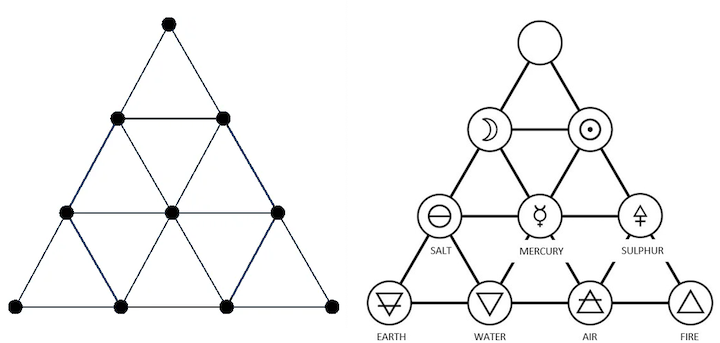
mathematical and alchemical versions of the same thing

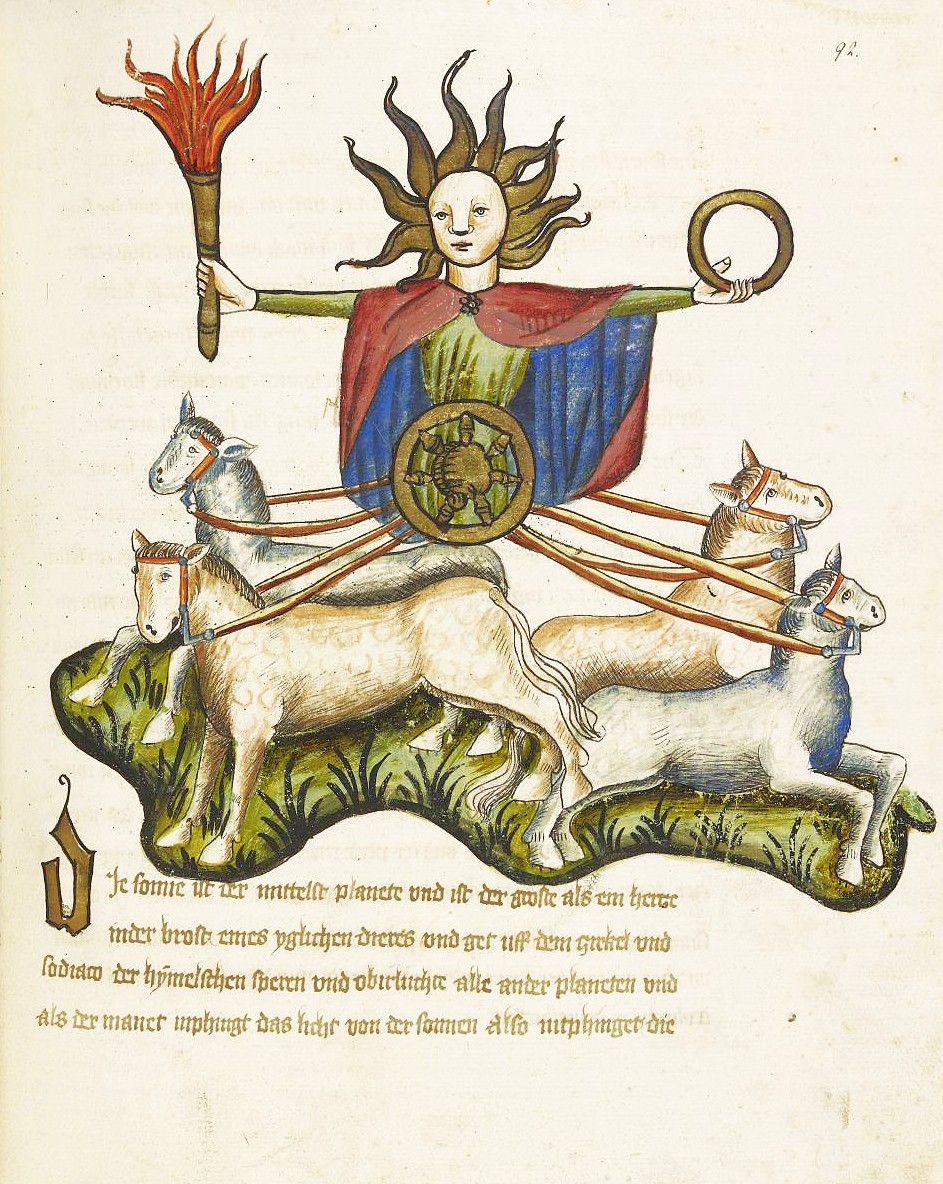
This simple formula, hidden in plain sight in triumph I, provides the foundational structure on which to then load our various interpretations; The Wheel of Fortune is both the first card of a three part cycle (10, 11, 12) as well as being the fourth card (the death) of the previous cycle (7, 8, 9). All the 1/4 cards indicate both initiation and completion – ie, change. They are always masc/solar (see below). Wheels are typically a solar symbol, and besides including the Sun itself, the 1/4 series contains the two triumph cards with wheels (7 and 10). Notice all the cards between 1 and 19 have crowns in them – another solar symbol – and that the the Wheel is central.
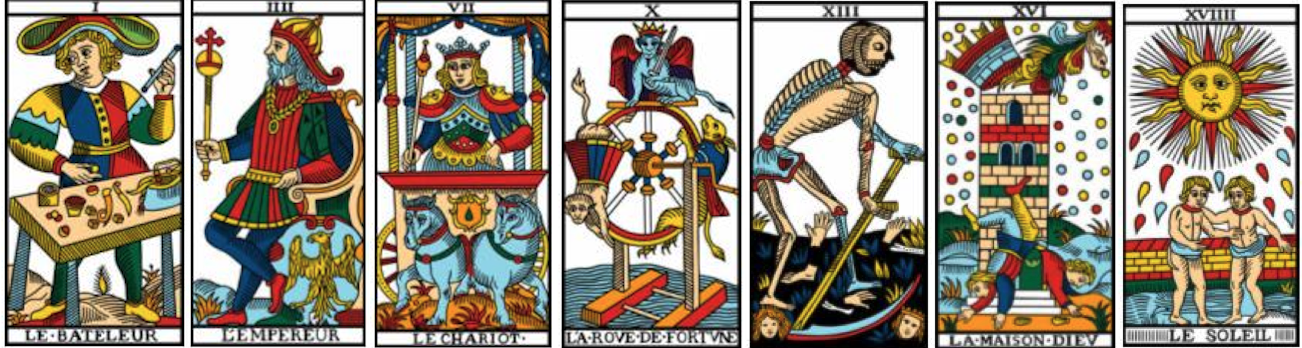
Cards in the 1/4 placements [Camoin-Jodorowsky deck]
German astronomical illustration of the Sun, 1445. How many cards from the 1/4 series do you see represented?

With 10, the perfect, complete number, ‘the great work’ (ie, the soul’s work) may now commence. 9 was the number of endings and of memory (Mnemosyne), of reflected, inner light. Similar to the Emperor, the old Hermit turns toward the past, drawing the numerological cycle to a close. We might imagine a shadow puppet play of life highlights projected onto the inside of his curtain-like cloak.
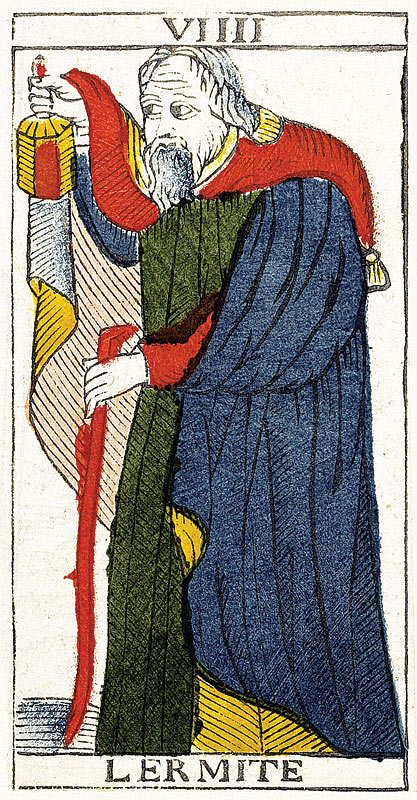
Pierre Madenié, 1709

Mathematically, 9 always returns to itself. The Pythagoreans were not enamoured with 9, but understood its importance as the first square (3×3) and for its role in human gestation, relating to the 9 spheres a soul transited before rebirth. More about the Hermit and his lamp here.

Pythagoras himself had been initiated into the Orphic Mysteries, among others, ’tis said. He believed in and taught metempsychosis (reincarnation), and that mathematical principals – numbers – are universal, guiding principals.
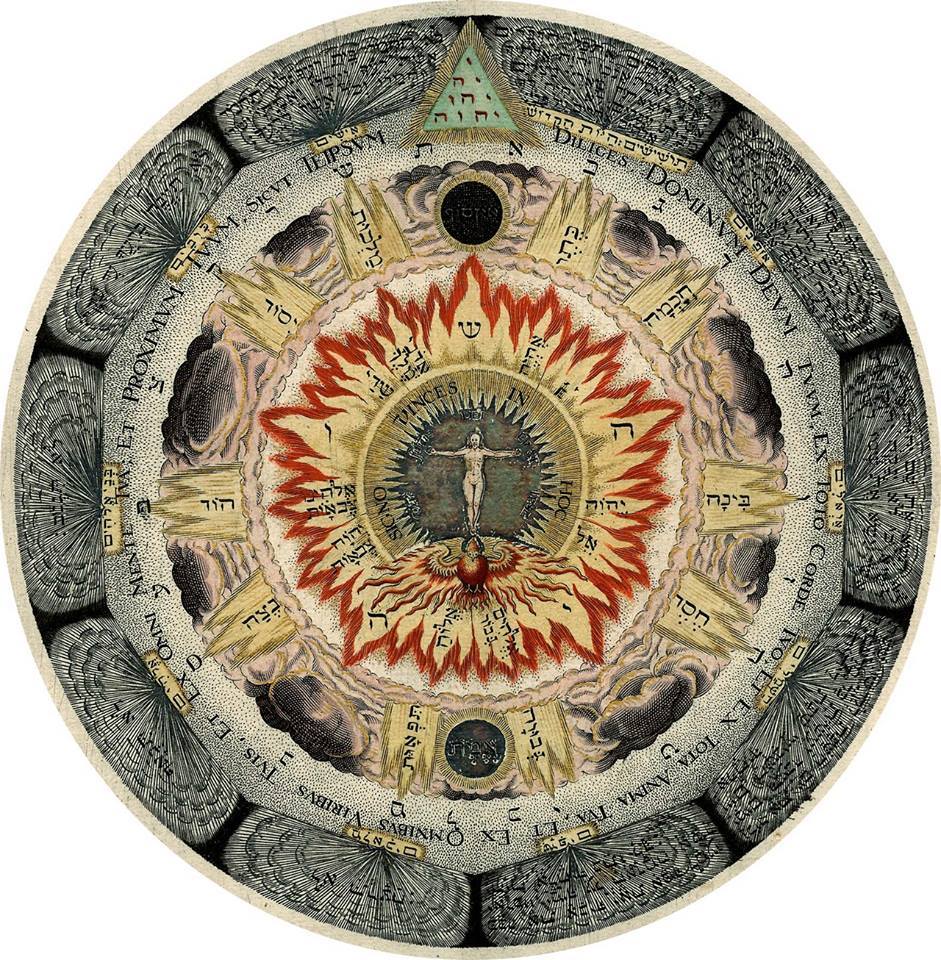
Alchemical etching from the ‘Amphitheatrum Sapientiae Aeternae’ by Heinrich Khunrath, Hamburg, 1595

10 is the ‘higher octave’ of 1. To Pythagoreans and alchemists alike, 1 was not actually a number (it could not be ‘numbered’ and anything multiplied or divided by 1 was still the same), but represented the Monad (God, origin, unity), symbolized by a circle with a central dot or eye. This is still the symbol for both the Sun and gold. Wheels are essentially monad shaped. [Note: They did not use or accept 0 as a number.].
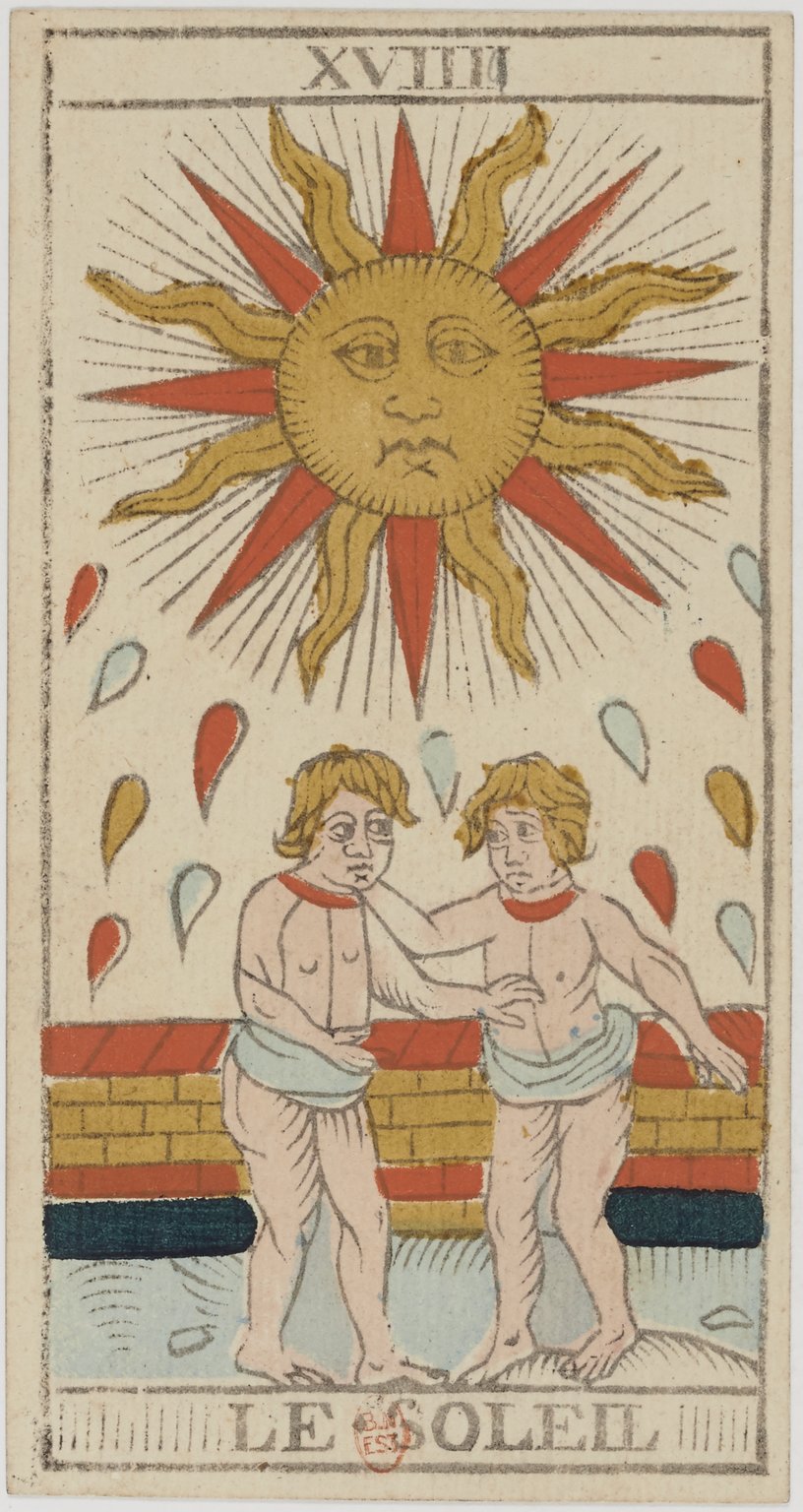
Conver type II, 1760

The next card after 10 that reduces to 1 when the digits are added together is 19, the actual Sun. There is no 4 in this last, seventh cycle of 3, unless we include Le Mat as 22. While ‘Pythagorean’ numerology considers 22 to be the ‘master builder’ (aka god), the man himself did not specifically mention this. However, what’s very interesting indeed is that the ratio of 22/7 was used by Archimedes to approximate pi. Thus by adding Le Mat as a 22nd triumph, division by 7 no longer gives us 3, the trinity, but pi, which is ‘never-ending.’

“Numbers are the Highest Degree of knowledge. They are knowledge themselves.” ~ Plato
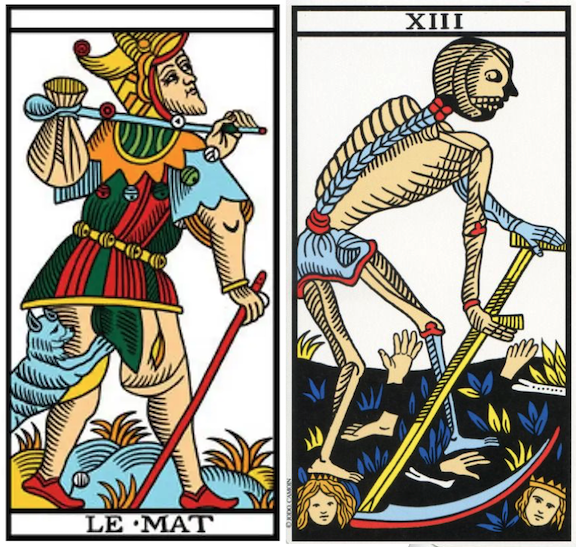
The infinite and the eternal? Camoin-Jodo Conver type II, 1997

The process of destruction and purification by fire and water prior to what will be rebirth in 19, 20, 21 begins with this most sacred number of the Pythagoreans because, where unity and wholeness is the ultimate intent of the work, God/the Divine must be invoked.

Alright, math class dismissed, time for art, myth and philosophy…

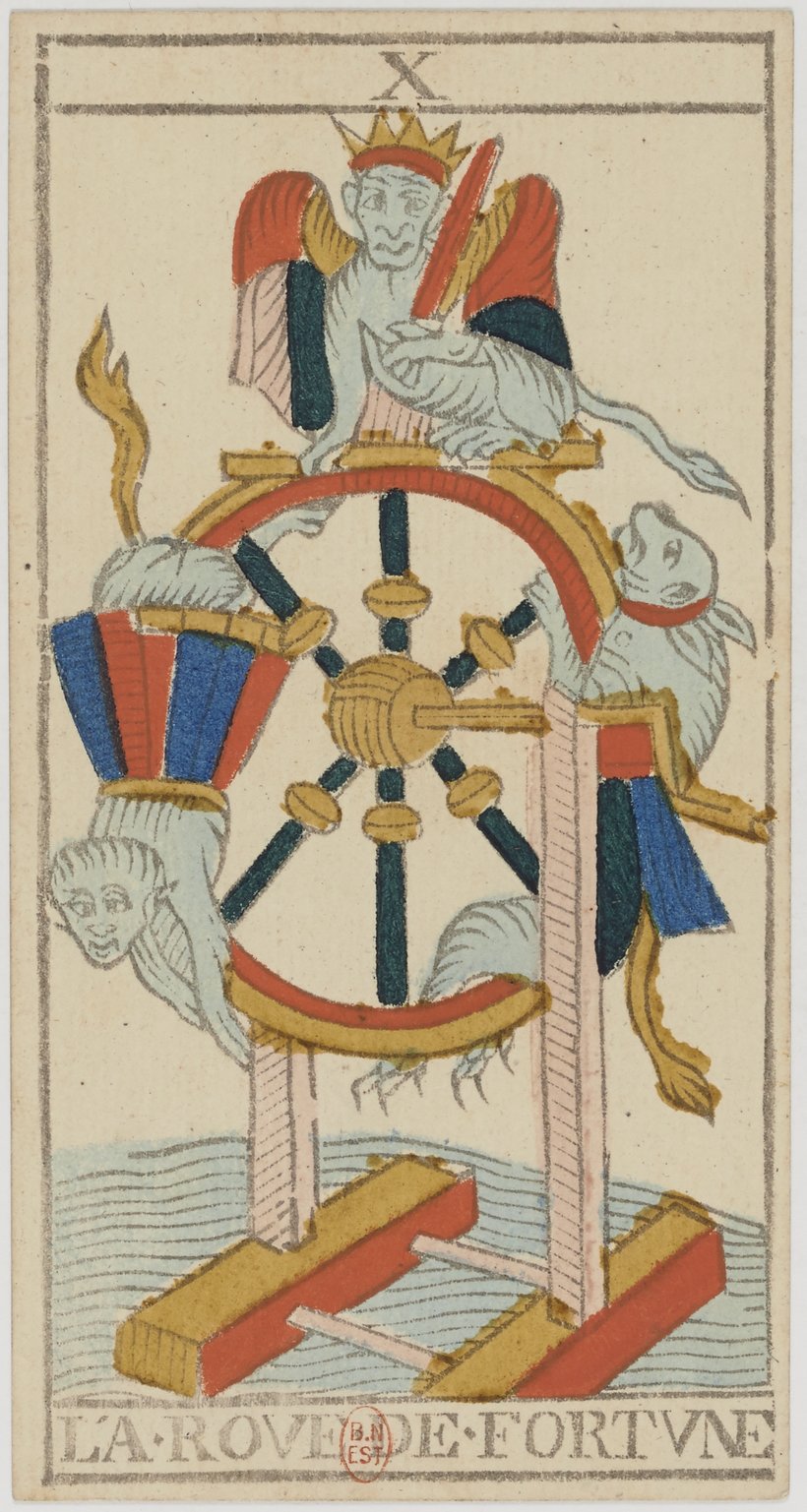
The Marseille Roue de Fortune card is a bit of a visual conundrum. The parts don’t quite fit together and though the creatures on it appear to be in motion (at least, the ones on either side do), nobody’s turning the handle. The base, which resembles a section of ladder, stands on water. Is it a water wheel? Maybe this rota cannot be fully understood literally, but is another riddle asking to be read as a composite of its parts.

I won’t go into the entire history of Fortuna’s Wheel, or ‘wheel’ be here all day, but one, particular detail in the Marseille version is what got my wheels in motion: at some point in the card’s r-evolution (perhaps simultaneously, in different traditions), the creature on the left transitions into a flaming pot.
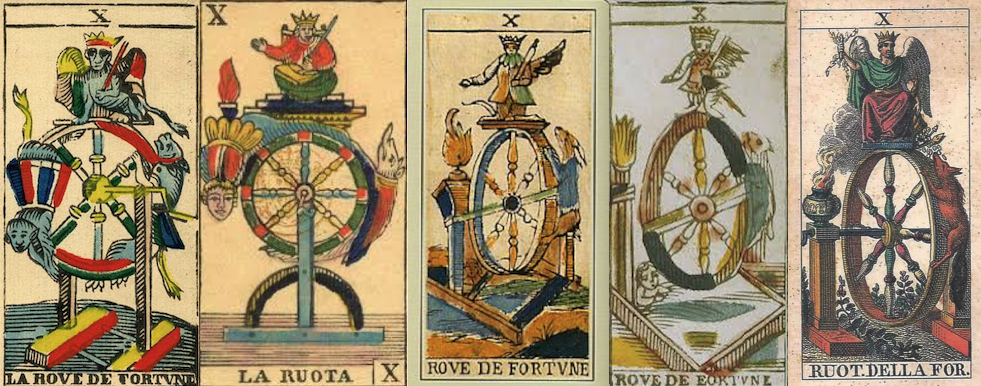
This has been dismissed as misinterpretation of worn away plates by printers who, (correctly) interpreting the tail as a flame, figured the Wheel should be equip with an altar or censer with which the passing of earthly existence into smoke was symbolized. (And now it does resemble an Arabic ’10’).

One possible precedent is in images of Ixion, where the wheel Zeus binds him to is being lit with a torch, although, there are plenty of mythical, flaming wheels (and altar pots) to choose from. Ours is not Ixion’s wheel per se, but maybe the flame is mnemonic of it. Ixion, having killed a kinsman and twice flagrantly violated the sacred law of Xenia, was denied the cathartic rituals that would cleanse him of his guilt, and, under Zeus’ orders was bound by Hermes to a fiery solar wheel for eternity [either rolling across the sky or stationary, down in Tartarus]. At this point in the game, there are two options; change or be stuck on repeat forever.
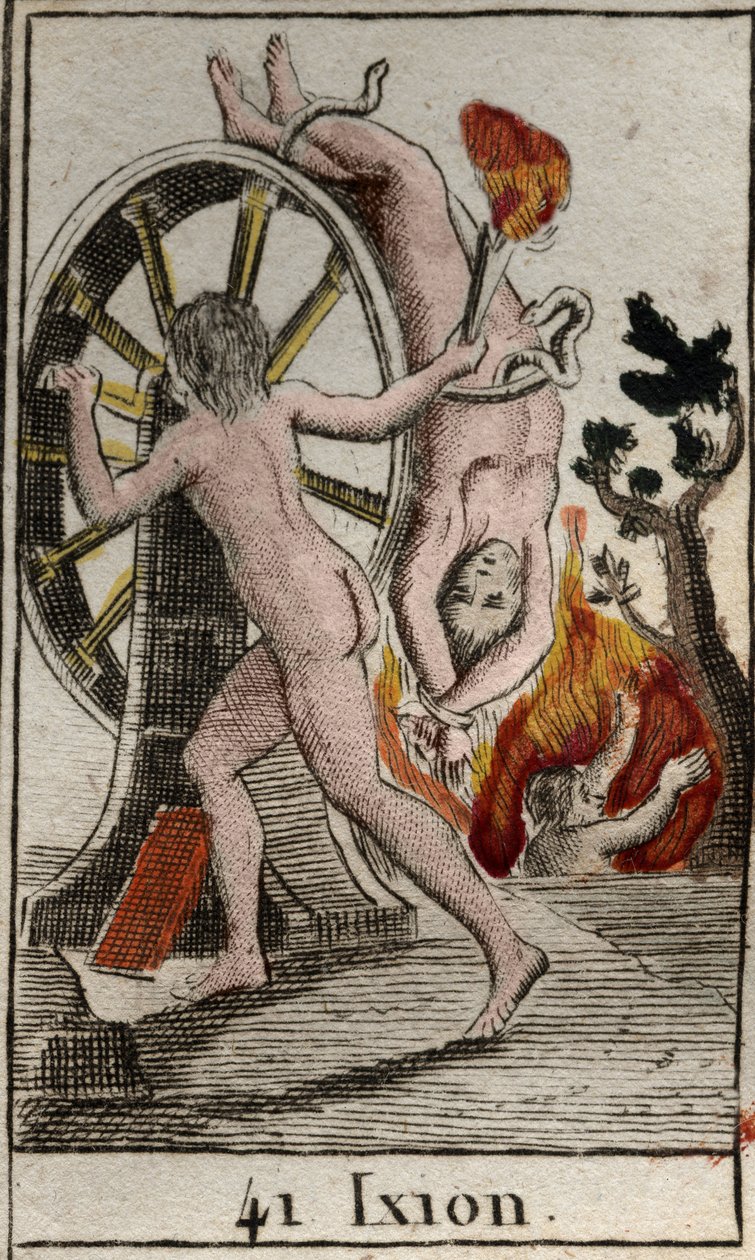
Ixion about to be lit, from ‘Mythologie de la jeunesse’, 1803

The Wheel’s stand can elude to a couple of things; like the Hanged Man’s gibbet, it might suggest a gateway, recalling the dokana of the Dioscuri (even shaped like the Gemini sign, a prelude to the twins in 19).
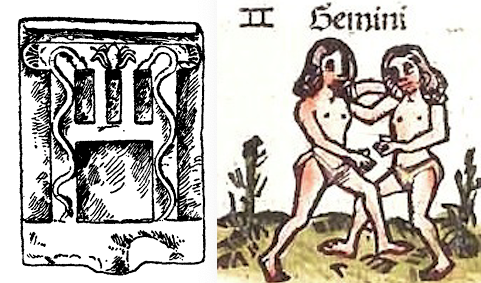
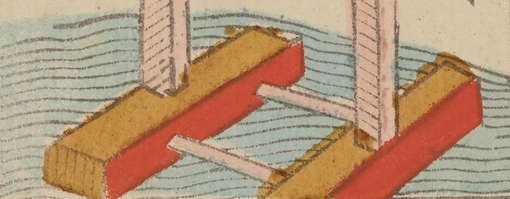
Dokana symbol and Gemini

It could also indicate that ‘the initiate’ has now made it this far on the scale philosophorum (philosopher’s ladder of mystical ascention), which will later appear atop the wall in 19. The two bars form the Arabic numeral 11, and/or the Roman numeral II, recalling “one becomes two…” Double digits begin here and the images start to reflect this. 10, with this design element, seeds 11 (La Force), situated exactly in the middle, a threshold with ten numbered cards on either side. The formidable, lion-wrestling mistress is partner to the Le Bateleur.
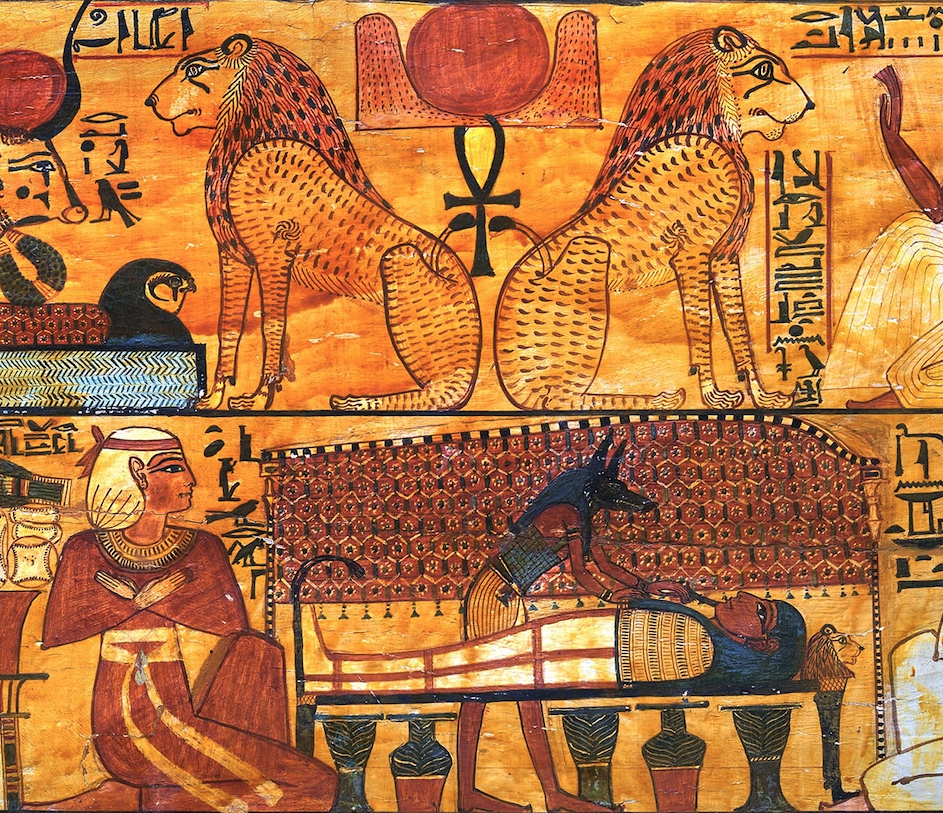
Lions of yesterday and tomorrow (eastern and western horizons), with the eternal in the middle, hieroglyph for ‘the horizon.’

The ‘foreparts of a lion’, seen here at the head of the embalming table, is the hieroglyph for ‘strength’, and is featured in the Strength card.

We might also imagine the Wheel as metaphorically representing the Sun above the watery horizon and the beings on either side as ‘yesterday’ and ‘tomorrow’’ – traditionally, ‘I have reigned’, and ‘I shall reign’ – with the top middle one as the present, ‘I reign’. Instead of a fourth on the bottom (usually an old, impoverished figure) there is a gateway to watery rebirth.
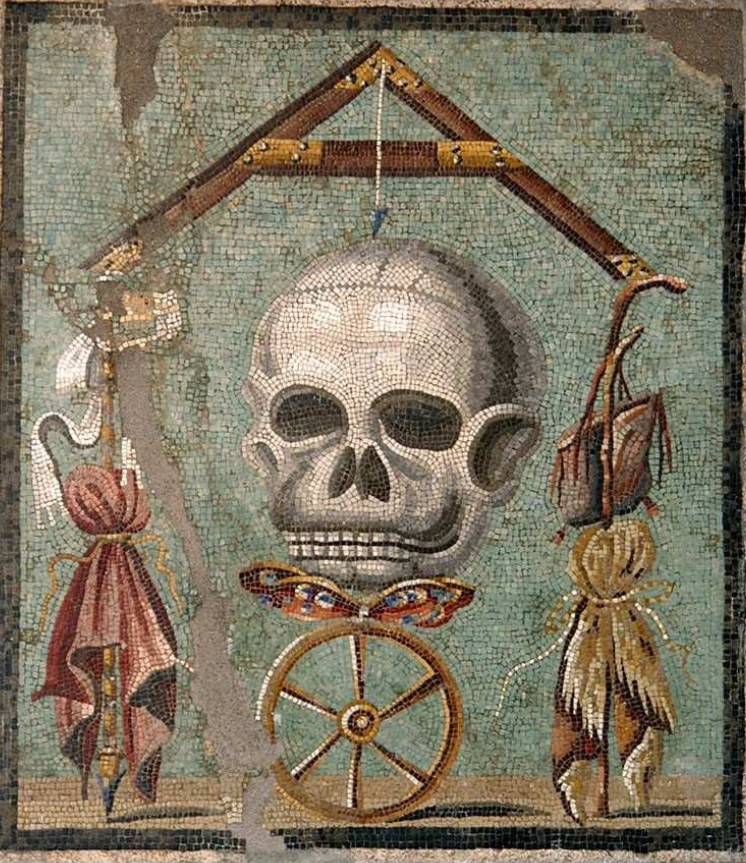
Memento Mori mosaic, in the Museo archeologico Nazionale di Napoli, 1st c

In this iconic ‘memento mori’ Roman mosaic from Pompeii, a simian skull is balanced atop a butterfly on a wheel. Above, a square level’s plumb bob is just touching it, the tool balanced atop two staffs, hung with the garbs of rich and poor. All are equalized in death, all are subject to Fortune’s whims. The mosaic was part of a banquet table, where Romans often practiced ‘carpe diem’, remembering their death tomorrow by partying today. The butterfly represents the immortal soul (Psyche). Butterfly, torch (especially going out or pointed downward), plumb line, fortune wheel, urn and of course skull/skeleton were all symbols of death, typical of the Roman ‘carpe diem’ motif.
[The tradition of death symbolism is also recurrent in Freemasonry. Masons practice reflecting on their mortality at every turn. The plumb represents death as well as the upright, balanced life and is a common,  gravestone motif.]
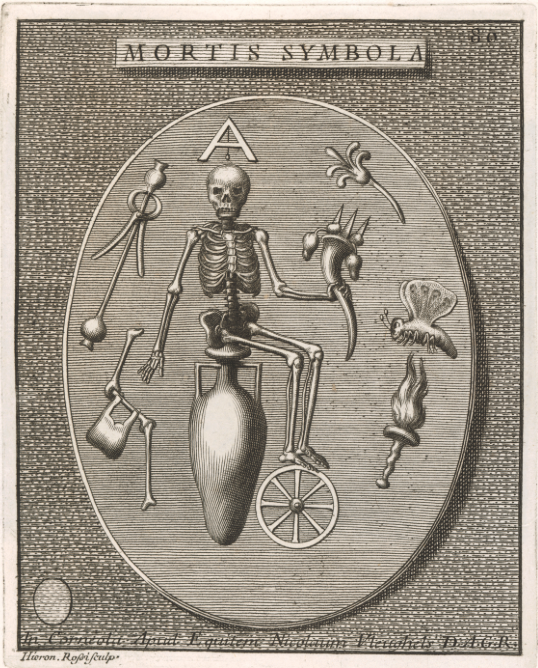
Roman symbols of Death

The explanation usually given for the monkey skull in the Roman mosaic is that cremation practices of the day had left the artist without a human one to refer to, but this ignores the fact that monkeys/apes were often used to parody humans. The memento mori theme was very popular and there is more than sufficient proof that artists of the day knew how to depict human skulls. An artist could easily have improvised the bone structure from a living human.
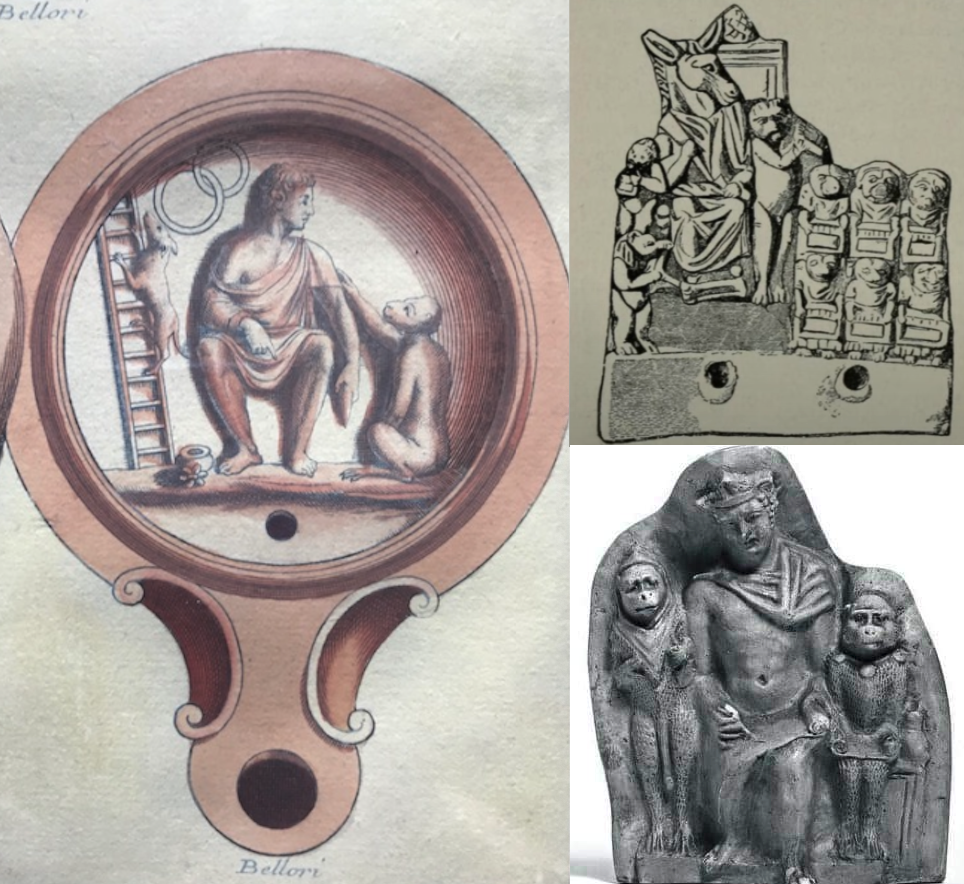
Lamp showing a juggler with monkey and dog (Carthage 1st c), Terracotta plaque (S. Italy, 1st c), Hermes seated between two baboons (Egypt, 3rd c BC, British Museum)

The little creatures on the TdM Wheel also seem to be parodying fearful humans stuck on the mortal coil, immediately following the card of remembering. Regrets…I’ve had a few…
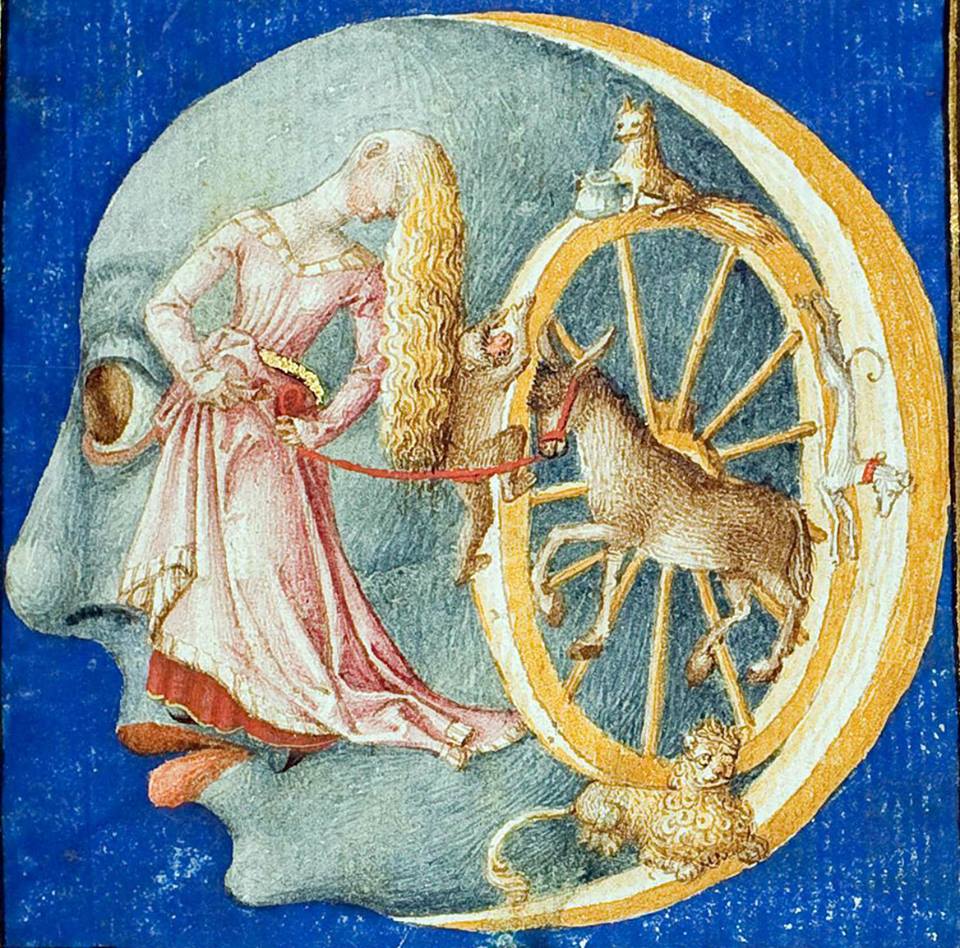
A Lunar Wheel of Fortune or Fate being turned by an ass, Hekate’s familiar. The woman’s hair-do is similar to that of Kairos (‘critical timing’), she might be the Roman equivalent, Occasio, who was female.

It would seem the tail of the simian-looking creature on the left side of the card was always intended to resemble a flame, both to illustrate the fire element, and to suggest that being turned on the wheel is akin to being ‘cooked.’ Perhaps there is nobody turning the handle because, as with the Chariot, which is not physically moving, there is no outer influence, the change is happening inside. Either we turn our own wheel or invite “fate” to do it – an outer expression whereby things seem to randomly happen to us (wheel of karma). The ‘winged’ Mercurial being at the apex might be symbolic of will, overseeing  the process, making sure the pace is natural and steady, that an even temperature is maintained. 

“Its purpose is constant digestion. Within its womb, substances are subjected not to violent flames but to the slow and merciful fire – ignis temperatus that mimics the warmth of the earth’s own generative belly. There, in that tranquil inferno, base substances soften, combine, and refine, until that which was profane begins its ascent toward the sacred. This is no vulgar boiling, but a sacred gestation.” ~ Universal Co-Masonry FB post, regarding the Athanor (alchemical furnace).
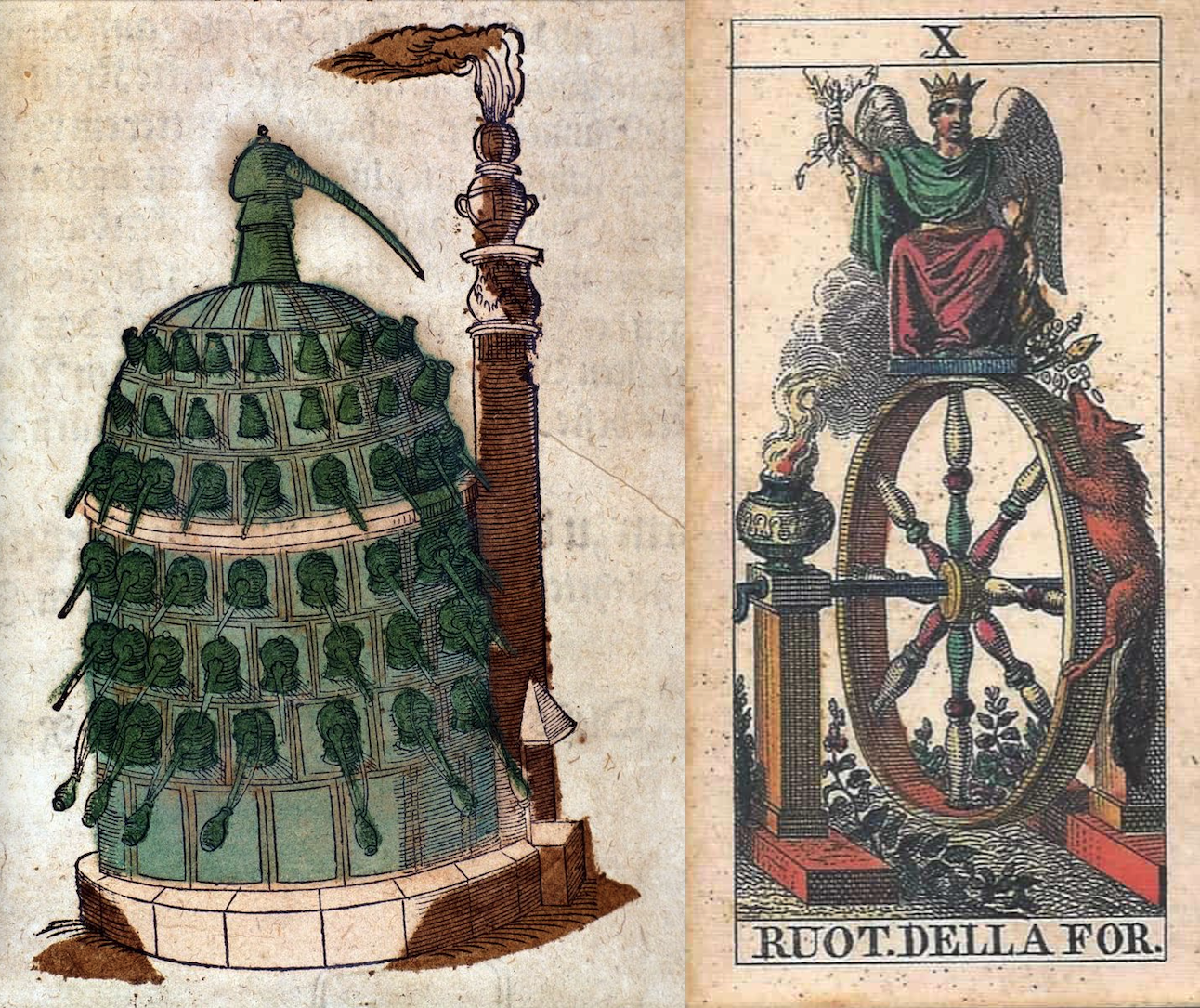
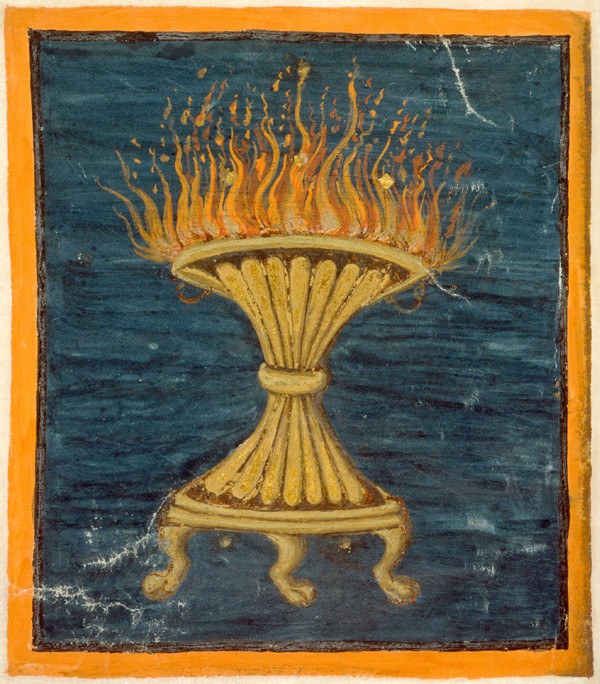
Athanor and Soprafino Wheel, 1835

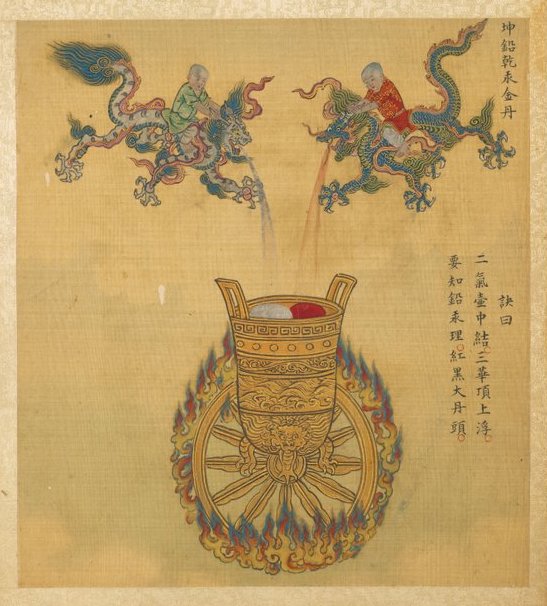
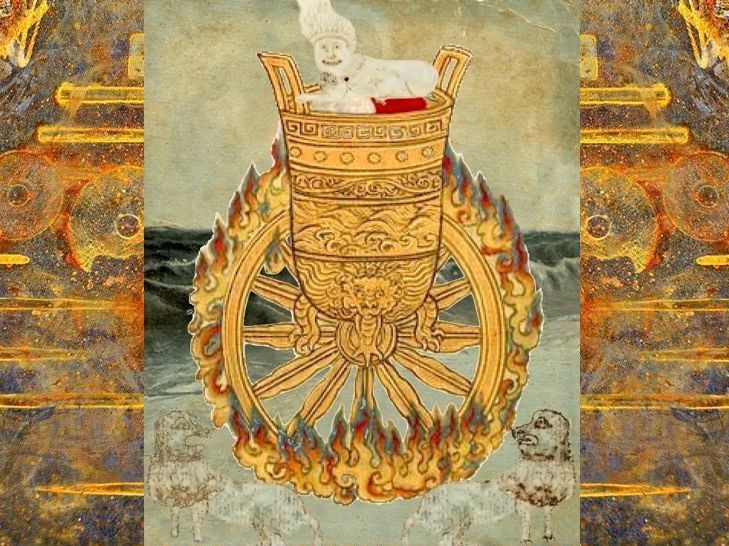
Above, with a suitable Tarot card for comparison, is the image that finally unlocked this card’s cryptic meaning for me. It is of an alchemist’s ‘athanor’, which is a self-feeding, clay furnace designed to maintain a steady temperature. Although etymologically unrelated (it comes from Arabic at-tannūr, “the baker’s oven”), ‘athanor’ oddly enough contains the Latin word ‘rota’ in it (albeit spelled backwards). Note the familiar design of the heat-release valve.

“The athanor’s design further symbolizes the unity of the macrocosm and microcosm through its correspondence to the four classical elements, integrating them into a harmonious whole; Fire represents the transformative heat in the lower chamber, Earth the stable structure, Air the circulating vents, and water the surrounding baths, collectively mirroring the alchemist’s inner equilibrium and the cosmic order. This elemental interplay underscores the Hermetic principle of “as above, so below,” where the furnace’s operations reflect the soul’s alignment with universal forces.” [Grokipedia…forgive me!]

Qing Dynasty Chinese School Taoist Alchemy

In fact, the alchemists did use the term ‘wheel’ (rota) as a metaphor for the cyclical nature of their art. The stages were not linear, but continuous – the end could also be the beginning, just as in nature.

The three figures on the TdM Wheel might represent the 3 philosophical elements – left, sulphur (soul/emotions/desires), right, salt (body), and top, mercury (spirit/imagination/moral judgement/higher mental faculties). The salt/body fellow has ass ears, which typically are a sign of ignorance (think Pinocchio) but also, again, possibly suggestive of Hekate, triplicate Goddess of the crossroads and occasional consort of Hermes (aka Mercurius) or Hermanubis. As supreme navigator of liminal spaces, her torch burned with the sacred solar fire of Helios. 

“O Sun our lord and sacred fire, the spear of Hekate of the roads, which she carries as she attends her mistress in the sky and as she inhabits the sacred crossroads of the earth, crowned with oak-leaves and the woven coils of savage dragons!”

~ fragment of a hymn to Helios and Hekate from the play Rhizotomoi (Root-Cutters) by the Greek tragedian, Sophocles [Loeb Classical Library].
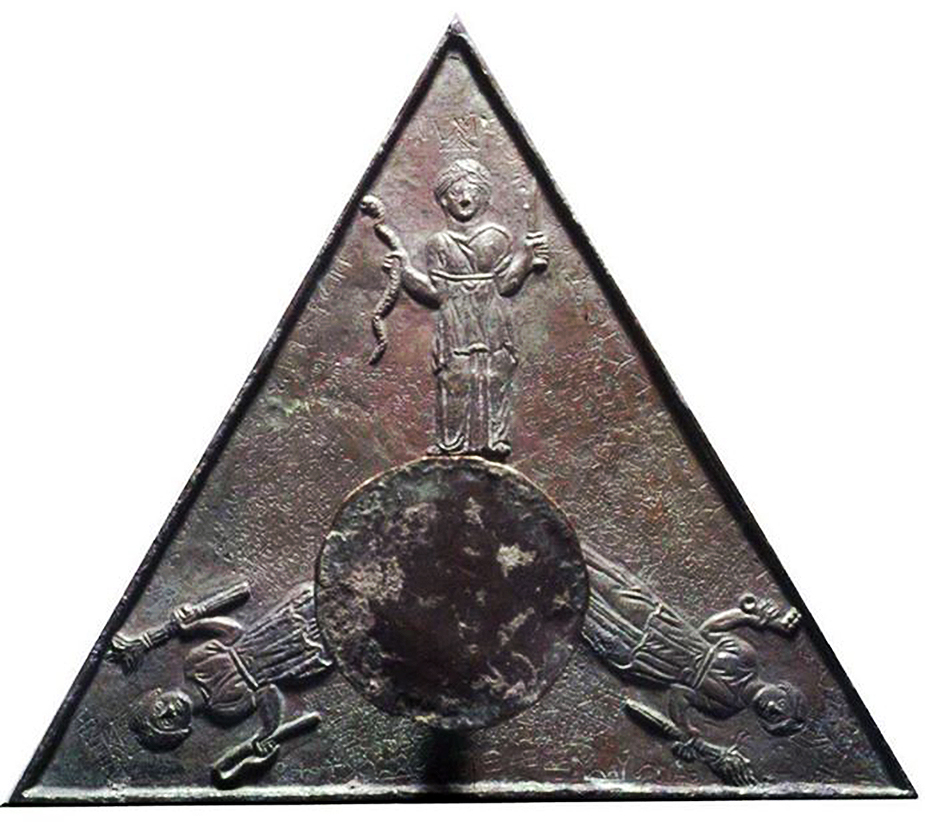
Goddess Hekate in magical plate from ancient Pergamon, Anatolia [Berlin Museum]
All 4 classical elements, too, are present:

AIR (sword pointed up, wing-like cape)
FIRE (flame-like tail pointed up)
WATER (below)
EARTH (vine or snake-like tail pointed down)

4 classical + 3 philosophical elements = 7.

In both type I and II, the number of spokes appears to be 6 (or three divided), but notice that a seventh is also formed by the Wheel’s handle. Clever. Seven elements, planets, metals and stages.

Addendum: The 6 spoked Wheel can also be read as the Labarum symbol (solar) adopted by Christian iconography, which is nevertheless based on the idea of “inverse directions…one of which is like a reflection or mirror image the other” – ie, ‘as above, so below’ – similar to Solomon’s seal. [René Guénon, Symbols of Analogy, via Wikipedia]
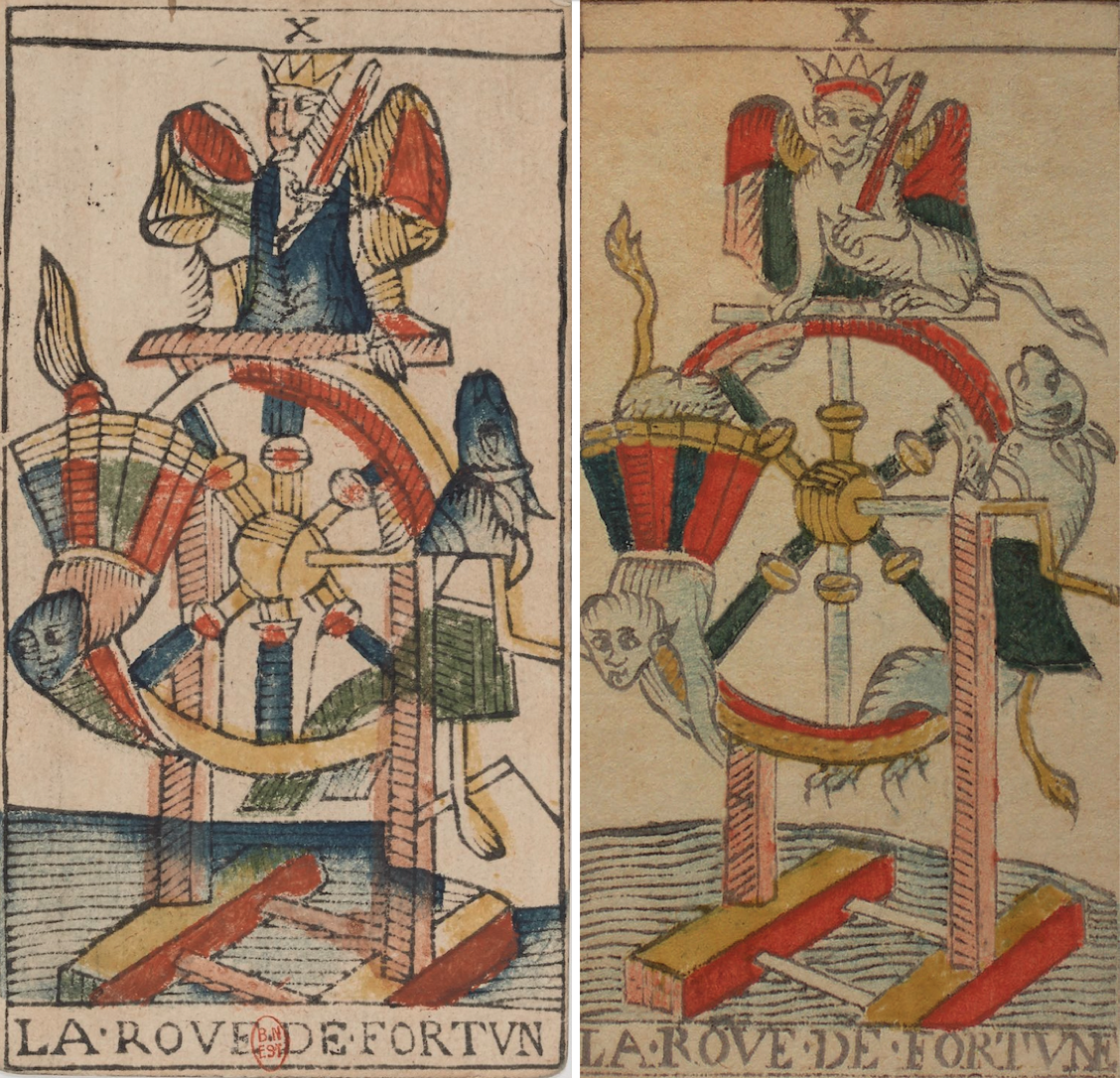
Dodal type I (ca 1701-15) and Chausson type II (1672)

The hub of the Wheel is divided into 3 sections, like a globus, while also resembling a lunar-solar combination – navigation of liminal spaces as we progress toward unity.

That the flaming tail was turned into an altar pot/censor doesn’t change the intrinsic meaning and actually alludes more strongly to the alchemical cooking process. The water below suggests ‘a slow, gentle cooking’, akin to that of the Bain Marie. Similar to the gentle turning of a wheel, the contents of a cooking pot or cauldron is stirred in a slow, spiralling motion. In Shakespeare’s tragic play of alchemy gone backwards, MacBeth, the Wyrd Sisters famous chant, ‘Double double, toil and trouble,’ is a reference to ‘the work.’ Originally, the old English word ‘wyrd’ (which became ‘weird’) meant  ‘fate’ or ‘destiny.’
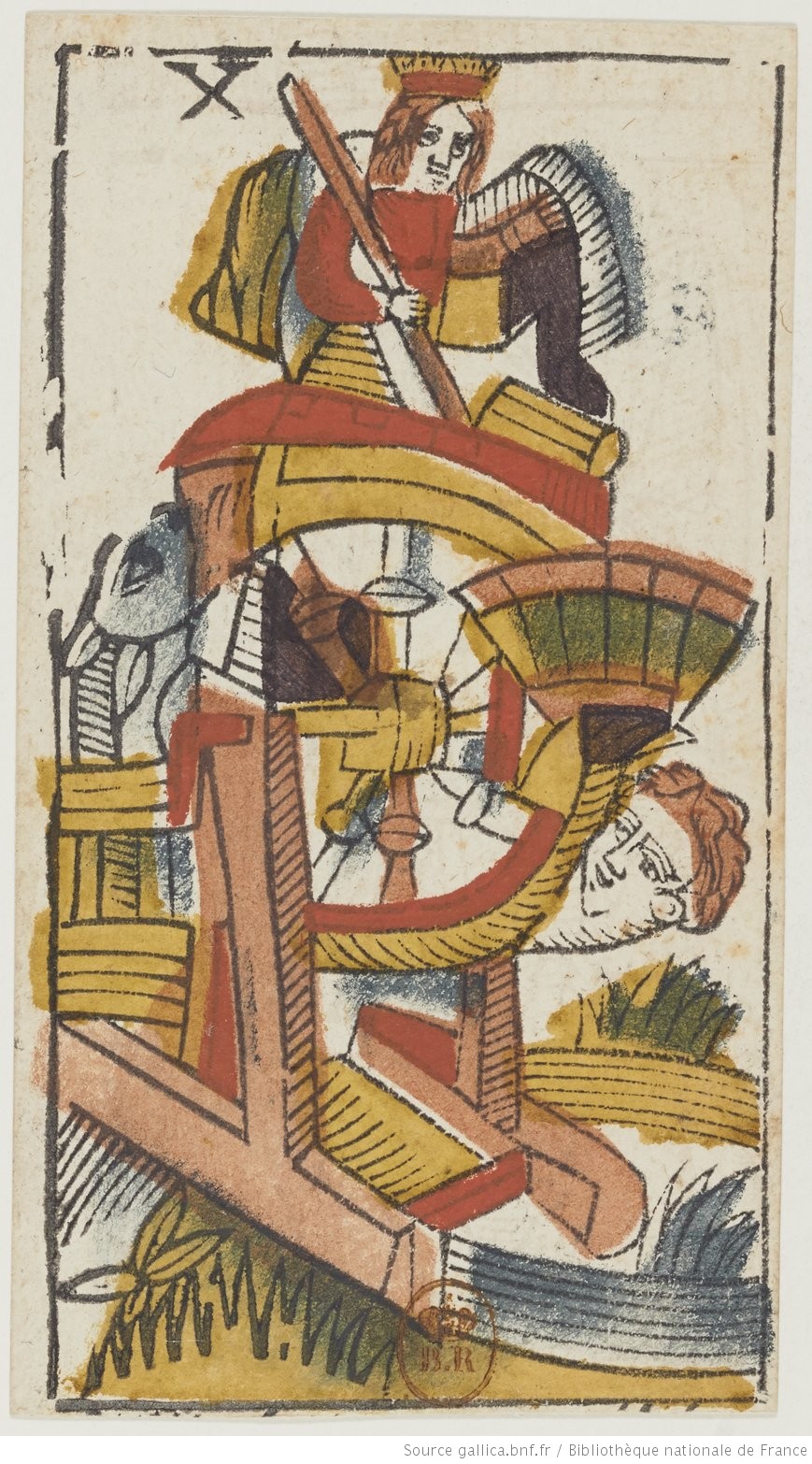
Jacques Vieville 1650

The Vieville card does not show any flame on the side, but rather, some suspiciously fiery-looking, yellow grass, below, possibly suggesting the pool of water is being heated from beneath. But the shape of the fire being’s skirt is consistent across TdM decks. It bears a similarity to the shape of constellation Ara, the altar on which sacrifices to Zeus were made, and is reminiscent of the Emperor’s skirt  (‘I have reigned’). The Wheel of Fortune was also an attribute of Zeus, god of optimists and gamblers. By ‘letting go and letting God’, we sacrifice our dross to the pyre, turning fate to faith. Remember Pythagoras’ holy number 10.

Ara constellation, Roman

Apollo, though one of the great gods of Olympus, is yet represented in some sort of dependence on Zeus, who is regarded as the source of the powers exercised by his son. [Theoi.com]

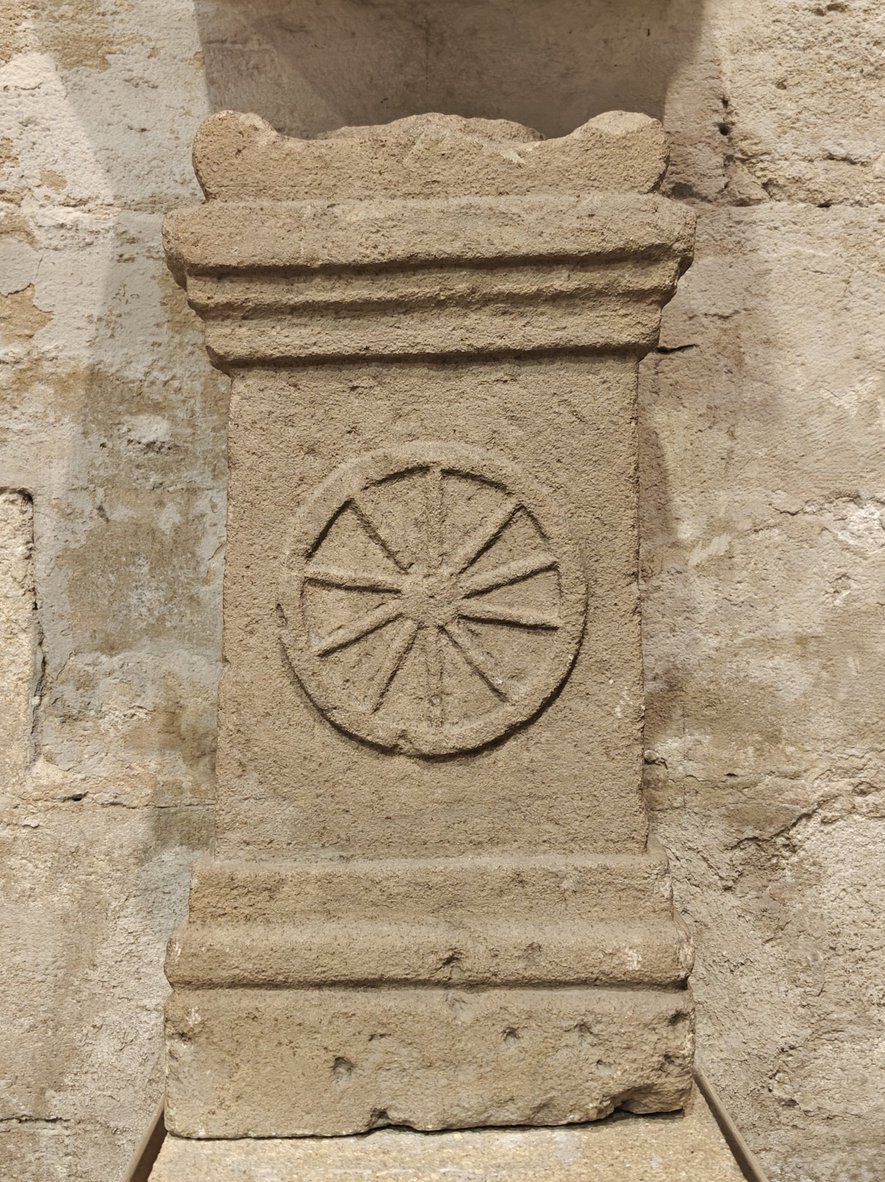
Jupiter (Zeus) altar featuring a 10-spoked wheel, the number of months in a Roman year.

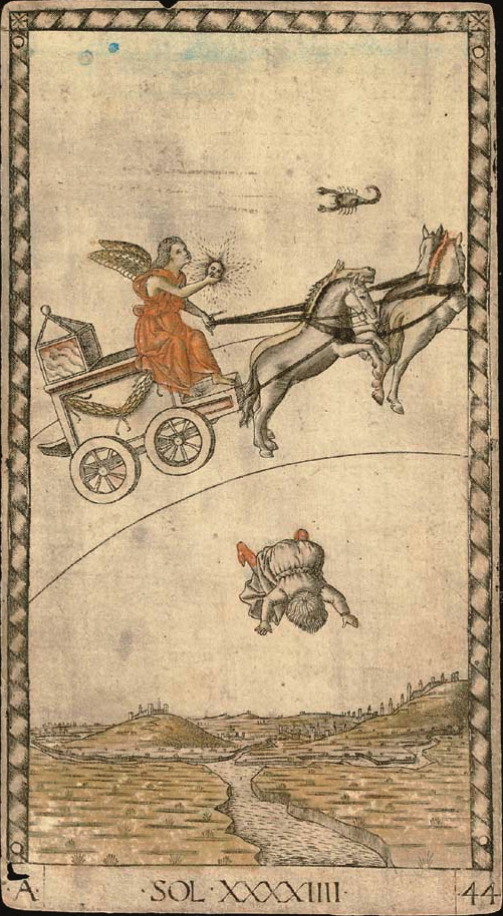
Helios, a Titan, was the Sun personified, later identified with Olympian Apollo, god of light and prophecy. The sad myth of Phaethon – the son of Helios who insisted he could drive his father’s chariot, but lost control of the horses and fell to his death – can, in the mythoalchemical sense, be equated with ‘the work’ being scorched by impatience (or hubris) or halted by negligence (or ignorance).

Tarocchi of Mantegna Sun, featuring the myth of Phaethon, 1465

The meaning of the Latin phrase Festina lente (‘make haste slowly’), is that activities should be performed with a proper balance of urgency and diligence. If tasks are rushed too quickly then mistakes are made and good, long-term results are not achieved. Work is best done in a state of flow in which one is fully engaged by the task and there is no sense of time passing. In this way we are in harmony with nature. ~rb

“Thus, let the Athanor burn–not with haste, but with faith–and may its light ever guide the hand and the heart of the true seeker.”
~ Universal Co-Masonry, ibid
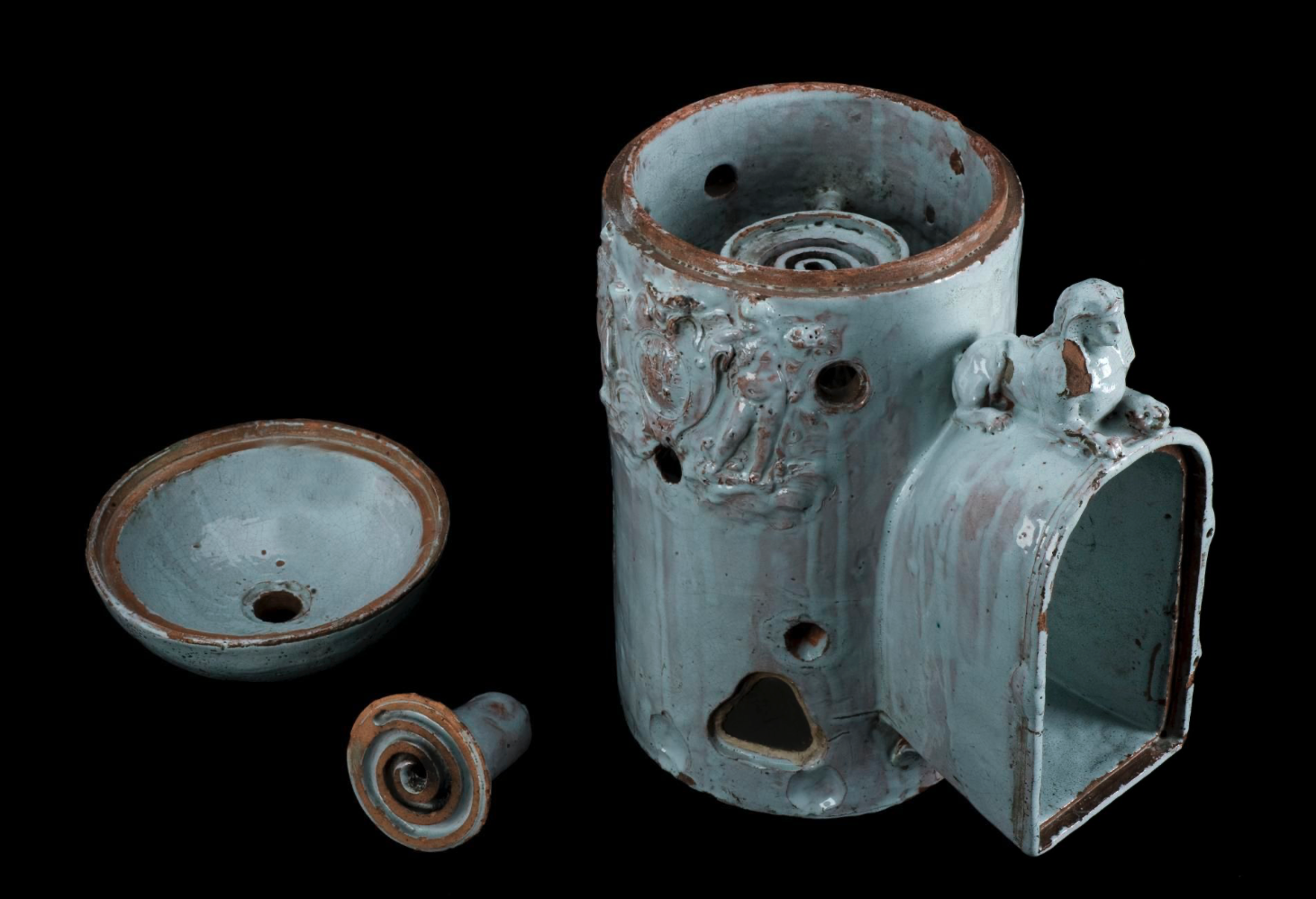
Alchemist’s athanor (top removed), stoneware, German, 1501-1700

All written content, besides quotations, is ©ROXANNA BIKADOROFF and may not be reprinted for republished in full without my permission. Kindly share via LINK only, which helps direct traffic here. If you wish to use a short pull quote, please include a credit (and link).

The Empress, the Alembic and the Secret Fire

From joy springs all creation, by joy it is sustained,
towards joy it proceeds, and to joy it returns.
– Mundaka Upanishad

Tarot de Marseille is a funny creature. Just when you think you’ve ‘figured it all out’, like a chimera it changes into something else. Fortunately I en-joy a mystery and seeking that which has no end. If I’ve learned one thing from TdM, it’s that the same pattern exists in whatever particular wisdom path you choose to follow. “All roads lead to Alexandria.” (wink)
The enigma is perhaps most apparent in the triad sequence, beginning with the Empress. To re-cap TdM’s inherent principal:

One becomes two, two becomes three and
out of three comes the one as the fourth.

Each 3 place card completes a triad from which the next cycle of three will be born, with 21 also completing the entire 3 x 7 cycle. Unlike the 1s with their solar crowns (monadic) and 2s with their lunar vessels (dyadic), there’s no  obvious, recurring object in every 3 place card (triadic), other than a predominance of wateriness (and darkness, in the case of 9, 12, 15 and 18). The Mercurial spirit of creation requires a container – a body of some kind – for transformation to take place, AND it is also that container, like caterpillar and pupa. They are not separate, but form each other. The 3 place cards allude to this secret, inner and outer process. Magic is afoot, is all we really know.
[Please click on any images to enlarge]

3 place cards, Camoin-Jodorowsky TdM

3
Let’s look at the three cards in the 3 place with the numeric sum of 3. The first, The Empress (3) shows us what we need to know. Atop her sceptre is the globus cruciger or sovereign’s orb – nothing unusual about that….except maybe the size? In reality, a globus this big would be hand held, with a smaller one atop the accompanying sceptre. Masculine sceptre and feminine orb (and the 4 and 3 of the orb’s parts) are being combined, and we can see that the base of her sceptre points to precisely where it’s all going to happen.

Emblem 2, the feminine qualities of the stone, from Michael Maier’s, Atalanta fugiens

In alchemy, one of the symbols for antimony, the ‘wild spirit of man’ (sometimes represented by a wolf) is the reversed Venus/copper symbol – a circle with cross on top. “Pliny the Elder (ca 77 AD) made a distinction between the “male” and “female” forms of antimony; the male form is probably the sulfide, while the female form, which is superior, heavier, and less friable, has been suspected to be native metallic antimony.” [Wikipedia]

cinnabar with mercury droplets, antimony rendered in antimony

But most (?) likely, it is the symbol for cinnabar, the ‘parent’ mineral from which Mercury is born. Note the orb which the philosopher’s child, hermaphroditic Mercury holds as he wades through the alchemical bathwater, below. Is it the cinnabar womb water, or the antimony purification bath, which eats away everything but gold? Or maybe both, considering the two parent luminaries lovingly at hand?

‘Our Son’ Mercury, Baro Urbigerus 1705

‘The watery matrix holdeth the fire captive.’  – Jacob Boehme

Like the eagle on her shield, the Empress has ‘wings.’ Beside her left hip is a scallop or scalloped bowl/baptismal fount, an old symbol of the Christian pilgrim. The scalloped basin was also a type of alchemical vessel and symbol of the Hermetic pilgrim, according to Fulcanelli. Either way, it has to do with the purification process.

According to 4th century gnosis mystic and alchemist,  Zosimos of Panopolis:

‘The ancient and divine writings say that the angels became enamoured of women; and, descending, taught them all the works of nature. From them, therefore, is the first tradition, chema, concerning these arts; for they called this book chema and hence the science of chemistry takes its name.’

For Zosimos, the alchemical vessel was imagined as a baptismal font, and the tincturing vapours of mercury and sulphur were likened to the purifying waters of baptism, which perfected and redeemed the Gnostic initiate. Zosimos drew upon the Hermetic image of the krater or mixing bowl, a symbol of the divine mind in which the Hermetic initiate was “baptized” and purified in the course of a visionary ascent through the heavens and into the transcendent realms.
[Wikipedia]

Hellenistic Greek Glass Shell 2nd-1st century B.C.

In both type 1 and type 2 Empress cards (covered by a block of colour in Conver), there is what resembles a triple flag under the basin, likely representing the main 3 stages/colours of the work (black, white, red), as in this relief (detail) on Notre Dame Cathedral depicting all the stages of alchemy (please see this new article on the Popess for more on Notre Dame alchemical reference). It might also represent the three philosophical elements; salt/body, sulphur/soul and mercury/spirit.

Threefold alchemy ‘flag’ from Notre Dame, Noblet and Payen Empress details.

All these raw, heavy materials, still in their ‘vulgar’ state almost appear to weigh her down. Mythically speaking, if the Emperor evokes Pluto (aka Dionysus, aka Osiris), his partner must also evoke Persephone, Queen of the Dead and personification of Spring regeneration. The ‘M’ shape of her blue skirt is the age-old symbol for water. Maya or Maia is mother ocean/womb, and Maria is literally ‘Maia with fire (R/Ur) in her belly’ (covered by red vest). The perennial fountain? Or an alembic?  I like to think of her eagle shield as the ultrasound screen, and her sceptre as the transducer.  But again, M might just stand for MERCURY, here in female form (remember, with 3s, the process, container and its contents are as one).

Noblet, Dodal and two versions of Conver Empress card

Another honourable Maria, namely Maria the Prophetess, was the first [non-mythical] alchemist of the western world. Written about by the great Zosimos of Panopolis, she lived sometime between the 1st and 3rd centuries in Alexandria, Egypt (of course). Maria also had a favourite axiom:

One becomes two, two becomes three and
out of three comes the one as the fourth.

Wait, haven’t we heard that before? Did she get it from Pythagoras (who lived several centuries prior) or is it just a case of universal truth? Both geniuses stood faithfully by these words. Pythagoras was not an alchemist, but nevertheless, he understood this fundamental equation to be the basis of all creative cycles.

mathematical and alchemical tetractys
Empress crown detail from Schaer Tarot

‘Maria the Jewess,’ as she’s also known, “incorporated life-like attributes into her descriptions of metal such as bodies, souls, and spirits. She believed that metals had two different genders, and by joining the two genders together a new entity could be made.” [Wikipedia]
She is accredited with many firsts, particularly her invention of the balneum Mariae (bain-Marie), progenator of the modern-day double-boiler. Of her written works surviving in Arabic we find two most curious titles; The Book of Maria and the Wise Men and The Epistle of the Crown and the Creation of the Newborn Baby. 

Leonora Carrington, The Chrysopeia of Mary the Jewess, 1964

Maria excelled in both mystical and scientific approaches and it’s thought she may have originated the idea of 4 colour stages in alchemy. Indeed she herself was an alembic, which is the whole point of this exercise, the teachings of the 3s. Hermes Trismegistus (‘thrice great’) was another such person, albeit more mythical. In Pythagorean numerology, 3 is the number of creativity, joy, artistic expression. In astrology, the trine is considered the most harmonious aspect, connecting planets or points of the same element. (However, it is fiery and energy can flow with lightening speed for better or worse).

Maria Prophetissima and Hermes Trismegistus from Michael Maier’s Symbola Aurea Mensae Duodecim Nationum (1617)
Maria’s bath, 1528.

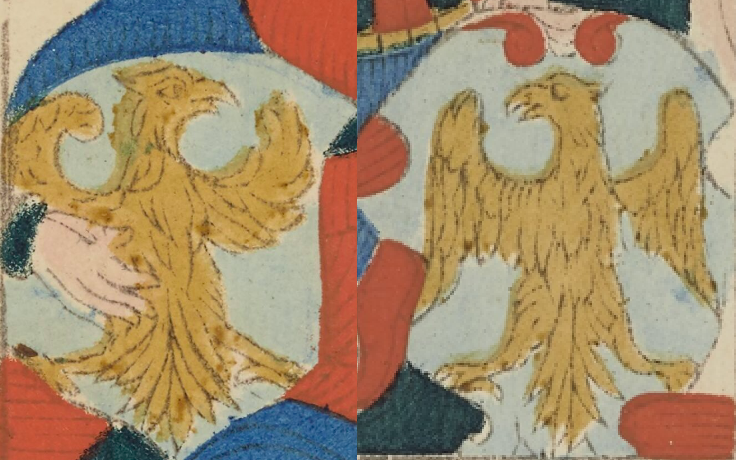
So, the Empress, similar to the Juggler, has all four elements (or stages) about her, in physical form; earth (ground below + snake/globus + barely visible horns), fire (crown + hair), air (wings + human features) and water (blue robe/shell). The eagle represents the work as well as the water element, and, if we look closely, we can see one of its wings is shaped like a wave, the other more like feathers/flames. This can be interpreted as inherent polarities, or perhaps the ‘moist’ and ‘dry’ paths of the work.

Comparison of Empress’ and Emperor’s shields.

The difference between Juggler and Empress is that 1 alone can’t yet do anything with all the separate, single parts, other than superficially (ie, practical magic), like performing tricks or perhaps trading with Jack for his cow.
The Empress and Emperor will complete each other (he too has orbed sceptre and eagle, and faces toward her), but they have not yet come together, they are still 3 and 4, neither added nor multiplied.

Conver Empress and World cards. Note the shield eagle’s amphibious wing.

In this older version (below), that she has attributes of the four ‘elemental beasts’ of the World card are more obvious; longer ‘horns’ (in crown and necklace), wings/human, eagle/phoenix and even a lion’s paw/mane.

Guilaume Dubesset-Claude Valentin, ca 1680

12
I’ve already written on some of the 3 place cards – the Hanged Man, the Hermit, the Devil and the Moon – so will just touch on the Hanged Man (12) here, as he’s part of this 3 x 3 sequence.
His flaming hair and his number might suggest solar connotations, although he’s still situated in-between the Sun and Moon ‘parents’. The Sun represents the gold, and thus the process of purifying the ‘inner’ (philosophical) gold is in progress. But it is not the literal Sun, physical fire or material gold. Rather, it is a different fire altogether.

Visconti Sforza 16th c, Jacques Vieville 17th c, Nicholas Conver TdM 18th c

In the middle example, the number is placed so that he is flipped, indicating that as his body descends, his spirit ascends (note the lunar and solar ‘mounds’ on each side of his head, the solar one containing all the heavenly spheres), with emphasis on the spiritual. Not an accident, but likely an Orphic reference. In the third card, the descent of the ‘Sun’ (his head) into matter is emphasized. High noon and midnight, apex and nadir, bipolar. It really is like the separation that goes on inside the alchemist’s glass egg. The main thing is that we can’t observe his inner process. Typically, the Hanged Man’s expression is placid, as if he’s either in acceptance or ‘somewhere else.’ His gibbet is like a (golden) doorway or threshold. All of this suggests he is experiencing what’s known in alchemy as the secret fire:

Search, therefore, this fire with all strength of your mind, and you shall reach the goal you have set yourself; for it is this that brings to completion all the stages of the Work, and is the key of all the Philosophers, which they have never revealed in their books. If you think well and deep upon this above-mentioned fire, you will know it. Not otherwise.
Potanus, The Secret Fire

To me, the Visconti-Sforza version looks very alchemical, its colours alluding strongly to the (philosophical) Green Lion devouring the Sun. I love how well the following description of the symbolism relates to the card, albeit it seems to be more from a Jungian perspective than traditional alchemy (and granted, the solar ‘ego’ looks anything but terrified):

The image corresponds to the releasing of primordial essence. That is why the lion is green, which is a primordial, unripe color. It also connotates fecundity. Eating the sun symbolizes the dominance of the Ego by instinctual forces. It is the beginning of a return to a more natural psychological state in which human beings flourish.
The ego perceives the encounter as terrifying because all transformational processes appear to be a kind of death to the ego. However, this process is the catalyst for an encounter with the Self. The instincts are amoral relative to human society and culture. Social conditioning aims to keep the instincts in check until the Higher Self is adequately present. Once present, our attitudes and feelings will be conditioned and directed by the Self. Otherwise, we experience a regression to the animalistic nature.
~ Tony Laguia, ‘The Green Lion Devouring the Sun‘ [Medium]

Visconti-Sforza hanged Man and Alchemical Green Lion devouring the Sun

21
The World (21) card, signifies the completion of the opus, the central figure representing ‘quintessence.’ Like an awakened eye, it is the revelation of that which embodies the essence of all past forms and potential for that shall be. In other words, what has been purified through many transformations becomes a catalyst for transformation; the Holy Grail or Philosopher’s Stone. Perhaps you’ve met someone who is a human tuning fork, or experienced a work of art, poetry, music, etc. that in its perfection had the effect of putting you ‘right side up’ again. Perhaps Tarot itself. ‘A light cannot help shedding its light. A flower cannot help giving off its fragrance.’ [Upanishads, ibid] When the young man in arcanum 6 was being initiated into the school of Venus/Eros, it was with the ultimate purpose of becoming just such a universal lover. ‘Everybody loves a lover.’

Ascend above any height, descend further than any depth; receive all sensory impressions of the created: water, fire, dryness and wetness. Think that you are present everywhere: in the sea, on earth and in heaven; think that you were never born and that you are still in the embryonic state: young and old, dead and in the hereafter. Understand everything at the same time: time, place, things: quality and quantity.
~ Corpus Hermeticum, 1460

The four creatures in the corners are assumed to be the four evangelists, the fixed signs of the zodiac, the seasons and/or the 4 elements. However…the bull is also lunar (2), the lion solar (1), and as we can see, they are now conjoined (3). The eagle previously represented the alchemical work, so then who might the winged human be when they’re at home? What of the Empress’ wings? Hmm.

Incidentally, Egyptian initiates were  called ‘scarabs’ because they ‘pushed along the egg of their regeneration’ – the container and the work?

Below, left, is the oldest of all known TdM type World cards (found in the Sforza castle cistern). Though it is badly damaged, some curious details remain. The androgyne or hermaphroditic Christ/Dionysus figure appears to have one breast only, on their right side, which is our left (mirroring). Their other, male side has the thicker leg. On their breasted/female side, the partially-obscured bull (or cow) has perfect, lunar crescent horns and on their male side, the lion has distinct, solar rays in its mane. Unique to this card, the angel in the top left (Aquarius/Matthew/air) has a ‘flame of inspiration’ in his forehead – ‘fire in the belly’ raised to crown level?

Oldest TdM ca mid-late 16th c (photo courtesy Ross Caldwell), Jacques Vieville ca 1650

The Vieville version, right, mixes things up a bit – bull and lion are switched around and have no wings. Since this card depicts a sexless figure facing straight forward, I ventured to see what one might look like as two. (Admittedly, it felt taboo, but…for science).
The male twin has a red cloak, denoting fire and his life force energy is directing upwards, expressed poignantly by what’s left of the sceptre. His body, arms open, creates an M for Mars. The female twin has a dark blue cloak, denoting water and her large V for Venus directs life force energy downward to her vulva, which she covers with her hands. Two opposite triangles, converging as one. Recall the Empress’ eagle shield. Also, that her eagle’s wings point upward, his downward, similar to the yin-yang idea of ‘opposite but interconnecting, mutually perpetuating forces.’ [wiki]

Vieville twins

In medieval alchemy, ‘philosophical Mercury’ is what remains when earth, air, fire and water are removed from a substance. It is associated with ‘prima materia’ (‘first matter’), from which all other matter is composed.

Philosophical Mercury, composed of sulphur and quicksilver (distinguished from their ordinary or ‘vulgar’ forms),  ca 1400

When you make the two one, and when you make the inside like the outside and the outside like the inside and the above like the below, and when you make the male and the female one and the same, so that the male not be male nor the female female, and when you fashion eyes in the place of an eye, and a hand in the place of a hand and a foot in the place of a foot, and a likeness in the place of a likeness: then will you enter [the kingdom].
~ From the Gospel of Didymos Judas Thomas (‘the Twin’), Nag Hammadi Library

ANAHATA the heart (fourth) chakra

Whatever wisdom path you choose to follow, the same patterns are found,  and this is because patterns are ultimately geometrical/mathematical. But wisdom is not just an intellectual exercise. It must be applied, to thrive.

In Sanskrit, ‘anahata’ means ‘unstruck.’ (Funny, considering arcanum 6). The anahata or heart chakra, illustrated by two, interlocking triangles, is associated with unconditional love, compassion, and joy. This rose window of our personal cathedral serves to balance the upper (spiritual) and lower (material) chakras, so that we may experience pure love for both self and others, without attachment and expectation.

On March 21 (3/3), Venus (Ptolemaic 3rd sphere) will conjunct Saturn in Pisces. Saturn is the cold karma lord and task master of our consciousness, who has a way of shackling the heart with guilt, pain and sorrow. In Pisces, Saturn can feel like the weight of the whole, wretched world (as we collectively witness the shadow expression of yet another ancient symbol). Venus, on the other hand, exalts in Pisces, bringing potential for a moment of healing, amnesty and grace to weary hearts. Like the Empress conducting Venus into her belly, if we channel the energy of this transit, perhaps whatever beauty we create from it will serve as a tuning fork for someone, somewhere, sometime down the road.  ~ rb

“I’ll be back…”

Thanks for reading!

All written content except quotations is copyright© Roxanna Bikadoroff and may not be reused or reprinted. Please share via LINK ONLY (accompanied by pull quote/paragraph with credit/link is fine).