The Hermit – Shedding a Little Light on the Situation

[Originally posted April 17, 2023, now re-posted with some Mercury retrograde addendums and edits. Enjoy!]

In 15th century Renaissance Tarot decks, this allegorical figure was called ‘Time’ and his device was an hour glass. Later, with a few exceptions, it was replaced by a lamp, changing the meaning somewhat. Instead of being a Saturnine symbol of old age reminding us of the passing of our mortal existence, he became more of a monk-sage, holding up a guiding light for seekers. But as we shall see, the two are not so different.

Visconti-Sforza Time

In this well-known Visconti-Sforza card, Father Time holds the hourglass and wears the deep blue of Lapis, i.e, wisdom/the philosopher’s stone (Lapis simply means ‘stone’). This he will wear into future Tarot decks, it is his trademark. On his head, a dome-shaped turban with rings. Until the 18th century, Saturn was known as the outermost planet, whose orbit encircled those of all the other planets’. It was the last stop. The average person was fortunate to experience one or even two Saturn returns in a lifetime. (The super-power of survival, however,  is a common gift to those born  under his rulership).

His colours are probably indicative of ‘the work’. Inside its holder, the hourglass is black and white (I inquired – it is not tarnished silver, but black paint). Likely this means the white inside it is salt. The tria prima of philosophical alchemy are as follows:
– SALT representing the body, which is material (in hourglass, also his white gloves, socks, hair)
– SULPHUR representing the soul, which is fiery (hat colours, also his lining or undergarment, boots)
– MERCURY representing the spirit, which is watery (blue cloak)
The green grass is symbolic of renewal/rebirth, nature, and is perhaps also an alchemical reference, which the Hanged Man card of this deck picks up on.
The planets are the ‘above’ to alchemy’s ‘below’, the metals, but spiritual (or philosophical) alchemy is about the transmutation of the soul.

Saturn, from Lazzarelli’s De Gentilium Deorum Imaginibus, ca 1470

The ‘So-Called Mantegna’ prints, an Italian Renaissance relation, though not actual cards, were a little more esoteric. Above is a page from a book by Ludovico Lazzarelli, which beautifully replicates the prints, in colour, with fancy borders. While still nothing typically Hermit-like about him, other than his shabby cloak, Saturn is doing the most allegorical thing possible to show the passing of time – eating his offspring, in order that he might reign eternal and avoid succession. (This was actually what kept patriarchs awake at night,  in olden days). The serpent or dragon biting its tail is one of the oldest alchemical symbols, representing mercury and the work itself; ‘my end is my beginning’.

Seated in a line, as if to complete a (second) scythe shape, are four of his children, a fifth one is about to be devoured. The sixth, Zeus-Jupiter has been hidden away by his mother, Rhea, and will later return to  succeed his Titan Father, beginning a new era of Olympian rule and providing an endless supply of mythology for generations to come. That cherub on the right holding a golden  ‘O’ (mirror or empty picture frame) for ‘Olympus’ might be him, preparing his new place in the line. The babe at its father’s lips must be Vesta, who was born/eaten first (and coughed up last). In fact, at one time, first-borns were given to the Gods, in sacrifice, that was their honour.  Again, the theme of age, elders, death. Note the mysterious (funerary?) urns which match the four, seated babes – Juno, Pluto, Neptune and Ceres. Missing is Vesta’s urn…are we to presume that Saturn himself is the container for her? Attached to the two brothers’ urns is a wreath, signifying completion, while new growth emerges from the sisters’ taller urns.

Rare Vesta in human form, from the lararium of a bakery in Pompeii, 1st c. (Vesta was patron Goddess of bakers). Note she also appears to be holding a coiled serpent. The ass was sacred to her.
Vesta or Vestal, lifting her lamp

In Ancient Rome, Vesta (Greek Hestia) was Goddess of the hearth, eternal flame of the city. Vestal Virgins enjoyed much privilege…as long as they kept their vow of chastity and never let the eternal flame go out.  Punishment for either was severe, usually being sealed up or buried alive. Extreme Saturn. The fate of Rome itself depended, it was believed, on that fire being kept alive. Similarly, and prior to this, in each Roman home, women had to ensure their home hearths didn’t go out, lest the ancestors and living family should suffer calamity.

Europa, Ripa 1603 and TdM style Hermite, 18th c (?)
Lamp-lifting Hermits: Old one from Lyon, Dodal Tarot de Marseille mid-17th c, Grumppenberg ca 1807-1816 (note the copulating snakes suggesting Tiresias).

Am likely not alone in seeing the Hermit’s lamp as being temple-shaped. It was indeed Vesta’s temples that were circular and domed, to replicate the dome of the sky over the earth. Just as Vesta’s flame represented eternal life, the little light in the Hermit’s temple-shaped lantern must also be symbolic of the eternal existence of spirit. 9 is indicative of (human) gestation…a most mysterious alchemical process. Interestingly, Vesta, with Janus, was also connected to liminality, in particular the marriage threshold. Typically the Hermit is looking back to illuminate the past, the dweller on the threshold of transformation.

Roman coin, silver, 55 BC

Returning to the Visconti-Sforza card, we find that the leap from being an allegory of Time to the christianized (?), hermetic Hermit of TdM is really just a small step. His hourglass is encased in a tri-sectioned (Hermes-Mercury), lantern/temple-shaped holder, and the black outline of the hourglass is shaped very much like two, entwined snakes. The TdM card simplifies it into a tri-sectioned lantern and calls him l’Ermite or l’Hermite, as an added clue (both old and new French were used, depending on when/where the cards were printed, meaning doesn’t change). Time is not simply about counting hours, but is essential to the great work that is our development of spiritual wisdom over the course of a lifetime. This ultimately (hopefully) prepares us for our transition from bodily form to spirit. The blue cloak takes up most of the V-S figure, while the white areas of salt and body are comparatively small.

V-S card detail

By now I hope you can see the connection between Saturn, representative of constricted time, lead and bodily age, and Vesta, embodiment of the vital, ever transformative life force energy – that which is eternal, whether you interpret it as Earth-fire, the Sun (by which her sacred fire was lit for the Olympic Games) or Holy Spirit. The Hermit holds up this little, temple light not as literal Vesta, but to evoke what her temple and fire signifies. Number 9 will in fact re-emerge or be reborn, in the Sun card, number 19, after a process of being ‘tortured’ (alchemically speaking) through the next 9 cards. In astrology, too,  the 9th sign, following the trials of Scorpio, is Sagittarius (aka the Sage) – mutable, transforming flame of the fire triplicity. Keep this light burning within you at all times, never let it be snuffed out. If it is, well, fortunately Vesta is also the sacred, phallic fire stick (brother Jupiter to the rescue!), with which she rekindles herself. This was inserted into a hollow piece of wood and “rotated in a phallic manner” to light her flame, ahem.

Time/Hermit, Bologna Leonne 1776 and Horologion (time keeping) Tower, Athens

Segue and full circle… I had mentioned device exceptions. This Time/Hermit figure above has both a (phallic?) column – probably a sundial, ironically – and wings on his back. It is usually interpreted as the fleeting of time but another way to see it is buoyant spirit (wings) readying to leave the heaviness of this mortal coil or simply not being affected by it. Perhaps the same sort of idea as the Tower card, a release from bondage or prison. Sometimes the elderly do begin to look angelic. Or maybe it’s just the signature of our old friend, Hermes-Mercury, the winged wonder. [Addendum: I intend to do a whole separate post about this.]

The Sanskrit word for temple (I recently learned), mandir, is a combination of mana, meaning ‘inner self’ and dir, meaning ‘a place’, ie, a ‘place where the inner self lives’. I can think of no better description for The Hermit.
Tarot images are cryptic, it’s not ‘this = that’, but rather, ‘this resembles that, I wonder if there might be a reason…’

Saturn and Vesta sitting in a forest, The Allegro & Il Penseroso of Milton, 1848 [BM]


All written content herein is copyright ©Roxanna Bikadoroff and may not be reproduced in whole or in part without permission. Kindly be respectful of my work and share via LINK ONLY. Thank you.

Tarot and Number

This is a brief, beginner post about the numerical cycles and number relationships in traditional/classic Tarot de Marseille (TdM). [Please note I am not going to be talking about the western Kabbalah that is incorporated into Waite-Smith Tarot.]

Pythagoras the philosopher and mathematician

I started out studying ‘western’ or ‘Pythagorean’ numerology in relation to Tarot, just as my early Tarot teachers did, consuming books that described the qualities numbers until I knew them as entities. In this tradition, numbers are reduced to a single digit, except master numbers 11, 22 and 33 (albeit we don’t go to 33 in Tarot), and viewed in terms of human personality traits. One of my teachers, Angeles Arrien, would have us figure out our life path card and card for the year, based on our birthdate. It can be insightful but also limiting. I’ve had to unlearn a few things…

Ideally, one should study the literature, then forget about it. Too much rigid this=that can actually hinder your inner understanding of the cards. Remember they are mnemonic devices, so let the image demonstrate how it illustrates the number, rather than trying to apply concepts to the image and make it fit. Play with the numbers, think also about the geometry generated by the number (3= triangle, 4=square, 5 = pentagram etc).

Note that the cards use Roman numerals, though they seem to illustrate Arabic numerical ‘concepts’ . For example The Hermit, VIIII, resonates with 9, the spiralling number that always returns to itself…as it is with people who have a 9 life path, according to numerology. 4 looks so much like the symbol for Jupiter, that the Emperor is often equated with him, though in reality the Jupiter symbol is not the same as a 4.

hermit tarot card illustrating the concept of number nine

Look at the multiples and different combinations…
For example, Empress (3), Hanged Man (1+2) and World (2+1). What is going on in this triplicity that stems from the Empress?
What minor arcana cards resonate with major arcana  cards of the same numerical value? In what suit does the 5 resonate best with the Pope card?  Which 7 with the Chariot?

The visual manifestation of the individual number is only one aspect, but the cards are not really independent of one another. They have various partners and opposites, higher and lower ‘octaves’, etc, their relationships to each other helps to define them, just as it is in life. Keep in mind the Roman numerals, too, so that XV (Devil) is the ‘higher octave’ or other face of V (Pope), not XVI (Lover), as it would be if we employed Arabic numerals (1+5 reduces to 6).

A simple example is that the numbered cards (in TdM the Fool is not numbered) contain 7 cycles of 3 (like a waltz), wherein every next ‘1’ card is also a ‘4’ (the death and rebirth of the cycle).
To Pythagoreans (and later, in alchemy, to Maria the Prophetess), this natural cycle of 4 = 1 symbolized the fundamental progression of creation:

‘One becomes Two, Two becomes Three,
and out of the Third comes the One as the Fourth.’

One – being the primordial source (monad) from which everything originates
Two – (considered the first ‘real’ number) being the duality that emerges from separation
Three – being the completion of a creation, whereby the two are united
Four – being the final stage, wherein unity is restored, but in a differentiated way

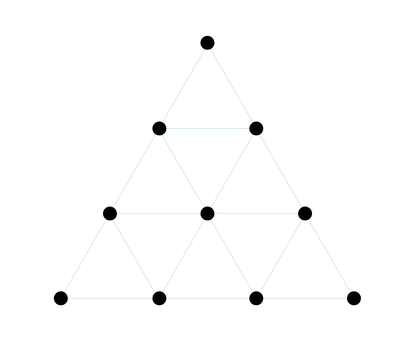
10, being the sum of 1+2+3+4 was thus considered the ‘perfect’ number, as illustrated by the tetractys. (In Pythagoras’ day, numbers were depicted with geometrically arranged dots, resembling pebbles).

So, the Empress completes the first creative cycle of 1-2-3, but the 4th card, her partner, the Emperor, signifies the ‘death’ of that cycle, AND the birth of the next. You will find that all the cards in the ‘1/4’ placement have something in common, as will all the cards in the ‘2’ placement and the ‘3’ placement.
21/The World, while being a ‘3’ placement card, illustrates wholeness and completion or ‘quintessence’; the unified ‘one’ (androgyne) at the centre of four (elements, fixed stars, seasons, etc).
With the understanding of this basic, universal foundation, we can build everything else. ~rb

empress and emperor cards of Jaques vidvill tarot

All written content ©Roxanna Bikadoroff and may not be reposted without permission. Please share via LINK only. Thank you.

2023 – Of Gods, Solar Heroes and Magic

Happy New Year!

Jupiter is back in Aries, until May 16. This masculine, fiery combo embodies the mythology of the solar hero (Aries) on a mission from God (Jupiter) or the ‘superhero’. The Sun’s exaltation is in Aries and the Sun is also the ‘son’.

John Singer Sargent, Hercules, 1921

Weapon-wielding, demi-god sons who saved humanity by wiping the floor with fabulous creatures were abundant in the ancient world (or at least abundantly immortalized), as they are, today – but one in particular stands out from all the others, for he wears the solar lion’s skin and performs twelve labours, just as the Sun and Jupiter themselves stay a day and a year, consecutively, in each zodiacal house. Sing along if you are old enough…

“Hercules, hero of song and story!
Hercules, winner of ancient glory!
Fighting for the right, fighting with his might;
With the strength of ten, ordinary men!
Hercules, people are safe when near him!
Hercules, only the evil fear him!
Softness in his eyes, iron in his thighs;
Virtue in his heart, fire in every part of
The Mighty Hercules!”

‘The Mighty Hercules’ TV series  1960s

I was dismayed to learn that the ‘real’ Hercules never had a magic ring, ripped abs and a quiff, or a centaur sidekick who’s favourite expression was  “Suffering Psyche!” But my childhood TV cartoon got one thing right, ‘Herc’ was the modern, macho superhero prototype:

“Heracles – or Hercules as he has been more popularly known ever since the Roman times – was the greatest of all Greek heroes, “one who surpassed all men of whom memory from the beginning of time has brought down an account.” A half-god of superhuman strength and violent passions, Heracles was the epitome of bravery and masculinity in the ancient world and the most notable champion of the Olympian order, which he staunchly protected from various chthonic monsters and earthly villains. Even though his short temper and lack of composure did cause both him and quite a few innocent mortals undeserved trouble, the magnitude of his labors was of such an order that it earned him the prize of immortality… Heracles is undoubtedly one of the most iconic figures in all of Greek mythology.”  [source]

Drunk Heracles “urinating” (in fact trying to get it up, for erroneous intent).

In the myth, Goddess Queen/evil stepmother Hera, angry that Zeus had sired him with another, who had the gall to name him ‘glory of Hera’, hated her step son and had marked him since birth. She sent two poisonous snakes (of course) to kill him in his cradle, but he strangled them with his bare, chubby little superbaby hands. Years later, grudge firm as ever, Hera served Heracles a potion to drive him temporarily insane and murder his own family. When the drugs wore off and he realized what he had done, remorseful Heracles sought spiritual advice from Apollo, who divined the gruelling tasks for his atonement. (Note that Apollo was a Sun god, who killed and usurped the Python). “In my defence, I was drunk and drugged!”

Delphic oracle with her tripod, Hellenist bell krater detail (British Museum)

The myth of Herc’s 10 labours was likely extended to 12 – which became the official number – because the day and the solar year were also divided into 12 sections (Roman year had formerly been 10 months, also), each through which the Sun himself was ‘guided’ by a lady of the hora, as he traversed the sky in his chariot. Every man of importance in the ancient world, political or religious, was depicted wearing a halo of the Sun’s rays – essentially what a golden crown is, made with the Sun’s metal. Alexander the Great, who self-identified with various mythic/solar heroes, including Heracles, was frequently depicted as Helios. Our image of the haloed Buddha (‘enlightened one’) also comes courtesy of the imported, Greco-Roman Sun God. Of course it wasn’t only reserved for men, they just tended to have a bit more power and a bit less humility.
[Side note: Though I’m not of the ‘there are really 13 signs!’ camp, it’s interesting that, in order to make things solar and mathematically ‘even’, the 13th constellation touching the ecliptic, associated with the serpent (and 13 being lunar) had to be left out. We now know our Sun is itself serpentine in nature, it ‘sheds’ its skin via coronial mass ejections (CMEs).]

Gilt roundel with Alexander as Helios, 4th c BC


“All the seven planets have

opened their gates.” – Goethe

Whilst reading up on Heracles and the horae, I took a rabbit hole into horary astrology. Turns out that on the first day of the first month of 2023, the first  hour belongs to the Sun, as does the day (Sunday), meaning the entire year is going to be under solar influence. The Sun card comes up (19 reduces to 1), as does the Chariot, being that it’s a universal 7 year ( 2+0+2+3). The actual picture of the solar demi-god in his vehicle!

The 7th house cusp of the zodiac, opposite to the natal horizon or ascendant, is where the Sun-self begins its descent and marks the beginning of knowing thyself through others (Libra), which is a different kind of awakening.

Vieville Tarot Sun and Charioteer, looking rather Alexander-ish

Unlike Heracles, the Charioteer, previously initiated as a Lover (6, which some do see as ‘Hercules at the crossroads’, choosing between Vice and Virtue),  is now tasked with keeping the solar and lunar sides of his own nature in Balance (8).

The fiery energy of Jupiter/Aries is boundless, until Saturn enters Pisces, March 7 and tempers the flame. Saturn specializes in labours and (karmic) atonement, and it’s entering the 12th sign, traditionally ruled by Jupiter. At best, Saturn/Pisces directs Jupiterian inspiration, so as to give form to visions and dreams, testing their weight and our faith, every step of the way. Are we just being given our tasks or is this the final push? Maybe both? (I have Saturn and Jupiter returns coming up this year, will let you know…).

There are 7 cycles of 3 (plus the Fool) in the Major Arcana, so each 4th card is also a new 1. So the Chariot, as the first card of the third triad,  is also a 1 placement. All ‘1‘ placement cards have to do with the theme of change/transition/death/rebirth: 1Magician, 4-Emperor, 7-Chariot, 10-Wheel, 13-Unnamed, 16-Tower, 19-Sun.

Being the number of traditional planets/planetary spheres, 7 has long held sacred significance as a microcosm, by which the weeks and solar years are divided.

Amulets found in Turkish excavation, dated from 7th-4th c BC

Horary astrology is also tied in with magic (using the energy of the planet at the appropriate time and/or creating talismans for positive outcome or amulets for protection). Before Solstice, I made some planet-themed bracelets. I hadn’t checked the planet hours at their creation, but when the Mars one proved conductive, I wondered whether I’d made it during a Mars hour or on a Tuesday. It remains to be seen whether Sun-ruled hours/days this year will have extra potency, but I intend to find out!  In astrology, the Sun is generally seen as a bringer of happiness, unless terribly aspected. Similarly, we feel hope when the Sun shines, except during a drought or heat dome.

“Symbols are to the mind what tools are to the hand–
an extended application of its powers.”
  – Dion Fortune

To me, the Chariot card is emblematic of Tarot itself and of magic; forces within and without in accordance, the meeting of above and below, the completion of the first 7 steps.

painted icon of seated blue sphinx on gold background
Blue Saharan Sphinx wood icon by Roxanna Bikadoroff

Sphinxes, such as those who ‘pull’ the triumphal Chariot in some decks, were guardians of mysteries and the dead. As human-lion anthropomorphs, they are also symbolic of Aquarius/Leo (or, previously, Leo/Aquarius). We might view the pelt-clad Heracles as an initiate, a man not yet integrated with the solar lion in the spiritual sense. (He did actually become an initiate of the mysteries, but only in order to capture Cerberus). He is still an accursed bête, wearing the old skin but not yet the golden crown of the solar lion (the Nemean lion he flayed represents the constellation of Leo).

Of the Aquarius Age, astrologer Alan Oken, in the 1970s wrote,

“In spite of the utopian visions which this writer shared with millions of his peers in the 1960s, the Age of Aquarius will not be dominated by a suddenly transcended, spiritually oriented, love-sharing world population. Mankind has yet to work out the natural animal aggression which is so much a part of his nature…”

He goes on to say that (as we are seeing) the Aquarian Age will be dominated by ideological conflicts and, because of the energies available and potential for evolutionary advancement, self-awareness is a priority for people of the Aquarian Age if we are to properly channel these energies – physical and metaphysical – for the benefit of all.

Heracles, in burning agony, throws himself on the fire

In the end, after a kind of alchemical trial by pyre, brought about by a toxic balm his second wife inadvertently procured from a centaur (Sagittarius, the centaur sign ruled by Jupiter, is the transforming fire of the zodiacal triplicity), Hera and Zeus both agreed he’d suffered enough, and Herc was placed in the sky, as the constellation formerly identified with Gilgamesh. “Victory is here, raise a mighty cheer!”

Final thoughts…

As we ‘permanently’ enter the rational, masculine, high-tech age of the Titans (fixed air Aquarius, that is), with Pluto making its first ingress into this sign March 23,  it’s important to  keep sight of our higher Aquarius/Leo nature. The Sun is just one star in the heavens, but it represents the creative here and now, the full potential and expression (Leo) of our present lifetime. Meanwhile, Aquarius, sign of the starry heavens (hence astrology/astronomy), can open our minds to the distant past and future. Imagination is our personal conjuring tool. Through our art, wonder and creativity we are connected to the cosmos and the gods of our higher consciousness. In sync with these, there is no need for domination or force.

TdM Ace of Wands, a cudgel transform’d


All written material except that which appears in quotations herein  is ©Roxanna Bikadoroff and may not be copied/reused without first obtaining my permission.  You may share the LINK TO THE POST , with a short, introductory excerpt only.
Any artwork of mine you share must include a credit/link [©Roxanna Bikadoroff]  Thank you for being respectful.


Numerology Briefing

Someone was asking me about numerology, today, so here’s a very brief explanation on how it works.

First,  and most importantly, what is your life path number? What are you  here to do/learn in this lifetime?

Let’s say you were born today:

Feb 24 2019

We reduce each part to a single number, like so:

Feb = 2
24 = (2+4) = 6
2019 = (2+0+1+9) =12 =(1+2) = 3

Then add these sums together:
2 + 6 + 3 = 11

Conver Tarot de Marseille ca 1760

Normally, if the final sum is two digits, you would again add them together (1+1 = 2), but with 11, 22 and 33 these are ‘master numbers’ so they are left as is. But you would still take into account the number they reduce to (2), because it is an underlying influence, just a lower vibration. Especially since some people are not yet able to live according to their master number and are working up to it.

Also we take into account the birth DAY number (6/Lover), which influences the life path.
Next, you could look up your life path number online and see what it means, or you could turn to your trusty Tarot deck for clues. 11, the ‘mute’ number of paradox and therefore truth, is the Strength card. Reduced to 2, it’s the High Priestess. 11 is the master spiritual number, representing two pillars, a portal to the ‘spiritual realm’.
People with 11 life paths are therefor revealers of one kind or another.

Francois Héri 1718 TdM

22 on the other hand is the master of the material world.
22 reduces to 4, The Emperor, who is like a fortress. In Tarot, 22 is the Fool when he turns up at the other end, because both 0 and 22 are ‘God’, the emptiness (some would say the unconscious) as well as the divine architect. People with 22 life paths are usually architects of one kind or another, good at giving form to their vision.

33 is the number of perfection – best of both worlds. (It’s why Freemasons have 33 degrees).

Jean Dodal TdM ca 1650

There are many factors in numerology, but the next most important is your name number, which is what you are expressing. So  having given each letter it’s number value, add them one by one for each name, then add together the sums of these, same as we did for the date:

Jane Erre
(Jane) 1 + 1 + 5 + 5 = 12 = (1+2) = 3
(Erre)  5 + 9 + 9 +5  = 28 = (2+8) = 10 = (1+0) = 1

3 + 1 = 4
Jane’s expression is 4, The Emperor.

[Note that after 9th letter ‘i’, we have to start reducing them to a single digit, except for ‘k’ (11) and ‘v’ (22).] Often people will change their name or some letters in their name to get a number that resonates better with who they are, for example changing Michael to Michel can make a big difference.

Pierre Madenié TdM ca 1709

Now, to find your personal ‘power’ number, add your life path number to your name number.

Mine is 8 + 3 = 11. 11 is also my DAY number, which influences my 8 life path,
‘walking the spiritual path with practical feet’.

Numerology is helpful in understanding Tarot. The images are illustrations of their number’s vibration, and number mysticism that goes back to Pythagoras. The zodiacal chart is also based on mathematical harmonics, which is why it works. Used together they can provide a more complete picture. ~rb

All written content ©Roxanna Bikadoroff. Please ask permission if you would like to post somewhere and provide a credit/link. Thanks.