Seeing with Divine Mind – The Justice Card of Ancient Tarot

I prayed to Her, taking a flower in my hands:
“Mother, here is Thy knowledge and here is Thy ignorance.
Take them both, and give me only pure love.
Here is Thy holiness and here is Thy unholiness.
Take them both, Mother, and give me pure love.
Here is Thy righteousness and here is Thy unrighteousness.
Take them both, Mother, and give me pure love.”
I spoke of all these, but I could not say: “Mother,
here is Thy truth and here is Thy falsehood, take them both.”
I gave up everything at Her feet but could not bring myself to give up truth.

~ from the Prayer of Ramakrishna (translated by A. Mookerjee)

Tarot’s Lady Justice, with her direct gaze and formidable countenance, doesn’t just represent an institution, but is the embodiment of truth, and the natural sense of order and harmony that permeates the cosmos. For this reason, she has is often been equated with the Egyptian Goddess Maat.
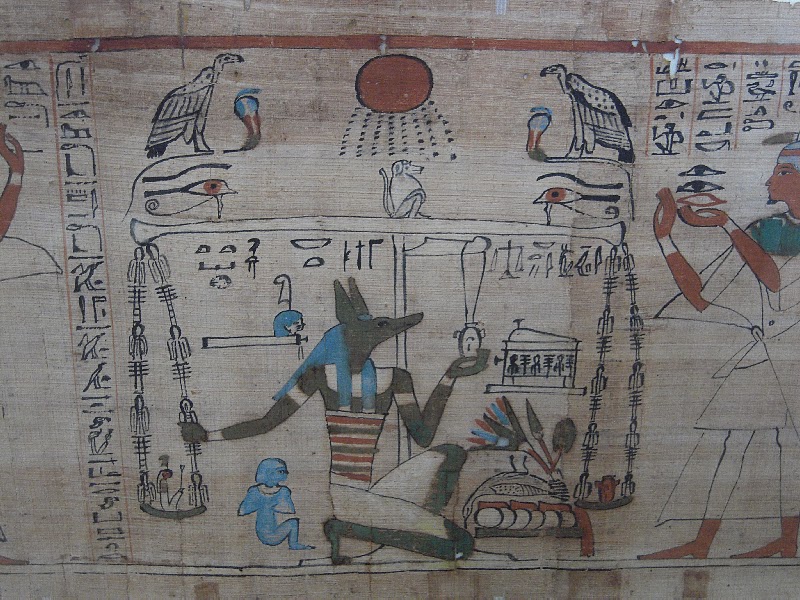
Anubis weighing a heart against a little figure of Maat

We’ve all seen images of the Weighing of the Heart ceremony, wherein the deceased person’s heart (seat of the mind, to the Egyptians) is weighed against her feather in the ‘Hall of Two Maats’ (two truths), but Maat was also a set of principals for the living:

“The ancient Egyptians deeply believed in the inherent grace and unity of the entire universe. They understood that cosmic harmony could be achieved through the most righteous ritual and public life, and any kind of disruption in this divine harmony would have many severe consequences, such as earthquakes or famine, which are caused by an impious king…”
[Egypt Tours Portal, Ancient Egyptian Principals of Maat]
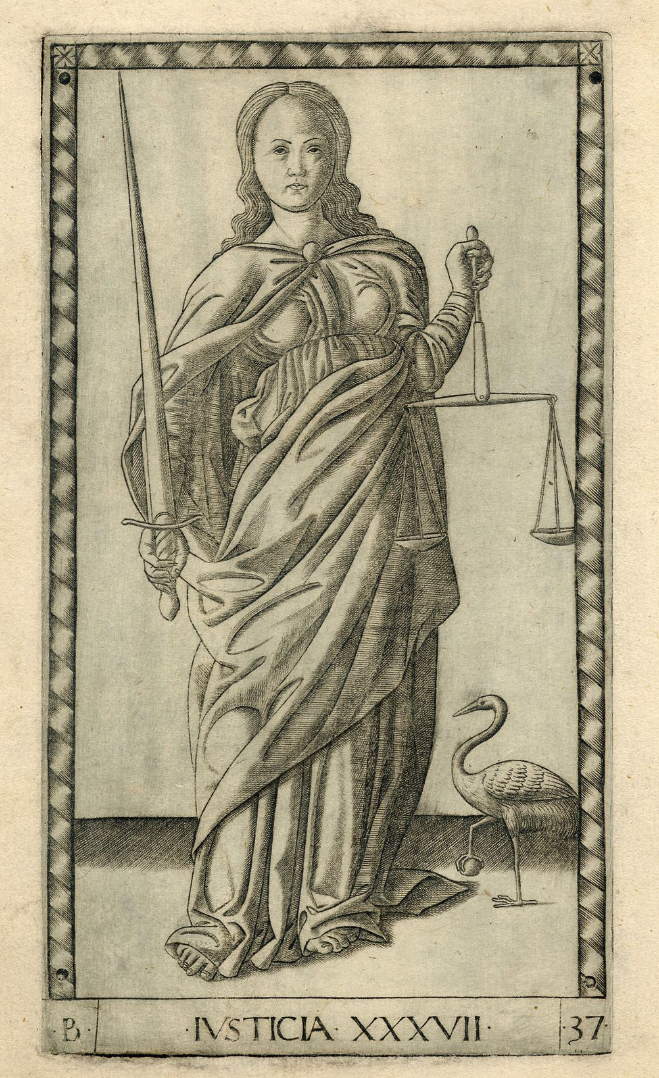
“Tarocchi of Mantegna,” Anon Ferrara 1465

Similarly, to Renaissance humanists, Justice as Cardinal Virtue was a guiding principal to live by – particularly for princes – in order to maintain personal and collective, moral standards. In the ‘Mantegna Tarocchi‘, which depicts the hierarchy of stations from the lowly beggar ‘Misero’ all the way to ‘First Cause,’ Heavenly Virtues are exceeded only by the gods themselves. Note how the stork familiar of Justice harkens back to Thoth, Maat’s Ibis-headed scribe consort – perhaps indicating that virtues need to be taught and developed (the stork was also a symbol for rhetoric).

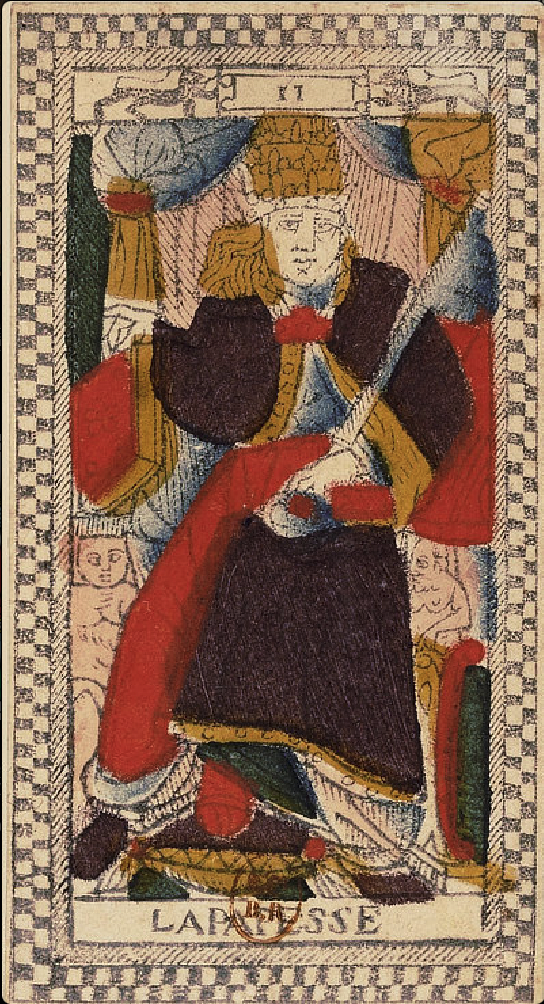
Tarot de Marseille’s Lady Justice, seated upon her throne, sword and scale in hand, seems straightforwardly emblematic. But, as with all TdM cards, might the particulars of her design reveal a more layered persona? Let’s investigate, beginning at the dawn of the Italian Renaissance…
[As always, please click on images to enlarge and for more details.]
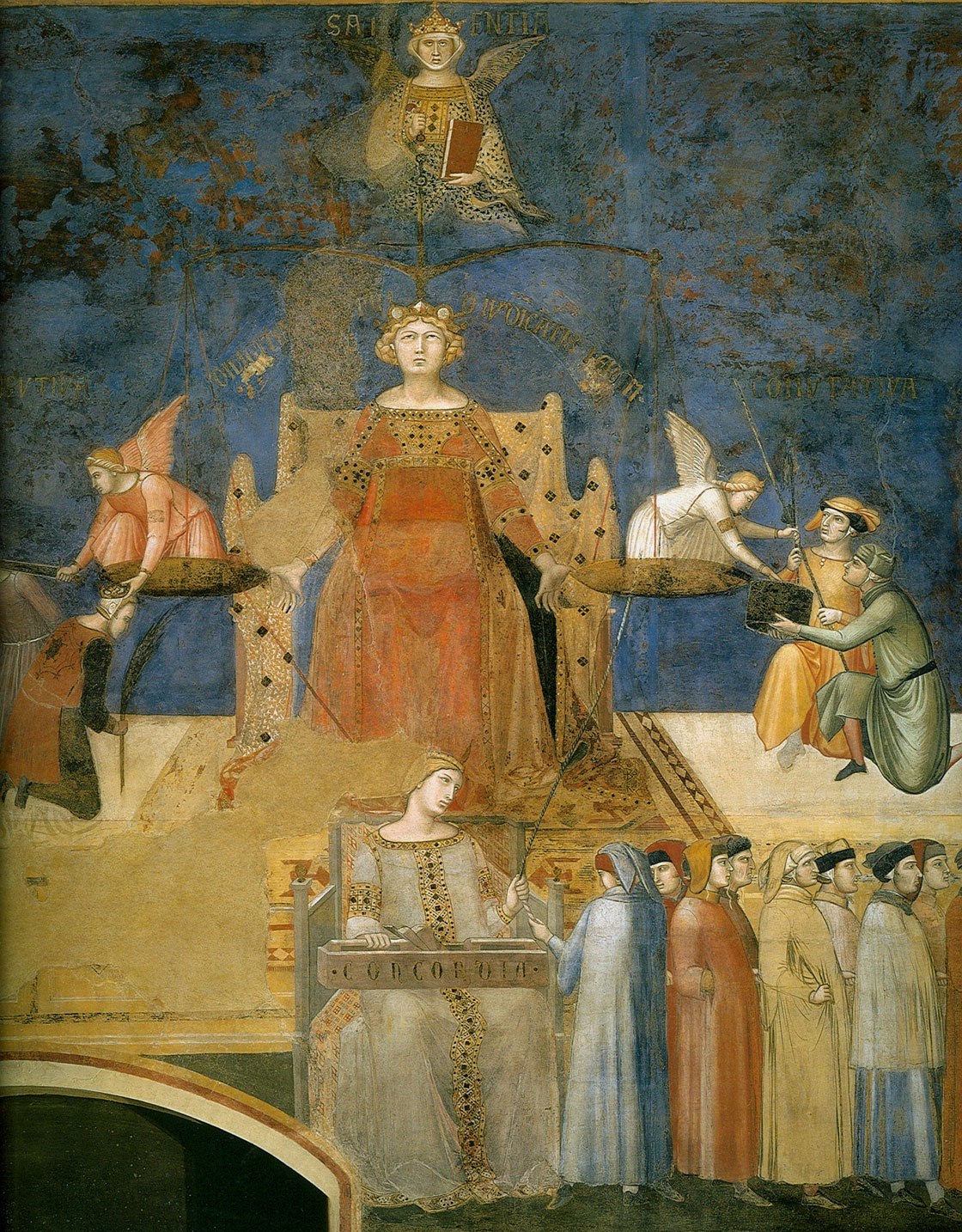
Ambrogio Lorenzetti, Justice (detail), Allegory of Good and Bad Government, 1338-39

The Allegory

Justice, still a figurehead of courthouses today, is the longest-surviving Cardinal Virtue. Her blindfold, supposed to indicate impartiality, makes her seem a bit benign, like she can’t actually witness what we’ve been up to. But prior to the 16th century, this was not the case, as we see in Ambrogio Lorenzetti’s exquisite, mid 14th c fresco, ‘Allegory of Good and Bad Government’ in the Palazzo Pubblico (town hall) of Sienna. Painted at a time when city states of Italy were becoming more secular, allegorical artworks like this in civic buildings were an attempt to incorporate the ancient virtues; to “legitimate and elevate secular activities by suggesting an association with the sacred.” By placing Justice and Judgement scenes in public places, “city states in Italy sought spiritual affirmation that their urban way of life was just as god-annointed as the old, feudal vision of society.” [Images of Justice, Curtis and Resnik, Yale Law Journal] 

Justice appears in the mural a few times, in different forms; most prominently she’s seated on a throne (‘Distributive’ and ‘Commutative’ Justice), a hand resting on either scale, whereupon two angels dish out punishment or reward. She looks upward toward the higher power, Wisdom, who looks up to God. A cord runs from each scale (one is worn away) to the hand of Concordia, symbolizing a balanced state of society. Everything is connected in perfect equilibrium, everyone knows their place and responsibility as citizens.
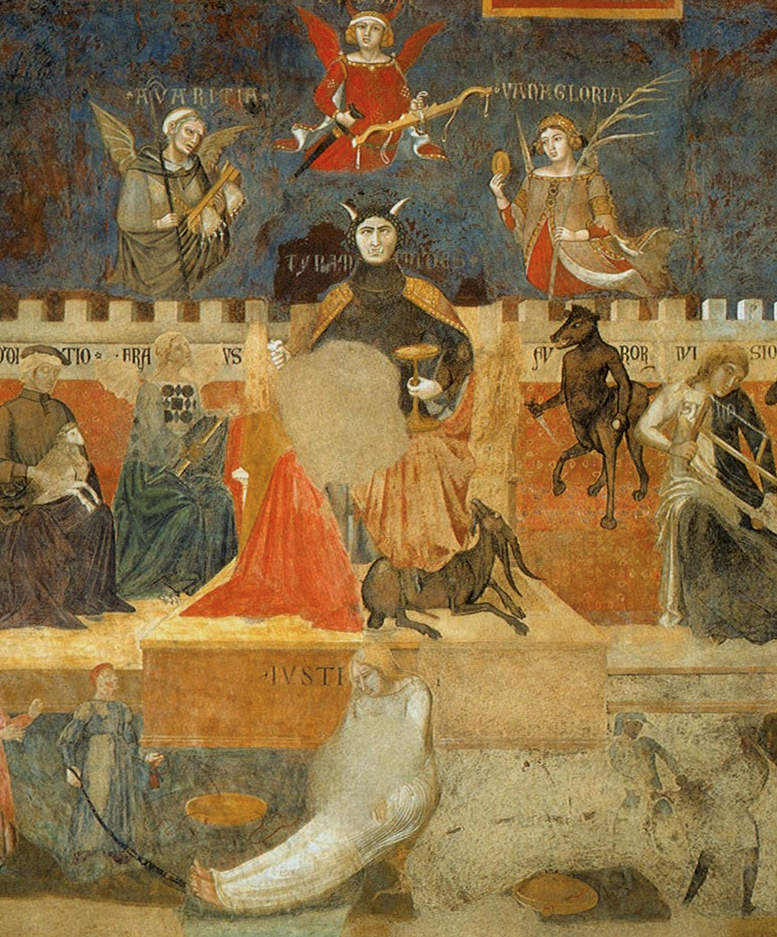
Ambrogio, Allegory of Bad Government (detail)

On the adjacent wall to her right/our left, the Satanic figure of ‘Bad Government’ is seated on a throne, the scales of Justice lie on the ground broken, and she sits in despair beneath him, possibly with hands bound. The relationship between the Supreme Court Justice and the Devil is established.

Watch this video for a more intricate tour of the mural. For our purposes, let it serve as an introduction to how the Virtue of Justice was “propagandized” at the time, and to some of the details that will carry over into the Tarot card.
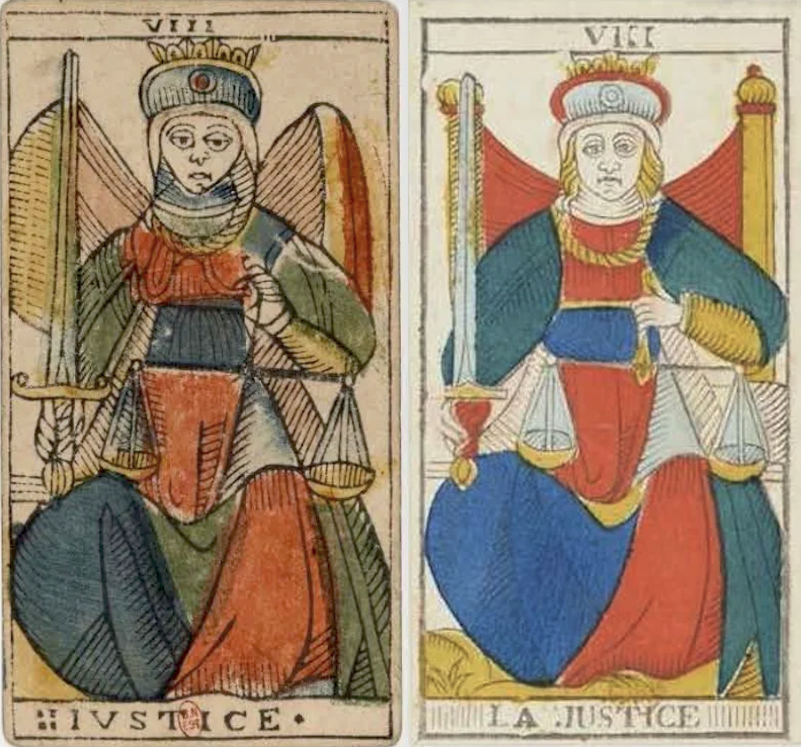
Examples of Type I (Dodal) and Type II (Conver) Tarot de Marsielle, 18th c.

The Pillared Throne

Type II TdM differs from type I, in that Justice’s ‘wings’ are absorbed into her throne’s concave and cylindrical shape. It features two, gold-coloured columns, one which is being ‘split’ by her sword. Emblemata books tell us that, unblindfolded, with sword held erect, she is ‘Divine Justice’. This is further indicated by her crown – more on that a bit later.

It’s important to compare decks for clues, and sometimes they’re found in unlikely places. In this earliest French Tarot, below, the Empress’ hand on the covered arm of her throne could also be seen as lifting her robe to reveal a leonine leg. Though it’s likely a skin she’s seated on, the gesture evokes a legend of the Queen of Sheba, where she lifts her skirt to step over water, revealing a hairy (sometimes exaggerated as bestial) leg.

If this connection was the artist’s intention, might the Emperor then show some hint of Solomon? I think yes – he is seated in columned throne, exactly like the one in TdM Justice, and holds not a sceptre, but a sword erect. “Remember, after all, the tale of Solomon, who offered to use the sword to cut the child in half, to give each claimant her share.” Ouch.
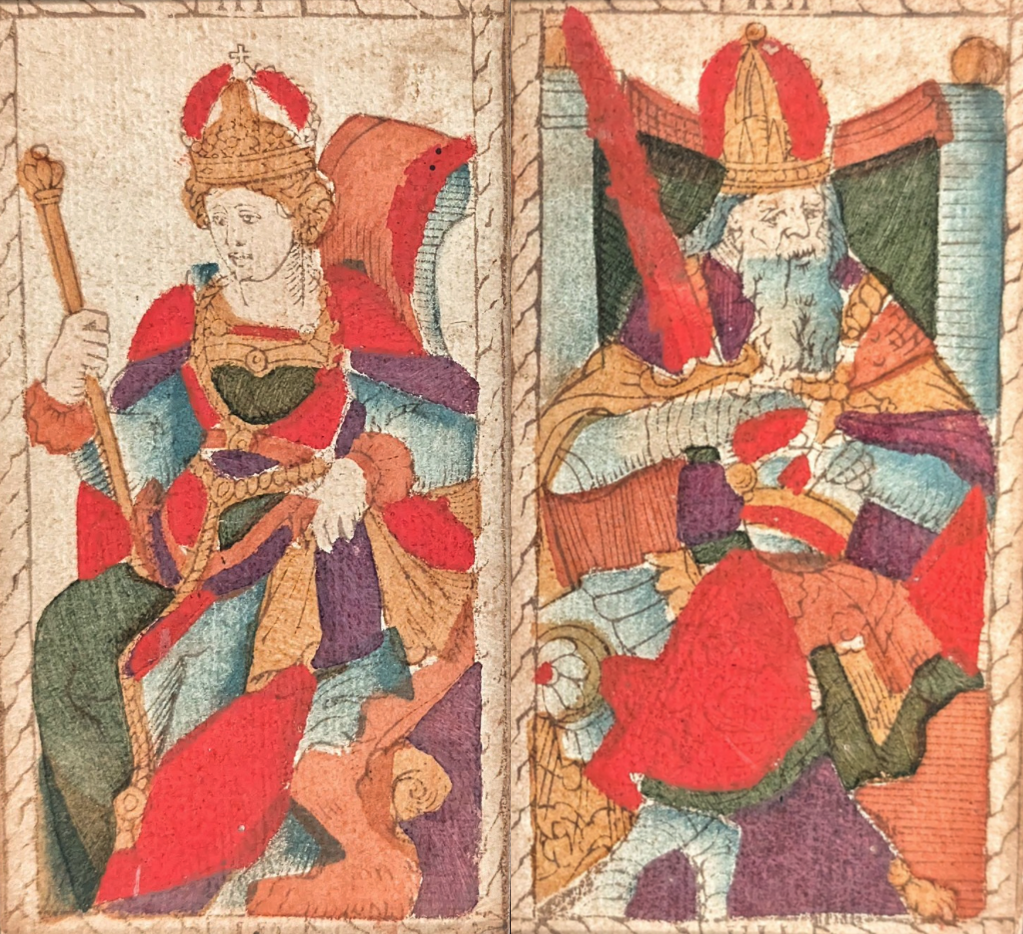
Empress and Emperor, Catelin Geofroy 1557 [photos: Alexandra Miron, click for details]
The Justice card of Catelin Geofroy no longer exists, alas. But, following this visual lead, the columns of TdM Justice’s throne might also be suggestive of Solomon’s brass pillars; on her right, the column of Boaz and on her left, Jachin.

“The earliest Jewish post-biblical account is of Romano-Jewish historian Flavius Josephus (Antiquities 8:165-9), who reframes the Queen of Sheba’s story for a Greek and Roman audience. He speaks of a philosopher Queen of Ethiopia and Egypt who, much like in the Hebrew Bible, travels to meet Solomon to subject him to a trial of wisdom. Josephus’ legend wasn’t picked up further in medieval Jewish and Islamic legends, but had a great influence on the further development of Christian tradition.” [The Collector]
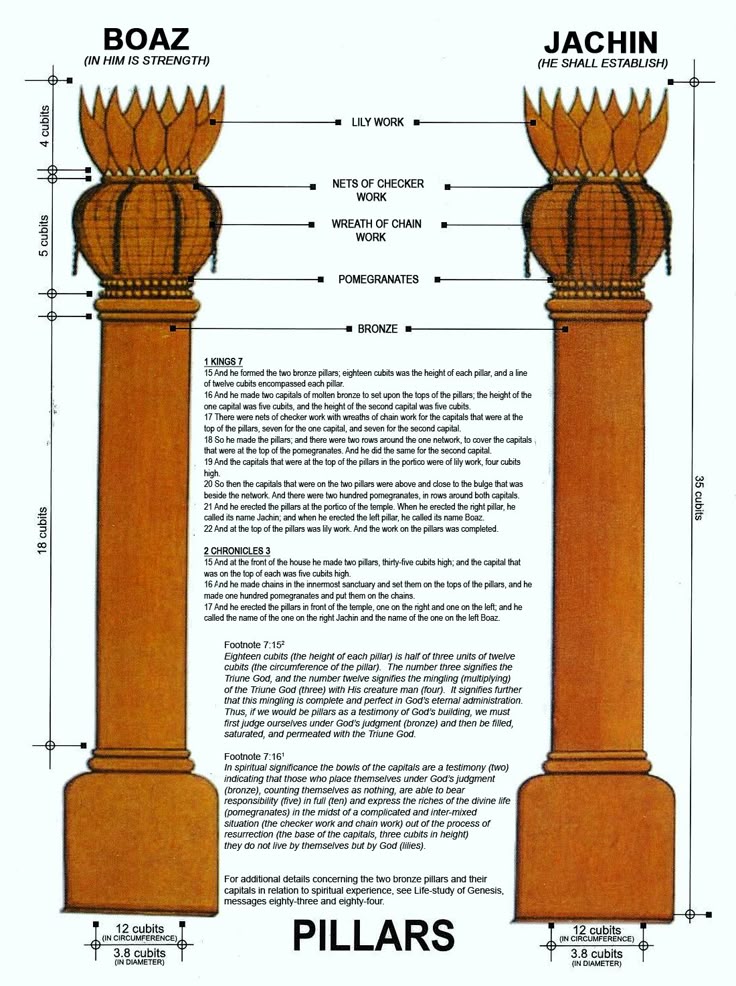
Solomon’s temple pillars [note it reads ‘bronze’, which is the modern interpretation]
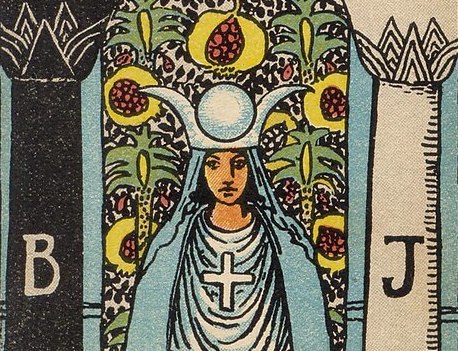
Each pillar was envisioned as having a bulge at the top, with a garland of pomegranates and a crown of lilies. The temple was also decorated with pomegranates. Described as symbols of ‘fertility and abundance’, ‘the promised land’, etc, it seems rather obvious from the Song of Songs that they have everything to do with Sheba’s divine (feminine) wisdom. So much so, that Smith and Waite (who was a Freemason) would put pomegranates and Solomonic pillars in the ‘High Priestess’ card, rather than Justice. (However, while the open pomegranates are saying one thing, her look is less than inviting, contrary to the traditional Popesse).

RWS High Priestess (detail)

In Greco-Roman tradition, the pomegranate is associated with fertility, death, changing seasons and immortality, its seeds resembling jewel-like blood droplets (often the blood of Dionysus). Persephone, by breaching the conditions of her spouse and eating six pomegranate seeds in Hades, is destined to remain underground for half the year and only return (be reborn) for the other half.
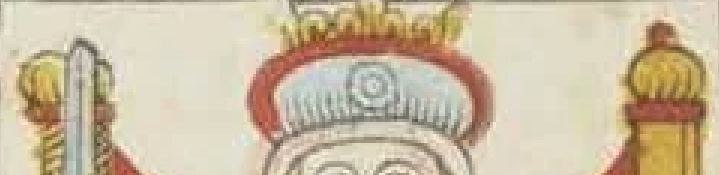
What is the little red dot on the pillar (right)?

In a similar and related tale, Eurydice is destined to remain in Hades after her beloved Orpheus breaks the one condition, that he mustn’t turn to look at her, en route back to the world of the living. The story of Eurydice may be a late addition to the Orpheus myths. In particular, the name Eurudike (‘she whose justice extends widely’) recalls cult-titles attached to Persephone. ” [wikipedia]

“Eurydice’s name means wide ruling Justice. She is the prototype of Dike, one of the Horea, born to Themis and Zeus. Dike stood for the All Way, The Way, The Truth, and The Light. As Dike’s prototype, Eurydice is a mythical goddess and archetype present in the underworld before the cloaking of the myth in the traditional romantic versions during the creation of the Classics by male authors.” [intro to Emily Miller, ‘Euridice’s Bones’]

(Similarly, Persephone was the ‘Iron Queen’ of the Underworld, prior to the Pluto abduction myth).
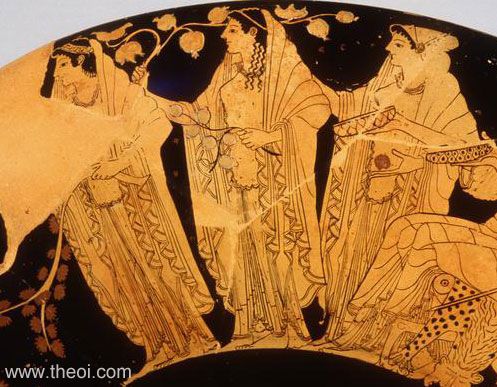
Horai (seasons) with pomegranates for Summer

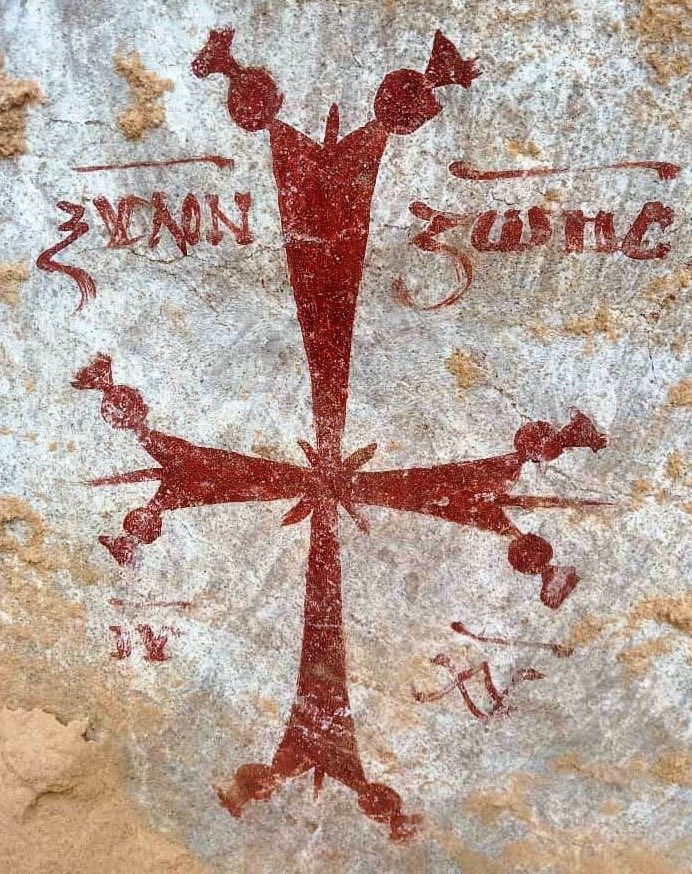
Coptic greek cross with pomegranates/”tree of life” from a recently discovered monastery in Egypt [Ministry of Tourism and Antiquities Egypt]
The fruit of the biblical tree of knowledge (of sex, death and immortality) was most likely a pom, not a pomme. The Lily, also a death and rebirth symbol is associated with Lilith, Isis and the Virgin Mary. Red and white are blood and milk, the colours of alchemical Rebis.

Brass signifies God’s judgement, ie, these are not merely ‘functional’ pillars. Passing between the two brass pillars represents entry into another world, eternity or another sphere. The card is divided not just vertically, but horizontally, by the bar of her scales; there is equilibrium between Heaven above and Earth below, just like in the Sienna mural. The curved back of Justice’s throne serves a dual design purpose, suggesting wings as well as heavenly spheres. Her sword traverses both realms and we notice the ball in its handle is threefold; the trinity of philosophical elements.
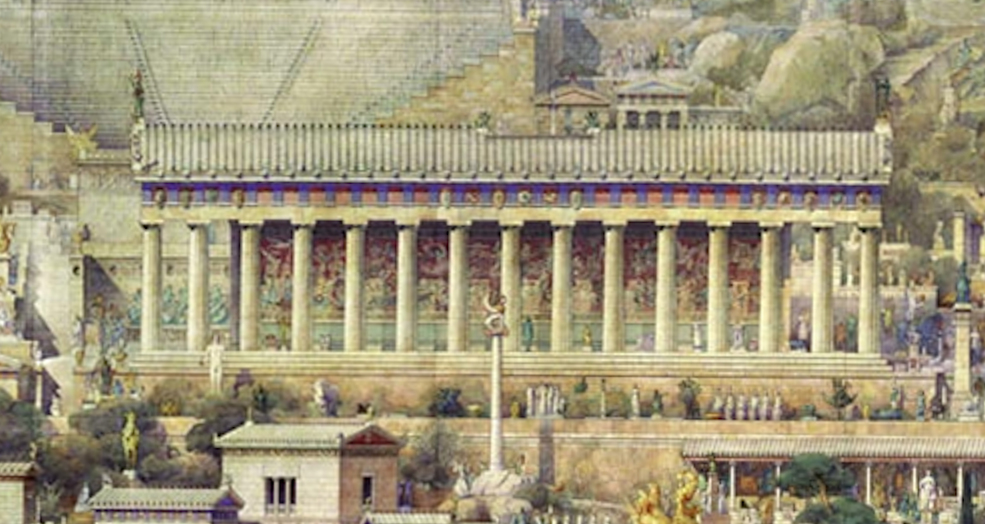
Temple of Apollo, Delphi

Wisdom Pillars

The two pillars of wisdom also can be likened to the two maxims inscribed at the entrance (possibly on columns) of the Temple of Apollo at Delphi. According to Pliney the Elder, these were written in letters of gold:

Know thyself
and
Nothing in excess
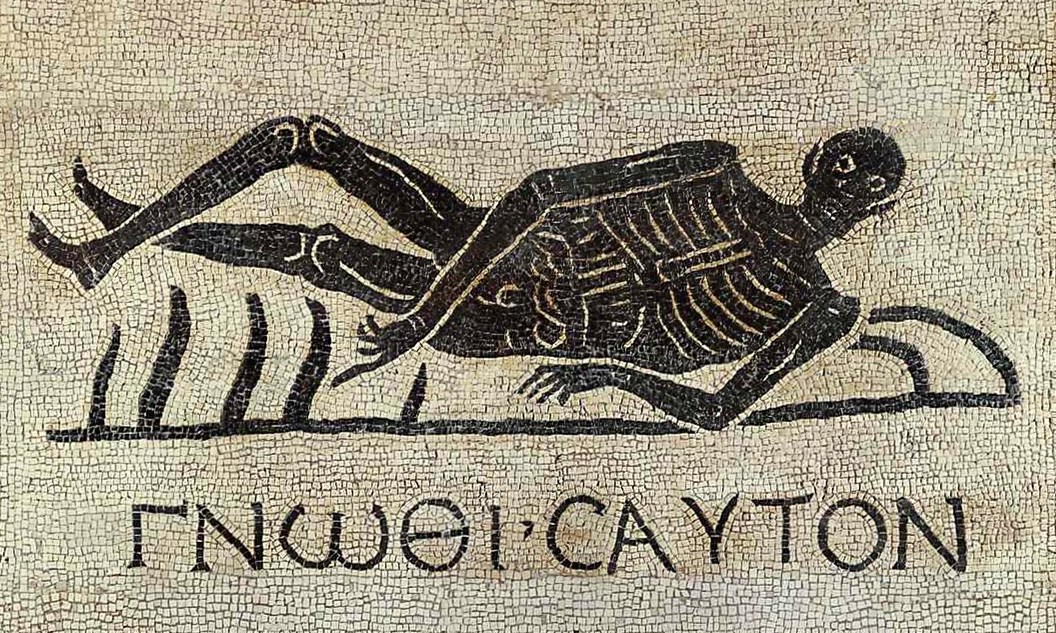
The famed ‘Know Thyself’ Roman mosaic (ca 30 BC-14 CE), Naples Museum

Know Thyself  [sword] 
The first application of the phrase to self-knowledge in the modern sense occurs in Plato’s Phaedrus, in which Socrates says that he has no leisure to investigate the truth behind common mythological beliefs while he has not yet discovered the truth about his own nature.
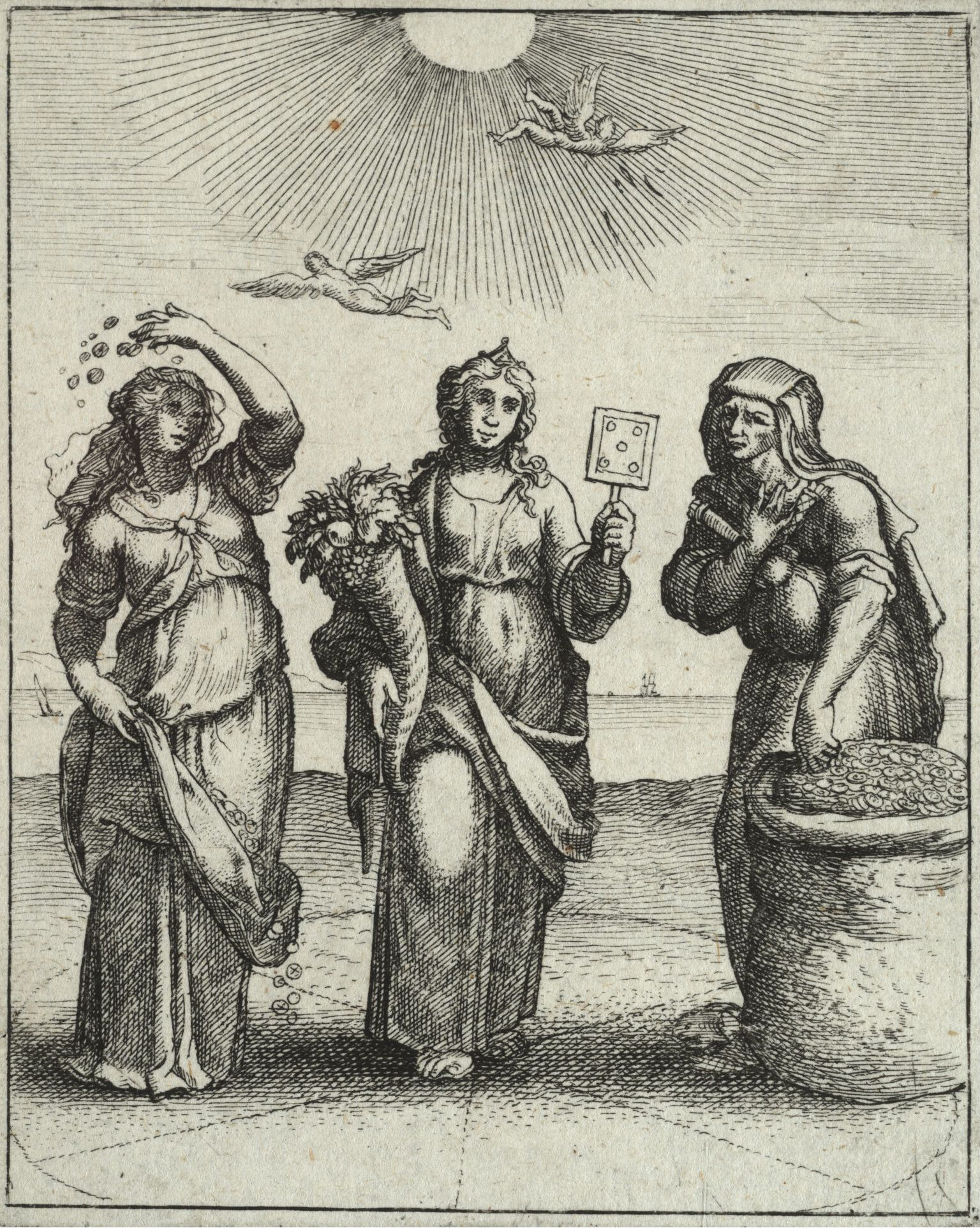
Wenceslas Hollar, The Golden Mean 1641-1644 (circa)

Nothing in Excess/Nothing too much  [scales]
The maxim has been said to have received its ‘ultimate expression’ in  Aristotle’s theory of ethics, according to which every classical virtue occupies  a middle place between the two extremes of excess and deficiency.
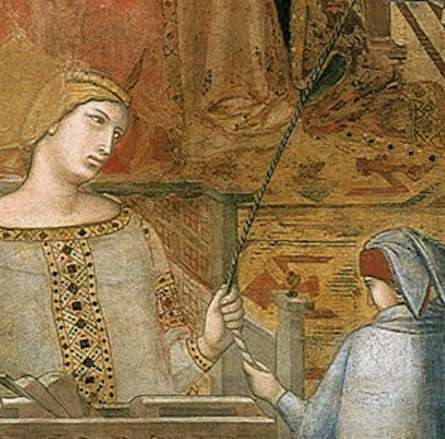
Concordia detail, Sienna mural

There was also a third maxim inscribed:

Give a pledge and trouble is at hand
The Greek word ἐγγύα, here translated “pledge”, can mean either (a) surety given for a loan; (b) a binding oath given during a marriage ceremony; or (c) a strong affirmation of any kind. Accordingly, the maxim may be a warning against any one of these things.
In Plutarch’s Septem sapientium convivium, the ambiguity of the phrase is said to have “kept many from marrying, and many from trusting, and some even from speaking.” [Wikipedia]

Among other things, which I’ll get to, the cord around Justice’s neck may indeed have to do with being bound to one’s word – or to one’s silence – especially in monetary and matrimonial matters (Libra).
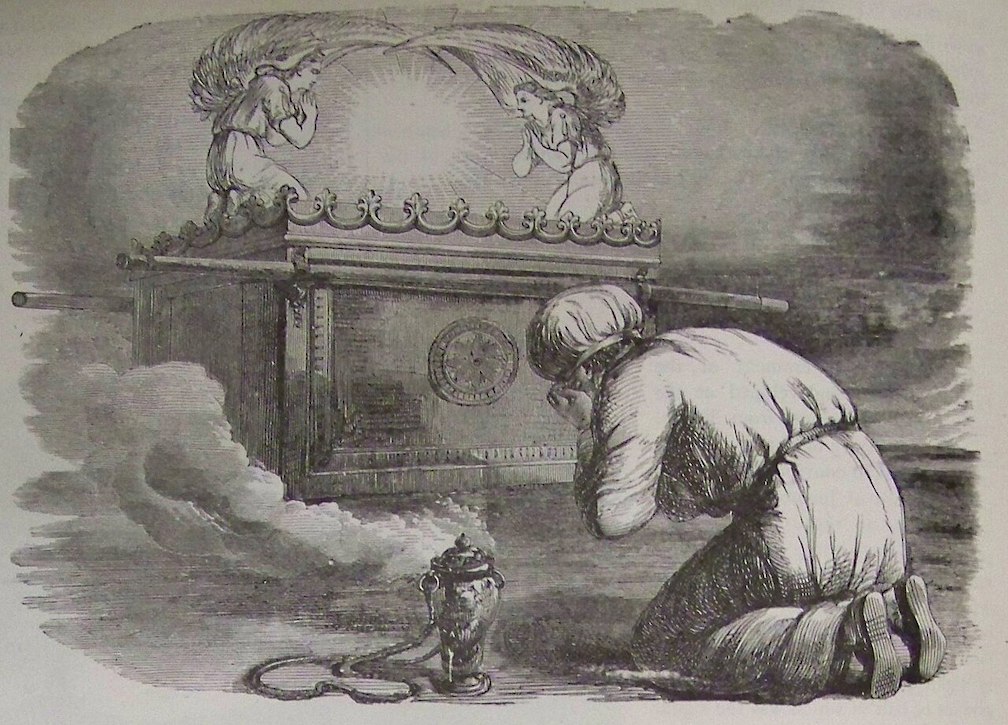
Mercy Seat, The Holman Bible, 1890 (note the curved angel wings are like bull horns).

Lady Have Mercy

Inside Solomon’s temple was something called a ‘Mercy Seat (hilasterion, “that which makes expiation” or “propitiation” for the removal of sin), which, according to the Hebrew Bible, was “the gold lid placed on the Ark of the Covenant with two cherubim at the ends to cover and create the space where Yahweh appeared and dwelled. This was connected with the rituals of the Day of Atonement.” (Yom Kippur, occurring in Libra season).

Oh my heart which I had from my mother! O heart of my different ages! Do not stand up as a witness against me, do not be opposed to me in the tribunal, do not be hostile to me in the presence of the Keeper of the Balance!

~ Egyptian Heart Prayer

Here the lines between Justice and Judgement start to blur, and the two often get conjoined when deciphering the meaning of this card, as was the intent of Italian civic hall murals. The difference is that Judgement (or Last Judgement) is a final verdict, whether it’s pronounced in a court of law or standing before a supreme being. Justice is about honing an inner sense of self-regulating equilibrium, guided by the understanding that we will ultimately face some kind of ‘judgement’ by the god(s) of our higher conscience – maybe not hellfire or pearly gates but ‘damned’ or ‘blessed’ to live in the kind of world we helped create. They are closely intertwined, but differing concepts.
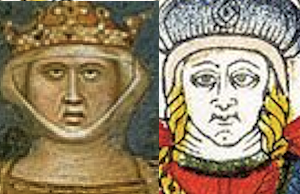
Sienna mural and Pierre Madenié details

In the ancient Greco-Roman world, supplication – begging for the sparing of one’s life, on the battlefield, for example – involved a specific set of gestures; the supplicant, on their knees (submissive stance), would clasp the dominant’s knees (they can’t walk away), reach up to clasp their chin (they can’t look away) and beg for mercy.

It’s been suggested that the scales rest on Lady Justice’s knee and are being tipped slightly. As well, the collar of her wimple, which again harkens back to our Sienna mural, has started to look a bit like hands. These are the type of details people often write off as ‘printing mistakes’, but might they have had a mnemonic function? In fact, during the Renaissance, Justice was sometimes depicted in a more gruesome way – as judges with severed hands.
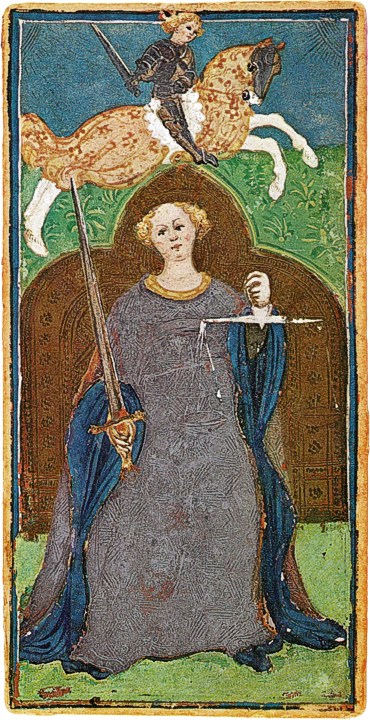
Visconti-Sforza Justice,  c 1450

We can back up this notion of ‘having mercy’ with another Justice card, the Visconti-Sforza. It’s an anomaly in the deck (unless the original other two Virtues were also illustrated thus), in that the gold background does not go all the way up, but instead creates a throne back or triptych shape, while over her head leaps a knight on a white horse. Likely this figure represents the chivalric code of the Arthurian knights, who, while charged with enforcing justice, were also required to ‘be just,’ ie, to act from their higher consciousness and show mercy whenever possible, rather than give in to brutish impulses. This is in keeping with the idea of Temperance, also. We know that the Arthurian legends were extremely popular in Italy (some having been illustrated by Bonafacio Bembo, who painted the cards).

That this ‘hero rider’ – the solar hero – is situated above the Virtue’s head brings to mind Athena (wisdom and strategy, with violence only as last resort) who was conceived in and born from  Zeus’ head (intellect). The virtuous knight here takes the role of divine wisdom, by which lady Justice is guided, as in the Sienna mural.
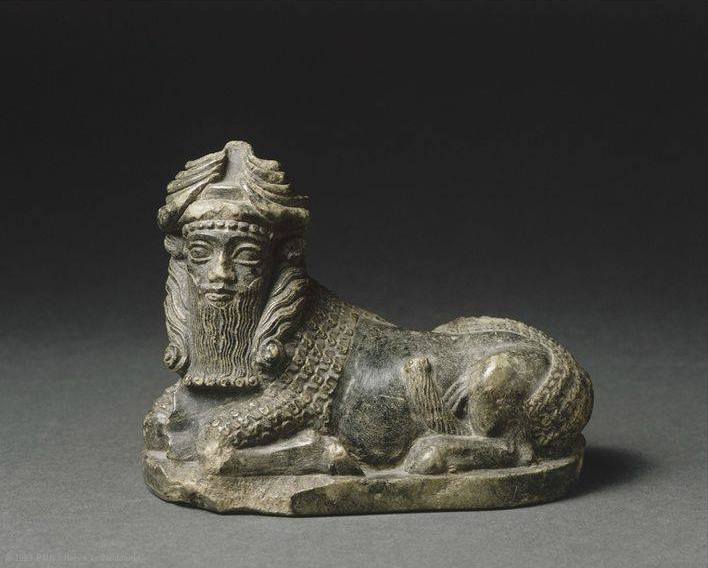
Recumbent bull with man’s head. Mesopotamia, c. 2350–2000 BC. Louvre

The Bull of Heaven

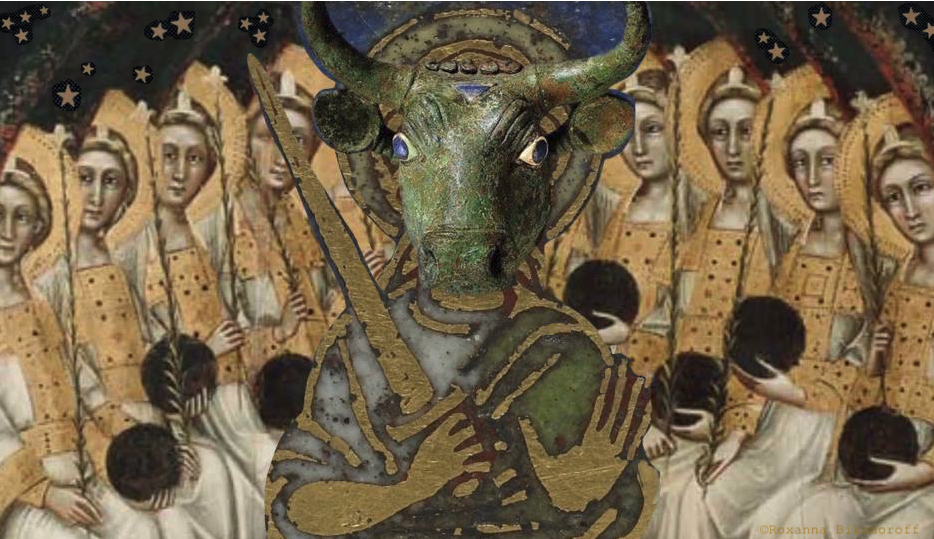
Let’s turn now to TdM Justice’s turbaned crown, up above the spheres. Although upside down, there is no mistaking the symbol for Taurus the bull, its horns cleverly formed by the interruption of her hair. The bull is a vehicle and/or attribute of any god or goddess worth their salt, particularly when they are acting as supreme judge. The two horns of the bull serve the same function as two pillars, maintaining stability and equilibrium.
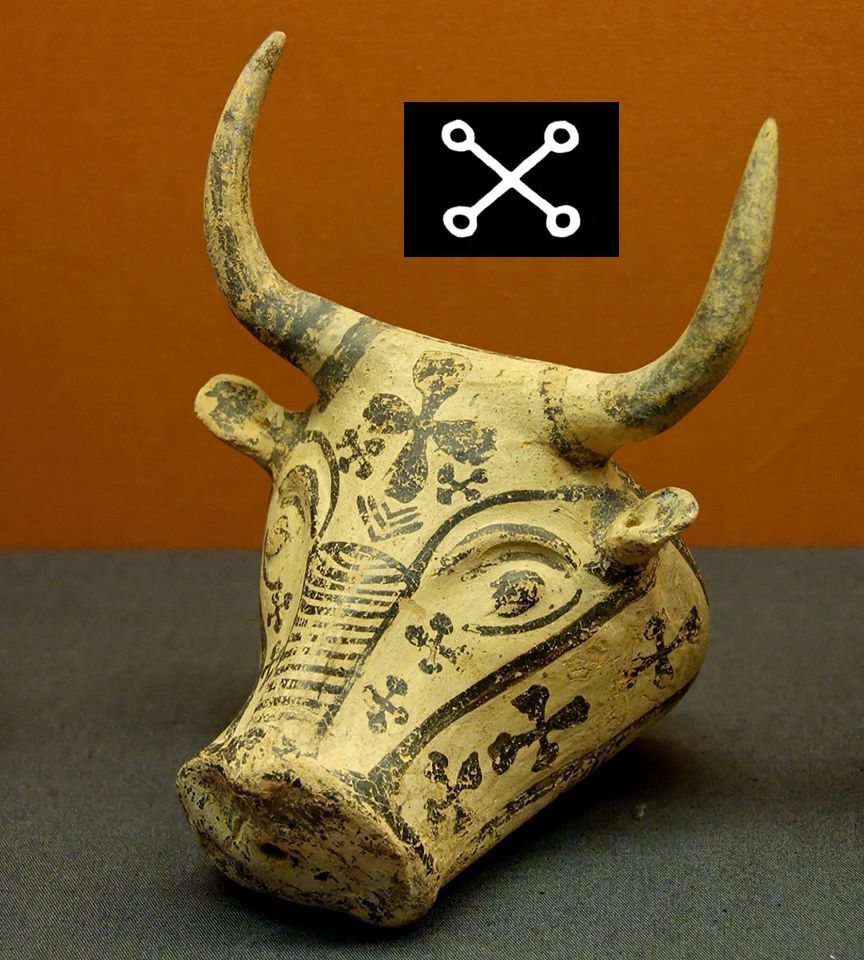
Mycenaean rhyton 1300-1200 BC, with sigil for Aldebaran (Agrippa)

Central and level with the ‘sun and moon’ pillar bulges is the all-seeing, monadic eye in Justice’s bull crown. We are reminded of the ‘Bull’s Eye’ (aka ‘God’s Eye’) in the constellation of Taurus, Aldebaran, the watcher in the East. This royal star was once connected to the Spring Equinox (opposite Autumnal Antares, Heart of the Scorpion) and rises with the Pleiades aka ‘Seven Sisters.’ Aldebaran is associated with St. Michael, whose name is the rhetorical question he posed to Satan: ‘Who is like unto God?’ Might this be what Justice is asking? Could the rider of the V-S card also be a stand-in for St. George, chivalric incarnation of Michael the dragon-slayer?
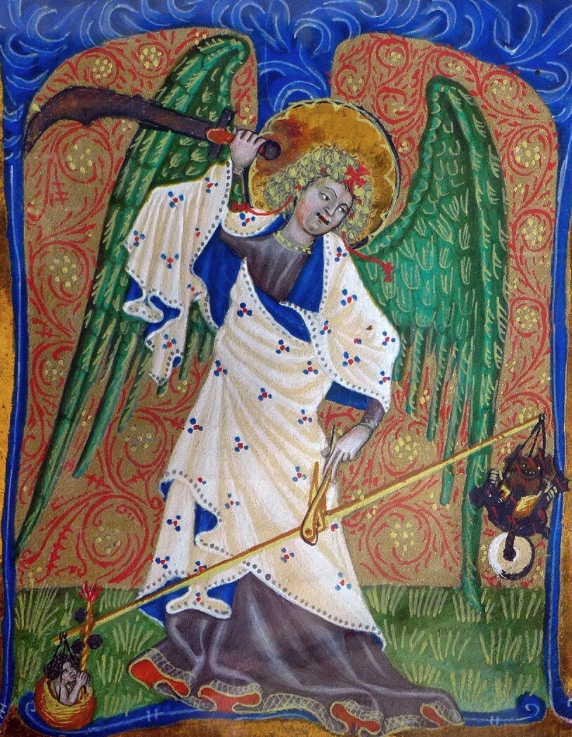
St. Michael weighing souls during the Last Judgement, 15th c

After 7 steps (or stages, or planetary spheres) we arrive at Justice, and 7 steps from Justice is the Devil. “If then you do not make yourself equal to God, you cannot apprehend God; for like is known by like.” If Justice is to be impartial in her judgement, she’s going to need that third eye.

The following is an excerpt from a fictitious 1490 dialogue by Italian doctor and humanist, Battista Fiera, between the painter Mantegna and the allegorical figure ‘Momus,’ on how to depict Justice. Mantegna, having heard conflicting accounts, has ‘consulted a series of philosophers’:

Mantegna: I began with Saxus Hippolytus. He said Justice should be represented with one eye; the eye being rather large and in the middle of the forehead; the eyeball, for sharper discernment, deep-set under a raised eyelid.

Momus: Suppose something happened behind her back? Might she not be taken in the rear? Will she be safe enough with only one eye in front?
. . . If she had an eye at the back as well, she’d be still more queenly and majestic.

Mantegna: Erasmus the Stoic [said] . . . that she ought to be shown seated, and holding scales in her hand.
“But . . . make her one-handed.”
“So that she couldn’t throw in a makeweight, of course.”
[Marianus] instructed me to depict her standing, and with eyes all over her as Argus was of old. . .  And brandishing a sword in her hand to ward off robbers, and to protect the innocent and the unfortunate . . . 
Astallius said she should be depicted sitting on a square marble chair with a slightly curved back, such as there was once at Lesbos, and measuring with a leaden rule.

Momus: To be sure, his was a milder image of Justice, since he left out the menacing sword; and he had good reason to fear she might have a fall. But why the leaden rule? Did he mean that Justice is sometimes twisted? For is not the common herd, remembering her waxen nose, loud in proclaiming that she is?

Mantegna: No, he didn’t mean that she is twisted; but he said she was to govern with equity – now and then to slacken the reins.

Momus: What did Fiera say?

Mantegna: [H]e enjoined me to depict her covered with ears as well.

Momus: Why? Was he afraid that she might become deaf?

Mantegna: He was . . . [and Astallius and Fiera also said] that Justice was to put on the habit of a penitent . . .

Momus: So, they want her to be mortified! But didn’t it occur to them to give her wings?

Mantegna: No one thought of that.

[excerpted with from ‘Images of Justice’ by Dennis E. Curtis and Judith Resnik, Yale Law Journal]
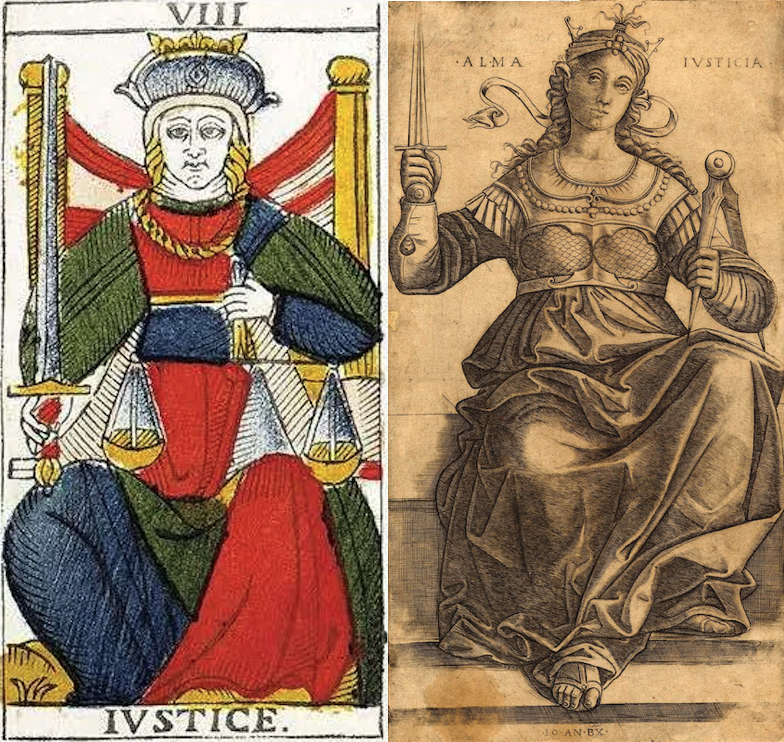
Pierre Madenié 1709 and Giovanni Antonio da Brescia 1475-1520  (note her foot shape).

The dividing line created by the bar of her scales can also be viewed as the horizon itself, where the cusp of Libra begins the Sun’s descent. The Pierre Madenié card provides another interesting detail; the handle of the scales is shaped like a divider compass (see Star post).

In the  Bolognese card, below, Justice’s scales hang from a globus she’s holding, similar to the Empress. This detail is consistent with emblems of Divine Justice, where her foot rests upon a globe. Like the TdM version, her lower half is weighty, grounded on Terra Firma, but in this case, she is Nature, ie, natural law, natural order, as above, so below. If we zoom in closely, there is what appears to be a little, bull head shape on her collar. Remember that Taurus is the sign of FIXED EARTH.
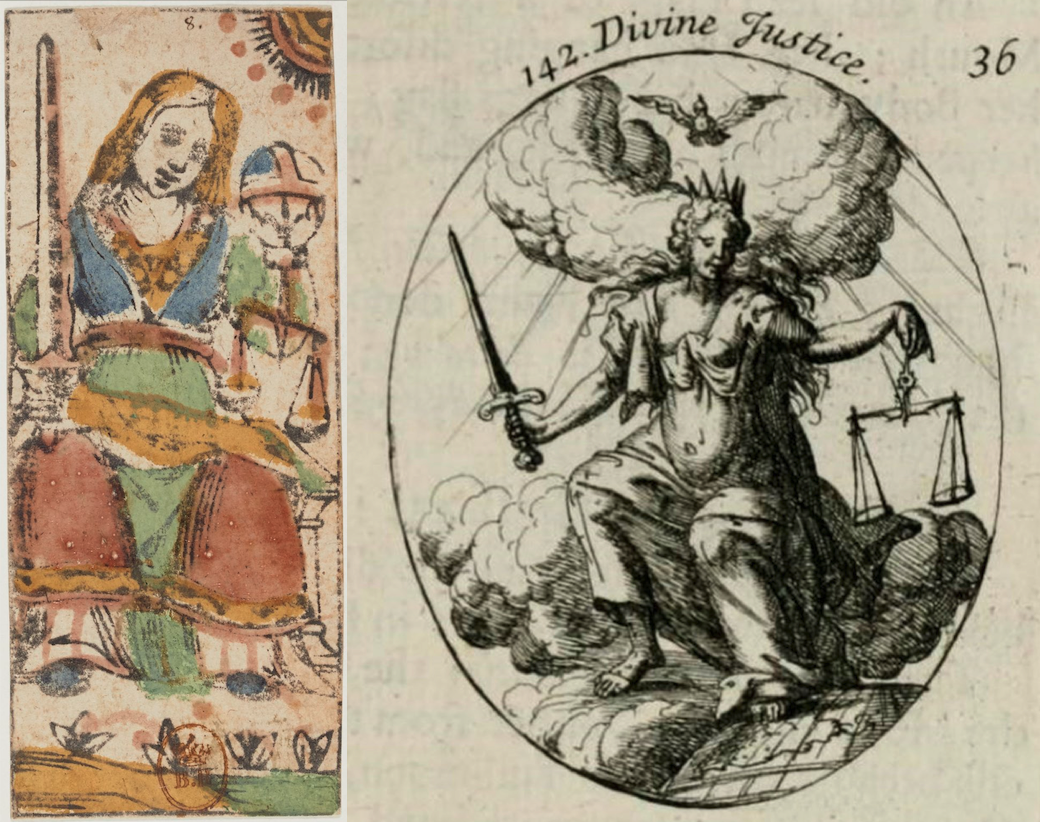
Alla Torre Justice card and Cesare Ripa Divine Justice

In the Rosicrucian image below, we can identify some similar components to the TdM Justice card, such as the two pillars of Wisdom (solar/father/fire/air and lunar/mother/water/earth). The above is as below, and the heavenly bodies shine onto a (directional) compass. In its centre is a globus cruciger, symbol for antimony (see Empress card) which is used in the purification of gold and silver, a material and spiritual process. At the very top is the symbol for Taurus, with Aries on the left, Gemini on the right. May, high Taurus season, when the Earth is most fecund, is when alchemists collect their dew, (again, Empress/Nature).
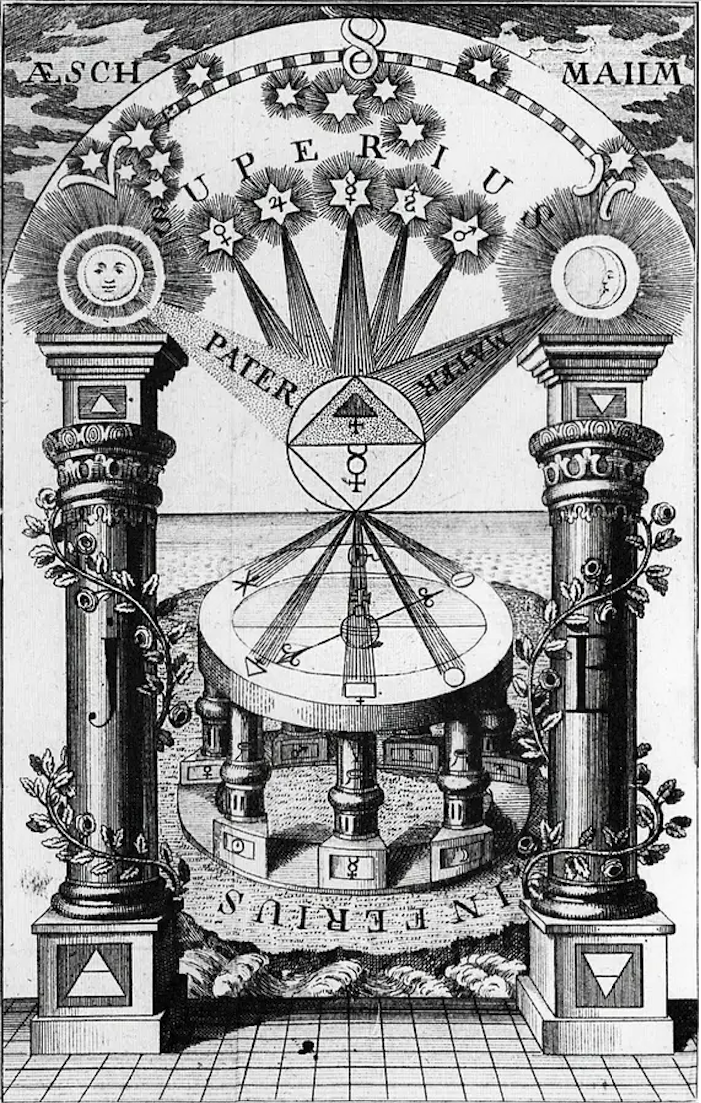
‘The Compass of the Wise’ frontispiece for a rare book on Freemasonry and Rosicrucianism by German author Adam Michael Birkholz, 1779

Mithras 

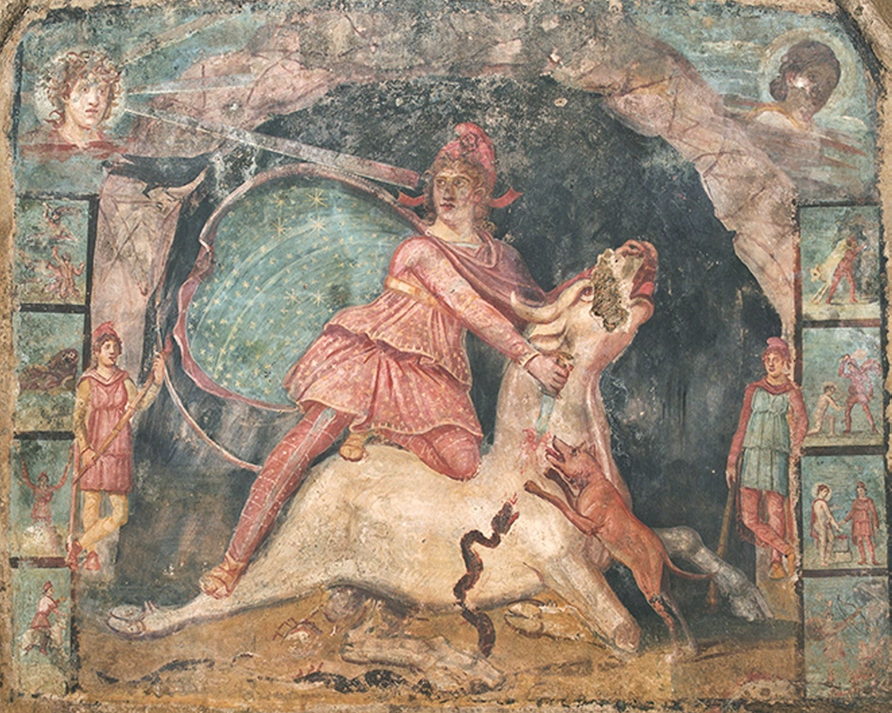
There is also a connection of these three Spring signs (Aries, Taurus, Gemini) to the Mithras Mystery Cult. Personally, I’ve never really jived with the brutal Tauroctony image – symbolic though it may be – central to every mithraeum in this exclusively male cult of Ancient Rome (2nd-3rd c). However, it is relevant to our topic. Originally, the Iranian god, Mithra was not associated with bull-slaying. Mithra is initiallyan ancient Iranian deity of covenants, light, oaths, justice, the Sun, contracts, and friendship. In addition to being the divinity of contracts, Mithra is also a judicial figure, an all-seeing protector of Truth…’As the god of contract, Mithra is indeceivable, infallible, eternally watchful, and never-resting. [Wikipedia]

Tauroctony fresco from a Mithras cave

Mithras is always accompanied by a pair of torch-bearing attendants, the Dadophori, a pair of ‘mini Mithras’ resembling the Dioscuri (Gemini). One holds his torch upwards, the other downwards, interpreted as the rising and setting Sun (life and death), creating a triad with the central solar god at the height of his power (noon) in the middle. They may also have symbolized the equinoxes. The slaying of the bull has been interpreted as the procession of Spring Equinox from Taurus to Aries (ca 2000 BC).
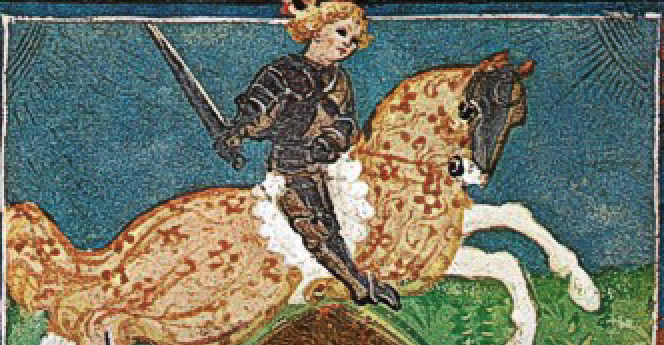
V-S detail

Interestingly, if we zoom in on the Visconti-Sforza Justice card, we can see the solar knight is also situated between two luminaries or suns. [Corner ‘suns’ were often just decorative, for example in the Bolognese tradition, but that was more than a couple of centuries later, and as noted, the background of this card is an anomaly.] And while we’re on the subject, does the TdM Justice’s hair not resemble torch flames?

“Within the Christianised zodiac, Taurus the bull was seen as an image of Christ in his role as the incarnating god, sacrificed in the redemptive act. Having rulership over the throat and vocals, Taurus was used in the secret zodiacal symbolism of Christianity as a symbol of the incarnate word ‘the Logos.” [Fred Gettings, The Secret Zodiac: The Hidden Art in Mediaeval Astrology]

Taurus was the word descending into matter/flesh, Pisces the ascent of the spirit back to the heavens.

Thus the death of the bull was the birth of life, and for this reason took its high place in the ceremony and art of the Mithraic cultus.” [ccel.org]
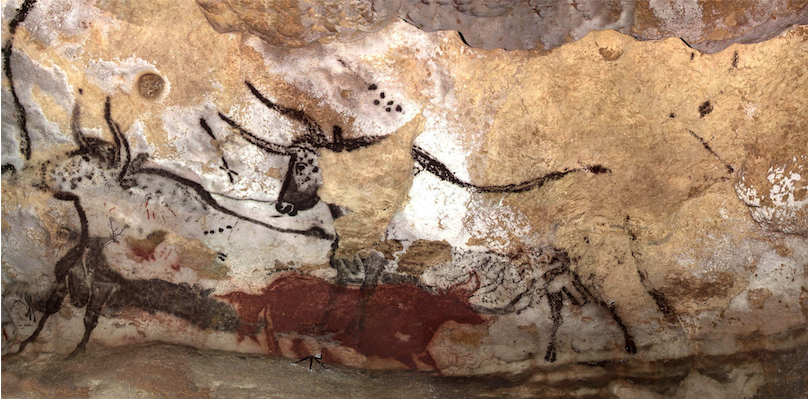
Lascaux Cave Bulls/Taurus constellation: ”Plus ça change, plus c’est la même chose.”

Some say that the Roman cult of Mithras, a ‘cult of the Sun that began as a personal  process in the darkness of a sacred cave’ was assimilated into Masonic traditions of the Middle Ages, or at least influenced them (he was born from a stone, after all). This purification ritual involved traversing 7 steps of his mystical staircase (possibly while on bended knee and blindfolded), corresponding to the 7 planetary spheres, in order to reach the Phrygian cap, a sword and a crown. Mithras, in the 8th sphere, represented cosmic order. 
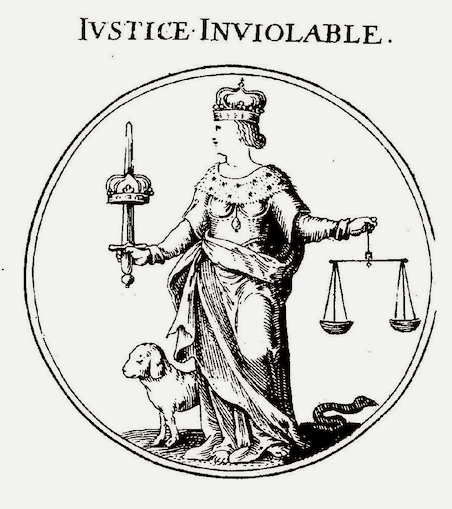
Remnants of the olde religion?

Curiously, Ripa later includes the dog and snake in his emblem of ‘Inviolable Justice,’ to symbolize how friendship and hatred can both corrupt good judgement. 
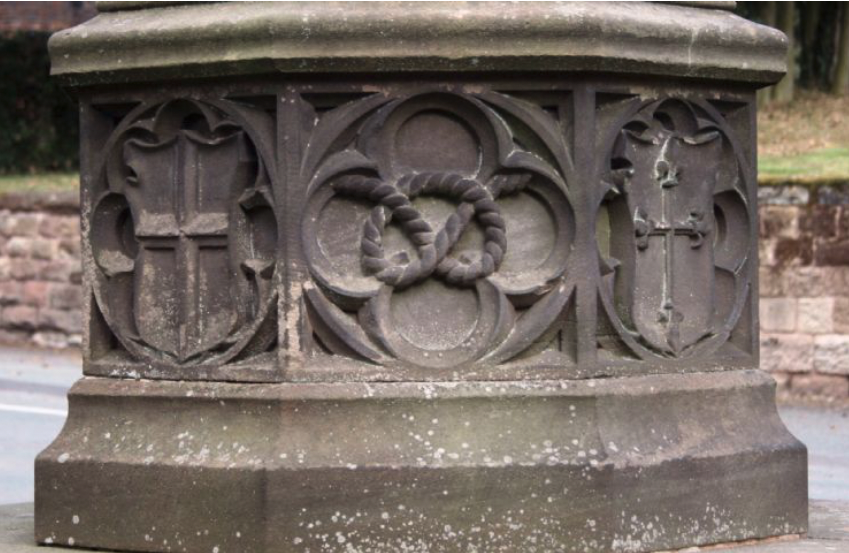
Masonry’s knotted cord

The Cord that Binds and Measures

Lastly we come to the golden rope or chain around TdM Justice’s neck. There are a few possible meanings for it. The most obvious explanation is that it’s to gently remind would-be criminals with, lest they should end up swinging like Le Pendu. However…

The English word ‘noose’ comes from the Old French ‘no(u)s’, from the Latin word ‘nodus’, meaning knot. But ‘nous’ was also the Ancient Greek concept for the higher, divine intellect, the mind’s eye that is the God’s eye. According to Aristotle, nous is the intelligence which apprehends fundamental truths (such as definitions, self-evident principles).’ 

‘Each intellectual virtue is a mental skill or habit by which the mind arrives at truth, affirming what is or denying what is not.’

[The cord connecting the two, Pisces fishes is called a ‘Nodus’, or ’Nodus Coelestis’, the Heavenly thread.]
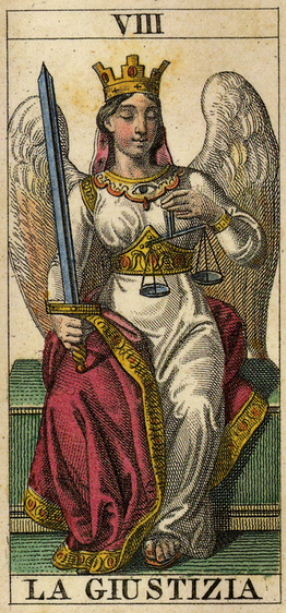
Soprafino Justice with bleeding eye

Returning to the ‘Allegory of Good Government’, recall it is also the cord (or a portion of it) that binds Justice to Concordia.

There is an unseen cord that binds
The whole wide world together;
Through every human life it winds,
This one mysterious tether.
There are no separate lives; the chain
Too subtle for our seeing,
Unites us all upon the plane of universal being.

~ Small Talks on Freemasonry, Joseph Fort Newton, Masonic Service Association of the United States, 1928

If it’s the golden chain she wears round her neck (no reason it can’t represent both), it is probably the one by which Heaven and Earth are connected. To alchemists, this chain represented a series of transformations ‘from elemental chaos to quintessence’:

“Since all things follow one another in continuous succession, descending in order to the lowest, it will be found, by one who observes closely, that from the highest God to the lowest, all are bound together by mutual links, and the connection is nowhere broken. This is Homer’s golden chain, which he says God commanded to hang from heaven to earth.” – Macrobius, Commentary on the Dream of Scipio.
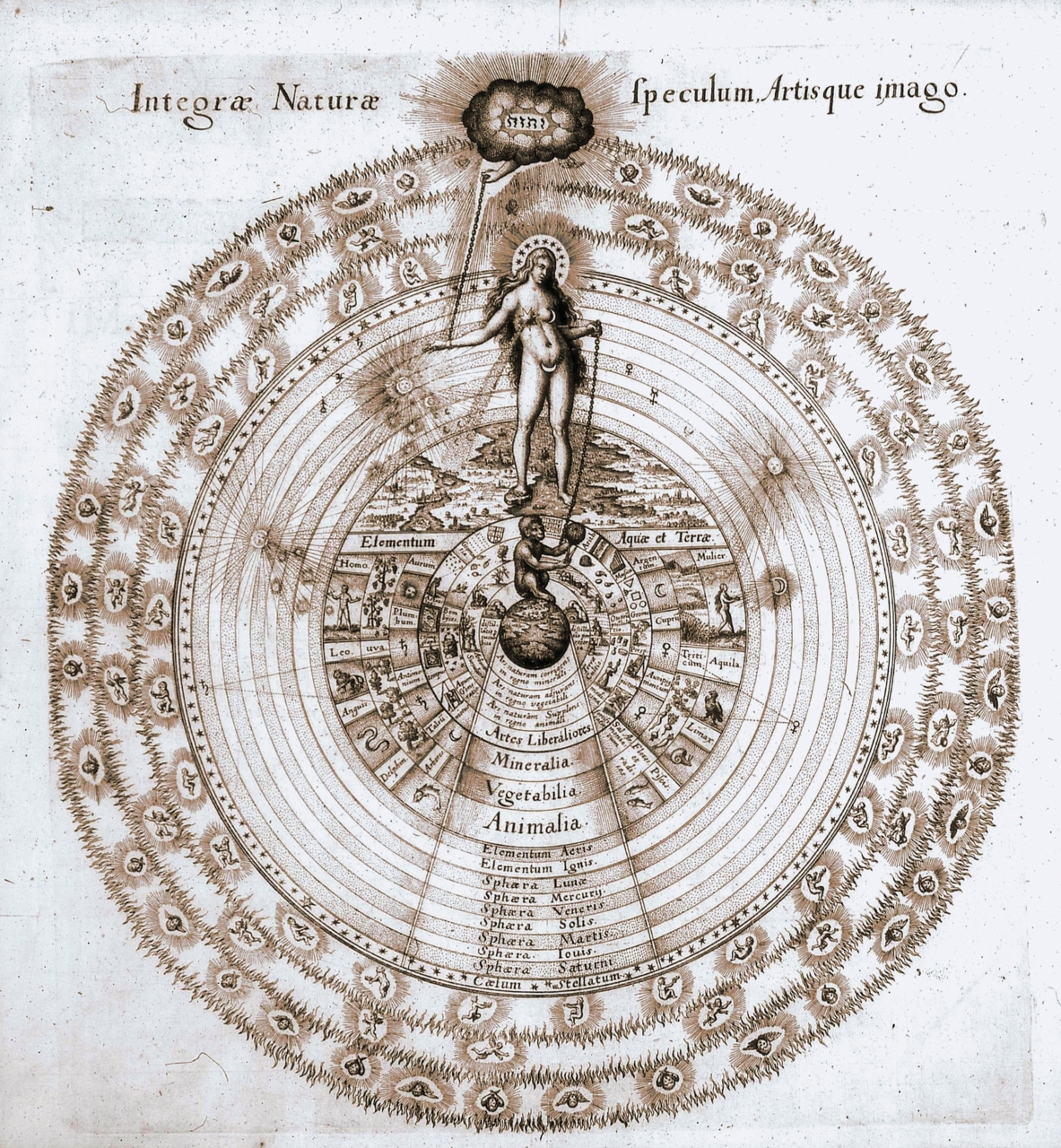
Integrae Naturae Speculum, Artisque Imago (Mirror of the whole of nature and the image of art), created by Robert Fludd, 1617. [click to enlarge]
You can kind of see a resemblance with the Anima Mundi here to a large, mediating figure of Justice, situated between heaven and earth, overlapping the planetary spheres. In place of sword and scales are two sections of the chain. Although she embodies both solar/masc and lunar/fem, the ‘world soul’ (like any soul) is considered feminine, and of this we are assured by the second lunar crescent in her pubis. Note also that the ape (reminiscent of Thoth?) uses a divider/compass.

Jacobello del Fiore, Justice, part of triptych, 1421 (Gallerie dell’Accademia, Venice).

Finale (finally!)

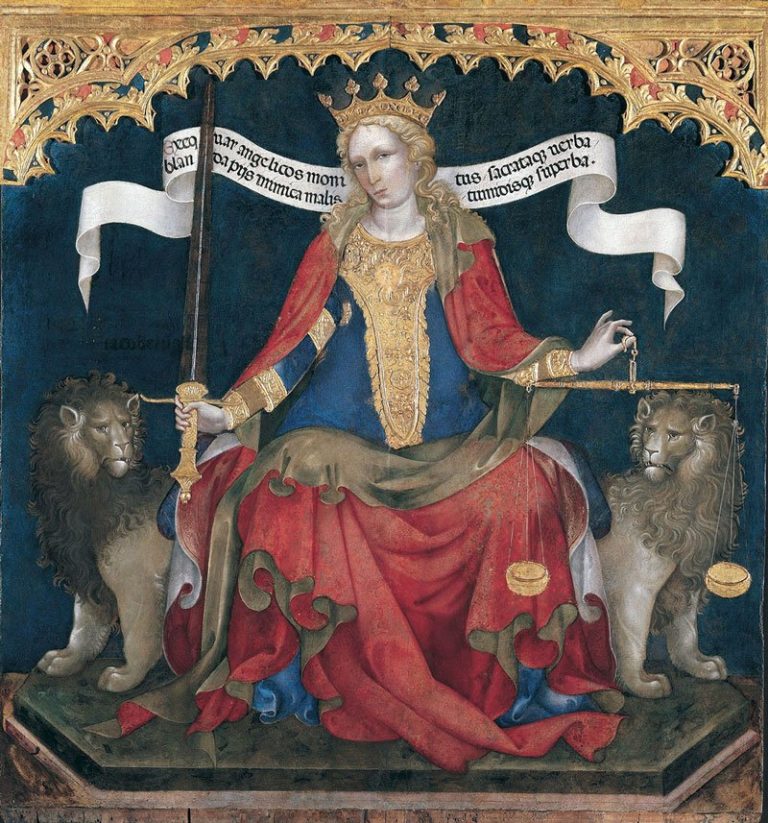
Perhaps my favourite Justice painting is another very fine Italian Renaissance depiction, where her divine and civic forms meet:

Justice is the primary virtue claimed by the Venetian state, and the lions allude to the justice and wisdom of Solomon. The female figure of Justice had even come to represent the personification of Venice herself. This identity is confirmed by the presence of Saint Michael in the left panel, minister of justice at the Last Judgment, who is shown in the act of unsheathing his sword to strike the final blow to the dragon beneath his feet and asks the enthroned Justice to “reward and punish according to merit and to commend the purged souls to the benign scales.
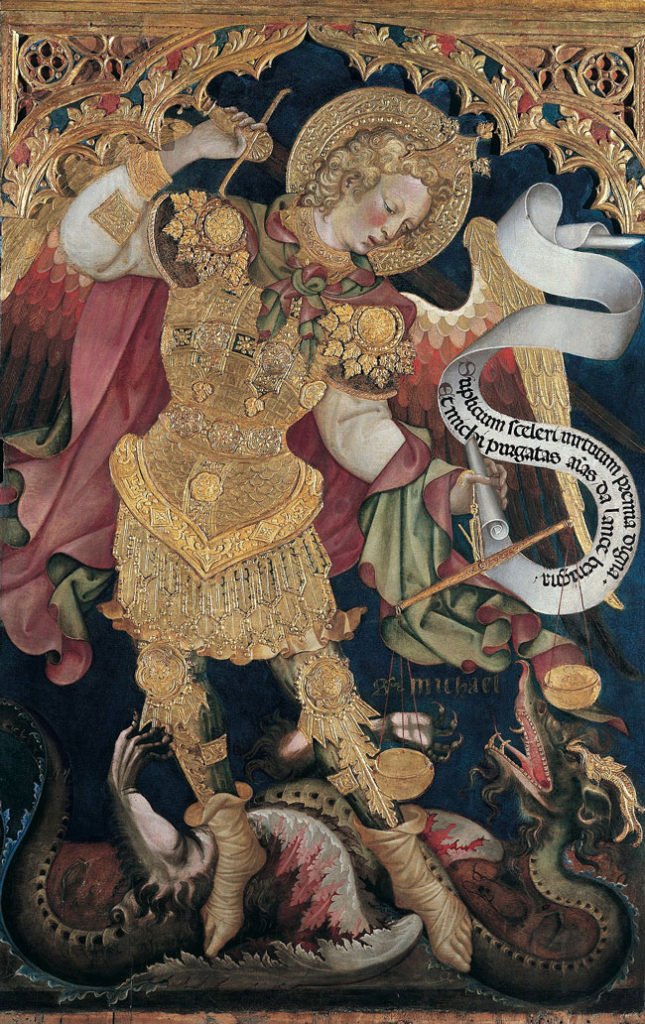
Jacobello, St. Michael

The Archangel Gabriel, bringer of peace, is depicted in the right panel, holding a lily in his left hand as he raises his right hand toward Justice in a gesture of benediction. Venetian legend professes that on the feast day of the Annunciation, when Christ was conceived for the spiritual salvation of humanity, God decreed the foundation of the city that was to offer political salvation to the Christian world following the fall of the pagan Roman Empire. In the allusive complexity of its self-representation Venice came to celebrate itself as a virgin city, never having been conquered, never violated. Jacobello’s figure thus acquires a complex persona, at once Justice, Venice, and the Virgin Mary.” [savevenice.org]
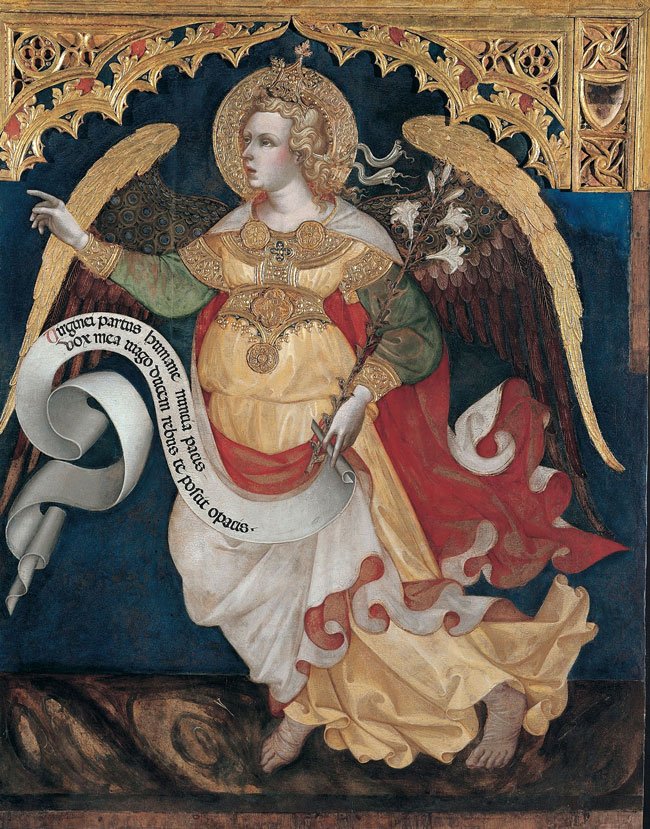
Jacobello, Gabriel

For a Tarot analogy, we could say she is at once Justice, the World and the Empress (and throw in Strength, too). As with many paintings of the time, it can also be interpreted in alchemical terms; Michael on Justice’s right, sword in his right hand, slays a black dragon, ‘fixing’ the volatile Mercury or breaking down prima materia, while a feminine Gabriel on Justice’s left wears a white cape and holds the white lily of purification in his/her left, the ‘white queen.’ The inside of his/her wings are even lined with peacock feathers.

All the colours of the alchemical stages are represented; black, white, [peacock], gold and red (see Michael’s wings, also). The complete and balanced Virtue wears a five-pointed crown (quintessence), the gold sun of wisdom and enlightenment on her chest (echoes of Athena’s aegis), and a red cape to match Gabriel’s white, signifying the union of opposites, integration of the soul, marriage of heaven and earth; the perfected work. ~rb
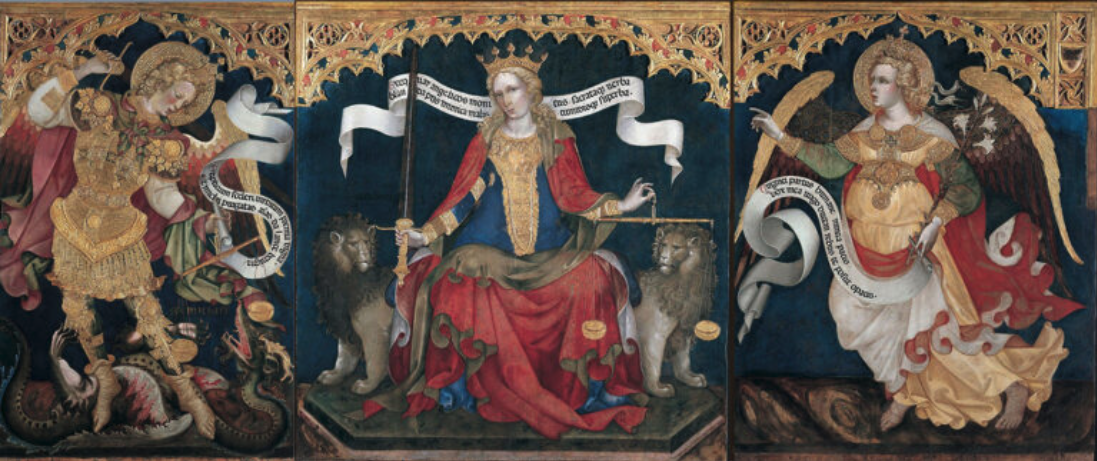
Jacobello del Fiore, Justice between the Archangels Michael and Gabriel, 1421 (full)

************************************************************
All written content *except quotations* is copyright ©Roxanna Bikadoroff. If you enjoyed the read, drop me a note, donate to my work, or share via LINK to the article. A short, credited excerpt/quote with link is fine, but do not republish the entire piece without permission, this would create imbalance in the world. Thanks!
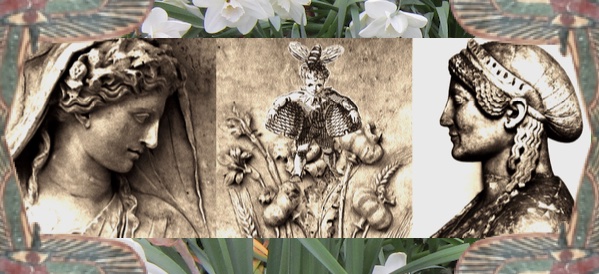
The Bees Knees ~ The Lover of Tarot de Marseille

O Crown of Light, O Darkened One,
I never thought we’d meet.
You kiss my lips, and then it’s done:
I’m back on Boogie Street.

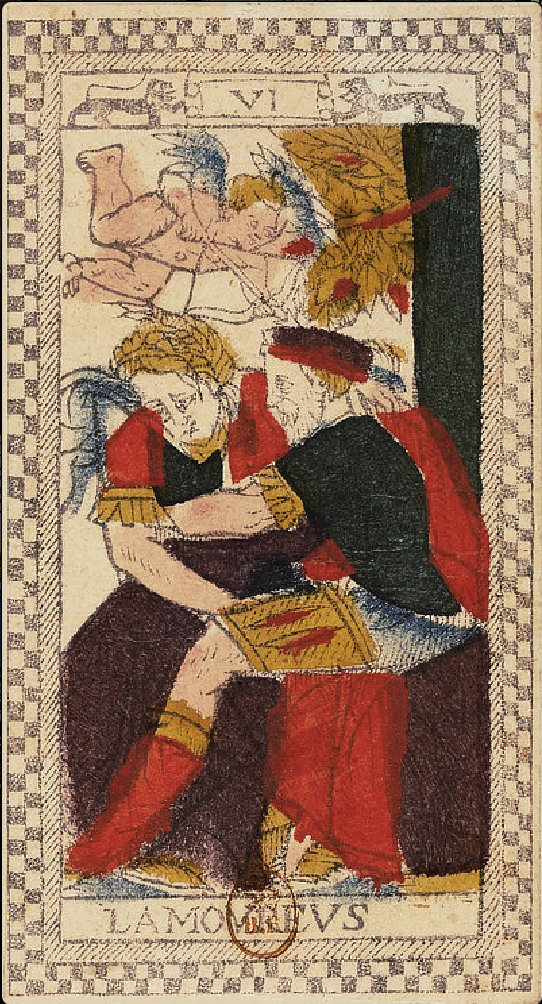
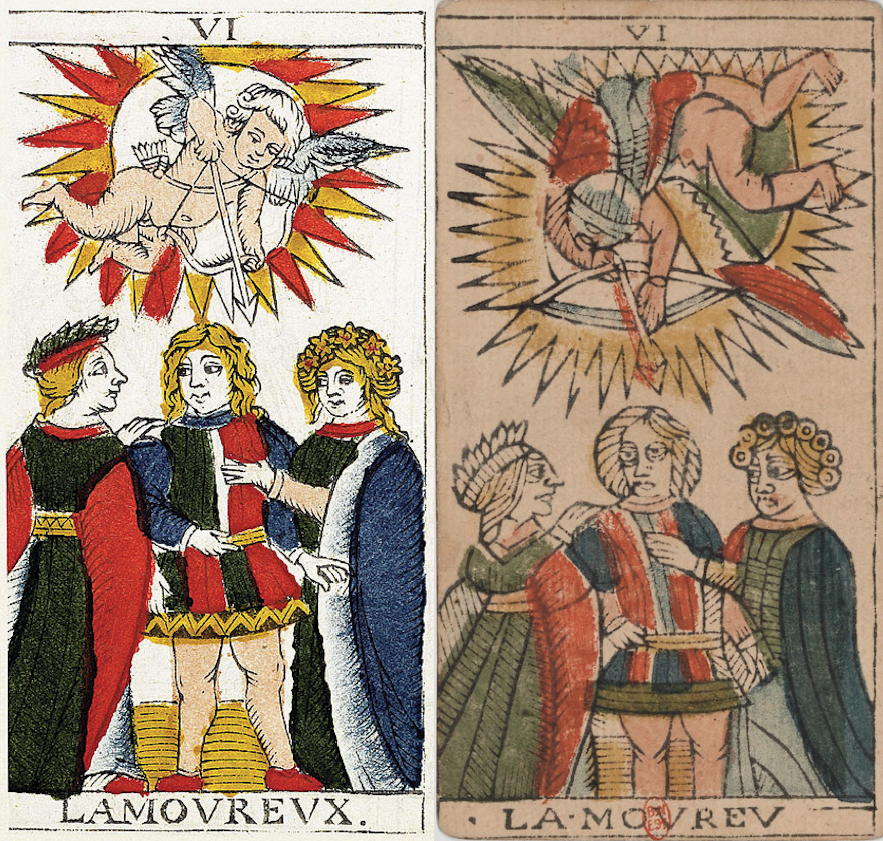
The Lover/L’Amoureux has typically been interpreted as Hercules (Herakles) at the Crossroads, or an emblematic representation of the choice between vice and virtue. Other theories abound – that the young man is choosing between an older and younger woman, or the older woman is bequeathing her daughter. It’s been debated, also, whether the word is singular or plural. [Answer: singular, although it can also be used as plural.] Here it most likely refers to the central character; ‘the loving one’, ‘the amorous one’, ‘the lover’. But the triad is also important.

While these explanations are adequate, if we want to know what lies beneath the surface, we must, as always, pay attention to the details in this version of the card, which are ‘hidden in plain sight.’

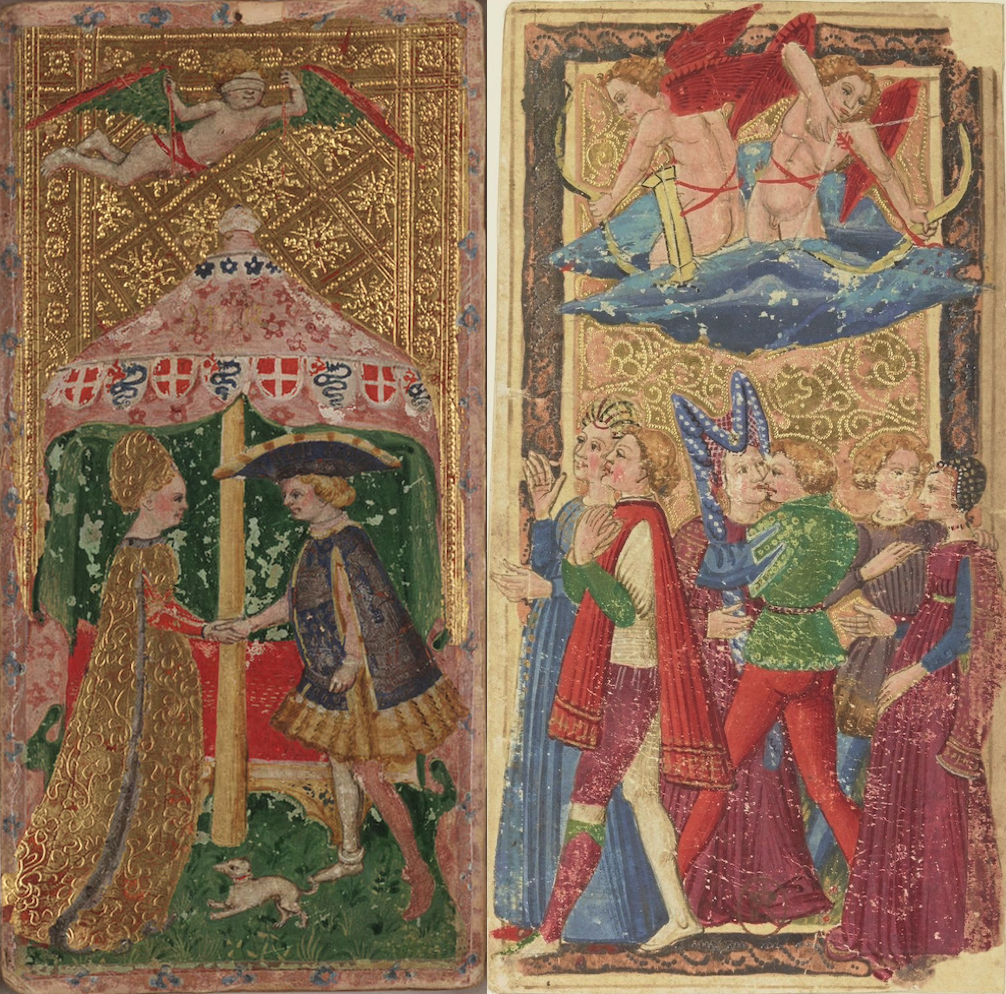
Visconti-Sforza Love ca 1450 and Charles VI Lovers ca 1475-1500.
Love (fragment) Cary Sheet, ca 1500.

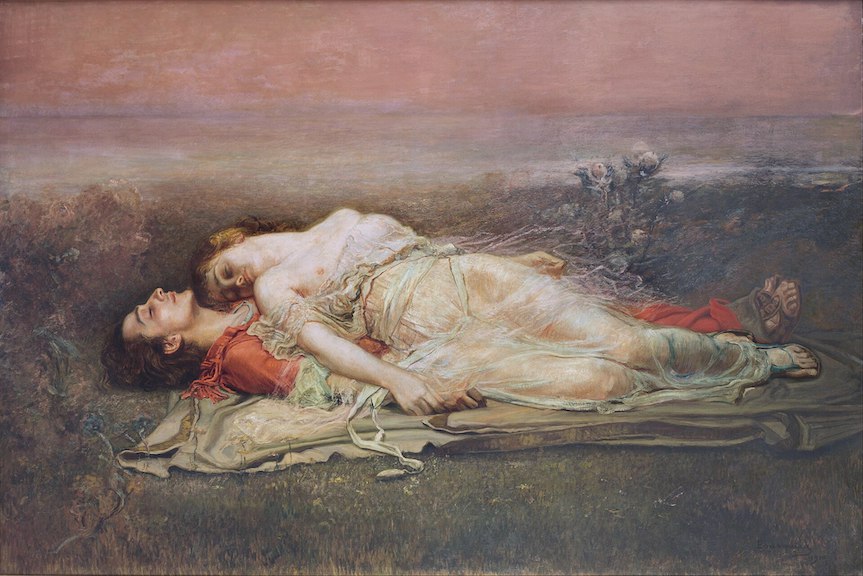
First, let’s look at the Visconti-Sforza and Charles VI cards, which offer few, but relevant clues. The V-S depicts the actual people for whom the deck was commissioned, Bianca Maria Visconti and Francesco Sforza, who were married in 1441 to unite the Visconti and Sforza families. This has nothing to do with the eventual TdM theme, except that it may have been inspired by Tristan and Isolde (very popular in Italy at the time), also likely the subject of the Cary fragment. In the legend, Tristan is delivering Isolde to a king to be married, but the two of them drink a love potion en route and tragic, ‘courtly love’, ensues.

Death of Tristan and Isolt, Rogelio de Egusquiza, 1910

In the Charles VI card, a pair of very determined cupids shoot at three pairs of courtly lovers below. Two of the men on either side clasp their hearts, while the one in the middle can’t contain his passion for his lady. That’s what it was all about – Eros had 0 to do with marriage.

The claw-footed Love, from Documenti d’Amore by Francesco da Barberino, ca 1315.

The Charles VI card recalls the imaginings of the early Renaissance poet and Giotto contemporary, Francesco da Barberino, who “deliberately inverted” love’s personification, emphasizing Cupid as the son of Mars and changed his image from “a personification of Divine Love to a personification of illicit Sensuality” by removing his blindfold.*
The connection to erotic love (Eros) and death is becoming established, and the card becomes less about marital love in the general sense. Much too dull for theatre, darling.

The Lovers, Anon. Tarot of Paris, ca 1650.

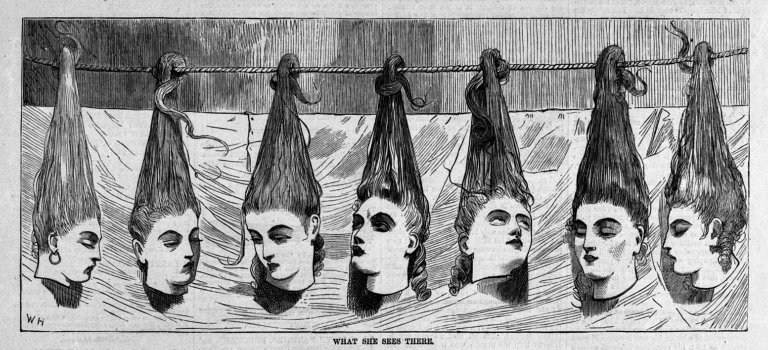
The Anonymous Tarot of Paris (ca 1650) gives us our first clue as to the French tradition. The amorous man holding in his arms a resigned, but not altogether unwilling woman might be modelled on Pluto and Persephone. The engraver has managed to convey much in her downward gaze, as if the man’s saying, ‘Come live with me, reign as my Underworld Queen!’ and she’s having an inner conflict, ‘Do I really want to go live down there…forever??’ Think of all the young women who must have felt this way through the centuries, marrying men they hardly knew, often far from home. The story of Bluebeard takes this very rational fear to its extreme. 

Winslow Homer, ‘What she sees there’ from Bluebeard.

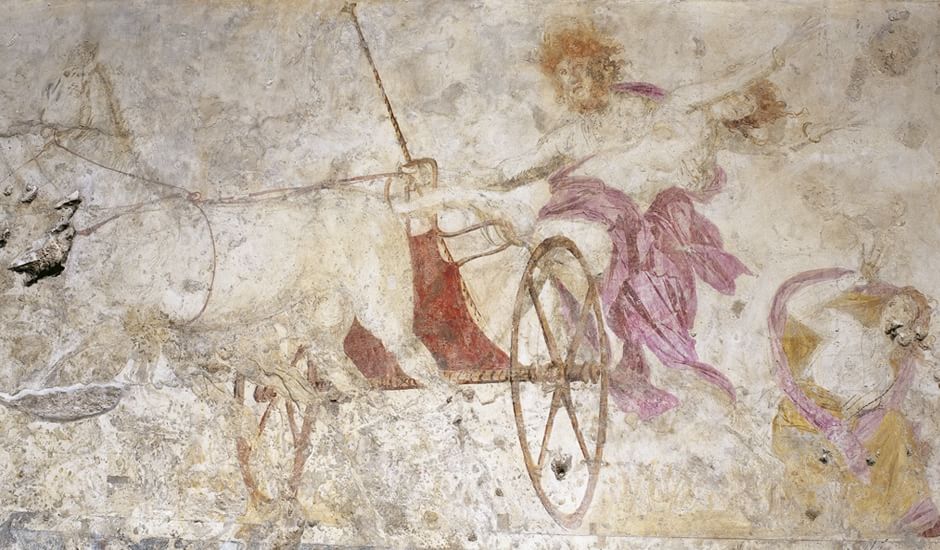
In ancient Greco-Roman times, love was rarely, if ever, the basis for marriage. A bride would effectively ‘die’ to her own family, transferred as property from father to husband, and would from here on have to worship at the altar of his family ancestors. Because it would be insulting to her own ancestral gods if she abandoned them willingly, a ‘faux’ kidnapping a la Pluto and Persephone had to be enacted, which is where the tradition of ‘carrying the bride over the threshold’ comes from. She has to pretend it’s not her own choice, that she was stolen!

Pompeii fresco featuring the abduction of Persephone.

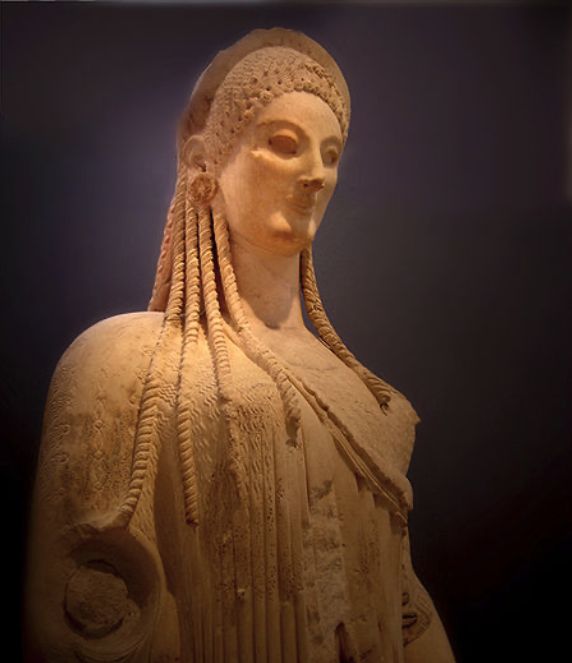
In actual fact, Persephone (‘bringer of destruction’, ‘bringer of death’, aka the ‘Iron Queen’) was already an Underworld ruler for a long time before the classical myth, and the TdM card is perhaps faithful to this. Before Persephone’s abduction and while she’s above ground, she is called ‘Kore’ (‘maiden’), and as part of the Underworld Goddess triad with Demeter and Hecate, she’s also the ‘maiden’ to mother and crone. Her priestesses were called ‘kores’ (masc. ‘kouros’) and it’s possible that initiation involved ritual marriage with one, ie, ‘marrying death’, so that later, ‘death’ in the form of a beautiful, young, underworld partner awaited the initiate when the time came to cross that threshold. Or, was she or he doomed to die with the deceased?
Nobody knows for sure.

Sculpture of a Kore

The connection to Persephone in Tarot of Paris becomes more honed and specific in the TdM card. Here, it is the man who some would assume is having to make a choice. He looks toward the woman wearing a crown of leaves or fronds, while his arms point toward the woman wearing a crown of flowers. The Pierre Madenié 1709 version makes it perfectly clear what kind: Narcissus, the flower Persephone was said to have been picking when she was snatched by Pluto. Further, if we look carefully at the halo around Eros above, in the Conver (type 2) versions, it is visibly skull-shaped. This can hardly be a printing mistake.

Pierre Madenié [type 2] 1709 (Yves Renaud) and orig. Jean Dodal [type 1] c 1701-15.
Not convinced? Alright, let’s turn to Dodal (type 1). It is difficult to make out the details of this somewhat ‘cubist’ Eros, but we if we examine closely, we see that his bow is also the handle of a jagged scythe or sickle (maybe a mix of both), which is an attribute of Demeter, as well as Kronos-Saturn, sixth planet-god from the Sun (ancient ‘end of the line’). So we can deduce that, in the esoteric sense of this card, the young man stands between Demeter and Persephone. He could be an initiate, who, after having undergone the ritual would have been referred to as one of the ‘olbioi’, meaning ‘blessed’ ‘blissful’ or ‘fortunate’ – ie, no longer fearing death. He looks kind of blissful…

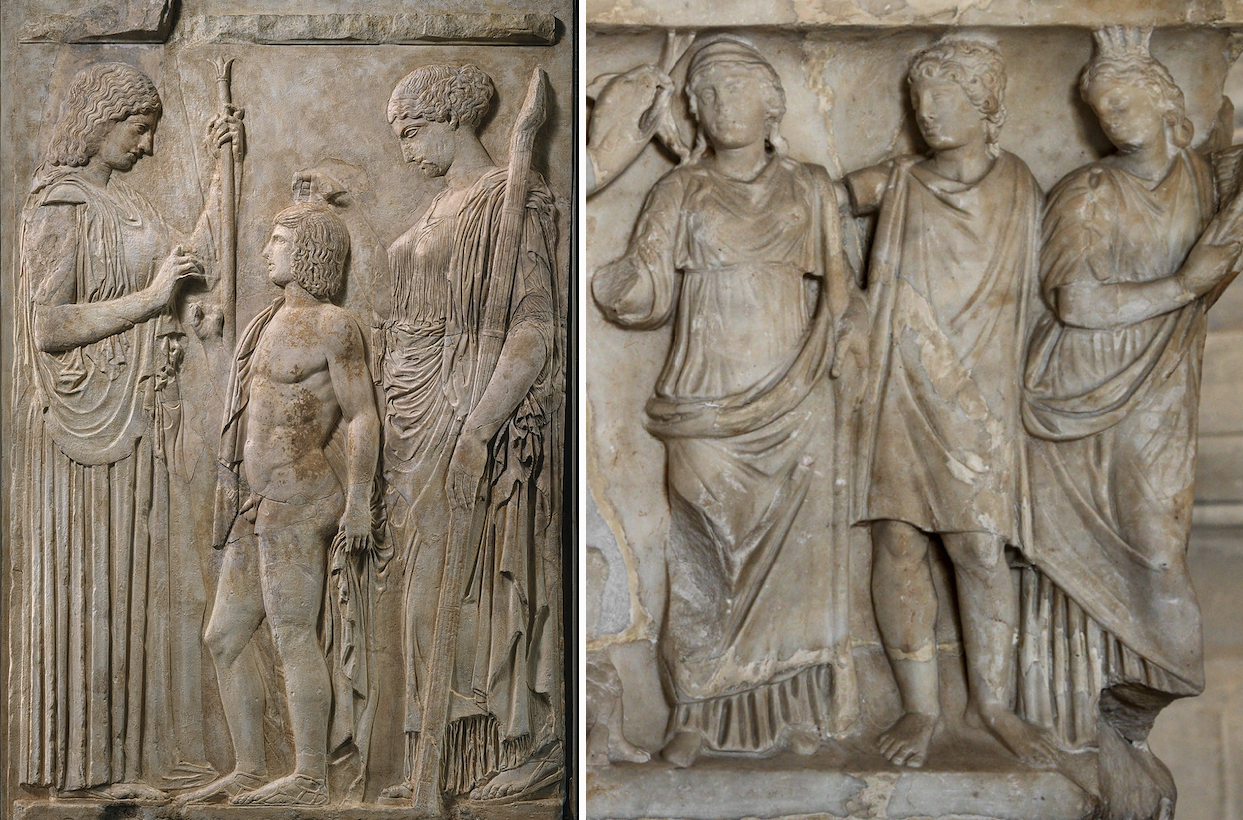
Reconstructed fragment of ‘The Great Eleusinian Relief’ 27 BC-14 AD (MET) and sarcophagus detail from 2nd c (Louvre) depicting Triptolemus with Demeter and Persephone. [please click image for more details]
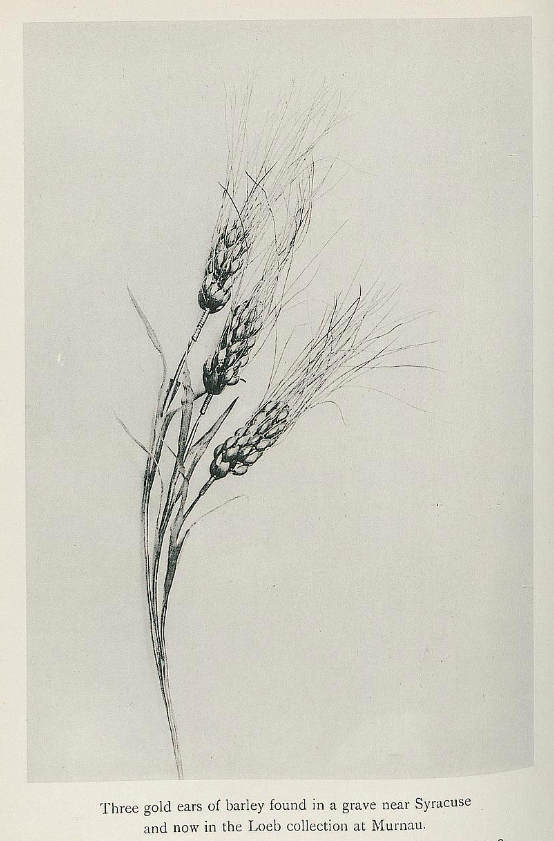
Central to the Eleusinian Mysteries was the hero Triptolemus, frequently depicted in the same setting, standing between Demeter and Persephone. He was the first initiate, who received from Demeter the knowledge of the grain; ie, the art of agriculture, the cycles of which also held the secrets of death and rebirth (metempsychosis). The Demeter cult was first and foremost an agricultural one.

(Syracuse in Italy, that is).

An ear of golden grain [barley, sometimes referred to as ‘corn’, though actual maize would not reach Europe until 1492] can be seen in the very first card. The Fool also has a similar shape dangling from his belt, though in this case I think it’s his passport – a leaf-shaped, gold, Orphic tablet. But anything gold, especially if flame-shaped, generally has to do with fire and the eternal, ever-resplendent spirit.

How to begin agrain…

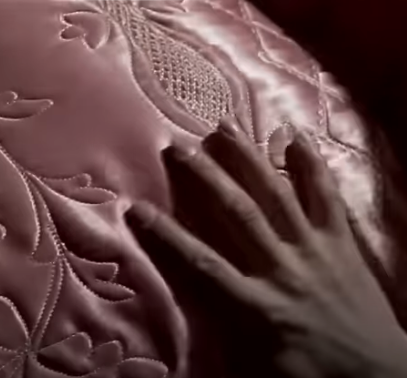
The movie still below is from a modern, rock-n-roll kitsch interpretation. Recognize it?  Extra points if you are old enough!

[click pic for more details]
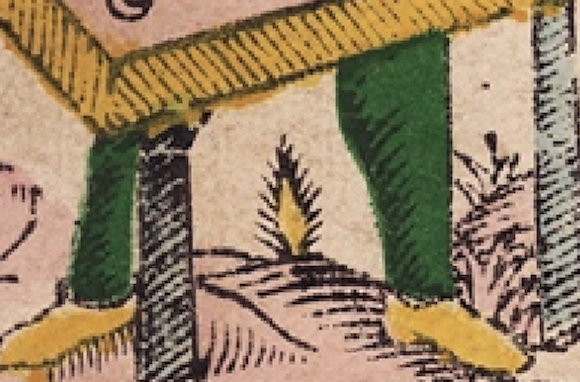
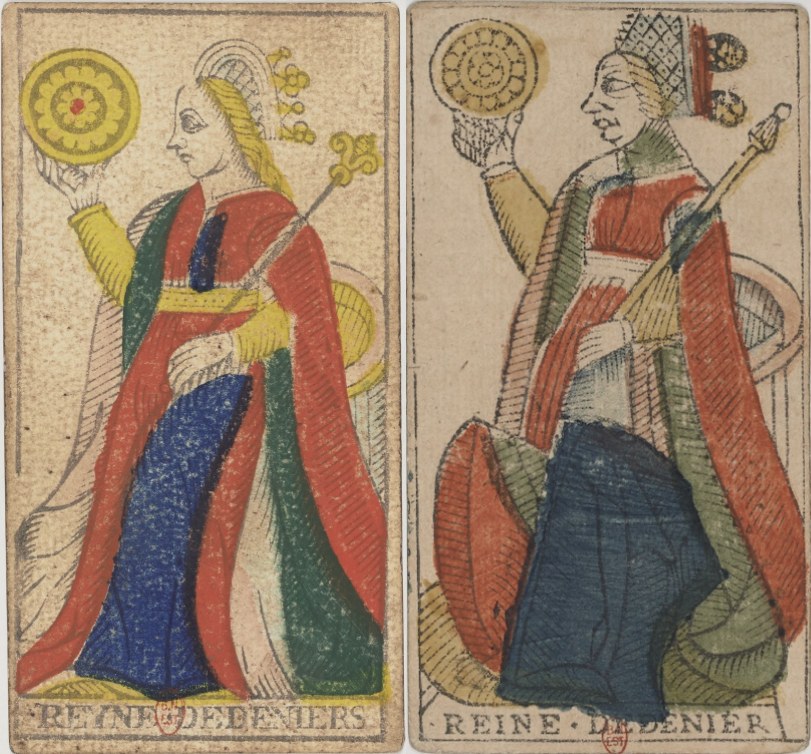
Honey, the liquid gold of nature’s tiny agriculturalists has been used to anoint and in libations since ancient times. (‘Christos’ means ‘anointed one’). This is, after all, the 6th card, and the hexagram of the apis has 6 sides. Astute TdM lovers will recall that the type 2 Queen of Money (Reyne de Denier) has a bee/beehive staff and her crown resembles a honey comb. This raises the question, are the ‘coins’ actually coins? Or are they phailes (libation dishes)? 

Conver (type 2) and Dodal (type 1) Queen of Coins (Are those pine cones on her crown?)
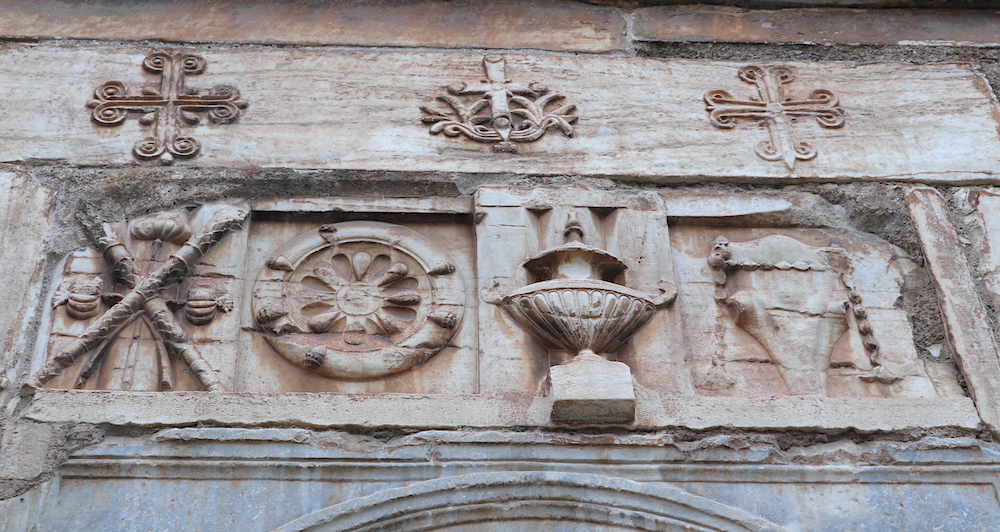
Spolia’ featuring ritual objects from temple of Demeter at Eleusis, repurposed on ‘Little Metropolis’ church in Athens: torches with poppies (baton), libation phaile (coin), incense burner (cup) and bucranium of sacrificed ox (sword). The crosses above are meant to ‘baptize’ and thereby neutralize the pagan imagery.

We should not be too rigid about naming precisely which mystery cult the cards might be pointing to, as the imagery seems to draw from several traditions as well as being mytho-alchemical. But the Eleusinian and Bacchic cults were inter-related, and one needn’t throw a stick far in ancient Greek myth to find some hero or heroine transgressing death in search of a loved one or sacred object and returning twice born and wiser or crazier for it. Dionysus, the Greek Osiris, was closely associated with alchemy, because his crop of expertise was the grape, and wine-making involved the essential fermentation process, from the blackened soil to the distillation of spirit. The long-haired Lover is certainly Dionysian, as his popularity with the ladies shows. To me it looks like they might be undressing him.

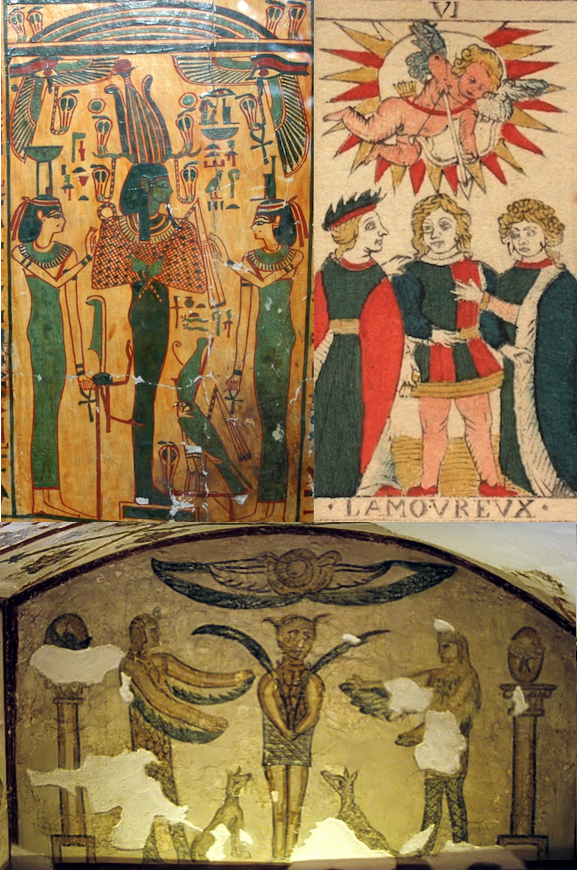
Isis and Nephthys preparing their beloved Osiris for his Underworld travels, Conver Lover card, fresco of an initiate from Tigran Tomb, Alexandria (note the Orphic eggs).

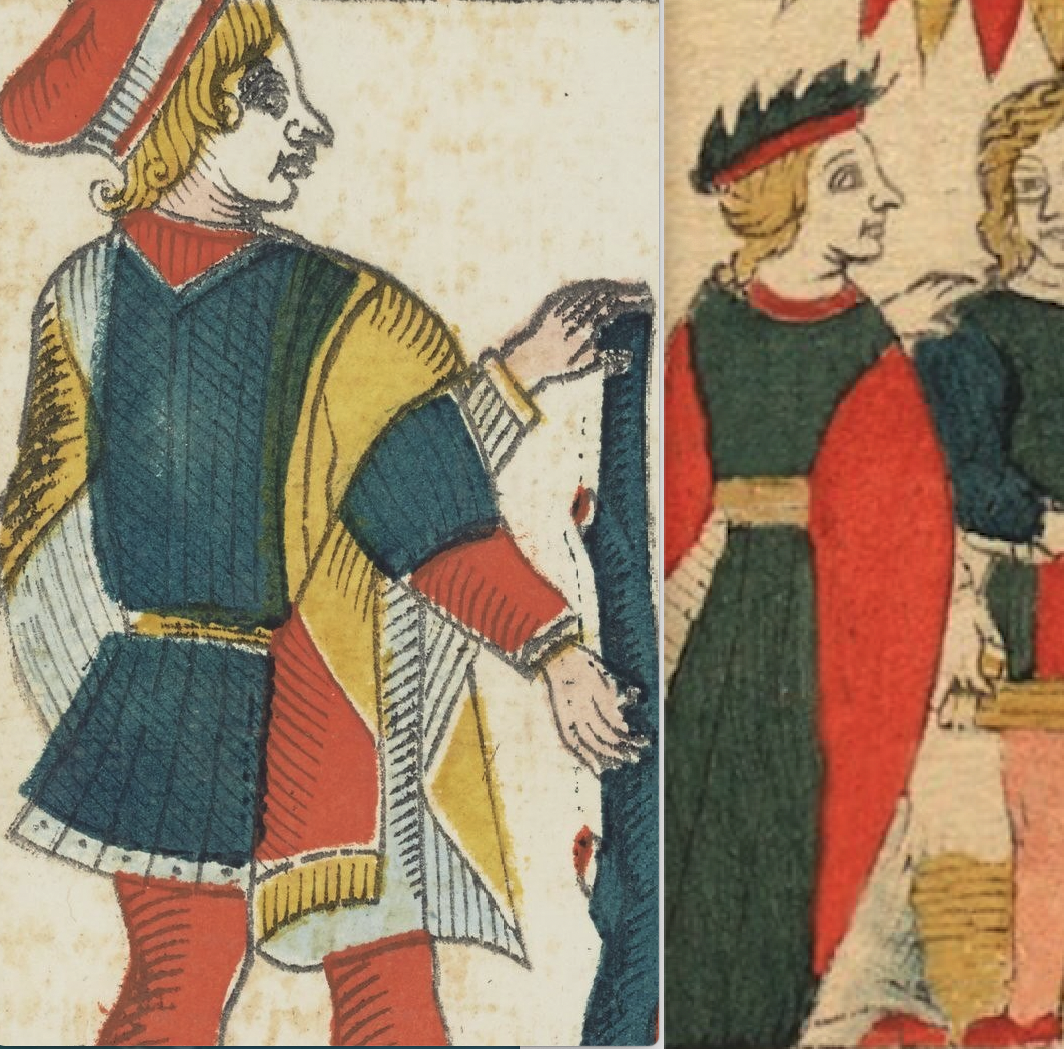
Worth a mention here is the similarity between the woman on the left of the Conver card with the Valet of Batons. Might this suggest a link to the Dionysian ritual phallus, or, to the club of Hercules, weighted/pulled toward the Underworld, while the young man looks ahead? Is he drawing up some chthonic energy, or, like the Juggler (prototype of the Valets), is he too young and inexperienced to recognize its ritual significance? Instead, maybe he’s using it to measure true, astronomical and visible horizons, with the intention of building a temple to his god…a Herculean task, surely.

Valet of Batons and detail from Lover card
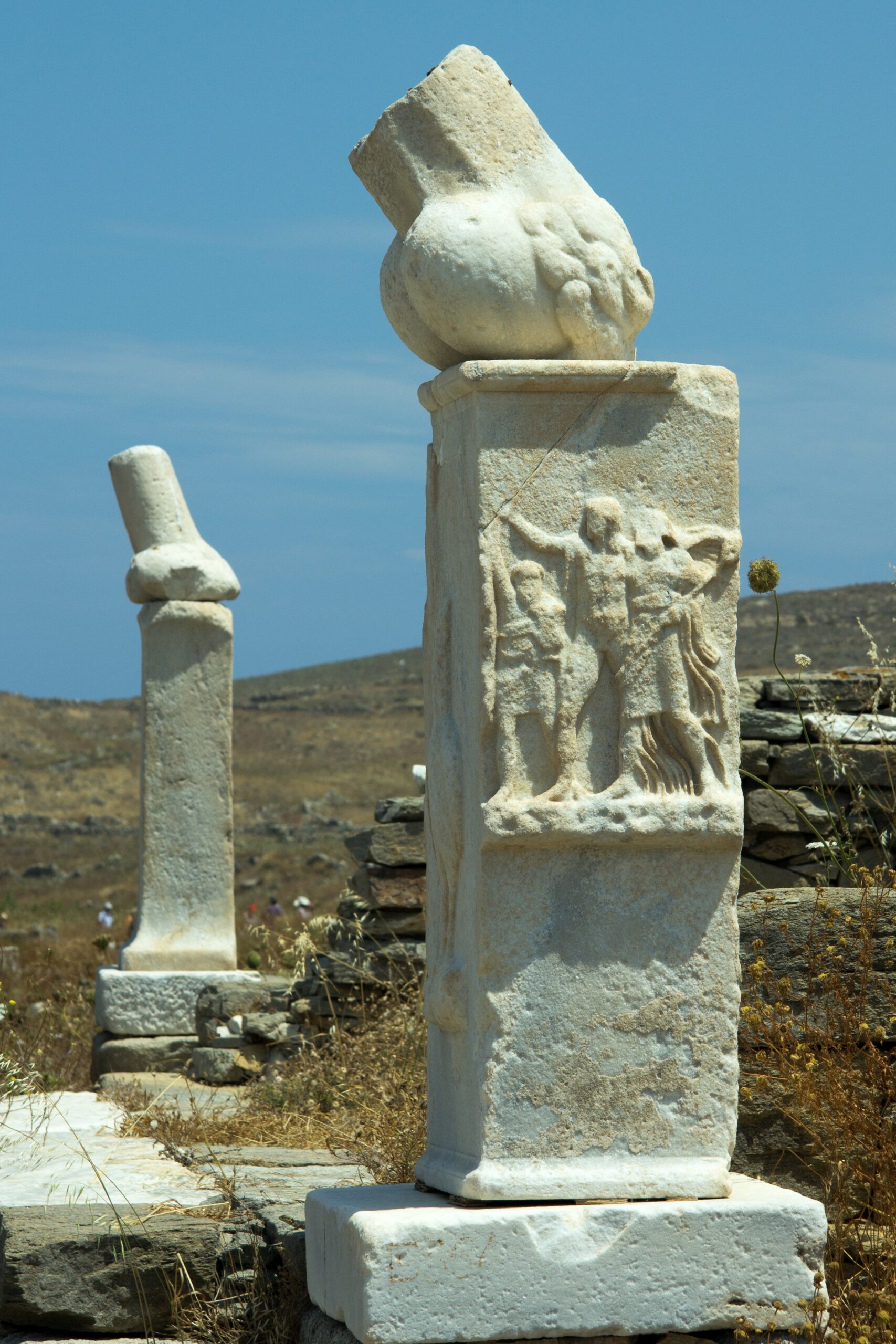
Ruins of Dionysus temple at Delos, Greece

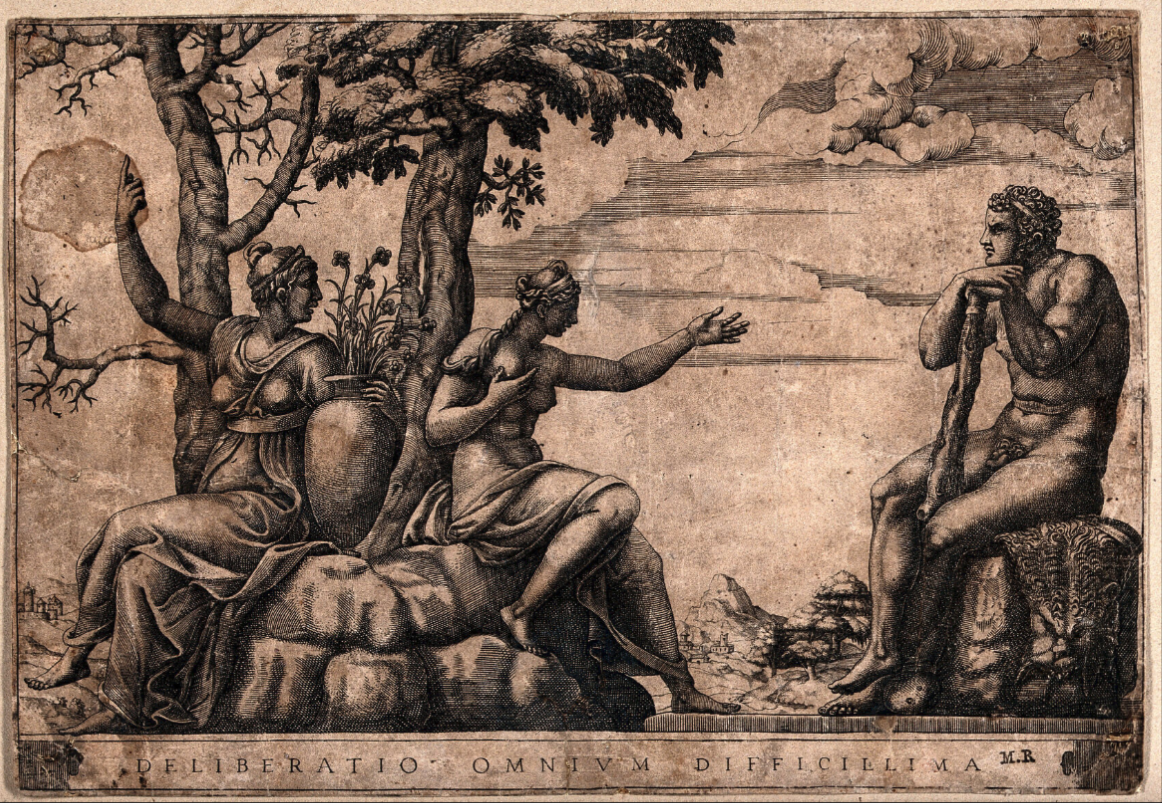
Hercules had to become an initiate in order to go kidnap Cerberus, the three headed hound of Hades, as his final labour. So if this card does relate to him, he’s likely not at the crossroads choosing between two women, but at the crossroads of the upper and lower realms, receiving initiation from two goddesses. In the next card, the newly-anointed, golden-crowned hero is in a liminal state, his lower half having descended into a square-shaped (matter/earth/Saturn) Chariot that is at least partly fixed to the ground (in type 2), resembling something funerary.

Don’t strain yourself thinking to hard, Herc!   Engraving by Giulio Romano, 16th c

Eros, son of Aphrodite, was said to be able to overpower all the heroes, for love really does wipe out fear of death (Thanatos) and the loss of a love is akin to dying. I’ll be entertaining/tackling this topic further, from a different horizon, in an upcoming post about the Sun card. Stay tuned!  ~rb

So come, my friends, be not afraid.
We are so lightly here.
It is in love that we are made;
In love we disappear.

***

Credits:

*Shelly MacLaren, “Or guarda tu …desta donna la forma”: Francesco da Barberino’s Poetic and Pictorial Invention (Dissertation).

Lyrics from ‘Boogie Street’ by Sharon Robertson/Leonard Cohen

All written content except quotations and meme is copyright ©Roxanna Bikadoroff and may not be re-used or reprinted without my permission. You are welcome to share the article via LINK and with a short pull quote/credit.
Thank you for being respectful.

Disrobing the Papal Couple – Tarot de Marseille’s Pope and Popess

Allegory of Prudence with Janus face, 16th c, Nantes, France

Previously we looked at the masculine/solar cards in the 1/4 placement, beginning with the Juggler (1). Now let’s turn our attention to the feminine/ lunar cards in the 2 placement, beginning with The Popess (2) and The Pope (5). These two flank Empress (3) and Emperor (4), like the spiritual component or parent of each. The book on the Popess’ lap, whatever its mystery content, illustrates this concept; two covers (‘hidden’) and two facing pages (‘spread eagle’) inside.

Various Conver cards, 18th c

To Pythagoreans, and others throughout western history, the number of duality, by itself, was considered negative. Besides being Lunar (death) and feminine (sin), 2, the first real number to follow the ‘monad’ created a division:

The confrontation between I and Thou contains, by its very nature, an opposition, and such an opposition becomes even more evident when the human I is confronted with the absolute, unique, divine Thou…
…it is impossible to think of anything truly opposed to the divine One. Thus, 2 becomes a number of contradiction and antithesis and, logically, of the non-divine. Since it produces discord, it is rarely used in magic.
– Annemarie Schimmel, The Mystery of Numbers

‘Hey big boy, need a little mystery wisdom, tonite?’ Anon. Tarot of Paris ca 1650

Not exactly the ‘yin-yang’ approach. Of course, 2 could also bring about union and balance, but for the most part, it was suspect. Patriarchal religion regarded the feminine 2 (Eve) as usurper of the one-on-one relationship with the Godfather.

Eye pennies or prophylactic eyes?  Conver 2 of Coins, BnF

Yet, Tarot de Marseille places the holy mother and father under its influence. Are we meant to interpret this as a mere jab? I don’t think so. 2 is the number of both desire – which is a complex issue – and duplicity; nothing in TdM is what is seems. Perhaps most importantly, 2 is the number of paradox, wherein truth lies. And although the 2s preceding the Strength (11) card are more indicative of division, those proceeding it emphasize reunification. The running visual theme in all of the 2 cards is of course pairs/doubles, always with some kind of vessel or opening. (We can think of the Papal crowns as a pair). I’m going to do a post on the Strength card by itself, because it’s so fascinating.

Cards which occupy the 2nd place, Camoin-Jodorowsky deck


Sweet Delight and Endless Night

But let’s begin with the Pope and his pair of strange little nipple-heads. These clearly have a connection with the middle figure in arcanum 20, another ‘2’ card, but we’ll leave that aside, for the time being.

Sarcophagus eyes

Number 5, belonging to sensual Venus, is connected to the 5 senses (plus 5 points of the human body, and 5 digits on each hand and foot, etc). Being the sum of the first two ‘real’ numbers (2 and 3), 5 is considered sacred, and has been since the days of Goddess worship. The role of numbers in TdM imagery interpretation cannot be understated:

From early times 5 was considered a somewhat unusual, even rebellious number, and the discovery by Hippasos of a fifth geometrical body, the pentagondodecahedron, which consists of 12 regular pentagons, embarrassed the Pythagoreans, who had concentrated on the 4. Legend tells that the discoverer of this new body was drowned for his transgression...
…Since the human being consists of 4 elements, a fifth, secret one (quinta essentia) was added in order to reach the sacred 5. This quinta essentia, our quintessence, was considered to be the real element of life, and its production was a goal of medieval alchemists.
To find the principal of life and overcome death one has to rely on procreation and Eros [Venus], so the quinta essentia again points back to the ancient life-giving power of the Mother Goddess…
– Annemarie Schimmel (ibid)

Heads will roll…

You might have noticed that, in many TdM versions of this card, the two, perfectly round, alternately spinning heads are not even really attached to their bodies. And in the Conver cards, they often have red centres, reminding me of my least favourite Peak Frean cookie.

Fruit Cream fortune cookies

Notice that the nipple-head on the Pope’s right has a golden hat (solar, but also appears to contain a Moon) on his back, distinguishing it from the one on his left, who usually has a light/flesh-coloured round form in front, partially hidden (lunar?). An arm appears behind him from outside the picture and in Conver type decks, a little curved knife shape under the hand suggests something sinister. The power struggle between Horus and Set comes to mind, wherein Horus loses an eye. The gradual restoration (‘filling’) of it relates to the Moon’s phases.

Agathos daemon (good) and Cacodaemon (bad), 2nd c Roman mosaic, Antioch

Here, we must bring Plato into the picture. The Myth of Er, from his Republic is, I think, essential to a more complete understanding of this card and the theme(s) of TdM in general. If you wish to be read to, here’s an audio link.

It opens with Socrates saying:

Well, I said I will tell you a tale; not one of the tales which Odysseus tells to the hero Alcinous, yet this too is a tale of a hero, Er the son of Armenius, a Pamphylian by birth. He was slain in battle, and ten days afterwards, when the bodies of the dead were taken up already in a state of corruption, his body was found unaffected by decay, and carried away home to be buried. And on the twelfth day, as he was lying on the funeral pile, he returned to life and told them what he had seen in the other world. He said that when his soul left the body he went on a journey with a great company, and that they came to a mysterious place at which there were two openings in the earth; they were near together, and over against them were two other openings in the heaven above. In the intermediate space there were judges seated, who commanded the just, after they had given judgment on them and had bound their sentences in front of them, to ascend by the heavenly way on the right hand; and in like manner the unjust were bidden by them to descend by the lower way on the left hand; these also bore the symbols of their deeds, but fastened on their backs.

He [Er] drew near, and they told him that he was to be the messenger who would carry the report of the other world to men, and they bade him hear and see all that was to be heard and seen in that place. Then he beheld and saw on one side the souls departing at either opening of heaven and earth when sentence had been given on them; and at the two other openings other souls, some ascending out of the earth dusty and worn with travel, some descending out of heaven clean and bright.

Further description given of wretched souls trying to climb out and being dragged back reminded me of my favourite Mercurius depiction of all time, which in turn reminded me of the Pope card.

Cappella della zodiaco, Agostino di Duccio
detail

The Conver Pope’s staff has the triple (ie, suspiciously Mercurial and/or Lunar) cross of a high-ranking Roman pontiff, used in procession or when crossing a threshold of a holy door. Hmm. 3 might also neutralize the divisive effect of 2 by creating sacred 5 (or 7). In other decks it’s usually a shepherd hook crosier – which, Tarot or not, comes from Egyptian Osiris – or something resembling a spindle whorl (or a mix of the two). Consistent in all versions, however, is that his staff appears to penetrate the lunar nipple-head on his left, like the pitchfork in the mosaic of the ‘bad daemon.’ And btw, who or what are those curious little daemons that flank the Pope’s head in the Vieville card?

Noblet, Payen and Vieville Popes

Further into The Myth or Er, we are told how souls choose their next ‘lots’:

When Er and the spirits arrived, their duty was to go at once to Lachesis; but first of all there came a prophet who arranged them in order; then he took from the knees of Lachesis lots and samples of lives, and having mounted a high pulpit, spoke as follows: ‘Hear the word of Lachesis, the daughter of Necessity. Mortal souls, behold a new cycle of life and mortality. Your genius will not be allotted to you, but you choose your genius; and let him who draws the first lot have the first choice, and the life which he chooses shall be his destiny. Virtue is free, and as a man honours or dishonours her he will have more or less of her; the responsibility is with the chooser –God is justified.’ When the Interpreter had thus spoken he scattered lots indifferently among them all, and each of them took up the lot which fell near him, all but Er himself (he was not allowed), and each as he took his lot perceived the number which he had obtained. Then the Interpreter placed on the ground before them the samples of lives; and there were many more lives than the souls present, and they were of all sorts. There were lives of every animal and of man in every condition. And there were tyrannies among them, some lasting out the tyrant’s life, others which broke off in the middle and came to an end in poverty and exile and beggary; and there were lives of famous men, some who were famous for their form and beauty as well as for their strength and success in games, or, again, for their birth and the qualities of their ancestors; and some who were the reverse of famous for the opposite qualities. And of women likewise; there was not, however, any definite character then, because the soul, when choosing a new life, must of necessity become different. But there was every other quality, and they all mingled with one another, and also with elements of wealth and poverty, and disease and health; and there were mean states also.

And they say Tarot was never about fortune telling until the late 18th century!

Lucky lottery numbers

In Medieval/Hellenistic astrology, no chart was complete without calculating the ‘Arabic’ lots or parts (pars). The two main ones still used today in the west are the Part of Fortune and Part of Spirit (or Daemon). The two are opposites, derived from the same equation done forwards and backwards, and, vice versa depending on whether a day (solar) or night (lunar) chart. It’s said that “the Lot of Fortune is the hand you’re dealt, and the Lot of Spirit is how you play your cards.” And so begins the game.

Daemones gambling for souls, between the prophylactic eyes.
‘Snake eyes’ aka ‘dog’s throw’ (Cerberus?) for Romans


Whatever sacred knowledge there was from the highest reasoning, the ancient poets joined to their measures. Thus the mystical philosophy of Poetry can be spoken in its own right. She sings mystical truths. For while the impulse of the heavens driven around in circles rushes down, she produces sounds with constant rotation.

~ Lodovico Lazzarelli, De Gentilium Deorum Imaginibus, 15th c (trans. William O’Neal)

Silenus with lyre and wild-eyed Dionysus (detail), 30 BC, British Museum

Although the Pope, like the Emperor, evokes various gods and prophets, or god-prophets, the one that stands out for me is Silenus, teacher and foster parent of Dionysus (if not an older Dion himself). For one thing, he always looks a bit drunk. And what is drink but the pap of satyrs? Also, if we follow the gold trim on his robe opening, particularly in ‘type 2’ (Conver, Madenié), we can make out a harp shape – an instrument often interchangeable in Medieval/Renaissance depictions of the Orphic lyre. Perhaps he is teaching Orphic hymns or using music to disarm the marked assassin sent by Pythagoras (or both). It’s not at all far-fetched when you consider that harmony and discord/chaos will produce good and bad fortune. A scholarly paper about that here.

Dionysus characterized the essence of the drama, by crossing and transgressing the border between the divine and the human world. When the gods interacted with men in the Homeric epics, they did so for their own selfish reasons, but in the classical drama they reflect and judge the activity of men. The drama thus reflects a change of paradigm from the world of myth to an ethical dialogue between men’s world and the will of heaven.
– Dr. Britt-Marie Nässtrom, The Rites and Mysteries of Dionysus: The Birth of the Drama

Skeleton with 2 wine jugs, Pompeii, Naples Museum. Photo: Marie-Lan Nguyen

Silenus wasn’t just a prophet, but when pie-eyed, possessed a ‘terrible wisdom,’ as famously expressed in this telling (during a brief capture by King Midas):

Midas, after hunting, asked his captive Silenus somewhat urgently, what was the most desirable thing among humankind. At first he could offer no response, and was obstinately silent. At length, when Midas would not stop plaguing him, he erupted with these words, though very unwillingly: ‘you, seed of an evil genius and precarious offspring of hard fortune, whose life is but for a day, why do you compel me to tell you those things of which it is better you should remain ignorant? For he lives with the least worry who knows not his misfortune; but for humans, the best for them is not to be born at all, not to partake of nature’s excellence; not to be is best, for both sexes. This should be our choice, if choice we have; and the next to this is, when we are born, to die as soon as we can.’ It is plain therefore, that he declared the condition of the dead to be better than that of the living.
– Aristotle, Eudemus (354 BCE), surviving fragment quoted in Plutarch, Wikipedia 

The Silenus mask, btw, was essential to the Dionysian mysteries and was the prototype for that worn by Thalia, muse of Comedy – the implication alluded to in a previous post on Death and the Moon. Note the doubles, in the pic below.

A shocking revelation, Dionysiac Frieze detail,  Villa of the Mysteries, Pompeii


She Whose Wedding is Great

Now, let’s return to that beguiling embodiment of the primal 2, The Popess. If you are familiar with the Gnostic hymn, The Thunder : Perfect Mind,  this gives a good sense of the paradoxical element of the mysteries in general, but especially of the dual feminine. The Popess holds a book open (one hand on each side, in type 2 decks) in full view – yet, unless we understand the imagery itself, we can’t begin to know what it says or means.

The rituals of the Lesser Mysteries were often called the myesis, as opposed to the rites of the Greater, which were called epopteia. The word myesis means “to teach” and also “to initiate.” Epopteia has a similar meaning, but with an important difference; it means “to witness” and “to be initiated.” The slight differences in these two words explain a fundamental difference in what happened to the initiates during these two sets of rituals. In the Lesser Mysteries, candidates were taught the theology of the Two Goddesses, and the meaning of the rites of the Mysteries. However, in the Greater Mysteries, they could experience what they had learned, and near the end of the week-long festival, they would even see a vision of Persephone.
~ Hellenion, Lesser Mysteries of Eleusis

Veiled Persephone or the soul of the deceased, Museum of Cyrene, Libya.

The Mysteries represented the myth of the abduction of Persephone from her mother Demeter by the king of the underworld Hades, in a cycle with three phases: the descent (loss), the search, and the ascent, with the main theme being the ascent of Persephone and the reunion with her mother. – Wikipedia

In type 2 versions of the card, the ends of her curled drapery are typically stencilled red, so that they resemble inverted torches, which are a lunar goddess symbol, since they illuminate the darkness. We could think of the torches as the descent, the labyrinthian book as the search and the ribbon going from its spine (hinge/door) to her heart, as the ascent.

Conver Papess and Victorian tombstone symbols
Altar with Iacchus, Demeter, Rhea and Kore, National Archaeological Museum of Athens. Note three boukrainion (bull craniums) with Moon horns.

The serpentine ‘scroll’ endings in type 1 might suggest the lituus, a ritual divining rod used in augury, or plant shoots. As well, in the Lesser Mysteries of Eleusis, ‘touching the snake’ meant the initiate was ready to receive them. The Dodal version (type 1) calls her ‘La Pances’, which in old French (and Italian) means ‘belly’ – a clue to her oracular nature? Perhaps the book represents words of wisdom from her middle.

Jean Dodal ‘La Pances’

Originally, ventriloquism was a religious practice. The name comes from the Latin for ‘to speak from the stomach: ventre (belly) and loqui (speak). The Greeks called this gastromancy (Greek: εγγαστριμυθία). The noises produced by the stomach were thought to be the voices of the unliving, who took up residence in the stomach of the ventriloquist. The ventriloquist would then interpret the sounds, as they were thought to be able to speak to the dead, as well as foretell the future. One of the earliest recorded group of prophets to use this technique was the Pythia, the priestess at the temple of Apollo in Delphi, who acted as the conduit for the Delphic Oracle.   – Wikipedia

Altar with sacred articles of Demeter, National Archaeological Museum of Athens

The phallic shape created by her crowned head and shoulders (well, why not, the Pope card has nipples) might have something to do with the desire element. It’s been suggested that this image (below) of a woman reaching to lift the covering of a ritual phallus, represents desire – the object of which is potent so long as its mystery is maintained. (It’s why we rarely see full frontal male nudity in the movies. That would spoil everything). The individual (or institution) ‘holding The Phallus’ has all the desire power, which translates as the power of mystery; ie, it is not a monarch or pope’s actual shlong that people are drawn to, but rather, the inexplicable mojo they are in possession of. And they keep possession of it precisely by keeping it under wraps. Otherwise, everyone would immediately see that the Emperor has no clothes. Comedians are their greatest nightmare.

Shrouded in mystery, Dionysiac Frieze detail, Villa of the Mysteries, Pompeii

So the (shrouded) shape of the Popess’ head and bib might serve to illustrate that she is the living mystery, or alone contains within her ‘perfect mind,’ that which we seek/desire. Further, that it is the feminine – woman – that naturally possesses ‘The Phallus’, for the simple reason that her procreative (lunar) magic is contained within, where it can’t be seen, only imagined. (Thus it’s ok to expose her, like the open book, since doing so won’t give anything away and will create more desire). The Popess presents us with the ultimate conundrum of the 2: the unknowable ‘other.’ And if you don’t think that is a powerful notion, you have obviously never seen an advertisement or a selfie.

‘Out of one (tis wonder and no wonder,) Come forth’, Manley P. Hall collection

That’s one possibility. The other might simply be that her crown resembles the omphalos of Delphi  – where the maxim ‘Know thyself‘ was inscribed on the temple – confirming that she is an oracle. The omphalos is modelled on a beehive and we can see the flowers in her crown, distinguishing it from the Pope’s. No reason both explanations can’t coexist, of course, that is the nature of the 2.

Python coin, Conver Popess, Omphalos

I’ve started using the word cryptic rather than esoteric, in reference to TdM, the latter is so wrongly overused and has all but lost its true meaning. However, the Popess truly embodies the esoteric, which at it’s root means ‘within.’ Prior to and/or without application, inquiries into her meaning are ‘Lesser Mysteries’.

The last 2 card is Judgement (20), which, as mentioned, is connected to 5 by a third nipple-head rising from the ‘grave.’ This bizarre and extremely loaded card is way TMI to include herein, but potentially offers insight into Tarot’s immense popularity at the dawn of the Aquarian Age. Stay tuned, I’ll get to it!  ~rb

Behold, I have related things about which you must remain in ignorance, though you have heard them.  –Apuleius

Persephone: “I brought the ergot!” Dionysus: “I brought the grapes and kantharos!”


Here’s another, short article of mine on the Popess, if you want more.

*All written content, except for  that which is in quotation (grey bold print) is copyright ©Roxanna Bikadoroff and may not be reused or reprinted in whole without my permission. Please share via LINK only (with a short, credited  excerpt, if necessary). Thanks for respecting my work as I have respected the work of others, herein.*


Resources:

The Myth of Er (Plato’s Republic)

The Lesser Mysteries of Eleusis (Gitana, Hellenion)

Mystery Cults and Visual Language in Graeco-Roman Antiquity: An Introduction (Nicole Belayche and Francesco Massa, Brill)

Phallus (video on Lacan’s theory, Todd McGowan)

Compare TdM cards (Reddit)

The Rites in the Mysteries of Dionysus (Dr. Britt-Mari Näsström, Brewmate, an excellent blog!)

Article about the liknon and its contents (Iulia Millesima)

Secrets of the Emperor’s Chicken

Jodorowsky-Camoin Emperor

There is a curious detail in the Marseille Emperor’s throne, which always reminded me of a goofy-looking bird, a bit like the Roadrunner cartoon. Merely an accident of design…or is  it? Jodo refers only to the eye-like, circular shape, as symbolic of ‘alchemical gold.’ He and Camoin also insist there was an egg (under eagle’s tail) in the Conver card, which they ‘restored,’ a topic of much debate in Tarot circles.

detail in 3 versions of the Conver Emperor

Details in Tarot imagery are known to get muddled or omitted, so it’s necessary to look at as many variations as possible, to try and put a picture together. Often it’s nothing, sometimes it’s something. In this case, it was the latter.

In the two versions below, you’d be forgiven for thinking the bird head on the back of the Emperor’s throne was just another eagle, being the imperial bird (and in the first card, it appears to be), except for a couple of other clues; in the 2nd card, the arm of the throne is clearly ‘feathered’ like a rooster’s tail. Also there is the fact that the brim of the Emperor’s helmet-crown is almost without exception consistent in its red colouring.

18th c Emperors (Solothurn and Benois)

We could also make the connection to the alchemical basilisk, which symbolized the destructive fire preceding the transmutation of metals, as well as having the ability to kill with a glance, like Medusa (hence situated behind the Emperor, his shadow nature or hidden super-power). And, of course, the presence of Mercurius, the transmuter.

Basilisk in 12th c archway

Now, the next question is, why? Why, when chickens are a medieval symbol of cowardice and avarice, and when the rooster in particular belongs to Mercury or Mars, would anyone associate the noble Emperor with poultry? Isn’t the Emperor an avatar of Jupiter??

Actually, Emperors and Gallus gallus go a long way back. No ancient Roman Emperor was without an assembly of sacred fowl. You see, in olden days, chickens were not bred for frying, but for fighting and alectryomancy, a form of augury. Chickens were used to predict the outcome of battles and, yup, who the next Emperor would be. We can see the military aspect of our Tarot Emperor, though he be seated in repose.

Etruscan buccher 630-20 BC and German Rooster helmet c 1530 (MET Museum, NY)

Alright, so what does the regal rooster have to do with de Zeus, if anything?
This is where it gets a bit esoteric, because TdM imagery is never this = that. We can find associations in the Emperor card to Jupiter (imperial eagle on his shield, sometimes a thunderbolt in his sceptre, bearded), Mars and Mercury (rooster, as mentioned), as well as the Sun (rooster, medieval 4th sphere, wears a radiate crown over his helmet), but what about Pluto? Pluto/Hades was, after all, an aspect of the Jupiterian triplicity, one of the ‘bros’.

While the other, major Greco-Roman gods were always busy doing – Mars at battle or cavorting with Venus, Mercury flying all over the place, Jupiter running Olympus between mythic, erm, conquests – it seems Pluto’s one, big event was the ‘abduction’ of his young bride, Persephone/Proserpine. After that, the god of subterranean riches pretty much just sits there on his Underworld throne or lies in repose at banquets for the newly-dead, right?

engraving by Wenzel Holler (detail) 1600, Francesco Berti Bologna Emperor  17th c

This is likely due to the abduction myth being a relatively late injection; Persephone had long presided in the underworld as part of a Goddess triplicity (with Demeter and Hekate), before the patriarchal gods usurped:

“There is an archaic role for Persephone as the dread queen of the Underworld, whose very name it was forbidden to speak. In the Odyssey, commonly dated circa 800 to 600 BCE, when Odysseus goes to the Underworld, he refers to her as the Iron Queen. Her central myth, for all its emotional familiarity, was also the tacit context of the secret initiatory mystery rites of regeneration at Eleusis, which promised immortality to their awe-struck participants—an immortality in her world beneath the soil, feasting with the heroes who dined beneath her dread gaze.”

Note the ‘dread gaze’ reference, again.

Persephone and Hades/Pluto Enthroned, 500-450 BC, Greek (Cleveland Museum of Art)

As it turns out, Hades/Pluto and Dionysus may have been one and the same (or syncretized). In this beautiful relief, we see that the cock and hen are familiars of Persephone and her consort, representing Springtime regeneration (and eggs!), when she emerges from the Earth to make it fecund, again. The ear of grain/wheat is another of her attributes (indeed she was the grain itself), and we see that the TdM Emperor wears a necklace (circle) of golden grain, just like Pluto/Dionysus wears on his head.

Going back to the subject of my previous post, every 4th card is also the 1st card of the next cycle of 3, the Empress being the first 3. Like Persephone, she embodies the cyclic, creative triplicity. The Emperor, in 4th place, represents the ‘death’ of the first cycle as well as the beginning of the next. Similarly, Winter is the 4th season, when the forces of life go underground.

Conver Empress and Emperor (BnF)

The aging Emperor is typically shown in profile, facing the Empress/past and with his back to the next cards/future (if they were laid out in numerical order). He will not go further in his current form, but holding his sceptre erect, looks to his lady for renewal, while she, in turn, holds her sceptre to her womb.

Addendum: Hermes-Mercury’s travels famously included being a psychopomp, being the only god who had licence to travel back and forth between realms. So don’t worry, this is not to discount the rooster/chicken as possible presence of Mercury,  significator of transition, alchemical, numerical or otherwise. Rather it is to draw attention to the Plutonian nature of the Emperor. Hermes-Mercury is present in every Major Arcana card of the TdM (more on that some other post). Interestingly, modern ‘evolutionary’ astrology sees planetary Pluto as having to do with both death and transformation. ~rb

“Hey hon, think I’m ovulating…”


All written content except quotation is copyright ©Roxanna Bikadoroff and may not be reused in whole or in part without permission. Feel free to share via LINK.