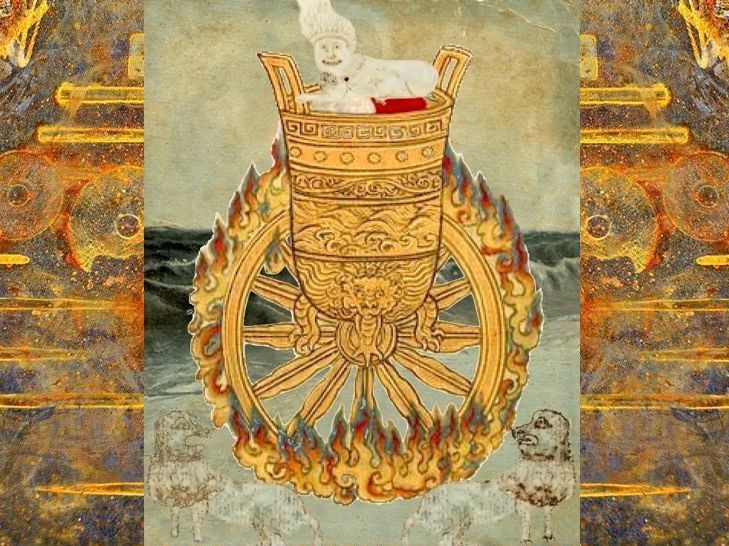
‘Festina Lente’ ~ Riding Tarot’s Hermetic Wheel of Fortune


Bless us, divine number, thou who generated gods and men! O holy, holy Tetractys, thou that containest the root and source of the eternally flowing creation! For the divine number begins with the profound, pure unity until it comes to the holy four; then it begets the mother of all, the all-comprising, all-bounding, the first-born, the never-swerving, the never-tiring holy ten, the keyholder of all.
~ prayer of the Pythagoreans to the ‘Mystic Tetrad’ [Wikipedia]
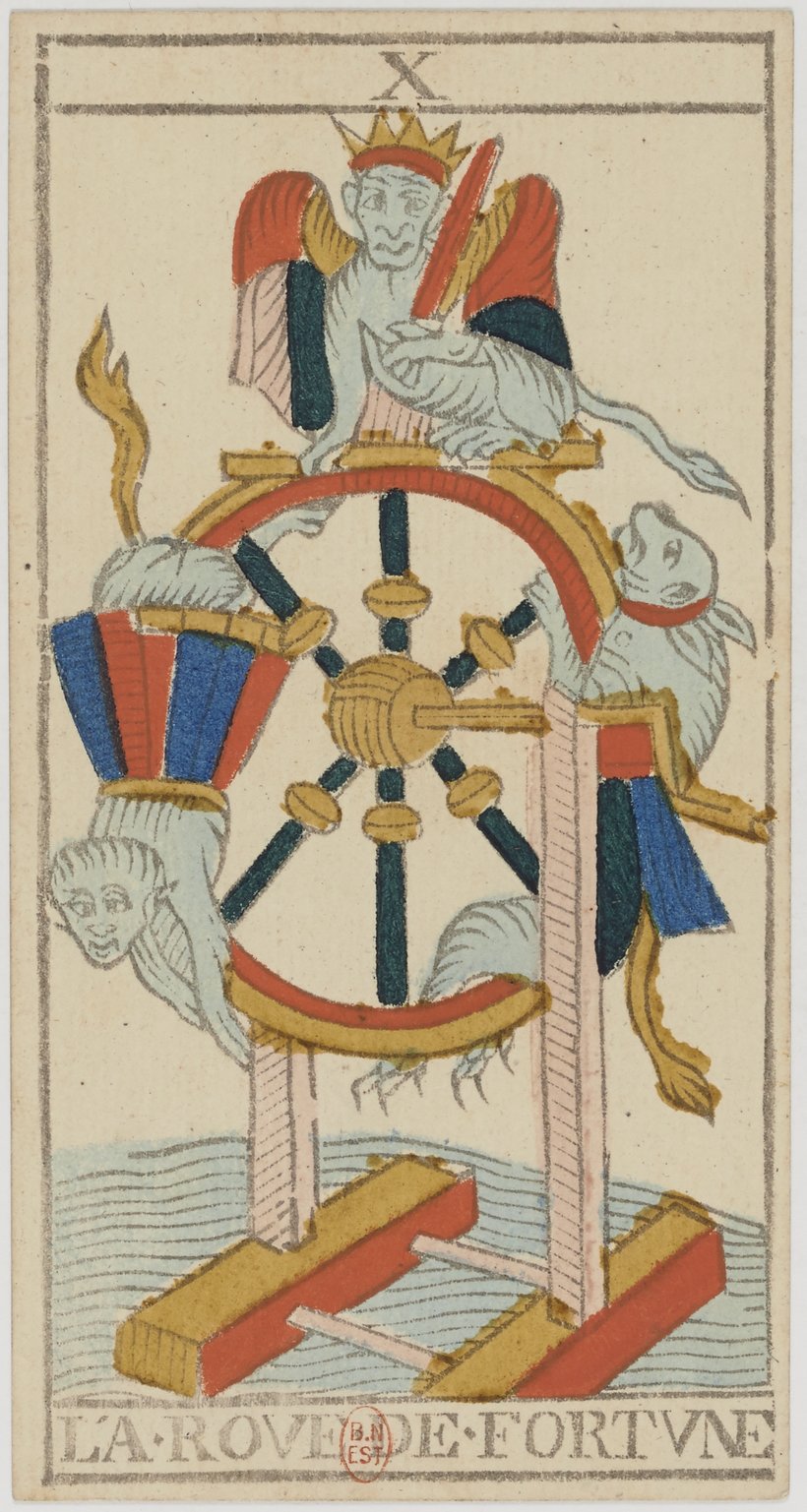
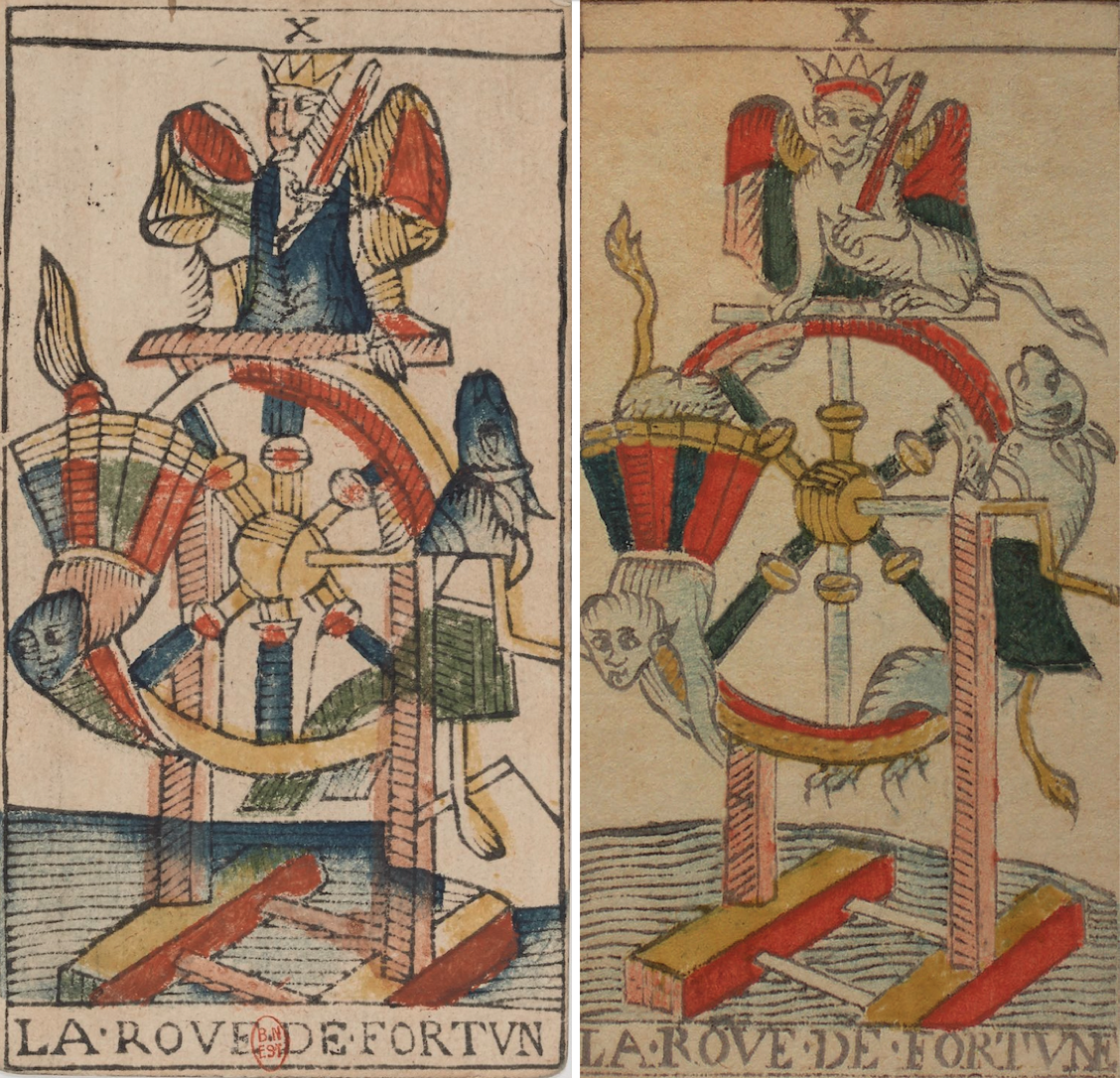
Nicholas Conver type II,  1760

Though it may appear comical, the importance of the triumph in tenth position is underlined by the reverence Pythagoreans paid to its number. To get a better grip on the Wheel of Fortune, it’s essential to understand it’s placement in the TdM numerical cycle, as it relates to the cosmology of  Pythagoras, famed philosopher-polymathematician (ca 570-495 BCE). The same cosmology was also the axiom of Maria the Jewess/Prophetess, famed alchemist-sage and inventor of the Bain-Marie and other alembics (ca 1st-3rd CE):

“One becomes Two, Two becomes Three,
and out of the Third comes the One as the Fourth.”
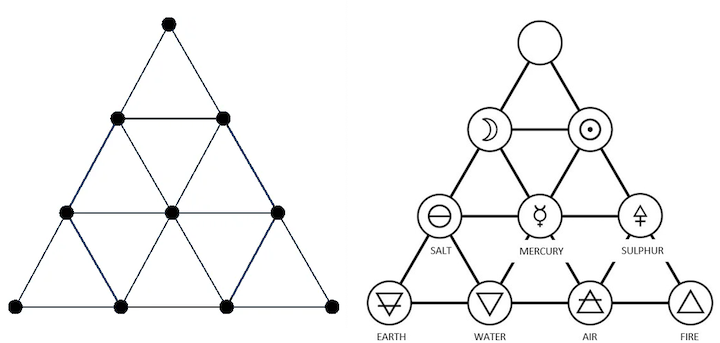
mathematical and alchemical versions of the same thing

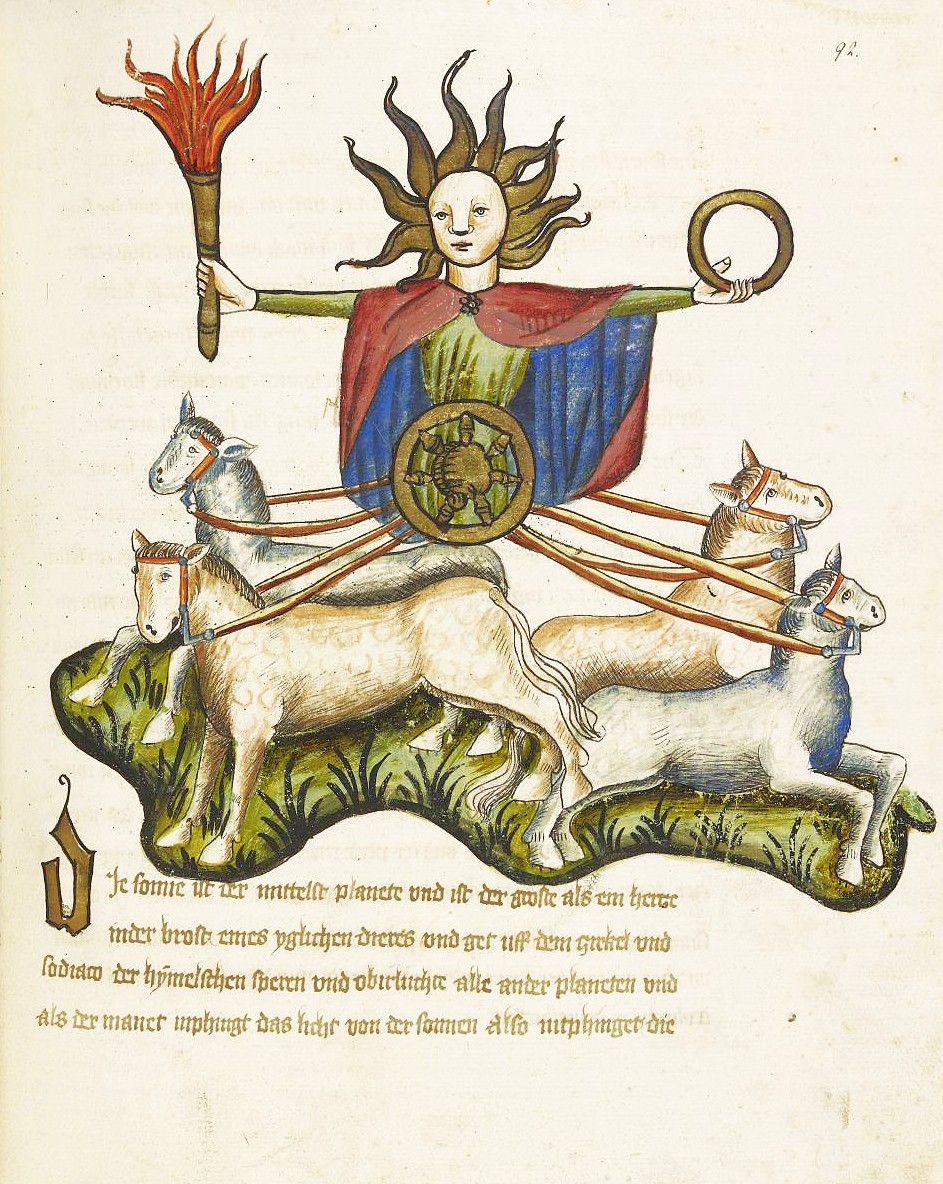
This simple formula, hidden in plain sight in triumph I, provides the foundational structure on which to then load our various interpretations; The Wheel of Fortune is both the first card of a three part cycle (10, 11, 12) as well as being the fourth card (the death) of the previous cycle (7, 8, 9). All the 1/4 cards indicate both initiation and completion – ie, change. They are always masc/solar (see below). Wheels are typically a solar symbol, and besides including the Sun itself, the 1/4 series contains the two triumph cards with wheels (7 and 10). Notice all the cards between 1 and 19 have crowns in them – another solar symbol – and that the the Wheel is central.
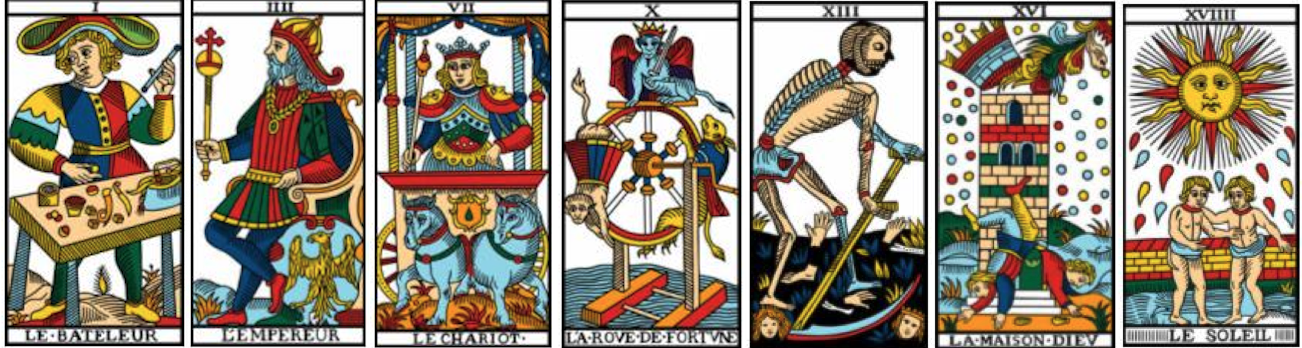
Cards in the 1/4 placements [Camoin-Jodorowsky deck]
German astronomical illustration of the Sun, 1445. How many cards from the 1/4 series do you see represented?

With 10, the perfect, complete number, ‘the great work’ (ie, the soul’s work) may now commence. 9 was the number of endings and of memory (Mnemosyne), of reflected, inner light. Similar to the Emperor, the old Hermit turns toward the past, drawing the numerological cycle to a close. We might imagine a shadow puppet play of life highlights projected onto the inside of his curtain-like cloak.
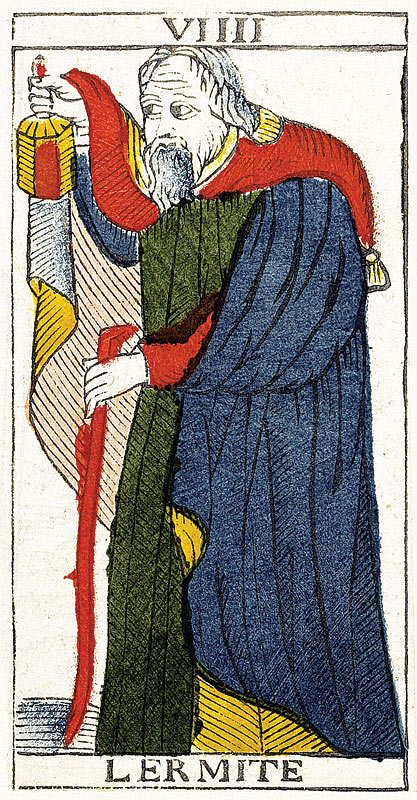
Pierre Madenié, 1709

Mathematically, 9 always returns to itself. The Pythagoreans were not enamoured with 9, but understood its importance as the first square (3×3) and for its role in human gestation, relating to the 9 spheres a soul transited before rebirth. More about the Hermit and his lamp here.

Pythagoras himself had been initiated into the Orphic Mysteries, among others, ’tis said. He believed in and taught metempsychosis (reincarnation), and that mathematical principals – numbers – are universal, guiding principals.
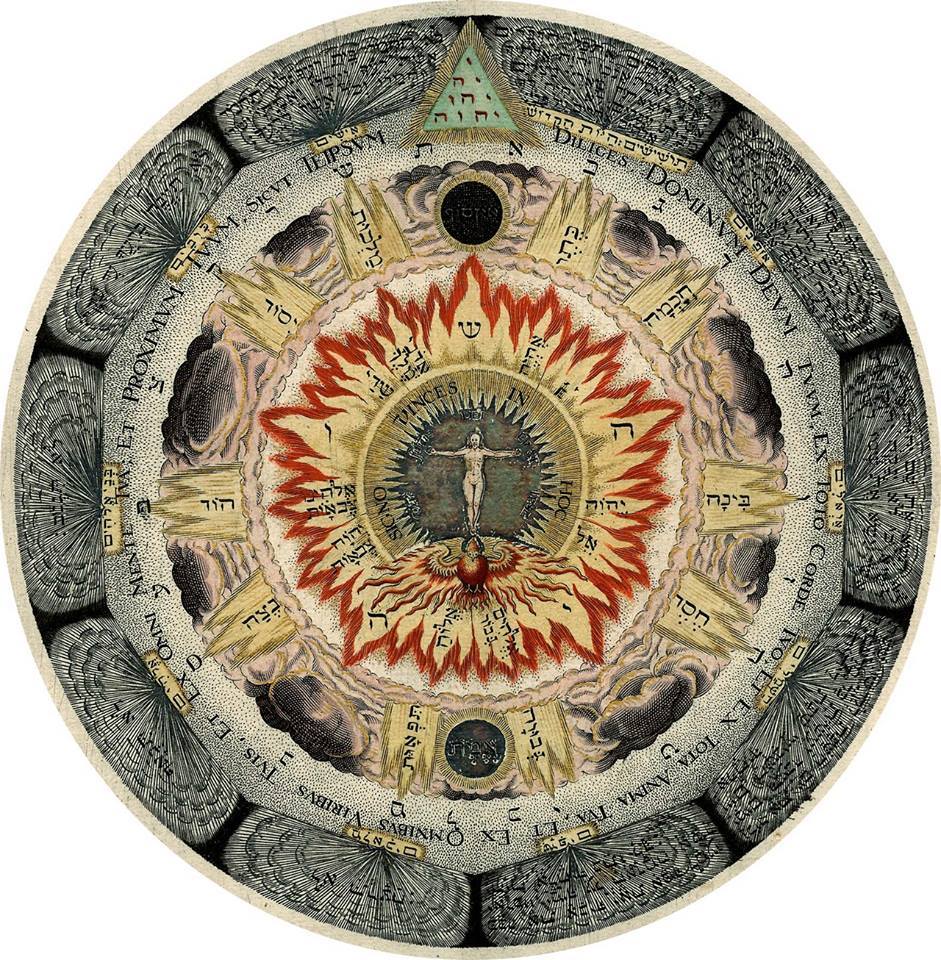
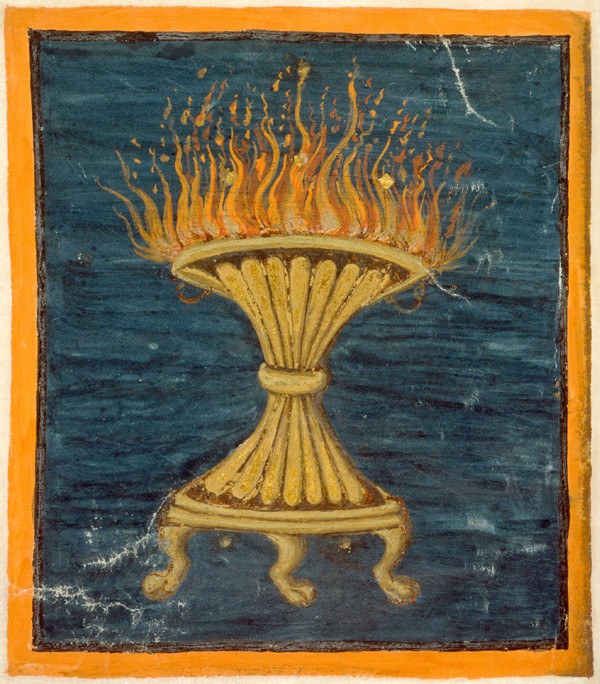
Alchemical etching from the ‘Amphitheatrum Sapientiae Aeternae’ by Heinrich Khunrath, Hamburg, 1595

10 is the ‘higher octave’ of 1. To Pythagoreans and alchemists alike, 1 was not actually a number (it could not be ‘numbered’ and anything multiplied or divided by 1 was still the same), but represented the Monad (God, origin, unity), symbolized by a circle with a central dot or eye. This is still the symbol for both the Sun and gold. Wheels are essentially monad shaped. [Note: They did not use or accept 0 as a number.].
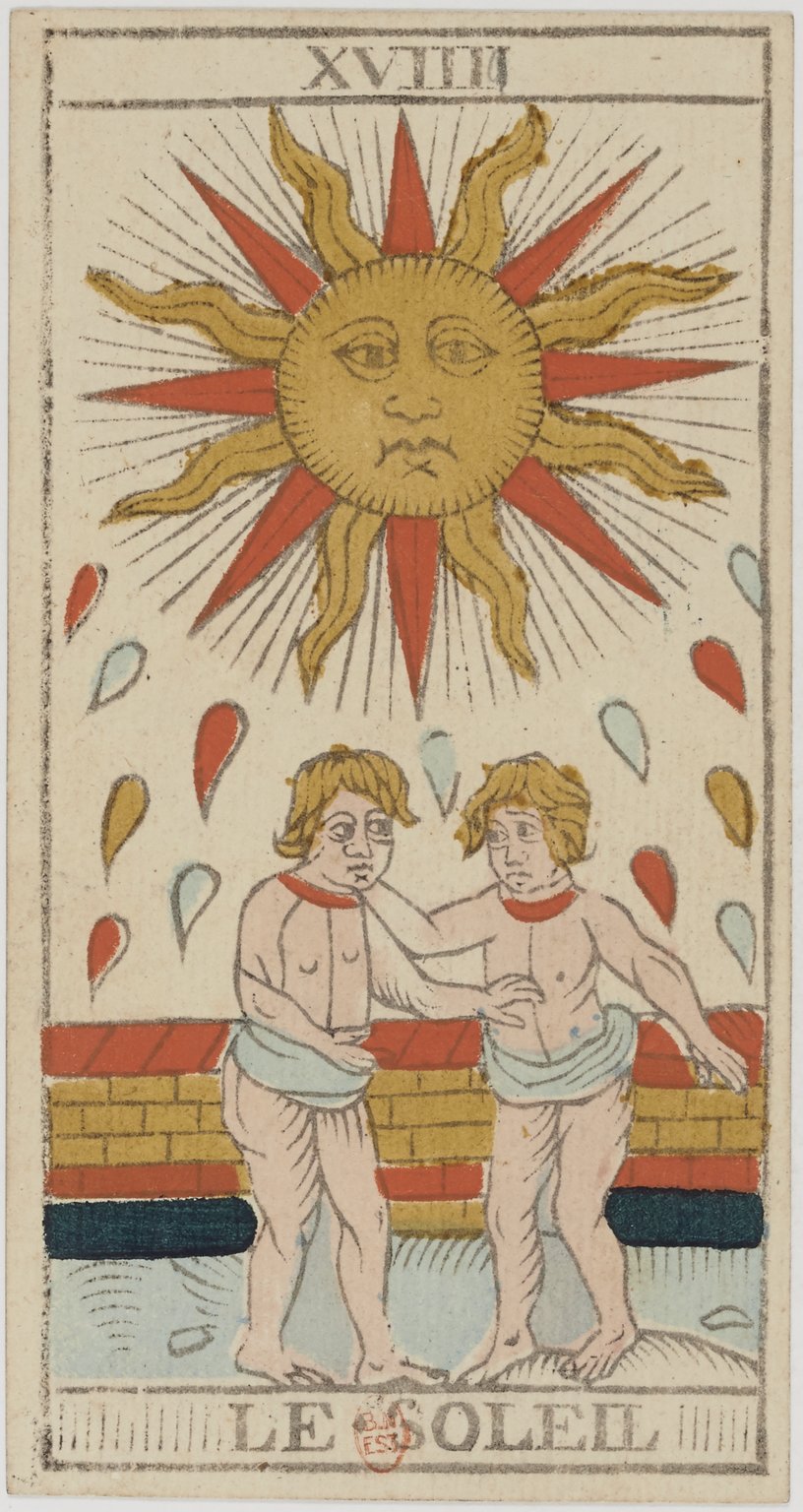
Conver type II, 1760

The next card after 10 that reduces to 1 when the digits are added together is 19, the actual Sun. There is no 4 in this last, seventh cycle of 3, unless we include Le Mat as 22. While ‘Pythagorean’ numerology considers 22 to be the ‘master builder’ (aka god), the man himself did not specifically mention this. However, what’s very interesting indeed is that the ratio of 22/7 was used by Archimedes to approximate pi. Thus by adding Le Mat as a 22nd triumph, division by 7 no longer gives us 3, the trinity, but pi, which is ‘never-ending.’

“Numbers are the Highest Degree of knowledge. They are knowledge themselves.” ~ Plato
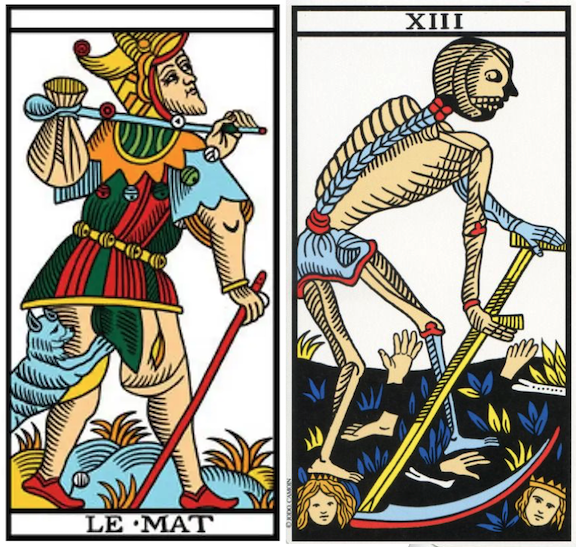
The infinite and the eternal? Camoin-Jodo Conver type II, 1997

The process of destruction and purification by fire and water prior to what will be rebirth in 19, 20, 21 begins with this most sacred number of the Pythagoreans because, where unity and wholeness is the ultimate intent of the work, God/the Divine must be invoked.

Alright, math class dismissed, time for art, myth and philosophy…

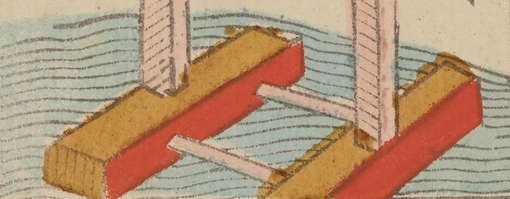
The Marseille Roue de Fortune card is a bit of a visual conundrum. The parts don’t quite fit together and though the creatures on it appear to be in motion (at least, the ones on either side do), nobody’s turning the handle. The base, which resembles a section of ladder, stands on water. Is it a water wheel? Maybe this rota cannot be fully understood literally, but is another riddle asking to be read as a composite of its parts.

I won’t go into the entire history of Fortuna’s Wheel, or ‘wheel’ be here all day, but one, particular detail in the Marseille version is what got my wheels in motion: at some point in the card’s r-evolution (perhaps simultaneously, in different traditions), the creature on the left transitions into a flaming pot.
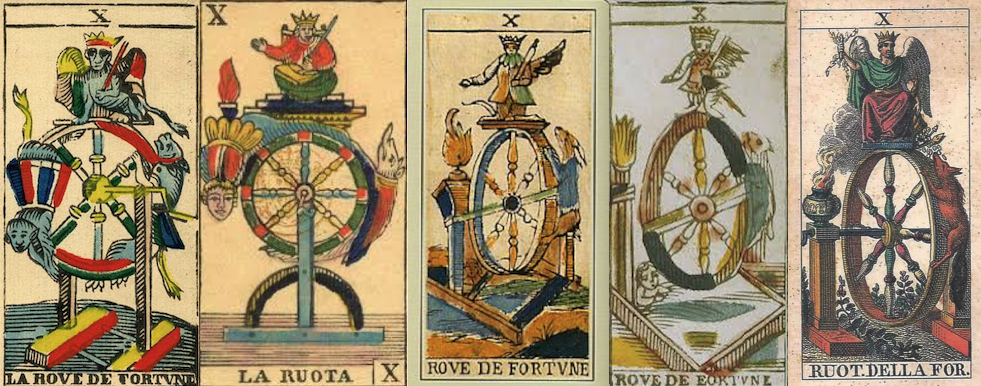
This has been dismissed as misinterpretation of worn away plates by printers who, (correctly) interpreting the tail as a flame, figured the Wheel should be equip with an altar or censer with which the passing of earthly existence into smoke was symbolized. (And now it does resemble an Arabic ’10’).

One possible precedent is in images of Ixion, where the wheel Zeus binds him to is being lit with a torch, although, there are plenty of mythical, flaming wheels (and altar pots) to choose from. Ours is not Ixion’s wheel per se, but maybe the flame is mnemonic of it. Ixion, having killed a kinsman and twice flagrantly violated the sacred law of Xenia, was denied the cathartic rituals that would cleanse him of his guilt, and, under Zeus’ orders was bound by Hermes to a fiery solar wheel for eternity [either rolling across the sky or stationary, down in Tartarus]. At this point in the game, there are two options; change or be stuck on repeat forever.
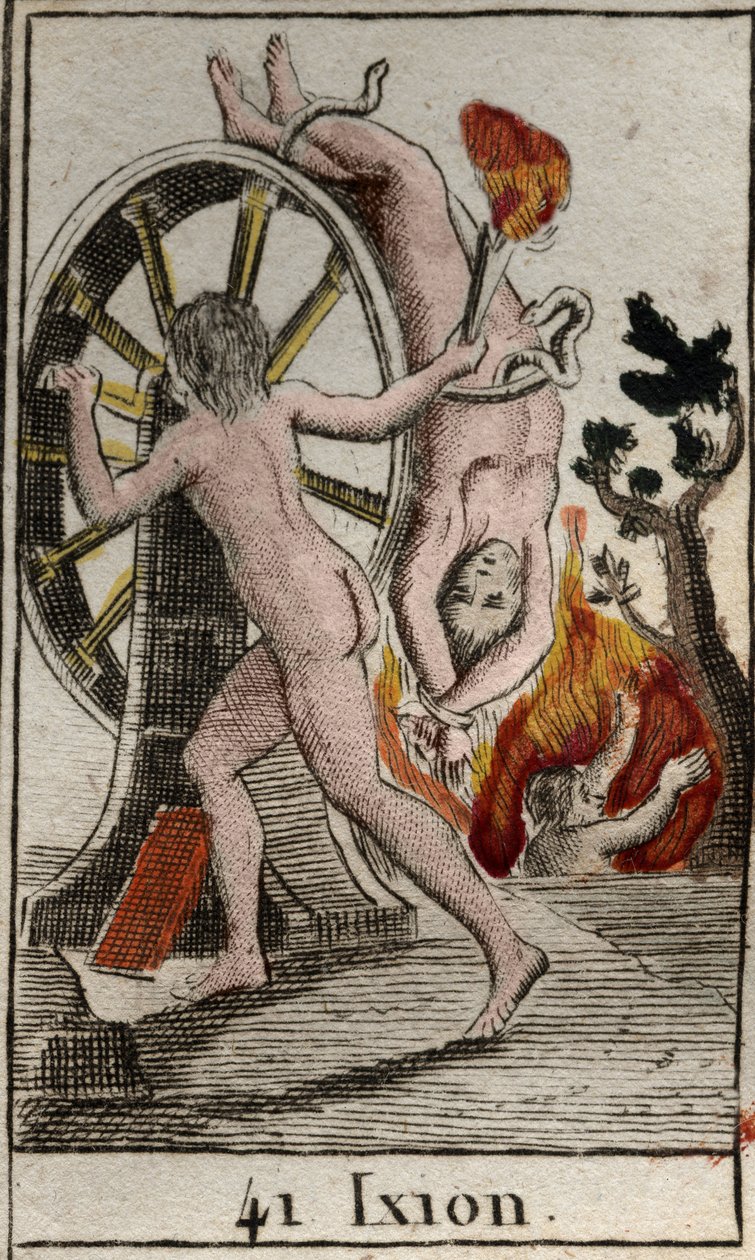
Ixion about to be lit, from ‘Mythologie de la jeunesse’, 1803

The Wheel’s stand can elude to a couple of things; like the Hanged Man’s gibbet, it might suggest a gateway, recalling the dokana of the Dioscuri (even shaped like the Gemini sign, a prelude to the twins in 19).
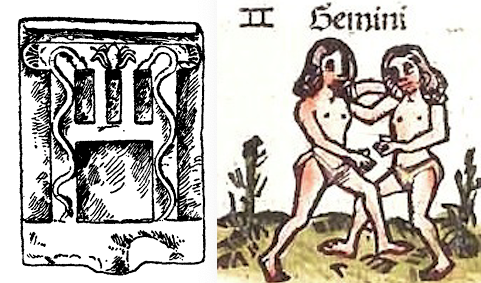
Dokana symbol and Gemini

It could also indicate that ‘the initiate’ has now made it this far on the scale philosophorum (philosopher’s ladder of mystical ascention), which will later appear atop the wall in 19. The two bars form the Arabic numeral 11, and/or the Roman numeral II, recalling “one becomes two…” Double digits begin here and the images start to reflect this. 10, with this design element, seeds 11 (La Force), situated exactly in the middle, a threshold with ten numbered cards on either side. The formidable lion-wrestling mistress is partner to the Le Bateleur.
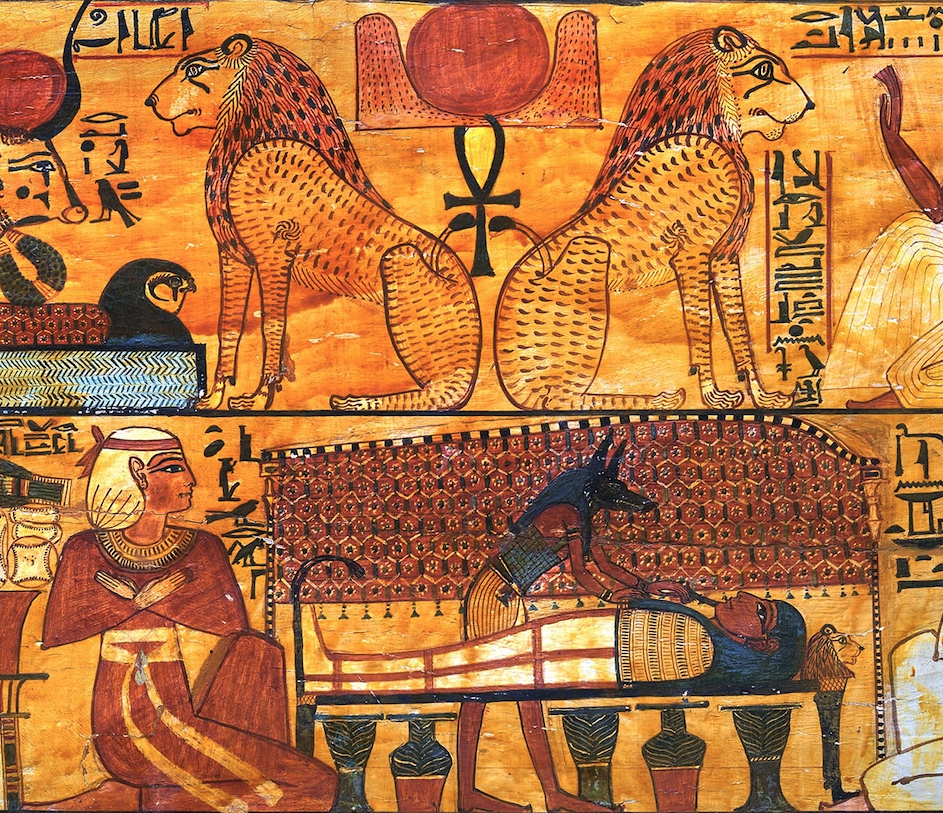
Lions of yesterday and tomorrow (eastern and western horizons), with the eternal in the middle, hieroglyph for ‘the horizon.’

The ‘foreparts of a lion’, seen here at the head of the embalming table, is the hieroglyph for ‘strength’, and is featured in the Strength card.

We might also imagine the Wheel as metaphorically representing the Sun above the watery horizon and the beings on either side as ‘yesterday’ and ‘tomorrow’’ – traditionally, ‘I have reigned’, and ‘I shall reign’ – with the top middle one as the present, ‘I reign’. Instead of a fourth on the bottom (usually an old, impoverished figure) there is a gateway to watery rebirth.
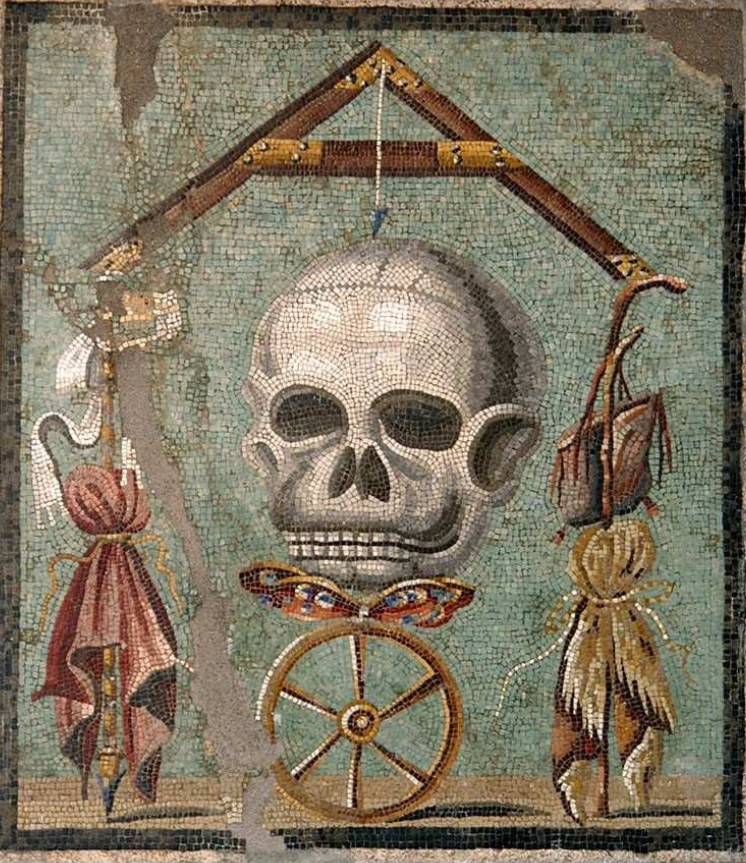
Memento Mori mosaic, in the Museo archeologico Nazionale di Napoli, 1st c

In this iconic ‘memento mori’ Roman mosaic from Pompeii, a simian skull is balanced atop a butterfly on a wheel. Above, a square level’s plumb bob is just touching it, the tool balanced atop two staffs, hung with the garbs of rich and poor. All are equalized in death, all are subject to Fortune’s whims. The mosaic was part of a banquet table, where Romans often practiced ‘carpe diem’, remembering their death tomorrow by partying today. The butterfly represents the immortal soul (Psyche). Butterfly, torch (especially going out or pointed downward), plumb line, fortune wheel, urn and of course skull/skeleton were all symbols of death, typical of the Roman ‘carpe diem’ motif.
[The tradition of death symbolism is also recurrent in Freemasonry. Masons practice reflecting on their mortality at every turn. The plumb represents death as well as the upright, balanced life and is a common,  gravestone motif.]
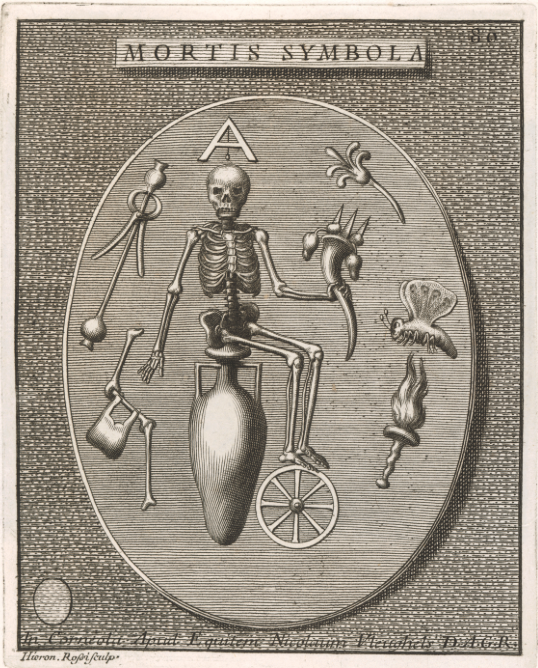
Roman symbols of Death

The explanation usually given for the monkey skull in the Roman mosaic is that cremation practices of the day had left the artist without a human one to refer to, but this ignores the fact that monkeys/apes were often used to parody humans. The memento mori theme was very popular and there is more than sufficient proof that artists of the day knew how to depict human skulls. An artist could easily have improvised the bone structure from a living human.
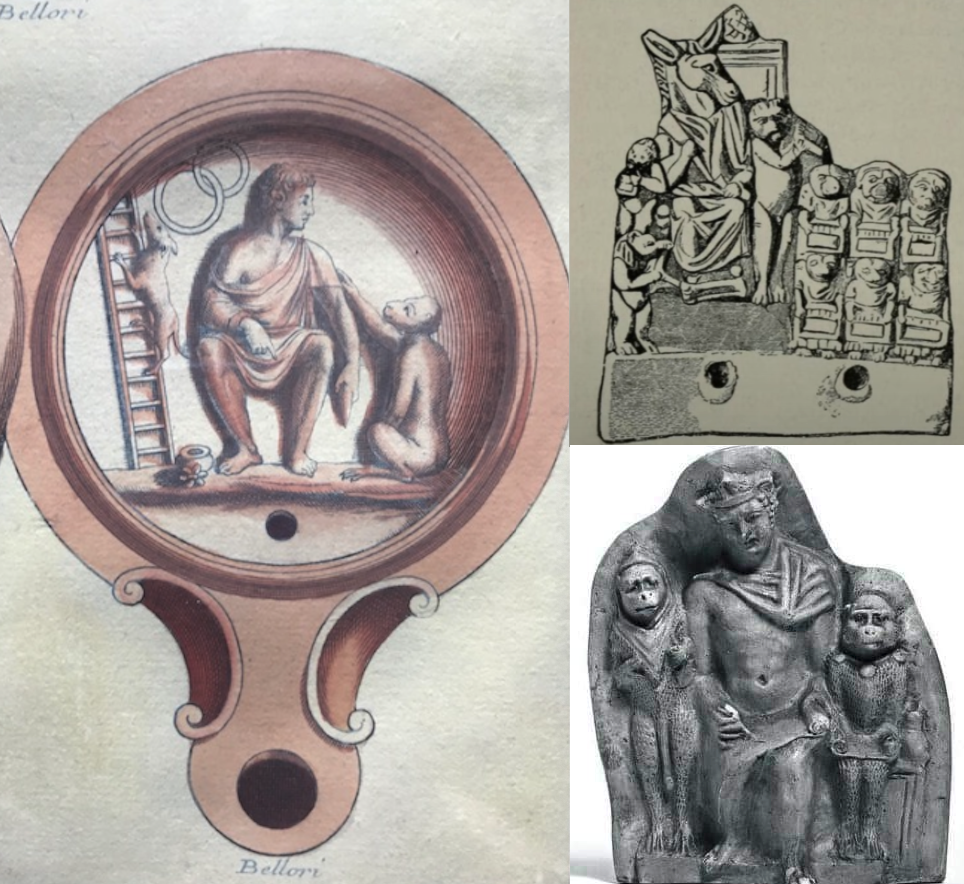
Lamp showing a juggler with monkey and dog (Carthage 1st c), Terracotta plaque (S. Italy, 1st c), Hermes seated between two baboons (Egypt, 3rd c BC, British Museum)

The little creatures on the TdM Wheel also seem to be parodying fearful humans stuck on the mortal coil, immediately following the card of remembering. Regrets…I’ve had a few…
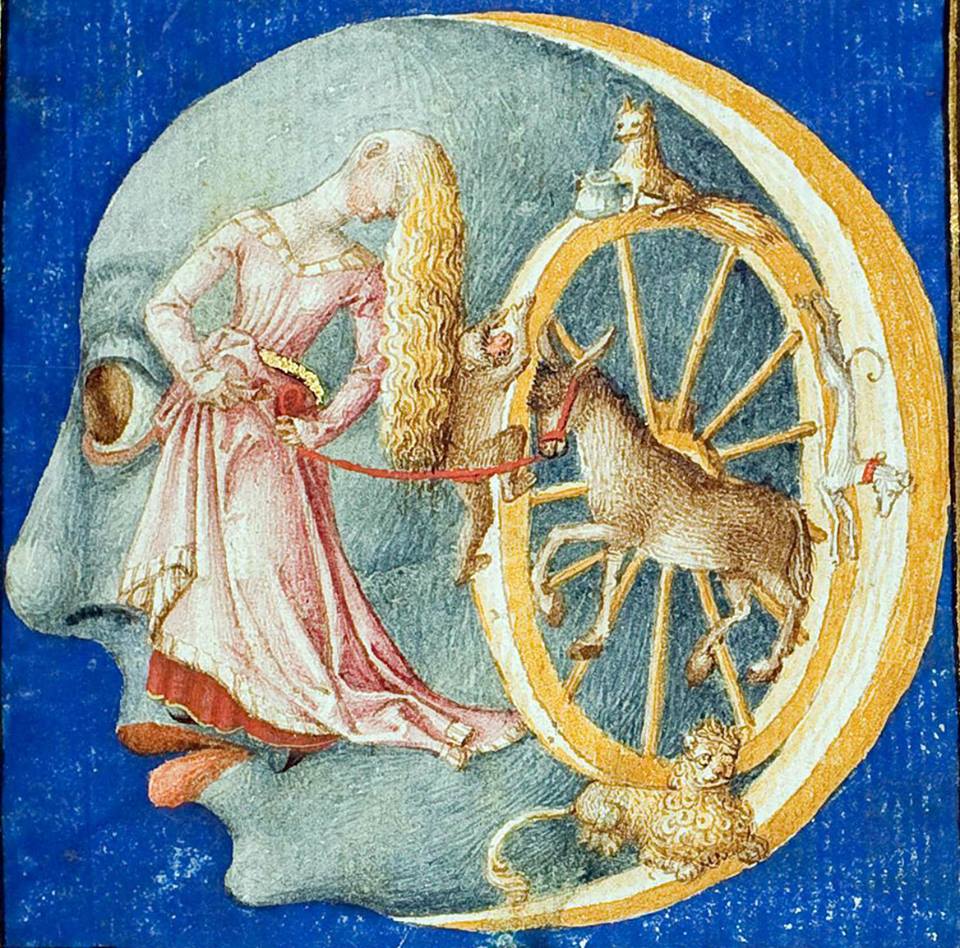
A Lunar Wheel of Fortune or Fate being turned by an ass, Hekate’s familiar. The woman’s hair-do is similar to that of Kairos (‘critical timing’), she might be the Roman equivalent, Occasio, who was female.

It would seem the tail of the simian-looking creature on the left side of the card was always intended to resemble a flame, both to illustrate the fire element, and to suggest that being turned on the wheel is akin to being ‘cooked.’ Perhaps there is nobody turning the handle because, as with the Chariot, which is not physically moving, there is no outer influence, the change is happening inside. Either we turn our own wheel or invite “fate” to do it – an outer expression whereby things seem to randomly happen to us (wheel of karma). The ‘winged’ Mercurial being at the apex might be symbolic of will, overseeing  the process, making sure the pace is natural and steady, that an even temperature is maintained. 

“Its purpose is constant digestion. Within its womb, substances are subjected not to violent flames but to the slow and merciful fire – ignis temperatus that mimics the warmth of the earth’s own generative belly. There, in that tranquil inferno, base substances soften, combine, and refine, until that which was profane begins its ascent toward the sacred. This is no vulgar boiling, but a sacred gestation.” ~ Universal Co-Masonry FB post, regarding the Athanor (alchemical furnace).
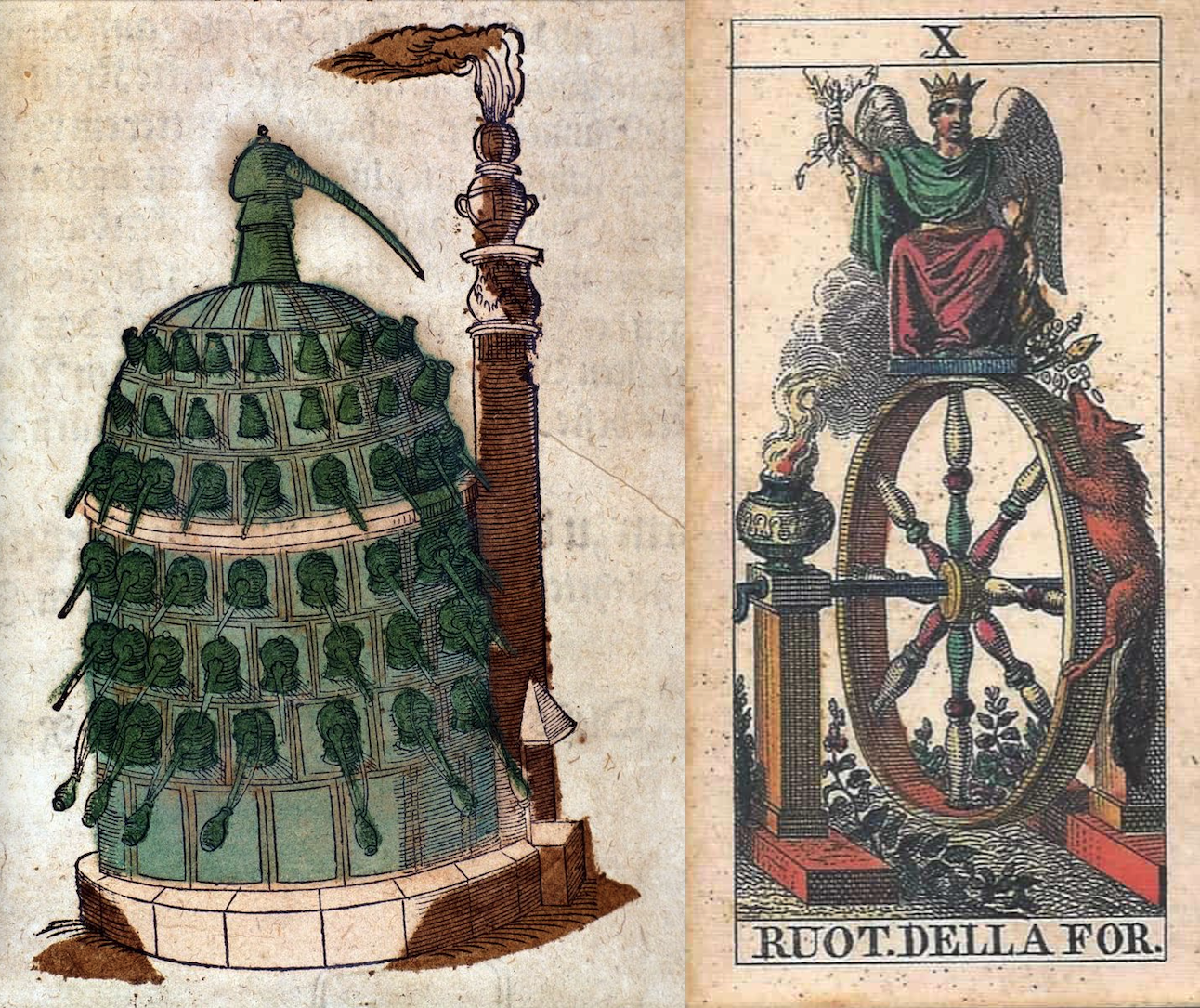
Athanor and Soprafino Wheel, 1835

Above, with a suitable Tarot card for comparison, is the image that finally unlocked this card’s cryptic meaning for me. It is of an alchemist’s ‘athanor’, which is a self-feeding, clay furnace designed to maintain a steady temperature. Although etymologically unrelated (it comes from Arabic at-tannūr, “the baker’s oven”), ‘athanor’ oddly enough contains the Latin word ‘rota’ in it (albeit spelled backwards). Note the familiar design of the heat-release valve.

“The athanor’s design further symbolizes the unity of the macrocosm and microcosm through its correspondence to the four classical elements, integrating them into a harmonious whole; Fire represents the transformative heat in the lower chamber, Earth the stable structure, Air the circulating vents, and water the surrounding baths, collectively mirroring the alchemist’s inner equilibrium and the cosmic order. This elemental interplay underscores the Hermetic principle of “as above, so below,” where the furnace’s operations reflect the soul’s alignment with universal forces.” [Grokipedia…forgive me!]

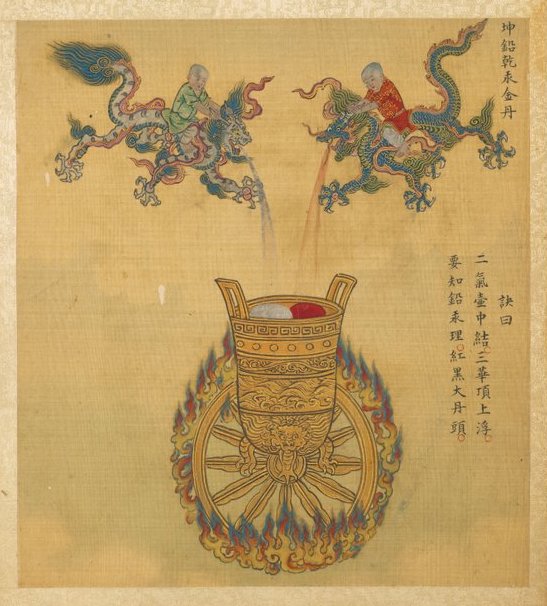
Qing Dynasty Chinese School Taoist Alchemy

In fact, the alchemists did use the term ‘wheel’ (rota) as a metaphor for the cyclical nature of their art. The stages were not linear, but continuous – the end could also be the beginning, just as in nature.

The three figures on the TdM Wheel might represent the 3 philosophical elements – left, sulphur (soul/emotions/desires), right, salt (body), and top, mercury (spirit/imagination/moral judgement/higher mental faculties). The salt/body fellow has ass ears, which typically are a sign of ignorance (think Pinocchio) but also, again, possibly suggestive of Hekate, triplicate Goddess of the crossroads and occasional consort of Hermes (aka Mercurius) or Hermanubis. As supreme navigator of liminal spaces, her torch burned with the sacred solar fire of Helios. 

“O Sun our lord and sacred fire, the spear of Hekate of the roads, which she carries as she attends her mistress in the sky and as she inhabits the sacred crossroads of the earth, crowned with oak-leaves and the woven coils of savage dragons!”

~ fragment of a hymn to Helios and Hekate from the play Rhizotomoi (Root-Cutters) by the Greek tragedian, Sophocles [Loeb Classical Library].
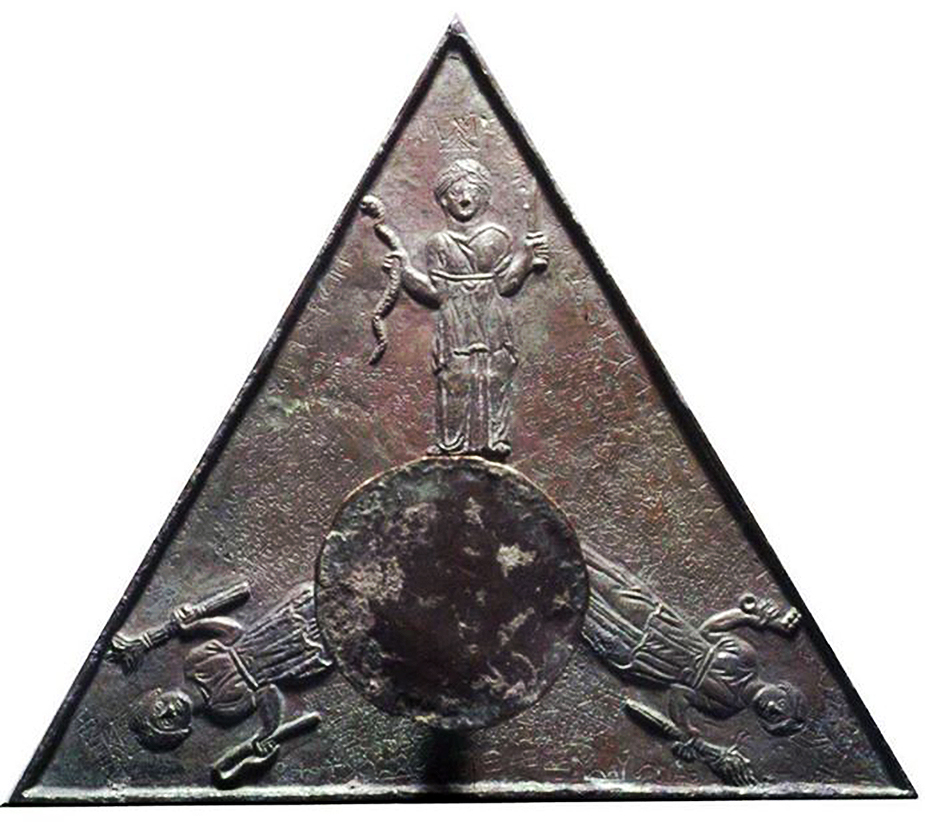
Goddess Hekate in magical plate from ancient Pergamon, Anatolia [Berlin Museum]
All 4 classical elements, too, are present:

AIR (sword pointed up, wing-like cape)
FIRE (flame-like tail pointed up)
WATER (below)
EARTH (vine or snake-like tail pointed down)

4 classical + 3 philosophical elements = 7.

In both type I and II, the number of spokes appears to be 6 (or three divided), but notice that a seventh is also formed by the Wheel’s handle. Clever. Seven elements, planets, metals and stages.  

Dodal type I (ca 1701-15) and Chausson type II (1672)

The hub of the Wheel is divided into 3 sections, and resembles a lunar-solar combination – navigation of liminal spaces as we progress toward unity.

That the flaming tail was turned into an altar pot/censor doesn’t change the intrinsic meaning and actually alludes more strongly to the alchemical cooking process. The water below suggests ‘a slow, gentle cooking’, akin to that of the Bain Marie. Similar to the gentle turning of a wheel, the contents of a cooking pot or cauldron is stirred in a slow, spiralling motion. In Shakespeare’s tragic play of alchemy gone backwards, MacBeth, the Wyrd Sisters famous chant, ‘Double double, toil and trouble,’ is a reference to ‘the work.’ Originally, the old English word ‘wyrd’ (which became ‘weird’) meant  ‘fate’ or ‘destiny.’
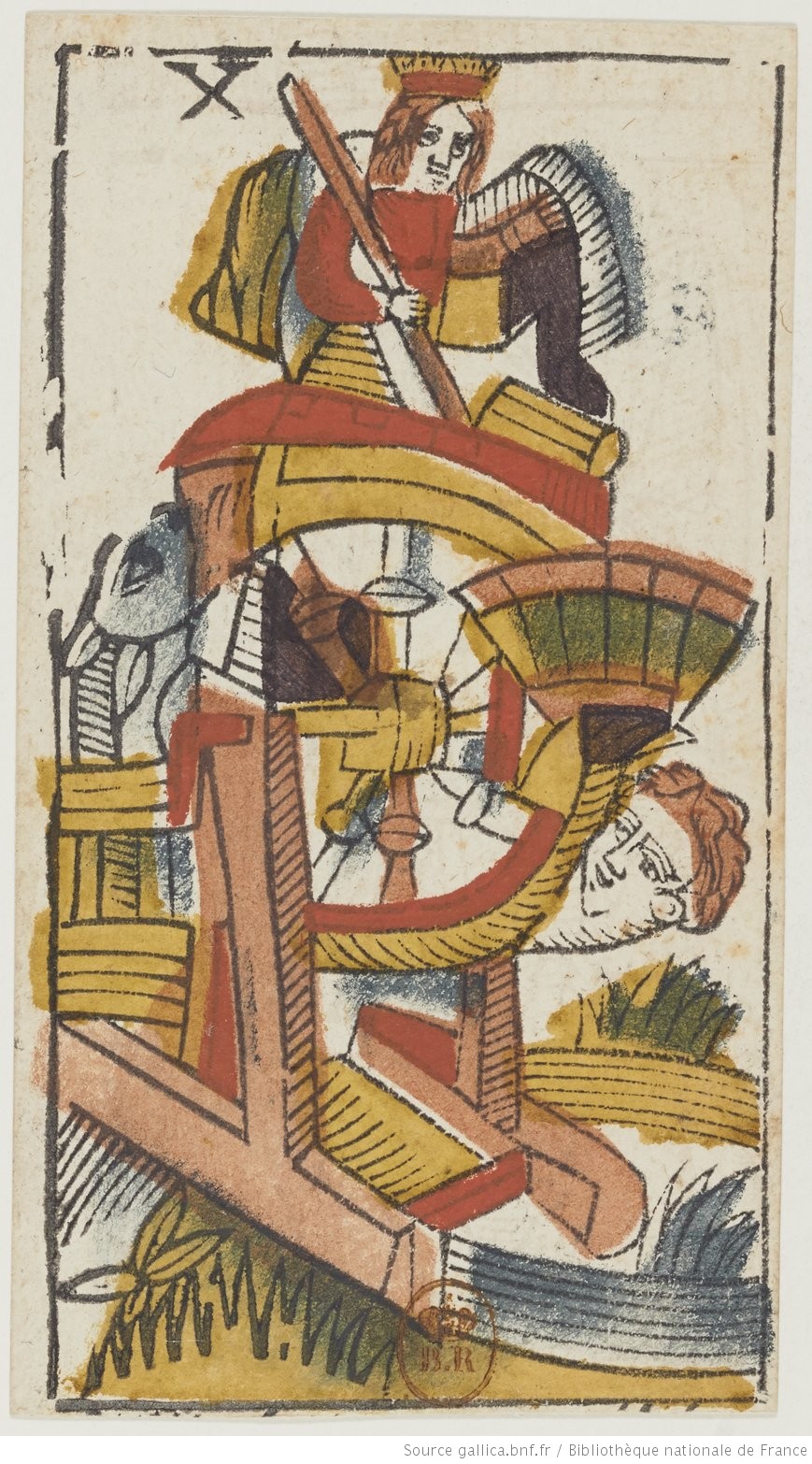
Jacques Vieville 1650

The Vieville card does not show any flame on the side, but rather, some suspiciously fiery-looking, yellow grass, below, possibly suggesting the pool of water is being heated from beneath. But the shape of the fire being’s skirt is consistent across TdM decks. It bears a similarity to the shape of constellation Ara, the altar on which sacrifices to Zeus were made, and is reminiscent of the Emperor’s skirt  (‘I have reigned’). The Wheel of Fortune was also an attribute of Zeus, god of optimists and gamblers. By ‘letting go and letting God’, we sacrifice our dross to the pyre, turning fate to faith. Remember Pythagoras’ holy number 10.

Ara constellation, Roman

Apollo, though one of the great gods of Olympus, is yet represented in some sort of dependence on Zeus, who is regarded as the source of the powers exercised by his son. [Theoi.com]

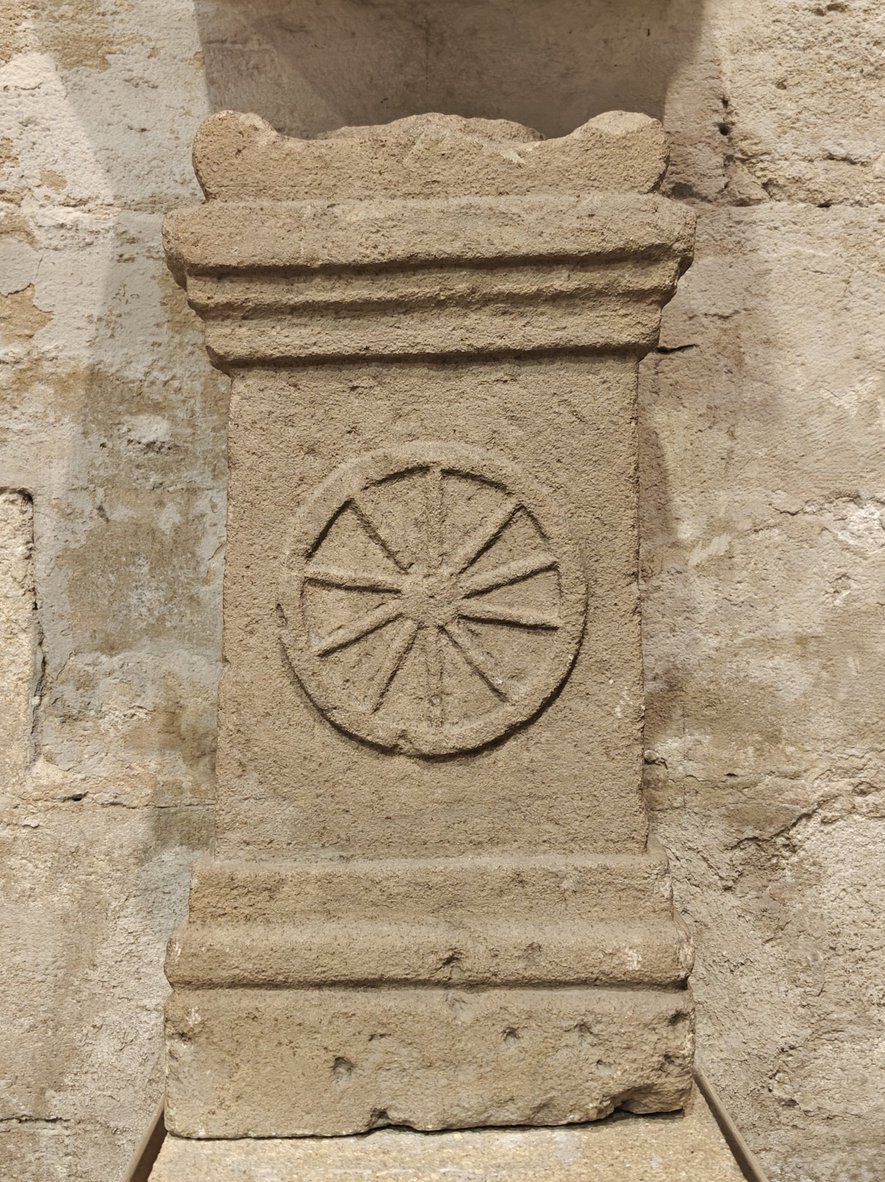
Jupiter (Zeus) altar featuring a wheel.

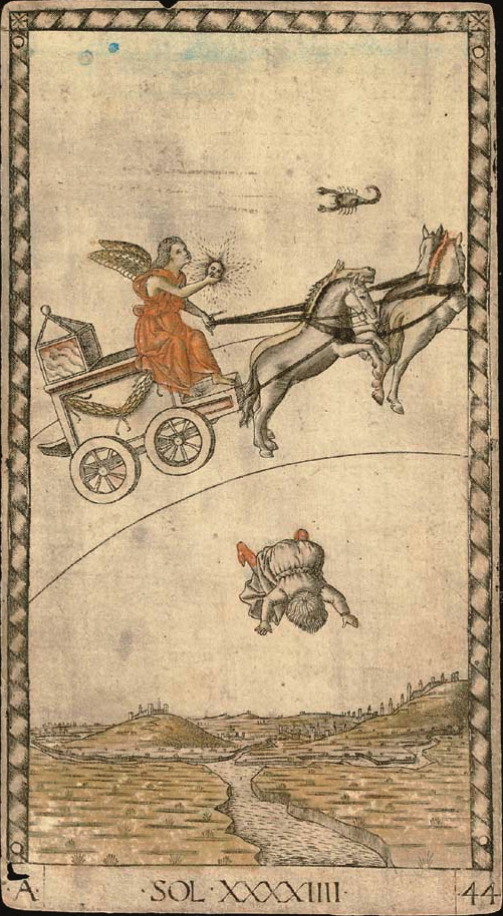
Helios, a Titan, was the Sun personified, later identified with Olympian Apollo, god of light and prophecy. The sad myth of Phaethon – the son of Helios who insisted he could drive his father’s chariot, but lost control of the horses and fell to his death – can, in the mythoalchemical sense, be equated with ‘the work’ being scorched by impatience (or hubris) or halted by negligence (or ignorance).

Tarocchi of Mantegna Sun, featuring the myth of Phaethon, 1465

The meaning of the Latin phrase Festina lente (‘make haste slowly’), is that activities should be performed with a proper balance of urgency and diligence. If tasks are rushed too quickly then mistakes are made and good, long-term results are not achieved. Work is best done in a state of flow in which one is fully engaged by the task and there is no sense of time passing. In this way we are in harmony with nature.

“Thus, let the Athanor burn–not with haste, but with faith–and may its light ever guide the hand and the heart of the true seeker.”
~ Universal Co-Masonry, ibid
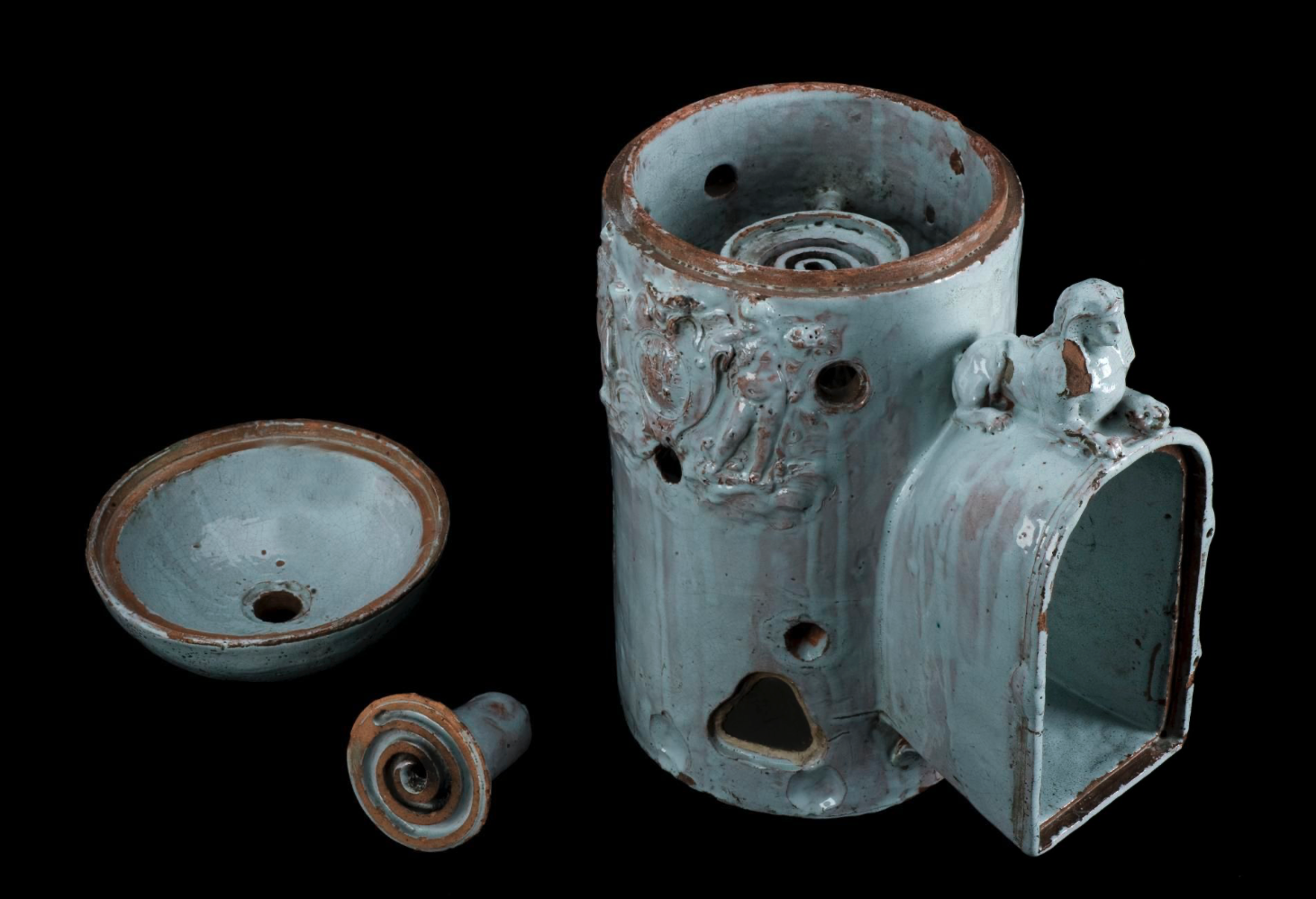
Alchemist’s athanor (top removed), stoneware, German, 1501-1700

All written content, besides quotations, is ©ROXANNA BIKADOROFF and may not be reprinted for republished in full without my permission. Kindly share via LINK only, which helps direct traffic here. If you wish to use a short pull quote, please include a credit (and link).
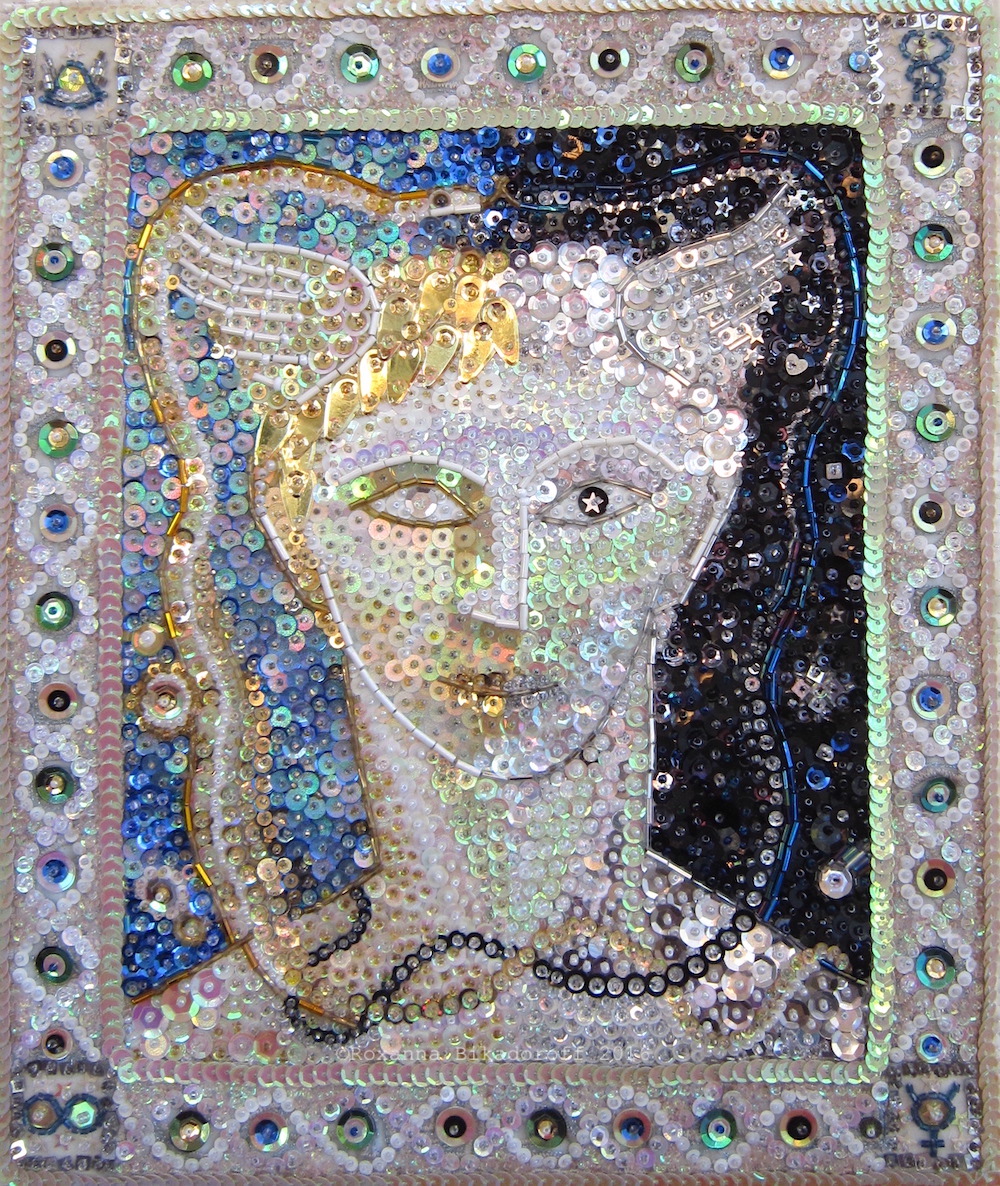
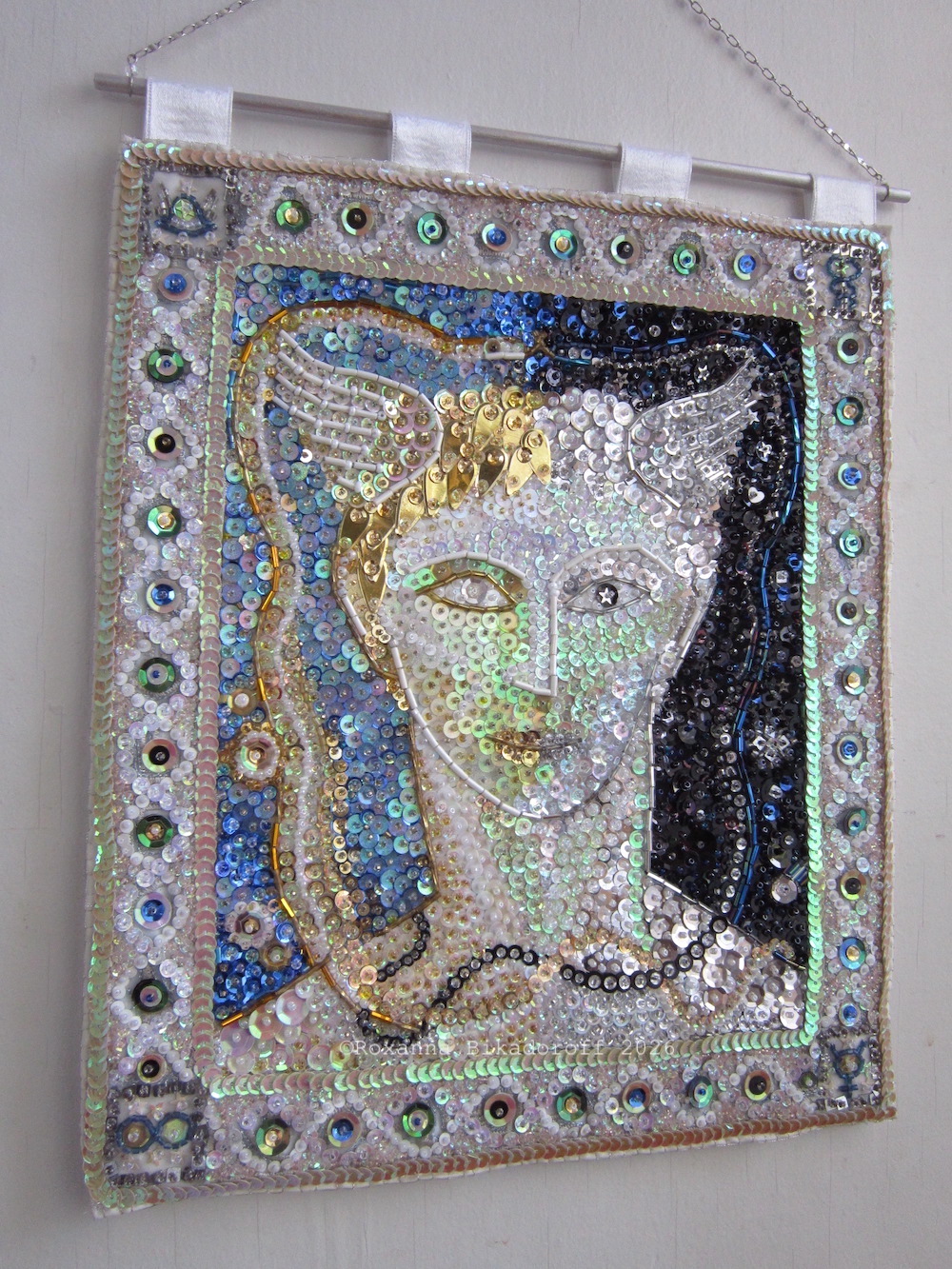
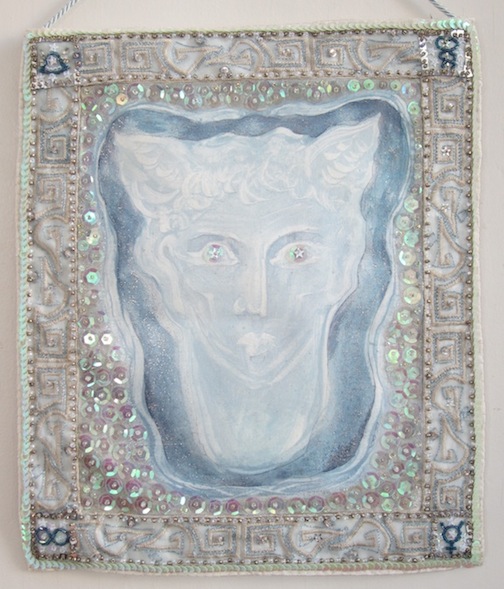
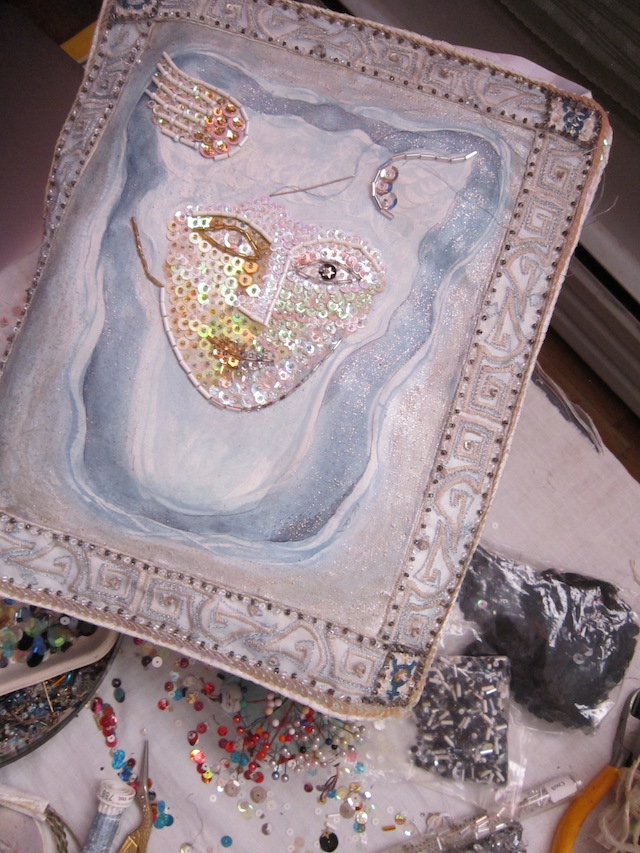
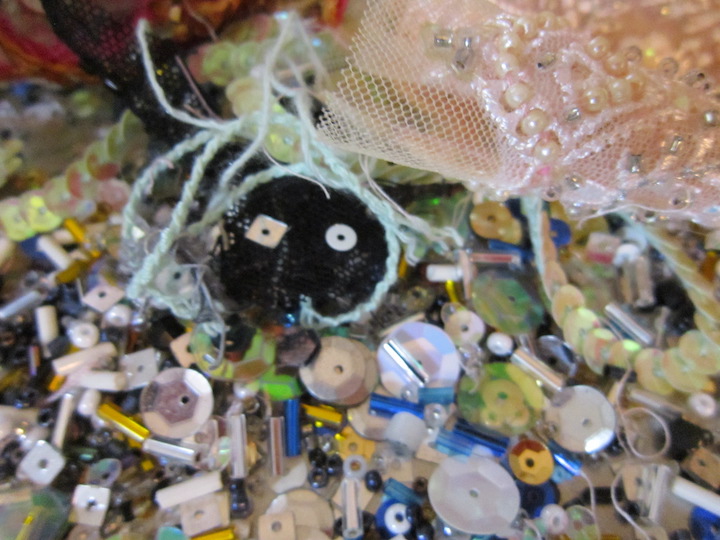
Mercurius, God of the Agora – a portrait in sequins

Portrait of Mercurius

Hail Hermes-Mercurius, fleet-footed genius of artisans, astrologers, writers, Tarot, theatre, magic, alchemy, thieves, commerce, crossroads and every communication, connection or interaction made between one entity and another! Ruler of the zodiac signs Gemini and Virgo (who has been known to wave a magic wand).

side view

This new icon was completed during Mercury’s transit of Pisces, Virgo’s polarity, while the Lunar Nodes are in Virgo/Pisces. I mean, how Virgo-Pisces is obsessively hand-sewing Mercury with opalescent, shiny objects that resemble fish scales or bird feathers?

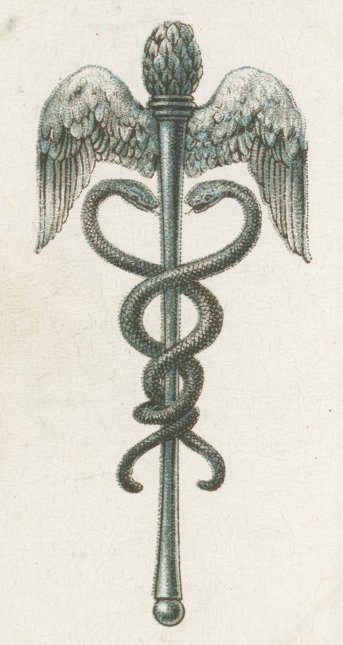
Caduceus [Will’s Cigarettes card, NYPL digital]
Opposing snakes frame his winged head (so full of thoughts and messages), as if his caduceus has magically come to life. Always in the middle, the etherial trickster glows with solar gold and lunar silver. The border is a design based on DNA ‘serpents’ and Argus eyes.

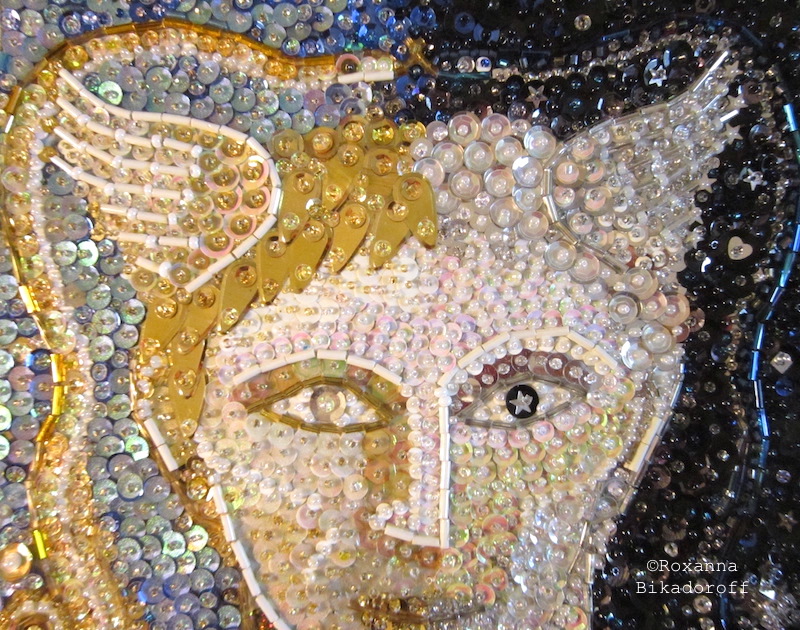
detail

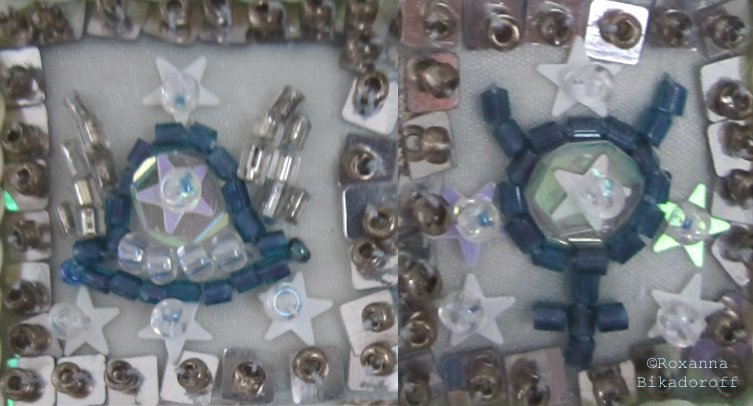
The original piece was a light, acrylic painting on canvas. I’d decorated it partially with sequins (eyes and background, and the four corner symbols). At one point, I removed the sequins and attempted to embroider on top, but it wasn’t right. All the visible needle holes in the painted surface meant it would have to be covered. I put it away for several years, but decided to tackle it again last Winter.

original piece, 2013


I’d purchased this beautiful trim in San Francisco, when I lived there and made my own belly dance costumes, years ago. It reminded me of Ancient Greek designs. I didn’t want to cover it, but after the middle part was finished, it didn’t match. So as a compromise, I left a bit of space for it to show through and provide another layer from behind the ‘Argus Eyes’.

corner details (winged helmet and Mercury symbol)

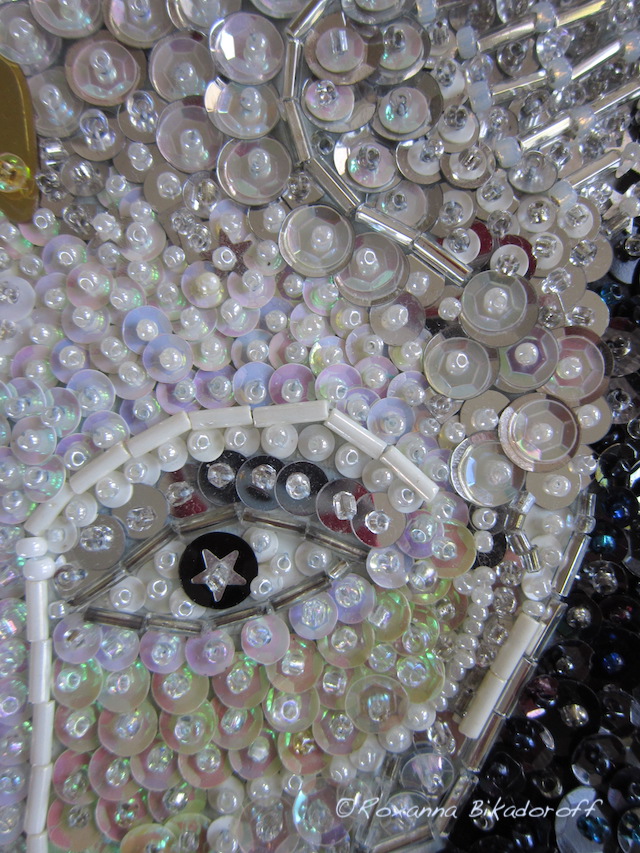
My earlier sequinned tapestries are inspired largely by Haitian ‘drapo’, but this smaller piece was also influenced by painterly, Roman mosaics. It does feel like I’m ‘painting’ with sequins, sometimes applying two or three on top of each other and choosing opalescent or metallic beads to achieve the right luminosity and gradation. Mercurius reflects differently, depending on light and angle. Sunlight can give him a pinkish hue.

silver eye detail

size:  approximately 11 x 13 inches, excluding chain.
materials:  sequins, glass seed beads, canvas, satin, satin ribbon, thread, wood dowel, acrylic paint, metal chain.
Not for sale. Decided I need to have him near!

This piece is also posted on my Beaded Icons page in the ART menu.

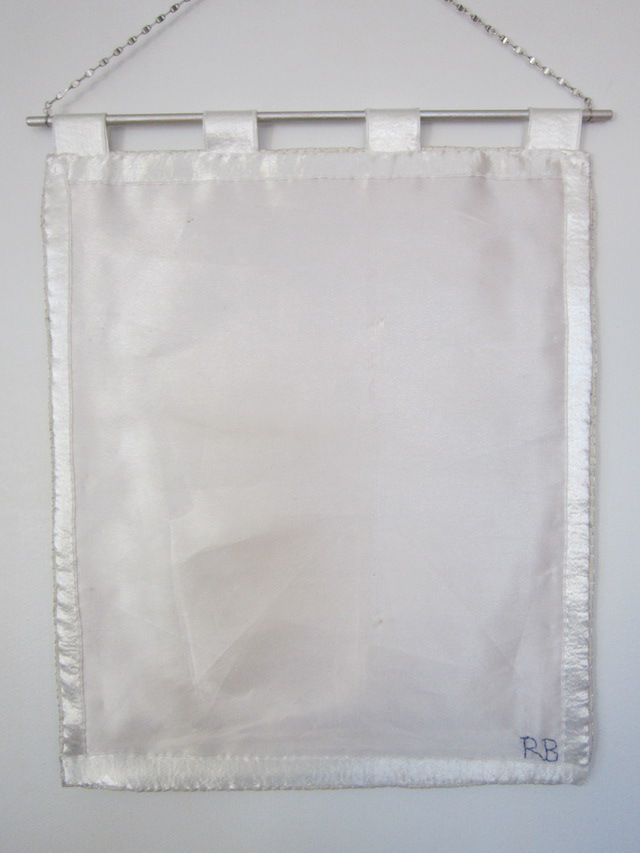
Stitch-signed on white satin backing


©Copyright Roxanna Bikadoroff. Please share via LINK only, no lifting pics or written content without permission. Thanks!

The Fool/Le Mat – Jolly Green Giant of Tarot de Marseille


“There is no danger of lowering God.”

“…a time comes, especially when the play of gods and heroes develops to gigantic proportions, when the spectator must feel the need for relief from the high concerns of great immortal themes; and a pathetic consciousness begins to form of little man confronted by these things – seeming by contrast comic in his limitations, yet peculiarly valiant in his one invincible power to take knocks; the Eternal Butt. His only weapon of offence to raise up against it all is the phallus, or a need to be undone and seduced when life becomes too much of an obstacle to step over with ease and dispassion.”
~ Richard Southern, The Seven Ages of Theatre, on the introduction of the comic interlude.

Fool from Heironymus Hess’ Dance of Death (after Holbein),  mid 19th c

It’s been said that the Renaissance was a direct reverberation of the Black Plague, that out of this grim blackening (it always begins with blackening) a golden age was created, the rebirth of the light. In Italy, three famous poets (‘the big three’) are usually credited with having initiated Humanist thinking, providing an inspirational blueprint or script for the artistic movement that would reshape the consciousness of Europe; Petrarch (The Triumphs), Danté (The Divine Comedy) and Boccaccio (The Decameron).

Petrarch’s Triumph of Vainglory [Fame], ca 1380 (BnF)
Renaissance scholar Jacob Burckhardt says that Danté “was and remained the man who first thrust antiquity into the foreground of national culture. In the ‘Divine Comedy’ he treats the ancient and the Christian worlds, not indeed as of equal authority, but as parallel to one another” and that Petrarch owed his fame among his contemporaries far rather to the fact that he was a kind of living representative of antiquity, that he imitated all styles of Latin poetry, endeavored by his voluminous historical and philosophical writings not to supplant but to make known the works of the ancients.”

Although Boccaccio too drew on and borrowed from classical/ancient themes and styles, The Decameron was set in more contemporary, plague times and is referred to as early satire. It has been nicknamed the ‘Human’ Comedy and from my understanding (I haven’t read it) gets pretty bawdy and anti-clerical, enough so that it was thrown upon the vanity bonfire. We might say that in Boccaccio’s case, the phallus was indeed raised as his weapon of offence against the high concerns of great immortal themes, and in defiance of death, following the plague.

Laugh? I thought I’d die!     (Camoin-Jodorowsky ConverTdM)

Tarot dates back at least to the middle Renaissance and, like the great poets, pairs ancient, classical themes and traditions with Medieval ones – especially the idea of a parade of characters (or gods), such as those in the Totentanz or Canterbury Tales, etc. The Fool and his Unnamed double emblematize the Middle Ages (pre-Renaissance) while at the same time representing that which is eternal; the immortal breath of spirit and the infinite void.

A jester points out God in a cloud, c 1405-15 (British Library)


“Men are born soft and supple; dead they are stiff and hard.
Plants are born tender and pliant; dead, they are brittle and dry.
Thus whoever is stiff and inflexible is a disciple of death.
Whoever is soft and yielding is a disciple of life.
The hard and stiff will be broken. The soft and supple will prevail.”
~ Lao Tzu

Noblet dingle dangle (mid 17th c)

Although the animal going after his buttocks in the classic, Conver Fool card (eg. Camoin-Jodorowsky and two samples in mid-quartet, below) looks canine, in pre-Conver type decks, such as Jean Noblet (above), it is usually feline. Fools were often depicted with a cat familiar,  licentious, nocturnal cats being associated with sinners and the Devil (hence they were persecuted along with witches in Medieval Europe, resulting in the spread of plagues due to rodent profusion).

‘Devil’s Anus’ Woman with a Mirror and Jester, 1600s (anon)

However…like the proverbial cat who may look upon a king, a court fool/jester was the only person allowed to truly ‘look at’ the king. Like Fluffy, he’s acutely unimpressed by human status. It’s an old tradition. In ancient Rome, for instance, there was a person whose role was to stand behind the celebrated conqueror in his victory chariot, whispering, “Remember you are a man.” As well, ‘there are accounts of a funny man who performed impressions of the deceased – at their own funerals. The archimimus was allowed to offend even family members.’ [BBC]

The number of Fools is infinite. ~ Ecclesiastes

Ancient Roman gallows humour [via BBC]
Our Tarot Fool is more jongleur (travelling entertainer) than court jester, but he comes from the same, marginalized lineage. Though they were very skilled, jongleurs were often mistrusted, even condemned as ‘agents of the Devil’ because of their music, profane songs and dancing, which smacked of ancient, Pagan ritual. I say ‘smacked’ because this is usually what that long spoon was for – a slap stick. (Perhaps the comedic prop reminded the church of those ‘Pagan’ libations). An outsider who ‘stirred things up’ would likely need to make ninja use of their accoutrement on occasion. Yet he makes no effort to shoo the clawed attacker away.

So is the Fool a king? For a possible answer to this question, we might ponder another: Why does the tear in his pants reveal green skin?
The usual explanation is that the printers were simply ‘pulling a fig leaf’ by colouring his bared rump green, yet somehow Noblet got away with exposing not only his fleshy butt, but genitals too (apparently his way of flipping the bird to the tax man). And why make the Fool’s ‘outer skin’ (leggings) flesh coloured?

Green Men; Dodal, 2 Conver versions, Bologna version

Another, small but noteworthy detail is that the monadic ball on his left shoulder is usually – though not always – the only one (of the two on his shoulders) coloured red. Green skin (more on his upper back?), dog and red shoulder ball might together suggest a connection to Osiris, conflated with his constellation, Orion.
Orion is actually mentioned in the Bible as ‘Kesil’, a Hebrew word meaning fool/dullard/stupid fellow. Maybe because Orion the Hunter boasted he could kill any animal (and was also a criminal who committed rape), or else the Israelites regarded the Egyptian lord the same way a cat regards a king.

This incredibly evocative mosaic (below) depicts the moment Orion is transformed into a god aka constellation. It is so loaded with symbolism and emotion, I’ll have to do a separate post about it, at some point.

The moment Orion is transformed, House of Orion, Pompeii

The descent and rebirth (as vegetation) of Osiris was based on his constellation’s disappearance below and reappearance above the horizon. Next to it, in Canis Major – hence the dog – is Sirius, star of his loyal, loving Isis. The heliacal rising of Sirius initiated the new agricultural year, signifying the Nile would be rising, beginning a new cycle of life. The ‘red giant’ star in Orion’s eastern shoulder is Betelgeuse. [Note: the constellation was not seen as literally being Osiris, nor was Sirius Isis herself. They were called Sah and Sopdet, consecutively.]

Orion (Betelgeuse in top left)  photo credit:  Rogelio Bernal Andreo

The death/dismemberment of Osiris and his resurrection as new vegetation can also be understood as an alchemical process, which begins with ‘blackening.’ The word ‘alchemy’ comes via Khemet, aka Egypt, the black land (its fertile soil), but also the ‘black art’ they practiced; smelting and melting metals, which initially turned them black and for which charcoal was used. The term later became equated with ‘black magic’…not excluding witches, fools and their devilish familiars.

Green Osiris with three-fold flail and crook.

“You sleep that you may wake
You die that you may live.”  ~ Pyramid Text 

Osiris was syncretized with Greek Dionysus, so in TdM tradition, if our Fool evokes one, he’s going to evoke the other, via attributes. Dionysus, the antithesis of rational Apollo, was naturally more ‘Fool-like’ than the wise, good and beloved king Osiris. But they played similar roles as dying (dismembered) and resurrecting agricultural gods, celebrated in annual festivals. The triumph was originally a hymn of praise (thriambos), to Dionysus, sung in processions to his honour. He was also god of the Greek stage (hence the masks).

Greco-Roman Mosaics: Dionysus dancing with panther and with satyr and maenad.
Baby Dionysus and his wild kitty, standing on a precipice (with masks), Pompeii

“The ancients conceived their divinities not as super-mundane beings of a different calibre from mankind, but as stooping sympathetically and not infrequently to don the mouse skin of humanity.”
 ~ Harold Bayley, The Secret Language of Symbolism

The word MAT likely comes from the Italian word ‘matto’ meaning crazy. But it can also refer to ‘dark’ (as in skin) or ‘dull’ (as in non-reflective or dim) or an actual mat, which, like the shoe, selflessly positions itself between us and the cold, dirty ground during pilgrimage or prayer. Similar to a mask?
There is also the oft mentioned Ma’at, Egyptian Goddess whose feather is weighed against hearts in the Judgement of the Dead. But let’s stay with crazy, dark and Christ-like, for the time being.

“Humour is reason gone mad.”  ~ Groucho Marx

Mad Dionysus Tauros (horned)

The cult of Dionysus was, initially, a rebellion against the powerful, known for only admitting people of the lowest ranks, like slaves, women, outcasts and outlaws. The aim of the cult was to spiritually liberate those who were always looked down on and empower them to help themselves. The devotees did practice sacrifice, and, in their frenzied, ecstatic state of becoming one with their god, were rumoured to have torn apart and eaten the flesh of whatever living being was in their path. Just imagine if, during Beatlemania, there’d been no bobbies to protect the Fab Four from scores of devouring, teen maenads. Would they have stopped at ‘a lock of George’s hair’?

But the wild things cried, “Oh please don’t go –
we’ll eat you up – we love you so!”
~ Where the Wild Things Are, Maurice Sendak, 1963

Beatlemania maenads, 1964  …and this is without the laced wine!

A clue to the Fool’s role in all of this sits square above his shoulders. Let me just say, I have tried to replicate his posture with a rod held over the opposite shoulder and face held upward and turned all the way to the side, while walking, and conclude he is either a skilled contortionist or is minus a skeleton. Upon closer examination, it appears he’s actually wearing a mask, which may have been moved to the side of his ‘real’ face.

Did I Fool you?

Pompeii Tarotist Didier Dufond (you can find him on Facebook) points out that:

Le Mat’s headdress shows all the elements of the liknon: the wicker braces, the handles, the revealed phallus (with undoubtedly part of the veil falling) and even a fruit (probably a poppy) in the same place as on a Campana plaque, elements dismantled and reassembled to make this strange headdress, prefiguring cubism, and that there are numerous representations of Silenus carrying this mystical van on his head to celebrate an initiation, head bend over and look towards the sky. In his late representations, Silenus lost his Socratic snub nose and his equine references to become totally “human” (Coptic hanging of Dionysus or mosaic of Sarrin… and tarot…).

[Addendum: Profuse apologies for previously having written that he said the Fool’s head “resembles the Silenus mask in a liknon,” my faulty understanding/translation of his video presentation. Nobody likes to be misquoted!]

To me, the basket-hood also resembles a serpent head with open maw, sometimes accentuated with red ‘lips’, which is perhaps reminiscent of the Egyptian Mehen – a giant serpent who wraps itself around the Sun god Ra (Re) to protect him during his journey through the Underworld, during which he merges with Osiris, who becomes his ‘corpse’. (The shape beneath his shoulders even looks like a reverse sunset).  It is also the name of an associated  game with a coiled serpent board. The transit of the soul essentially begins at the snake’s tail and ends being ‘born’ through its mouth, a la Jonah and the Whale (the Christian version). This mystical rebirth is the real [a descendant confirmed it] meaning of the Visconti Biscione. ‘Renaissance’ means rebirth, after all (topic of future post).

Serpent births (clockwise from top left: TdM Fool, Mehen, Visconti Biscione, Jonah

Whether you care to invoke Osiris or not, or recognize a twinning with #13, it’s obvious that Le Mat is divided into 3 sections by his sticks; the bottom section shows his foot having made the initial step below (even the ground appears lowered), the middle one shows his thigh being wounded, or at least ‘unveiled.’ A mortal wound to the thigh was a typical prerequisite for heroes prior to descent (as was madness), but often what was meant by ‘thigh’ in myth was actually ‘genitals.’ (The Fisher King tale is a good example of this). The phallus held a prominent place in Dionysian ritual, to say the least (perhaps Noblet was conveying more than just an insult). Furthermore, remember Dionysus’ second birth was from the thigh of his father, Zeus, which is what made him a God and not simply a hero. At the top, the face or mask re-emerging from a winged maw (as described), and/or hinting at Dionysian objects.  Oh yes, and his passport dangles beside his opened ham.


Fool’s ‘Passport’? Orphic gold tablets were sometimes leaf-shaped.

The Fool’s face resembles depictions of Hermes (hence the ‘wing’ in his hood) or Dionysus (Silenus was pug-nosed, but as Dufond states above, he later lost the “Socratic snub nose.”). Regardless, it’s clearly mask-shaped. In the Conver version (last two squares, above), you can even see the defining line of its side edge. His hood is also shaped to subtly define the mask border.

Coin with Silenus mask (or laureate head) in liknon and baby satyr playing with the mask
Mercury 6th-4th c BC and Dionysus 490-480 BC

Silenus, teacher and ward of Dionysus was of course a satyr and the Silenus mask would have been worn by the leader of the chorus in Greek Satyr plays. This became the mask of Comedy (Thalia), the other side being Tragedy (Melpomene). Boccaccio was influenced by these bawdy plays which were once the highlight of the Dionysian festival. Yes, in spite of efforts to prove the contrary, satire is indeed related to satyr plays.

Actors, House of the Tragic Poet, Pompeii

Like Silenus, the Fool archetype also has a dark side; that of the nihilist who believes that life is meaningless, rejecting all religious and moral principles and projecting their own inner emptiness onto the outer world. I am sure we’ve all met someone who fits this description (or been this person, in our existential twenties). Maybe this is why the Fool must embody all 21 arcana, before he can emerge at the other end crazy wise, and not just crazy.  ~rb

Afoot and light-hearted I take to the open road,
Healthy, free, the world before me,
The long brown path before me leading wherever I choose.
Henceforth I ask not good-fortune, I myself am good-fortune,
Henceforth I whimper no more, postpone no more, need nothing,
Done with indoor complaints, libraries, querulous criticisms,
Strong and content I travel the open road.
The earth, that is sufficient,
I do not want the constellations any nearer,
I know they are very well where they are,
I know they suffice for those who belong to them.
(Still here I carry my old delicious burdens,
I carry them, men and women, I carry them with me wherever I go,
I swear it is impossible for me to get rid of them,
I am fill’d with them, and I will fill them in return.)

 ~ excerpt from Walt Whitman’s ‘Song of the Open Road’

***

Speaking of immortality…
Below is an Ice Age ivory carving nick-named ‘The Adorant’, thought to represent the constellation of Orion:
“The total number of notches (88) not only coincides with the number of days in 3 lunations (88.5) but also approximately with the number of days when the star Betelgeuse (Orion) disappeared from view each year between its heliacal set (about 14 days before the spring equinox around 33,000 BC) and its heliacal rise (approximately 19 days before the summer solstice). Conversely, the nine-month period when Orion was visible in the sky approximately matched the duration of human pregnancy…”
~ Don’s Maps (fantastic site!)

‘The Adorant’…oldest Tarot card??


Opening quote, ‘There is no danger of lowering God’ from Harold Bayley (quoting the Dean of Ely),
The Lost Language of Symbolism, v. 1

*ALL WRITTEN CONTENT HEREIN EXCEPT CREDITED/LINKED QUOTES AND EXCERPTS ARE © COPYRIGHT ROXANNA BIKADOROFF, ORIGINAL CONTENT, AND MAY NOT BE RE-USED WITHOUT MY PERMISSION.*  
Please share my posts via LINK ONLY. A short excerpt/quote with credit and link is also fine. Thank you.