The Empress, the Alembic and the Secret Fire

From joy springs all creation, by joy it is sustained,
towards joy it proceeds, and to joy it returns.
– Mundaka Upanishad

Tarot de Marseille is a funny creature. Just when you think you’ve ‘figured it all out’, like a chimera it changes into something else. Fortunately I en-joy a mystery and seeking that which has no end. If I’ve learned one thing from TdM, it’s that the same pattern exists in whatever particular wisdom path you choose to follow. “All roads lead to Alexandria.” (wink)
The enigma is perhaps most apparent in the triad sequence, beginning with the Empress. To re-cap TdM’s inherent principal:

One becomes two, two becomes three and
out of three comes the one as the fourth.

Each 3 place card completes a triad from which the next cycle of three will be born, with 21 also completing the entire 3 x 7 cycle. Unlike the 1s with their solar crowns (monadic) and 2s with their lunar vessels (dyadic), there’s no  obvious, recurring object in every 3 place card (triadic), other than a predominance of wateriness (and darkness, in the case of 9, 12, 15 and 18). The Mercurial spirit of creation requires a container – a body of some kind – for transformation to take place, AND it is also that container, like caterpillar and pupa. They are not separate, but form each other. The 3 place cards allude to this secret, inner and outer process. Magic is afoot, is all we really know.
[Please click on any images to enlarge]

3 place cards, Camoin-Jodorowsky TdM

3
Let’s look at the three cards in the 3 place with the numeric sum of 3. The first, The Empress (3) shows us what we need to know. Atop her sceptre is the globus cruciger or sovereign’s orb – nothing unusual about that….except maybe the size? In reality, a globus this big would be hand held, with a smaller one atop the accompanying sceptre. Masculine sceptre and feminine orb (and the 4 and 3 of the orb’s parts) are being combined, and we can see that the base of her sceptre points to precisely where it’s all going to happen.

Emblem 2, the feminine qualities of the stone, from Michael Maier’s, Atalanta fugiens

In alchemy, one of the symbols for antimony, the ‘wild spirit of man’ (sometimes represented by a wolf) is the reversed Venus/copper symbol – a circle with cross on top. “Pliny the Elder (ca 77 AD) made a distinction between the “male” and “female” forms of antimony; the male form is probably the sulfide, while the female form, which is superior, heavier, and less friable, has been suspected to be native metallic antimony.” [Wikipedia]

cinnabar with mercury droplets, antimony rendered in antimony

But most (?) likely, it is the symbol for cinnabar, the ‘parent’ mineral from which Mercury is born. Note the orb which the philosopher’s child, hermaphroditic Mercury holds as he wades through the alchemical bathwater, below. Is it the cinnabar womb water, or the antimony purification bath, which eats away everything but gold? Or maybe both, considering the two parent luminaries lovingly at hand?

‘Our Son’ Mercury, Baro Urbigerus 1705

‘The watery matrix holdeth the fire captive.’  – Jacob Boehme

Like the eagle on her shield, the Empress has ‘wings.’ Beside her left hip is a scallop or scalloped bowl/baptismal fount, an old symbol of the Christian pilgrim. The scalloped basin was also a type of alchemical vessel and symbol of the Hermetic pilgrim, according to Fulcanelli. Either way, it has to do with the purification process.

According to 4th century gnosis mystic and alchemist,  Zosimos of Panopolis:

‘The ancient and divine writings say that the angels became enamoured of women; and, descending, taught them all the works of nature. From them, therefore, is the first tradition, chema, concerning these arts; for they called this book chema and hence the science of chemistry takes its name.’

For Zosimos, the alchemical vessel was imagined as a baptismal font, and the tincturing vapours of mercury and sulphur were likened to the purifying waters of baptism, which perfected and redeemed the Gnostic initiate. Zosimos drew upon the Hermetic image of the krater or mixing bowl, a symbol of the divine mind in which the Hermetic initiate was “baptized” and purified in the course of a visionary ascent through the heavens and into the transcendent realms.
[Wikipedia]

Hellenistic Greek Glass Shell 2nd-1st century B.C.

In both type 1 and type 2 Empress cards (covered by a block of colour in Conver), there is what resembles a triple flag under the basin, likely representing the main 3 stages/colours of the work (black, white, red), as in this relief (detail) on Notre Dame Cathedral depicting all the stages of alchemy (please see this new article on the Popess for more on Notre Dame alchemical reference). It might also represent the three philosophical elements; salt/body, sulphur/soul and mercury/spirit.

Threefold alchemy ‘flag’ from Notre Dame, Noblet and Payen Empress details.

All these raw, heavy materials, still in their ‘vulgar’ state almost appear to weigh her down. Mythically speaking, if the Emperor evokes Pluto (aka Dionysus, aka Osiris), his partner must also evoke Persephone, Queen of the Dead and personification of Spring regeneration. The ‘M’ shape of her blue skirt is the age-old symbol for water. Maya or Maia is mother ocean/womb, and Maria is literally ‘Maia with fire (R/Ur) in her belly’ (covered by red vest). The perennial fountain? Or an alembic?  I like to think of her eagle shield as the ultrasound screen, and her sceptre as the transducer.  But again, M might just stand for MERCURY, here in female form (remember, with 3s, the process, container and its contents are as one).

Noblet, Dodal and two versions of Conver Empress card

Another honourable Maria, namely Maria the Prophetess, was the first [non-mythical] alchemist of the western world. Written about by the great Zosimos of Panopolis, she lived sometime between the 1st and 3rd centuries in Alexandria, Egypt (of course). Maria also had a favourite axiom:

One becomes two, two becomes three and
out of three comes the one as the fourth.

Wait, haven’t we heard that before? Did she get it from Pythagoras (who lived several centuries prior) or is it just a case of universal truth? Both geniuses stood faithfully by these words. Pythagoras was not an alchemist, but nevertheless, he understood this fundamental equation to be the basis of all creative cycles.

mathematical and alchemical tetractys
Empress crown detail from Schaer Tarot

‘Maria the Jewess,’ as she’s also known, “incorporated life-like attributes into her descriptions of metal such as bodies, souls, and spirits. She believed that metals had two different genders, and by joining the two genders together a new entity could be made.” [Wikipedia]
She is accredited with many firsts, particularly her invention of the balneum Mariae (bain-Marie), progenator of the modern-day double-boiler. Of her written works surviving in Arabic we find two most curious titles; The Book of Maria and the Wise Men and The Epistle of the Crown and the Creation of the Newborn Baby. 

Leonora Carrington, The Chrysopeia of Mary the Jewess, 1964

Maria excelled in both mystical and scientific approaches and it’s thought she may have originated the idea of 4 colour stages in alchemy. Indeed she herself was an alembic, which is the whole point of this exercise, the teachings of the 3s. Hermes Trismegistus (‘thrice great’) was another such person, albeit more mythical. In Pythagorean numerology, 3 is the number of creativity, joy, artistic expression. In astrology, the trine is considered the most harmonious aspect, connecting planets or points of the same element. (However, it is fiery and energy can flow with lightening speed for better or worse).

Maria Prophetissima and Hermes Trismegistus from Michael Maier’s Symbola Aurea Mensae Duodecim Nationum (1617)
Maria’s bath, 1528.

So, the Empress, similar to the Juggler, has all four elements (or stages) about her, in physical form; earth (ground below + snake/globus + barely visible horns), fire (crown + hair), air (wings + human features) and water (blue robe/shell). The eagle represents the work as well as the water element, and, if we look closely, we can see one of its wings is shaped like a wave, the other more like feathers/flames. This can be interpreted as inherent polarities, or perhaps the ‘moist’ and ‘dry’ paths of the work.
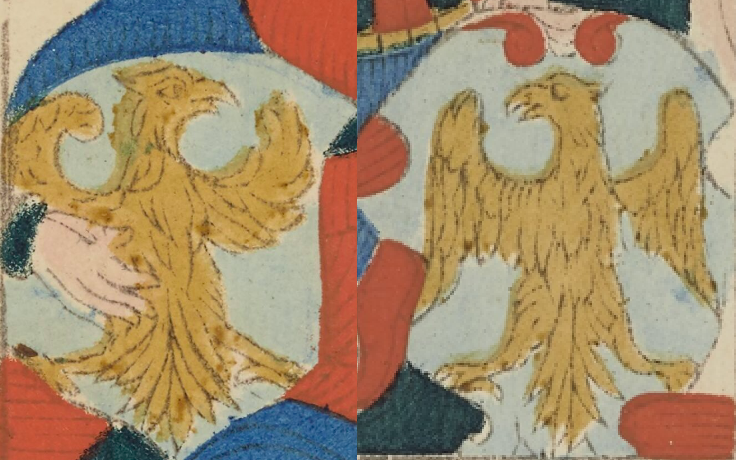
Comparison of Empress’ and Emperor’s shields.

The difference between Juggler and Empress is that 1 alone can’t yet do anything with all the separate, single parts, other than superficially (ie, practical magic), like performing tricks or perhaps trading with Jack for his cow.
The Empress and Emperor will complete each other (he too has orbed sceptre and eagle, and faces toward her), but they have not yet come together, they are still 3 and 4, neither added nor multiplied.

Conver Empress and World cards. Note the shield eagle’s amphibious wing.

In this older version (below), that she has attributes of the four ‘elemental beasts’ of the World card are more obvious; longer ‘horns’ (in crown and necklace), wings/human, eagle/phoenix and even a lion’s paw/mane.

Guilaume Dubesset-Claude Valentin, ca 1680

12
I’ve already written on some of the 3 place cards – the Hanged Man, the Hermit, the Devil and the Moon – so will just touch on the Hanged Man (12) here, as he’s part of this 3 x 3 sequence.
His flaming hair and his number might suggest solar connotations, although he’s still situated in-between the Sun and Moon ‘parents’. The Sun represents the gold, and thus the process of purifying the ‘inner’ (philosophical) gold is in progress. But it is not the literal Sun, physical fire or material gold. Rather, it is a different fire altogether.

Visconti Sforza 16th c, Jacques Vieville 17th c, Nicholas Conver TdM 18th c

In the middle example, the number is placed so that he is flipped, indicating that as his body descends, his spirit ascends (note the lunar and solar ‘mounds’ on each side of his head, the solar one containing all the heavenly spheres), with emphasis on the spiritual. Not an accident, but likely an Orphic reference. In the third card, the descent of the ‘Sun’ (his head) into matter is emphasized. High noon and midnight, apex and nadir, bipolar. It really is like the separation that goes on inside the alchemist’s glass egg. The main thing is that we can’t observe his inner process. Typically, the Hanged Man’s expression is placid, as if he’s either in acceptance or ‘somewhere else.’ His gibbet is like a (golden) doorway or threshold. All of this suggests he is experiencing what’s known in alchemy as the secret fire:

Search, therefore, this fire with all strength of your mind, and you shall reach the goal you have set yourself; for it is this that brings to completion all the stages of the Work, and is the key of all the Philosophers, which they have never revealed in their books. If you think well and deep upon this above-mentioned fire, you will know it. Not otherwise.
Potanus, The Secret Fire

To me, the Visconti-Sforza version looks very alchemical, its colours alluding strongly to the (philosophical) Green Lion devouring the Sun. I love how well the following description of the symbolism relates to the card, albeit it seems to be more from a Jungian perspective than traditional alchemy (and granted, the solar ‘ego’ looks anything but terrified):

The image corresponds to the releasing of primordial essence. That is why the lion is green, which is a primordial, unripe color. It also connotates fecundity. Eating the sun symbolizes the dominance of the Ego by instinctual forces. It is the beginning of a return to a more natural psychological state in which human beings flourish.
The ego perceives the encounter as terrifying because all transformational processes appear to be a kind of death to the ego. However, this process is the catalyst for an encounter with the Self. The instincts are amoral relative to human society and culture. Social conditioning aims to keep the instincts in check until the Higher Self is adequately present. Once present, our attitudes and feelings will be conditioned and directed by the Self. Otherwise, we experience a regression to the animalistic nature.
~ Tony Laguia, ‘The Green Lion Devouring the Sun‘ [Medium]

Visconti-Sforza hanged Man and Alchemical Green Lion devouring the Sun

21
The World (21) card, signifies the completion of the opus, the central figure representing ‘quintessence.’ Like an awakened eye, it is the revelation of that which embodies the essence of all past forms and potential for that shall be. In other words, what has been purified through many transformations becomes a catalyst for transformation; the Holy Grail or Philosopher’s Stone. Perhaps you’ve met someone who is a human tuning fork, or experienced a work of art, poetry, music, etc. that in its perfection had the effect of putting you ‘right side up’ again. Perhaps Tarot itself. ‘A light cannot help shedding its light. A flower cannot help giving off its fragrance.’ [Upanishads, ibid] When the young man in arcanum 6 was being initiated into the school of Venus/Eros, it was with the ultimate purpose of becoming just such a universal lover. ‘Everybody loves a lover.’

Ascend above any height, descend further than any depth; receive all sensory impressions of the created: water, fire, dryness and wetness. Think that you are present everywhere: in the sea, on earth and in heaven; think that you were never born and that you are still in the embryonic state: young and old, dead and in the hereafter. Understand everything at the same time: time, place, things: quality and quantity.
~ Corpus Hermeticum, 1460

The four creatures in the corners are assumed to be the four evangelists, the fixed signs of the zodiac, the seasons and/or the 4 elements. However…the bull is also lunar (2), the lion solar (1), and as we can see, they are now conjoined (3). The eagle previously represented the alchemical work, so then who might the winged human be when they’re at home? What of the Empress’ wings? Hmm.

Incidentally, Egyptian initiates were  called ‘scarabs’ because they ‘pushed along the egg of their regeneration’ – the container and the work?

Below, left, is the oldest of all known TdM type World cards (found in the Sforza castle cistern). Though it is badly damaged, some curious details remain. The androgyne or hermaphroditic Christ/Dionysus figure appears to have one breast only, on their right side, which is our left (mirroring). Their other, male side has the thicker leg. On their breasted/female side, the partially-obscured bull (or cow) has perfect, lunar crescent horns and on their male side, the lion has distinct, solar rays in its mane. Unique to this card, the angel in the top left (Aquarius/Matthew/air) has a ‘flame of inspiration’ in his forehead – ‘fire in the belly’ raised to crown level?

Oldest TdM ca mid-late 16th c (photo courtesy Ross Caldwell), Jacques Vieville ca 1650

The Vieville version, right, mixes things up a bit – bull and lion are switched around and have no wings. Since this card depicts a sexless figure facing straight forward, I ventured to see what one might look like as two. (Admittedly, it felt taboo, but…for science).
The male twin has a red cloak, denoting fire and his life force energy is directing upwards, expressed poignantly by what’s left of the sceptre. His body, arms open, creates an M for Mars. The female twin has a dark blue cloak, denoting water and her large V for Venus directs life force energy downward to her vulva, which she covers with her hands. Two opposite triangles, converging as one. Recall the Empress’ eagle shield. Also, that her eagle’s wings point upward, his downward, similar to the yin-yang idea of ‘opposite but interconnecting, mutually perpetuating forces.’ [wiki]

Vieville twins

In medieval alchemy, ‘philosophical Mercury’ is what remains when earth, air, fire and water are removed from a substance. It is associated with ‘prima materia’ (‘first matter’), from which all other matter is composed.

Philosophical Mercury, composed of sulphur and quicksilver (distinguished from their ordinary or ‘vulgar’ forms),  ca 1400

When you make the two one, and when you make the inside like the outside and the outside like the inside and the above like the below, and when you make the male and the female one and the same, so that the male not be male nor the female female, and when you fashion eyes in the place of an eye, and a hand in the place of a hand and a foot in the place of a foot, and a likeness in the place of a likeness: then will you enter [the kingdom].
~ From the Gospel of Didymos Judas Thomas (‘the Twin’), Nag Hammadi Library

ANAHATA the heart (fourth) chakra

Whatever wisdom path you choose to follow, the same patterns are found,  and this is because patterns are ultimately geometrical/mathematical. But wisdom is not just an intellectual exercise. It must be applied, to thrive.

In Sanskrit, ‘anahata’ means ‘unstruck.’ (Funny, considering arcanum 6). The anahata or heart chakra, illustrated by two, interlocking triangles, is associated with unconditional love, compassion, and joy. This rose window of our personal cathedral serves to balance the upper (spiritual) and lower (material) chakras, so that we may experience pure love for both self and others, without attachment and expectation.

On March 21 (3/3), Venus (Ptolemaic 3rd sphere) will conjunct Saturn in Pisces. Saturn is the cold karma lord and task master of our consciousness, who has a way of shackling the heart with guilt, pain and sorrow. In Pisces, Saturn can feel like the weight of the whole, wretched world (as we collectively witness the shadow expression of yet another ancient symbol). Venus, on the other hand, exalts in Pisces, bringing potential for a moment of healing, amnesty and grace to weary hearts. Like the Empress conducting Venus into her belly, if we channel the energy of this transit, perhaps whatever beauty we create from it will serve as a tuning fork for someone, somewhere, sometime down the road.  ~ rb

“I’ll be back…”

Thanks for reading!

All written content except quotations is copyright© Roxanna Bikadoroff and may not be reused or reprinted. Please share via LINK ONLY (accompanied by pull quote/paragraph with credit/link is fine).

Death and the Moon in Tarot de Marseille

Previously, we looked at the influence of hieroglyphica and emblemata in the Renaissance and its connection to Tarot de Marseille, how TdM’s ‘mytho-alchemical’ imagery is hieroglyphic in nature, playfully imbedded with visual hints of esoteric meaning hidden in plain sight. The cards relate to each other in a variety of ways, too, be it by numeric pattern or other similarities. (Perhaps why they naturally lend themselves to being ‘read’, a different narrative following every shuffle).
Do read my post on  Horapollo and the Hieroglyphic Mysteries of TdM , if you haven’t, as an introduction. And as always, click images for details.

Fool and Death (Camoin-Jodorowsky deck)

The Unnamed Card – Death

The Unnamed card (‘Death/La Mort’) is a prime example. Most Tarotists are aware of its relationship with The Fool/Le Mat, and how they strike the very same pose. By design alone, it is immediately apparent that the two figures are related or even one and the same; the first being unnumbered, the second, unnamed. Suddenly it all makes sense, right?

Original Tragicomedy act: the Greek Muses Melpomene (T) and Thalia (C)

Let’s take a closer look at the Unnamed card and its relationship to another major, The Moon, that we might find the visual clues needed for a better understanding of their mystery teachings.

The first consistent features we notice in the TdM skeleton, are its colour-emphasized spine and hip bones, and the skin pulled back around his skull, creating a crescent shape. Also, his spine appears to be made of grain. Typically, it matches the grain in the Emperor’s necklace (which his chicken-basilisk surely must covet!). The Emperor wears the golden seeds of his own, cyclic renewal. 1 + 3 = 4 and in number order, both cards are in the 1/4 place.

grain storage?
Skull face (featuring  pyramid and new Moon) and Moon face of TdM

It’s obvious, too, that the Reaper’s face is a mirror image of the Moon. Makes sense, the Solar year has 13 moons, the last one being the ‘killing Moon.’ [Clarification: although there are 13 moons within a solar year, there are not 13 full, synodic cycles of the moon in every solar year, but roughly every 2.5 solar years (when we get a ‘blue moon’). 2.5 solar years is one Saturn transit through a zodiac sign.] It’s ultimately why Sun worshippers suffer from triskaidekaphobia. Try as they might, the Greeks could not make 13 – or death – be rational and fit in. They felt the same way about 0, rejecting it outright (ie, no number?). The “inconstant Moon” has long been considered a kind of depository for souls coming and going between incarnations. It is not the light of wakefulness.

Of course Horapollo is talking about the djed bone of Osiris and we can see how the card must be a reference to the Osirian myth. While the djed bone has obvious phallic implications, it is actually symbolic of the grain god’s spine, by which his ‘kundalini energy’ or ‘life force’ climbs:

“The djed was an important part of the ceremony called “raising the djed“, which was a part of the celebrations of the Sed festival, the Egyptian jubilee celebration. The act of raising the djed has been explained as representing Osiris’s triumph over Seth. Ceremonies in Memphis are described where the pharaoh, with the help of the priests, raised a wooden djed column using ropes. The ceremony took place during the period when fields were sown and the year’s agricultural season would begin, corresponding to the month of Koiak, the fourth month of the Season of the Inundation. This ceremony was a part of one of the more popular holidays and celebrations of the time, a larger festival dedicated to Osiris conducted from the 13th to 30th day of the Koiak. Celebrated as it was at that time of the year when the soil and climate were most suitable for agriculture, the festival and its ceremonies can be seen as an appeal to Osiris, who was the God of vegetation, to favor the growth of the seeds sown, paralleling his own resurrection and renewal after his murder by Seth.” [wikipedia]

Seth and his hungry familiar, the Oxyrhynchus

As for his phallus, remember that when Isis collected her dismembered beloved’s pieces to put them back together, she could not find this last bit, which had been eaten by a fish, so the resourceful Goddess had to make a new one, using magic. Might we even see a fishbone shape in the reaper’s frame, its head being the hips and tail being the crescent? Peut-être.

Claude Burrell 1751 (Yves Renaud repro 2015) and a bass

Dismemberment is the  beginning of the transformation process. This card alludes to that which Osiris/Osiris-Dionysus presided over, the natural cycles of death and resurrection/rebirth. He was also called ‘god of the living’ and ‘lord of silence’ (ie, no name?). The black soil [of Kemet (‘kmt‘), the ‘black land’ from whence comes ‘alchemy’] pertains to fertility – new growth from rich putrefaction and loam. The Egyptians took their cues from nature, the great alchemist. 

“In some rare instances, Osiris was depicted wearing a crown that included a rendering of the moon. This has led some researchers to surmise he was associated with the moon or the night.” [Ancient Egypt Online

Thoth (Thoth-Hermes), Ibis-headed god of the Moon, who oversees the whole transmutation, might also be at hand…

Ibis beak and scythe

The Moon – Rebirth

Now that we’re experts on the Lunar associations in the Unnamed card…what about the Moon card’s association with Death?

That the crayfish may literally represent the astrological sign of Cancer in TdM is, as the detective novels say, a ‘red herring’. But the association reminds us that in ancient Egypt, Cancer was a scarab – symbol of birth, life, death, resurrection and immortality.

Osiris Canopus with ‘scrab’ (detail) Roman-Egyptian 100-200 AD

Crabs and other sea creatures (and worms) become active, lay eggs, spawn or hatch with lunar cycles/tides, just as we came into the world through our mother’s watery womb at the end of 9 (1+8) lunations. Cancer also rules the breasts and Momma’s milk. Interestingly, in Arab astronomy, the four stars of Cancer were seen as a crib or manger, while in Chinese, as ghosts or spirits of the deceased. [Tip: Stick with stars, planets and constellations, rather than ‘signs’ if/when applying to TdM.]

Cary and Dodal Moon cards – 200 year difference in crayfish design

The Great Mother’s milk is of course the Milky Way, by which the stalwart scarab navigates. Surely this did not escape the Egyptians, whose sky was the Goddess Nut, and readers familiar with Pythagorean and Orphic beliefs will see the significance. Note how the position of the crayfish mimics the upward facing scarab in Egyptian art. Scarab amulets carved with magical hieroglyphs were buried with the dead to protect the heart (seat of the mind) and ensure a safe transition. But the full Moon’s bright light can actually make the scarab’s journey longer and more difficult.

Nutrient-rich dung is my gold:  Winged scarab, Greek Period (304-330 BC)

It’s tempting to assume that TdM printers were unfamiliar with the number of legs on a crayfish. But might there be a better explanation for its having only 6?
Greco-Romans and Gnostics, incorporating Egyptian culture/religion also used amuletic, carved scarabs and gems – which, as mentioned previously, were collected and studied during the Italian Renaissance:

“The leading families of Renaissance Italy, the Visconti and the Sforza dukes in Milan, the Estes and Gonzagas in Ferrara and Mantua, or the Medicis in Florence, were certainly willing to pay huge sums of money for authenticated ancient gems: Piero de’ Medici is reported to have remarked that an engraved gemstone was ‘worth more than gold itself.’ They became treasured family heirlooms.” [John Mack, The Art of Small Things]

Like hieroglyphica and coinage, this art form influenced emblemata and likely Tarot as well.

[addendum: the crayfish was used on Greek coins as a symbol for ‘city.’ Marseilles, a port city,  was originally founded and colonized by the Greeks.]

Roman carved gems with triplicate Hekate and Moon card crayfish
Hekate with Anubis (gem and impression), 2nd century

The Moon card, being 18,  falls into the ‘3’ position and contains the three dominions of the Goddess Hekate; sky, earth and sea. Hekate (pronounced Hekaté) was portrayed in antiquity as three figures around a central column; forming the Lunar Goddess triad with Selene and Diana, or Underworld Goddess triad with Demeter and Persephone (mysteries). Goddess of crossroads, the saffron-robed, torch-bearing Hekate was invoked to guide souls in the afterlife (some sources say Hermes was her consort) – note the crayfish’s torch-like claws. 

Green Conver Moon card and Hecate lamp (Roman, 1st-4th c)
Selene with ‘claws’ and torch (Roman, 1st c)

But she had many other roles besides psychopomp, including Goddess of childbirth. Let’s not ignore the crayfish’s uterine shape, either.

The two fortresses in the distance are thought by some to be her temple towers, which is not unreasonable. As well, the Lunar Nodes – ecliptic points where paths of Sun and Moon cross (hence eclipses), connected to reincarnation – have an approximately 18.5 year cycle. Hmm. The visual clue, however, is that these structures are the only elements here, besides the Moon and ‘spirit-dew’, that are above the horizon (the dogs look as if sinking beneath it). There are few cards that make use of depth perspective, so this should alert our attention.

Addendum: Tarot expert Andrea Vitali points out something so hidden in plain sight, even I didn’t spot it (!), which is that the entire lunar cycle is depicted in the card; the two towers representing waxing and waning phases, the middle obviously being the full phase, and the water/crayfish being the dark Moon, when it is not visible. This adds to the idea of Hekate residing here, in the underworld/between world or unconscious realm, so to speak. As mentioned, the claws resemble the guiding torches she bears during this passage. 

Pompeii fresco (detail)

The horizon is where the stars rise and set, ie, are born and die. Circumpolar stars never sink beneath the horizon, thus represent the eternal. Two such stars were known to the Egyptians, therefor, as the Indestructibles; Kochab, in Ursa Minor and Mizar, in Ursa Major, which flanked the Pole Star (then Thuban, constellation of Draco). Pharaohs’ pyramids were built in exact alignment with these stars so they could be directly ‘beamed up, Scotty.’

For those without custom-built pyramids, the in-between state might be less streamlined and more perilous. The Moon here appears to occult the Northernmost star, just as she obscures the Milky Way for our scarab. A wandering soul without a visible sky map might find themselves reborn down here, rather than as a god in eternity. I say we invoke the crayfish.

And look, it’s those 4 stars! A bit of a stretch, perhaps…but how curious that the tip of the right dog’s tail in the Conver Moon card is clipped by the border. Accidental or intended clue?
The little croc-headed beastie pasted in the lower right is Ammit, the composite Goddess (I think also part leopard and hippo) who gobbles scale-tipping hearts. Actually, she is more like a composter of the heart-mind:

“Two ways are offered to our soul after death: either a final liberation or a return into incarnation in order to continue the experience of becoming conscious. Many are the texts alluding to reincarnation, either overtly or implicitly through such locutions as ‘renewal of life’ or ‘repetition of births’.
The Judgment of the Dead takes place in the ‘Hall of the Double Maât’. This judgment is made in the presence of the dead person’s consciousness, Maât, while the other Maât, cosmic consciousness, presides at the weighing of his heart. Placed on one of the pans of the scale, and weighed against the feather of Maât, the heart expresses the feelings and passions which, if too heavy, risk drawing the soul back again towards earth.”
[Lucie Lamie, Egyptian Mysteries New Light on Ancient Knowledge]

Thus we return to the first lesson, that of the Fool (Le Mat, as if that wasn’t obvious enough) and the Unnamed being as one. An important, first lesson to get us through life, death and all the in-betweens. ~rb

PART II explores a more likely reference for the two guardian beasties.


Who will reach the Moon first?

*Happy Sun and Pluto into Aquarius!*

All written content (except in blue quotations) is original, researched and composed by and copyright ©Roxanna Bikadoroff. It may not be reprinted anywhere without permission. Please share via LINK only (a short pull quote/paragraph is ok, with a link/credit). Thank you.


Horapollo and the Hieroglyphic Mysteries of Tarot de Marseille


It is a tradition in esoteric history that whenever a new culture is embryonic in the womb of an older one, or when an esoteric school recognizes that a culture has served it’s purposes and is coming to an end, then a major work of art is created in dedication, as an outer sign for future ages. The work of art may be a remarkable piece of music, a poem, a garden or a building — but whatever its external artistic form, it encapsulates, in entirely esoteric principals, a summary of what has gone before, and what is to come. All great esoteric artists from Dante to Shakespeare, from Milton to Blake, have recognized this primal function of their art. The interesting thing is that all too often it is the exoteric aspects of their products which attract attention of those who follow, and the esoteric contents remain hidden, save perhaps for the seeing few, who are themselves alive to the esoteric background to human history.

– Fred Gettings, The Secret Zodiac

Marcus Zuerius Boxhorn, Emblemata, 1635

At the height of Renaissance in the 15th century, a fresh, Humanistic view of the world was flourishing. Scholarly and creative minds, it seems, had been opened through a revised symbolic and syncretic way of thinking. Revised, because a pre-existing, Medieval tradition of visuals serving as a window to higher concepts was already well-established, as were heraldic devices and emblems, but a big part of the collective re-awakening came by way of a new, parabolic language in the arts, born or copied from an older one shrouded in mystery. Renaissance literally means rebirth. But who and what was being reborn? A civilization, perhaps, that had planned for just such an everlasting afterlife?

[please click images to enlarge and read]

In Italy, especially in Florence, there was great interest in learning from the distant past. Greco-Roman revivalism in poetry and philosophy, art and architecture thrived, as the nobles competed for legacy and church fathers, for a time, actively encouraged and commissioned works. Pagan gods and goddesses frequently appeared alongside Christian ones, albeit not as subjects of worship (except for Isis, under guise as the Virgin). Ex-pats had returned from exile with personal libraries including medical, alchemical and astronomical manuscripts from the Middle East. Arthurian legends of courtly love from England and France were extremely popular. The printing press now meant more people could have access to literature – although nobles considered printed works to be gauche and still preferred to commission hand-crafted books. Among these, of course,  was the first, Latin translation of The Corpus Hermeticum. The ‘alchemization’ of Europe had begun.


(More here. Pre-Conver Emperors do not show the Basilisk throne).

Egyptian artifacts, housed in Italy since Roman times, were a major part of this resurgence in all things ancient, esoteric and therefor exemplary. (To give you an idea, Pope Alexander VI aka Rodrigo Borgia even had his genealogy ‘traced’ back to Osiris thus establishing a link between the Egyptian gods and the church). Renaissance Humanists, fascinated by hieroglyphs, began a race to unlock them that would continue for the next 3 centuries. One main source of reference was a manuscript called ‘The Hieroglyphics of Horapollo Nilous.’ Horapollo (Horus Apollo) was a 5th century Egyptian scribe and one of the last remaining priests of Isis, who had also made a partially successful effort at decipherment (hieroglyphs were already thousands of years old, by his time). A translation of his work had turned up in Florence, in 1422 and was first printed in 1505. Another, slightly later reference source was the ‘Mensa Isiaca‘ or Table of Isis, which Athanasius Kircher in particular took as a model.

Egyptian winged Uraeus and Hieroglyphica by Valeriani, 1556

‘Hieroglyphica’, as it became known, inspired a tidal wave of emblematic art (‘emblemata’), as neo-Platonists and others sought to emulate these cryptic little pictures, resulting in an imaginative, western European hybrid. Hermetic and alchemical artists would employ this method of concealed meaning ‘for initiates only’ (namely, other hermeticists/alchemists).

This genre of the symbolic rereading of the hieroglyphs – “enigmatic hieroglyphs” as Rigoni and Zanco (1996) call them – was very popular in the late Hellenistic period. It should not surprise us, then, that so many Renaissance Humanists – for whom this was all quite familiar through Lucan, Apuleius, Plutarch, Clement of Alexandria and, especially, Ennead V by Plotinus – should see in the Hieroglyphica a genuine connection with the highest sphere of wisdom.

– Studiolum 

Other antiquities being scoured for emblematic images were things like Roman coins, medallions and gem charms, which the ruling class loved to collect. Roman carved gems in particular were highly sought after, and became family heirlooms, often set in jewelry [see ‘Death and the Moon’ post].

It was out of this tradition that Tarot de Marseille emerged, presumably in Italy, during the mid 16th century. [No known prior examples of the classic TdM format exist and the oldest known example of a triumph is a single, World card – the oldest complete decks known are 17th century.] Its images are not just allegorical, but ‘hieroglyphic’ in nature – though obviously not actual Egyptian hieroglyphs. The apparent (I would even say obvious) application of Horapollo’s descriptions alone leaves little doubt, though, that they were purposefully designed with visual clues that provided a context for imbedded messages. What that purpose was and why playing cards, we can’t know for certain, but as Counter-Reformation loomed on the horizon, maybe it was time to encapsulate esoteric principals for future ages?

I will dive more deeply into some of the ‘glyphs in the other cards (not included herein), in upcoming blogposts, but wanted to provide this overview, first.

Stay tuned! ~rb

Wee sphinx from Minchiate Tarot, 18th c

All written content herein except quotations is COPYRIGHT ©ROXANNA BIKADOROFF and may not be reused in full anywhere without permission. Please share via LINK only (with short, credited pull-quote, if needed).

QUOTATIONS:
~ Fred Gettings opener from ‘The Secret Zodiac – The Hidden Art in Mediaeval Astrology’ [Routeledge & Kegan Paul, 1987]
~ ‘Enigmatic hieroglyphics’ quote from studiolum.com
~ Horapollo text translations (Alexander T. Cory, 1840) from
sacred texts.com

REFS/OTHER LINKS:
~ The Egyptian Renaissance – The Afterlife of Ancient Egypt in Early Modern Italy, Brian Curran, Penn State University (pdf)
~ Hieroglyphs and Meaning, Lucia Morra, Carla Bazzanella (pdf)
~ Pinturicchio’s Frescoes in the Sala dei Santi in the Vatican Palace, Roger Gill, Birmingham City University (pdf)
~ The Art of Small Things by John Mack [Harvard University Press]
~ Horapollo Hieroglyphica via Jason Colavito
~ Giovanni Pierio VALERIANO BOLZANI Hieroglyphica, Google Books