Uranus enters Gemini tomorrow! This will be our prelude, until it stations retrograde Sept 6/25 – Feb 4/26, during which, it will re-enter Taurus. When an outer planet retrogrades back into a sign it is leaving, it’s a bit like a Janus-face review, since so much can happen over the period of years it takes to make a sign transit. In Uranus’ case, 7-8 years, which is significant. Ringed Uranus – as mentioned in the previous article, Uranus in Gemini – Trickster from another Dimension – rotates on its ‘side’ (from our perspective), like a wheel. In Tarot de Marseille the 21 triumphs (major arcana) are divided into 3 x 7 = 21. Or 7 x 3, which I like to think of as the waltz step of the heavenly Muses.
Franchises Gaffurius (friend of Leonardo), Practica Musicae frontspiece, 1496
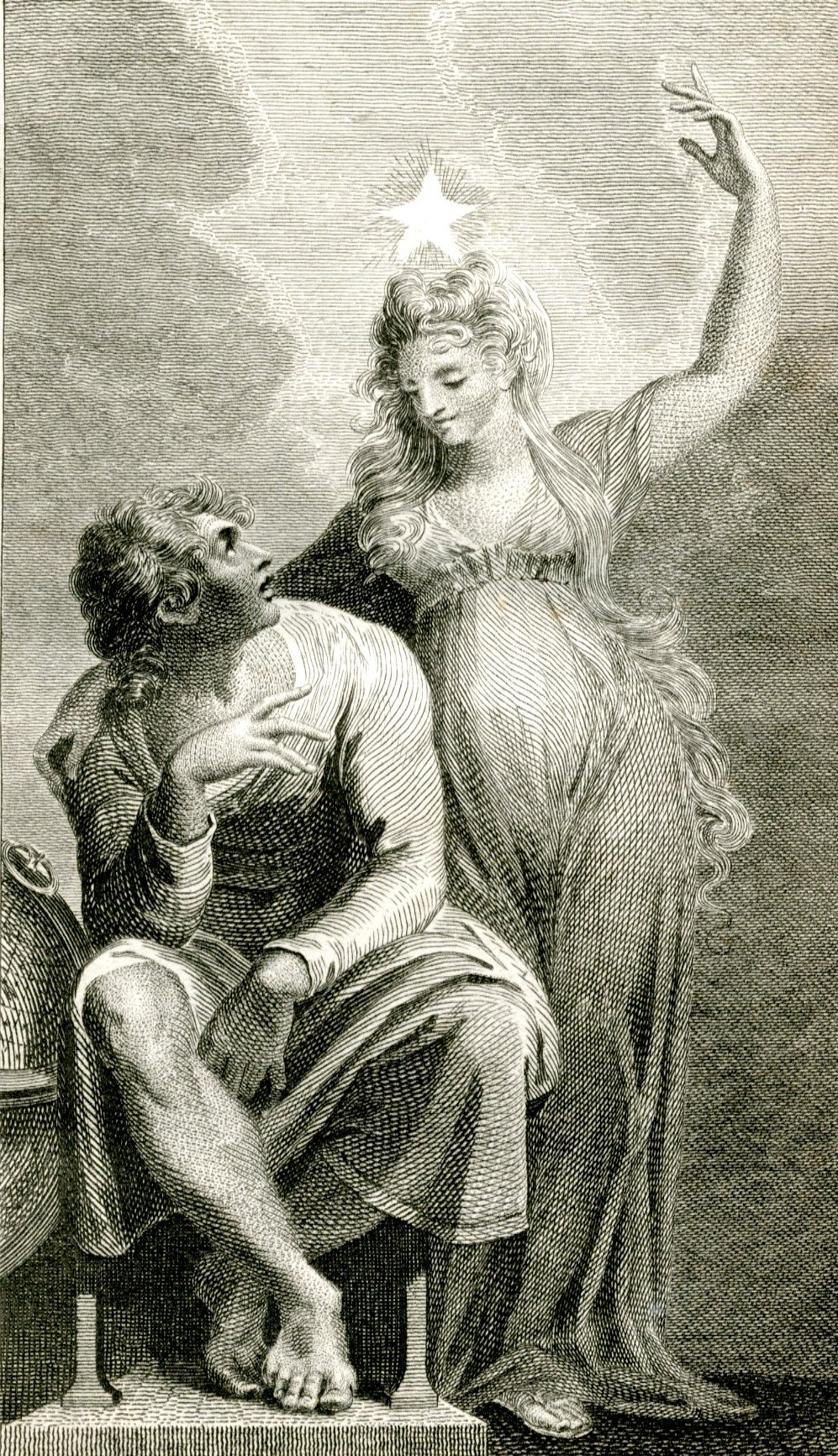
Speaking of Heavenly Muses…I would now like to introduce the good fairy of this transit, Urania, muse of Astronomy and Astrology. Venus is in Gemini right now (my own Venus sign) and is prodding me to write on something a little more inspirational for the occasion than bitcoin and freaks. I apologize if anyone was left uninspired previously. Hopefully this will make up for it.
In the woodcut above, created long before the discovery of Uranus, we see Apollo conducting the ‘music of the spheres’ (Pythagoras’ idea). At the bottom, Thalia, Muse of Comedy and Idyllic Poetry relates to Earth. Ha ha. At the top is Urania, relating to the starry realm. Astrologer Christopher Renstrom points out that while Jupiter was the sky god, it was more the day-to-day sky, not the starry night sky. Jupiter was a fertility god – he made rain and threw thunderbolts, affecting human life directly, thus myths of his decent to dabble in disguise with humans/human ladies abound. But Ouranos, the greater sky god and father of creation (Gaia/Earth being Mother), was not depicted in human form. Mostly we know him from the myth of his castration by titan son, Kronos-Saturn, whereby his testicles are thrown into the sea and Venus, in all her glory, is born out of the foam.
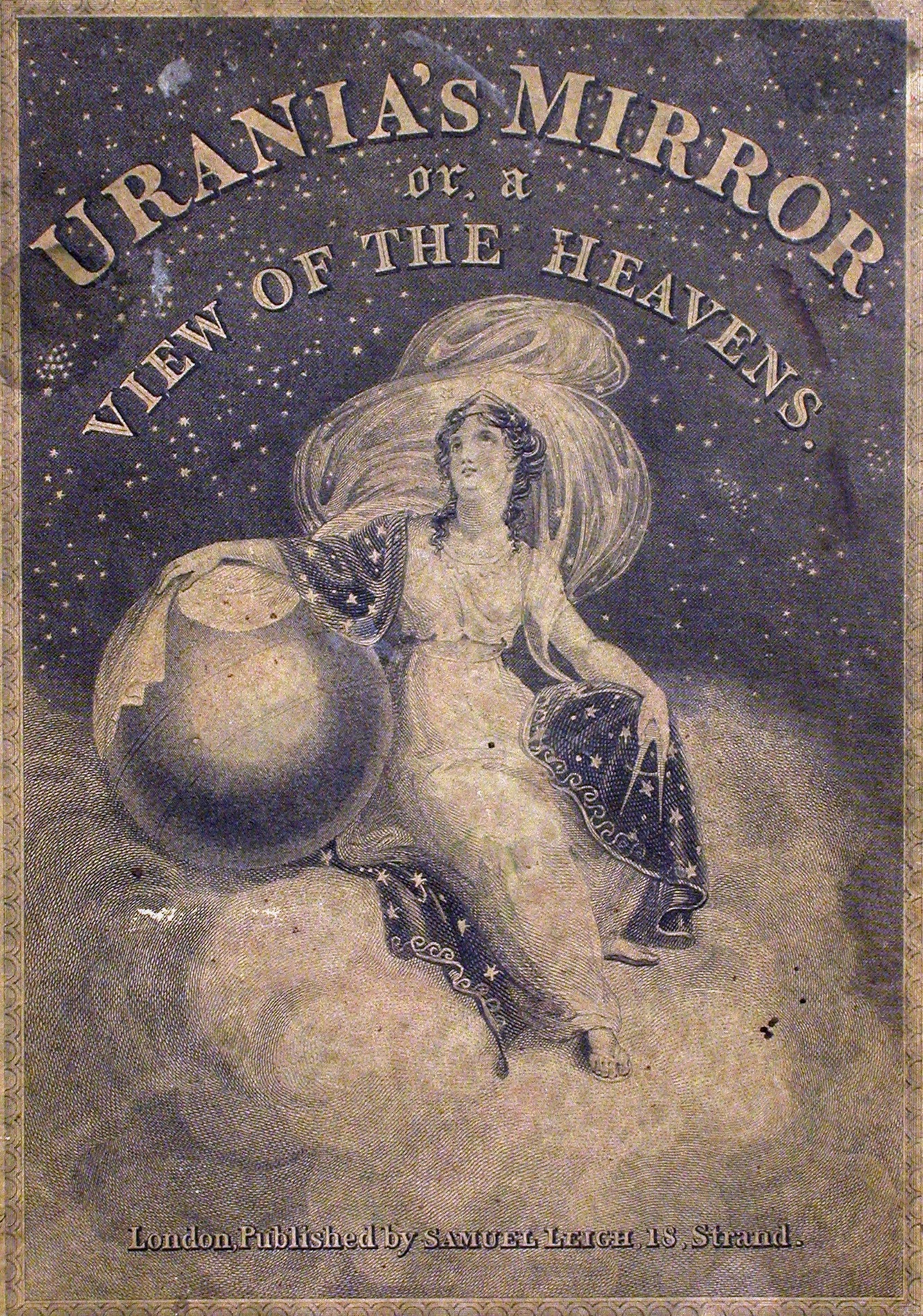
Urania’s Mirror, (London 1825), a boxed set of 32 cards [click image for more detail]So…Urania is the feminine aspect of Uranus; the suffix ‘us’ being masculine, ‘ia’ being feminine. The planet Uranus has come to represent ‘the heavenly realm of the stars’, but since Uranus will be entering the sign of the twins, while conjoined with Venus herself, perhaps we need to incorporate and equalize the genders for this planet. There has certainly in modern years been a marriage of inspiration (muse) and technology. We’ve wanted to understand the universe, travel beyond the Jupiterian sky and Saturnian limitations, and so we have continually re-invented the means to do so. Once upon a time, to be an astrologer, you would have had to be versed in astronomy, but now technology provides us with the calculations without ever having to look up. We need to look up, now. Waaaaay up. The muse of the starry heavens invites astrologers and others to look beyond the traditional planets. But not simply as an escape.
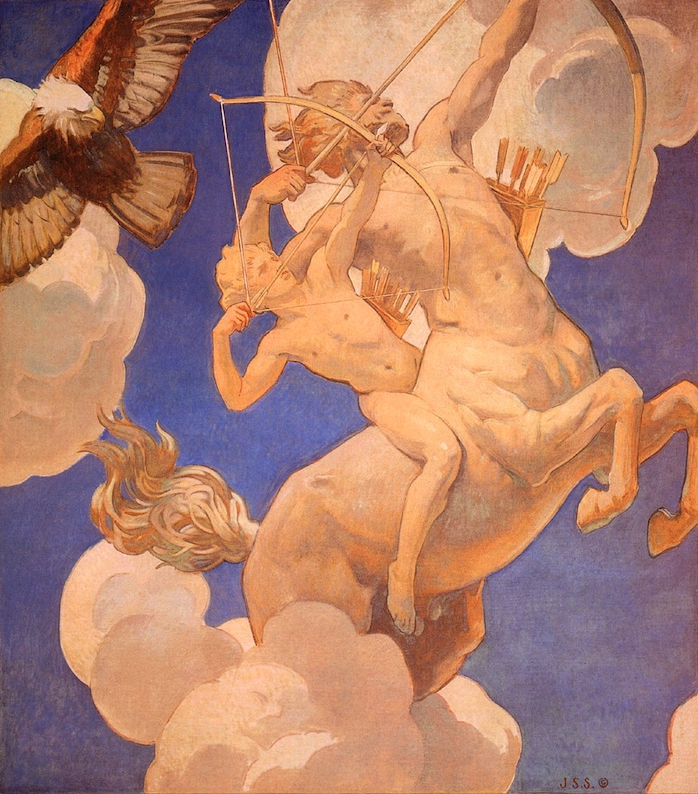
By-passing Jupiter’s eagle. John Singer Sargent, Chiron and Achilles, 1921
The opposite sign to Gemini is Sagittarius, ruled by Jupiter. The centaur was thought to represent Chiron, who is not a true centaur, but a ‘monster’ hybrid of horse and human parents (Saturn in the form of a horse raped his mother). Sagittarius, the eternal optimist, is ever aiming beyond that which binds us to the earth, and the heaviness of bodies controlled by unbridled passions and physical pain. I call it the ‘unbearable lightness of being Sagittarius.’ Uranus in Sagittarius’ polarity sign will encourage us to take it higher. With our faith in what is possible, may we evolve.
There is a currently a lot going on down here that makes it feel like we are devolving into bog creatures, or that we have entered the Hell realm. Indeed, as mentioned, some of the possible implications of Uranus in Gemini are frightening – technology running amok, US involved in a major war (its president a walking example of Uranus Gemini unhinged), bit coin hunger trashing the environment – BUT, these are fear and greed driven desires and precisely why we need to try harder than ever to envision a brighter future, even if that ultimately means becoming a real star some day (a privilege once reserved for pharaohs).
It’s worth noting that Uranus was also in Gemini during the height of the Renaissance. Arts and exploration flourished as skies and minds opened.
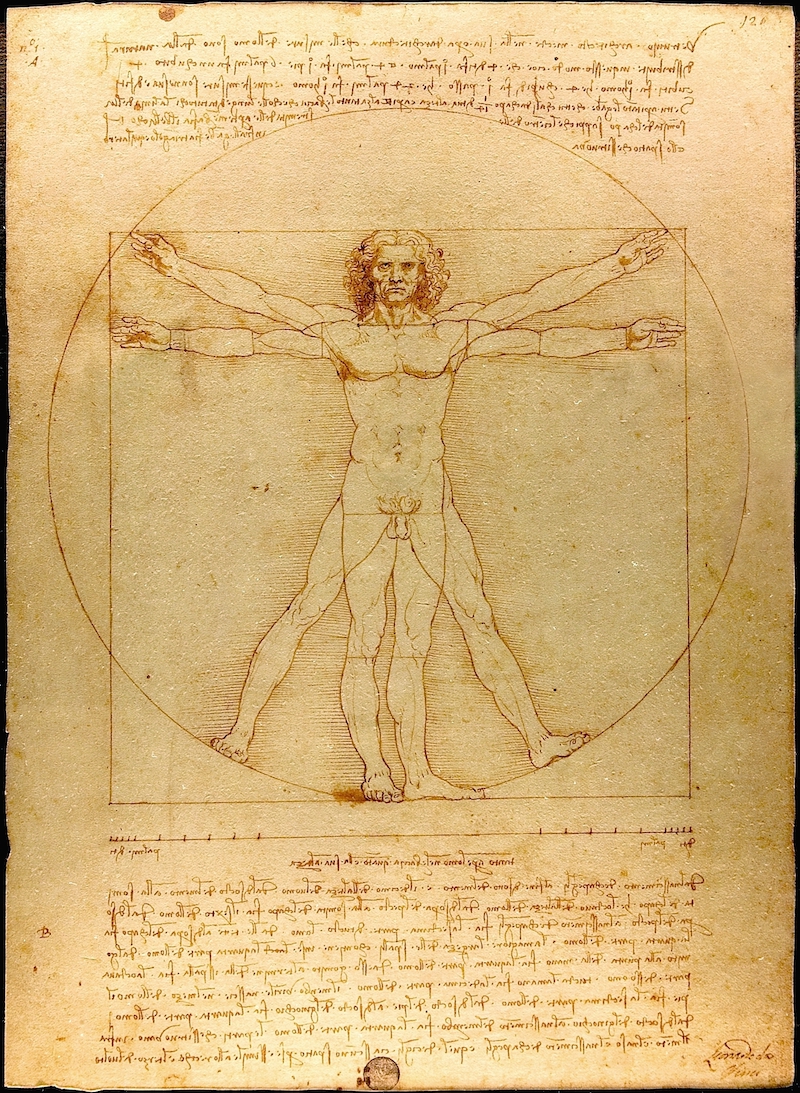
Da Vinci’s iconic Vitruvian Man, created in 1490, while Uranus in Gemini.
Uranus-Urania is not just about the sky ‘out there’ but the higher mind, that of the eternal spirit. There is always a period of darkness before the light. There is always a dark night of the soul (Pluto in Aquarius related), this is where inner light must gestate. The universe is a very dark place, but it is full of beaming stars, our distant ancestors. Listen to the music of the spheres! ~rb
In case you’ve been too preoccupied with the whiplashing American news…
Formidable seismic activity began occurring on Feb 5 in Greece’s most popular tourist destination, Thira (aka Santorini) and people are being evacuated from the heavenly island in droves. Some old timers are choosing to stay, being fatalistic…perhaps they will take care of the animals left behind. All those cats! Authorities are saying there is ‘no need to worry’ about volcano eruptions. Hmm….I wonder.
Of course, seismic activity in the Greek Islands and the surrounding seasis attributed to the Titan God, Typhon, who, after a long and bloody battle, Zeus managed to seal up under Mt. Etna, a still very active volcano on the east coast of Sicily (Prototype for St. Michael and Satan). Still rattling his chains and fuming, Typhon is responsible for typhoons, tsunamis, quakes, volcanos, plagues and other such disasters. But in the mytho-alchemical sense, Typhon is like Mercury on steroids, similar to Uranus being called the ‘higher octave’ of Mercury and having the effect of creating sea changes. For example, when the Greek gods fled Typhon into Egypt, where they donned animal heads/masks for disguise, the great Pan jumped into the sea, transforming via crisis into our Capricorn sea-goat. Part 3 of this post about the TdM Devil goes into this Typhon material.
Detail in map of the Underworld, showing Typhon under the volcano.
As it turns out, there is a trans-Neptunian object (TNO) named after him, as there is for everything – a binary system (it has a Moon) – currently at 28 Scorpio. Athanasius Kircher had once associated Typhon to this sign.At the moment of the first quake, TNO Typhon was/is opposing Uranus and Moon conjunct at 23 Taurus (earth).
I have long ‘intuited’ 23 as being Uranian in nature due to the discordant vibration of this prime number that reduces to 5. Today this is actually a commonly accepted idea. Lately, with Uranus having just stationed direct at 23 degrees of Taurus (typically a sign that thrives on harmony), you must admit, there has been quite a lot of discord! We can’t but acknowledge the POTUS’ wrecking ball nature, with his North Node closely flanked by Sun and Uranus – his most elevated planet – in Gemini. (Both Muck and his outspoken 4 yr old Mini-Me also have Sun-Uranus conjunctions). The number between 45 and 47 is 46, which, divided by 2 is…23.
Barry Blitt’s ‘Anything but That’ …at 23rd St??
This isn’t to say 23/Uranian discordant energy is necessarily always bad, but it is often shocking – you don’t see it coming – and has the effect of breaking up the harmonic order it refuses to fit into.
Returning to the main theme, Typhon, I also learned that astral Typhon was discoveredFeb 5, 2002 – exactly 23 years to the day of this earthquake! (Yes, tremors started earlier, but it’s not an official quake unless it registers 5. on the Richter scale). Very mysterious, especially with Typhon’s distinctly serpentine attributes and it being a lunar EARTH SNAKE year.
Stamp featuring Zeus and Typhon duking it out
But is there a deeper meaning to all this, not just some wow-conspiracy-theory-sounding-coincidence? We have to remember that the Underworld, to the Greeks, was not yet the Hell of Christianity, although it did have a section like this for bad people and monsters, called Tartarus. Rather, Hades was an inverted, somewhat depressing mirror version of the above world of the living. Pluto is simply dark Zeus (also Dionysus, but let’s keep it simple).
Uranus, named after the sky itself, gets and sends its energy from the beyond the Saturnian sphere, ‘out of the blue’, often taking the form of inspiration (Urania) or strokes of genius. It’s fiery/airy. If Uranus is the higher octave of Mercury, then its ‘messages’ are going to come faster and more intensely. Typhon, similarly, rears up from deep below, sending shocks in the form of earth or water events, rocking our physical foundations.
Giulio Bonasone (Italian 1531-76), Jupiter, Neptune and Pluto dividing the universe. MET
When Jupiter and his two ‘brothers’ (actually all aspects of the one triplicity) cast lots and divided the realms, Neptune didn’t just get the sea, but the whole ‘middle realm’ where the other two worlds meet. We currently have the North Node conjunct Neptune in Pisces, trine Typhon/Scorpio, sextile Uranus/Taurus. Meanwhile, Pluto, Lord of Hades is in Uranus’ fixed air sign of Aquarius. We look to global events for clues to how and where the planetary aspects are manifesting. Greece is where our western ‘civilization’ began, The surrounding seas and islands are literally the realm of the old gods. Seems to me that some very shape-shifting, powerful chthonic and cosmic forces are at work or perhaps even doing battle, their combined effect being felt acutely by us middle-realm dwellers. Perhaps the frequency of 23 provides a conduit. ~rb
In the next instalment I will further explore 23 and Uranus in the charts of various air disasters.
They are never final in the sense of a literal statement, which would fix the mind to a given point; nor are they final in the sense of the mystical Absolute in which all images would vanish. Rather they keep the mind in continued suspense by presenting the paradox of an ‘inherent transcendence’; they persistently hint at more than they say. It is a mistake, therefore, to overlook a certain ambiguity in the praise of hieroglyphs which Ficino, and after him Giordano Bruno, adopted from an incidental remark by Plotinus. In a famous passage of the fifth Ennead, Plotinus had suggested that Egyptian ciphers are more suitable for sacred script than alphabetic writing because they represent the diverse parts of a discourse as implicit, and thus concealed, in one single form. Since Pico ascribed the same virtue to the writing of Hebrew without vowels, it is legitimate to suspect that the Renaissance speculations on ‘implicit signs’ were not concerned with a positive theory of optical intuition, but with that far less attractive subject called steganography, the cryptic recording of sacred knowledge. Because God, in the opinion of Ficino, ‘has knowledge of things not by a multiplicity of thoughts about an object, but by a simple and firm grasp of its essence’, it seemed only right that the Egyptian priests had imitated the divine comprehension in their script, signifying ‘the divine mysteries not by the use of minutely written letters, but of whole figures of plants, trees, and beasts.’ But as Erasmus observed in the Adagia, the content of these figures was not meant to be open to direct inspection, or ‘accessible to anyone’s guess’; they presupposed in the reader a full acquaintance with the properties of each animal, plant, or thing represented… Thus, contrary to the divine intelligence which the reading of hieroglyphs is supposed to foreshadow, the intuitive grasp of them depends on discursive knowledge. Unless one knows what a hieroglyph means, one cannot see what it says. But once one has acquired the relevant knowledge, ‘unfolded’ by more or less exoteric instruction, one can take pleasure in finding it ‘infolded’ in an esoteric image or sign.
With this in mind, let us venture, armed with discursive information, to intuitively grasp the divine intelligence ‘infolded’ in this most hieroglyphic of TdM triumphs. [As always, click any images to enlarge and for more info.]
PART ONE
15th century ‘Fortitude’ cards: Visconti-Sforza, Cary-Yale, Charles VI
Earliest examples of the Fortitude card expressed the concept allegorically as physical strength/courage; Hercules or Samson beating up the lion or a formidable lady exerting control over it (taming animal instinct or temperament). Alternately, this formidable Virtue could be found grasping or busting up a pillar, as you do. Sadly, the dragon-extractor with an anvil on her head standing on a wine press didn’t get selected…guess Medieval fashions had become passé.
Engravings: Samson rendering the Lion late 15th c, Hans Ledenspelder ‘Forteza’ (after 15th c “Mantegna” prints) mid 16th c
La Force from a French Book of Hours, 1430-35 [Morgan Library]Numerous variations of a man or woman atop a lion also appear in Valeriano’s 1556 Hieroglyphica book. He and others were directly inspired by Horapollo Nilous, an Egyptian scribe and one of the last remaining priests of Isis, whose ‘translations’ of Egyptian hieroglyphs had been re-discovered in 1422 and put to print in 1505. Such as,‘To denote Strength, they portray the FOREPARTS OF A LION, because these are the most powerful members of his body.’ Read all about Horapollo’s Hieroglyphica and TdM here.
Lion tamers from Valeriano’s Hieroglyphica 1556
The word ‘force/forza’ comes from Latin ‘fortis’, meaning “strong, mighty; firm, steadfast; brave, bold.” It later came to include “courage, fortitude; violence, power, compulsion.” Being top of the food chain and having a solar mane (Leo), the noble lion is one of the oldest symbols of power and rule, including rule of law; it’s roar equated with the thundering word of God. Examples are exhaustive, going back to ancient times. But male deities could only hope to possess or overcome this indomitable force of nature, which ultimately belonged to the great Mother – giver, protectress and taker of life.
Lion Goddess Medley (click image for details)
Without diving too far into the whole lion-goddess topic, there are a couple that might be mythically relevant to us; Al-lāt and Medusa/the Gorgoneion/Athena. We’ll return to them, and to Hercules, in a circular fashion. But the use of a woman, rather than Hercules or Samson, in the TdM Strength card might be intended to illustrate a ‘princely virtue not confined of military strategy, a combination of force and prudence’ and the mitigating effect of Venus on Mars’ impulsive and destructive nature. She does not destroy it – nothing would ever perish without Mars, creating a different kind of imbalance – merely keeps it in check, Venus as lion-tamer.
Henri Cartier-Bresson, The House with the Caryatids, Athens, 1953
When we place all the numbered triumphs in a row, Strength/La Force is situated smack in the middle – a gateway or junction between earth and heaven, waking life and the intermediate state, or even just at midlife:
Midway upon the journey of our life I found myself within a forest dark, For the straightforward pathway had been lost.
Ah me! how hard a thing it is to say What was this forest savage, rough, and stern, Which in the very thought renews the fear.
So bitter is it, death is little more; But of the good to treat, which there I found, Speak will I of the other things I saw there.
That we can’t readily locate Prudence might indicate that Justice, Force and Temperance are more than just classical Virtues, if not the totality of them. Note how they all fall into the ‘2’ placement, according to the Pythagorean cosmology, ‘One becomes two, two becomes three, and out of the third comes the one as the fourth.’ Justice and Temperance flank Force on either side like two caryatids; one holding a sword and scales of dismemberment, the other, watery vessels of renewal. Seven cards (as with the 1s and 3s), three on either side of the central one.
Cards in the ‘2’ placement, Camoin-Jodorowsky deck, 1997
Ten, the divine number that forms the mystic tetractys – was also of great importance to Pythagoreans. Here is how the cards match up using their Roman numerals (this is not the numerology way of adding the digits together to reduce it to the ‘lower octave’, which can only be done with Arabic numerals):
Our chief concern here is that I (Le Bateleur), XI (La Force) and XXI (Le Monde) represent beginning, middle and end (and/or vice versa). In the beginning, as mentioned in this post about the Juggler/Bateleur, we see beneath his table a little, mandorla-shaped flame or golden barley grain (or cypress tree), in the distance. At the end, the complete being makes their appearance inside a similarly shaped wreath. And at the half-way mark, the lion’s maw extends directly from the yonic gates. Unique to TdM, this strongwoman doesn’t simply straddle the lion, it is part of her, just like Skylla’s hounds.
The ‘rule of three’: beginning, middle and end (Nicolas Conver TdM, ca 1760)
The pip cards are also numbered I to X, and the suit of swords bears a similar design to XXI. To Pythagoreans, the Vesica Piscis created by two, intersecting circles represented the intersection of heaven and earth – a place where dimensions merge into a lens or keyhole through which a more essential (or quintessential) reality might be glimpsed. Of course the church picked this concept up and ran with it.
Immaculate Conception, Taller del Pinturicchio, ca 1490
Notice how the TdM suit continually ‘blinks’ from sword (masc/odd) to flower (fem/even), until a blending of both (active red becomes passive blue, one sword becomes two) in the last card. The design is thought to be based on playing cards that originated during the Mamluk sultanate in Egypt, which ended in the early 16th century.
Conver TdM Sword pips
Now for a slight detour…
For over a thousand years prior to Islam, Northern Arabia and well beyond had been the domain of Al-lāt, central figure of a lunar triad known as ‘Manat’. The Black Stone in the Kabaa at Mecca (thought to be a meteor) was once part of Al-lāt’s cult and, as such, is not mentioned in the Quran. ‘The Kaaba marked the location where the sacred world intersected with the profane, and the embedded Black Stone was a further symbol of this; an object as a link between heaven and earth.’ [Wikipedia] There were in fact two more stones (the other two goddess of the lunar triad?), a red one associated with the deity of the South Arabian city of Ghaiman and a white one in the Kabaa of Al-Abalat, near the city of Tabala, south of Mecca. (Note the relation to the three primary colours of alchemy).
Manat triad with Al-lāt in the style of Athena and Lion of Al-lāt from her temple (destroyed by ISIL).
One of the hidden secrets of the medieval bardic romance is the Arabian origin of the Waste Land motif, most prominent in the Holy Grail cycle of tales. Despite monkish efforts to convert it into a Christian chalice, the Grail was generally recognized as a female symbol, whose loss implied fear for the fertility of the earth. Crusaders had seen for themselves the desolation of Arabia Deserta, one of the most lifeless regions on earth. They heard the Shi’ite heretics’ explanation for it: Islam had offended the Great Goddess, and she had cursed the land and departed. Now nothing would grow there. [Barbara G. Walker, The Women’s Encyclopedia of Myths and Secrets]
Preserving the source: Rochais 18th c, Visconti-Sforza 15th c, Al Leone 17th c
In the three Aces of Cups, above, the lunar triad and feminine symbolism is obvious, as is a hint of Islamic influence. In the two, printed cards, it almost looks as if her ‘house’ has been up and transplanted (from the Holy Land?).
The Lyford House being transplanted by barge, 1957
In Christianity, the triple Moon Goddess became the ‘three Marys,’ the central or all-in-one figure being the ‘Mother of God.’ There were variations on the triad, depending on the context. She could also be expressed as the three virgins – Mother Mary with St. Catherine and St. Barbara.
In TdM tradition, the cup’s tripartite, central, steeple (flanked by three ‘minarets’ on each side = seven) evokes the robed Madonna – or at least something veiled and sacred with three conjoined circles at the top. All the great cathedrals of Europe were built and named for ‘Our Lady.’ Somewhat surprisingly, Mary is revered in Islam as the greatest and purest woman that ever lived, and is the only woman mentioned in the Quran.
Mary ‘Our Lady Of Willesden’ pilgrim’s badge, early 16th c
The Visconti-Sforza card depicts a beautiful fountain with water flowing from the ‘waxing’ and ‘waning’ flowers. Its central flower is aligned with the vessel-shaped vessel-shaped eagle at the top [note connection with TdM Empress]. Under the Visconti, 14th-early 15th century Milan was a centre of Marian veneration out of which, despite macho, power politics, much wealth, beauty, art and culture was generated (or re-generated), including the hand-painted Tarot cards that bear their name.
Madonna and child flanked by lions, from a 15th c Parisian Book of Hours
END OF PART ONE
. . . . . . . . . . . . . . .
. . . . . . . . . . . . . . . .
PART TWO
Welcome back. Now let’s return to the card in question and examine some details of our TdM mistress, beginning with her infamous hat. Many have noted its ‘lemniscate’ shape, but otherwise it’s a conundrum. Examples of Renaissance era straw hats, hair nets (most likely) and headgear are continually compared, as if to suggest there is no other reason for its weird shape except that’s just (kind of like) what people wore. Well, alright, but why did the artist choose this particular shape of hat, for this particular card? Consistent in Tarot de Marseille, which takes cues from Renaissance art, is that the image components must serve more than one, visual function and must therefore remain vague enough to evoke or suggest, but never give the whole game away. It’s a puzzle we are invited to figure out.
Dodal (type 1) and Conver (type 2) hats
In both type 1 and 2 versions, only one side of the brim has a leafy/scaled pattern. We’ve established that XI is midway between I and XXI, and that what begins as a single ‘grain’ shape in the first card will become a whole wreath in the end. Might it not stand to reason, then, that only one side of her hat has been ‘filled’ thus far?
The scaly side in type 1 also strangely resembles a (bearded) serpent head, like that of the Egypto-Greco-Roman Agathos Daimon or ‘good spirit’ guarding the mysteries in the catacombs, below (and in opener image). The four, petal-like shapes in the gorgoneion (Medusa mask) above it are also a close fit.
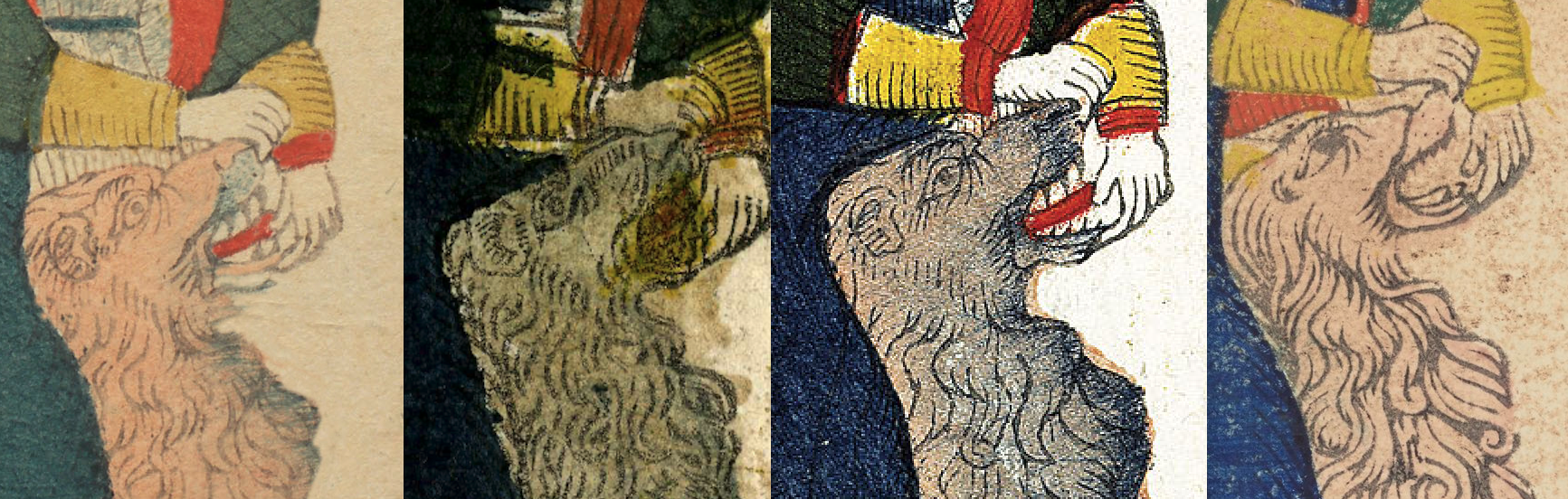
Kom el Shoqafa Egypto-Greco-Roman catacombs, Alexandria [photo: Justina Atlasito]In the Conver card, we immediately notice a few irksome details about this so-called ‘lion.’ It looks like something canine – or perhaps a bear – wearing a lion’s skin (and evoking the serpent?). Also, the top of the woman’s hat seems to replicate the beast’s lower mandible. In some versions, the lion has no lower teeth, as if they have migrated to her hat (below, right), but in others (the close up, below), it still has a few. Comparing with earlier versions, it does appear to be a printing mistake – or, was the image altered intentionally? Sometimes accidents can add another dimension.
L to R: Chosson 1672, Dubesset-Valentin 1680c, Pierre Madenié, Conver 1760.
Addendum:Didier Dufond, who is the expert on Bacchic-Orphic symbolism in TdM recently pointed out (in a comment on the Fool post, which is perhaps more relevant within the context of this post):
..I add that this liturgical sequence was unknown to scholars at the time of the Renaissance, which suggests a direct transmission, far from the elites of that time. Same concealment technique with the strange hat of Force, with the pine cone of the thyrsus decorated with a knot, plus undoubtedly a snake and a crown of ivy, all attributes of the bacchantes. And a bacchante thinking of tearing off the head of a lion with her hands is known in Euripides’ tragedy The Bacchae, when it was about her own son, Pentheus.
So, in this case, the serpentine ‘petals’ of the gorgoneion in the tomb are pinecones just like in the thyrsus the Agathos Daimon below holds. Can’t believe I didn’t catch that!!
What he is referring to is a scene in said Greek tragedy where Pentheus, King of Thebes, having imprisoned and insulted Dionysus, ends up having his head torn off by his own mother, Agave, who thinks he is a lion. So much for the ‘princely virtue not confined of military strategy, a combination of force and prudence’ and the mitigating effect of Venus on Mars’ impulsive and destructive nature! Agave is clearly a force of nature. I need to study this play.
It has also been suggested that the beast resembles the ‘Tarasque‘, an ancient, lion-headed, dragon-like creature from French/Gaulish mythology that was ‘tamed’ by St. Martha. This does not change the esoteric meaning at all, but rather adds to it, since Martha was one of the ‘3 Marys’ and appears in connection with her brother Lazarus being raised from the dead.
Valentin & Dubesset c 1680 (previously dated earlier) and Conver ca 1760Nicolas Conver (British Museum card) ca 1760
2 placement cards always depict some kind of vessel(s), here represented by her two, mismatched, gold vambraces. In Conver versions, each is divided by eight lines into nine sections (excluding the full bands on the ends). This might not be accidental, as we shall see.
It’s also odd that the artist, after having taken such great care with the animal’s detail right down to the teeth, would have neglect to fix the lady’s goitre – another detail unique to Conver (supposed to be her hair). Now it looks as though her head has been, idk, severed? Hmm, what mythical being had a severed head with serpent scales…oh right.
“Visita Interiora Terrae Rectificando Invenies Occultum Lapidem Veram Medicinam” [Visit the interior of the earth, and by rectifying you will find the hidden stone which is the true medicine].
‘Golgoi Sarcophagus’, 475-450 BC. Discovered by tomb robbers in 1873 [MET]The Popess held open to us the book of lesser mysteries. Now it seems we’ve arrived at the gates of the greater mysteries, judging by the guardians:
At first in motion set those beauteous things; So were to me occasion of good hope, The variegated skin of that wild beast,
The hour of time, and the delicious season; But not so much, that did not give me fear A lion’s aspect which appeared to me.
He seemed as if against me he were coming With head uplifted, and with ravenous hunger, So that it seemed the air was afraid of him;
And a she-wolf, that with all hungerings Seemed to be laden in her meagreness, And many folk has caused to live forlorn!
~ Dante [ibid]
Dante running from the three Beasts, William Blake 1824-27
Throughout history, initiations have been performed in caves, or underground, in the belly of the Great Mother. We know that mystery initiates confronted the darker aspects of themselves during the simulated death experience that is essentially descent into the ‘unconscious’. Dante, who bridged classical/Pagan and Christian theologies, would have been no stranger to this idea. The three scary beasts he meets in the dark wood – a leopard-like creature, a lion and a she-wolf – are usually understood as fraud, violence and greed/incontinence, i.e., the very shadows of our three Virtues, whether personal or collective (the she-wolf, which frightened him most, is also thought to symbolize Rome).
The famed, Capitoline She-Wolf nursing Romulus and Remus, 5th c BC
What’s fascinating is how the TdM artist has merged the three, Dantean bardo-monsters into one creature. Wearing of a flayed skin easily subs for ‘fraud’ and Dante specifically refers to this creature by its ‘variegated skin.’ (Perhaps this mystery animal is otherwise occupied flaying Le Mat).
A fool may deceive by his dress and appearance, but his words will soon show what he really is.~ Aesop
As mentioned, both the Gorgoneion and Agathos Daimon (serpent/good spirit) had a powerful apotropaic function. Snakes were not considered evil by any means, they were the children of Mother Earth and protected her sacred places.
Shrine fresco showing offerings being made to the ‘good spirit.’ Pompeii, 1st c AD
Kom El Shoqafa, like other catacombs in Alexandria around this time, featured both Egyptian and Greco-Roman gods and rituals. When it came to the final journey, initiates agreed no ancestral Gods should be left out, regardless of anyone’s recent conversion. In a similar vein, travellers usually respected and made offerings to local gods – especially Hermes, in the form of a herm (where he gets his name) – for protection in foreign turf.
Whether or not the TdM artist(s) knew of such ancient catacombs where Egyptian, Greco-Roman and Christian religious imagery co-habitated peacefully, who knows (Kom El Shoqafa itself was only discovered in 1900), but they were certainly aware of the syncretization of the gods and had some grasp on how hieroglyphic imagery worked (on multi-levels), if not on the actual meanings of real hieroglyphs. And they surely would have been familiar with the likes of Leonardo da Vinci, a master at using a single, timeless image to tell more than one narrative, while leaving room for ambiguity.
‘An endeavour to concentrate in a single subject those various powers, which, rising from different points, naturally move in different directions’, was regarded by Sir Joshua Reynolds as unprofessional by a painter. ‘Art has its boundaries, though imagination has none.’ The expression of a ‘mixed passion’ was ‘not to be attempted’. But Renaissance artists rarely feared to attempt what the 18th century pronounced impossible. [Edgar Wind, ibid]
Hercules and the Hydra, 4th c, Catacomb of Via Latina, Rome
In the Christian Catacombs of Via Latina, we find this fabulous fresco of Hercules fighting a Medusa-esque Hydra, his second labour. Both figures are red, emphasizing the Martian life-blood-force, or force of nature, presumably being transferred to him from the monster. Fading into the background is the Nemean lion’s flayed skin (again resembling a bear), fruit of his first labour:
Because its golden fur was impervious to attack, it could not be killed with mortals’ weapons. Its claws were sharper than mortals’ swords and could cut through any strong armour. According to Apollodorus, he was the offspring of Typhon. In another tradition, told by Aelian (citing Epimenides) and Hyginus, the lion was “sprung from” the moon-goddess Selene, who threw him from the Moon at Hera’s request. [Wikipedia]
Hercules finally corners the lion in its own, dark cave, clubs it senseless, then strangles it with his bare hands. But after trying unsuccessfully to flay it with knife and stone, Athena finally has to intervene and tell him to use one of the lion’s own claws (those razor-like spikes in La Force’s hat?).
Aesop’s Ass in Lion’s Skin by Victor Wilbour, 1916 [Smithsonian]Athena will help him out again in his final labour, as will Hermes the psychopomp, for it involves making the ultra-perilous trip to Hades, to kidnap Cerberus the three-headed Hell-hound. For this, Hercules must first be initiated into the Eleusinian Mysteries and purified. He will essentially enter the intermediate state, traverse the realm of death and re-emerge again.
That the fresco depicts Hercules naked and full of regenerative, serpent fire suggests his protective function in the afterlife, as well as perhaps a belief in re-emergence (be it on earth or in heaven). In the myth, the hero only achieves god status at the end of his trials when, in mortal pain from a nasty balm (made from the poison side of Medusa’s bloodstream), he finally throws himself on a funeral pyre, ie., the transforming fire. At this point, Hera and Zeus both decide he’s had enough and place him up in the heavens. [This old post goes into it in more detail.] Thus, Herc had his own cult back in the day, worshipped as a divine protector of mankind.
Franchises Gafurius, Practica Musicae frontspiece, 1496
11 has also been called the ‘mute’ number (perhaps because it is ‘neuter’; odd but reduces to even). In the woodcut above, Apollo’s serpent, fitted with the ‘special Cerberus of Serapis’ head (lion flanked by dog and wolf, which was also a hieroglyphic allegory of Prudence) descends the spheres from heavenly Apollo to the silent, chthonic realm of Thalia, equated with the musical pause. One can’t help drawing a parallel to La Force, with her looped, serpentine hat above, bare foot firmly planted on the Earth, and, in the Conver card, the 9 sections in her cuffs. Also to Dante’s three beasts.
Gafurius, a good friend of Leonardo, owned a copy of Ficino’s translation of Plato’s works. Edgar Wind again:
Gafurius’s serpent is distinguished by a particularly engaging trait. While plunging head-downward into the universe, it curls the end of its tail into a loop on which Apollo ceremoniously sets his feet. A serpent’s tail turning back on itself is an image of eternity or perfection (commonly illustrated by a serpent biting its own tail, but known also in the form of a circular loop on the serpent’s back…). Gafurius thus makes it diagrammatically clear that Time issues from Eternity, that the linear progression of the serpent depends on its attachment to the topmost sphere where its tail coils into a circle. That the ‘descent’ of a spiritual force is compatible with its continuous presence in the ‘supercelestial heaven’ was a basic tenet of Neoplatonism. Plotinus illustrated this difficult doctrine, which was essential to his concept of emanation, by the descent of Hercules into Hades. Homer, he said, had admitted ‘that the image of Hercules appeared in Hades while the hero was really with the gods, so that the poet affirms this double proposition: that Hercules is with the gods while he is in Hades.’ Pico della Mirandola extended the argument to Christ’s descent into Limbo, in the most startling of his Conclusiones in theologia, no. 8, which it is not surprising to find among the articles that were condemned…
Interesting, then, that the very next card, #12 Le Pendu/The Hanged Man depicts exactly such a figure; a man with golden locks who appears to be hanging head down, in limbo and, when flipped, dancing with his head in the heavens. No wonder his face expresses not agony but ‘mind in continued suspense by presenting the paradox of an ‘inherent transcendence’.
Jacques Vieville 17th c, Nicolas Conver TdM 18th c
The theme of the older cards has evolved from an allegorical but obvious representation of Hercules in his first labour as lion-basher to a more cryptic one eluding to his final labour, initiation and transition. At this ‘still point’ in the game, TdM’s enigmatic strongwoman of the threshold demands that we leave – or sacrifice – our own singular preconceptions (and egos) at the gates and submit to a higher/deeper understanding, if we wish to follow suit. ~rb
Back in 1994, when I made decent money as an editorial illustrator and had extra for personal projects and crazy promotional material…in the days before digital files, websites and steampunk, I created this little ‘deck’ of illustrated Fortune Cookie cards. It was indeed meant to evoke Victorian Orientalism, but was also inspired by Max Ernst collages and Edward Gorey, mixed with my own, somewhat goth-infused sensibility, for which I was then recognized.
I had at my disposal only J. G. Heck’s ‘Complete Encyclopedia of Illustration’, some 1960s Letraset stock imagery, a Xerox machine, scissors and a Rotring Rapidograph. Oh yes, and a bag of fortune cookies. It was actually one of my Aries Mum’s whim suggestions pulled out of her magic hat, and I thought it sounded like a hoot.
Perhaps it was an early prototype of sorts for the Tarot deck I would begin work on 4 years later, which also uses mixed media, old art, scissors, paint instead of ink and has turned into a Magnum Opus. But the two have little else in common. (I had also completed a deck of illustrated cards (non-Tarot) in 1988, which I may get around to posting at some point).
Maybe in the future (had better see what the crystal ball says), I will do a real deck of ‘fortune telling’ cards, it seems to be a popular thing and might be fun.
One thing at a time. ~rb
Prudence/Wisdom, 17th c needlework book cover, British (Met Museum, NY)
Theory has it that the 4th Cardinal Virtue, Prudence, is ‘missing’ from Tarot de Marseille. Many have tried to figure out which, if any, of the other trumps could possibly be her (Star, Popess, Hanged Man, Hermit and World have been proposed). My own speculation is that, if she is indeed present and hiding, a conglomerate of Popess and Pope could share the role of Prudence, on account of the Janus face, as well as making sense numerically – each Virtue falls into the ‘2’ placement, as do the Pope and Popess. Prudence was said to be the ‘mother of all Virtues’, without which one could not master the others. However, the World card does suggest wisdom attained (the Stone), as opposed to wisdom being received or sought.
Janus-faced Prudence with serpent and book, ca 1480-1520
In a previous article, ‘Disrobing the Papal Couple – Tarot de Marseille’s Pope and Popess,‘ I used an image (sculpture) of a Janus-faced Prudence as the opener. But because I’m more attracted to exploring the cryptic, esoteric principals at work in TdM, and the Cardinal Virtue identities of Justice, Strength and Temperance are exoteric, I didn’t venture down that road. There’s enough existing literature on this. Instead, I explored the Popess as an initiator, oracle and portal to the mysteries, noting that her book was wide open because her ‘greater’ mystery was hidden inside. Also that the strap going across her chest went from the book’s spine to her heart, suggesting a pathway of ascent.
BUT there was one thing I had neglected to notice, another piece of the puzzle. It just amazes me how Tarot de Marseille keeps offering up new bits n pieces, like treasures washing up on the beach. Maybe I’m late to the game, but I’ve never encountered mention of it anywhere, so, for what it’s worth…
Philosophia aka ‘Allegory of Alchemy’, Notre Dame Cathedral (central portal) Paris
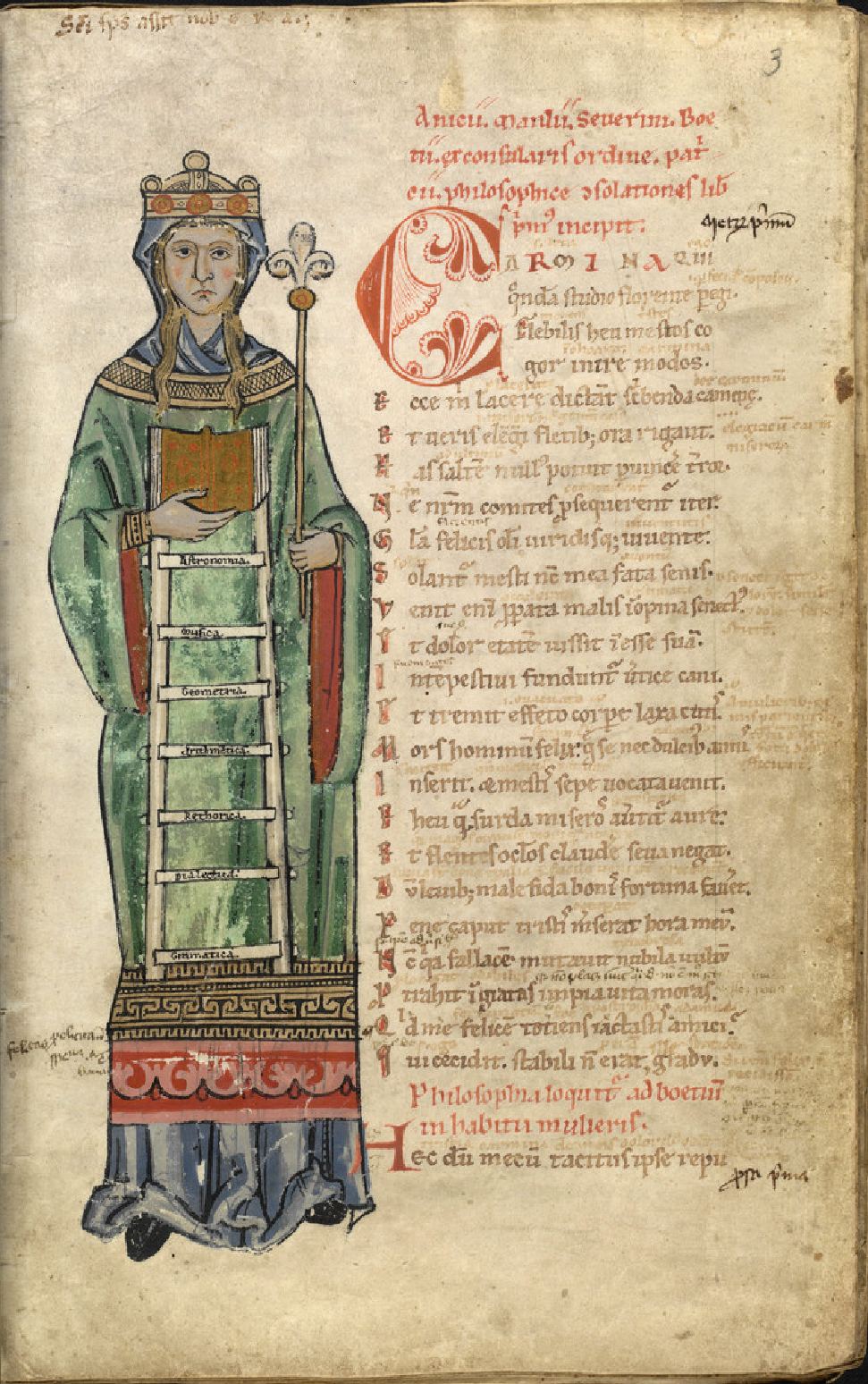
Above is a relief from the gothic Cathedral of Notre Dame in Paris. It’ is a figure of Philosophia, a 19th century restoration by Eugène Viollet-de-Luc, honouring the medieval sciences. Believed to be based on Boethius‘ vision of Philosophia with the ladder of Liberal Arts (see below), it has nevertheless come to be widely known by its esoteric name, Allegory of Alchemy, as deduced by the mysterious 20th century alchemist Fulcanelli in his Le Mystère des Cathédrales. The two aren’t mutually exclusive, to alchemists, since alchemy is ‘natural philosophy’ and at one time they did refer to themselves as philosophers (hence the ‘philosopher’s stone’, not the ‘alchemist’s stone’). The important detail for us is that the figure is holding two books; one is held open, symbolizing the exoteric or lesser mysteries, the other is hidden behind, closed, symbolizing the esoteric or greater mysteries (which is not universal in depictions of Philosophia).
Philosophia and the Ladder of Liberal Arts, ca 1230, Universitats Bibliothek Leipzig.
The 9-runged ladder – the scala philosophorum or scale of the wise – is an emblem of the mystical ascension “that raises man through the transformation towards the Divine and the understanding of art.” [Melinda Miceli, ‘Isis in Paris‘] In his definitive book, Fulcanelli describes it as “glyph of the patience the faithful must possess in the course of the nine successive operations of the hermetic labour.” [Wikipedia]
Besides Boethius and alchemy, this mystical, hierarchical set of steps to spiritualization has other symbolic variations, including Plato’s Ladder of Love, which ascends from erotic, physical love to appreciating beauty in the soul: ‘This hierarchy is conventionally referred to as Plato’s scala amoris or ‘ladder of love’, for the reason that the uppermost form of love cannot be reached without having initially stepped on the first rung of the ladder, which is the physical attraction to a beautiful body or individual.’ Philosophia means ‘lover of wisdom’.
However one wishes to interpret the scala philosophorum, the hidden book’s content is revealed only by way of its ascension. Wisdom is unfolded to us in a timely process, there’s no skipping steps to the second book.
Now, please look tres carefully at these ‘type 2’ versions of the TdM Popess, below. Do you see it?
Three Conver versions, ca 1760
…How about in these ones?
Burdell 1751, Madenié 1709, Héri 1718.
That’s right…TWO BOOKS. One open on top, the other closed, hidden behind/under it.
The serpent held by Prudence is said to represent Wisdom (‘be ye wise as serpents’), but when she also holds a book, the serpent might represent esoteric wisdom in particular, ie, mysteries. “Look like th’ innocent flower but be the serpent under’t” ? The Popess, by nature of her number is the first expression of duality. Thus, she is the gateway to and source of two wisdom paths; outer and inner, solar and lunar. On one level, she represents the orthodox or dogmatic teachings of the faith (church) and/or (if you like) the Cardinal Virtue Prudence, aka classical Wisdom. Simultaneously, on another level, Gnostic Wisdom and/or secret spiritual self-knowledge, aka ‘for initiates’.
The Juggler laid out the tools and the Popess provides the instruction manuals, two ways of understanding the Tarot de Marseille. But maybe it’s first necessary to start with the book that is (somewhat suggestively) held wide open, before following the strap from its spine, toward the greater mysteries of her heart. ~rb
Care to support my work? Donations are always welcome!
– Full text of Fulcanelli’s Mystery of the Cathedrals ( English translation).
– Audio of same, for those who like to be read to.
– Great image of the alchemical ladder in this scholarly paper on alchemy in Shakespeare’s Julius Caesar’.
– Another site detailing the alchemical symbolism at Notre Dame.
Here’s another example from Notre Dame, which, according to Fulcanelli, represent the different stages of the work.
Lately I’ve been digging through my old art, trying sort out what’s sellable, what’s garbage and what’s just fun to share. This is of the latter category.
A looong, long time ago, I’d endeavoured to rewrite Struwwelpeter (a childhood favourite) for a modern audience. Things to be avoided on pain of terrible consequence would include all forms of disobeying convention, such as doing drugs, self-pleasuring and feminism. Shock-headed Peter himself was a rastaman with an enormous mane of dreads.
Here’s my favourite piece, The Dreadful Passion of Harriet, based on The Dreadful Story of Harriet and the Matches. Enjoy!
[Please click on images to enlarge and hit ‘pause’ to stop the slide show.]
This iconic image was created for The Progressive Magazine’s calendar in 1992 (beautifully designed each year by Patrick JB Flynn). It illustrated this quote by Marge Piercy:
I will choose what enters me, what becomes flesh of my flesh. Without choice, no politics, no ethics lives. I am not your cornfield, not your uranium mine, not your calf for fattening, not your cow for milking. You may not use me as your factory. Priests and legislators do not hold shares in my womb or my mind. This is my body. If I give it to you I want it back. My life is a non-negotiable demand.
Original t-shirts for The Progressive, 1990s
I’m now making this image FREE to use for non-profit, pro-choice organizations to fundraise for supporting women being denied their basic, human rights. Personal use is also fine. Adding/tweaking colour is fine.
The opening image is a high res (300 dpi) jpg. Click on it, pause the slide show, and lift the image onto your desktop.
The image may not be used freely for personal or corporate profit, advertising, or other commercial exploits.
Examples of permissible use (copyright free) :
– pro-choice t-shirts, prints, posters, stickers, etc to fundraise – public mural – tattoo – small run of T-shirts/product for you and your friends – a nice print for yourself or a gift – signs for pro-choice rallies
Any for-profit, commercial use that does not donate the profits to such organizations will still require my permission and a negotiated contract/usage fee, as is usual for re-use of my work – i.e. if you want to use it on an album or book cover and keep the coinage, please contact me to discuss terms.
*Note that the original quote is not included, so please clear with Marge Piercy and/or her publisher for any use other than personal. (Alternatively, one could just put something simple like CHOICE or I WILL CHOOSE, or go wordless).*
In writing the previous post about the Tarot de Marseille Devil, I’d become interested in Typhon as a mytho-alchemical archetype. The deep-delve into research and ‘essay’ writing had also provided a needed Sherlock distraction from still-too-recent bereavement. You’d think grief might fuel some kind of creative expression for an artist, but often it is just too dense a material to work with. Sometimes all one can do is be in the blackness.
Classic Typhon
Down here, at the bottom of the bog-womb, far away from rational thought, gelatinous, amphibious beings are secretly spawning the makings of renewal. That is their sole business. At the deepest, pitch-black ocean levels, creatures deemed monstrous by ‘above’ standards float embryonically in conditions that would kill us, creating their own phosphorescence and exerting as little energy as possible. This is no longer the realm of Neptune and his entourage of Nereids, but of Typhon and his posse of Gorgons.
Amphibious Typhon
Having no luck with my more sophisticated art attempts, I decided to just linger here and sketch the monster. As children, isn’t that one of the first things we draw? Because these embodiments of our young emotions and fears also serve as guardians of our budding imagination and creative process. Who would dare question them on why they have 7 heads or spit poison barf? And in the psychology of myth and fairy tale, the only hero who will ultimately be able to overcome the monster is the one who created it.
Demonic-Draconic Typhon
As it happened, in doing these initial studies, the juices of inspiration began to flow again. Researching and writing about Typhon in relation to the TdM Devil was enlightening, I came to understand the archetype as a primal, hermaphroditic, self-reproducing creative force, as well as the alembic itself. But intellectual understanding is not enough, one has to experience the process. And the heck, drawing monsters is fun. ~rb
Last year I was contacted by Aaron Louis, New York recording artist and head of audiovisual at the MoMA, to see if I’d be interested in illustrating the cover for his upcoming album. Aaron had first seen my work via the Flannery O’Connor book cover series, after Everything That Rises Must Converge was featured on the TV series LOST, and we’d become Facebook friends.
Flannery O’Connor book in ‘Lost’
I’ve retired from commercial illustration, but since Aaron was a fan of Flann and has plenty of artistic ‘street cred’ himself, I had a good feeling about it and agreed to have a listen. Immediately, both the first and second songs had me bopping out of my chair. Aaron not only has an ear for all kinds of musical genres (though he says his base is punk rock) but is a talented lyric poet as well. His songs are original, tight and fresh. I was excited for him and agreed to take on this gig, an honour.
As this was my first album cover (better late than never!), I came up with about 10 initial ideas. A video of an owl flying around with a stick horse had appeared on my news feed, which I took as a sign we’d be going with the stick horse idea, but he chose a different one to take to final. It wasn’t quite right, though, and in the end, augury proved correct. This time, I preserved the initial sketch, developing it more, rather than risk loosing the spontaneity by doing the whole thing over as a final. Piama Habibullah, the designer then tweaked the colour to make it more neon, for a vintage 1970s punk/new wave look.
The Clamor LP package (photo courtesy Aaron Louis/The Clamor)
The inspiration for the piece comes from an illustrated poetic manuscript from the beginning of the 14th century, would you believe. I do a lot of image researching for my Tarot studies, and had discovered this book by Francesco da Barberino called ‘I Documenti d’Amore’ in the Vatican digital hoards.
You’ve probably heard of the ‘big three’ – Danté, Petrarch and Boccaccio – but da Barberino for some reason didn’t achieve the same level of fame. (Probably because he didn’t seek it). But his highly original ‘personifications’ certainly influenced the work of his contemporaries. Perhaps his ideas were just too wacky. This claw-footed ‘Amor’ (note the word is in ‘Clamor’) spearing and collecting trophy hearts is a bit more ‘punk rock’ than the typical cupid.
Personification of ‘Amor’, from Francesco da Barberino, early 14th c (artist unknown)Amor (detail)
A lot of The Clamor’s songs are relationship-inspired. It’s said that all songs fall under two themes; love and war – sometimes both – and indeed, da Barberino’s ‘Amor’ almost seems to be a conglomerate. Another of my ideas was this simple image of an angel and demon as heart and spade, which ended up being used for singles and the center sticker on the LP. It has more that simple, symbolic Flannery O’Connor cover look Aaron initially liked. (The black background version more so).
The Clamor Heart and Spade logo
I also drew bunch of little, ink line pieces for the inner sleeve, to go with the printed lyrics. It’s an homage to bands/albums of our youth, such as The Ramones or The Clash – notice Piama even made the words diagonal, reminiscent of ‘London Calling’.
You can hear some of the singles on The Clamor band’s official website, find out where to stream, plus buy the album and some cool, RB tees!
Once upon a time, now long forgotten, that first human pondered their hand. How is it that I can imagine something, and my hand knows how to make it? How is it there are this many fingers? What can it mean? Hands must be magical. Talk to the Hand.
“Put your hand in mine, we will travel to another time…” ~Lucious Jackson,Gypsy
Khamsa necklace of silver, horn, coral, late 20th c, Morocco
The Hamsa/Khamsa or hand of Fatima, like the Nazar (‘evil eye’) is a common and ancient protective amulet throughout the Mediterranean and Middle East.
Who was Fatima? She seems to have many incarnations…in Islam, she’s the daughter of the prophet Muhammad, five years old when her father began receiving revelations. In Catholicism she’s a Marian apparition, reported in Portugal by three shepherd children. In legend, she is sometimes a great warrior princess, other times, as in ‘Fatima the Spinner and the Tent‘, an artisan who’s accumulated crafting skills and ingenuity save her from one calamitous situation after another. This Sufi retelling of Greek folklore describes Fatima in her role as creatrix and teacher, of which the female hand symbol is perhaps most indicative. Lucky? Yes, because I learned how to make things and can show you how.
“A man who works with his hands is a laborer; a man who works with his hands and his brain is a craftsman; but a man who works with his hands and his brain and his heart is an artist.”~ Louis Nizer
Thus we have the combined energies of crafty magician, Hermes-Mercury and beauty-loving Aphrodite-Venus, whose sacred number is five (symbol is the pentagram) and who is married to Vulcan, the craftsman who forges exquisite, metal creations. We conjure ideas with our imagination, but we manifest them with our hands, though perhaps less and less, these days, which is why, apparently we are getting dumber! Talk to the Hamsa!