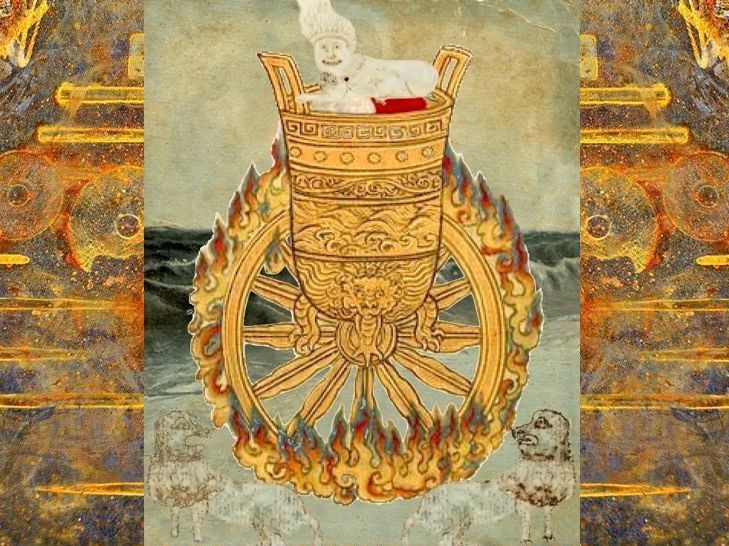
“Bless us, divine number, thou who generated gods and men! O holy, holy Tetractys, thou that containest the root and source of the eternally flowing creation! For the divine number begins with the profound, pure unity until it comes to the holy four; then it begets the mother of all, the all-comprising, all-bounding, the first-born, the never-swerving, the never-tiring holy ten, the keyholder of all.”
~ prayer of the Pythagoreans to the ‘Mystic Tetrad’ [Wikipedia]
First, we do the math…
Though it may appear comical, the importance of the triumph in tenth position is underlined by the reverence Pythagoreans paid to its number. To get a better grip on the Wheel of Fortune, it’s essential to understand it’s placement in the TdM numerical cycle, as it relates to the cosmogony of Pythagoras, famed philosopher-polymathematician (ca 570-495 BCE). The same cosmogony was also the axiom of Maria the Jewess/Prophetess, famed alchemist-sage and inventor of the Bain-Marie and other alembics (ca 1st-3rd CE):
“One becomes Two, Two becomes Three,
and out of the Third comes the One as the Fourth.”
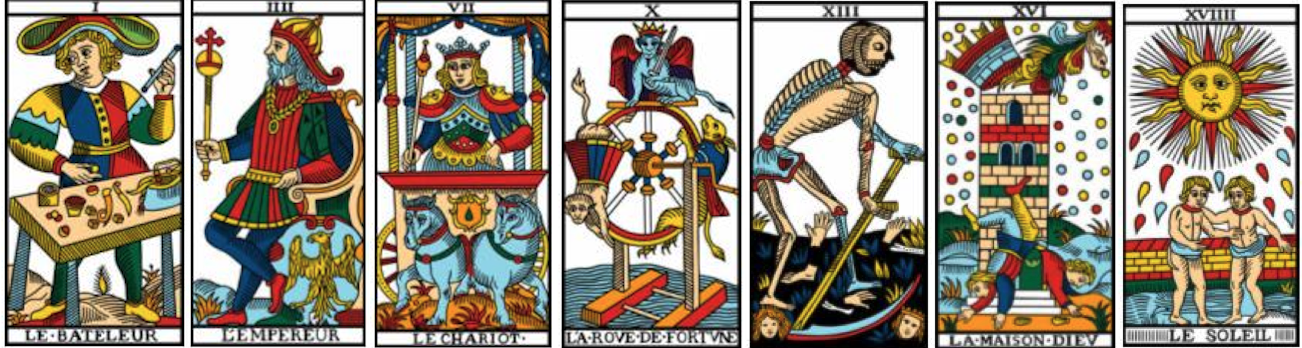
This simple formula, hidden in plain sight in triumph I, provides the foundational structure on which to then load our various interpretations; The Wheel of Fortune is both the first card of a three part cycle (10, 11, 12) as well as being the fourth card (the death) of the previous cycle (7, 8, 9). All the 1/4 cards indicate both initiation and completion – ie, change. They are always masc/solar (see below). Wheels are typically a solar symbol, and besides including the Sun itself, the 1/4 series contains the two triumph cards with wheels (7 and 10). Notice all the cards between 1 and 19 have crowns in them – another solar symbol – and that the the Wheel is central.
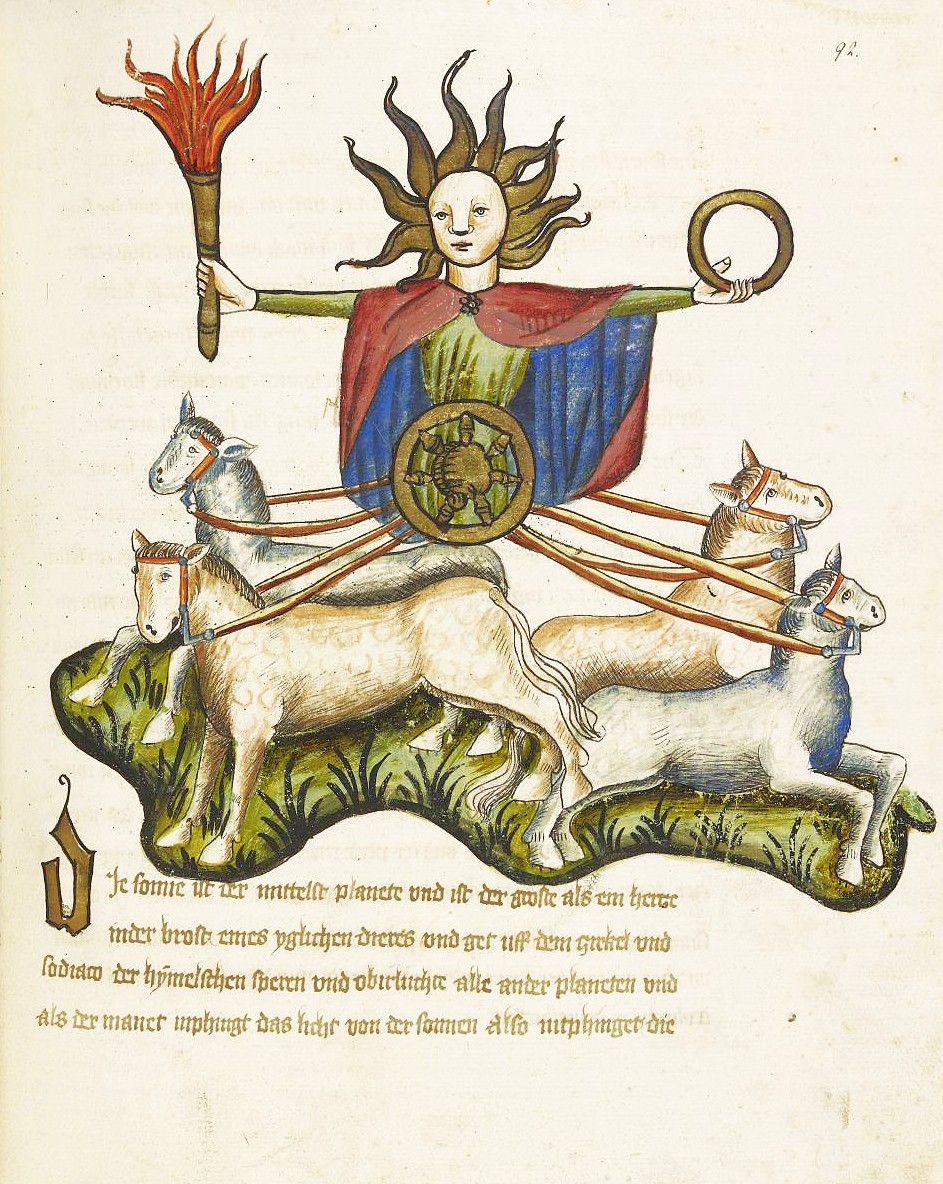
“The decad is potentially generated by even and odd: for 10 is five times two. It is the perimeter and limit of all number: for they run their course by wheeling and turning around it as if it were a turning-point in a race. Moreover, it is the limit of the infinitude of numbers.”
~ from Anatolius, The Theology of Arithmetic, translated by Robin Waterfield
With 10, the perfect, complete number, ‘the great work’ (ie, the soul’s work) may now commence. 9 was the number of endings and of memory (Mnemosyne), of reflected, inner light. Similar to the Emperor, the old Hermit turns toward the past, drawing the numerological cycle to a close. We might imagine a shadow puppet play of life highlights projected onto the inside of his curtain-like cloak.
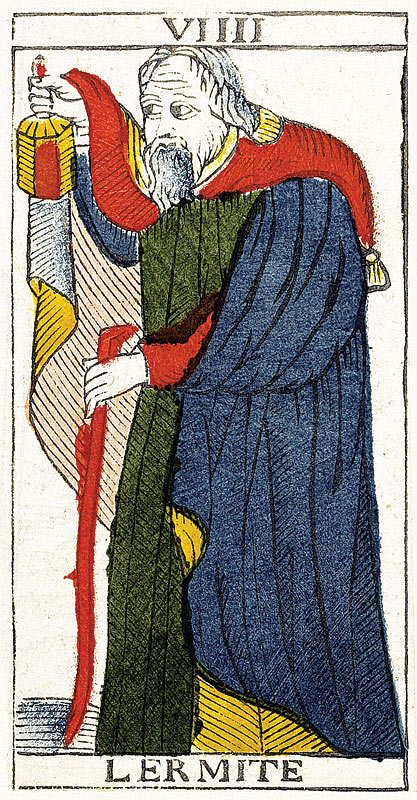
Mathematically, 9 always returns to itself. The Pythagoreans were not enamoured with 9, but understood its importance as the first square (3×3) and for its role in human gestation, relating to the 9 spheres a soul transited before rebirth. More about the Hermit and his lamp here.
Pythagoras himself had been initiated into the Orphic Mysteries, among others, ’tis said. He believed in and taught metempsychosis (reincarnation), and that mathematical principals – numbers – are universal, guiding principals.
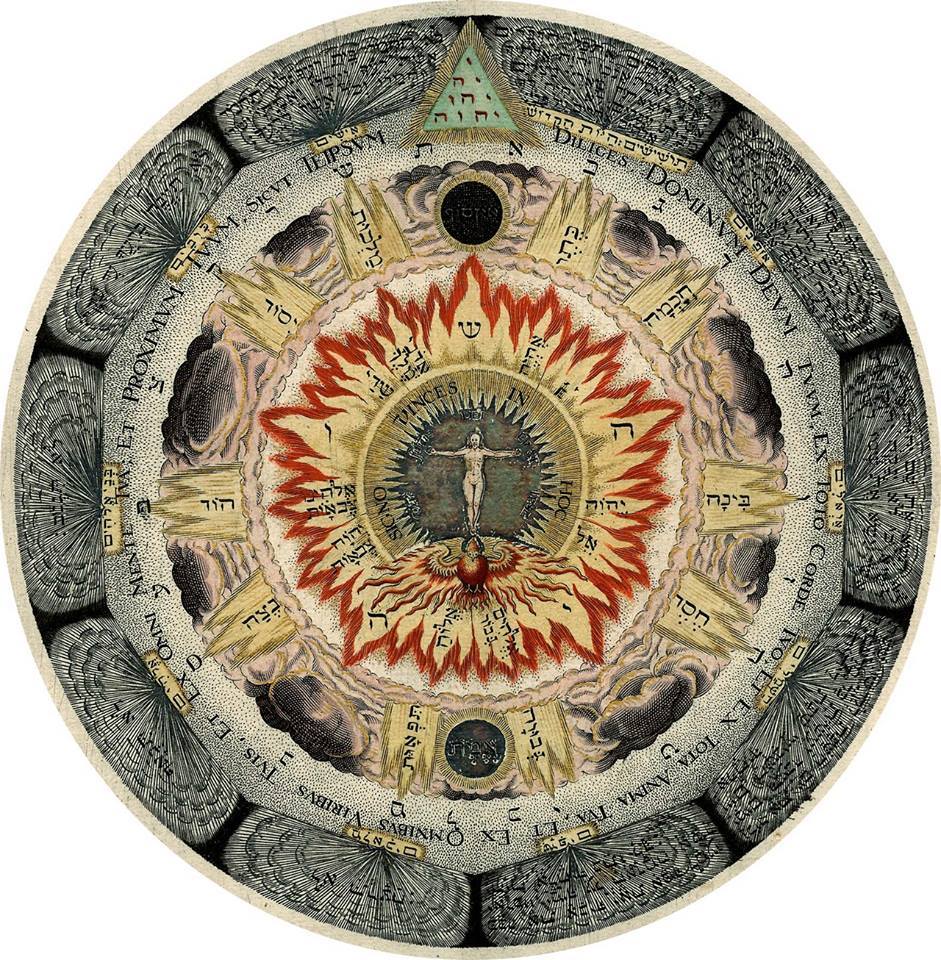
10 is the ‘higher octave’ of 1. To Pythagoreans and alchemists alike, 1 was not actually a number (it could not be ‘numbered’ and anything multiplied or divided by 1 was still the same), but represented the Monad (God, origin, unity), symbolized by a circle with a central dot or eye. This is still the symbol for both the Sun and gold. Wheels are essentially monad shaped. [Note: They did not use or accept 0 as a number.].
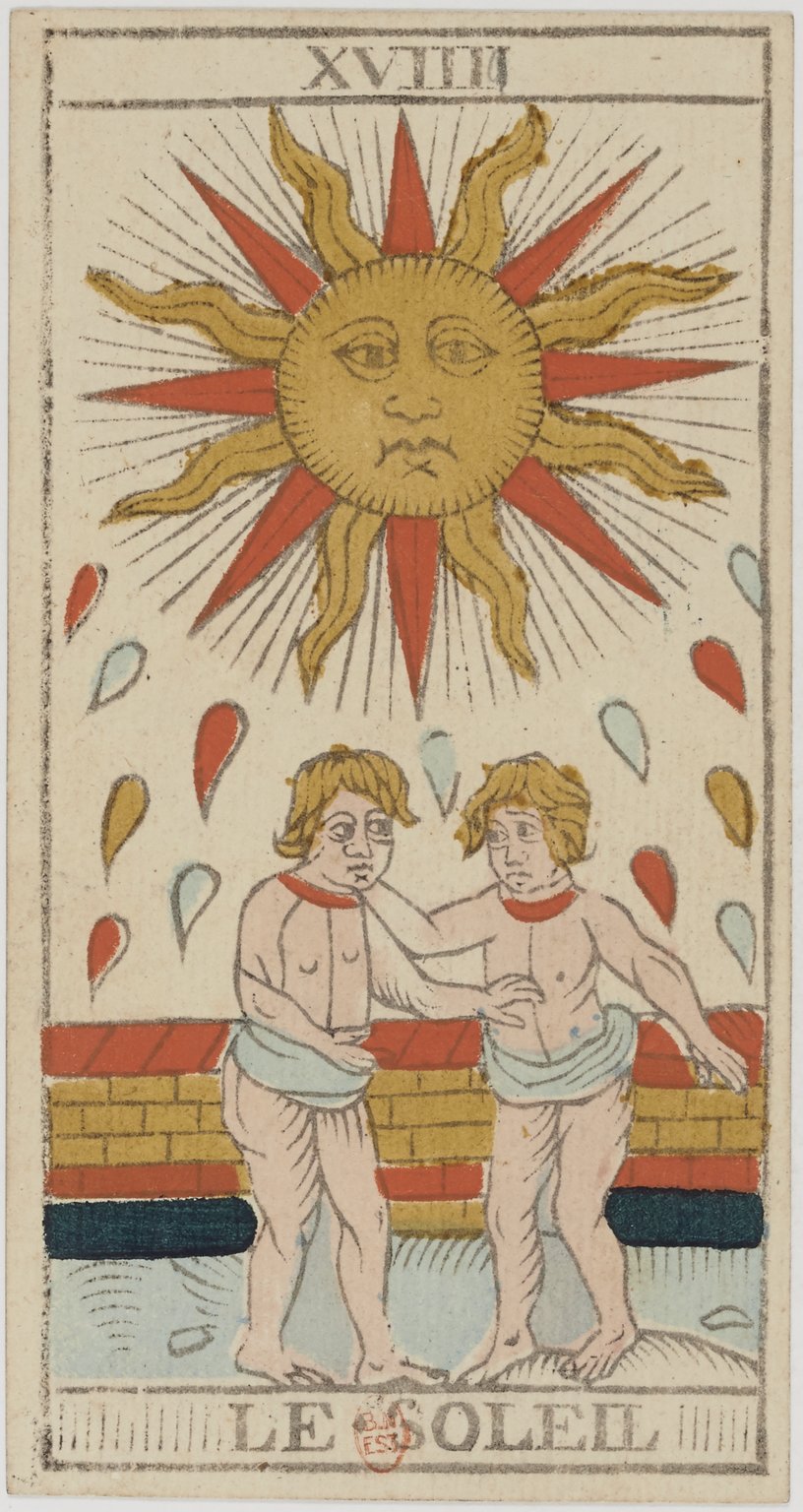
The next card after 10 that reduces to 1 when the digits are added together is 19, the actual Sun. There is no 4 in this last, seventh cycle of 3, unless we include Le Mat as 22. While ‘Pythagorean’ numerology considers 22 to be the ‘master builder’ (aka god), the man himself did not specifically mention this. However, what’s very interesting indeed is that the ratio of 22/7 was used by Archimedes to approximate pi. Thus by adding Le Mat as a 22nd triumph, division by 7 no longer gives us 3, the trinity, but pi, which is ‘never-ending.’
“Numbers are the Highest Degree of knowledge. They are knowledge themselves.” ~ Plato
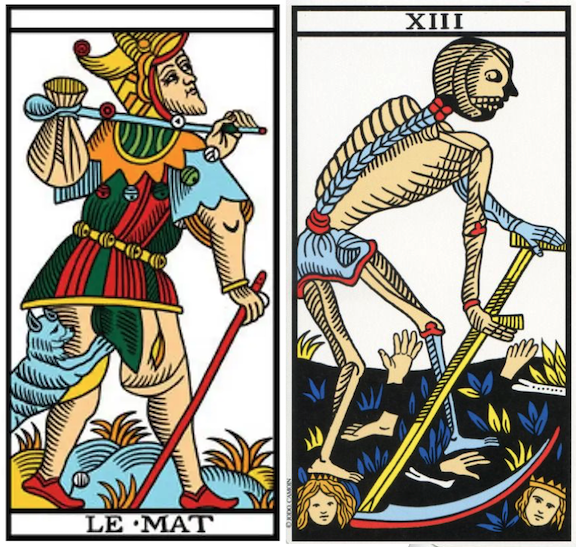
The process of destruction and purification by fire and water prior to what will be rebirth in 19, 20, 21 begins with this most sacred number of the Pythagoreans because, where unity and wholeness is the ultimate intent of the work, God/the Divine must be invoked.
Alright, math class dismissed, time for art, myth and philosophy…
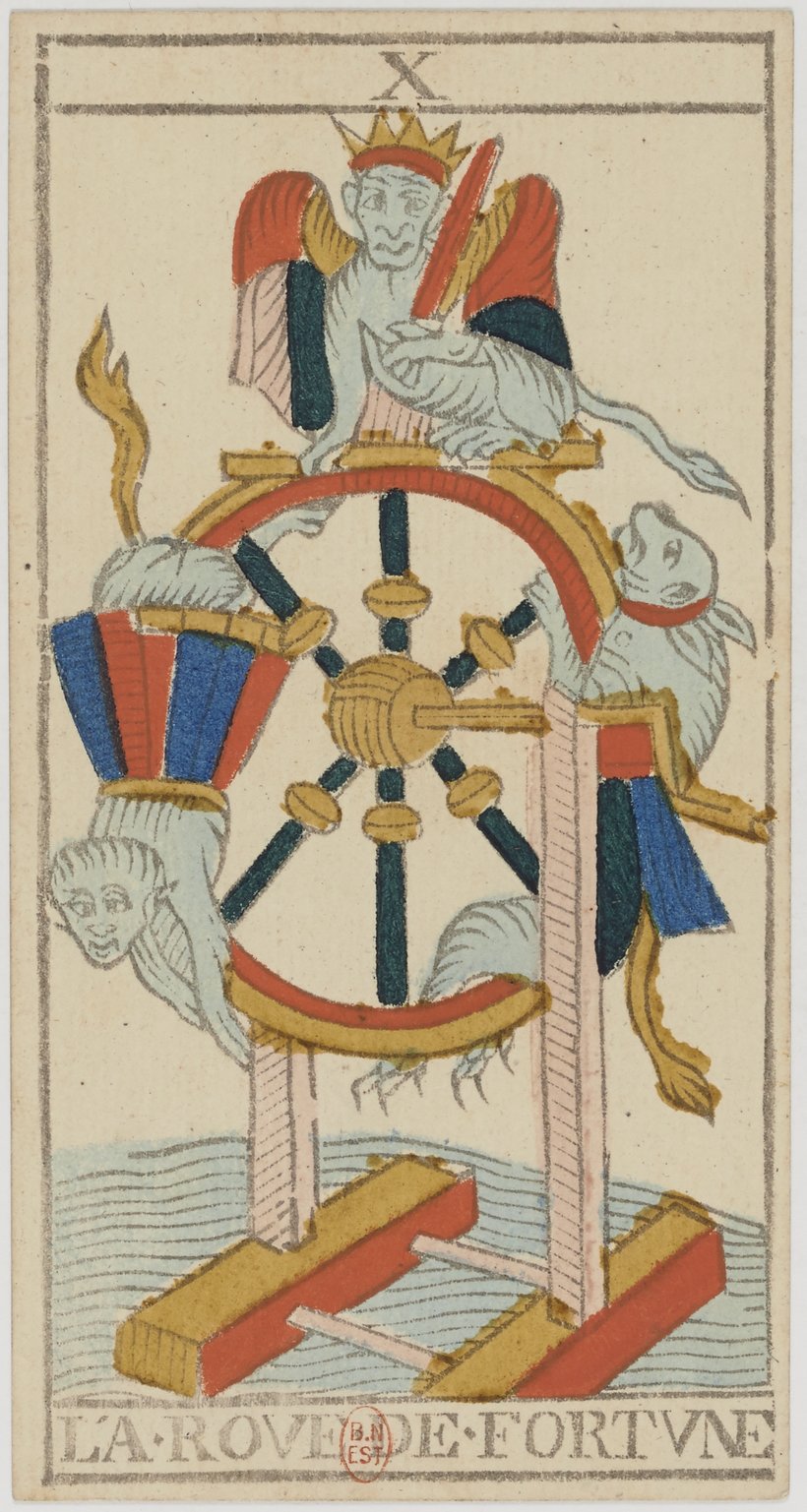
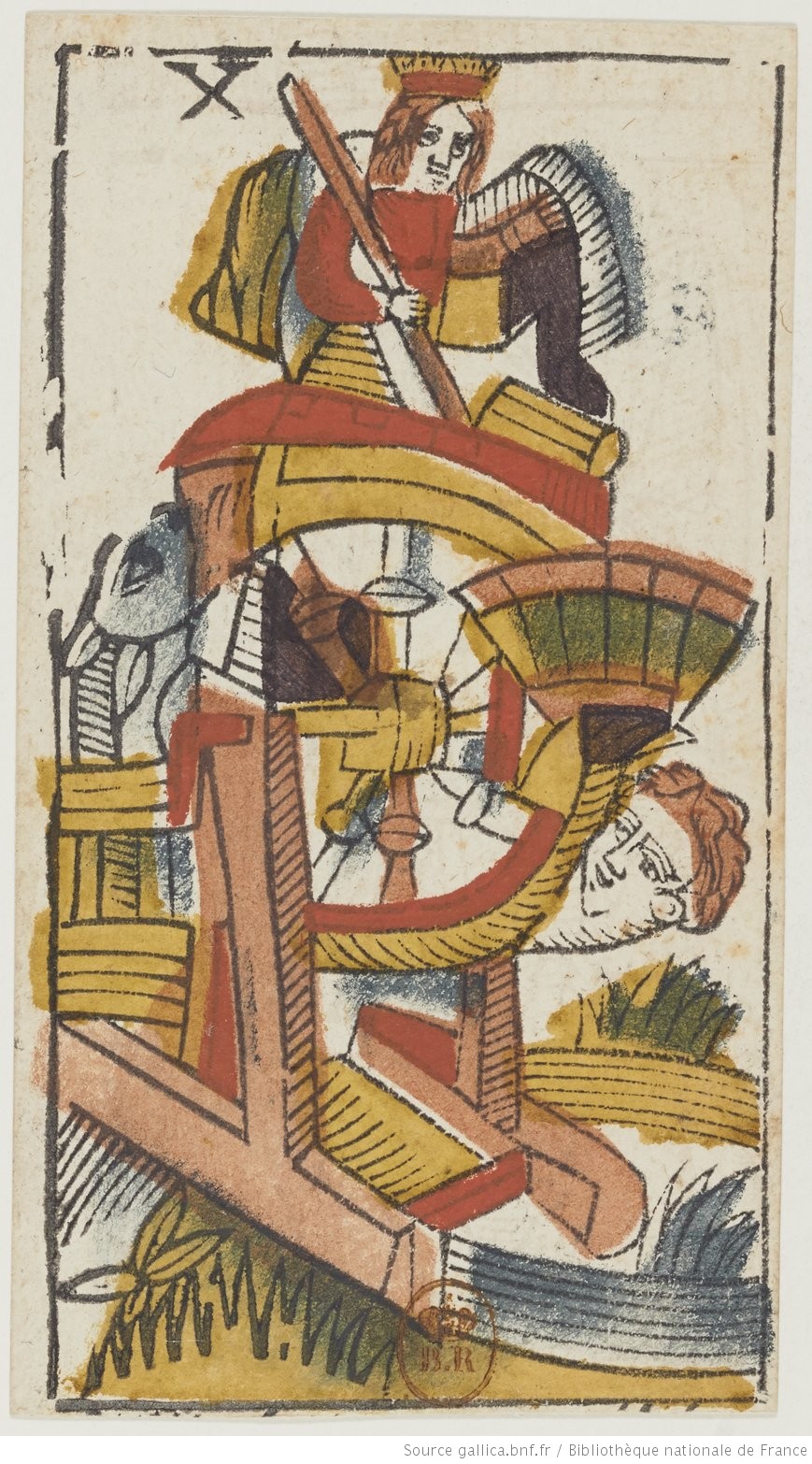
The Marseille Roue de Fortune card is a bit of a visual conundrum. The parts don’t quite fit together and though the creatures on it appear to be in motion (at least, the ones on either side do), nobody’s turning the handle. The base, which resembles a section of ladder, stands on water. Is it a water wheel? Maybe this rota cannot be fully understood literally, but is another riddle asking to be read as a composite of its parts.
I won’t go into the entire history of Fortuna’s Wheel, or ‘wheel’ be here all day, but one, particular detail in the Marseille version is what got my wheels in motion: at some point in the card’s r-evolution (perhaps simultaneously, in different traditions), the creature on the left transitions into a flaming pot.
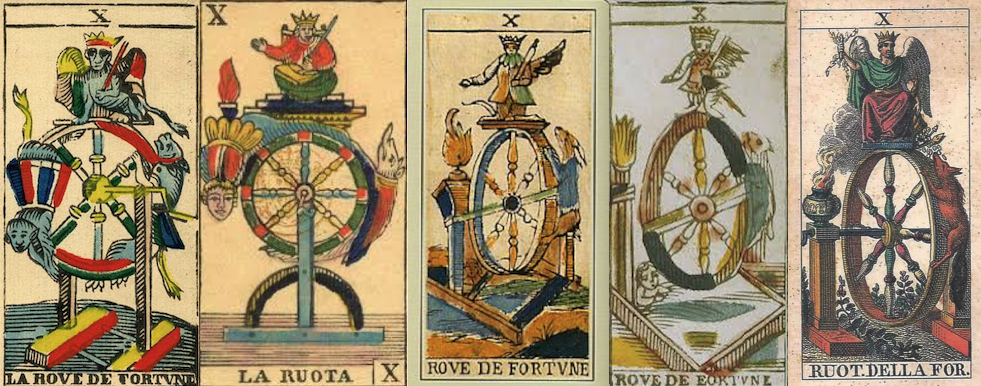
This has been dismissed as misinterpretation of worn away plates by printers who, (correctly) interpreting the tail as a flame, figured the Wheel should be equip with an altar or censer with which the passing of earthly existence into smoke was symbolized. (And now it does resemble an Arabic ’10’).
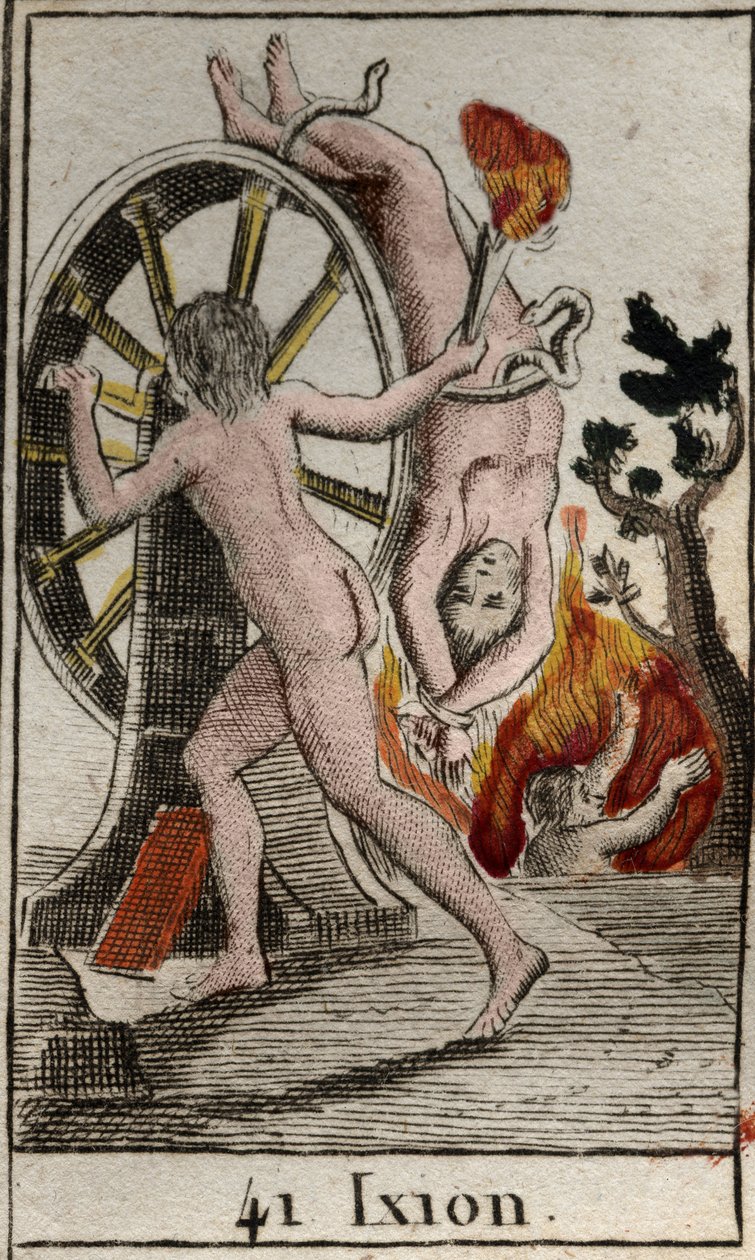
One possible precedent is in images of Ixion, where the wheel Zeus binds him to is being lit with a torch, although, there are plenty of mythical, flaming wheels (and altar pots) to choose from. Ours is not Ixion’s wheel per se, but maybe the flame is mnemonic of it. Ixion, having killed a kinsman and twice flagrantly violated the sacred law of Xenia, was denied the cathartic rituals that would cleanse him of his guilt, and, under Zeus’ orders was bound by Hermes to a fiery solar wheel for eternity [either rolling across the sky or stationary, down in Tartarus]. At this point in the game, there are two options; change or be stuck on repeat forever.
The Wheel’s stand can elude to a couple of things; like the Hanged Man’s gibbet, it might suggest a gateway, recalling the dokana of the Dioscuri (even shaped like the Gemini sign, a prelude to the twins in 19).
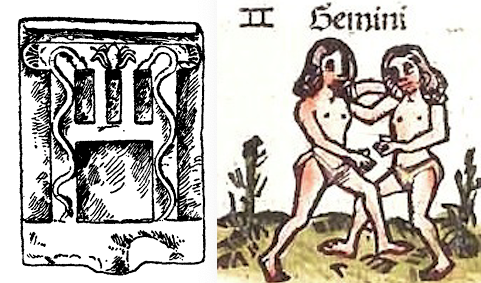
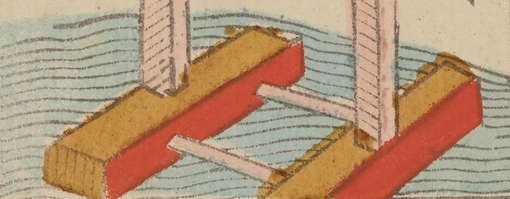
It could also indicate that ‘the initiate’ has now made it this far on the scale philosophorum (philosopher’s ladder of mystical ascention), which will later appear atop the wall in 19. The two bars form the Arabic numeral 11, and/or the Roman numeral II, recalling “one becomes two…” Double digits begin here and the images start to reflect this. 10, with this design element, seeds 11 (La Force), situated exactly in the middle, a threshold with ten numbered cards on either side. The formidable, lion-wrestling mistress is partner to the Le Bateleur.
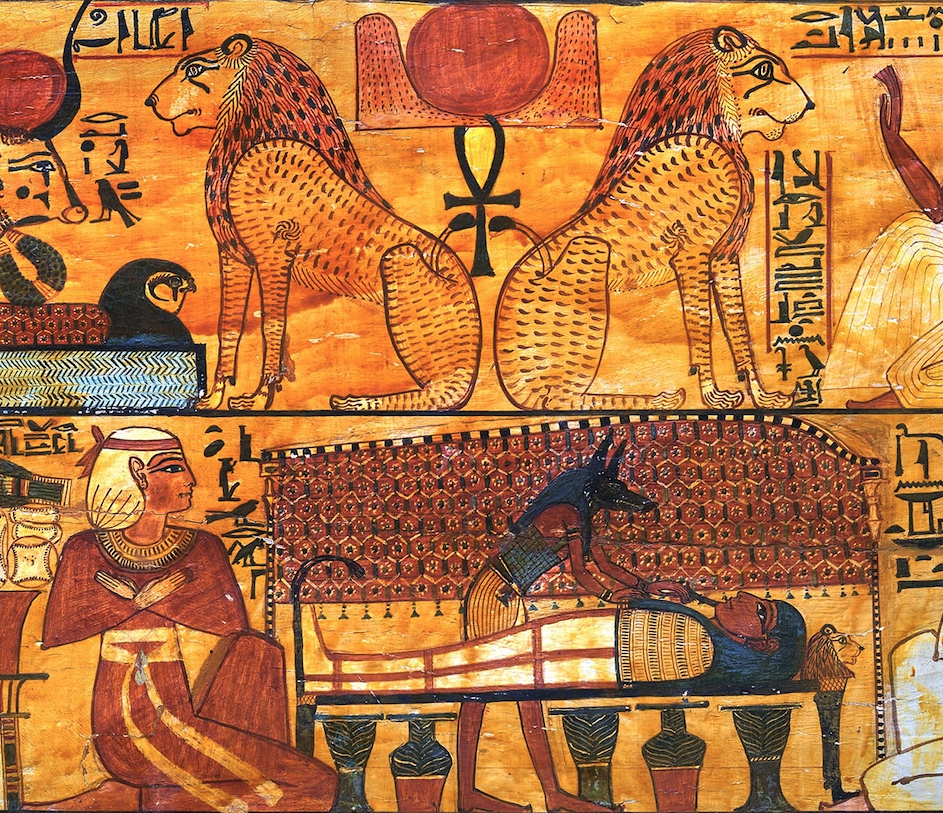
The ‘foreparts of a lion’, seen here at the head of the embalming table, is the hieroglyph for ‘strength’, and is featured in the Strength card.
We might also imagine the Wheel as metaphorically representing the Sun above the watery horizon and the beings on either side as ‘yesterday’ and ‘tomorrow’’ – traditionally, ‘I have reigned’, and ‘I shall reign’ – with the top middle one as the present, ‘I reign’. Instead of a fourth on the bottom (usually an old, impoverished figure) there is a gateway to watery rebirth.
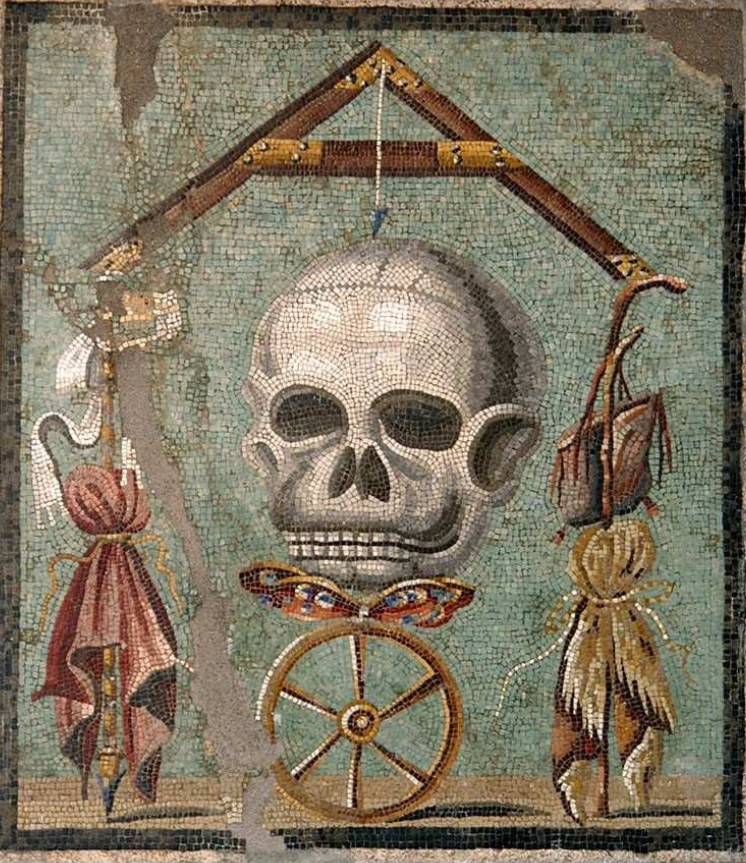
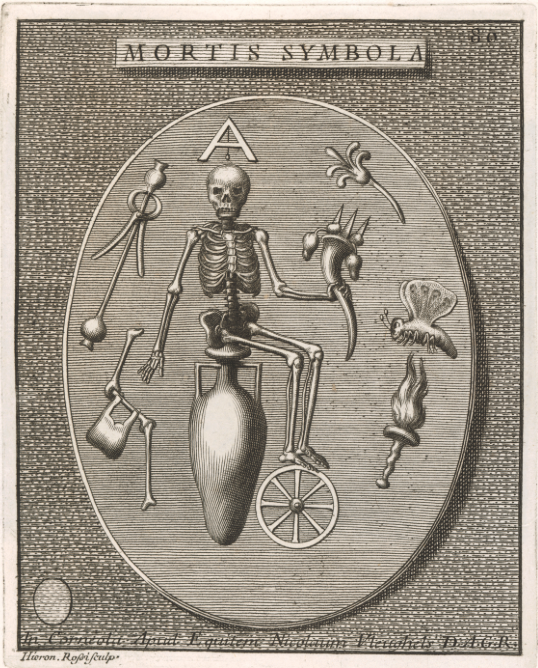
In this iconic ‘memento mori’ Roman mosaic from Pompeii, a simian skull is balanced atop a butterfly on a wheel. Above, a square level’s plumb bob is just touching it, the tool balanced atop two staffs, hung with the garbs of rich and poor. All are equalized in death, all are subject to Fortune’s whims. The mosaic was part of a banquet table, where Romans often practiced ‘carpe diem’, remembering their death tomorrow by partying today. The butterfly represents the immortal soul (Psyche). Butterfly, torch (especially going out or pointed downward), plumb line, fortune wheel, urn and of course skull/skeleton were all symbols of death, typical of the Roman ‘carpe diem’ motif.
[The tradition of death symbolism is also recurrent in Freemasonry. Masons practice reflecting on their mortality at every turn. The plumb represents death as well as the upright, balanced life and is a common, gravestone motif.]
The explanation usually given for the monkey skull in the Roman mosaic is that cremation practices of the day had left the artist without a human one to refer to, but this ignores the fact that monkeys/apes were often used to parody humans. The memento mori theme was very popular and there is more than sufficient proof that artists of the day knew how to depict human skulls. An artist could easily have improvised the bone structure from a living human.
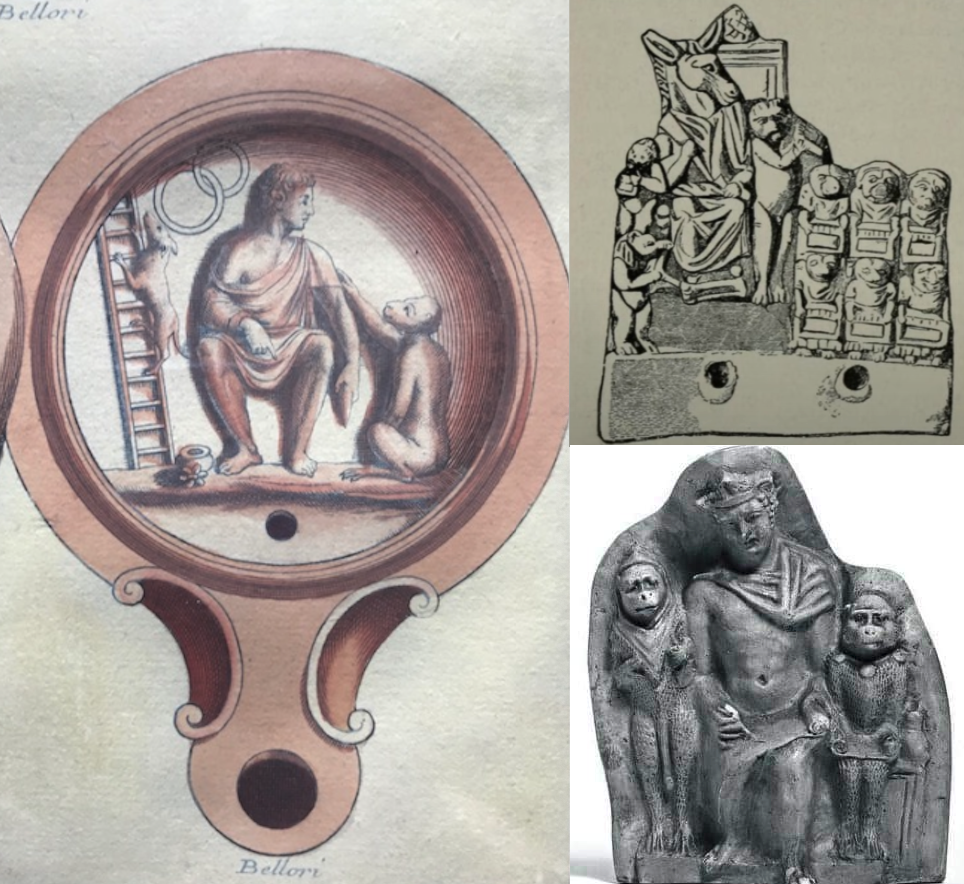
The little creatures on the TdM Wheel also seem to be parodying fearful humans stuck on the mortal coil, immediately following the card of remembering. Regrets…I’ve had a few…
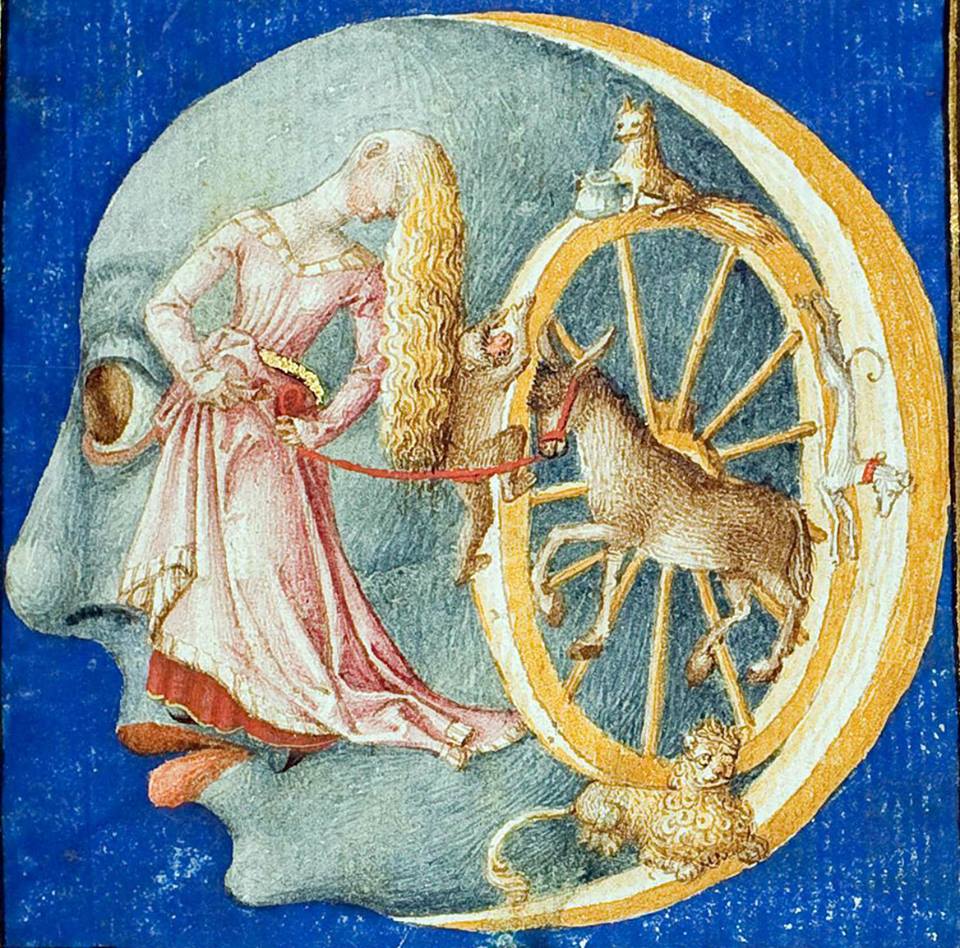
It would seem the tail of the simian-looking creature on the left side of the card was always intended to resemble a flame, both to illustrate the fire element, and to suggest that being turned on the wheel is akin to being ‘cooked.’ Perhaps there is nobody turning the handle because, as with the Chariot, which is not physically moving, there is no outer influence, the change is happening inside. Either we turn our own wheel or invite “fate” to do it – an outer expression whereby things seem to randomly happen to us (wheel of karma). The ‘winged’ Mercurial being at the apex might be symbolic of will, overseeing the process, making sure the pace is natural and steady, that an even temperature is maintained.
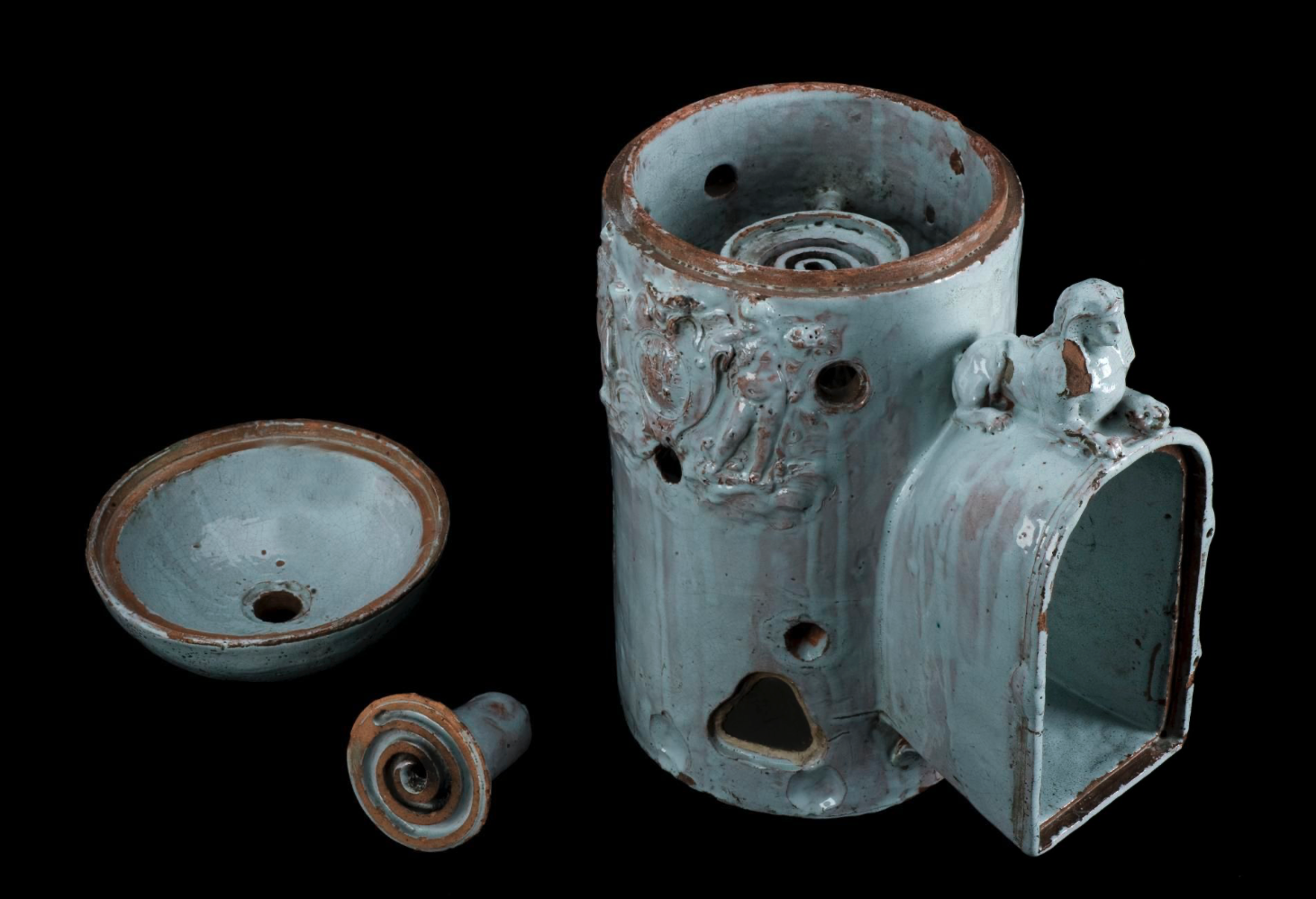
“Its purpose is constant digestion. Within its womb, substances are subjected not to violent flames but to the slow and merciful fire – ignis temperatus that mimics the warmth of the earth’s own generative belly. There, in that tranquil inferno, base substances soften, combine, and refine, until that which was profane begins its ascent toward the sacred. This is no vulgar boiling, but a sacred gestation.” ~ Universal Co-Masonry FB post, regarding the Athanor (alchemical furnace).
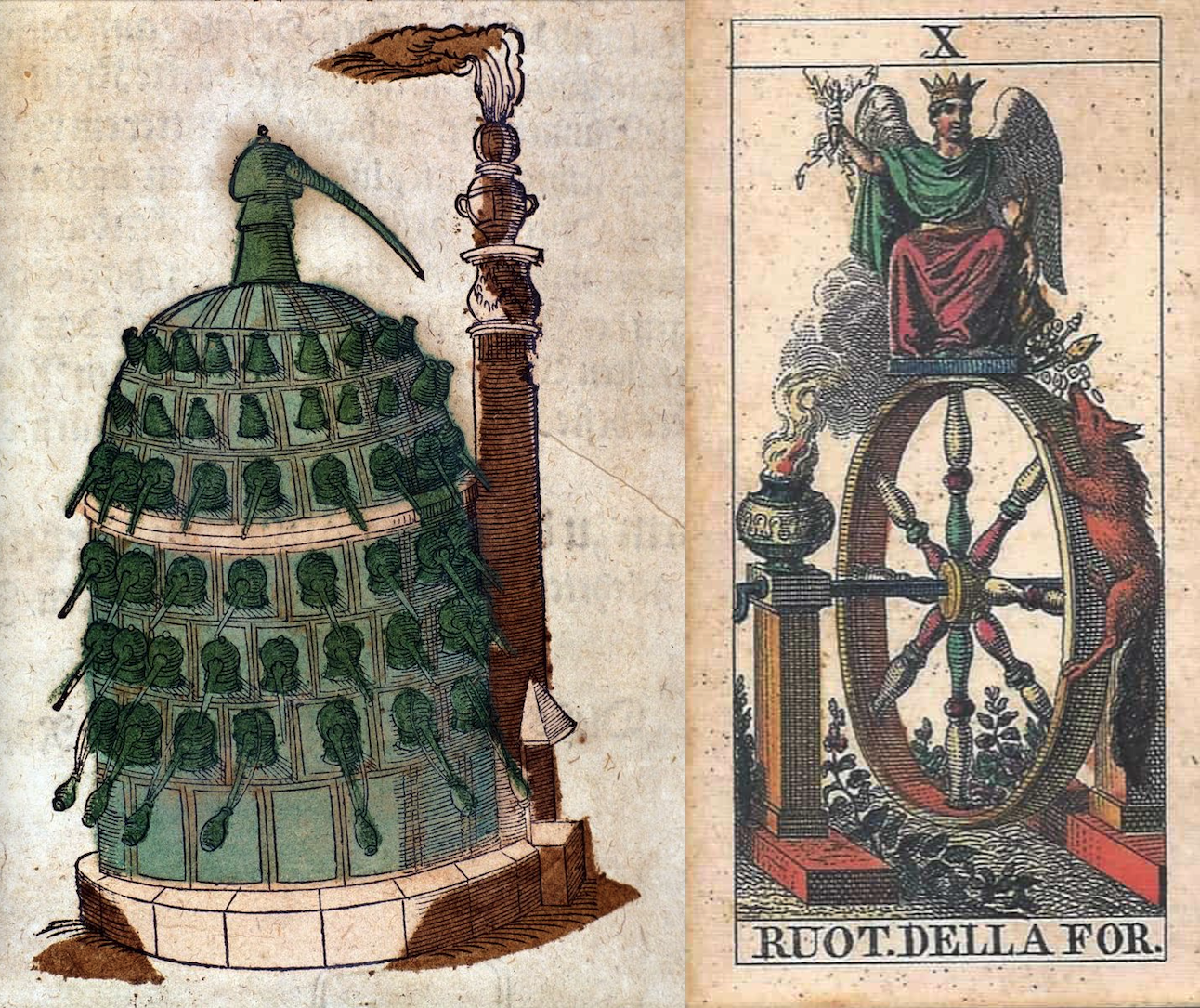
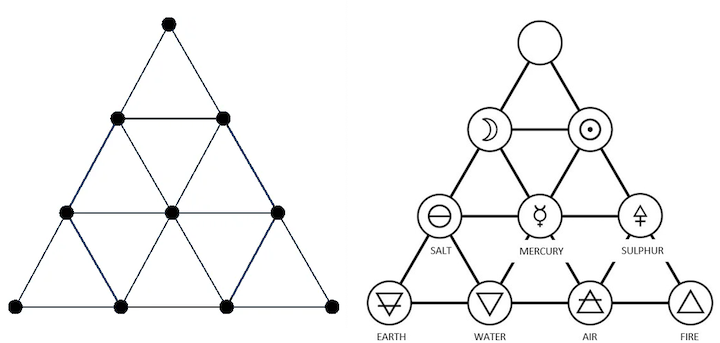
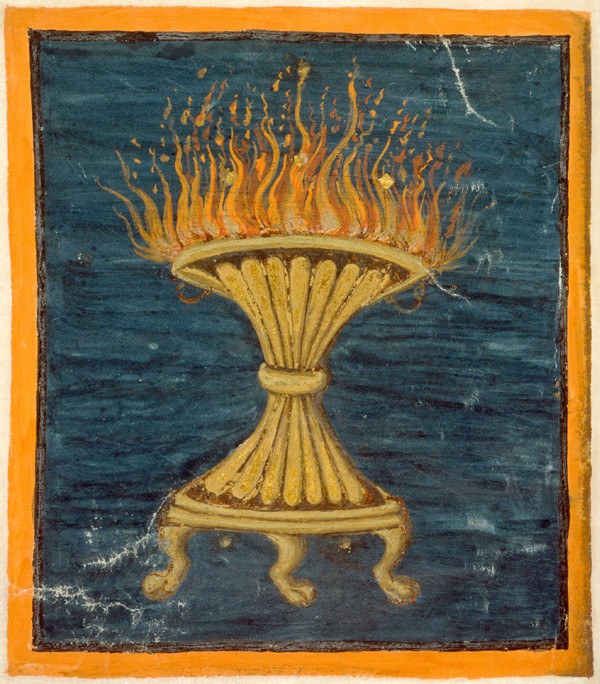
Above, with a suitable Tarot card for comparison, is the image that finally unlocked this card’s cryptic meaning for me. It is of an alchemist’s ‘athanor’, which is a self-feeding, clay furnace designed to maintain a steady temperature. Although etymologically unrelated (it comes from Arabic at-tannūr, “the baker’s oven”), ‘athanor’ oddly enough contains the Latin word ‘rota’ in it (albeit spelled backwards). Note the familiar design of the heat-release valve.
The Hermetic principle of ‘as above, so below,’ (microcosm and macrocosm) is integrated in the athanor’s design, through correspondence to the four classical elements; Fire = the transformative heat in the lower chamber, Earth = the stable structure, Air = the circulating vents, and water = the surrounding baths. The furnace’s operations reflect the soul’s alignment with universal forces, mirroring the alchemist’s inner equilibrium with cosmic order.
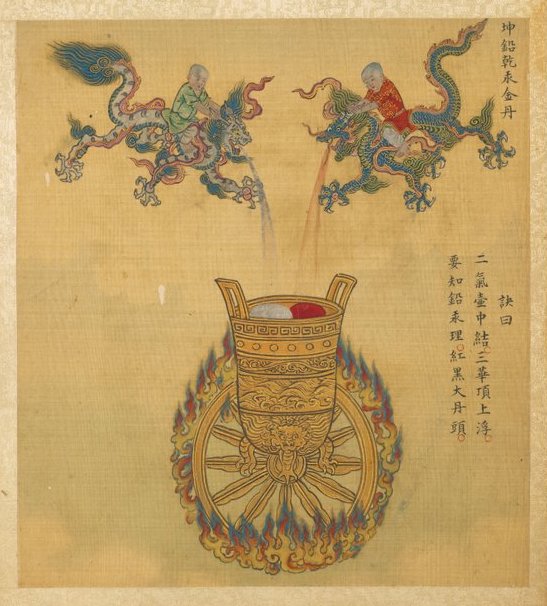
In fact, the alchemists did use the term ‘wheel’ (rota) as a metaphor for the cyclical nature of their art. The stages were not linear, but continuous – the end could also be the beginning, just as in nature.
The three figures on the TdM Wheel might represent the 3 philosophical elements – left, sulphur (soul/emotions/desires), right, salt (body), and top, mercury (spirit/imagination/moral judgement/higher mental faculties). The salt/body fellow has ass ears, which typically are a sign of ignorance (think Pinocchio) but also, again, possibly suggestive of Hekate, triplicate Goddess of the crossroads and occasional consort of Hermes (aka Mercurius) or Hermanubis. As supreme navigator of liminal spaces, her torch burned with the sacred solar fire of Helios.
“O Sun our lord and sacred fire, the spear of Hekate of the roads, which she carries as she attends her mistress in the sky and as she inhabits the sacred crossroads of the earth, crowned with oak-leaves and the woven coils of savage dragons!”
~ fragment of a hymn to Helios and Hekate from the play Rhizotomoi (Root-Cutters) by the Greek tragedian, Sophocles [Loeb Classical Library].
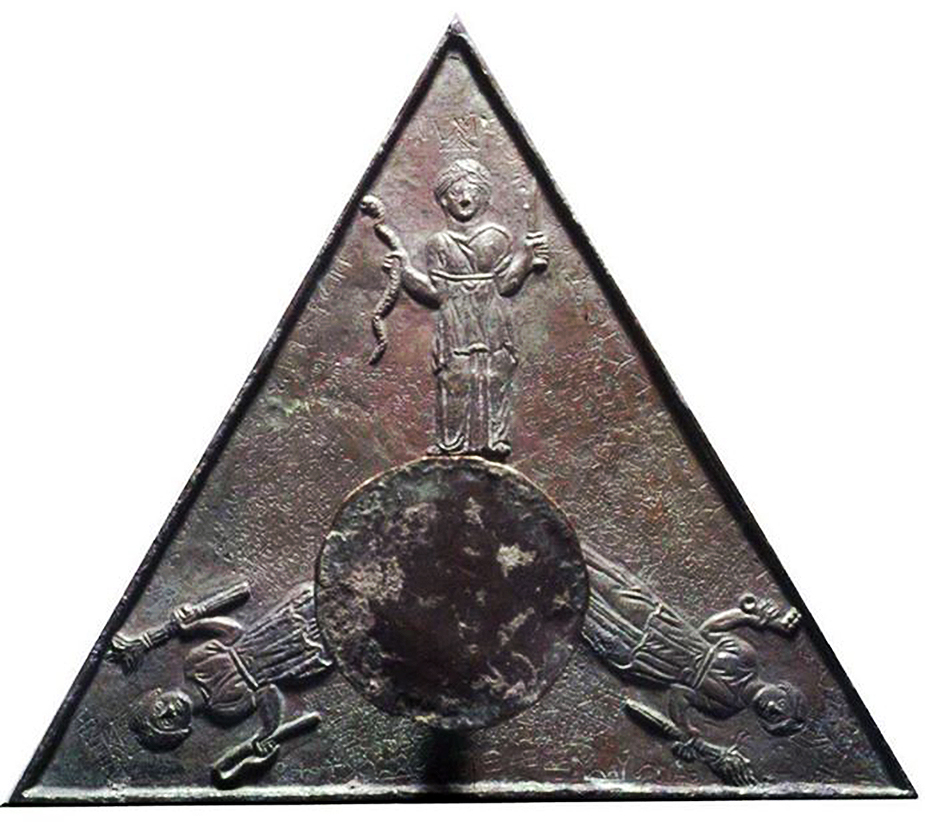
AIR (sword pointed up, wing-like cape)
FIRE (flame-like tail pointed up)
WATER (below)
EARTH (vine or snake-like tail pointed down)
4 classical + 3 philosophical elements = 7.
In both type I and II, the number of spokes appears to be 6 (or three divided), but notice that a seventh is also formed by the Wheel’s handle. Clever. Seven elements, planets, metals and stages.
Addendum: The 6 spoked Wheel can also be read as the Labarum symbol (solar) adopted by Christian iconography, which is nevertheless based on the idea of “inverse directions…one of which is like a reflection or mirror image the other” – ie, ‘as above, so below’ – similar to Solomon’s seal. [René Guénon, Symbols of Analogy, via Wikipedia]
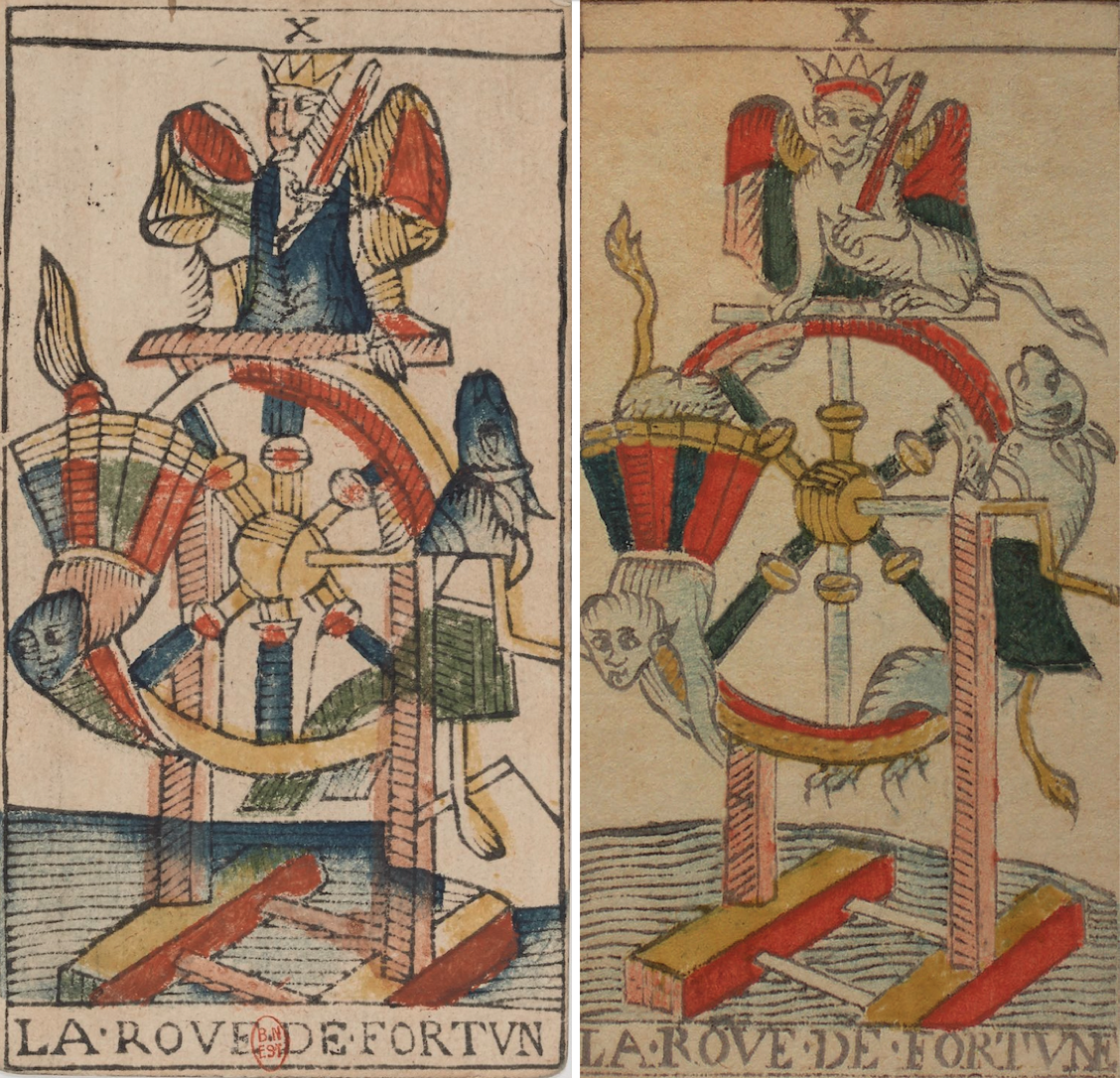
The hub of the Wheel is divided into 3 sections, like a globus, while also resembling a lunar-solar combination – navigation of liminal spaces as we progress toward unity.
That the flaming tail was turned into an altar pot/censor doesn’t change the intrinsic meaning and actually alludes more strongly to the alchemical cooking process. The water below suggests ‘a slow, gentle cooking’, akin to that of the Bain Marie. Similar to the gentle turning of a wheel, the contents of a cooking pot or cauldron is stirred in a slow, spiralling motion. In Shakespeare’s tragic play of alchemy gone backwards, MacBeth, the Wyrd Sisters famous chant, ‘Double double, toil and trouble,’ is a reference to ‘the work.’ Originally, the old English word ‘wyrd’ (which became ‘weird’) meant ‘fate’ or ‘destiny.’
“Apollo, though one of the great gods of Olympus, is yet represented in some sort of dependence on Zeus, who is regarded as the source of the powers exercised by his son.” [Theoi.com]
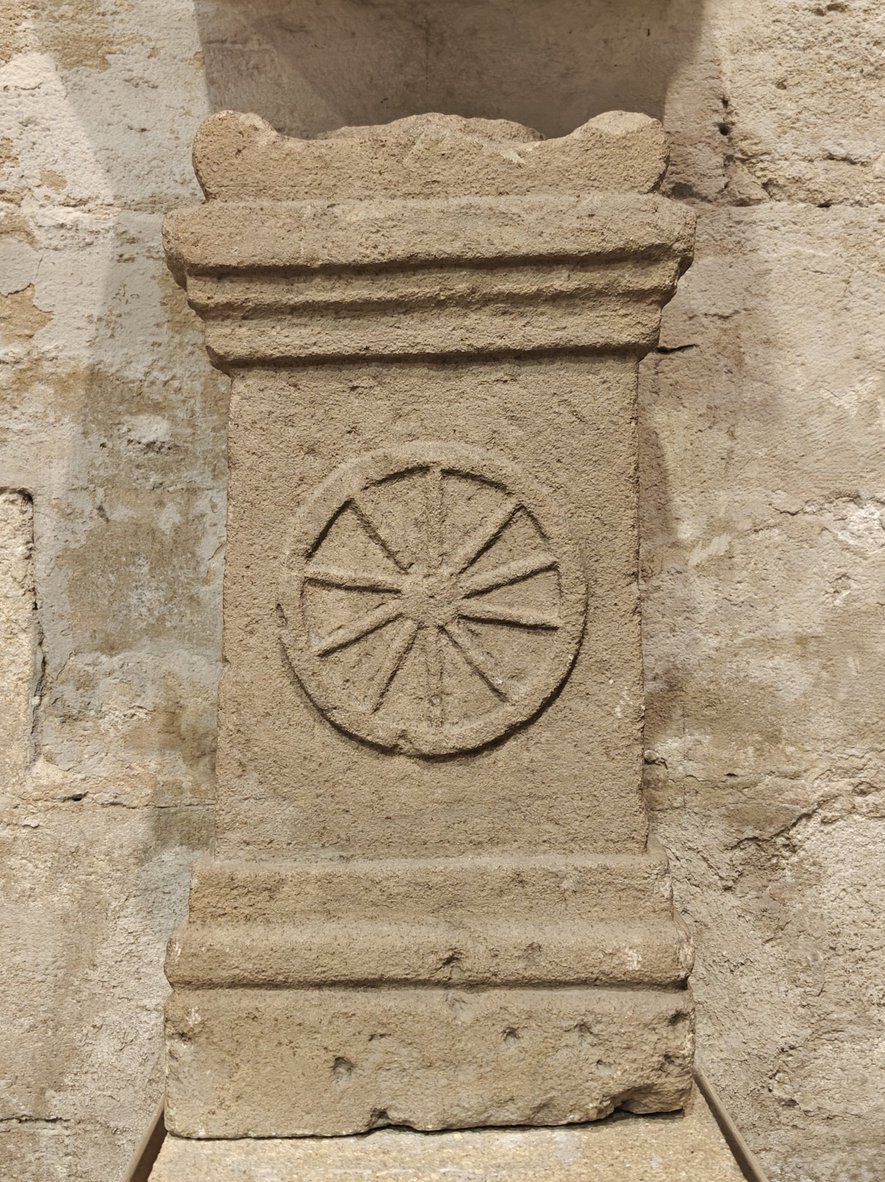
Helios, a Titan, was the Sun personified, later identified with Olympian Apollo, god of light and prophecy. The sad myth of Phaethon – the son of Helios who insisted he could drive his father’s chariot, but lost control of the horses and fell to his death – can, in the mythoalchemical sense, be equated with ‘the work’ being scorched by impatience (or hubris) or halted by negligence (or ignorance).
To go this way, nowhere else, I confess;
Note only the tracks of my wheel.
And to give equal warmth everywhere,
Too soon to earth and the sky neither rises nor falls.
Because by climbing too high the sky you will burn,
And descending too low the earth will destroy.
But if through the middle your career remains,
The race is more united and the way safer.
~ Nuysement, Philosophical Poem of the Truth of Mineral Physics, in Traittez de l’Harmonie et Constitution generalle du Vray Sel . Paris, Périer and Buisard, 1620 and 1621, p. 254.
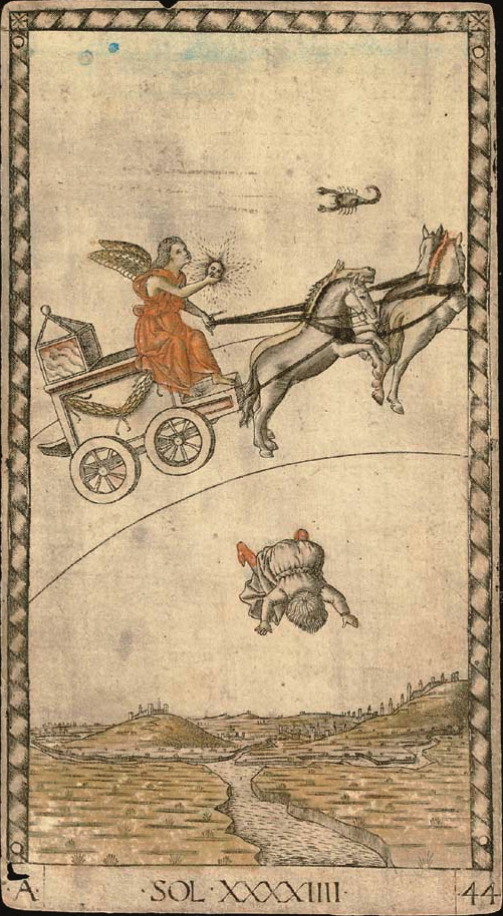
The meaning of the Latin phrase Festina lente (‘make haste slowly’), is that activities should be performed with a proper balance of urgency and diligence. If tasks are rushed too quickly then mistakes are made and good, long-term results are not achieved. Work is best done in a state of flow in which one is fully engaged by the task and there is no sense of time passing. In this way we are in harmony with nature. ~rb
“Thus, let the Athanor burn–not with haste, but with faith–and may its light ever guide the hand and the heart of the true seeker.”
~ Universal Co-Masonry, ibid
All written content, besides quotations, is ©ROXANNA BIKADOROFF and may not be reprinted for republished in full without my permission. Kindly share via LINK only, which helps direct traffic here. If you wish to use a short pull quote, please include a credit (and link).