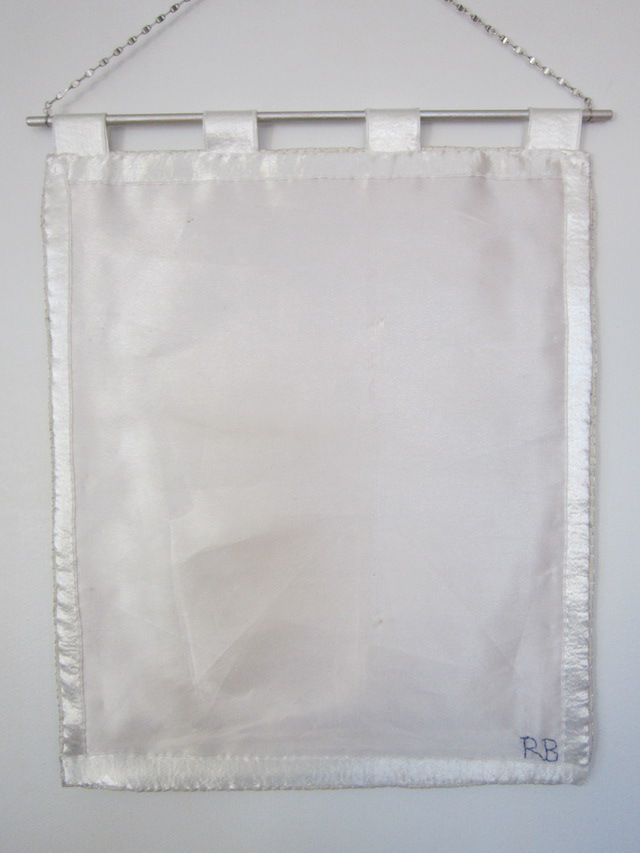
Hail Hermes-Mercurius, fleet-footed genius of artisans, astrologers, writers, Tarot, theatre, magic, alchemy, thieves, commerce, crossroads and every communication, connection or interaction made between one entity and another! Ruler of the zodiac signs Gemini and Virgo (who has been known to wave a magic wand).
side view
This new icon was completed during Mercury’s transit of Pisces, Virgo’s polarity, while the Lunar Nodes are in Virgo/Pisces. I mean, how Virgo-Pisces is obsessively hand-sewing Mercury with opalescent, shiny objects that resemble fish scales or bird feathers?
Caduceus [Will’s Cigarettes card, NYPL digital]Opposing snakes frame his winged head (so full of thoughts and messages), as if his caduceus has magically come to life. Always in the middle, the etherial trickster glows with solar gold and lunar silver. The border is a design based on DNA ‘serpents’ and Argus eyes.
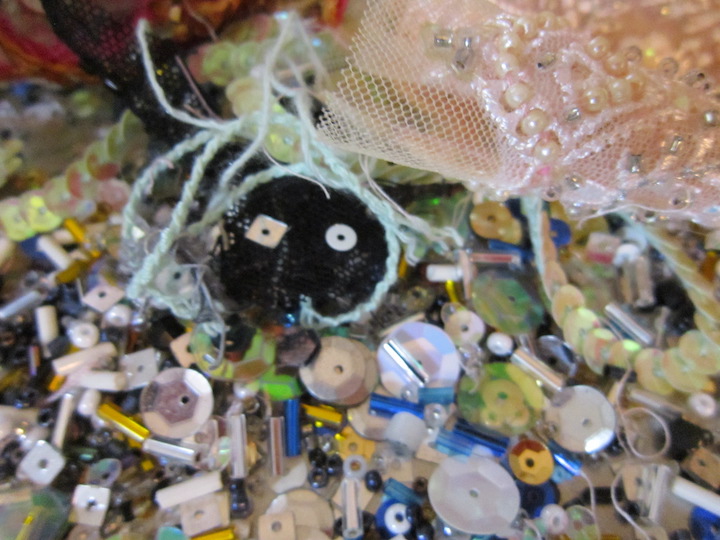
detail
The original piece was a light, acrylic painting on canvas. I’d decorated it partially with sequins (eyes and background, and the four corner symbols). At one point, I removed the sequins and attempted to embroider on top, but it wasn’t right. All the visible needle holes in the painted surface meant it would have to be covered. I put it away for several years, but decided to tackle it again last Winter.
original piece, 2013
I’d purchased this beautiful trim in San Francisco, when I lived there and made my own belly dance costumes, years ago. It reminded me of Ancient Greek designs. I didn’t want to cover it, but after the middle part was finished, it didn’t match. So as a compromise, I left a bit of space for it to show through and provide another layer from behind the ‘Argus Eyes’.
corner details (winged helmet and Mercury symbol)
My earlier sequinned tapestries are inspired largely by Haitian ‘drapo’, but this smaller piece was also influenced by painterly, Roman mosaics. It does feel like I’m ‘painting’ with sequins, sometimes applying two or three on top of each other and choosing opalescent or metallic beads to achieve the right luminosity and gradation. Mercurius reflects differently, depending on light and angle. Sunlight can give him a pinkish hue.
silver eye detail
size: approximately 11 x 13 inches, excluding chain. materials: sequins, glass seed beads, canvas, satin, satin ribbon, thread, wood dowel, acrylic paint, metal chain. Not for sale. Decided I need to have him near!
This piece is also posted on my Beaded Icons page in the ART menu.
I prayed to Her, taking a flower in my hands: “Mother, here is Thy knowledge and here is Thy ignorance. Take them both, and give me only pure love. Here is Thy holiness and here is Thy unholiness. Take them both, Mother, and give me pure love. Here is Thy righteousness and here is Thy unrighteousness. Take them both, Mother, and give me pure love.” I spoke of all these, but I could not say: “Mother, here is Thy truth and here is Thy falsehood, take them both.” I gave up everything at Her feet but could not bring myself to give up truth.
~ from the Prayer of Ramakrishna (translated by A. Mookerjee)
Tarot’s Lady Justice, with her direct gaze and formidable countenance, doesn’t just represent an institution, but is the embodiment of truth, and the natural sense of order and harmony that permeates the cosmos. For this reason, she has is often been equated with the Egyptian Goddess Maat.
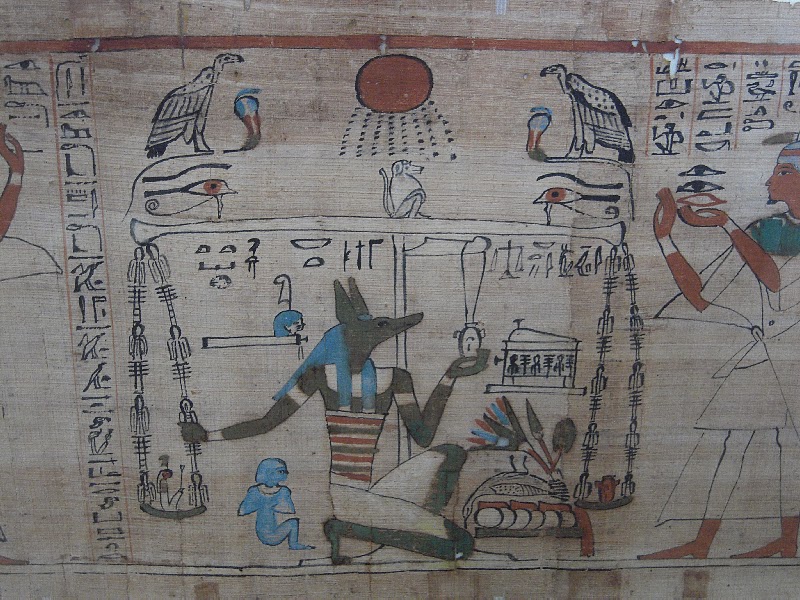
Anubis weighing a heart against a little figure of Maat
We’ve all seen images of the Weighing of the Heart ceremony, wherein the deceased person’s heart (seat of the mind, to the Egyptians) is weighed against her feather in the ‘Hall of Two Maats’ (two truths), but Maat was also a set of principals for the living:
“The ancient Egyptians deeply believed in the inherent grace and unity of the entire universe. They understood that cosmic harmony could be achieved through the most righteous ritual and public life, and any kind of disruption in this divine harmony would have many severe consequences, such as earthquakes or famine, which are caused by an impious king…” [Egypt Tours Portal, Ancient Egyptian Principals of Maat]
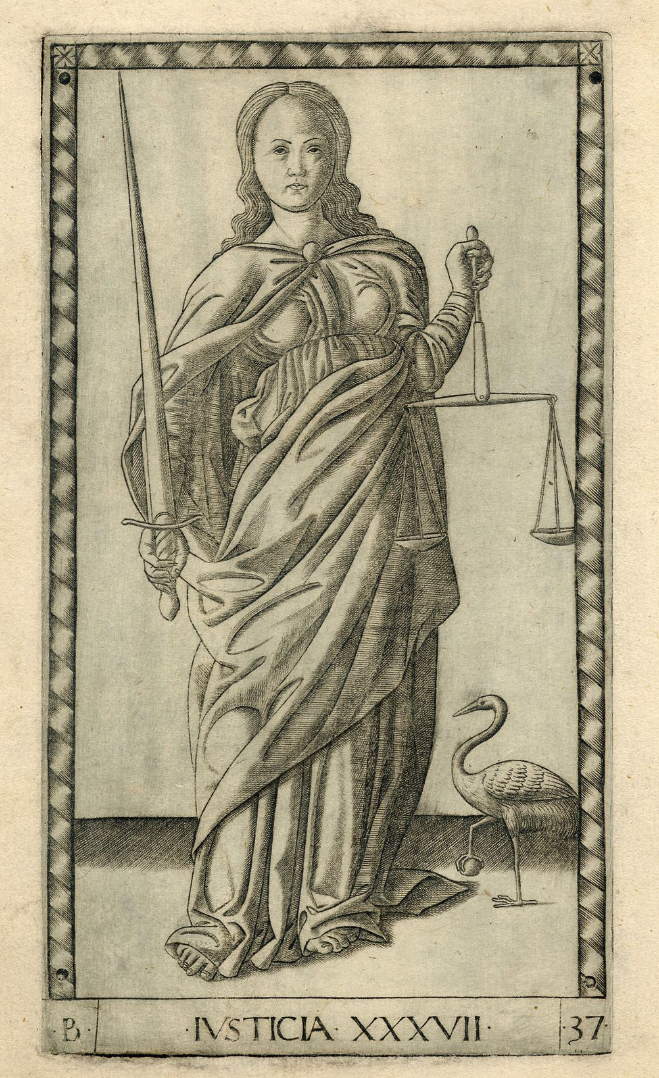
“Tarocchi of Mantegna,” Anon Ferrara 1465
Similarly, to Renaissance humanists, Justice as Cardinal Virtue was a guiding principal to live by – particularly for princes – in order to maintain personal and collective, moral standards. In the ‘Mantegna Tarocchi‘, which depicts the hierarchy of stations from the lowly beggar ‘Misero’ all the way to ‘First Cause,’ Heavenly Virtues are exceeded only by the gods themselves. Note how the stork familiar of Justice harkens back to Thoth, Maat’s Ibis-headed scribe consort – perhaps indicating that virtues need to be taught and developed (the stork was also a symbol for rhetoric).
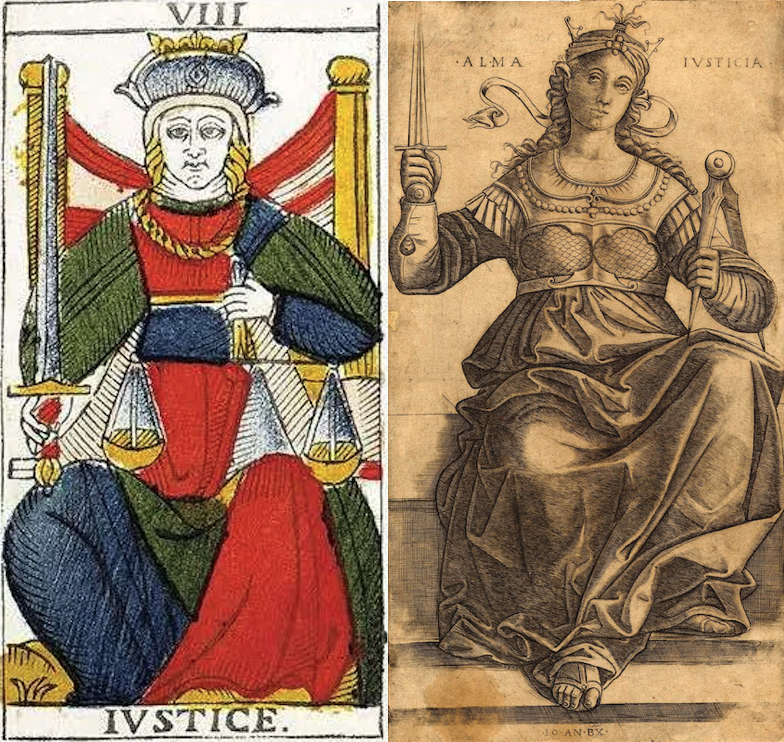
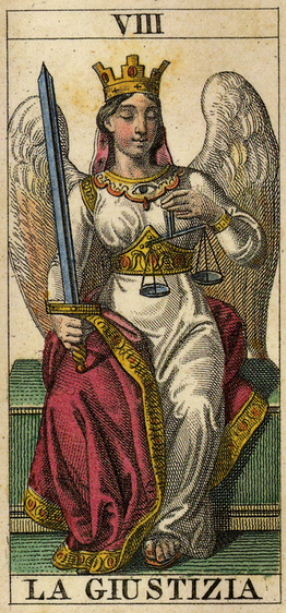
Tarot de Marseille’s Lady Justice, seated upon her throne, sword and scale in hand, seems straightforwardly emblematic.But, as with all TdM cards, might the particulars of her design reveal a more layered persona? Let’s investigate, beginning at the dawn of the Italian Renaissance… [As always, please click on images to enlarge and for more details.]
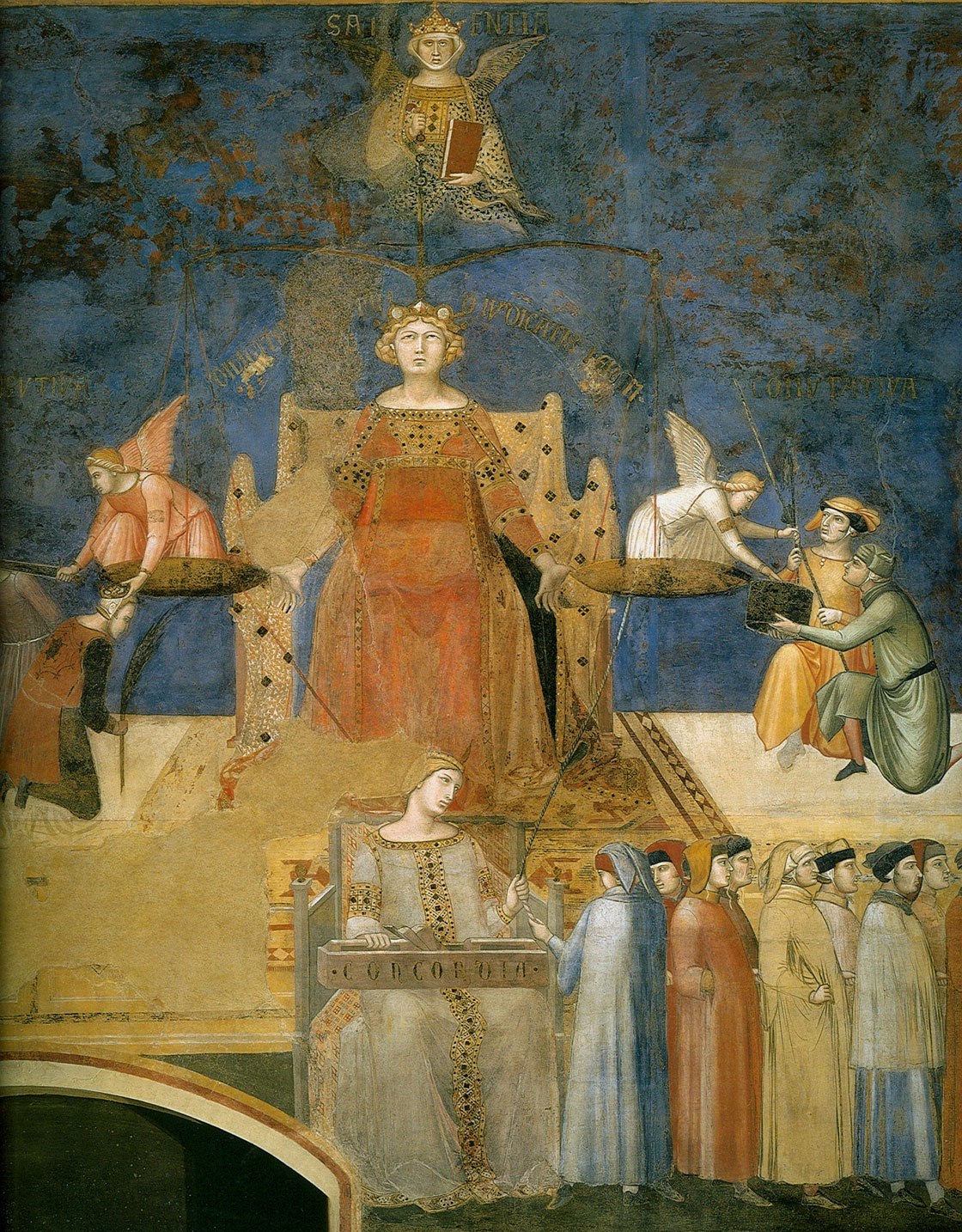
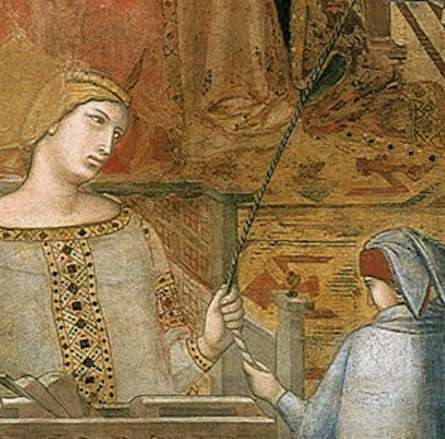
Ambrogio Lorenzetti, Justice (detail), Allegory of Good and Bad Government, 1338-39
The Allegory
Justice, still a figurehead of courthouses today, is the longest-surviving Cardinal Virtue. Her blindfold, supposed to indicate impartiality, makes her seem a bit benign, like she can’t actually witness what we’ve been up to. But prior to the 16th century, this was not the case, as we see in Ambrogio Lorenzetti’s exquisite, mid 14th c fresco, ‘Allegory of Good and Bad Government’ in the Palazzo Pubblico (town hall) of Sienna. Painted at a time when city states of Italy were becoming more secular, allegorical artworks like this in civic buildings were an attempt to incorporate the ancient virtues; to “legitimate and elevate secular activities by suggesting an association with the sacred.” By placing Justice and Judgement scenes in public places, “city states in Italy sought spiritual affirmation that their urban way of life was just as god-annointed as the old, feudal vision of society.” [Images of Justice, Curtis and Resnik, Yale Law Journal]
Justice appears in the mural a few times, in different forms; most prominently she’s seated on a throne (‘Distributive’ and ‘Commutative’ Justice), a hand resting on either scale, whereupon two angels dish out punishment or reward. She looks upward toward the higher power, Wisdom, who looks up to God. A cord runs from each scale (one is worn away) to the hand of Concordia, symbolizing a balanced state of society. Everything is connected in perfect equilibrium, everyone knows their place and responsibility as citizens.
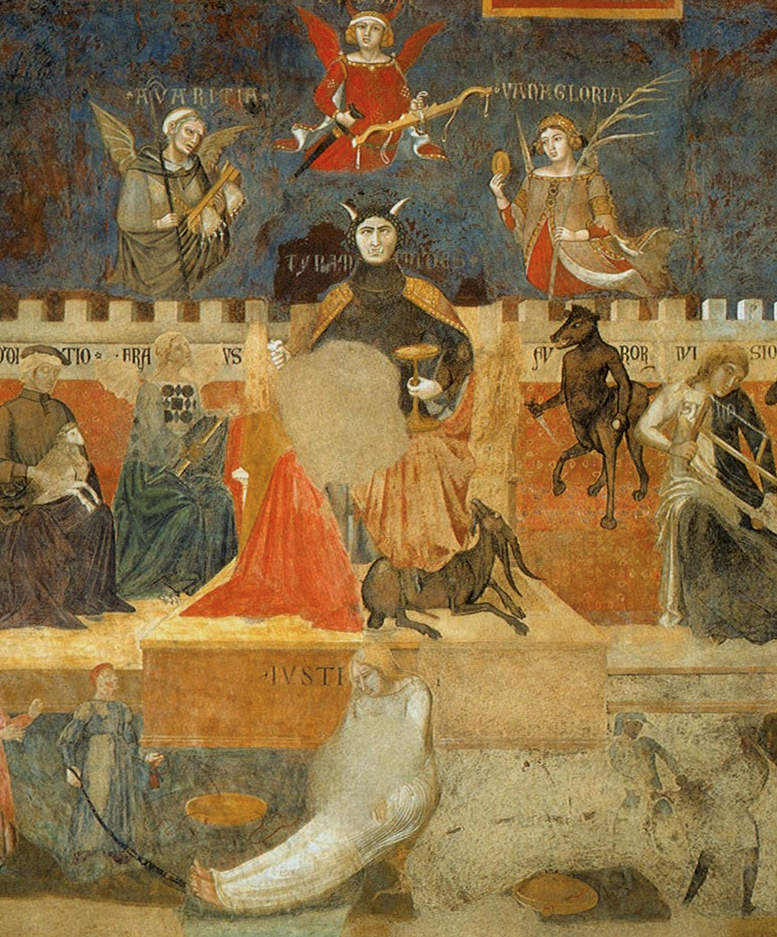
Ambrogio, Allegory of Bad Government (detail)
On the adjacent wall to her right/our left, the Satanic figure of ‘Bad Government’ is seated on a throne, the scales of Justice lie on the ground broken, and she sits in despair beneath him, possibly with hands bound. The relationship between the Supreme Court Justice and the Devil is established.
Watch this video for a more intricate tour of the mural. For our purposes, let it serve as an introduction to how the Virtue of Justice was “propagandized” at the time, and to some of the details that will carry over into the Tarot card.
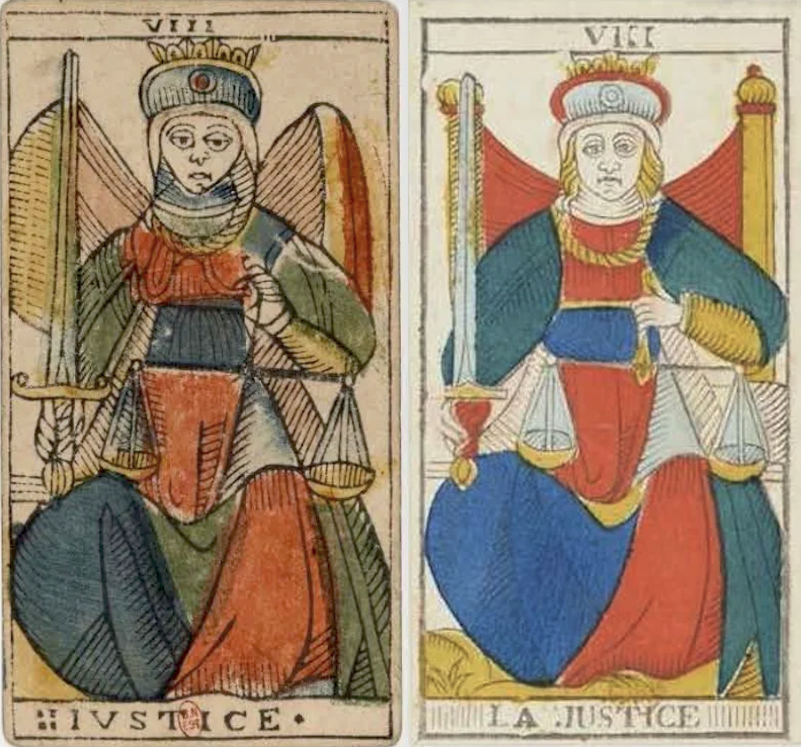
Examples of Type I (Dodal) and Type II (Conver) Tarot de Marsielle, 18th c.
The Pillared Throne
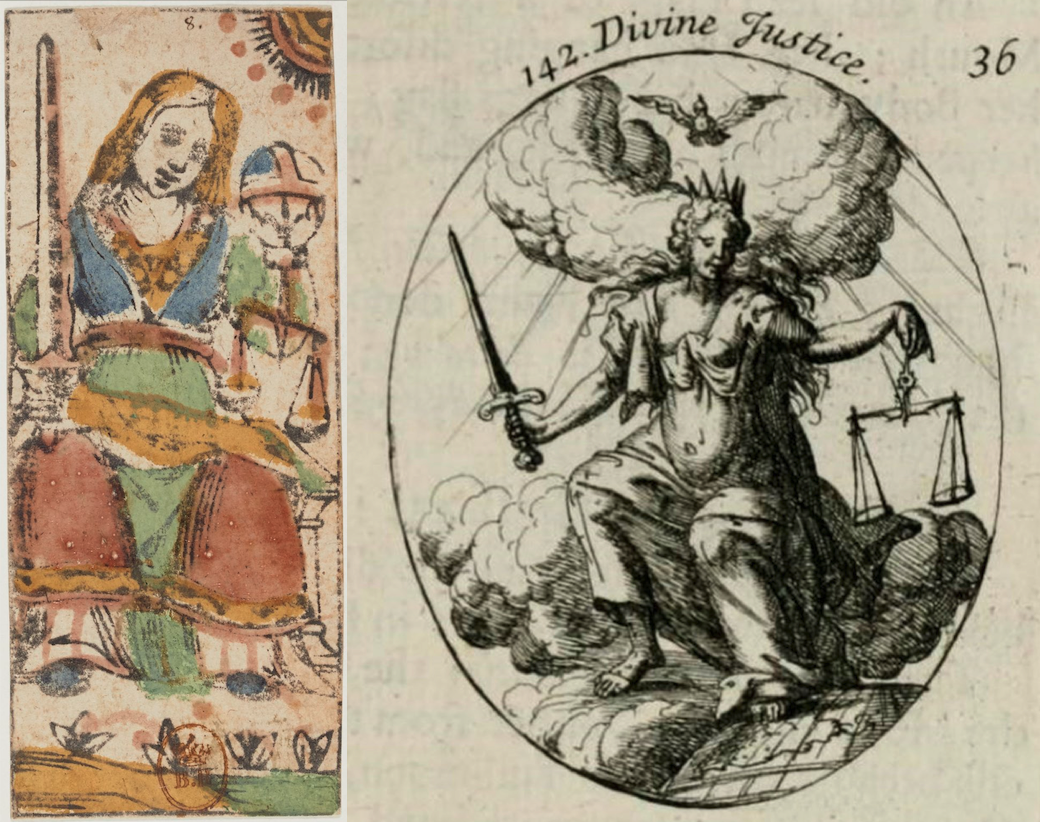
Type II TdM differs from type I, in that Justice’s ‘wings’ are absorbed into her throne’s concave and cylindrical shape. It features two, gold-coloured columns, one which is being ‘split’ by her sword. Emblemata books tell us that, unblindfolded, with sword held erect, she is ‘Divine Justice’. This is further indicated by her crown – more on that a bit later.
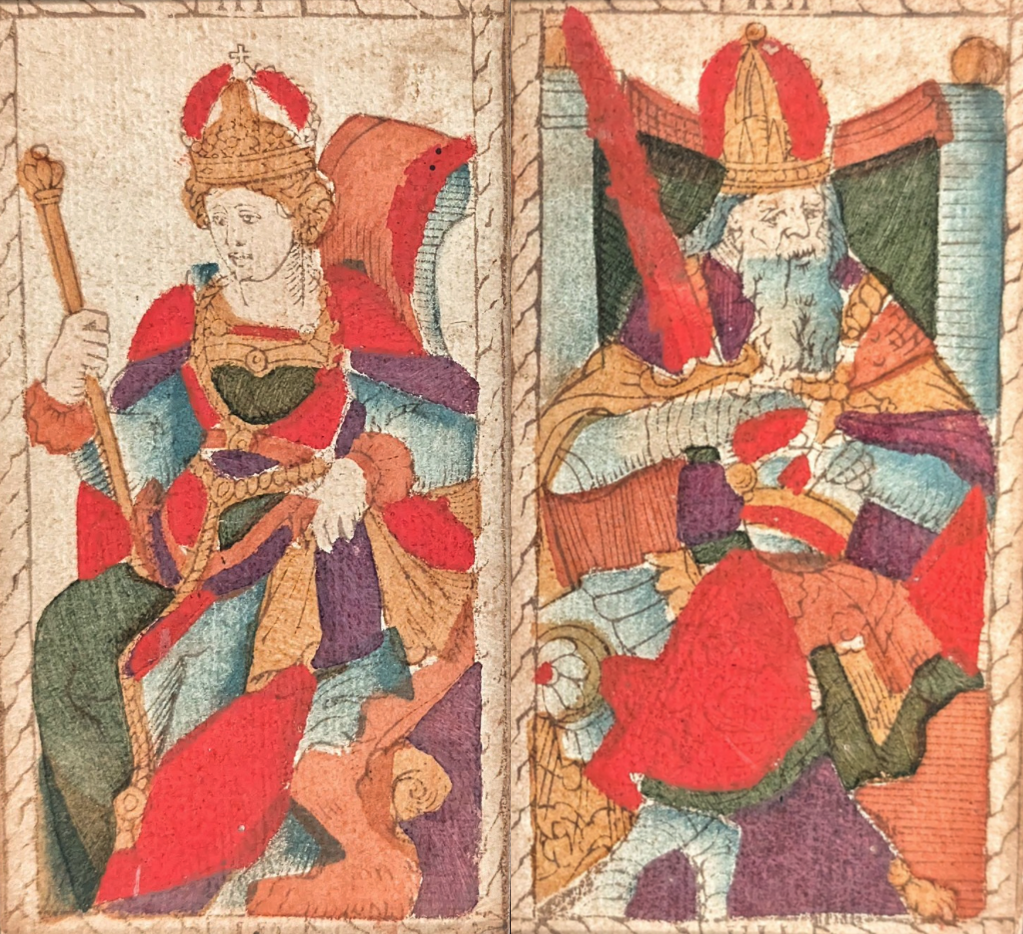
It’s important to compare decks for clues, and sometimes they’re found in unlikely places. In this earliest French Tarot, below, the Empress’ hand on the covered arm of her throne could also be seen as lifting her robe to reveal a leonine leg. Though it’s likely a skin she’s seated on, the gesture evokes a legend of the Queen of Sheba, where she lifts her skirt to step over water, revealing a hairy (sometimes exaggerated as bestial) leg.
If this connection was the artist’s intention, might the Emperor then show some hint of Solomon? I think yes – he is seated in columned throne, exactly like the one in TdM Justice, and holds not a sceptre, but a sword erect. “Remember, after all, the tale of Solomon, who offered to use the sword to cut the child in half, to give each claimant her share.” Ouch.
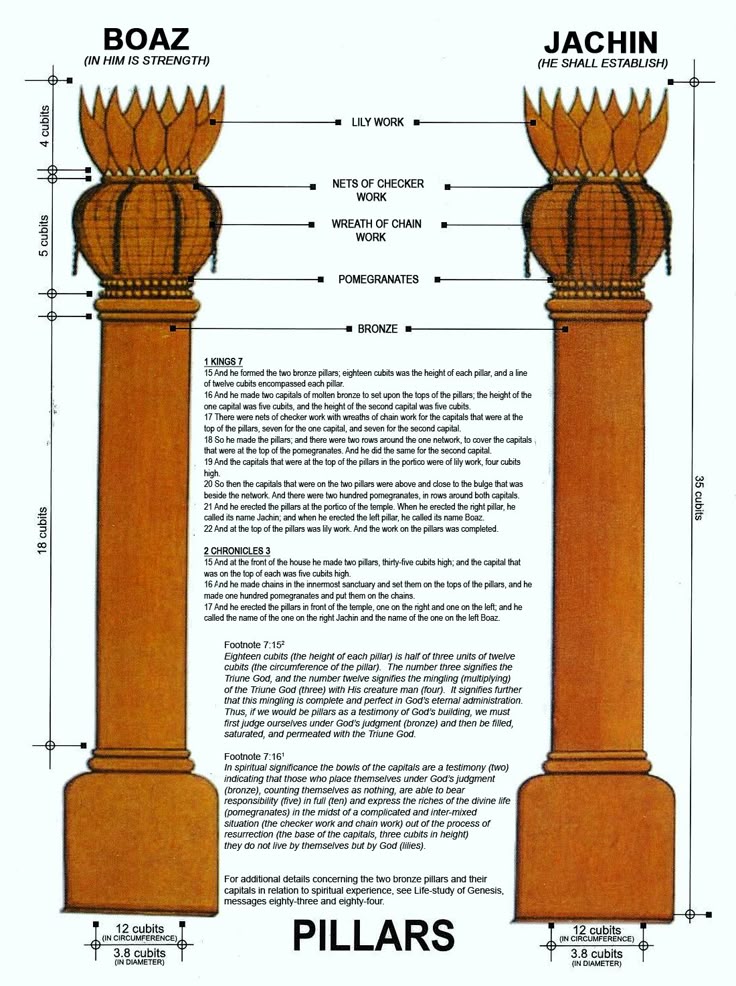
Empress and Emperor, Catelin Geofroy 1557 [photos: Alexandra Miron, click for details]The Justice card of Catelin Geofroy no longer exists, alas. But, following this visual lead, the columns of TdM Justice’s throne might also be suggestive of Solomon’s brass pillars; on her right, the column of Boaz and on her left, Jachin.
“The earliest Jewish post-biblical account is of Romano-Jewish historian Flavius Josephus (Antiquities 8:165-9), who reframes the Queen of Sheba’s story for a Greek and Roman audience. He speaks of a philosopher Queen of Ethiopia and Egypt who, much like in the Hebrew Bible, travels to meet Solomon to subject him to a trial of wisdom. Josephus’ legend wasn’t picked up further in medieval Jewish and Islamic legends, but had a great influence on the further development of Christian tradition.” [The Collector]
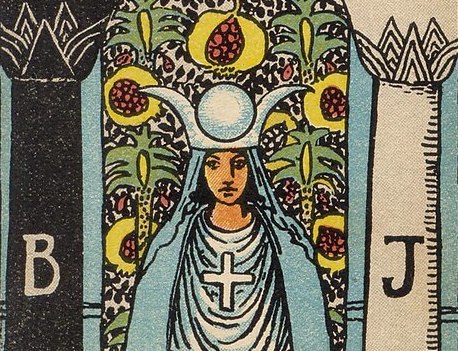
Solomon’s temple pillars [note it reads ‘bronze’, which is the modern interpretation]Each pillar was envisioned as having a bulge at the top, with a garland of pomegranates and a crown of lilies. The temple was also decorated with pomegranates. Described as symbols of ‘fertility and abundance’, ‘the promised land’, etc, it seems rather obvious from the Song of Songs that they have everything to do with Sheba’s divine (feminine) wisdom. So much so, that Smith and Waite (who was a Freemason) would put pomegranates and Solomonic pillars in the ‘High Priestess’ card, rather than Justice. (However, while the open pomegranates – and date palms – are saying one thing, her look is less than inviting, contrary to the traditional Popesse).
RWS High Priestess (detail)
In Greco-Roman tradition, the pomegranate is associated with fertility, death, changing seasons and immortality, its seeds resembling jewel-like blood droplets (often the blood of Dionysus). Persephone, by breaching the conditions of her spouse and eating six pomegranate seeds in Hades, is destined to remain underground for half the year and only return (be reborn) for the other half.
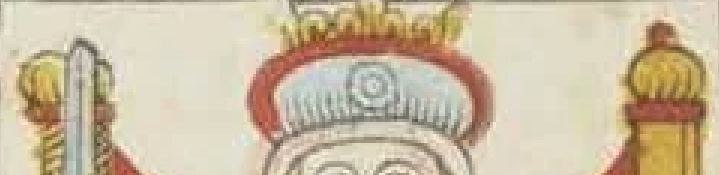
What is the little red dot on the pillar (right)?
In a similar and related tale, Eurydice is destined to remain in Hades after her beloved Orpheus breaks the one condition, that he mustn’t turn to look at her, en route back to the world of the living. “The story of Eurydice may be a late addition to the Orpheus myths. In particular, the name Eurudike (‘she whose justice extends widely’) recalls cult-titles attached to Persephone. ” [wikipedia]
“Eurydice’s name means wide ruling Justice. She is the prototype of Dike, one of the Horea, born to Themis and Zeus. Dike stood for the All Way, The Way, The Truth, and The Light. As Dike’s prototype, Eurydice is a mythical goddess and archetype present in the underworld before the cloaking of the myth in the traditional romantic versions during the creation of the Classics by male authors.”[intro to Emily Miller, ‘Euridice’s Bones’]
(Similarly, Persephone was the ‘Iron Queen’ of the Underworld, prior to the Pluto abduction myth).
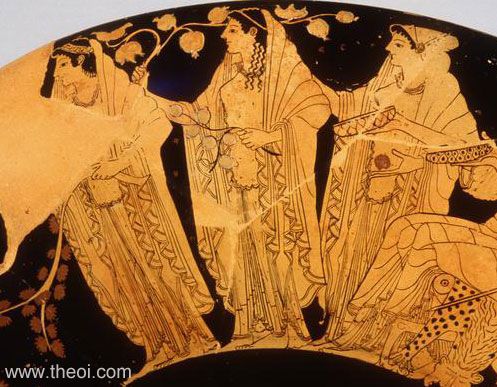
Horai (seasons) with pomegranates for Summer
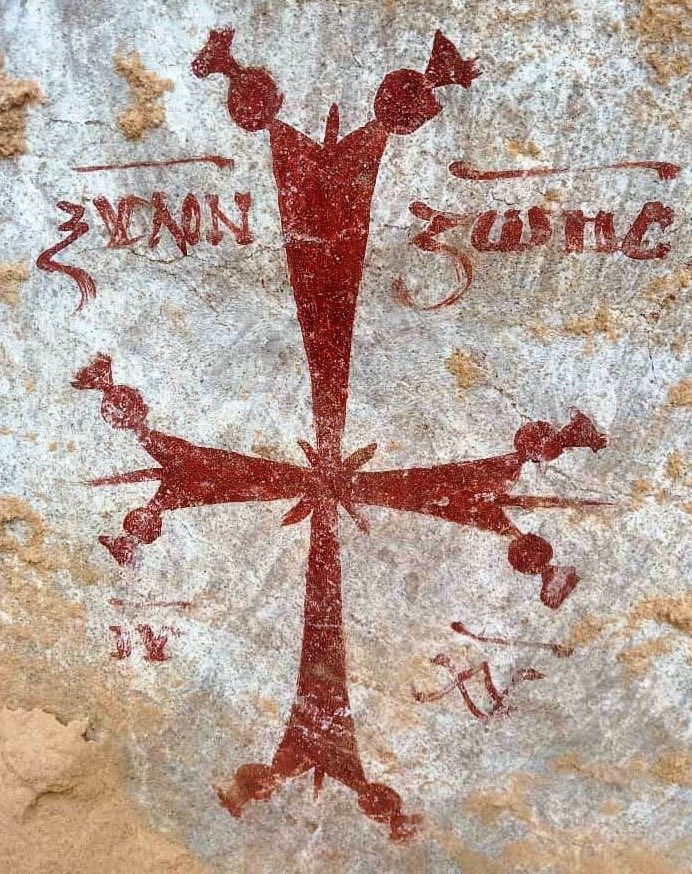
Coptic greek cross with pomegranates/”tree of life” from a recently discovered monastery in Egypt [Ministry of Tourism and Antiquities Egypt]The fruit of the biblical tree of knowledge (of sex, death and immortality) was most likely a pom, not a pomme. The Lily, also a death and rebirth symbol is associated with Lilith, Isis and the Virgin Mary. Red and white are blood and milk, the colours of alchemical Rebis.
Brass signifies God’s judgement, ie, these are not merely ‘functional’ pillars. Passing between the two brass pillars represents entry into another world, eternity or another sphere. The card is divided not just vertically, but horizontally, by the bar of her scales; there is equilibrium between Heaven above and Earth below, just like in the Sienna mural. The curved back of Justice’s throne serves a dual design purpose, suggesting wings as well as heavenly spheres. Her sword traverses both realms and we notice the ball in its handle is threefold; the trinity of philosophical elements.
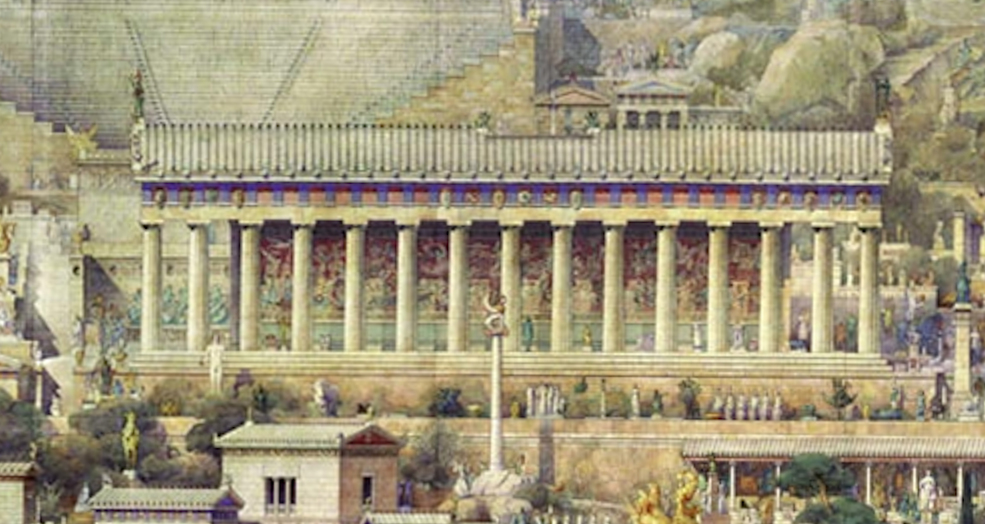
Temple of Apollo, Delphi
Wisdom Pillars
The two pillars of wisdom also can be likened to the two maxims inscribed at the entrance (possibly on columns) of the Temple of Apollo at Delphi. According to Pliney the Elder, these were written in letters of gold:
Know thyself
and Nothing in excess
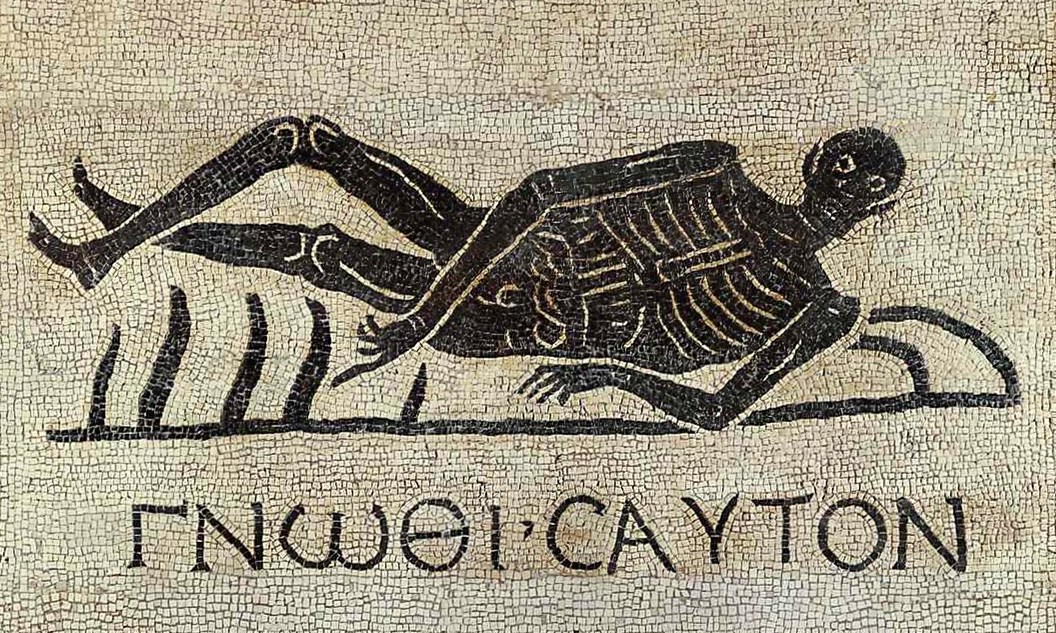
The famed ‘Know Thyself’ Roman mosaic (ca 30 BC-14 CE), Naples Museum
Know Thyself[sword] The first application of the phrase to self-knowledge in the modern sense occurs in Plato’s Phaedrus, in which Socrates says that he has no leisure to investigate the truth behind common mythological beliefs while he has not yet discovered the truth about his own nature.
Wenceslas Hollar, The Golden Mean 1641-1644 (circa)
Nothing in Excess/Nothing too much[scales] The maxim has been said to have received its ‘ultimate expression’ in Aristotle’s theory of ethics, according to which every classical virtue occupies a middle place between the two extremes of excess and deficiency.
Concordia detail, Sienna mural
There was also a third maxim inscribed:
Give a pledge and trouble is at hand The Greek word ἐγγύα, here translated “pledge”, can mean either (a) surety given for a loan; (b) a binding oath given during a marriage ceremony; or (c) a strong affirmation of any kind. Accordingly, the maxim may be a warning against any one of these things. In Plutarch’s Septem sapientium convivium, the ambiguity of the phrase is said to have “kept many from marrying, and many from trusting, and some even from speaking.” [Wikipedia]
Among other things, which I’ll get to, the cord around Justice’s neck may indeed have to do with being bound to one’s word – or to one’s silence – especially in monetary and matrimonial matters (Libra).
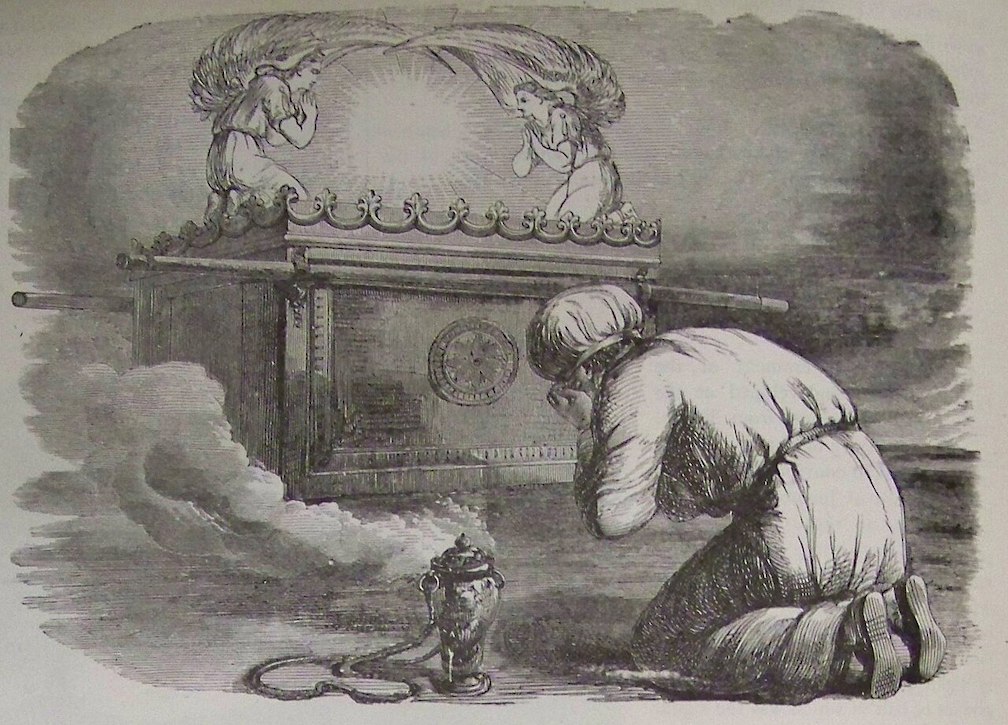
Mercy Seat, The Holman Bible, 1890 (note the curved angel wings are like bull horns).
Lady Have Mercy
Inside Solomon’s temple was something called a ‘Mercy Seat (hilasterion, “that which makes expiation” or “propitiation” for the removal of sin), which, according to the Hebrew Bible, was “the gold lid placed on the Ark of the Covenant with two cherubim at the ends to cover and create the space where Yahweh appeared and dwelled. This was connected with the rituals of the Day of Atonement.” (Yom Kippur, occurring in Libra season).
Oh my heart which I had from my mother! O heart of my different ages! Do not stand up as a witness against me, do not be opposed to me in the tribunal, do not be hostile to me in the presence of the Keeper of the Balance!
~ Egyptian Heart Prayer
Here the lines between Justice and Judgement start to blur, and the two often get conjoined when deciphering the meaning of this card, as was the intent of Italian civic hall murals. The difference is that Judgement (or Last Judgement) is a final verdict, whether it’s pronounced in a court of law or standing before a supreme being. Justice is about honing an inner sense of self-regulating equilibrium, guided by the understanding that we will ultimately face some kind of ‘judgement’ by the god(s) of our higher conscience – maybe not hellfire or pearly gates but ‘damned’ or ‘blessed’ to live in the kind of world we helped create. They are closely intertwined, but differing concepts.
Sienna mural and Pierre Madenié details
In the ancient Greco-Roman world, supplication – begging for the sparing of one’s life, on the battlefield, for example – involved a specific set of gestures; the supplicant, on their knees (submissive stance), would clasp the dominant’s knees (they can’t walk away), reach up to clasp their chin (they can’t look away) and beg for mercy.
It’s been suggested that the scales rest on Lady Justice’s knee and are being tipped slightly. As well, the collar of her wimple, which again harkens back to our Sienna mural, has started to look a bit like hands. These are the type of details people often write off as ‘printing mistakes’, but might they have had a mnemonic function? In fact, during the Renaissance, Justice was sometimes depicted in a more gruesome way – as judges with severed hands.
Visconti-Sforza Justice, c 1450
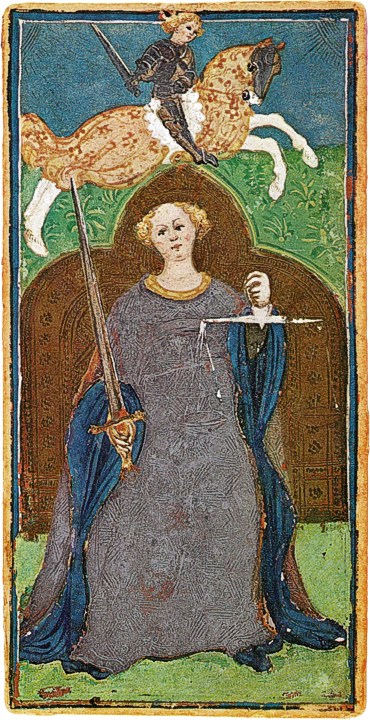
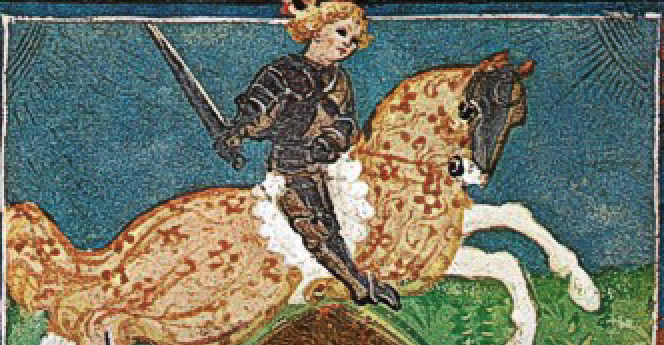
We can back up this notion of ‘having mercy’ with another Justice card, the Visconti-Sforza. It’s an anomaly in the deck (unless the original other two Virtues were also illustrated thus), in that the gold background does not go all the way up, but instead creates a throne back or triptych shape, while over her head leaps a knight on a white horse. Likely this figure represents the chivalric code of the Arthurian knights, who, while charged with enforcing justice, were also required to ‘be just,’ ie, to act from their higher consciousness and show mercy whenever possible, rather than give in to brutish impulses. This is in keeping with the idea of Temperance, also. We know that the Arthurian legends were extremely popular in Italy (some having been illustrated by Bonafacio Bembo, who painted the cards).
That this ‘hero rider’ – the solar hero – is situated above the Virtue’s head brings to mind Athena (wisdom and strategy, with violence only as last resort) who was conceived in and born from Zeus’ head (intellect). The virtuous knight here takes the role of divine wisdom, by which lady Justice is guided, as in the Sienna mural.
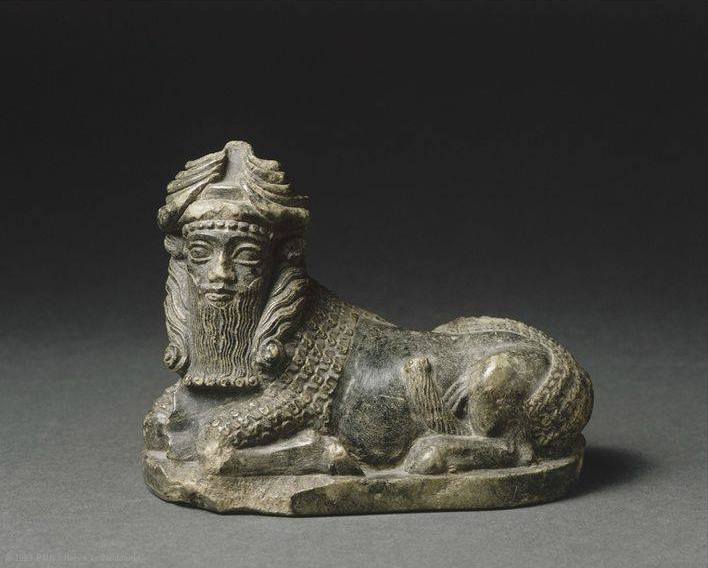
Recumbent bull with man’s head. Mesopotamia, c. 2350–2000 BC. Louvre
The Bull of Heaven
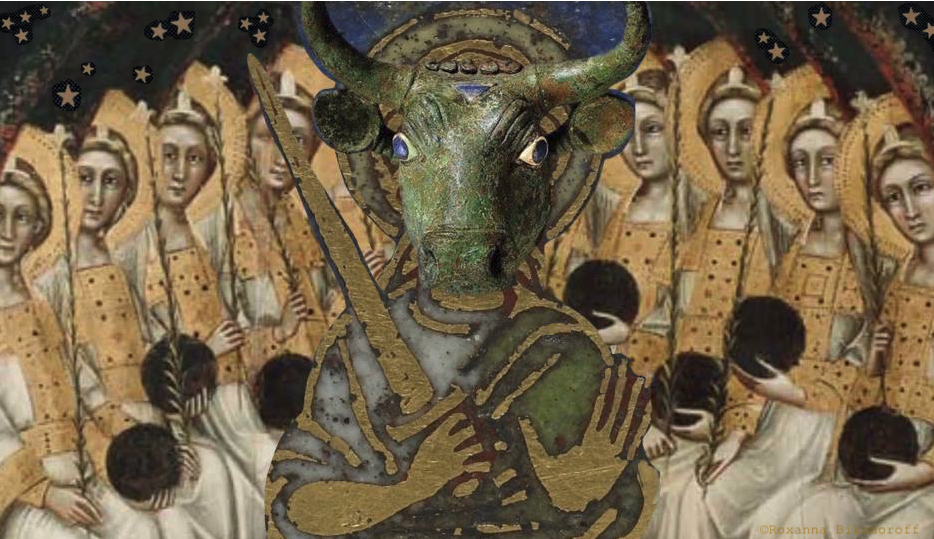
Let’s turn now to TdM Justice’s turbaned crown, up above the spheres. Although upside down, there is no mistaking the symbol for Taurus the bull, its horns cleverly formed by the interruption of her hair. The bull is a vehicle and/or attribute of any god or goddess worth their salt, particularly when they are acting as supreme judge. The two horns of the bull serve the same function as two pillars, maintaining stability and equilibrium.
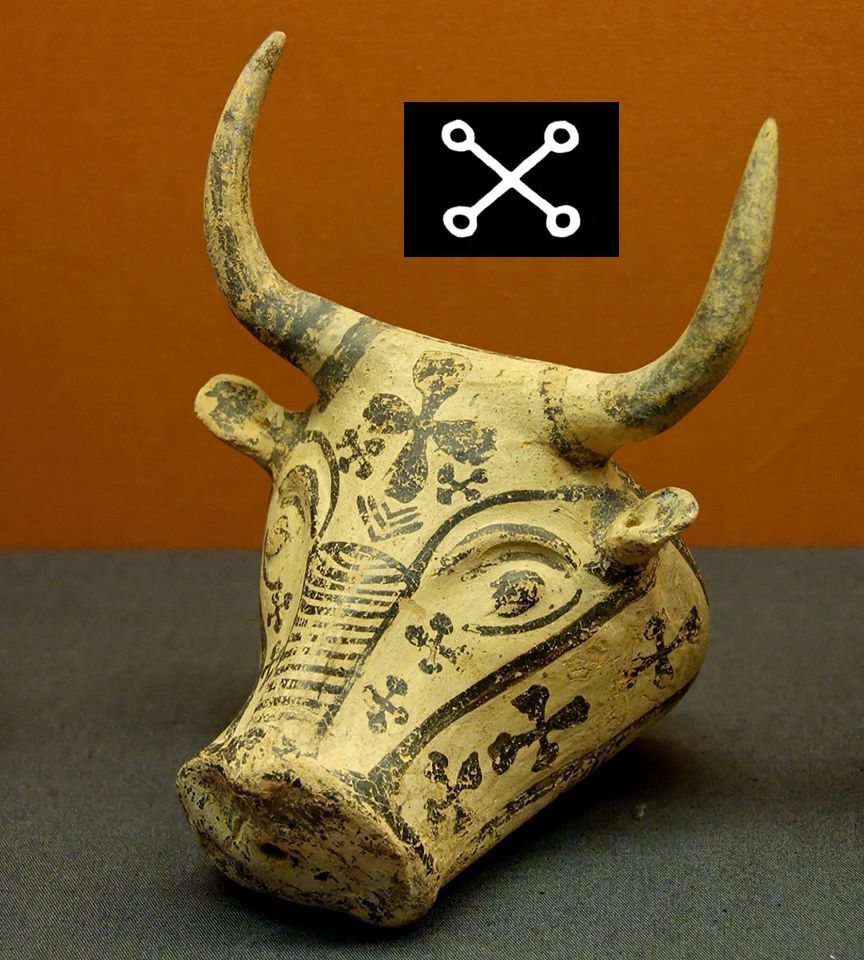
Mycenaean rhyton 1300-1200 BC, with sigil for Aldebaran (Agrippa)
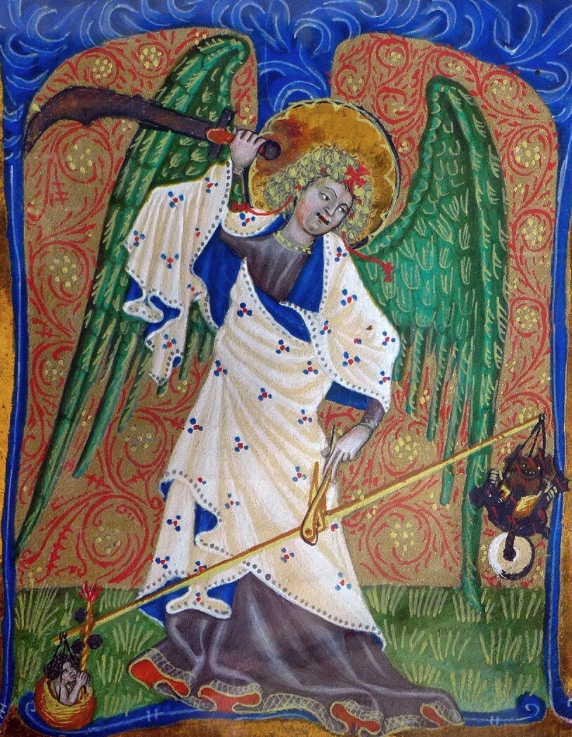
Central and level with the ‘sun and moon’ pillar bulges is the all-seeing, monadic eye in Justice’s bull crown. We are reminded of the ‘Bull’s Eye’ (aka ‘God’s Eye’) in the constellation of Taurus, Aldebaran, the watcher in the East. This royal star was once connected to the Spring Equinox (opposite Autumnal Antares, Heart of the Scorpion) and rises with the Pleiades aka ‘Seven Sisters.’ Aldebaran is associated with St. Michael, whose name is the rhetorical question he posed to Satan: ‘Who is like unto God?’ Might this be what Justice is asking? Could the rider of the V-S card also be a stand-in for St. George, chivalric incarnation of Michael the dragon-slayer?
St. Michael weighing souls during the Last Judgement, 15th c
After 7 steps (or stages, or planetary spheres) we arrive at Justice, and 7 steps from Justice is the Devil. “If then you do not make yourself equal to God, you cannot apprehend God; for like is known by like.” If Justice is to be impartial in her judgement, she’s going to need that third eye.
The following is an excerpt from a fictitious 1490 dialogue by Italian doctor and humanist, Battista Fiera, between the painter Mantegna and the allegorical figure ‘Momus,’ on how to depict Justice. Mantegna, having heard conflicting accounts, has ‘consulted a series of philosophers’:
Mantegna: I began with Saxus Hippolytus. He said Justice should be represented with one eye; the eye being rather large and in the middle of the forehead; the eyeball, for sharper discernment, deep-set under a raised eyelid.
Momus: Suppose something happened behind her back? Might she not be taken in the rear? Will she be safe enough with only one eye in front? . . . If she had an eye at the back as well, she’d be still more queenly and majestic.
Mantegna: Erasmus the Stoic [said] . . . that she ought to be shown seated, and holding scales in her hand. “But . . . make her one-handed.” “So that she couldn’t throw in a makeweight, of course.” [Marianus] instructed me to depict her standing, and with eyes all over her as Argus was of old. . . And brandishing a sword in her hand to ward off robbers, and to protect the innocent and the unfortunate . . . Astallius said she should be depicted sitting on a square marble chair with a slightly curved back, such as there was once at Lesbos, and measuring with a leaden rule.
Momus: To be sure, his was a milder image of Justice, since he left out the menacing sword; and he had good reason to fear she might have a fall. But why the leaden rule? Did he mean that Justice is sometimes twisted? For is not the common herd, remembering her waxen nose, loud in proclaiming that she is?
Mantegna: No, he didn’t mean that she is twisted; but he said she was to govern with equity – now and then to slacken the reins.
Momus: What did Fiera say?
Mantegna: [H]e enjoined me to depict her covered with ears as well.
Momus: Why? Was he afraid that she might become deaf?
Mantegna: He was . . . [and Astallius and Fiera also said] that Justice was to put on the habit of a penitent . . .
Momus: So, they want her to be mortified! But didn’t it occur to them to give her wings?
Pierre Madenié 1709 and Giovanni Antonio da Brescia 1475-1520 (note her foot shape).
The dividing line created by the bar of her scales can also be viewed as the horizon itself, where the cusp of Libra begins the Sun’s descent. The Pierre Madenié card provides another interesting detail; the handle of the scales is shaped like a divider compass (see Star post).
In the Bolognese card, below, Justice’s scales hang from a globus she’s holding, similar to the Empress. This detail is consistent with emblems of Divine Justice, where her foot rests upon a globe. Like the TdM version, her lower half is weighty, grounded on Terra Firma, but in this case, she is Nature, ie, natural law, natural order, as above, so below. If we zoom in closely, there is what appears to be a little, bull head shape on her collar. Remember that Taurus is the sign of FIXED EARTH.
Alla Torre Justice card and Cesare Ripa Divine Justice
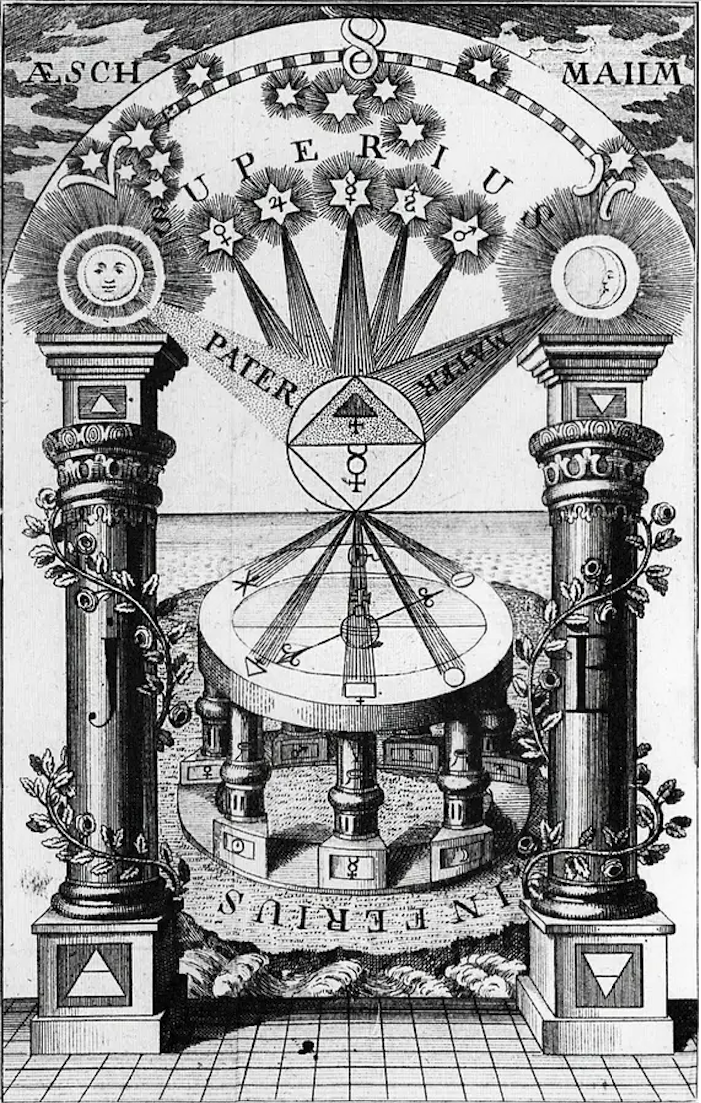
In the Rosicrucian image below, we can identify some similar components to the TdM Justice card, such as the two pillars of Wisdom (solar/father/fire/air and lunar/mother/water/earth). The above is as below, and the heavenly bodies shine onto a (directional) compass. In its centre is a globus cruciger, symbol for antimony (see Empress card) which is used in the purification of gold and silver, a material and spiritual process.At the very top is the symbol for Taurus, with Aries on the left, Gemini on the right. May, high Taurus season, when the Earth is most fecund, is when alchemists collect their dew, (again, Empress/Nature).
‘The Compass of the Wise’ frontispiece for a rare book on Freemasonry and Rosicrucianism by German author Adam Michael Birkholz, 1779
Mithras
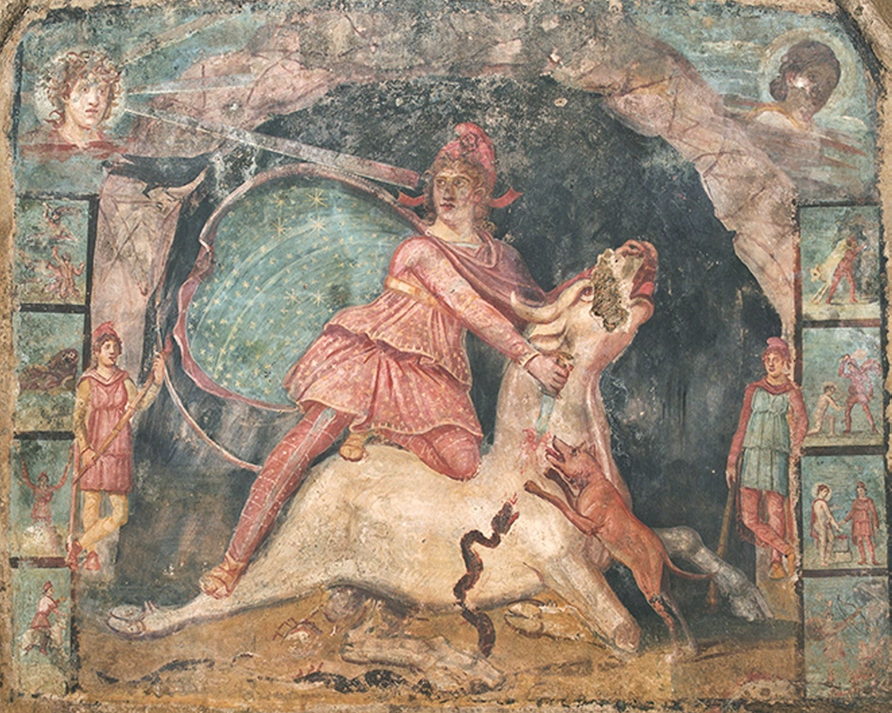
There is also a connection of these three Spring signs (Aries, Taurus, Gemini) to the Mithras Mystery Cult. Personally, I’ve never really jived with the brutal Tauroctony image – symbolic though it may be – central to every mithraeum in this exclusively male cult of Ancient Rome (2nd-3rd c). However, it is relevant to our topic. Originally, the Iranian god, Mithra was not associated with bull-slaying. Mithra is initially ‘an ancient Iranian deity of covenants, light, oaths, justice, the Sun, contracts, and friendship. In addition to being the divinity of contracts, Mithra is also a judicial figure, an all-seeing protector of Truth…’As the god of contract, Mithra is indeceivable, infallible, eternally watchful, and never-resting.’[Wikipedia]
Tauroctony fresco from a Mithras cave
Mithras is always accompanied by a pair of torch-bearing attendants, the Dadophori, a pair of ‘mini Mithras’ resembling the Dioscuri (Gemini). One holds his torch upwards, the other downwards, interpreted as the rising and setting Sun (life and death), creating a triad with the central solar god at the height of his power (noon) in the middle. They may also have symbolized the equinoxes. The slaying of the bull has been interpreted as the procession of Spring Equinox from Taurus to Aries (ca 2000 BC).
V-S detail
Interestingly, if we zoom in on the Visconti-Sforza Justice card, we can see the solar knight is also situated between two luminaries or suns. [Corner ‘suns’ were often just decorative, for example in the Bolognese tradition, but that was more than a couple of centuries later, and as noted, the background of this card is an anomaly.] And while we’re on the subject, does the TdM Justice’s hair not resemble torch flames?
“Within the Christianised zodiac, Taurus the bull was seen as an image of Christ in his role as the incarnating god, sacrificed in the redemptive act. Having rulership over the throat and vocals, Taurus was used in the secret zodiacal symbolism of Christianity as a symbol of the incarnate word ‘the Logos.” [Fred Gettings, The Secret Zodiac: The Hidden Art in Mediaeval Astrology]
Taurus was the word descending into matter/flesh, Pisces the ascent of the spirit back to the heavens.
“Thus the death of the bull was the birth of life, and for this reason took its high place in the ceremony and art of the Mithraic cultus.” [ccel.org]
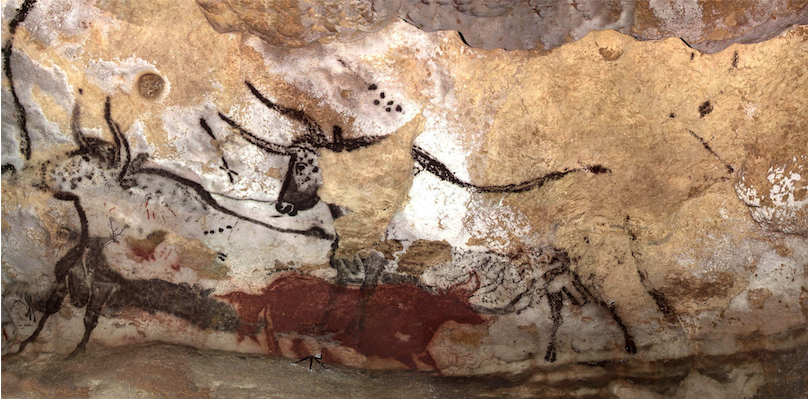
Lascaux Cave Bulls/Taurus constellation: ”Plus ça change, plus c’est la même chose.”
Some say that the Roman cult of Mithras, a ‘cult of the Sun that began as a personal process in the darkness of a sacred cave’ was assimilated into Masonic traditions of the Middle Ages, or at least influenced them (he was born from a stone, after all). This purification ritual involved traversing 7 steps of his mystical staircase (possibly while on bended knee and blindfolded), corresponding to the 7 planetary spheres, in order to reach the Phrygian cap, a sword and a crown. Mithras, in the 8th sphere, represented cosmic order.
Remnants of the olde religion?
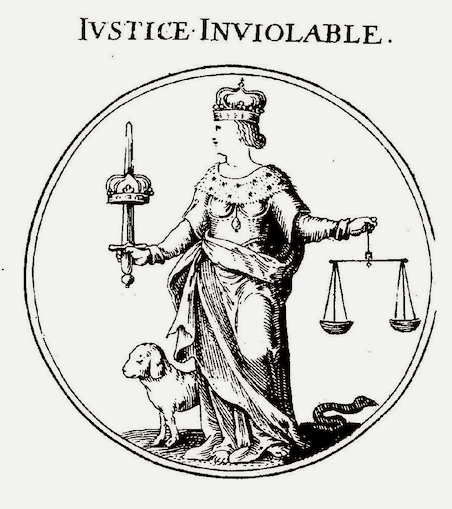
Curiously, Ripa later includes the dog and snake in his emblem of ‘Inviolable Justice,’ to symbolize how friendship and hatred can both corrupt good judgement.
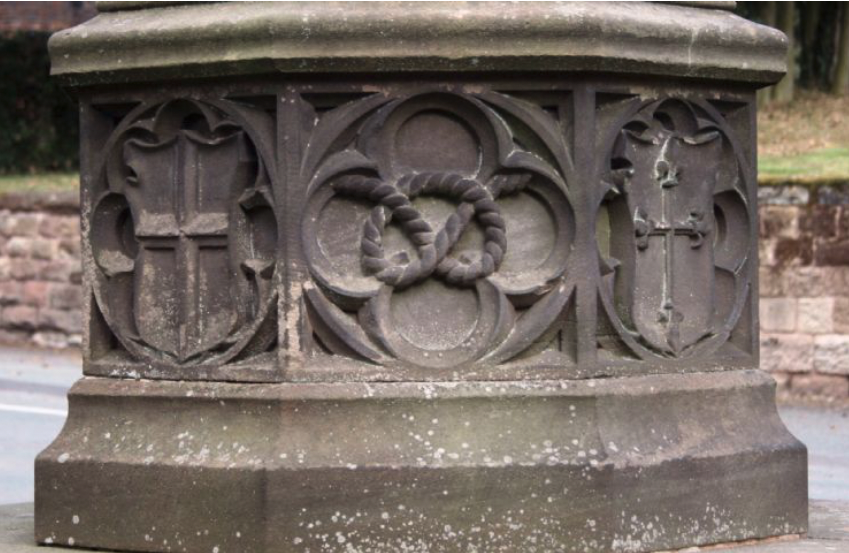
Masonry’s knotted cord
The Cord that Binds and Measures
Lastly we come to the golden rope or chain around TdM Justice’s neck. There are a few possible meanings for it. The most obvious explanation is that it’s to gently remind would-be criminals with, lest they should end up swinging like Le Pendu. However…
The English word ‘noose’ comes from the Old French ‘no(u)s’, from the Latin word ‘nodus’, meaning knot. But ‘nous’ was also the Ancient Greek concept for the higher, divine intellect, the mind’s eye that is the God’s eye. According to Aristotle, nous is the intelligence ‘which apprehends fundamental truths (such as definitions, self-evident principles).’
‘Each intellectual virtue is a mental skill or habit by which the mind arrives at truth, affirming what is or denying what is not.’
[The cord connecting the two, Pisces fishes is called a ‘Nodus’, or ’Nodus Coelestis’, the Heavenly thread.]
Soprafino Justice with bleeding eye
Returning to the ‘Allegory of Good Government’, recall it is also the cord (or a portion of it) that binds Justice to Concordia.
There is an unseen cord that binds The whole wide world together; Through every human life it winds, This one mysterious tether. There are no separate lives; the chain Too subtle for our seeing, Unites us all upon the plane of universal being.
~ Small Talks on Freemasonry, Joseph Fort Newton, Masonic Service Association of the United States, 1928
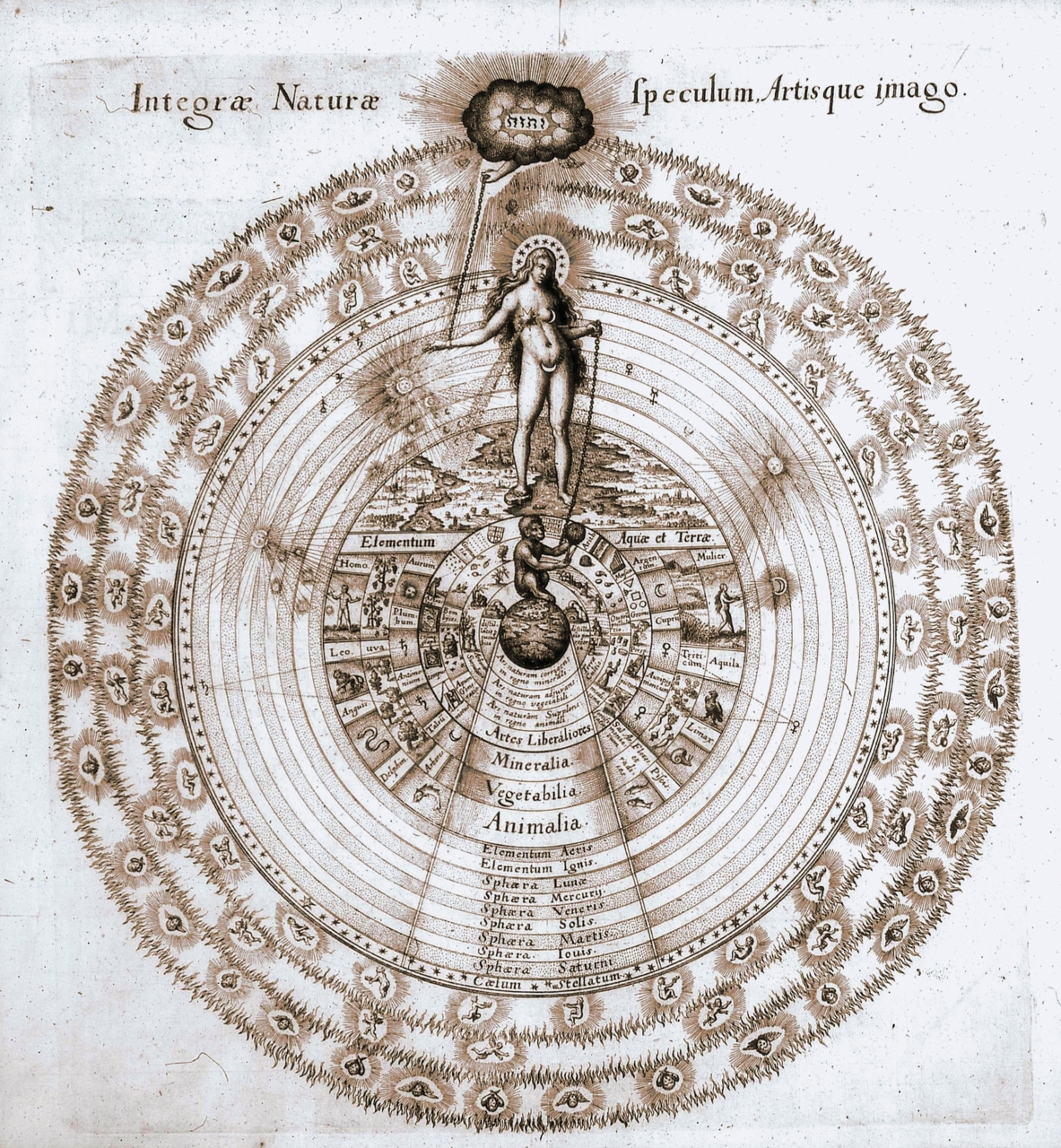
If it’s the golden chain she wears round her neck (no reason it can’t represent both), it is probably the one by which Heaven and Earth are connected. To alchemists, this chain represented a series of transformations ‘from elemental chaos to quintessence’:
“Since all things follow one another in continuous succession, descending in order to the lowest, it will be found, by one who observes closely, that from the highest God to the lowest, all are bound together by mutual links, and the connection is nowhere broken. This is Homer’s golden chain, which he says God commanded to hang from heaven to earth.”– Macrobius, Commentary on the Dream of Scipio.
Integrae Naturae Speculum, Artisque Imago (Mirror of the whole of nature and the image of art), created by Robert Fludd, 1617. [click to enlarge]You can kind of see a resemblance with the Anima Mundi here to a large, mediating figure of Justice, situated between heaven and earth, overlapping the planetary spheres. In place of sword and scales are two sections of the chain. Although she embodies both solar/masc and lunar/fem, the ‘world soul’ (like any soul) is considered feminine, and of this we are assured by the second lunar crescent in her pubis.Note also that the ape (reminiscent of Thoth?) uses a divider/compass.
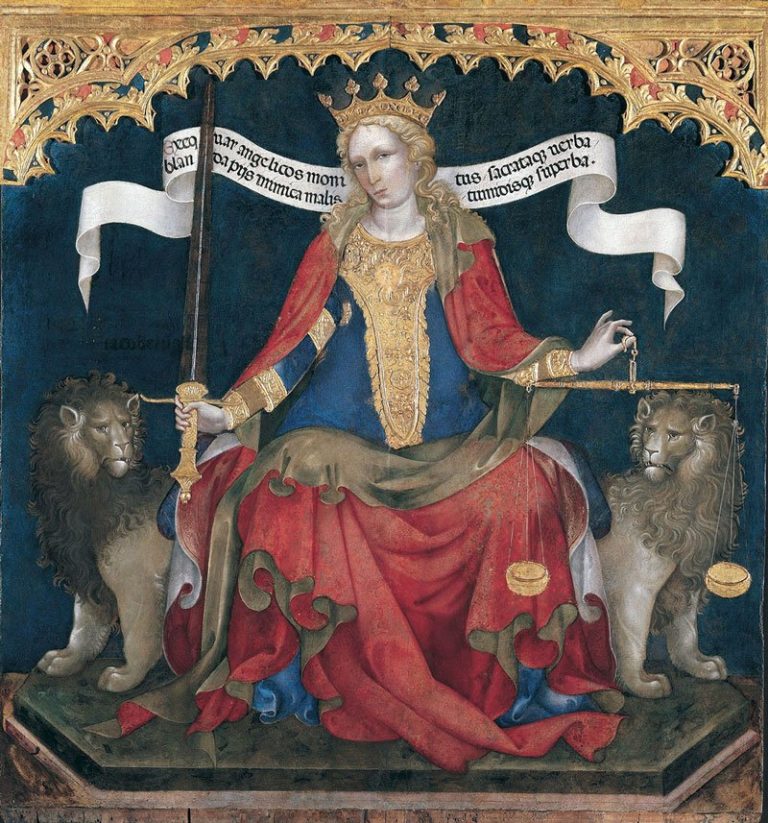
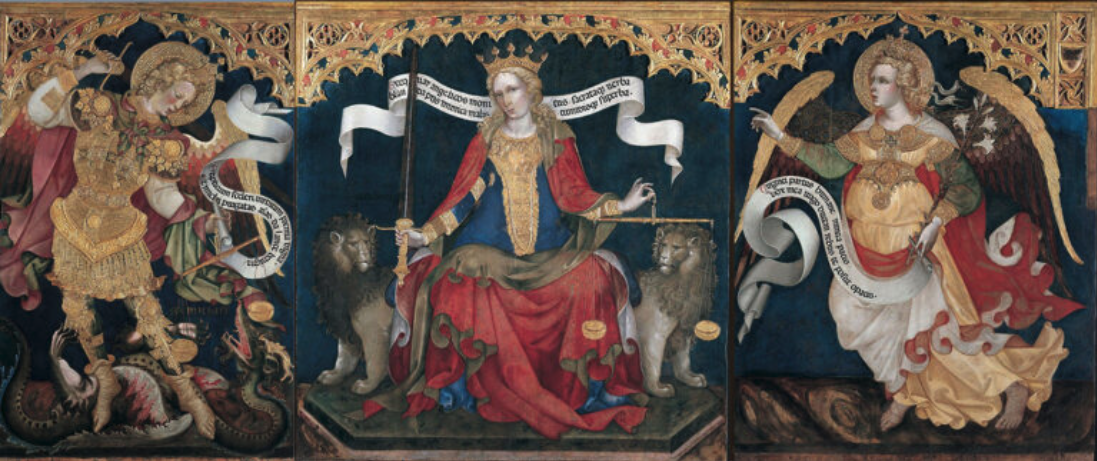
Jacobello del Fiore, Justice, part of triptych, 1421 (Gallerie dell’Accademia, Venice).
Finale (finally!)
Perhaps my favourite Justice painting is another very fine Italian Renaissance depiction, where her divine and civic forms meet:
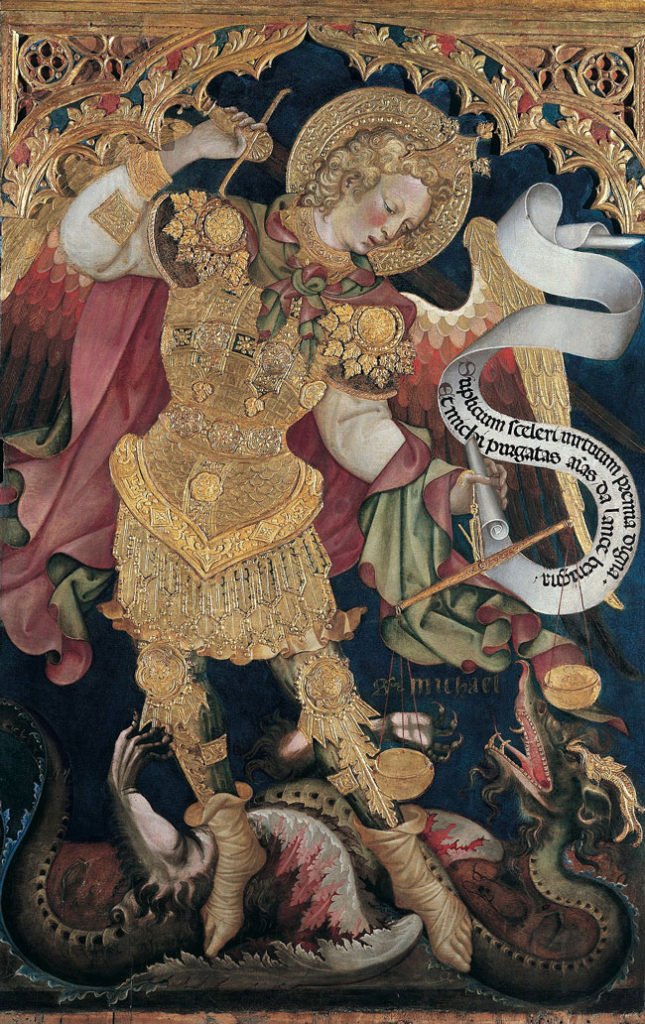
“Justice is the primary virtue claimed by the Venetian state, and the lions allude to the justice and wisdom of Solomon. The female figure of Justice had even come to represent the personification of Venice herself. This identity is confirmed by the presence of Saint Michael in the left panel, minister of justice at the Last Judgment, who is shown in the act of unsheathing his sword to strike the final blow to the dragon beneath his feet and asks the enthroned Justice to “reward and punish according to merit and to commend the purged souls to the benign scales.
Jacobello, St. Michael
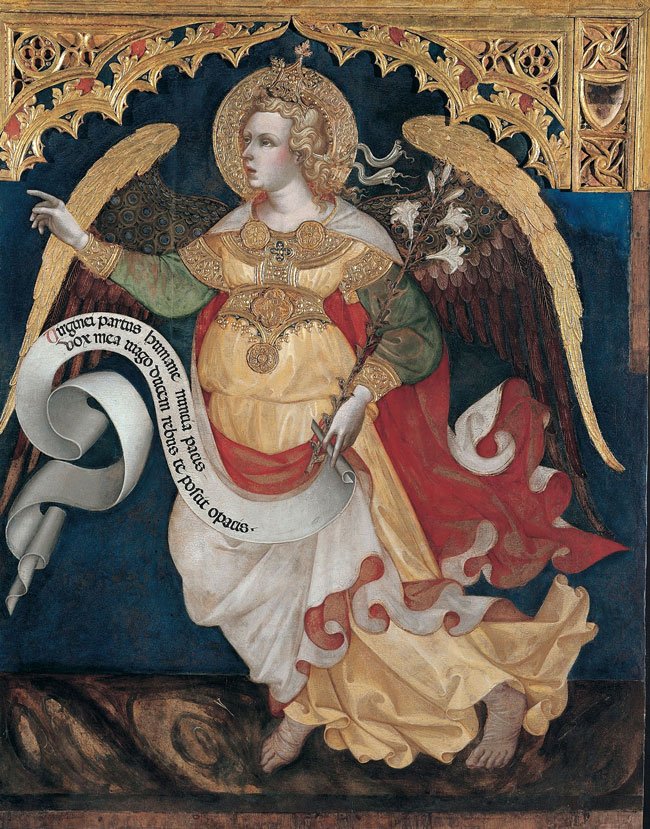
The Archangel Gabriel, bringer of peace, is depicted in the right panel, holding a lily in his left hand as he raises his right hand toward Justice in a gesture of benediction. Venetian legend professes that on the feast day of the Annunciation, when Christ was conceived for the spiritual salvation of humanity, God decreed the foundation of the city that was to offer political salvation to the Christian world following the fall of the pagan Roman Empire. In the allusive complexity of its self-representation Venice came to celebrate itself as a virgin city, never having been conquered, never violated. Jacobello’s figure thus acquires a complex persona, at once Justice, Venice, and the Virgin Mary.” [savevenice.org]
Jacobello, Gabriel
For a Tarot analogy, we could say she is at once Justice, the World and the Empress (and throw in Strength, too). As with many paintings of the time, it can also be interpreted in alchemical terms; Michael on Justice’s right, sword in his right hand, slays a black dragon, ‘fixing’ the volatile Mercury or breaking down prima materia, while a feminine Gabriel on Justice’s left wears a white cape and holds the white lily of purification in his/her left, the ‘white queen.’ The inside of his/her wings are even lined with peacock feathers.
All the colours of the alchemical stages are represented; black, white, [peacock], gold and red (see Michael’s wings, also). The complete and balanced Virtue wears a five-pointed crown (quintessence), the gold sun of wisdom and enlightenment on her chest (echoes of Athena’s aegis), and a red cape to match Gabriel’s white, signifying the union of opposites, integration of the soul, marriage of heaven and earth; the perfected work.~rb
Jacobello del Fiore, Justice between the Archangels Michael and Gabriel, 1421 (full)
In case you’ve been too preoccupied with the whiplashing American news…
Formidable seismic activity began occurring on Feb 5 in Greece’s most popular tourist destination, Thira (aka Santorini) and people are being evacuated from the heavenly island in droves. Some old timers are choosing to stay, being fatalistic…perhaps they will take care of the animals left behind. All those cats! Authorities are saying there is ‘no need to worry’ about volcano eruptions. Hmm….I wonder.
Of course, seismic activity in the Greek Islands and the surrounding seasis attributed to the Titan God, Typhon, who, after a long and bloody battle, Zeus managed to seal up under Mt. Etna, a still very active volcano on the east coast of Sicily (Prototype for St. Michael and Satan). Still rattling his chains and fuming, Typhon is responsible for typhoons, tsunamis, quakes, volcanos, plagues and other such disasters. But in the mytho-alchemical sense, Typhon is like Mercury on steroids, similar to Uranus being called the ‘higher octave’ of Mercury and having the effect of creating sea changes. For example, when the Greek gods fled Typhon into Egypt, where they donned animal heads/masks for disguise, the great Pan jumped into the sea, transforming via crisis into our Capricorn sea-goat. Part 3 of this post about the TdM Devil goes into this Typhon material.
Detail in map of the Underworld, showing Typhon under the volcano.
As it turns out, there is a trans-Neptunian object (TNO) named after him, as there is for everything – a binary system (it has a Moon) – currently at 28 Scorpio. Athanasius Kircher had once associated Typhon to this sign.At the moment of the first quake, TNO Typhon was/is opposing Uranus and Moon conjunct at 23 Taurus (earth).
I have long ‘intuited’ 23 as being Uranian in nature due to the discordant vibration of this prime number that reduces to 5. Today this is actually a commonly accepted idea. Lately, with Uranus having just stationed direct at 23 degrees of Taurus (typically a sign that thrives on harmony), you must admit, there has been quite a lot of discord! We can’t but acknowledge the POTUS’ wrecking ball nature, with his North Node closely flanked by Sun and Uranus – his most elevated planet – in Gemini. (Both Muck and his outspoken 4 yr old Mini-Me also have Sun-Uranus conjunctions). The number between 45 and 47 is 46, which, divided by 2 is…23.
Barry Blitt’s ‘Anything but That’ …at 23rd St??
This isn’t to say 23/Uranian discordant energy is necessarily always bad, but it is often shocking – you don’t see it coming – and has the effect of breaking up the harmonic order it refuses to fit into.
Returning to the main theme, Typhon, I also learned that astral Typhon was discoveredFeb 5, 2002 – exactly 23 years to the day of this earthquake! (Yes, tremors started earlier, but it’s not an official quake unless it registers 5. on the Richter scale). Very mysterious, especially with Typhon’s distinctly serpentine attributes and it being a lunar EARTH SNAKE year.
Stamp featuring Zeus and Typhon duking it out
But is there a deeper meaning to all this, not just some wow-conspiracy-theory-sounding-coincidence? We have to remember that the Underworld, to the Greeks, was not yet the Hell of Christianity, although it did have a section like this for bad people and monsters, called Tartarus. Rather, Hades was an inverted, somewhat depressing mirror version of the above world of the living. Pluto is simply dark Zeus (also Dionysus, but let’s keep it simple).
Uranus, named after the sky itself, gets and sends its energy from the beyond the Saturnian sphere, ‘out of the blue’, often taking the form of inspiration (Urania) or strokes of genius. It’s fiery/airy. If Uranus is the higher octave of Mercury, then its ‘messages’ are going to come faster and more intensely. Typhon, similarly, rears up from deep below, sending shocks in the form of earth or water events, rocking our physical foundations.
Giulio Bonasone (Italian 1531-76), Jupiter, Neptune and Pluto dividing the universe. MET
When Jupiter and his two ‘brothers’ (actually all aspects of the one triplicity) cast lots and divided the realms, Neptune didn’t just get the sea, but the whole ‘middle realm’ where the other two worlds meet. We currently have the North Node conjunct Neptune in Pisces, trine Typhon/Scorpio, sextile Uranus/Taurus. Meanwhile, Pluto, Lord of Hades is in Uranus’ fixed air sign of Aquarius. We look to global events for clues to how and where the planetary aspects are manifesting. Greece is where our western ‘civilization’ began, The surrounding seas and islands are literally the realm of the old gods. Seems to me that some very shape-shifting, powerful chthonic and cosmic forces are at work or perhaps even doing battle, their combined effect being felt acutely by us middle-realm dwellers. Perhaps the frequency of 23 provides a conduit. ~rb
In the next instalment I will further explore 23 and Uranus in the charts of various air disasters.
The Hanged Man/Le Pendu is surely among the most disturbing and evocative of the Tarot triumphs. He’s undergoing torture, but seems unwilling to reveal anything about his inner experience (I almost titled this piece, “We have ways of making you talk,” but this is now the title of some TV series). As it turns out he’s got a LOT to communicate to those who have crossed the threshold (XI) of Tarot’s ‘greater mysteries.’ Think of him as the babbling head of Orpheus. So let’s dive in, head first and dissect this frightful, human pendu-lum from toe to head; his mytho-alchemy, number symbolism, religious/cult connotations and more!
Charles VI Tarot (15th c) Note the 3 and 4 pegs beside his bags.
HUMBLE BEGINNINGS
Formerly called ‘The Traitor,’ the figure initially held a sack in each hand, presumably containing money he either stole or acquired in a dubious exchange (such as bribery). In the Charles VI card (above), he almost looks like he ran into a trap, baited with the dough. The image is thought to be modelled on pittura infamante(‘shame portraits’) of the Italian Renaissance – horrifically, this punishment was actually inflicted on criminals and Jews. We could also imagine these ‘hermetically sealed’ bags as containing something secret (like the Fool’s bindle) that he won’t release, even under duress – alembics, if you will. In some Minchiate decks (cousin of Tarot), he is simply holding two roundels and is cleaned up to like an acrobat/jongleur.
Although he wasn’t hung thusly, it is also perhaps a reference to Judas Escariot, who was paid 30 pieces of silver for betraying Jesus to the Romans. Silver is the Moon’s metal, gold is the Sun’s, and Christ, the other twin, is characterized as solar/gold – similar in the nocturnal/diurnal sense to Dionysus and Apollo, who both ‘possess’ Orpheus at different times.
Visconti Sforza 16th c, Jacques Vieville 17th c, Nicholas Conver TdM 18th c
In the Visconti Sforza card (left, above), the calm, golden-haired rendition, similar to our TdM figure emerges. We see no money bags (did he even commit a crime?) and his hands are now hidden (tied?) behind his back. If we zoom in, we can see red ‘flames’, ie, life force, dripping from his clothing. Obviously fire doesn’t drip, blood does, but it’s shaped like flames, similar to the red plume escaping from the Charles VI figure’s leg. These flaming blood drips are transferred to the cut branches of his gibbet in TdM.
Beneath his head, just touching his hair is a pool of blue water – again, we are reminded of the head of Orpheus, thrown into the River Hebron, by the maenads. His leggings are green, the colour of new life, yet to ripen, and his very prominent gibbet now resembles a golden doorway. Because of how his leggings seem to be ‘chomping’ him, this card always reminds me of the alchemical Green Lion devouring the Sun image (below), said to represent vitriol (sulphuric acid) dissolving gold.
V.I.T.R.I.O.L. or V.I.T.R.I.O.L.U.M. (‘visita interiora terrae, rectificandoque, invenies occultum lapidem’, or ‘visit the interior of the earth, and purifying it, you will find the hidden stone.’ This is another way of saying, ‘look within yourself for the truth’). This phrase must be present in all Masonic chambers of reflection directly facing the candidate.
Visonti-Sforza hanged Man and Alchemical Green Lion devouring the Sun
In the Vieville version (middle) the number is printed/situated so that we must turn him ‘right-side up’ to read it correctly, thus also bringing the Lunar and Solar mounds either side of his large-ish head into view. Note the Solar mound also contains the planetary spheres. His fingers seem to sprout like angelic wings from his shoulders, symbolic of Mercury elevating the spirit to the realm of the gods (we see this detail in Noblet, Dodal, and Chausson, also). As with the Marseille card, his gibbet now shows 6 cut branches on each side, only here the middle piece upon which he lands or dances has 4.
The Hanged Man dangles by his foot, not unlike a bunch of grapes clinging to a vine, and his wild hair in the TdM version does seem to evoke Dionysus. (Christ purportedly claimed to be ‘the true vine’, unlike that Pagan weirdo).
Grape flavoured Gods: The Wine Press by John Roddam Spencer Stanhope and Pompeii fresco Dionysus (both details)
ALCHEMICAL SCAPEGOAT
Ascending while or following descent is often expressed in myth by the ordeal of a [solar] god – Odin obviously comes to mind in relation to this card, but so do a few other resurrected or ‘twice-born’ gods. The Bacchic-Orphic mysteries also elude to a kind of simultaneous ascent-descent described as ‘rushing into milk’ (‘a bull, you rushed into milk’) or ‘falling into milk’ (‘a kid, I fell into milk’), found on a few of the gold tablets buried with initiates.
Alma Nungarrayi Granites, Seven Sisters MilkyWay Dreaming
Too involved to go into here (please check out the Orphic link posted above the three Pendu cards, if you want to know more), but ‘milk’ is thought to refer to the Milky Way and/or Paradise. Initiates would descend to the Underworld after death, where they were to tell the guardians they are ‘a child of the starry heavens, as you yourselves know,’ have been purified and wish to now return to their rightful place in the stars with their family of gods and heroes.
The Vieville card seems to elude to this concept, with its addition of heavenly spheres. He’s done or doing time here in human form, but will return. You decide which deity.
Ascend and descend: Franchises Gaffurius, Practica Musicae frontspiece, 1496
Aside: I asked musician friends for an example of ascending and descending notes being played/sung simultaneously, in order to possibly better comprehend the card on an emotional level, and was directed to JS Bach’s Chorale Harmonizations. These are just snippets, but have a listen.
In the classic Conver ‘type II’ version (right, above, next to Vieville), the mounds are just slightly differentiated and there is only one cut branch in the middle bough which has been reinterpreted as a little spoon, making 13.
For stirring up? Or making libations of wine on sacrificial victims?
Addendum: I only recently noticed in the Charles Cheminade deck (middle detail, above), one of the oldest existing type 1 TdM examples, the rope our Pendu hangs by is shaped like a spoon, so it must be a reference to the Fool and the ‘ultimate transformation’ process at hand.
His mane is firey like the Sun and his blue leggings are watery, so either things are upside down or the Sun has essentially sunk. A fallen angel? Or a drowned person with hair flowing in the water?
The Death of Orpheus by Jean Delville 1893
In alchemy, oftentimes what is meant by fire is sulphur and by water, mercury. These are the two prime materials or principals which, along with salt were the three ‘heavenly substances,’ or tria prima – philosophical elements, which, combined with the four classical elements, were thought to be the basis of everything. (3 + 4 pegs in Charles VI card, Empress + Emperor). It’s a bit confusing, because philosophical Mercury is spirit, even though it’s equated with water, and sulphur is soul, although it is fiery. Salt is the physical body. Think of the salt in an hourglass, Le Pendu being like a human version.
XII Le Pendu/The Hanged Man is the middle ‘3’ card (1+2=3); the first being III The Empress (3) and third being XXI The World (2+1=3). Previously, I speculated that The Empress represents the beginning of ‘the work’ and the alembic itself. (All the ‘3’ placement cards – III, VI, VIIII, XII, XV, XVIII, XXI – have this ‘combining’ theme).
‘From Me Life’ from a 1717 treatise
In this wonderful illustration, God/Yahweh shines above the slogan A ME VITA (‘from me life’). Messenger/psychopomp Mercury floats just beneath, in spiritual/philosophical form, delivering the life force with his caduceus (pointing it heads downward), waking and overseeing the transformation of the vulgar metals below – each corresponding to a planet/luminary.(On the far left is his own metal ore).The solar and lunar trees have 7 ‘fruits’ in each (a set of parents for every metal?). The space between them forms an alembic shape. From each metal mountain, a stream leads to the fire in an egg-shaped, earthy furnace (watery and fiery purification). In the flames is an orb containing two opposite triangles of water and fire together in perfect union, with a monad (gold/divinity/totality, etc) in the middle.
Compare with Le Pendu, hanging between solar and lunar trees (best example being the Vieville), his firey hair ‘becoming gold’ in a bizarre, purification torture ritual. He ascends as he descends, like two triangles meeting.
Payen (type I) Empress and Emperor cards-early 18th c
The two imperial eagles are akin to the two triangles, yet to meet, eagle being emblematic of ‘the work’ and the process of transformation [Scorpio] that is yet to occur. 3 x 4 = 12. ‘Lovers don’t meet/they are in each other all along.’ [Rumi].
Vieville Temperance (c 1650) and Flamel Mercury (c 1330)
It is Mercury’s passive feminine divine nature, that allows the alchemist to transform one’s life and live more in harmony with the laws of nature. Mercury to the alchemist of today, is a symbol of the sexual waters of creation and the spinal fluid, that brings the carnal desires into submission of the divine mind. Once the alchemist understands the principles of Mercury (mind) and finds balance between its feminine passive force, and sulfur’s (soul) active masculine force, within his or her salt (fixed matter/body), he or she will become the philosopher’s stone, able to turn lead into gold at will. ~ The Wandering Alchemist
Watery Hanged Man from Dali Tarot
TOE-DIP INTO THE OCCULT
The Dali Hanged Man (above) is based on the Waite-Smith Tarot, but gives him the Hebrew letter lamed, in accordance with the French occult school, even though the Golden Dawn assigned mem to this card. Mem means ‘water’ and has to do with (self) reflection.
There are at least five different arrangements of Hebrew letters to Tarot triumphs, which to me makes the whole concept a bit wobbly-legged. Based on the accommodating nature of TdM and what I have read so far on the Hebrew letters, if there is anything to see here, it is likely much more fluid and nuanced than simply ‘this card = that letter.’
Nevertheless, to my limited understanding, the Golden Dawn (and Crowley) choice of mem rather than lamed for the Hanged Man is kind of fitting, considering the wateriness, although in terms of self-reflection, it also works with the Unnamed/Death card.
‘Know Thyself’ Roman mosaic, 1st c AD
Most of these schools agree that The Empress = gimmel, the third letter of the Aleph-bet. Although gimmel is never assigned to XII or XXI, it bears a phonetic similarity the word ‘gibbet’ (13th c French). The earliest pictograph for gimmel was a foot. Here are some meanings associated with the letter gimmel. Does it describe the Empress?
– Foot, Pride, Camel
– Lift up (above god = pride)
– The benefactor or the giver of charity; ‘A rich person running to give charity to a poor person.’ – ‘According to Kabbalah, the design of the gimmel is composed of two letters. The first is a vav, represents a person who stands upright. To the person’s left side is a yud, which signifies both the foot and the act of giving.’ – ‘He descended to die for us, he ascends to resurrect us. He is Jacob’s Ladder.’
That last one immediately reminded me of Philippe Camoin’s theory. Jacob’s Ladder was the original ‘Stairway to Heaven’, a hypothetical set of steps by which angels (and thereby souls) ascend and descend.
Philippe Camoin’s ladder insight
The ladder is also a Hermetic symbol of initiation into esoteric wisdom, via exoteric knowledge, the first step. This fits with the position of the card, directly following XI, the threshold of the ‘greater mysteries,’ and X, wherein a small portion of of a ladder (two rungs) forms the base of the Wheel. Camoin also points out a little ladder in the Fool’s bindle.
Dante Gabriel Rossetti, How They Met Themselves (1851-60)
THROUGH A GLASS DARKLY
Esoteric (from Greek ‘within’) is a kind of knowledge that is only realized by ‘meeting it half-way.’ This is different from occult (from a Latin word meaning ‘hidden’), which suggests something outwardly revealed. The difference is subtle, and the two words are often used interchangeably (pet peeve!), but I think the TdM Hanged Man/Pendu exemplifies the esoteric. Each will come to know him on their own, personal terms, by their own projections and reflections.
Since ancient times, mirrors of some material or other have served the function of water (reflecting self/lunar) and fire (reflecting sun/solar). An example of the latter is the concave mirror with which the solar, Olympic flame was lit.
Bacchic-Orphic mystery initiation was thought to involve a simulated death experience wherein one essentially ‘met themselves’. This transformative and purifying ritual, of which little is actually known, was to prepare initiates for the real afterlife ordeal. The fresco detail below depicts the use of reflection in a metal bowl (spiked wine all drank), combined with the comedic death mask. It could be actual or a metaphor.
Consider also how the TdM Pendu’s face also bears a resemblance to the snake-haired gorgoneion – the mask concealing the greatest mystery of all – and how the six, ‘bloody’ branch cuts on each side evoke Medusa’s severed jugular veins; one that flowed with the elixir of rebirth, the other, of death. The Hanged Man hovers in the threshold between the two.
A scary revelation, Villa of Mysteries, Pompeii
Excerpt snagged from an alchemy group thread:
“The purpose of the mirror was not to allow a person to contemplate himself physically, because scarcely was the mirror put down, when the person lost memory of his own image. The Mirror represents the Divine Spirit. When the soul sees itself in it, it observes the shameful things in itself and rejects them. … Once purified, it imitates and takes as model the Holy Ghost; it becomes spirit itself; calm possesses it and it turns continuously to this superior state in which it knows (the divine] and is known [by it]. Then having become without shadow, it divests itself of the chains that are its own and those it has in common with the body. And what is the word of the philosophers? Know thyself. – from Julius Evola’s interpretation of ‘La Chimie au Moyen Age’ and has been translated into English by E. E. Rehmus
The Hanged Man may not appear to be suffering in physical pain for the simple reason that he isn’t undergoing any or it’s not really the point of this exercise. Rather, the appearance of an unbearable situation is for those of us on the outside to see, that we might grasp the nature of his/our inner process.
Always, the first truth revealed in darkness is…the darkest one; the face of that which we are ashamed or afraid of, hidden from or kept hidden from view, like whatever Le Pendu hides behind his back, while staring squarely at us. Always, the first stage in an alchemical opus is ‘the blackening.’
Uh oh…
Possibly the equal Sun and Moon of Vieville indicate an eclipse, ie, a temporary but significant darkening. Only after the shadow is brought into the light of our awareness can the light of the divine self be freely revealed as the complete being (ie, the ‘philosopher’s stone’) in the mandorla/vesica piscis of the World card. The shape is yonic as well as an opened eye; it represents rebirth through renewed vision, an awakening or ‘apocalypse’ which literally means ‘lifting of the veil’. Talk about words that become twisted beyond recognition!
Who hasn’t seen the reflection of their worst and best selves in the eyes of another, or God in the eyes of a beloved or a newborn? The ‘enlightened’ being reflects back to everyone their own, divine nature. 12 is 21, in the mirror.
Pierre Madenie World card 1709 and Leonhardt Thurneisser’s Anima Mercury 1570
SACRIFICIAL TO SACRED
Is this the ‘religious experience’ our Hanged Man, traitor to his divine ‘Christ’ self, has yet to experience? In making a sacrifice of his ‘sins’ or lesser being, the gods receive them as sacred gifts. Indeed, it was common practice to tear bits of clothing (or even body parts) from the sacrificed person, now magically imbued. The satyr Marsyas, while being flayed for his hubris at Apollo’s command, cries, ‘Why do you tear me from myself?!’ It’s to reveal the Apollonian within [Edgar Wind, Pagan Mysteries in the Renaissance].
Some literally do put themselves through ordeals and physical extremes in the name of ritual purification or sacrifice, similar to cooking/torturing the stone. Others, in the name of martyrdom. Jupiter is the traditional ruler of Pisces, 12th (last) sign of the zodiac, associated with self-sacrifice, self-undoing, martyrdom, and the whole Piscean Age we are currently birthing out of, into Aquarius.
Shiva devotee doing his daily practice. The Netherlands, 1727-1738
“The festival at which the king of Calicut staked his crown and his life on the issue of battle was known as the “Great Sacrifice.” It fell every twelfth year, when the planet Jupiter was in retrograde motion in the sign of the Crab, and it lasted twenty-eight days, culminating at the time of the eighth lunar asterism in the month of Makaram. As the date of the festival was determined by the position of Jupiter in the sky, and the interval between two festivals was twelve years, which is roughly Jupiter’s period of revolution round the sun, we may conjecture that the splendid planet was supposed to be in a special sense the king’s star and to rule his destiny, the period of its revolution in heaven corresponding to the period of his reign on earth.” – ‘The Golden Bough’, by James George Frazer (on the Killing of Divine Kings)
“At the end of their reigns, some Irish Kings were sacrificed or slain by having their palaces burned about them while they were either stabbed or drowned in a butt of wine or beer. That is to say, they were sacrificed by the two chief elements controlled by the druids, Fire and Water, the sacrificial draught and the funeral pyre. Their fate was perhaps ritual purification before natural death.” – The Penguin Dictionary of Symbols, Jean Chevalier and Alain Gheerbrandt, trans. John Buchanan Brown
God-King Kurtz’s bedtime stories in ‘Apocalypse Now’
Since the Solar cycle is a mini Jupiter cycle (12 months vs 12 years), the Sun is Jupiter’s (God’s) son, planetarily speaking. At the end of his 12 year reign, the king would have to die, preferably by suicide. Similarly, the 13th Lunar month in a Solar year ‘kills’ the Sun. “He’s murdering the time! Off with his head!” Frazer suggests that in some places, this led to the practice of a false king – a substitute victim. Robert Graves writes about similar in Ancient Greece in ‘The Greek Myths,’ and an alternate Gospel from the late Middle Ages declares Christ himself had such a substitute, namely Judas.
Moon and Sun trees (detail), Rosarium Philosophorum, 19th c
The Hanged Man might be seeing his reflection upside down in water, outer and inner worlds reflecting each other, so that 13 branch cuts doubled become 26, the number of YHVH (Yahweh, aka God, Jupiter, Odin, etc). We too might be seeing only a reflection, or someone beneath the water. He does appear bloated, like a drowned body (or perhaps holding his breath). Yet, this is where life begins – in water, in utero, in a bath of mercury…
Liquid Mercury mirror telescope [NASA pic] TO CONCLUDE
In its metal form, the surface of ‘quicksilver’ or ‘water-silver’ (Greek hydrargyros) is essentially a mirror. Mercury never shows its own face, only reflections – masks, as it were. Another fact is that our eyes see everything upside down, our brain turns what we see right side up. Hanging upside down for long periods of time will actually result in reversing this!
The Hanged Man/Le Pendu reveals that there are many different perspectives from which we can view things (Tarot, for one) and sometimes a new outlook can change the course of our lives. When turned ‘right-side up’, as many have noted, he appears to be doing the maenad jig, like the Hermetic-Bacchic-Orphic-Christ-Androgyne in the mandorla, thereby assuring us it’s all necessary, that we all turn upside down in water before undergoing birth trauma and finally re-emerging as a complete being in a state of grace. But at this point, 21 is still a long way off. The ‘dark night of the soul’ has only just begun. ~rb
poem b Efrem K. Weitzman, student at Cooper Union, 1943
(courtesy of Bill Wolf)
Like all her fans, I was crushed to learn of Sinéad O’Connor’s (Shuhada’ Sadaqat’s) death. I’m not going to get too into analyzing her personal struggles…suffice it to say we of the Pisces Saturn opposite Pluto-Uranus generation are working through lifetimes of (usually religious) guilt and/or persecution, which can involve putting oneself back in a similar situation. Sinéad often walked through fire of her own making, but likely she’d been burned (or burned others) at the stake in the distant past. Sadly, she didn’t make her second Saturn return.
Ripping up the pope on SNL “Fight the Real Enemy”
Squares are challenging, especially T-squares, and her Sagi Venus was in this configuration with the Pluto-Uranus/Saturn-Chiron opposition, her Xena warrior Venus believing unequivocally that without the freedom to love who and how we want, there can be no healing. As well, Pallas Athena, Jupiter’s favourite warriordaughter in rebel Aries. But her Black Moon Lilith, sometimes a self-saboteur in youth was also in Pisces, sign of the martyr, conjunct Saturn, and the two of them opposite Mars in Libra. Not easy to keep a balance (Libra) with the ironman Mars sitting on one of your scales, while luminaries Venus and Sun have their hands full trying to mediate the forces of Pluto/Uranus and Saturn/Chiron. Saturn in this placement can feel like one’s been abandoned by god and/or one’s own father, which is what happened. All of them under Jupiter’s watch (see explanation below).
Sinead O’Connor natal chart with asteroids Dec 8 1966
Read her book, ‘Rememberings’ if you want to know about her personal life. Here’s a great Guardian interview from 2021, upon its release.
With Chiron tightly conjunct her Saturn, the urge to break and heal the long cycle of pain would be even stronger, but as we know, Chiron’s own wounds never quite heal even as he healed others. Sinéad gave music her all, and all her music. “We’re only given as much as the heart can endure” sang Capricorn Patti Smith, but Sagittarius is known to bite off more than they can chew. Sagittarius is clichéd as being a lucky, optimistic, freedom-loving zealot. And that would be true. However there is also what I’ve always referred to as ‘the unbearable lightness of being Sagittarius.’ It’s kind of like an unbearable heaviness, except light. (Sagis will understand).
Michelangelo’s sculpture of a young slave – spirit trying to release from body.
I had actually just been listening to Sinéad’s Irish Ballads the night before the sad news broke, that crystal-perfect voice, remembering how she’d said that these songs were ‘ghosts.’ Spirit possession, be it via songs, demons or Holy Spirit or can be a very stressful practice, definitely not for the faint of heart. Sometimes they won’t leave.
Jupiter, like Sagittarius, is given this benign definition of ‘greater benefic’ or ‘fortunate’ or signifying ‘excess’. And these would be true. But Jupiter’s influence, being of the spirit, is perhaps not fully fathomed until a person has passed and their own, ‘larger than life’ spirit becomes one with everything. That’s kind of the whole point of Jupiter’s religiosity (although many astrologers now attribute this ‘seeking oneness’ quality and Pisces rulership to Neptune, I see the outer planets as a slow release over a long period of time, affecting whole generations, so am not quite ready to replace the traditional rulerships with them). Similarly, when a loved one dies you recognize and perhaps feel it in a breeze or passing bird…a Jupiterian serendipity. This planetary god makes spirit known.
Jupiter in the end shows where a person died a ‘good death’ (though not necessarily without physical pain), ‘with honours’ or simply how the pull to spirit realm was at that moment overriding the material. Think of how we are drawn into sleep each night, the realm of dreams – Pisces being Jupiter’s other traditional sign. Likely she died in her sleep.
Celtic designs on Jupiter
Sinéad’s Sagittarius Sun (ruler of Leo) was in mutual reception with her Leo Jupiter (ruler of Sagittarius). Her Libra Moon and Taurus North Node were also ultimately under the influence of Jupiter, since her Venus (ruler of Taurus and Libra) was in the sign of Sagittarius. It’s called the ‘chain of command’ in a chart. At the same time, her natal Venus was being trined by transiting retrograde Venus. Retrograde Venus is where we get the myth of Ishtar going into to the underworld – ie, the period of invisibility in the Sun’s rays, before re-emerging the other side – where, en route, she had to remove a veil at each of seven gates (heavenly spheres).
I’m dancing the Seven Veils Want you to pick up my scarf See how the black moon fades Soon I can give you my heart
~ first lines of Sinead O’Connor’s first big hit, ‘Mandinka’
Natal chart with transits on day of departure
When the news of her death broke, Jupiter was conjunct her North Node (future/material) and Sun was on her Jupiter. As well, the Moon was transiting her South Node (past/spiritual) node. The Lunar Nodes are an axis and work together, not separately. Whatever was going on, it seems her God-father came to take her home, with honours for her musical contribution and valiant battle with lifetimes old cause of so much abuse and suffering. Yes, she had a martyr complex at times (her Neptune conjunct south node in the 12th house was a significator of that in this life and the past), but that was also deeply imprinted in the psyche via catholicism. Life throws us enough suffering without the added notion that somehow we ‘deserved’ it and are being punished by the almighty for simply being ourselves, but that is the general idea of ‘original sin’ and it’s made a real mess of things.
Lamp with Ishtar’s underworld twin Ereshkigal, Syria
As well, we see transiting Mercury, flanked by Lilith and Venus, squaring her natal 12th house Mercury, representing her son Shane. Like his mum, he had been institutionalized (12th house), and sadly, although on ‘suicide watch’ he had ended his own life (age 17) last year. She expressed in her last tweet how she was basically walking dead without him, that he was the ‘lamp of her soul’ and that they ‘shared a soul’. Transiting Mercury is the psychopomp, conjunct retrograde (underworld) Venus and Black Moon Lilith (the void/anti-Moon). So much there offering her the door. “Alright, my daughter, you’ve had more than enough.”
It is not personal, human foibles (sorry, media) that ultimately defines how a great artist will be remembered, but their legacy. Jupiter also sired the nine Heavenly Muses, when he slept with the Titan Mnemosyne (‘of Memory’).
I think Sinéad, Jupiter’s daughter, whom Christy Moore once referred to as ‘one of our [Ireland’s] sons,’ and a catholic priest asked she sign his copy of her book ‘because she is a prophet’, was blessed by at least several of them. ~rb
Madonna of Mercy with Kneeling Friars, 1424, Fra Angelico
Saturn in Pisces (March 7, in a 7 year) will mean different things to different people. Depending on where our illusions lie and our willingness to wake in or from the dream, Saturn can feel either harsh or liberating. Saturn is actually a liberator, though not often seen in this light. (Hence, its exaltation sign is Libra).
Sometimes it’s as simple as recognizing whether a dream is really worth the time anymore and/or if we’re ready to do the work to make it real. Other times, especially in Pisces, we have to go a bit deeper into our psyche.
One thing about Saturn in Pisces that has been resonating with me lately (and a constant, life challenge with this being my Saturn placement), is how it can give authoritative voice to those self-sabotaging mantras Pisces is so good at creating. Often these do originate with some authority figure, like a parent, school teacher or even early religious teachings. There may be ‘aha’ moments in life where we realize they were a) not true/except to the person who said it b) useful in order to grow by rebelling against them. [Sir Christopher Lee, Saturn on the ascendant, said the more discouragement he got – first from his mother, then people in the biz who said he was too tall, not British-looking enough, etc. – the more determined it made him to succeed in acting, and, that his epitaph should read ‘I showed them!’]
Or perhaps it’s more subtle…a 12th house type garbage dump of collected mantras all jumbled together. In Pisces, that Saturnian discernment and good judgement is important because this sign has much do with creativity and imagination, as well as faith, especially in ourselves. Where have we ‘imprisoned’ ourselves or ‘sentenced’ ourselves to never trying because we aren’t good enough/can’t make money from this/hadn’t a formal education in it/feel we are in a sibling’s shadow/will only make a fool of ourselves…?
Thinking back to my first Saturn return, it was when that book ‘The Artist’s Way‘ came out. I was living in New York, doing bootcamp as an illustrator, and heard the author being interviewed on NPR. She had some good tips on zeroing in on where that debilitating thought was seeded. When you do, the original, flippant comment should now be given the Donald Duck accent it deserves.
Personally I didn’t listen to grade school teachers who came up with gems like, “that’s not how you draw a tree!”, but l was armed with planets, whereas others may not have been. Being told I wrote “like Dickens” by an art school writing class teacher (ie, not avant-garde enough) was maybe slightly more damaging, although, tbh, I quite liked Dickens. For me, it was more the perpetual, continually reiterated belief (of individuals and Canadian society at large) that artists must struggle, art was no way to make a living, that sort of thing. Even later, when I felt free(er) of these straight-jackets, I would simply find new ones, courtesy of the astrologers, psychics and other intuitives I sought advice from and handed over my personal authority to. Pisces is so good at relinquishing power and its responsibility to its own needs!
Conver Tarot de Marseille c 1760
In the TdM Tower card, the force that ruptures the prison tower and releases the two people is not a lightening bolt, but a feathery plume, which some say is actually coming out of rather than directed toward the structure. Note that the Tower/16 is 7 ‘steps’ from the Hermit/9. Seven is the number of wisdom, and this time it’s Grandmother wisdom. We can take heart in the fact that Saturn in Pisces is a lot more understanding and gentle than in Capricorn and Aquarius. This is a mutable sign, so it’s more of a water birth than by forceps or cesarian. It’s safe to come out of hiding, now.
I recommend astrologer Molly McCord’s Youtube videos on Saturn in Pisces 2023. She talks about this and much more, very insightful!
Jupiter is back in Aries, until May 16. This masculine, fiery combo embodies the mythology of the solar hero (Aries) on a mission from God (Jupiter) or the ‘superhero’. The Sun’s exaltation is in Aries and the Sun is also the ‘son’.
John Singer Sargent, Hercules, 1921
Weapon-wielding, demi-god sons who saved humanity by wiping the floor with fabulous creatureswere abundant in the ancient world (or at least abundantly immortalized), as they are, today – but one in particular stands out from all the others, for he wears the solar lion’s skin and performs twelve labours, just as the Sun and Jupiter themselves stay a day and a year, consecutively, in each zodiacal house. Sing along if you are old enough…
“Hercules, hero of song and story! Hercules, winner of ancient glory! Fighting for the right, fighting with his might; With the strength of ten, ordinary men! Hercules, people are safe when near him! Hercules, only the evil fear him! Softness in his eyes, iron in his thighs; Virtue in his heart, fire in every part of The Mighty Hercules!”
I was dismayed to learn that the ‘real’ Hercules never had a magic ring, ripped abs and a quiff, or a centaur sidekick who’s favourite expression was “Suffering Psyche!” But my childhood TV cartoon got one thing right, ‘Herc’ was the modern, macho superhero prototype:
“Heracles – or Hercules as he has been more popularly known ever since the Roman times – was the greatest of all Greek heroes, “one who surpassed all men of whom memory from the beginning of time has brought down an account.” A half-god of superhuman strength and violent passions, Heracles was the epitome of bravery and masculinity in the ancient world and the most notable champion of the Olympian order, which he staunchly protected from various chthonic monsters and earthly villains. Even though his short temper and lack of composure did cause both him and quite a few innocent mortals undeserved trouble, the magnitude of his labors was of such an order that it earned him the prize of immortality… Heracles is undoubtedly one of the most iconic figures in all of Greek mythology.” [source]
Drunk Heracles “urinating” (in fact trying to get it up, for erroneous intent).
In the myth, Goddess Queen/evil stepmother Hera, angry that Zeus had sired him with another, who had the gall to name him ‘glory of Hera’, hated her step son and had marked him since birth. She sent two poisonous snakes (of course) to kill him in his cradle, but he strangled them with his bare, chubby little superbaby hands. Years later, grudge firm as ever, Hera served Heracles a potion to drive him temporarily insane and murder his own family. When the drugs wore off and he realized what he had done, remorseful Heracles sought spiritual advice from Apollo, who divined the gruelling tasks for his atonement. (Note that Apollo was a Sun god, who killed and usurped the Python). “In my defence, I was drunk and drugged!”
Delphic oracle with her tripod, Hellenist bell krater detail (British Museum)
The myth of Herc’s 10 labours was likely extended to 12 – which became the official number – because the day and the solar year were also divided into 12 sections (Roman year had formerly been 10 months, also), each through which the Sun himself was ‘guided’ by a lady of the hora, as he traversed the sky in his chariot. Every man of importance in the ancient world, political or religious, was depicted wearing a halo of the Sun’s rays – essentially what a golden crown is, made with the Sun’s metal. Alexander the Great, who self-identified with various mythic/solar heroes, including Heracles, was frequently depicted as Helios. Our image of the haloed Buddha (‘enlightened one’) also comes courtesy of the imported, Greco-Roman Sun God. Of course it wasn’t only reserved for men, they just tended to have a bit more power and a bit less humility.
[Side note: Though I’m not of the ‘there are really 13 signs!’ camp, it’s interesting that, in order to make things solar and mathematically ‘even’, the 13th constellation touching the ecliptic, associated with the serpent (and 13 being lunar) had to be left out. We now know our Sun is itself serpentine in nature, it ‘sheds’ its skin via coronial mass ejections (CMEs).]
Gilt roundel with Alexander as Helios, 4th c BC
“All the seven planets have opened their gates.” – Goethe
Whilst reading up on Heracles and the horae, I took a rabbit hole into horary astrology. Turns out that on the first day of the first month of 2023, the first hour belongs to the Sun, as does the day (Sunday), meaning the entire year is going to be under solar influence. The Sun card comes up (19 reduces to 1), as does the Chariot, being that it’s a universal 7 year ( 2+0+2+3). The actual picture of the solar demi-god in his vehicle!
The 7th house cusp of the zodiac, opposite to the natal horizon or ascendant, is where the Sun-self begins its descent and marks the beginning of knowing thyself through others (Libra), which is a different kind of awakening.
Vieville Tarot Sun and Charioteer, looking rather Alexander-ish
Unlike Heracles, the Charioteer, previously initiated as a Lover (6, which some do see as ‘Hercules at the crossroads’, choosing between Vice and Virtue), is now tasked with keeping the solar and lunar sides of his own nature in Balance (8).
The fiery energy of Jupiter/Aries is boundless, until Saturn enters Pisces, March 7 and tempers the flame. Saturn specializes in labours and (karmic) atonement, and it’s entering the 12th sign, traditionally ruled by Jupiter. At best, Saturn/Pisces directs Jupiterian inspiration, so as to give form to visions and dreams, testing their weight and our faith, every step of the way. Are we just being given our tasks or is this the final push? Maybe both? (I have Saturn and Jupiter returns coming up this year, will let you know…).
There are 7 cycles of 3 (plus the Fool) in the Major Arcana, so each 4th card is also a new 1. So the Chariot, as the first card of the third triad,is also a1placement. All ‘1‘ placement cards have to do with the theme of change/transition/death/rebirth: 1–Magician, 4-Emperor, 7-Chariot, 10-Wheel, 13-Unnamed, 16-Tower, 19-Sun.
Being the number of traditional planets/planetary spheres, 7has long held sacred significance as a microcosm, by which the weeks and solar years are divided.
Amulets found in Turkish excavation, dated from 7th-4th c BC
Horary astrology is also tied in with magic (using the energy of the planet at the appropriate time and/or creating talismans for positive outcome or amulets for protection). Before Solstice, I made some planet-themed bracelets. I hadn’t checked the planet hours at their creation, but when the Mars one proved conductive, I wondered whether I’d made it during a Mars hour or on a Tuesday. It remains to be seen whether Sun-ruled hours/days this year will have extra potency, but I intend to find out! In astrology, the Sun is generally seen as a bringer of happiness, unless terribly aspected. Similarly, we feel hope when the Sun shines, except during a drought or heat dome.
“Symbols are to the mind what tools are to the hand–
an extended application of its powers.”– Dion Fortune
To me, the Chariot card is emblematic of Tarot itself and of magic; forces within and without in accordance, the meeting of above and below, the completion of the first 7 steps.
Blue Saharan Sphinx wood icon by Roxanna Bikadoroff
Sphinxes, such as those who ‘pull’ the triumphal Chariot in some decks, were guardians of mysteries and the dead. As human-lion anthropomorphs, they are also symbolic of Aquarius/Leo (or, previously, Leo/Aquarius). We might view the pelt-clad Heracles as an initiate, a man not yet integrated with the solar lion in the spiritual sense. (He did actually become an initiate of the mysteries, but only in order to capture Cerberus). He is still an accursed bête, wearing the old skin but not yet the golden crown of the solar lion (the Nemean lion he flayed represents the constellation of Leo).
Of the Aquarius Age, astrologer Alan Oken, in the 1970s wrote,
“In spite of the utopian visions which this writer shared with millions of his peers in the 1960s, the Age of Aquarius will not be dominated by a suddenly transcended, spiritually oriented, love-sharing world population. Mankind has yet to work out the natural animal aggression which is so much a part of his nature…”
He goes on to say that (as we are seeing) the Aquarian Age will be dominated by ideological conflicts and, because of the energies available and potential for evolutionary advancement, self-awareness is a priority for people of the Aquarian Age if we are to properly channel these energies – physical and metaphysical – for the benefit of all.
Heracles, in burning agony, throws himself on the fire
In the end, after a kind of alchemical trial by pyre, brought about by a toxic balm his second wife inadvertently procured from a centaur (Sagittarius, the centaur sign ruled by Jupiter, is the transforming fire of the zodiacal triplicity), Hera and Zeus both agreed he’d suffered enough, and Herc was placed in the sky, as the constellation formerly identified with Gilgamesh. “Victory is here, raise a mighty cheer!”
Final thoughts…
As we ‘permanently’ enter the rational, masculine, high-tech age of the Titans (fixed air Aquarius, that is), with Pluto making its first ingress into this sign March 23, it’s important to keep sight of our higher Aquarius/Leo nature. The Sun is just one star in the heavens, but it represents the creative here and now, the full potential and expression (Leo) of our present lifetime. Meanwhile, Aquarius, sign of the starry heavens (hence astrology/astronomy), can open our minds to the distant past and future. Imagination is our personal conjuring tool. Through our art, wonder and creativity we are connected to the cosmos and the gods of our higher consciousness. In sync with these, there is no need for domination or force.
Another important theme of Jupiter in Pisces is keeping faith as we navigate waters that are not always perfectly clear. Jupiter has everything to do with faith, but we should also remember that he is the greater prophet as well as a triad (with his other expressions being ‘brothers,’ Neptune and Pluto). Zeus-Jupiter’s psychopomp/messenger son Hermes-Mercury is really just a chip off the old block. Indeed, Jupiter is often overlooked as having anything to do with death in a chart, but will often indicate whether a person had a ‘good’ death, in the spiritual sense.
Again, this quote:
For the supreme maker first creates things, then seizes upon them and thirdly perfects them… …Thus they first flow from that perennial fountain as they are born, then they flow back to it as they seek to revert to their origin, and finally they are perfected after they have returned to their beginning. This was divined by Orpheus when he called Jupiter the beginning, the middle and the end of the universe…
~ from Pagan Mysteries in the Renaissance, by Edgar Wind
As if to reiterate, the Cerberus, who guards the gates of Hades, has three dog heads, said to represent past, present and future (from an excellent blog, linked below):
One head of the dog represents the past, one the present, and the third is the future. Cerberus characterizes all of the negative aspects of each of these time frames. He aims to freeze forward movement and lock us into negative, repetitive patterns. Obsessing about the past, overwhelm in the present, and fear of the future are his methods.
We all have a three-headed dog in the dark regions of our psyche. If we are to live the life we envision, and not the one we fear, we must overcome Cerberus. The past, present and future can be sources of comfort, inspiration and encouragement. Or, they can be a nightmare. The choice is ours to make.
It’s worth mentioning that Scylla, the legendary sea-monster of Greek mythology (ie, yet another demonized Goddess) that haunted the rocks of a narrow straight, opposite the whirlpool Charybdis, also had dog extensions growing from her flanks. This is likely the origin of the expression, ‘caught between a rock and a hard place.’ When we can see no way through a situation and must ultimately turn to faith, have patience and wait for an answer to our request from the universe for help or guidance.
Sunk waist-deep in the cave’s recesses, she still darts out her head from that frightening hollow, and there, groping greedily round the rock, she fishes for dolphins (delphines) and for sharks (kynes) and whatever beast (ketos) more huge than these she can seize upon from all the thousands that have their pasture from loud-moaning Amphitrite. No seaman ever, in any vessel, has boasted of sailing that way unharmed, for with every single head of hers she snatches and carries off a man from the dark-prowed ship. You will see that the other cliff lies lower, no more than an arrow’s flight away. On this there grows a great leafy fig-tree; under it, awesome Kharybdis (Charybdis) sucks the dark water down . . . No, keep closer to Skylla’s cliff, and row past that as quickly as may be; far better to lose six men and keep your ship than to lose your men one and all.’ So she spoke, and I answered her: ‘Yes, goddess, but tell me truly–could I somehow escape this dire Kharybdis and yet make a stand against the other when she sought to make my men her prey?’ So I spoke, and at once the queenly goddess answered : ‘Self-willed man , is your mind then set on further perils, fresh feats of war? Will you not bow to the deathless gods themselves?
People often come for readings because of fear and want to believe they have some control over the future by finding out what it might be. This is not really possible – at least not without a grasp on the past and more importantly, the present. For like Jupiter and his brothers, or the heads of Cerberus, the three are all one being. And would it actually even help to see into the future? This is also why Jupiter, ruler of Sagittarius, is the god of speculation and gambling.
Yesterday, on my low tide beach walk, I came upon a small, dead fish. I noticed the water was very murky. Perhaps it had lost it’s way or its gills became clogged. More likely it was a bait fish that didn’t get eaten. Each day, the tides bring in something different; reams of ivy cuttings, a dead sea lion, limes, agates, plant bulbs, bits of china and glass, fossil wood, a yacht, rose petals, star fish, bones…manifestations of the cluttered 12th house. From whence did these things come? How did they end up here? And where do they go when they disappear again? Life on earth came from this body of salt water and it’s all still a great mystery to us. This is why Jupiter, traditional ruler of Pisces is the god of religion and spiritual matters.
At this moment, the Moon is at 0 Virgo, directly opposite Jupiter. Virgo is one of Mercury’s houses, and has a tendency toward sorting practical details and analyzing. Mercury is in Gemini, his other house, and is ‘slowing down’ in preparation for retrograde, beginning on the 29th. Though we will try, we will be unable to see what’s ahead during this time and must now let Jupiter faith and trust in the greater mystery to guide us. Pay attention to dreams, serendipity and omens (such as finding a dead fish).
Remember that symbolic phenomena doesn’t necessary ‘mean’ anything other than what it IS in its mysterious power. Our Virgo/Mercurial analyzer wants to know what it literally means, so we heed the warnings of priests, superstitions and dream analysis books, not to mention astrologers, rather than just trusting what we felt and that we can’t ultimately know the reason. (However, an astrologer, like the meteorologist, can tell you what conditions will be like, so that you can better prepare).
As an example, once, when I was not well and had very little ‘qi’, a friend was driving me to a doctor’s appointment, when a crow, scuffling with another crow, hit the window on my side, like a bolt. It gave me a great shock, as you can imagine. The next day, another bird hit my studio window, which rarely happens, especially not right after another such incident! I could have groped in the dark for meaning and seen this as a ‘bad omen’ (certainly not good for the birds), but instead took it for what it was…life energy literally being hurled at me in physical form. I thanked the bird messengers for their vehicular sacrifice. Similarly, when things happen or don’t happen due to timing, which is so often the case during Mercury Rx, we get upset and ‘blame the messenger’, when maybe it was a blessing in disguise.
Perhaps you’ve heard this fable?
There is a Taoist story of an old farmer who had worked his crops for many years. One day his horse ran away. Upon hearing the news, his neighbors came to visit. “Such bad luck,” they said sympathetically.
“Maybe,” the farmer replied.
The next morning the horse returned, bringing with it three other wild horses. “How wonderful,” the neighbors exclaimed.
“Maybe,” replied the old man.
The following day, his son tried to ride one of the untamed horses, was thrown, and broke his leg. The neighbors again came to offer their sympathy on his misfortune. “Maybe,” answered the farmer.
The day after, military officials came to the village to draft young men into the army. Seeing that the son’s leg was broken, they passed him by. The neighbors congratulated the farmer on how well things had turned out. “Maybe,” said the farmer.
“Herman Melville depicted the great whale Moby Dick as a powerful force of nature, impossible to comprehend fully. He attributes to the whale not only great antiquity, but also divinity. One of the most striking and effective ways in which he does so is by describing the whale as a manifestation (avatar) of the Hindu deity Vishnu, whose mythology he recounts, the Matsya Avatāra. These passages are analysed in the context of the novel’s other references to India and Hindu religious thought. In an effort to interpret the significance of India and Hinduism in the novel, aspects of Melville’s life and thought are also analysed. We conclude that the structure of the myth of the fish avatar is reflected in the novel’s structure, arid that the novel presents a concept of the divine at variance with Christian theological orthodoxy. But in the great Sperm Whale, this high and mighty god-like dignity inherent in the brow is so immensely amplified, that gazing on it, in that full front view, you feel the Deity and the dread powers more forcibly than in beholding any other object in living nature.”
Jupiter comes back to his water domicile of Pisces tomorrow (Thurs May 13) at 6:36 EDT/3:36 PDT. This means both Pisces ‘rulers’ are there, Neptune being the other. This hasn’t happened since the mid 1800s. (Am not really comfortable assigning rulerships to the 3 outer alchemists – Uranus, Neptune and Pluto – but that’s the consensus).
According to my astro day planner, this week sees Jupiter, Neptune, Saturn (Aquarius), Mercury (Gemini) and the Moon (Sun night to Wed morn in Cancer) all in their home signs – i.e., the unadulterated, pure stuff, so if any of you make tinctures or other creations that are under the influence of these planets, a good time to utilize this. Spiritual energy and compassion is available in abundance now if we should chose to tap into it, or if we have been trying to no avail, this will now help.
Jupiter is called the ‘greater benefactor’, but in truth, often he just blows things out of proportion. The god-like Moby Dick can also be viewed as the outward obsession of man, who has become spiritually impotent in his desire to conquer nature (ie, the feminine). It echoes the ancient Mesopotamian hero-creation myth, wherein the Goddess Tiamat, ‘shining personification of the sea’, is cut in two by Marduk, dragon-slaying early ancestor of Perseus and St. George. Tiamat’s severed body becomes the earth and the heavens. Then there is also the Inuit myth of Sedna, who was ‘impetuous’ in her refusal to marry the guy her father chose for her, so he takes her out and tosses her into the sea, then chops off her fingers as she clings to the boat begging for mercy. Her severed fingers become plentiful sea creatures and Sedna, the great Sea Mother Goddess. Hurray for dismemberment and rebirth!
Could it be, as the human sacrifice-happy Aztecs believed, that when we enter the womb, we are actually being entombed in a body, and it’s when we die that we are actually being born? (You’re welcome, human sacrifices). Is that what our collective death-wish is all about? Is that why Captain Ahab can’t stop following his Behemoth around?
Sedna is currently in the late degrees of tropical Taurus, conjunct Black Moon Lilith in the sign of fixed Earth and nature itself, but will be in the actual constellation for a while, yet. She’s also trine Pluto in Capricorn at the moment. (Venus and the Moon are also within the Taurus constellation, but are in tropical Gemini).
The ancient bull knows all about being sacrificed to the Gods and becoming one in the process, which is why Zeus-Jupiter was called ‘bull powerful’. Its myth and symbolism is too extensive to go into here, but suffice it to say the bull was the first zodiacal constellation (other early constellations, such as Orion and Ursa Major are not part of the zodiac). So any God who’s anyone has to wear horns, provide food and fodder or at least have a thunderous bellow and a fecund nature.
Planets in Pisces are in sextile (good, working aspect) to those in Taurus, so there will be compatibility between planets in both signs, starting with Jupiter and Uranus, and Jupiter will be getting a good dose of bull-power. We must seize the day, however, because Jupiter will be in Pisces for less than a year, shorter than his usual stay in a sign, due to retrograde (starting June 20) and return to Aquarius (Jul 28 – Dec 29). So we get a month this year and just 5 months next year of this prime Jupiter time. But he does come back to Pisces during retrograde again, from Oct 28 to Dec 19, 2022.
For the supreme maker first creates things, then seizes upon them and thirdly perfects them… …Thus they first flow from that perennial fountain as they are born, then they flow back to it as they seek to revert to their origin, and finally they are perfected after they have returned to their beginning. This was divined by Orpheus when he called Jupiter the beginning, the middle and the end of the universe…
~ from Pagan Mysteries in the Renaissance, by Edgar Wind
This is the time to:
– dive deep into spiritual concerns, pray, meditate, be magnanimous
– put spiritual teachings to actual practice
– turn attention to the plight of marine mammals in captivity and in the Arctic
– find teachings in nature, especially the ocean
– make dreams actually happen; that novel, that new location, that garden…
– sustain soul healing, continuing what the Scorpio full Moon and recent, Taurus new moon have set in motion
– release from ‘karmic debt’
– wear purple and amethyst to honour Jupiter in Pisces
Three types of bronze fish money of the Zhou Dynasty, China. circa 1122-255, BC
If you require a Tarot or astrology reading at this time, please contact me. You can find out more about readings here.
Venus is in Pisces until March 21st, so I thought it would be a good time to post some of my mermaid and Stella Maris themed art.
This acrylic painting is called Pacific Puttanesque. I did it when living near the beach in White Rock, BC, back in 2010. The title refers to Puttanesca sauce which basically means ‘whore sauce’, either because it originated in a Naples bordello or because it’s fishy-smelling, due to the anchovies. Her half-shell looks more like a Venus’ flytrap than a scallop and doesn’t quite conceal her monsters. Victorian fantasy postcards provided inspiration. The frame is decorated with local shells, to resemble boards from an old, sunken boat. (NFS, private collection).
Pacific Puttanesque
This next, mixed media piece, called Stella Maris was sort of a pre-trial for the Star card in my Tarot deck, which ended up being something entirely different. It’s from 1999-2000. A friend of mine said after looking at it she had a dream about the Statue of Liberty. (Limited edition, digital prints are available).
Stella Maris
On the topic of Stella Maris, the star in Mari’s crown…
This miniature, beaded icon of her is a more recent creation, the last of a series of attempts to return the universal (or original pagan) meaning to Catholic imagery, which had ‘borrowed’ and adapted it. In Roman times, fish was eaten on Friday to honour Aphrodite-Venus, because it was thought to be an aphrodisiac. This was prior to her being covered with heavy robes.
The star itself might have been Venus or any guiding star for mariners, such as Polaris or Sirius.
Stella Maris
Similarly, we have La Virgin de la Caridad – Our Lady of Charity. One of the Seven Virtues, she is said to have appeared to rescue two Cuban boatmen and their slave, who were caught in a storm, sometime in the early 1600s. Hence she’s the patron saint of Cuba, but of course religion had to be practiced underground there for about four decades. Caridad is also paired with the more Venusian Oshun in Orisha religion, who rules sex, pleasure, marriage, the arts and money matters. (NFS, private collection).
Caridad Mini
Following the BP oil spill disaster, off the coast of Florida in 2010, I created a whole series of these Worst Cocktail Ever Florida Souvenirs, using some old cocktail mermaids, shells and driftwood. Self-explanatory. This is one of two that remain, and they are for sale.
Worst Cocktail Ever Souvenir
Sea Spirit was also painted in response to the BP spill. It takes inspiration from the Cape Dorset prints I loved, as a child. I thought about how awful it would be if such a spill were to occur in the pristine Arctic waters, for all the marine mammals there. Unfortunately, with the ice melting and more oil exploration going on, the likelihood is increasing. So this is a Sedna type Goddess who’s life-giving breasts are clogged with oil blobs. Acrylic on canvas. (NFS private collection).
Sea Spirit
But let’s end things on a cheerier note. This mixed-media icon is of Poseidon-Neptune’s partner, Amphitrite. One of those Victorian fantasy postcards I referred to in the beginning of the post. (NFS, private collection).

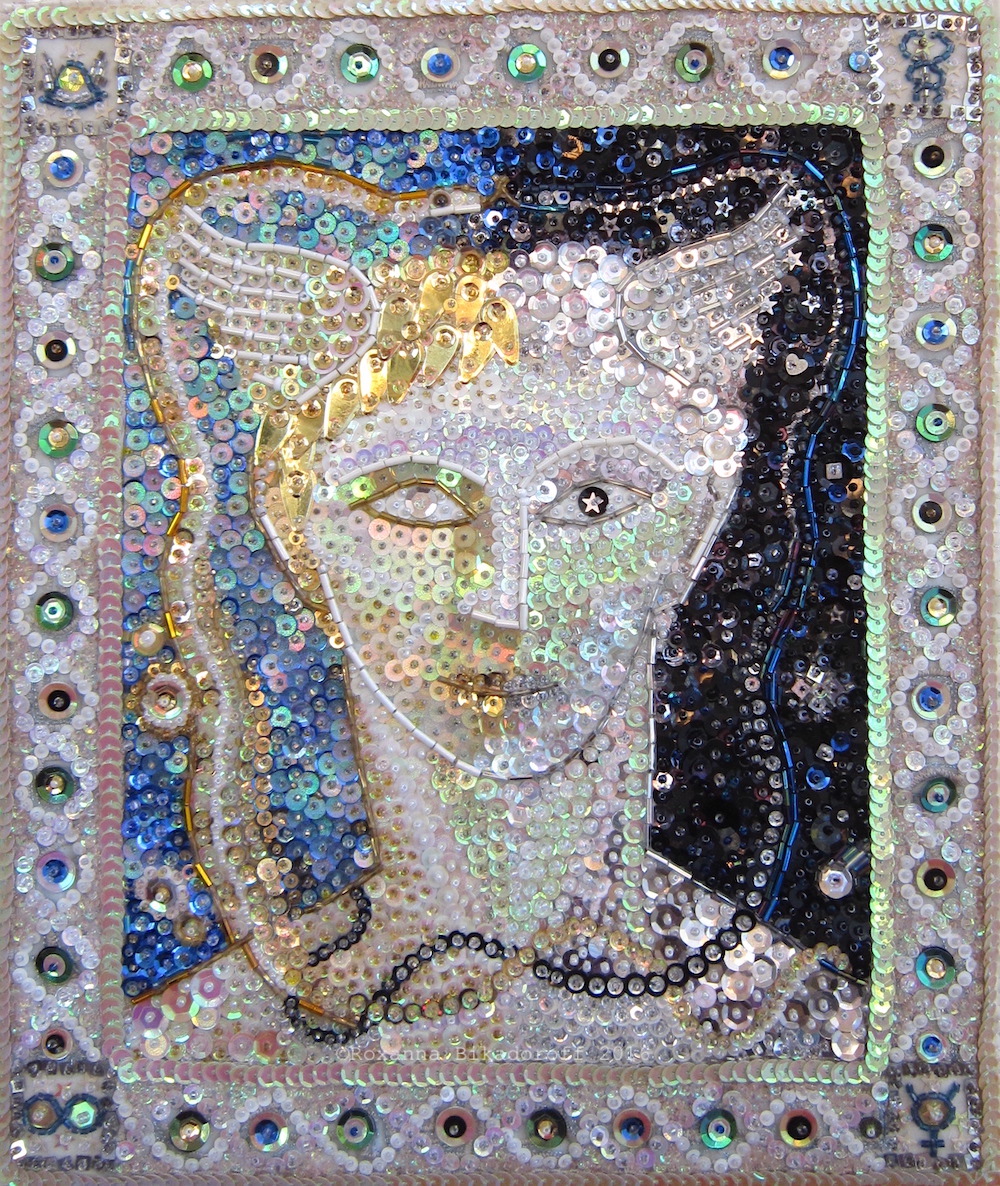
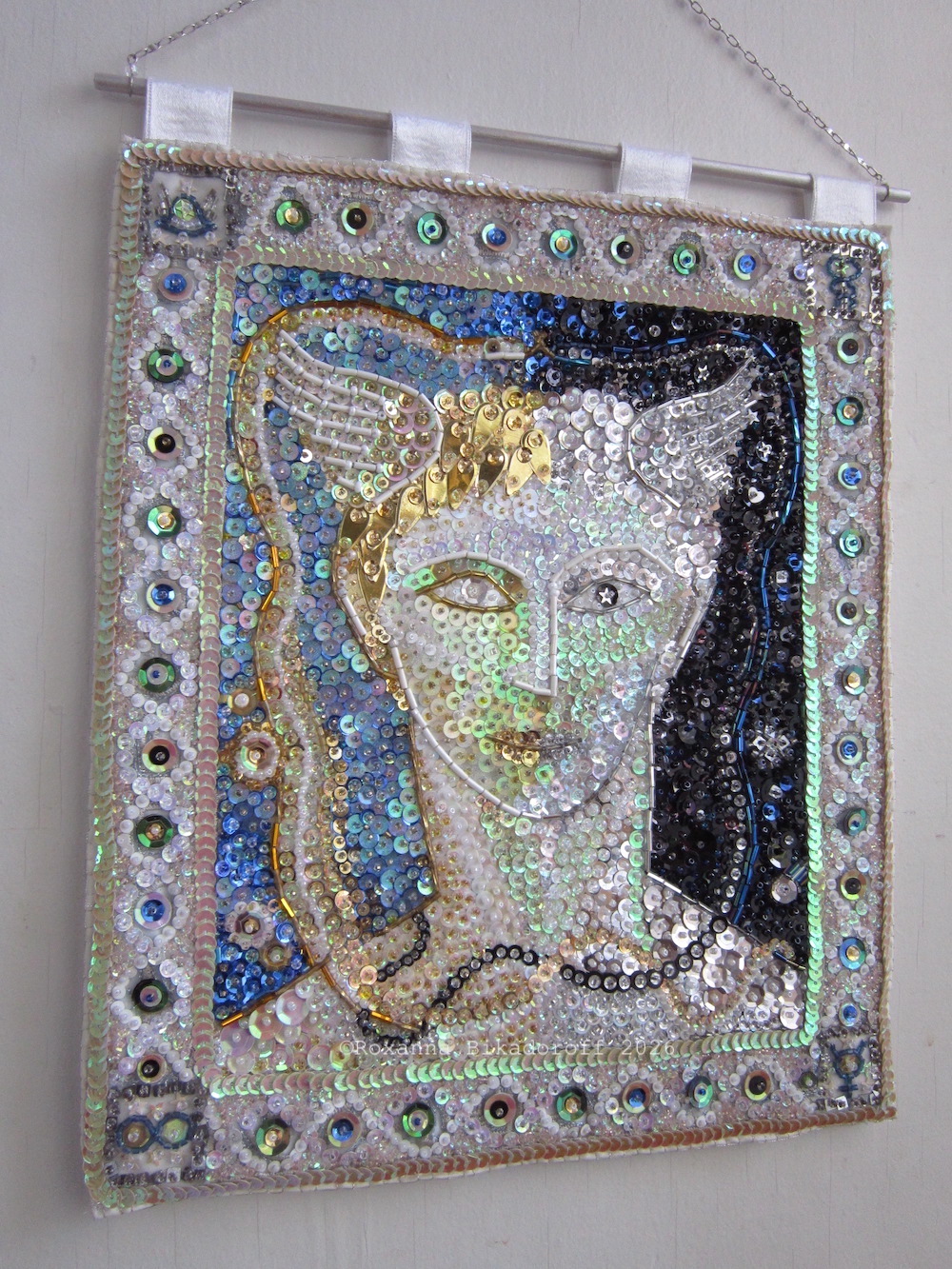
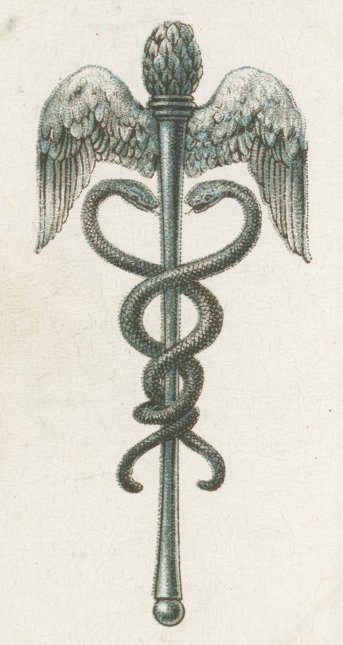
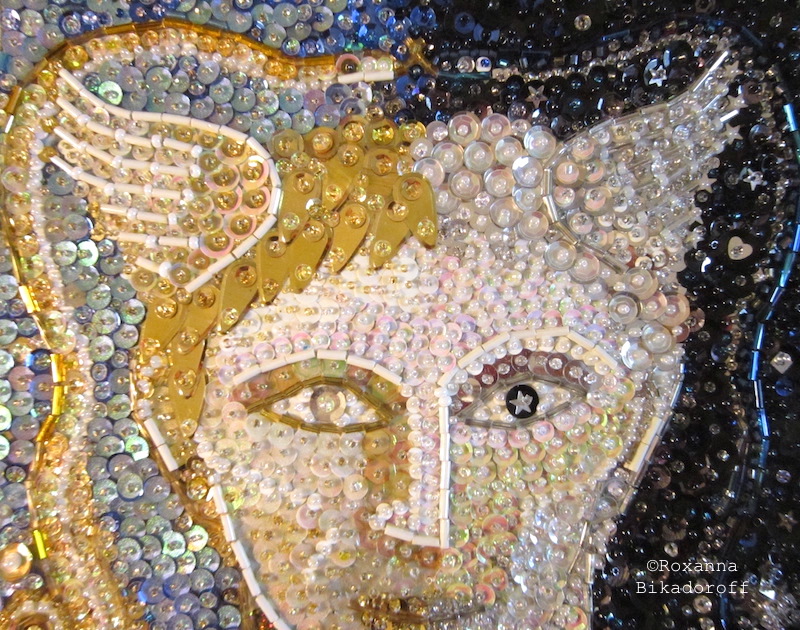
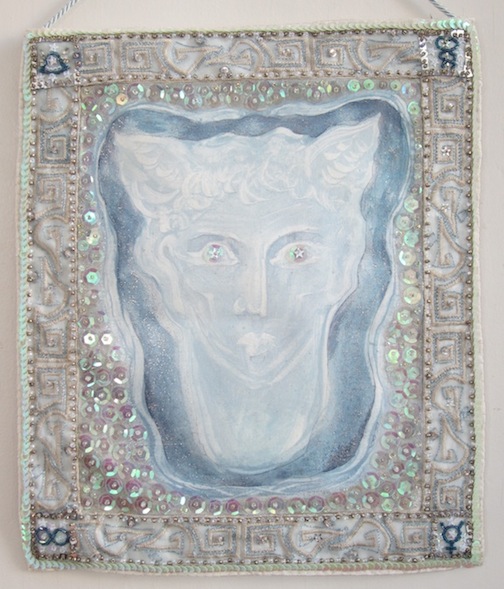
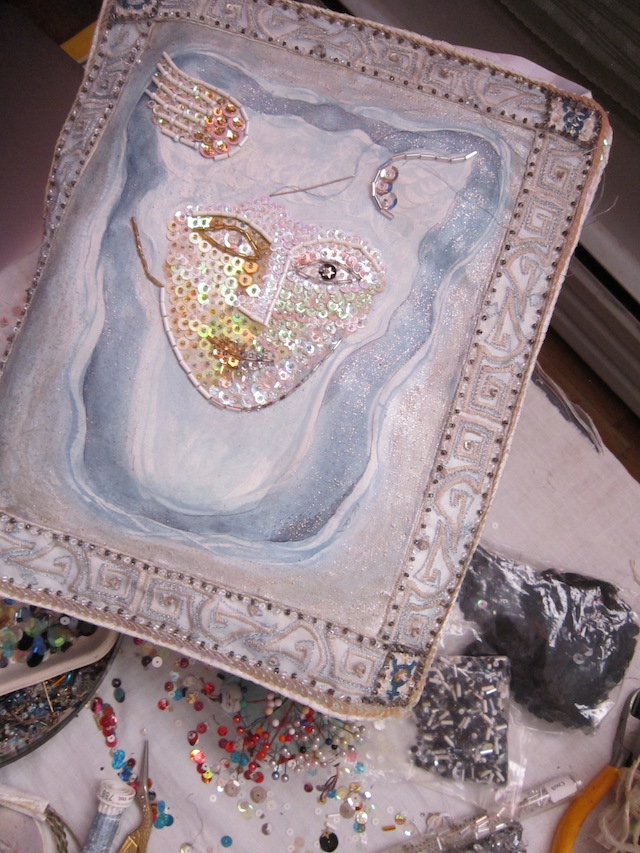
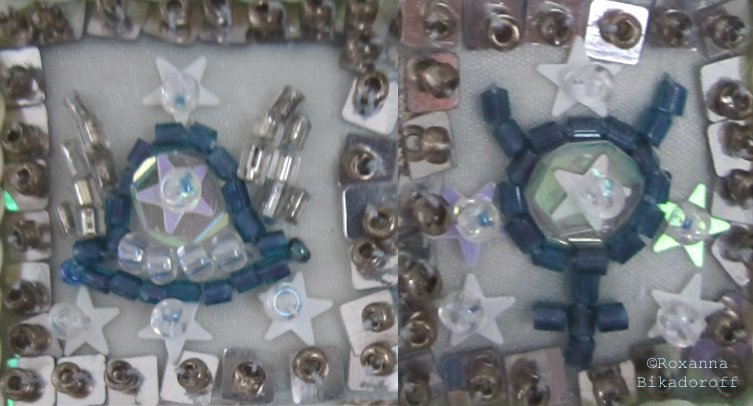
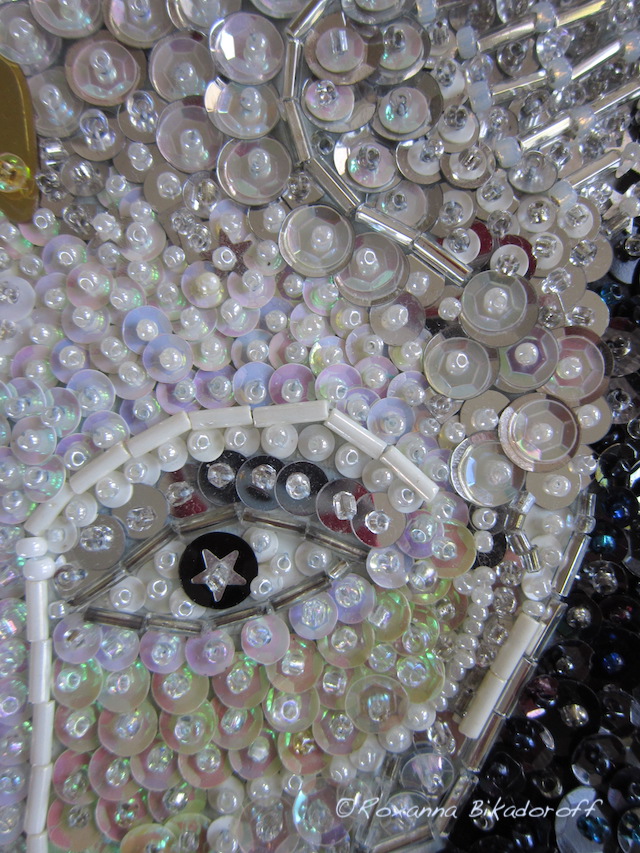 silver eye detail